AI side hustles offer a practical way to earn part-time income without the burnout often associated with freelancing. By pairing your existing skills with AI tools, you can complete tasks that once took hours such as drafting content, creating visuals, or organizing research in a fraction of the time.
You don’t need to be a tech expert to start. Whether you are looking for extra flexibility, testing a new career path, or turning a creative hobby into a service, the opportunity lies in using AI to speed up your workflow, not replace your judgment.
This guide moves beyond the hype. We will explore 15 reliable AI side hustles, realistic earning expectations, and simple workflows to help you build a sustainable income stream.
Key Takeaways
AI Side Hustles
- AI side hustles use tools that support tasks such as writing, design, research, and organization.
- The best opportunities match your skills, available time, and comfort with learning new workflows.
- AI assists with speed and structure, but human judgment still guides accuracy and quality.
- Earning potential varies widely based on demand, consistency, and the scope of services offered.
- Clear workflows and intentional practice help you produce more reliable results for clients.
- Ethical use, transparent communication, and steady skill development create long-term trust.
Disclaimer: I am an independent Affiliate. The opinions expressed here are my own and are not official statements. If you follow a link and make a purchase, I may earn a commission.
How AI creates opportunities for part time income
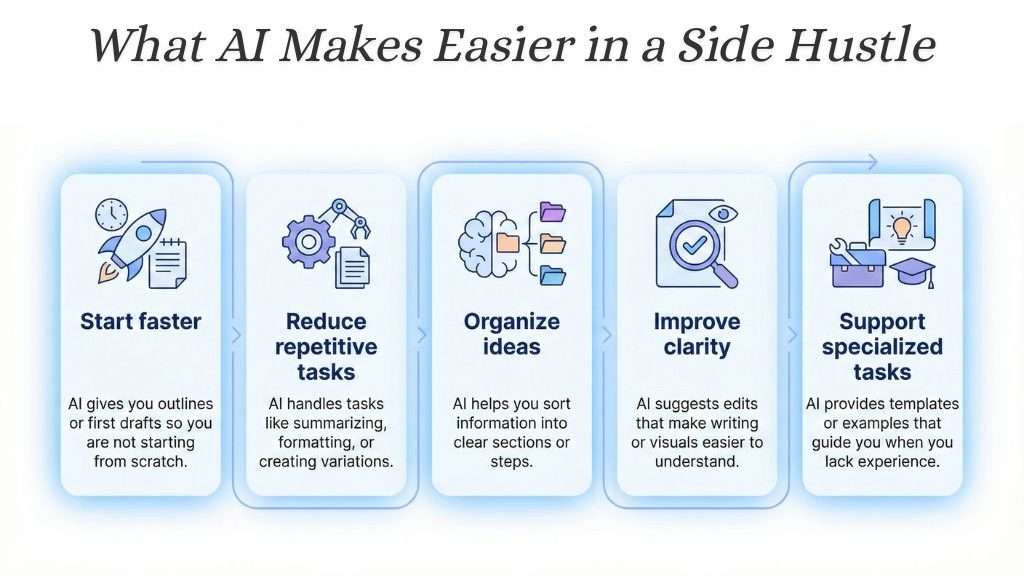
AI tools open the door to side hustles by supporting the parts of a task that usually take the longest. They help you draft ideas faster, organize information more clearly, and refine early versions of creative work with less effort. When used well, AI becomes a partner that reduces friction without replacing your decision making.
AI makes creative tasks faster to start
Many people struggle with blank page moments. AI can generate outlines, sample drafts, or early concepts that help you start quickly. You still shape the direction, but the initial lift becomes lighter. This support is especially helpful in writing and design work.
AI improves consistency for repetitive work
Tasks such as summarizing notes, formatting content, or converting information from one style to another can be time consuming. AI can handle these steps with predictable patterns, which helps you maintain steady output. Consistency is a major benefit for clients who value reliable delivery.
AI reduces barriers to specialized skills
Some work requires a level of structure or creativity that feels out of reach for beginners. AI can guide you through these steps by providing examples, templates, or model outputs that you refine. This makes certain services more accessible to people who are still building confidence.
AI helps people offer services with clearer, more polished output
Polishing content, improving tone, and tightening structure are common client needs. AI tools can suggest edits or surface alternative approaches that make your final work clearer. The result is a more professional draft produced in less time.
AI tools continue to expand their usefulness, but these core functions remain stable and dependable as of this year. They lower the effort needed to produce quality work while keeping final judgment in your hands.
15 reliable AI side hustles to explore
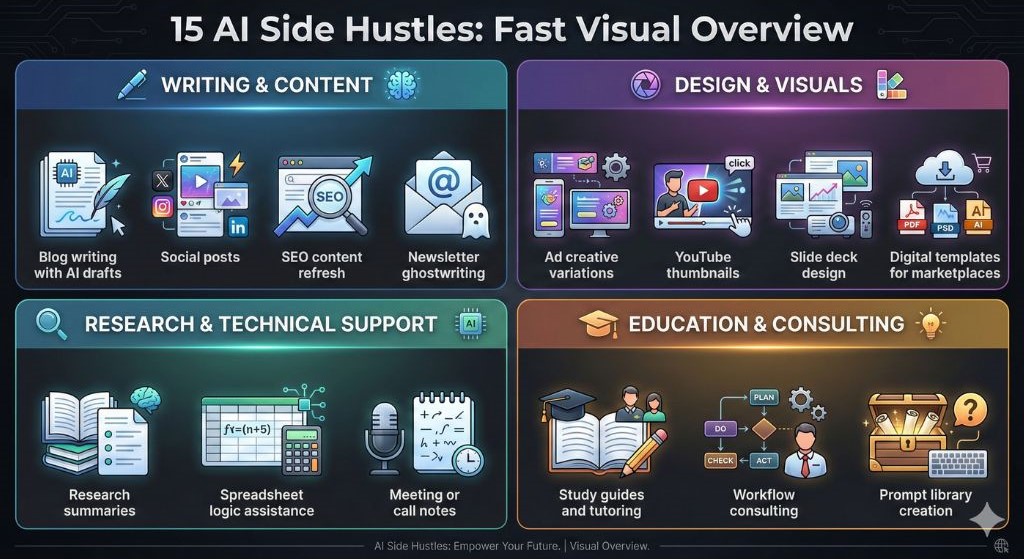
AI supported side hustles work best when they are grounded in real demand. The roles below reflect services that individuals and small teams continue to request. Each option pairs human judgment with AI tools to help you work faster and deliver consistent results.
Content and writing based side hustles
1. Freelance blog writing with AI supported drafting
AI helps you outline articles, generate early drafts, and refine structure. You still choose angles, verify details, and shape the final voice. This combination reduces writing time while helping clients publish more consistently.
2. Social media content services
AI can produce caption ideas, content variations, and simple scheduling templates. You adapt them to the client’s brand tone and select the strongest options. This service fits well for small businesses that want steady posts.
3. SEO content optimization and refresh services
AI can summarize existing pages, identify missing topics, and suggest structural improvements. You decide which updates matter and polish the final text. This approach supports sites that need ongoing content maintenance.
4. Newsletter ghostwriting
AI can help with topic ideas and early drafts. You refine tone, add personal elements, and ensure that the message fits the audience. This side hustle works well for founders, creators, or consultants who want regular communication.
Design and visual creation side hustles
5. AI powered ad creative production
AI can generate concepts, layouts, or image variations. You guide the direction and edit the final selection to match platform requirements. This helps clients test multiple creative angles quickly.
6. YouTube thumbnail design
AI tools assist with image composition and variations. You adjust color, typography, and visual hierarchy. Thumbnails remain in demand for channels that post frequently.
7. Presentation or slide deck creation
AI can outline the deck and suggest structure. You refine visuals, improve clarity, and ensure coherence across slides. Many professionals look for help turning raw ideas into polished presentations.
8. Template or digital product design for marketplaces
AI can produce draft layouts or visual elements. You finalize design choices and create files people can reuse. Digital products work best when they solve a clear, recurring need.
Technical and analytical side hustles
9. Data summarization and research support
AI can process long documents and surface key insights. You verify accuracy, organize findings, and present them clearly. This type of support helps consultants, students, and small teams.
10. Spreadsheet automation using AI assisted formulas
AI can suggest formulas or structures for simple automations. You test them and refine the logic. Many businesses need help cleaning data or improving basic workflows.
11. AI powered note taking and meeting summarization
AI transcribes and highlights main points. You edit the summary for accuracy and clarity. This service fits teams that prefer consistent documentation.
Education and consulting side hustles
12. AI tutoring and study guide creation
AI helps you draft outlines, explanations, and quiz questions. You adjust tone and difficulty for the learner. This works well for school subjects and professional skills.
13. Workflow optimization consulting for freelancers
AI can map steps, suggest templates, and generate documentation. You analyze the workflow and adapt the recommendations. Many freelancers want guidance that saves time without increasing complexity.
14. Building prompt libraries or templates for niche industries
AI can help produce variations and test outputs. You select the strongest prompts and organize them for a specific use case. This service supports teams that need consistent messaging or repeated content tasks.
Creative and entertainment side hustles
15. Podcast script writing with AI assisted structure
AI provides outlines, segment ideas, and early drafts. You refine the voice and ensure the message fits the host’s style. This works well for creators who want steady publishing

Quick-Reference Toolkit: Tools & Platforms
To help you get started, here is a breakdown of the specific tools and platforms often used for these side hustles.
| Category | Side Hustle | Recommended AI Tools | Where to Find Clients |
|---|---|---|---|
| Category | Side Hustle | Recommended AI Tools | Where to Find Clients |
| Writing | Blog & Newsletter Writing |
Claude, ChatGPT (Drafting) Jasper (Marketing copy) Grammarly (Editing) |
ProBlogger, Upwork, Substack (for own newsletters) |
| Writing | SEO & Optimization |
Surfer SEO, Frase (Optimization) Perplexity (Research) |
LinkedIn, Contra, Niche marketing agencies |
| Design | Ad Creative & Thumbnails |
Midjourney (Image gen) Canva Magic Studio (Layouts) Adobe Firefly (Commercial safe images) |
Fiverr, Ytjobs (for YouTubers), Dribbble |
| Design | Presentations & Decks |
Gamma, Beautiful.ai (Slide generation) PowerPoint AI (Formatting) |
Upwork, LinkedIn (Targeting consultants) |
| Technical | Data & Spreadsheets |
ChatGPT Plus (Data Analyst) Excel Copilot (Formulas) |
Toptal, Freelancer, Small business forums |
| Education | Tutoring & Study Guides |
ChatGPT, Claude (Curriculum planning) QuizGecko (Quiz generation) |
Outschool, Teachable, Chegg Tutors |
| Creative | Podcast & Video Scripts |
ChatGPT (Scripting) Descript (Editing transcripts) ElevenLabs (Voiceovers) |
YTJobs, Fiverr, Podcast editing groups |

How much can you earn with AI side hustles
Earning potential varies widely because each side hustle depends on skill level, time commitment, and market demand. AI can help you work faster, but it does not guarantee income. Instead, it shortens the early stages of a task and supports you as you refine the final result. This combination can increase the number of projects you complete, but your experience and consistency still shape overall outcomes.
Most people begin with smaller projects while they learn how to use AI tools in real workflows. Early earnings tend to be modest because you are building samples, testing systems, and finding your first clients. Over time, income typically rises as you refine your process and understand which services fit your strengths.
Different platforms also influence earning patterns. Short, repeatable tasks may pay less per project but create steady work. Larger projects such as presentations, blog posts, or research summaries may pay more but require deeper review and editing. The right balance depends on your schedule and the type of work you prefer.
Marketplaces adjust rates throughout the year, and pricing often reflects your niche rather than the tool you use. As of this year, many freelancers combine AI assistance with strong communication and steady delivery, which helps them build trust and return clients. Clear expectations and dependable processes remain the most consistent drivers of long term earning potential.
How to choose the right AI side hustle for your skills
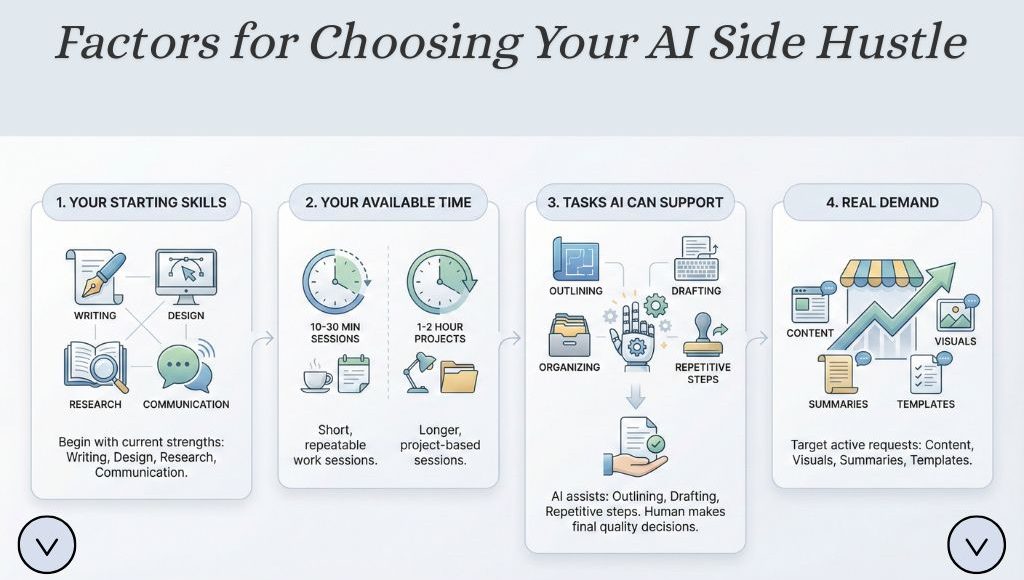
Choosing an AI supported side hustle starts with understanding your strengths. AI can assist with drafting, structuring, or refining work, but the direction still comes from you. When you match a side hustle with your interests and available time, the work becomes more sustainable and more rewarding.
Assess your starting skills
Begin with what you already know how to do. Writing, design, research, organization, and communication all translate well into AI assisted services. A side hustle feels easier to maintain when it builds on skills you have used before, even if they are informal.
Match your available time with the workload pattern
Some tasks require steady, weekly output, such as social content or newsletters. Others allow project based work, such as slide decks or research summaries. Choose a path that fits your schedule so you can deliver consistently without feeling rushed.
Identify which tasks AI can support, not replace
AI helps most with early drafts, outlines, variations, and repetitive steps. It does not replace your decisions about accuracy, tone, or quality. Look for tasks where AI saves time, and where your contribution improves the final result.
Validate demand before investing effort
Spend time checking if people actively request the service you want to offer. Search freelance platforms, browse community forums, or speak with potential clients. Demand gives you direction and helps you avoid building a service that few people need.
Selecting the right side hustle is a balance of interest, capability, and opportunity. When these elements align, AI becomes a helpful tool rather than a substitute for skill.

Workflows and prompt templates for common AI side hustles
AI works best when you use it inside a repeatable workflow. These workflows show how to combine your judgment with the model’s support so you can move from idea to finished deliverable with less friction.
Blog writing workflow
- Ask the model for a simple outline based on the topic.
- Refine the outline to match the angle you want.
- Request a draft section by section.
- Edit for accuracy, tone, and flow.
Sample prompt: “Create a blog outline for beginners on this topic. Include three main sections and short notes for each.”
Social content batching workflow
- Gather key ideas or themes from the client.
- Use AI to generate caption variations.
- Select the strongest lines and adjust tone.
- Organize the content into a weekly or monthly plan.
Sample prompt: “Generate five caption variations for this idea in a friendly, concise tone.”
Research and summarization workflow
- Collect sources or long documents.
- Ask the model for short summaries of each item.
- Combine the summaries and refine them into one narrative.
- Verify facts and adjust for clarity.
Sample prompt: “Summarize these notes in one paragraph for readers who want the main idea.”
Video script workflow
- Outline the key points or segments.
- Let AI generate an early draft of each part.
- Adjust pacing and voice to fit the creator’s style.
- Add transitions and a closing statement.
Sample prompt: “Write a short script for a one minute video that explains this topic in simple terms.”
These workflows give you a starting point. As you practice, you can customize them for your style and create variations that fit specific clients or industries.

Tools worth considering for AI side hustles
AI tools can support writing, design, research, and workflow organization. The best choice depends on the type of work you plan to offer and the level of control you want over the final output. Each category below highlights what the tools help with rather than suggesting specific outcomes.
Writing and content tools
These tools assist with outlining, drafting, rewriting, and summarizing. They can help you start faster and refine language more efficiently. You still review accuracy, adjust tone, and guide structure for the intended audience.
Image and design tools
Image generators and design assistants support concept creation, layout ideas, and visual variations. They are useful for thumbnails, ad graphics, templates, and social content. Human judgment remains essential for branding and overall composition.
Research and analysis tools
Research tools help process long documents, extract insights, and create summaries. They can handle large amounts of text and identify patterns you later refine. This category works well for support roles, such as summarization or competitive analysis.
Automation and productivity tools
These tools structure workflows, automate small steps, and convert raw inputs into organized outputs. They may help with note taking, meeting summaries, content calendars, or spreadsheet formulas. They are most helpful when paired with a clear review process.
AI tools continue to evolve each year, and their features change regularly. It helps to choose tools that match the tasks you plan to offer rather than collecting many options at once. A simple, stable set of tools is often more effective than frequent switching.
Risks, limits, and ethics of AI assisted work
AI tools can support meaningful side hustle opportunities, but they come with limits that matter for anyone doing paid work. Understanding these limits helps you protect quality, maintain trust, and avoid problems that can arise when a tool is used without careful review.
Accuracy remains a key concern. AI outputs may include errors, missing context, or assumptions that do not fit the audience. You are responsible for checking facts, refining tone, and ensuring that the final work matches the client’s needs. A careful review process is essential for long term credibility.
Licensing rules vary across platforms. Some tools allow broad commercial use, while others include restrictions on generated content. It is important to read the usage policies and confirm that both you and your clients can legally use the materials you produce.
AI can also introduce inconsistency when instructions are unclear. Prompts that lack detail can lead to results that drift away from the intended message. Setting clear boundaries and using structured prompts helps reduce this issue.
Ethical considerations shape how you position your service. Being transparent about your process, respecting privacy, and avoiding misleading claims build trust with clients. These practices support sustainable work and reduce the risk of misunderstandings.
AI continues to improve, but human oversight remains the foundation of quality. When you combine clear judgment with steady communication, you create a service that supports clients reliably and responsibly.

How to get your first client or customer
Finding your first client often feels like the hardest step, but the process becomes easier when you offer a simple, well defined service. Early clients look for clarity more than complexity, and AI supported workflows help you deliver consistent results even when you are just starting.
Start with small, clear scope services
Choose a task you can deliver reliably, such as a blog outline, a content refresh, or a short slide deck. Smaller projects build confidence and help clients understand what you can provide. Clear scope also reduces the chance of misalignment.
Use samples created with AI supported workflows
Show brief examples of what you can do. These samples help clients picture the result before they commit. You can create them from fictional topics or adapt past work as long as you respect privacy.
Offer a simple discovery conversation
A short conversation helps you understand what the client needs and how you can support their goals. It also gives you a chance to confirm expectations about tone, format, and timing. Good communication early on leads to smoother projects.
Maintain a clear revision and delivery process
Explain how many revisions you include and how you deliver the final work. A steady process reduces uncertainty for both sides. It also helps you plan your time and avoid rushed adjustments near deadlines.
Getting your first client is a mix of clarity, consistency, and approachable communication. Once you establish a rhythm, referrals and repeat work often follow.

Conclusion
AI side hustles create opportunities for people who want flexible, part time income supported by dependable tools. The work relies on your judgment and communication, while AI helps you start faster, refine drafts, and handle repetitive steps with less effort. This balance allows you to focus on decisions that shape quality and trust.
Each side hustle in this guide offers a different path, and the best choice depends on your skills, interests, and available time. When you pair a clear service with a steady workflow, clients understand what they can expect and how you can help. Over time, these systems make your work more consistent and more satisfying.
AI tools will continue to evolve, but the essentials remain stable. Clear prompts, careful review, and thoughtful planning create results you can rely on. If you begin with one small service and refine it through practice, you build a side hustle that grows at a pace you can manage.

Frequently Asked Questions
Are AI side hustles suitable for beginners
Yes, many AI supported tasks are approachable for beginners because the tools help with drafting and structure. You still need to review and refine the output, but you do not need advanced technical skills to start. Clear communication and steady practice matter more than prior experience.
Do I need to learn coding to offer an AI side hustle
Coding is not required for most AI assisted services. Many roles focus on writing, design, research, or organization. If you choose a technical path, the model can often guide you through basic steps, and you can expand your skills gradually.
How much time do AI side hustles usually take
Time varies based on the service. Some tasks, like social content batching or short summaries, fit into brief work sessions. Others, such as full articles or slide decks, require more review and refinement. Choosing a service that matches your schedule helps you stay consistent.
Are AI side hustles saturated
Some areas have more competition, but saturation often depends on niche and quality. Clients look for reliable communication, clear structure, and dependable delivery. Small improvements in process set your service apart from general AI generated content.
Can AI replace my contribution entirely
AI can speed up drafting and support repetitive tasks, but your judgment guides accuracy, tone, and final quality. Clients pay for clarity, context, and alignment with their goals. AI helps you work faster, but it does not replace the value of review and decision making.
What skills help most when starting an AI side hustle
Helpful skills include clear writing, basic organization, and steady communication. You also benefit from the ability to refine instructions so the model stays aligned with your intent. These skills improve naturally as you work with real tasks and real clients.
How do I stay updated as AI tools change
Check tool updates every few months and review new features that support your workflow. Focus on stable skills such as prompting, editing, and structuring work. These skills remain relevant even as specific tools evolve.

0 Comments