Introduction
Email marketing is one of the most measurable marketing channels available. Every send produces data. Every campaign generates signals. Yet many marketers focus on a single number and treat it as the full story.
Performance does not live inside one metric. It lives inside a system.
Delivered emails must be opened. Opened emails must be clicked. Clicks must convert. At the same time, bounce rates, complaints, and unsubscribes quietly shape whether your future emails even reach the inbox.
The goal is not sending more emails. The goal is building predictable performance. These 10 metrics work together to show whether your email system is healthy, engaged, and profitable.
Key Takeaways
- Email marketing performance is a measurable pipeline, not a single metric.
- Delivery and list health determine whether your emails even reach the inbox.
- Engagement metrics like open rate and click-through rate signal relevance and intent.
- Conversion rate connects email activity to actual revenue.
- Bounce rate, complaints, and unsubscribes quietly shape long-term deliverability.
- Segmentation improves performance at every stage of the system.
- Optimizing the weakest stage first produces the fastest improvement.
Email becomes predictable when you evaluate the full system instead of chasing isolated numbers.
Disclaimer: I am an independent Affiliate. The opinions expressed here are my own and are not official statements. If you follow a link and make a purchase, I may earn a commission.

Why Email Performance Is a System, Not a Single Number
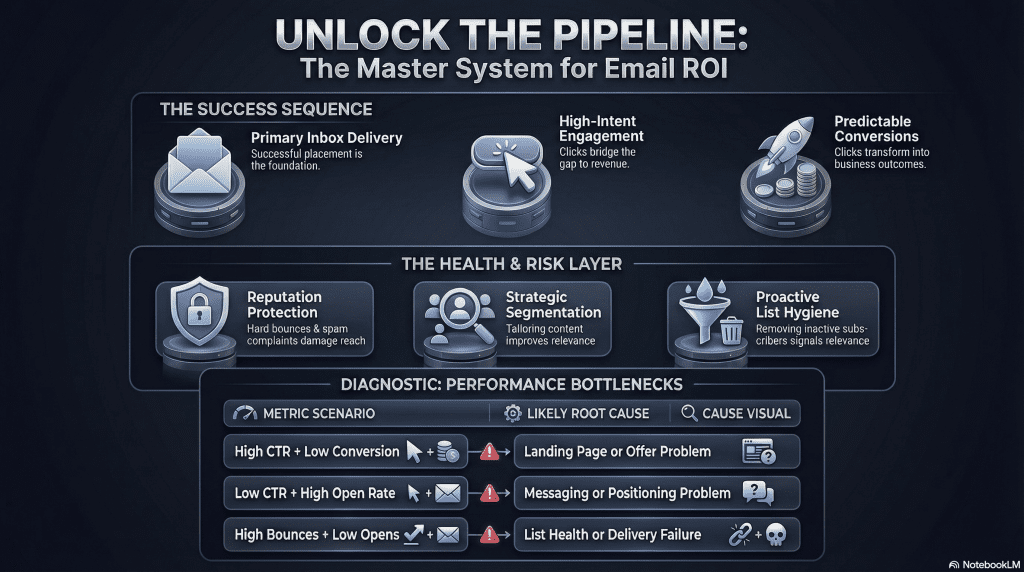
Email performance follows a clear behavioral sequence.
An email is delivered.
- It is opened.
- It is clicked.
- It converts.
Each step depends on the one before it. If delivery fails, opens never happen. If opens are weak, clicks collapse. If clicks do not convert, revenue never materializes.
This creates a measurable pipeline:
Delivered → Opened → Clicked → Converted
However, there is also a risk layer running alongside it.
- Emails can bounce.
- Subscribers can complain.
- Recipients can unsubscribe.
These signals affect sender reputation, inbox placement, and future deliverability. A campaign might generate strong clicks today while quietly damaging list health for tomorrow.
Email performance is therefore not one metric. It is a chain reaction. Every stage either strengthens or weakens the next.
Understanding this structure prevents misdiagnosis. If conversions drop, the problem might not be your offer. It might begin at delivery, engagement, or segmentation.
When you evaluate email as a system, you stop chasing isolated improvements and start optimizing the entire pipeline.
Stage 1. Delivery and List Health Metrics
Before an email can generate clicks or revenue, it must reach the inbox. Delivery and list health metrics determine whether your emails are even seen.
If this stage fails, nothing else matters.
Open Rate
Open rate measures the percentage of delivered emails that are opened.
It reflects subject line effectiveness, sender recognition, and audience interest. However, open rate is also influenced by inbox placement. If emails land in spam, open rates decline regardless of subject quality.
Open rate signals early engagement, but it only matters after successful delivery.
Bounce Rate
Bounce rate measures the percentage of emails that fail to deliver.
There are two types of bounces, and both affect list health differently.
Hard Bounce
A hard bounce is a permanent delivery failure.
This usually happens when:
- The email address does not exist
- The domain is invalid
- The address has been permanently disabled
Hard bounces damage the sender reputation if not removed quickly. These addresses should be cleaned from your list immediately.
Soft Bounce
A soft bounce is a temporary delivery issue.
This may occur because:
- The inbox is full
- The server is temporarily unavailable
- The message is too large
Soft bounces do not require immediate removal, but repeated soft bounces can signal list quality problems.
Deliverability
Deliverability measures whether your emails successfully reach the inbox rather than the spam folder.
Delivery rate only confirms the message was accepted by a server. Deliverability determines placement. Strong engagement, clean lists, and low complaint rates improve inbox placement over time.
Spam Complaint Rate
Spam complaint rate measures the percentage of recipients who mark your email as spam.
Even a small complaint rate can significantly harm sender reputation. Email providers monitor this signal closely. Consistently high complaint rates reduce inbox placement and limit future reach.
Unsubscribe Rate
Unsubscribe rate measures how many recipients opt out after receiving your email.
Some unsubscribes are normal. A sudden increase signals misalignment between audience expectations and message content.
Unsubscribes protect list health when managed correctly. Ignoring disengaged subscribers increases complaints and reduces deliverability.
Delivery and list health metrics protect your ability to communicate. If these signals weaken, engagement and revenue decline regardless of how strong your content or offer may be.

Stage 2. Engagement Metrics
Once your email reaches the inbox, engagement determines whether recipients interact with your message. Engagement metrics show whether your content creates interest and movement toward action.
Strong engagement also improves future deliverability. Inbox providers monitor interaction signals when deciding whether to prioritize your emails.
Click-Through Rate (CTR)
Click-Through Rate measures the percentage of recipients who click a link inside your email.
CTR reflects message clarity, offer strength, and call-to-action effectiveness. While open rate signals curiosity, CTR signals intent.
A low CTR usually points to:
- Weak value proposition
- Unclear call to action
- Poor message-to-audience alignment
- Overloaded email design
A strong CTR indicates that subscribers understand your message and see value in taking the next step.
CTR is the bridge between attention and revenue.
Segmentation
Segmentation is not a metric, but it directly influences performance at every stage.
Instead of sending the same message to your entire list, segmentation allows you to tailor content based on behavior, interest, or lifecycle stage.
Segmentation improves:
- Open rates
- Click-through rates
- Conversion rates
- Deliverability over time
When subscribers consistently engage with relevant emails, inbox providers interpret that as a positive signal. That improves inbox placement and protects sender reputation.
Engagement is not only about clicks. It is a feedback loop that influences whether future emails reach the inbox.

Stage 3. Business Outcome Metrics
Delivery enables engagement. Engagement enables clicks. Clicks create opportunity. Conversion determines whether the email actually produces revenue.
This is where performance becomes financial.
Conversion Rate
Conversion rate measures the percentage of recipients who complete the desired action after clicking.
That action could be:
- Making a purchase
- Booking a call
- Registering for a webinar
- Downloading a resource
Conversion rate reflects what happens after the click. It measures how effectively your landing page, offer, and user experience turn interest into results.
It is critical to distinguish between email performance and offer performance.
- High CTR + Low Conversion Rate often indicates a landing page or offer problem.
- Low CTR + High Conversion Rate usually indicates a messaging or positioning problem inside the email.
This diagnostic clarity prevents misdirected optimization.
If conversions are weak, improving subject lines will not fix the issue. If clicks are weak, redesigning the landing page will not solve the root cause.
Conversion rate connects email performance to business outcomes. It is the final stage of the pipeline, but it depends entirely on the strength of every stage before it.

How These 10 Metrics Work Together
Email marketing performance is not isolated events. It is a connected pipeline.
List health protects deliverability.
Deliverability enables opens.
Opens enable clicks.
Clicks enable conversions.
Each stage feeds the next.
- If bounce rates rise, inbox placement declines.
- If deliverability declines, open rates fall.
- If opens fall, click volume drops.
- If clicks drop, conversions disappear.
Optimizing the wrong stage wastes effort.
For example:
- Improving subject lines will not fix poor deliverability.
- Redesigning landing pages will not solve low click-through rates.
- Increasing send volume will not repair list quality issues.
Segmentation strengthens every stage. It improves relevance, which improves engagement. Engagement signals improve inbox placement. Better placement improves opens, which increases clicks and ultimately conversions.
When you understand the flow, you stop chasing single metrics and start diagnosing bottlenecks.
Email performance improves when you identify the weakest stage and strengthen it first.

Common Email Marketing Mistakes
Even with the right metrics in place, performance weakens when the wrong signals receive attention. Most email marketing problems are not caused by dramatic failures. They result from small, repeated mistakes across the system.
- Obsessing over open rate only. Open rate reflects curiosity, not revenue. Strong subject lines can inflate opens while weak content suppresses clicks. When teams celebrate opens without examining engagement or conversion, they optimize attention instead of outcomes.
- Ignoring bounce rate and list quality. A growing list creates the illusion of progress. However, invalid or outdated addresses increase bounce rates and weaken sender reputation. Over time, this reduces inbox placement, which lowers engagement across every campaign.
- Never cleaning inactive subscribers. Sending repeatedly to disengaged contacts lowers overall engagement signals. Inbox providers interpret low interaction as lack of relevance. This affects deliverability for active subscribers as well. List hygiene protects long-term performance.
- Sending the same message to everyone. Broad messaging reduces relevance. When content does not align with subscriber intent or lifecycle stage, engagement declines. Segmentation improves alignment, which improves open rate, click-through rate, and conversion rate simultaneously.
- Blaming email when the offer is weak. High click-through rate with low conversions often indicates a landing page or offer problem. Optimizing subject lines or design will not fix a weak value proposition. Diagnose the stage before making changes.
- Increasing send volume to fix performance. Sending more emails does not solve engagement issues. It often amplifies unsubscribe rates and complaints. Sustainable performance comes from relevance and timing, not frequency alone.
Email marketing rarely collapses suddenly. It erodes when warning signals are ignored. Protect list health first, diagnose bottlenecks accurately, and optimize the weakest stage in the system before scaling.
Conclusion
Email marketing is not guesswork. It is a measurable pipeline with clear signals at every stage.
Delivery determines reach. Engagement determines interest. Conversion determines revenue. List health protects the entire system. When you monitor these metrics together, performance becomes predictable instead of reactive.
Strong email programs do not chase one number. They diagnose bottlenecks. They protect the sender reputation. They segment intentionally. They optimize the weakest stage before scaling the strongest one.
Each metric tells part of the story. Together, they determine profit.
When you evaluate email marketing as a connected system, improvement becomes structured, measurable, and repeatable.

Frequently Asked Questions About Email Marketing Metrics
What is the most important email marketing metric?
There is no single most important metric. Email performance works as a system. Delivery enables opens, opens enable clicks, and clicks enable conversions. Focusing on only one number often leads to misdiagnosis. The most important metric is usually the weakest stage in your current pipeline.
Is open rate still reliable?
Open rate provides directional insight but should not be treated as a standalone performance indicator. Privacy updates and tracking limitations can distort exact measurements. Use open rate to gauge subject line effectiveness, but validate performance through click-through rate and conversion rate.
What is a healthy email bounce rate?
A healthy bounce rate is typically low and stable. Sudden increases indicate list quality issues or acquisition problems. Hard bounces should be removed immediately. Repeated soft bounces should be monitored to protect sender reputation and deliverability.
How do inbox providers evaluate engagement?
Inbox providers monitor signals such as opens, clicks, replies, complaints, and deletions. Consistent engagement improves inbox placement over time. Low interaction signals reduce visibility. Engagement is not just a marketing metric; it is also a deliverability signal.
Why do I have high open rates but low revenue?
High open rates combined with low clicks or conversions usually indicate a mismatch between your message and your offer. The subject line may create curiosity, but the content or call to action may not create enough value to drive action.
Should I track the unsubscribe rate closely?
Yes. A small unsubscribe rate is normal and healthy. However, sudden spikes indicate messaging misalignment, excessive frequency, or audience fatigue. Monitoring unsubscribe trends helps protect long-term list health.

0 Comments