Introduction
Microtasks are often presented as one of the easiest ways to make money online. The idea is simple. You complete small tasks, get paid for each one, and repeat the process.
That simplicity is what makes them appealing.
There are no formal requirements. No advanced skills. In many cases, you can start immediately. This creates the impression that microtasks are an accessible way to earn money from anywhere.
But there is a trade-off.
Each task pays very little. Progress is slow. And the total amount you can earn is limited by how much time you are willing to spend.
If you understand that structure, microtasks become easier to evaluate. They are not a path to meaningful income. They are a system for earning small amounts through simple, repetitive work.
This guide explains what microtasks are, how they work, and what you can realistically expect from them.
- Microtasks are small, simple jobs that pay very little per task
- They require little to no skill, which keeps earnings low
- You are paid per task, not for your time, which affects overall income
- The main limitation is the time-to-reward ratio
- They work best as a spare-time activity, not a reliable income source
Disclaimer: I am an independent Affiliate. The opinions expressed here are my own and are not official statements. If you follow a link and make a purchase, I may earn a commission.
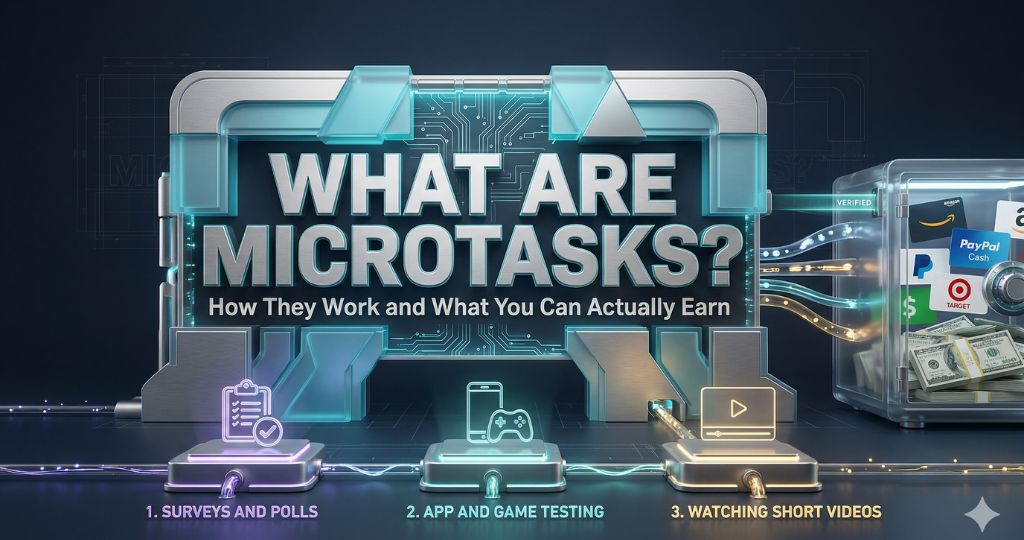
What Microtasks Are
Microtasks are small, simple jobs that can be completed quickly and independently.
Each task is limited in scope. It might take a few seconds or a few minutes, but it does not require long-term effort or ongoing commitment. Once the task is done, you move on to the next one.
Common examples include:
- Answering short surveys
- Tagging images or data
- Verifying information
- Completing basic online actions
These tasks are usually distributed through online platforms. Companies post large numbers of small tasks, and workers complete them one at a time.
The key characteristic is simplicity.
Microtasks do not require specialized skills. They are designed so that almost anyone can complete them with minimal instruction. This is what makes them accessible, but it also explains why the pay per task is low.
Instead of earning based on time or expertise, you are paid for each individual task you complete.

Why Microtasks Exist
Microtasks exist because many types of work can be broken into small, repeatable actions.
Companies often need things like:
- Data labeled
- Content reviewed
- Simple decisions made at scale
Individually, these tasks are too small to assign as full jobs. But in large numbers, they become important.
Instead of hiring employees to handle this work, companies split it into small pieces and distribute it through online platforms. This allows thousands of people to complete tasks at the same time.
This model is efficient. It reduces cost and speeds up results.
It also explains the trade-off for workers. The tasks are easy to access and require little skill, but each one pays very little because it is only a small part of a larger process.
How Microtasks Work
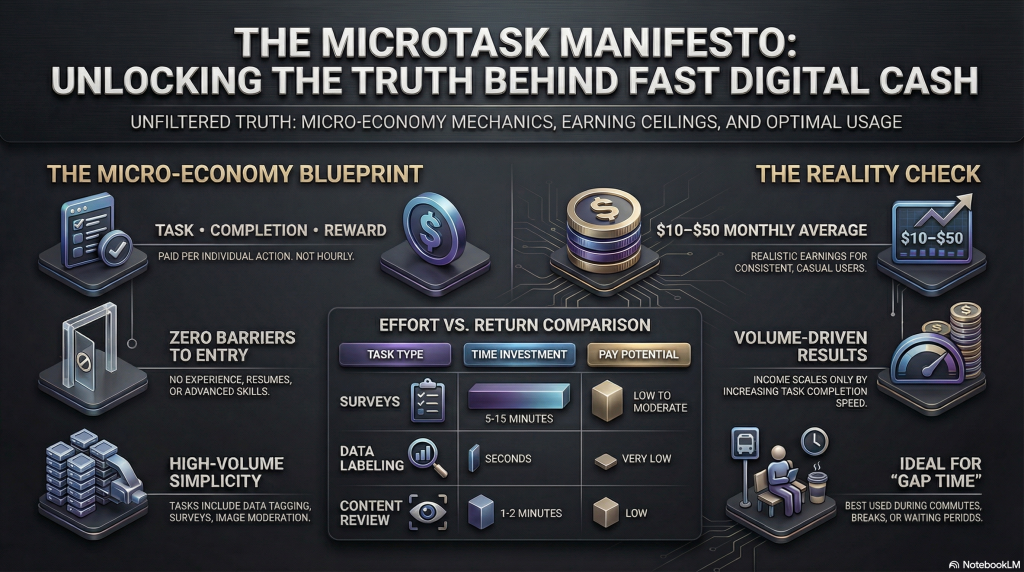
Microtasks follow a simple structure: Task → Completion → Payment
Each step is straightforward, but how it plays out affects your overall experience.
1. Tasks Are Posted on Platforms
Microtasks are usually available through online platforms.
These platforms act as intermediaries:
- Companies upload tasks
- Users browse and select them
Each task includes:
- A short description
- Instructions
- A fixed payment amount
You choose what to work on based on what is available.
2. You Complete Individual Tasks
You work on one task at a time.
Each task is designed to be:
- Quick to complete
- Easy to understand
- Independent from other tasks
There is no long-term commitment. Once you finish a task, you move on to the next one.
Some tasks are completed immediately, while others may require review or approval before being accepted.
3. Tasks Are Reviewed or Approved
In many cases, your work is checked before payment is finalized.
This can include:
- Automated checks
- Manual review
If a task does not meet the requirements, it may be rejected. In that case, you do not get paid for that task.
This is part of how platforms maintain quality.
4. You Get Paid Per Task
Payment is tied to each individual task.
- You are not paid hourly
- Each task has a fixed value
- Your total earnings depend on how many tasks you complete
Because tasks are small, payments are also small.
The Key Reality
The system is simple, but the limitation is built into it.
You earn by completing tasks one by one. There is no way to significantly increase earnings without increasing the number of tasks you complete.
That is why the time-to-reward ratio becomes the main factor.
Types of Microtasks
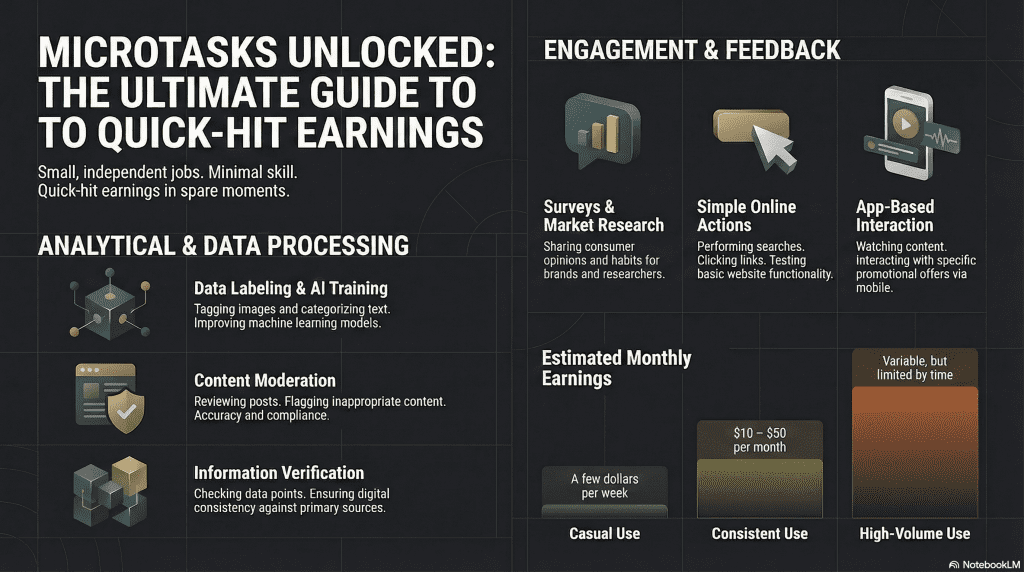
Microtasks come in several forms, but they all follow the same idea: small actions completed quickly for small payments.
Surveys
Surveys are one of the most common types of microtasks.
You answer questions about:
- Opinions
- Habits
- Preferences
They are easy to access but often inconsistent. You may start a survey and get disqualified before finishing.
Data Labeling and AI Tasks
These tasks involve helping train systems by organizing or labeling data.
Examples include:
- Tagging images
- Categorizing text
- Identifying objects or patterns
They are usually simple but require attention to detail.
Content Moderation and Review
These tasks involve checking content for accuracy or compliance.
You might:
- Review posts or comments
- Flag inappropriate content
- Verify information
They are repetitive but require basic judgment.
Simple Online Tasks
These include small digital actions such as:
- Clicking links
- Performing searches
- Testing websites or apps
They are quick to complete but usually pay very little.
App-Based Microtasks
Many apps package microtasks into a simplified format.
Examples include:
- Completing surveys
- Watching content
- Interacting with offers
These are similar to platforms like Swagbucks or InboxDollars, but presented in a more structured way.
The Key Difference Between Types
The main difference is not complexity. It is efficiency.
Some tasks:
- Pay slightly more but take longer
Others:
- Pay very little but are quick
Understanding this difference helps you avoid spending too much time on low-value work.

How to Get Started With Microtasks
Getting started with microtasks is simple, but your early choices affect how useful the experience is.
1. Choose a Platform
Microtasks are available through different platforms.
Some focus on:
- Surveys and consumer tasks
- Data labeling and digital work
- App-based activities
Each platform offers different types of tasks and pay levels. It is usually better to start with one and understand how it works before trying multiple.
2. Create an Account
You will need to sign up and complete a basic profile.
This may include:
- Personal information
- Demographic details
- Skill or interest areas
Your profile affects:
- Which tasks you can access
- How often you qualify for tasks
3. Start With Simple Tasks
Begin with smaller, easier tasks to understand the system.
This helps you:
- Learn how tasks are structured
- Understand how long they take
- See how payments work
At this stage, the goal is familiarity, not maximizing earnings.
4. Evaluate Time vs Reward
Not all tasks are worth completing.
As you gain experience, start paying attention to:
- How long tasks take
- How much they pay
This helps you avoid spending time on low-value work.
5. Build a Consistent Routine
Microtasks reward consistency more than intensity.
Short, regular sessions:
- Help you find better tasks
- Improve your efficiency
- Build steady, small earnings
Irregular use often leads to slower progress.
How Much You Can Realistically Earn
Microtasks have a low earning ceiling. That is one of their defining characteristics.
Most people earn very little overall, especially when starting out.
In many cases:
- A few dollars per week with casual use
- $10 to $50 per month for consistent users
- Higher amounts are possible, but uncommon
What Affects Your Earnings
Your results depend on a few key factors:
- Type of tasks: Some pay slightly more than others
- Speed and accuracy: Faster completion can increase output
- Task availability: Not all platforms have constant work
Even with these factors, the increase is limited. The structure does not allow for large jumps in earnings.
What Hourly Earnings Look Like
Microtasks are not paid hourly, but it is useful to think in those terms.
In practice:
- Many tasks pay only a few cents
- Time spent per task adds up quickly
This often results in low effective hourly earnings, sometimes below minimum wage.
Why Earnings Stay Low
The system is designed for:
- Simple tasks
- Large numbers of workers
- Minimal skill requirements
Because almost anyone can do the work, companies do not need to pay much per task.
This keeps the barrier to entry low, but also limits how much you can earn.
The Right Expectation
Microtasks are best understood as:
- A way to earn small amounts in spare time
- A system based on volume, not value
- A low-skill, low-reward activity
If you expect meaningful income, the results will feel disappointing. If you expect small, incremental earnings, the system makes more sense.
Common Mistakes to Avoid
Microtasks are simple, but small mistakes can significantly reduce their value.
Expecting Meaningful Income
This is the most common mistake.
Many people assume:
- They can earn quickly
- They can build consistent income
In reality, microtasks are not designed for that.
Better approach:
- Treat them as small, supplemental earnings
Choosing Low-Value Tasks
Not all tasks are worth your time.
Common issue:
- Tasks that take too long for very little pay
- Repetitive work with minimal return
Better approach:
- Pay attention to time vs reward
- Skip tasks that feel inefficient
Spending Too Much Time
It is easy to keep completing tasks without noticing how much time has passed.
The problem:
- Earnings do not increase proportionally with time
- The return per hour stays low
Better approach:
- Set limits on how long you spend
- Use microtasks in short sessions
Using Too Many Platforms at Once
Trying to use multiple platforms early on can create confusion.
What happens:
- You do not learn how any one system works well
- You spend time switching instead of earning
Better approach:
- Start with one platform
- Expand only after you understand it
Ignoring Task Requirements
Some tasks require specific instructions or quality standards.
If ignored:
- Tasks may be rejected
- You do not get paid
Better approach:
- Read instructions carefully
- Focus on accuracy, not just speed
Chasing “Easy Money”
Microtasks are often presented as easy income.
This leads to:
- Unrealistic expectations
- Frustration when results are small
Better approach:
- Focus on understanding the system
- Accept the limits of the model

When Microtasks Make Sense
Microtasks make sense in specific situations where expectations and usage are aligned.
When You Have Spare Time
Microtasks work best in short, unstructured moments.
Examples:
- Waiting
- Taking a break
- Filling small gaps in your day
In these cases, your time has low immediate value, so small earnings feel reasonable.
When You Want Low-Pressure Work
Microtasks do not require commitment.
You can:
- Start and stop at any time
- Work as little or as much as you want
- Avoid deadlines or long-term responsibility
This makes them suitable for casual use.
When You Are Exploring Online Work
For beginners, microtasks provide a simple entry point.
They help you:
- Understand how online platforms work
- Learn how tasks are structured
- Evaluate time versus reward
They are not advanced, but they are accessible.
When You Accept Small Earnings
Microtasks only make sense if you expect limited results.
They work when your goal is:
- Earning small amounts over time
- Supplementing other income sources
- Using time that would otherwise go unused
The Core Idea
Microtasks make sense when:
- Your time has low opportunity cost
- You are not relying on the income
- You are comfortable with slow, incremental earnings
Used this way, they serve a clear purpose. Outside of that, their limitations become more noticeable.

When Microtasks Do NOT Make Sense
Microtasks become inefficient when they are used outside of their limits.
If You Need Reliable Income
Microtasks do not provide stable or predictable earnings.
They do not offer:
- Consistent work
- Fixed pay
- Long-term income
If you need dependable money, this approach will not meet that need.
If You Value Your Time Highly
The return per hour is low.
If your time could be used for:
- Learning a skill
- Higher-paying work
- Building something long-term
Then microtasks are not an efficient choice.
If You Expect to Scale Earnings
There is no real way to increase income significantly.
You cannot:
- Automate the work
- Multiply results
- Build a system that grows over time
Your earnings remain tied to how many tasks you complete.
If You Try to Maximize Every Task
Trying to optimize every detail often leads to diminishing returns.
For example:
- Spending too long choosing tasks
- Overanalyzing small differences in payouts
This adds effort without meaningful improvement in earnings.
If You Expect Fast Results
Microtasks build slowly.
Even with consistent effort:
- Earnings remain small
- Progress takes time
If you expect quick results, it will feel frustrating.
The Core Limitation
Microtasks are built around small actions and small payouts.
That structure does not change. Adding more effort increases output, but not enough to create meaningful income.
Are Microtasks Worth It?
Microtasks can be worth it, but only under specific conditions.
The value depends less on the platform and more on how you use it.
When They Are Worth It
Microtasks make sense when:
- You are using spare time that would otherwise go unused
- You are not relying on the income
- You are comfortable earning small amounts slowly
In this context, they serve a clear purpose. They turn low-value time into small, incremental rewards.
When They Are Not Worth It
They become inefficient when:
- You are trying to earn meaningful income
- You are spending large amounts of time on them
- You expect consistent or scalable results
In these cases, the return does not justify the effort.
The Trade-Off
The core trade-off is simple:
- Low barrier to entry → Almost anyone can start
- Low earning potential → Rewards stay small
You gain accessibility, but you give up earning power.
The Real Answer
Microtasks are not inherently good or bad.
They are a tool.
If used with the right expectations, they can be useful for small, occasional earnings. If used with the wrong expectations, they will feel like a poor use of time.

Conclusion
Microtasks are easy to understand once you see how the system is structured.
You complete small tasks. You receive small payments. Over time, those payments add up slowly. That is the entire model.
The appeal comes from accessibility. Almost anyone can start, and there are no major barriers. But that same simplicity is what limits the earning potential.
Microtasks are not designed to generate meaningful income. They are designed to distribute small pieces of work across many people at a low cost.
If you approach them with the right expectations, they can be useful. They allow you to earn small amounts in spare time without commitment.
If you expect more than that, they will feel inefficient.
So the question is not whether microtasks work.
They do.
The question is whether small, time-based earnings fit your goals. If they do, microtasks have a place. If they do not, your time is better spent elsewhere.

Frequently Asked Questions
What are microtasks?
Microtasks are small, simple jobs that can be completed quickly, often in a few minutes or less, and pay a small amount per task.
How do microtasks work?
You choose tasks from a platform, complete them individually, and get paid for each one. Your total earnings depend on how many tasks you finish.
How much can you earn from microtasks?
Most people earn small amounts, often ranging from a few dollars per week to around $10 to $50 per month with consistent use.
Are microtasks a reliable source of income?
No. Microtasks do not provide stable or predictable income. They are best used as a supplemental or spare-time activity.
What types of microtasks are available?
Common types include surveys, data labeling, content review, and simple online tasks like searching or clicking.
Do microtasks require any skills?
Most microtasks require little to no specialized skills. Some tasks may require attention to detail, but they are generally designed to be accessible.
Why do microtasks pay so little?
They are simple tasks that can be done by many people. Because of this, companies can offer low payments while still finding workers.
How can you earn more with microtasks?
You can improve earnings slightly by:
- Choosing higher-paying tasks
- Working consistently
- Avoiding low-value activities
However, the overall earning potential remains limited.
Are microtask platforms safe to use?
Many platforms are legitimate, but it is important to choose well-known services and avoid anything that requires upfront payment.
Can microtasks replace a full-time job?
No. Microtasks are not designed to provide full-time income. They work as a small, flexible way to earn extra money.

0 Comments