Introduction
Subscription-based marketing is a strategy centered on acquiring and retaining customers through a recurring revenue model rather than one-time transactions.
Instead of focusing solely on individual purchases, businesses build systems designed for ongoing engagement. Customers subscribe and in return, they receive continuous access, products, or services delivered over time.
This approach has gained significant traction across industries. From streaming services and SaaS platforms to subscription boxes and membership communities, recurring models have reshaped how companies generate revenue and build customer relationships.
The appeal is practical. Businesses benefit from more predictable revenue, stronger customer retention, and higher lifetime value. Customers benefit from convenience, consistency, and often better long-term value.
However, subscription success does not happen automatically. It requires a deliberate strategy, one that balances acquisition, retention, pricing, and ongoing value delivery.
When implemented thoughtfully, subscription-based marketing creates more than recurring payments. It creates sustained growth built on trust and long-term relationships.
Key Takeaways
- Subscription-based marketing creates predictable revenue streams.
- Customer retention and engagement are key to long-term success.
- Different subscription models exist, including product-based, service-based, and membership-based subscriptions.
- Retention strategies, personalized experiences, and automation improve growth.
- Successful brands like Netflix and Dollar Shave Club use subscription marketing to scale.
Disclaimer: I am an independent Affiliate. The opinions expressed here are my own and are not official statements. If you follow a link and make a purchase, I may earn a commission.

What Is Subscription-Based Marketing?
Subscription-based marketing is the strategy of attracting, converting, and retaining customers within a recurring payment model rather than relying on one-time purchases.
Instead of selling a product once, businesses create an ongoing relationship. Customers subscribe and in return, they receive continuous access, delivery, or service over time.
At its best, this model creates alignment. Customers receive consistent, evolving value. Businesses generate steady, predictable revenue.
Companies across industries leverage this approach, including:
- SaaS platforms
- Digital content providers
- Streaming services
- Membership communities
- Physical product subscription brands
The structure may vary, but the core principle remains the same: long-term value exchanged for recurring payment.
One-Time Sales vs. Subscription Models
Understanding the distinction between traditional sales and subscriptions clarifies why this model has become so powerful.
One-Time Sales
- Revenue depends on constant new customer acquisition.
- Marketing costs tend to be higher over time.
- Relationships are often transactional and short-lived.
- Revenue forecasting is less predictable.
Every month starts at zero.
Subscription Models
- Revenue builds on existing customers.
- Long-term relationships become the priority.
- Customer lifetime value increases.
- Cash flow becomes more predictable.
Each month builds on the last.
Why This Shift Matters
The move toward subscription models is not just about recurring payments. It’s about shifting from transaction-based growth to relationship-based growth.
When marketing focuses on retention as much as acquisition, messaging changes. Customer experience becomes central. Long-term trust becomes the objective.
That shift from single sale to sustained value is what defines subscription-based marketing.

Benefits of Subscription Marketing
Subscription marketing isn’t just a pricing strategy. It’s a structural shift in how revenue is generated and relationships are built. When executed thoughtfully, it creates stability for the business and continuity for the customer.
Here’s how.
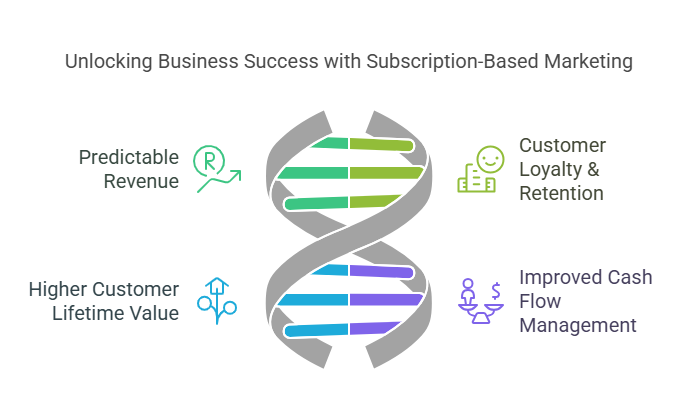
1. Predictable Revenue
Monthly recurring revenue (MRR) provides a clearer financial picture than one-time transactions. Instead of guessing next month’s performance, businesses can forecast income based on active subscribers.
This predictability supports:
- More accurate budgeting
- Smarter hiring decisions
- Confident investment in marketing and product development
- Reduced dependence on short-term sales spikes
Predictable revenue doesn’t eliminate risk, but it reduces uncertainty. And reduced uncertainty strengthens long-term decision-making.
2. Customer Loyalty & Retention
Subscription models naturally encourage ongoing engagement. Rather than repeatedly convincing customers to make new purchasing decisions, the relationship continues by default.
That continuity allows businesses to:
- Build familiarity and trust over time
- Deliver consistent value
- Improve the customer experience through feedback and iteration
- Create stronger brand affinity
When customers remain engaged month after month, loyalty becomes a byproduct of steady value delivery.
3. Higher Customer Lifetime Value (CLV)
Because subscribers pay repeatedly, their total contribution over time is often significantly higher than that of one-time buyers.
Higher CLV allows businesses to:
- Invest more in customer acquisition while remaining profitable
- Allocate more resources toward retention initiatives
- Improve product quality and service infrastructure
The focus shifts from single transactions to long-term relationships and long-term relationships generate compounding returns.
4. Improved Cash Flow Management
Recurring income creates financial rhythm. With greater visibility into incoming revenue, businesses can plan for expansion, product launches, and operational improvements more strategically.
This stability supports:
- Long-term growth planning
- Inventory forecasting
- Sustainable marketing budgets
- Reduced reliance on seasonal fluctuations
Stronger cash flow management doesn’t just protect the business. It creates room for thoughtful growth rather than reactive decision-making.
Bottom Line:
At its core, subscription marketing aligns business incentives with customer success. When customers continue paying, it’s because they continue receiving value.
That alignment is what turns recurring revenue into long-term resilience.
Subscription-Based Marketing: Types of Subscription Models
Subscription businesses come in different forms, but they all share one core principle: ongoing value delivered on a recurring basis. The structure of the model shapes how you market, retain, and grow your subscriber base.
Here’s a slightly deeper look at the main categories.
1. Product-Based Subscription Services
Product-based subscriptions focus on physical goods delivered on a recurring schedule. The appeal often lies in convenience, discovery, or routine replenishment.
Common examples include:
- Subscription boxes (e.g., meal kits, beauty boxes, pet supplies)
- E-commerce brands offering recurring product shipments (household essentials, supplements, grooming products)
These models work best when they remove friction from repeat purchases. Marketing should emphasize consistency, ease, and the ongoing benefit of never running out of something important.
Retention depends heavily on product quality, customization options, flexible delivery schedules, and a smooth logistics experience.
2. Service-Based Subscriptions
Service-based subscriptions provide access rather than physical products. The value is typically tied to content, software functionality, or ongoing participation.
Examples include:
- Streaming platforms like Netflix and Spotify
- SaaS (Software-as-a-Service) products such as Adobe and Dropbox
- Fitness memberships like Peloton or traditional gym subscriptions
In these models, perceived value is closely tied to usage. Marketing should focus on outcomes, improvements, and tangible benefits rather than features alone.
Strong onboarding, regular feature updates, and consistent engagement are essential to preventing churn.
3. Membership-Based Businesses
Membership-based subscriptions center around belonging, exclusivity, or enhanced access. The value often extends beyond a single product or service.
Examples include:
- Exclusive content platforms like Patreon and MasterClass
- Online communities and coaching programs
- VIP memberships for retailers such as Amazon Prime and Costco
These models succeed when members feel part of something meaningful. Marketing should highlight insider access, status, community connection, and long-term value.
Retention is driven by consistent engagement, fresh benefits, and a strong sense of identity around the membership.
Bottom Line:
While these models differ in delivery and positioning, they all rely on the same foundation: sustained value, clear expectations, and trust built over time.
Choosing the right structure depends on what you offer and how consistently you can deliver meaningful results to your subscribers.

How to Build a Subscription-Based Marketing Strategy
A strong subscription strategy isn’t built around tactics alone. It’s built around alignment between your offer, your audience, and the long-term value you deliver. Each step below builds on the previous one, creating a system rather than a series of isolated efforts.
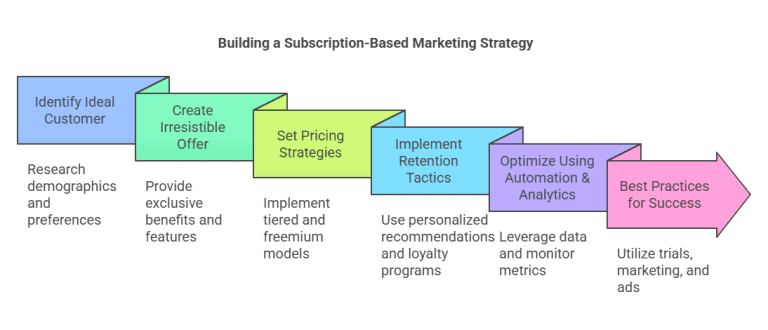
1. Identify Your Ideal Customer
Every successful subscription begins with clarity about who it is for.
Start by researching your audience’s demographics, preferences, buying behaviors, and recurring pain points. Look beyond surface-level data. What problem do they face repeatedly? What ongoing need makes a subscription model logical rather than forced?
Then define your unique value proposition. What specific, sustained outcome do you provide that competitors do not? Why should someone stay subscribed month after month?
Clarity here makes every other decision pricing, messaging, retention easier and more effective.
2. Create an Irresistible Offer
An effective subscription offer provides more than access. It provides a compelling reason to commit.
This might include:
- Exclusive discounts
- Early access to new releases
- Premium content or features
- Members-only perks or bonuses
The goal is not to overload the offer with extras. It’s to create clear differentiation. If your subscription feels interchangeable with competitors, retention becomes fragile.
Focus on benefits that reinforce your core value, not distractions that complicate the experience.
3. Set Pricing Strategies
Pricing shapes perception. It signals quality, positioning, and accessibility.
Consider offering tiered pricing plans that serve different customer segments. For example:
- Entry-level plans for price-sensitive users
- Mid-tier plans for regular users
- Premium tiers for advanced features or added support
Freemium models can also work well when structured properly. A limited free version lowers entry barriers, while paid upgrades unlock meaningful additional value.
The key is alignment. Pricing tiers should reflect clear differences in outcomes, not arbitrary feature splits.
4. Implement Retention Tactics
Acquisition starts the relationship. Retention sustains it.
Effective retention strategies include:
- Personalized recommendations based on user behavior
- Loyalty programs and referral incentives
- Automated onboarding and engagement emails
- Re-engagement campaigns when activity declines
The focus should always remain on reinforcing value. Subscribers stay when they see consistent progress, improvement, or convenience in their lives.
Retention systems should feel supportive not intrusive.
5. Optimize Using Automation & Analytics
Sustainable subscription growth depends on measurement and refinement.
Use email marketing automation to guide onboarding, send renewal reminders, and deliver targeted content based on user behavior. Automation ensures consistency without sacrificing personalization.
Leverage customer data to tailor experiences. Small personalization adjustments often have a significant impact on engagement.
Monitor key performance indicators such as:
- Churn rate
- Monthly Recurring Revenue (MRR), as defined by Investopedia
- Customer Lifetime Value (CLV), commonly analyzed by platforms like HubSpot
Metrics are not just reports. They are feedback loops. When analyzed consistently, they highlight where your strategy needs refinement.
Bottom Line:
A subscription-based marketing strategy is not built in a single launch cycle. It evolves.
By clearly defining your audience, crafting a differentiated offer, structuring smart pricing, investing in retention, and continuously optimizing through data, you create a system designed for long-term growth.
And in subscription businesses, long-term growth is the real objective.
Best Practices for Subscription Marketing Success
Subscription businesses don’t just win by acquiring customers. They win by earning ongoing trust. That means every marketing effort should focus not only on sign-ups, but on long-term retention and lifetime value.
Here’s how to approach it thoughtfully and sustainably.
1. Offer Free Trials & Freemium Models to Attract Users and Increase Sign-Ups
Reducing friction at the entry point is one of the most effective ways to grow a subscription business. Free trials and freemium models allow potential customers to experience real value before making a financial commitment.
However, success depends on structure:
- Make the trial long enough for users to experience meaningful results.
- Guide users toward key “aha” moments early.
- Communicate clearly what happens after the trial ends.
- Use onboarding emails and in-product prompts to prevent confusion.
A free trial should feel like a guided experience, not an empty sandbox. The goal is not just sign-ups, it’s activation.
2. Use Email & Content Marketing to Nurture Subscribers and Prevent Churn
Once someone subscribes, the real work begins.
Email and content marketing play a central role in reinforcing value. Thoughtful communication keeps subscribers engaged, informed, and confident in their decision to stay.
Effective nurturing includes:
- Onboarding sequences that teach users how to get the most from the product.
- Educational content that deepens their understanding and usage.
- Regular check-ins that highlight new features or improvements.
- Proactive messaging when engagement drops.
Content builds authority. Email builds relationship. Together, they reduce churn by continuously reminding subscribers why they joined in the first place.
3. Leverage Referral Programs & Influencer Marketing to Expand Reach
Subscription growth becomes more efficient when existing customers help drive it.
Referral programs work best when they are simple and mutually beneficial. Offer clear incentives for both the referrer and the new subscriber. Make sharing effortless. Avoid overcomplicating the reward structure.
Influencer marketing, when done thoughtfully, adds credibility and reach. The key is alignment:
- Choose influencers whose audience naturally fits your offer.
- Prioritize long-term partnerships over one-off promotions.
- Focus on authentic demonstrations, not scripted endorsements.
Trust transfers when recommendations feel genuine. That trust accelerates growth.
4. Upsell & Cross-Sell Opportunities to Maximize Revenue Per Customer
Increasing average revenue per user often costs less than acquiring new subscribers.
Upsells and cross-sells should feel like logical next steps, not pressure tactics. Present them at moments when the customer clearly understands the value of your core offer.
Examples include:
- Tier upgrades when usage limits are reached.
- Add-ons that enhance existing functionality.
- Bundled services that solve adjacent problems.
The guiding principle is relevance. If the additional offer clearly improves the customer’s outcome, it won’t feel like selling, it will feel like support.
5. Utilize Paid Ads & Retargeting to Bring Back Potential Subscribers
Not everyone converts on the first visit. Retargeting helps you re-engage those who showed interest but didn’t commit.
Paid advertising works best when it’s strategic:
- Retarget trial sign-ups who didn’t activate.
- Remind cart abandoners of unfinished purchases.
- Share testimonials or case studies with recent site visitors.
- Offer helpful resources rather than constant discounts.
Ads should reinforce value, not create urgency for its own sake. When retargeting focuses on clarity and reassurance, it strengthens brand credibility rather than eroding it.
Bottom Line:
Sustainable subscription marketing is not about aggressive growth tactics. It’s about building a system that supports every stage of the customer journey:
- Lower the barrier to entry.
- Deliver early wins.
- Reinforce ongoing value.
- Expand relationships thoughtfully.
- Re-engage with relevance.
When each piece works together, acquisition, retention, and expansion become aligned and that alignment is what drives predictable, long-term success.
Challenges in Subscription-Based Marketing & How to Overcome Them
Subscription models offer predictable revenue, but they also come with recurring pressure points. Retention, payment systems, competition, and pricing all require ongoing attention. Addressing these proactively is what separates stable growth from constant volatility.
1. Customer Churn
Churn is the most significant threat to subscription profitability. Acquiring customers takes time and capital. Losing them erodes both revenue and momentum.
The key is identifying why customers leave. Common reasons include low engagement, unclear value, pricing concerns, or lack of perceived progress.
How to reduce churn:
- Use retention tools within platforms like Shopify to monitor engagement and trigger targeted offers.
- Send personalized re-engagement emails when activity drops.
- Offer exclusive content, loyalty perks, or subscriber-only benefits.
- Provide pause options as an alternative to cancellation.
- Collect structured feedback during cancellation to uncover recurring issues.
Retention is less about persuasion and more about reinforcing consistent value. When customers clearly see ongoing benefit, churn naturally declines.
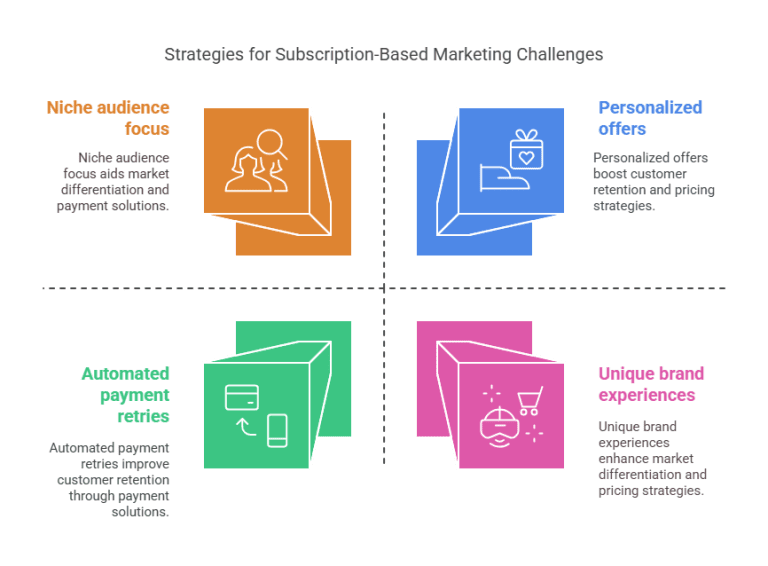
2. Payment Processing & Failed Transactions
Not all churn is intentional. Failed payments caused by expired cards, insufficient funds, or processing errors can quietly impact revenue.
These losses are often preventable.
Best practices include:
- Implement automated retry systems (often called dunning management).
- Send polite reminders before renewal dates.
- Notify customers immediately if a payment fails.
- Offer multiple payment options, such as credit cards and digital wallets.
- Make updating billing information quick and simple.
The goal is frictionless continuity. A seamless billing experience protects revenue while maintaining trust.
3. Market Saturation
Subscription businesses exist in nearly every industry. Competing in a crowded market requires clarity, not noise.
Lowering prices is rarely the answer. Sustainable differentiation comes from focus and experience.
Ways to stand out:
- Define a specific niche audience rather than appealing broadly.
- Develop marketing campaigns that address precise, real-world pain points.
- Deliver a noticeably better onboarding and support experience.
- Create consistent brand messaging rooted in clear positioning.
- Build community or exclusivity around your offer.
When your subscription feels designed for a particular group rather than “everyone,” your messaging becomes sharper and more persuasive.
4. Pricing & Value Perception
Pricing communicates more than cost. It signals quality, positioning, and confidence.
If pricing feels disconnected from value, conversions suffer. If it feels confusing, trust erodes.
To strengthen pricing strategy:
- Continuously test pricing tiers and packaging structures.
- Offer annual plans or bundled options where appropriate.
- Clearly outline what each tier includes.
- Avoid hidden fees or complicated terms.
- Reinforce value through outcomes, testimonials, and use cases.
Transparent pricing paired with clear value messaging reduces friction in the buying decision.
Bottom Line:
Subscription marketing is not static. It requires ongoing refinement across retention, billing systems, differentiation, and pricing.
When these elements are managed intentionally, subscription businesses shift from reactive problem-solving to steady, predictable growth.
Real-World Examples of Subscription-Based Marketing in Action
Understanding subscription marketing conceptually is helpful. Seeing it applied in real businesses makes the strategy tangible.
Below are examples from entertainment, consumer goods, SaaS, and e-commerce. Each illustrates a different path to recurring revenue but all share the same foundation: consistent value delivered over time.
Case Study: How Netflix Disrupted the Entertainment Industry
Netflix began as a DVD rental-by-mail service. Its defining shift came when it moved to a monthly subscription streaming model.
Rather than charging per rental, Netflix offered unlimited on-demand access for a fixed monthly fee. This removed friction and fundamentally changed consumer expectations around entertainment.
The company strengthened its model with data-driven personalization. By analyzing viewing behavior, Netflix improved recommendations, increased engagement, and invested in original programming aligned with audience demand.
The result was scale and market dominance. Subscription revenue became predictable, churn was managed through ongoing content releases, and the brand reshaped the entertainment landscape.
Key lesson: Pair recurring access with personalization and continuous content updates to keep subscribers engaged.
Case Study: How Dollar Shave Club Scaled with Content & Direct-to-Consumer Strategy
Dollar Shave Club entered a razor market dominated by major retail brands. Instead of competing through traditional retail channels, it launched with a direct-to-consumer subscription model.
Customers received affordable razors delivered regularly to their door. The value proposition was simple: convenience and cost savings.
The company accelerated growth with memorable content marketing. Its launch video went viral, clearly explaining the subscription model in a way that felt accessible and distinctive. Influencer partnerships and digital campaigns further amplified awareness.
Rapid subscriber growth followed, ultimately leading to its acquisition by Unilever in a deal valued at approximately $1 billion.
Key lesson: Clear positioning and strong storytelling can make a recurring physical product feel modern and compelling.
Case Study: How Adobe Strengthened Revenue with a SaaS Transition
Adobe historically sold software licenses as one-time purchases. Customers paid large upfront fees and upgraded periodically.
In 2013, Adobe shifted to a subscription-only model through Creative Cloud. Instead of buying software outright, customers paid monthly or annually for ongoing access.
This model offered:
- Lower upfront cost
- Continuous feature updates
- Cloud storage and collaboration tools
- Tiered plans for different user segments
While the transition required adjustment, it ultimately stabilized revenue and increased lifetime value. Adobe also gained deeper insights into user behavior, enabling better product development and targeted upsells.
Key lesson: Subscription models can transform financial stability when combined with continuous product improvement.
Case Study: How Amazon Built Loyalty Through Amazon Prime
Amazon Prime is not just a shipping program, it’s a bundled subscription ecosystem.
For a recurring fee, members receive:
- Fast, free shipping
- Access to streaming content
- Exclusive deals and promotions
- Additional digital perks
The strategy increases purchase frequency while strengthening customer loyalty. Once subscribed, members are more likely to concentrate their spending within the Amazon ecosystem.
This model demonstrates how subscriptions can extend beyond a single product and instead enhance an entire customer relationship.
Key lesson: Bundled value increases retention and deepens brand reliance.
What These Examples Reveal
Across industries, successful subscription brands share several characteristics:
- They solve a recurring need.
- They reduce friction in access or delivery.
- They reinforce value consistently over time.
- They use data to personalize and improve the experience.
Subscription-based marketing works when the model genuinely benefits the customer. When convenience, personalization, and consistency align, recurring revenue becomes a natural outcome not a forced one.
Conclusion: Subscription-Based Marketing
Subscription-based marketing offers businesses a sustainable and scalable way to generate recurring revenue. But its true strength lies beyond predictable income.
At its core, this model shifts the focus from single transactions to ongoing relationships. Growth becomes less about constant acquisition and more about consistent value delivery.
By implementing thoughtful retention strategies, leveraging personalization, and using marketing automation intelligently, companies can build a loyal subscriber base that compounds over time.
Whether in SaaS, e-commerce, digital media, or membership-based businesses, the long-term advantage comes from one principle: deliver value consistently, communicate clearly, and optimize continuously.
Subscription success is not built on hype or aggressive tactics. It’s built on trust, reliability, and relevance month after month.

Frequently Asked Questions (FAQs)
What are the three types of subscription models?
The three main types are product-based subscriptions (physical goods), service-based subscriptions (software, media), and membership-based businesses (exclusive access, VIP communities).
How do subscription-based businesses make money?
They generate revenue through recurring monthly or yearly payments while maintaining customer engagement to reduce churn.
What is the most profitable subscription business model?
SaaS and streaming platforms tend to have high profit margins due to low overhead costs and scalable digital products.
How do I reduce churn in a subscription business?
Reduce churn by offering loyalty programs, personalized engagement, and proactive customer support.
How do I start a subscription-based business from scratch?
Start by identifying a profitable niche, setting up a pricing model, and using content marketing, social media, and paid ads to attract subscribers.

0 Comments