Lead generation now happens across more channels than many small businesses can manage manually.
A potential customer might arrive from search, ads, social media, referrals, webinars, lead magnets, chat, email, or a product page. Each interaction can reveal useful intent, but those signals often end up scattered across forms, inboxes, CRMs, spreadsheets, and marketing tools.
AI can help bring more order to that process.
It can support lead capture, scoring, segmentation, follow-up, CRM updates, and sales follow-up, so less work depends on manual sorting. But it still depends on a clear audience, a useful offer, accurate data, and human judgment.
This guide explains how AI fits into lead generation, where it helps most, how the workflow works, which tools can support it, and how to use automation without losing trust, relevance, or control.
- AI can support lead capture, qualification, segmentation, nurturing, routing, and follow-up when it is connected to a clear lead generation process.
- Using AI in lead generation can help both inbound and outbound workflows, but the strategy should not be reduced to cold email automation.
- The strongest use cases include website lead capture, quizzes, chatbots, lead scoring, CRM organization, email follow-up, and data enrichment.
- AI works best when you already understand your ideal customer, offer, qualification criteria, and follow-up path.
- Tools can automate parts of the process, but they cannot replace clear targeting, useful offers, human judgment, or trust.
- AI-assisted outreach, scoring, and follow-up still need review for accuracy, relevance, privacy, and compliance.
- Start with one lead source, one qualification method, and one follow-up workflow before adding more tools or automation.
Disclaimer: I am an independent Affiliate. The opinions expressed here are my own and are not official statements. If you follow a link and make a purchase, I may earn a commission.
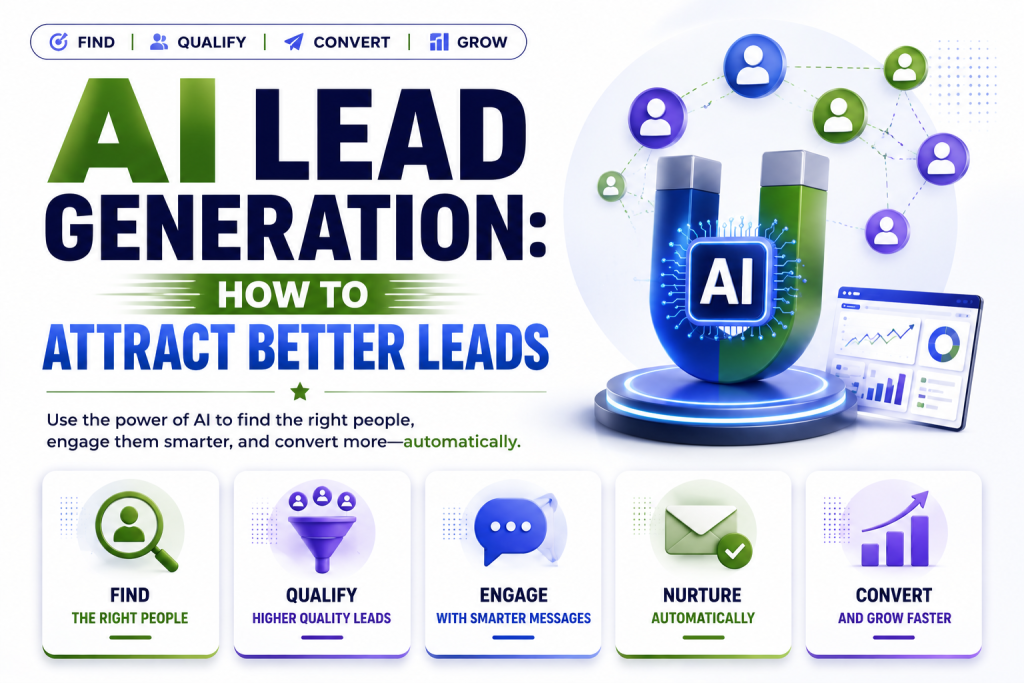
What Is AI Lead Generation?
AI lead generation is the use of artificial intelligence to support the process of attracting, capturing, qualifying, and following up with potential customers.
It can help with website forms, landing pages, quizzes, chatbots, lead magnets, CRM data, email nurturing, lead scoring, segmentation, and sales handoff.
The goal is not simply to collect more contacts.
The goal is to make the lead generation process easier to manage, so you can understand who is interested, what they need, how qualified they are, and what should happen next.
For example, AI can help identify which website visitors show buying intent, which quiz answers suggest a stronger fit, which leads should receive a specific email sequence, or which contacts should be routed to a sales conversation.
It can also help enrich lead records, summarize conversations, draft follow-up messages, and keep contacts organized inside a CRM.
This can support both inbound and outbound lead generation.
Inbound workflows may include content, lead magnets, forms, quizzes, chatbots, webinars, or personalized website experiences. Outbound workflows may include prospect research, enrichment, scoring, and more relevant outreach.
Both can be useful, but they are not the same strategy.
The strongest systems start with a clear definition of a qualified lead. AI can process signals and automate next steps, but it still needs direction.
Without a clear audience, offer, and follow-up path, AI only makes a weak lead generation process move faster.
Why AI Matters In Lead Generation
Organizing Multi-Channel Signals
Lead generation is harder to manage manually because prospects now come from more places.
Someone might find your business through search, social media, ads, referrals, webinars, lead magnets, product pages, chat widgets, or email campaigns. Each interaction can reveal useful intent, but those signals are easy to miss when they are spread across different tools.
AI matters because it can help organize those signals.
It can support faster response times, better segmentation, cleaner CRM records, more relevant follow-up, and smarter prioritization. Instead of treating every lead the same, AI can help identify which contacts are more engaged, better matched to your offer, or ready for a different next step.
Reducing Manual Work
That does not mean AI should make every decision.
It means AI can reduce the manual work involved in understanding and managing leads.
For example, it can help sort quiz responses, summarize chatbot conversations, recommend lead scores, suggest email segments, identify common objections, or flag contacts that may need personal follow-up.
Supporting Small Businesses
This is especially useful for small businesses.
A founder, consultant, service provider, or small agency may not have a sales operations team, data analyst, or full-time CRM manager. AI can make the process more organized without adding more admin work.
Better Lead Handling Over Volume
The value is not just more leads.
The value is better lead handling.
More leads do not help much if they are unqualified, ignored, poorly followed up with, or sent the same generic message. AI helps lead generation work better by adding more context, consistency, and timing to the process.
Used well, it can turn scattered forms, emails, and follow-up tasks into a clearer system.

How AI Lead Generation Works
AI lead generation works by collecting signals, organizing lead data, and helping decide what should happen next.
The process can be simple or advanced, but the basic flow is usually the same. Someone interacts with your business, AI helps interpret that interaction, and the system uses that information to qualify, segment, nurture, or route the lead.
A Lead Enters The System
The process starts when someone shows interest.
That signal might come from a form submission, quiz result, chatbot conversation, webinar registration, product page visit, lead magnet download, email click, demo request, or contact record inside a CRM.
At this stage, the person may be ready to buy, still researching, or only mildly interested.
AI helps by organizing the available context instead of treating every lead the same.
AI Collects Or Enriches Lead Data
Once a lead enters the system, AI can help gather or enrich useful information.
That may include company size, job title, industry, location, website activity, content viewed, form answers, past interactions, or CRM history.
The purpose is not to collect data for its own sake.
The purpose is to understand whether the lead matches your ideal customer profile and what kind of follow-up may be useful.
The Lead Is Scored Or Segmented
The next step is often scoring or segmentation.
Lead scoring helps estimate how promising a lead may be based on fit, behavior, engagement, or intent. Segmentation groups leads based on shared traits, needs, answers, or actions.
someone who downloads a beginner checklist may need education. Someone who requests a demo may need direct follow-up. Someone who completes a pricing calculator may need a more specific recommendation.
This step helps separate those paths.
The System Triggers A Next Step
After scoring or segmentation, the system can trigger the next action.
That action may be an email sequence, chatbot response, CRM update, sales notification, calendar link, personalized recommendation, retargeting audience, or internal task.
This is where automation becomes useful for consistency.
Instead of manually reviewing every lead and deciding what happens next, the workflow can move people into the right path faster.
Follow-Up Becomes More Relevant
AI can help tailor follow-up based on what the lead has shown interest in.
A lead who downloaded a marketing planner should not receive the same message as someone who requested a consultation. A beginner should not receive the same sequence as someone with advanced needs.
Relevant follow-up does not mean every message has to be complex.
It means the message should match the lead’s context, stage, and next logical step.
The Lead Is Routed Or Nurtured
Some leads should go to a sales conversation.
Others should go into a nurture sequence.
AI can help decide which path makes sense based on lead score, behavior, firmographic data, form answers, or engagement level.
A high-fit lead may be routed to a call. A lower-intent lead may receive educational content. A lead with missing information may be asked a qualifying question before moving forward.
This helps small businesses spend attention where it matters most.
Performance Data Improves The Workflow
The final step is learning from results.
AI can help identify which lead magnets, pages, forms, quizzes, emails, chat flows, or traffic sources produce the most useful leads.
That feedback can improve future campaigns.
If a quiz attracts many signups but few qualified leads, the questions may need to change. If a chatbot books calls that do not convert, the qualification flow may be too loose. If one lead magnet produces fewer leads but better customers, it may deserve more promotion.
The goal is not to automate every part of the process.
The goal is to help the right leads move through the right path with less friction and better timing.
Where AI Helps Most In Lead Generation
AI is most useful when it improves a specific part of the lead generation process.
It should help you capture leads more clearly, qualify them faster, follow up with more relevance, or organize the information needed to make better decisions.
Website Lead Capture
AI can improve what happens when someone visits your website.
That may include smarter forms, personalized calls to action, chat widgets, product recommendations, page suggestions, or lead magnet offers based on visitor behavior.
For example, a visitor reading beginner content may be offered a checklist. A visitor viewing a pricing page may be invited to book a consultation. A returning visitor may see a more specific offer based on previous activity.
The goal is not to interrupt every visitor.
The goal is to match the offer to the visitor’s likely intent.
Lead Magnets And Quizzes
AI can make lead magnets more useful by helping personalize the result.
A static checklist gives everyone the same resource. A quiz, assessment, calculator, or interactive form can collect answers and guide the visitor toward a more relevant next step.
For example, a quiz can segment leads by business stage. A calculator can estimate potential savings. An assessment can identify gaps in a marketing funnel.
Those answers can then shape the follow-up.
A beginner may receive educational content. A more advanced lead may receive a consultation invite, product recommendation, or case study.
Chatbots And Conversational Forms
Chatbots and conversational forms can help answer questions, collect information, and qualify leads before a person needs to step in.
They can ask what the visitor needs, identify the right product or service category, collect contact details, and route the conversation based on the answer.
This can be useful for small businesses that receive the same questions often or want to qualify leads before booking calls.
The experience still needs careful design.
A chatbot should make the next step easier. It should not trap the visitor in a scripted conversation or pretend to know more than it does.
Lead Scoring And Qualification
AI can help prioritize leads based on fit and behavior.
A lead who downloads one beginner guide may not need the same follow-up as someone who visits a pricing page, watches a demo, and answers a qualification form.
Lead scoring may use signals such as:
- Form answers
- Website activity
- Email engagement
- Company size
- Job title
- Industry
- Product interest
- Past interactions
The score helps you decide which leads may need personal attention and which ones may need more nurturing.
It should not be treated as perfect.
Lead scores should be reviewed against real outcomes, such as replies, bookings, purchases, consultations, or closed deals.
Email Follow-Up And Lead Nurturing
AI can help make follow-up more relevant after someone becomes a lead.
That may include welcome emails, educational sequences, product recommendations, reminder emails, or re-engagement messages.
The value is not just writing emails faster.
The value is matching the message to the lead’s context. Someone who downloaded a beginner checklist may need education. Someone who completed an advanced assessment may need a consultation or demo. Someone who abandoned a trial may need help understanding one specific feature.
AI can help draft and organize these paths, but human review is still needed to protect tone, accuracy, and trust.
CRM Organization And Sales Handoff
AI can help keep lead records cleaner and more useful.
It can summarize conversations, update fields, suggest next steps, assign leads to the right person, and flag contacts that may need attention.
This matters because many leads are lost after capture.
Someone fills out a form, joins a list, asks a question, or downloads a resource, but the follow-up is unclear. AI can help reduce that gap by making sure the right information reaches the right system or person.
Prospecting And Enrichment
Prospecting and enrichment can be part of the process, especially for B2B businesses.
AI can help find potential prospects, enrich contact records, identify company details, summarize public information, and support more relevant outreach.
This can be useful for consultants, agencies, service providers, and B2B sales workflows.
But it should not become the whole strategy.
More contacts do not automatically mean more useful leads. The goal should be better fit, better context, and better follow-up, not larger lists.
Analytics And Optimization
AI can help identify which parts of your lead generation system are working.
It can compare lead sources, form completion rates, quiz results, email engagement, chatbot outcomes, booking rates, and conversion quality.
This helps answer practical questions:
- Which lead magnet attracts the most qualified leads?
- Which form fields reduce signups?
- Which quiz results turn into consultations?
- Which traffic source produces leads that actually convert?
- Which follow-up sequence gets replies or bookings?
AI can help surface patterns, but you still need to decide what to change.
The best use of AI is not more automation for its own sake. It is better understanding, cleaner handoff, and more relevant follow-up.

When AI Lead Generation Makes Sense
AI becomes useful when there is a real lead generation workflow to support.
It works best when you know who you want to reach, what makes someone a qualified lead, and what should happen after that person shows interest.
Automation can organize the process, reduce manual work, and make follow-up more consistent. It cannot fix a vague offer, unclear audience, weak traffic source, or missing follow-up path.
Existing Traffic Is Not Turning Into Leads
AI can help when people visit your website, read your content, view your offer, or interact with your brand but do not take the next step.
This may include smarter forms, personalized calls to action, chatbot flows, quizzes, assessments, or lead magnet recommendations.
The goal is to turn existing attention into clearer lead capture.
Lead Follow-Up Feels Too Generic
Many businesses collect leads but follow up with everyone the same way.
Someone downloads a resource, asks a question, joins a list, or requests information, then receives a message that does not reflect what they actually did.
AI can help segment those leads, organize follow-up paths, draft more relevant emails, and route people based on behavior, answers, or intent.
This is often a good starting point because the leads already exist. The problem is how they are handled.
Your CRM Has Useful Data, But No Clear System
A CRM is only useful when the information inside it is accurate, organized, and actionable.
AI can help summarize interactions, clean up records, suggest missing fields, group similar contacts, flag high-intent leads, and recommend next steps.
This can help small businesses stop losing leads inside their own systems.
Qualification Takes Too Much Manual Time
If too much time goes into reviewing weak-fit leads, AI can support the qualification process.
Forms, quizzes, chatbots, and scoring rules can collect useful information before a sales conversation happens.
That does not mean every decision should be automated.
It means the system can help identify who may need immediate attention, who may need nurturing, and who may not be a strong fit for the offer.
Segmentation Needs To Be More Relevant
Not every lead should receive the same message.
AI can help group leads based on interest, stage, industry, role, company size, behavior, quiz results, or past engagement.
Better segmentation makes follow-up more useful.
A beginner can receive educational content. A high-intent lead can receive a consultation invite. A returning visitor can receive a more specific offer.
The Foundation Is Still Unclear
AI may not be the right starting point if the foundation is unclear.
It is usually too early to automate when:
- You do not know your ideal customer
- Your offer is not clear
- You do not have a reliable lead source
- Your website or landing page does not explain the value well
- You have no follow-up process
- Your data is incomplete or unreliable
- You plan to use AI only to send more generic outreach
In those cases, fix the strategy first.
AI is most useful after you have something concrete to improve, such as a form, lead magnet, CRM, email sequence, chatbot, sales process, or content funnel.
The better the foundation, the more useful the automation becomes.
AI Lead Generation Tools To Know
Tools are useful only when they solve a clear problem in your workflow.
Some help capture leads. Some qualify visitors through forms, quizzes, or chat. Others support CRM organization, email nurturing, prospect research, enrichment, or automation between platforms.
You do not need all of them.
Start with the weakest part of your current lead generation process, then choose a tool that improves that specific step.
| Tool | Best For | Role In The Workflow |
|---|---|---|
| HubSpot | CRM and lead management | Capturing leads, organizing contacts, scoring leads, and managing follow-up |
| Intercom | Website conversations | Chat, visitor engagement, qualification, routing, and support-to-sales handoff |
| Typeform | Forms, quizzes, and surveys | Collecting lead information through interactive forms and assessments |
| ScoreApp | Score-based assessments | Segmenting leads by answers, score, need, or readiness |
| ActiveCampaign | Email nurturing | Segmenting leads, sending follow-up sequences, and supporting lead scoring |
| Apollo | B2B prospecting | Finding prospects, enriching contact data, and supporting outbound workflows |
| Clay | Data enrichment | Combining data sources, enriching leads, scoring prospects, and routing information |
| Zapier | Simple automation | Connecting forms, CRMs, email tools, spreadsheets, and other lead workflows |
| Make | Visual workflow automation | Building multi-step automations between lead capture, CRM, email, and reporting tools |
If leads are not being captured, start with forms, quizzes, chat, or lead magnets.
If leads are captured but not followed up with well, focus on email automation, segmentation, or CRM workflows.
If too much time goes into researching prospects, enrichment and prospecting tools may help.
The tool should follow the system, not replace it. Build the workflow first. Add software only when it removes a real bottleneck.
How To Start With AI Lead Generation
Start with the simplest useful version of the system.
Do not try to automate every channel, tool, and follow-up path at once. A better starting point is one lead source, one qualification method, and one follow-up workflow.
Choose One Lead Source
Begin with the place where leads already come from or where you have the clearest chance to capture them.
That might be your website, blog, landing page, newsletter, webinar, quiz, paid ad, chatbot, or CRM.
Do not try to improve every source at the same time.
Choose the one that already shows some activity or the one most closely connected to your offer.
Define A Qualified Lead
Before using AI to score, segment, or route leads, define what a qualified lead means for your business.
That definition may include:
- Business type
- Company size
- Budget range
- Location
- Role or job title
- Problem they need solved
- Timeline
- Product interest
- Engagement level
- Form or quiz answers
AI can process this information, but you need to decide which signals matter.
Pick One Capture Method
Choose one way to collect lead information.
That could be a form, quiz, chatbot, calculator, lead magnet, booking page, or demo request.
The capture method should match the visitor’s intent.
A beginner may prefer a checklist or quiz. A higher-intent prospect may be ready for a consultation form or demo request. Someone with a specific question may prefer chat.
Add One Qualification Step
Do not collect information only because a tool makes it easy.
Add one useful qualification step that helps you understand the lead better.
For example, you might:
- Ask about the person’s biggest challenge
- Ask which service they are interested in
- Ask about company size or role
- Use quiz answers to assign a segment
- Use page behavior to identify interest
- Use a short form question to separate beginner and advanced leads
This gives AI better context for scoring, routing, or follow-up.
Create One Follow-Up Path
After the lead signs up, the next step should be clear.
That may be a welcome email, a resource delivery email, a personalized recommendation, a consultation invite, a product demo, a nurture sequence, or a sales notification.
The follow-up path should match the lead’s intent.
Someone who downloads a beginner guide should not be pushed immediately into a sales call. Someone who requests a demo should not receive only general educational content.
Connect The Workflow
Once the lead source, capture method, qualification step, and follow-up path are clear, connect the tools.
For example:
- A quiz result sends the lead to the right email sequence
- A form submission creates or updates a CRM record
- A chatbot conversation notifies the right person
- A high-intent lead triggers a sales task
- A lead magnet signup receives a relevant follow-up sequence
Start with one clean connection before building more complex automation.
Review And Improve
After the workflow runs, review the results.
Look at how many people sign up, which leads are qualified, which follow-up messages get engagement, and which leads move to the next step.
AI can help summarize patterns, but your decisions should come from real outcomes.
If the workflow attracts too many weak-fit leads, improve the promise or qualification step. If leads sign up but do not respond, improve the follow-up. If high-intent leads are delayed, improve routing.
Start simple, then improve the system one step at a time.

What AI Should And Should Not Handle
AI can support lead generation, but it should not control the entire process.
The best systems use AI for speed, organization, pattern recognition, and consistency. They still rely on people for strategy, judgment, relationships, and final decisions.
Tasks AI Can Support
AI is useful for repetitive or data-heavy work.
It can summarize lead information, sort contacts into segments, suggest lead scores, draft follow-up messages, identify common questions, route form submissions, enrich records, and connect tools through automation.
These tools can also help create first drafts of emails, chatbot responses, quiz result pages, landing page copy, and internal sales notes.
That support matters because it reduces manual work and makes follow-up more consistent.
Decisions People Should Own
People should still own the parts of lead generation that require judgment.
That includes defining the ideal customer, deciding what qualifies a lead, reviewing sensitive messages, handling objections, joining sales conversations, managing relationships, and making sure the process feels trustworthy.
Review AI-generated copy before it reaches prospects or customers.
This is especially important when a message includes claims, pricing, personal data, industry-specific advice, or sales commitments.
Where The Balance Matters Most
The balance matters most when a lead moves from automation to a real conversation.
AI can help identify the lead, collect context, and prepare the next step. But once someone shows serious interest, human involvement becomes more important.
That is where trust, nuance, and timing matter.
A strong system does not remove people from lead generation. It helps them spend less time sorting, guessing, and chasing, so they can spend more time on the conversations that matter.
Trust, Privacy, And Compliance Considerations
Using AI in lead generation still requires trust.
A tool may be able to collect, score, enrich, or automate lead data, but that does not mean every use is appropriate. Lead generation often involves personal information, email communication, behavioral signals, and customer intent.
Privacy and compliance should be part of the workflow from the start.
Limit The Data You Collect
Do not collect information just because a form, chatbot, or enrichment tool makes it possible.
Ask for the information that helps you qualify the lead or provide a better next step.
For a simple lead magnet, an email address may be enough. For a consultation request, it may make sense to ask about company size, budget, timeline, or the problem the person wants solved.
Collecting less data can reduce friction and lower risk.
Make The Next Step Clear
People should understand what they are signing up for.
If someone downloads a checklist, tell them whether they will also receive follow-up emails. If they complete a quiz, explain how their answers may be used. If they request a demo, make the sales follow-up clear.
Clear expectations build trust before the first email arrives.
Review AI-Generated Messages
AI can help draft emails, chatbot responses, quiz results, and sales notes, but those messages still need review.
Check for accuracy, tone, relevance, and claims that may be too strong.
This matters especially when AI uses lead data to personalize a message. A message can be technically personalized and still feel careless if it misreads the person’s situation.
Keep Outreach Honest
If email is part of your lead generation process, make sure the message is honest and easy to opt out of.
The Federal Trade Commission says commercial email should not use misleading header information or deceptive subject lines. It should also include a valid physical postal address and give recipients a clear way to opt out of future messages.
The FTC also says opt-out requests must be honored within 10 business days. See the FTC’s CAN-SPAM Act compliance guide for the full requirements.
Respect Privacy Rules
Privacy rules vary by location, audience, data type, and channel.
If your lead generation process collects or processes personal data, review the rules that apply to your business. The European Commission explains that GDPR principles include lawfulness, fairness, transparency, purpose limitation, data minimization, accuracy, storage limitation, security, and accountability.
See the European Commission’s GDPR principles for more detail.
For California consumers, the California Attorney General explains that the CCPA gives consumers rights such as knowing, deleting, correcting, limiting, and opting out of certain uses of personal information.
See the California Attorney General’s CCPA overview for more detail.
Use Human Judgment In Sensitive Moments
Automation should not replace judgment when the situation is sensitive.
If a lead asks a detailed question, raises an objection, shares private information, or shows strong buying intent, a person should review the interaction or step in directly.
AI can help prepare context. Humans should handle trust.
Audit The Workflow Regularly
AI-supported lead generation systems can drift.
Forms change. Tools update. Email sequences become outdated. Scoring rules stop matching real customer behavior. Privacy requirements may change. Data sources may become less reliable.
Review the system regularly.
Check what data you collect, where it goes, who can access it, what messages are being sent, and whether the workflow still reflects your current offer and audience.
Trust is not created by automation. It is protected by clear consent, accurate data, honest messaging, careful follow-up, and human oversight.
Common Mistakes To Avoid
AI can make a weak lead generation process move faster, which is not always a good thing.
If the audience is unclear, the offer is vague, or the follow-up is generic, automation can multiply the problem instead of fixing it.
Automating Before The Strategy Is Clear
AI needs direction.
If you have not defined what makes someone a qualified lead, the system may score, segment, or route people based on weak signals.
Before adding automation, decide which signals matter most. That may include industry, role, company size, budget, problem, timeline, engagement, or fit with your offer.
A clear qualification standard makes every tool more useful.
Treating AI As The Lead Source
AI can help capture, qualify, enrich, and follow up with leads.
It does not automatically create demand.
You still need traffic, content, ads, referrals, partnerships, events, search visibility, or another real source of attention. Without that, AI has nothing useful to process.
Think of AI as support for the system, not the system itself.
Sending Generic Follow-Up Faster
Personalization is not just adding a first name.
A relevant follow-up should reflect what the lead did, answered, asked, downloaded, viewed, or requested.
If every lead receives the same message, the workflow is not truly personalized. It is just automated.
Use AI to help match the message to the lead’s context.
Collecting More Data Than You Need
Long forms and invasive questions can reduce trust.
Ask only for information that helps you qualify the lead or provide a better next step.
A quiz may need several answers. A demo request may need more detail. A simple checklist usually does not.
The amount of data you request should match the value of the offer.
Trusting Bad Data
Lead scoring and segmentation are only as good as the data behind them.
Incomplete records, outdated contact information, unclear form answers, or messy CRM fields can lead to poor routing and weak follow-up.
Clean up the basics before trusting automation too much.
Adding Too Many Tools Too Soon
More tools do not always create a better system.
A business may add a chatbot, CRM, quiz builder, enrichment tool, email platform, automation tool, and analytics dashboard before the workflow is clear.
That creates complexity.
Start with the smallest setup that captures leads, qualifies them, and follows up clearly. Add tools only when they solve a real bottleneck.
Skipping Human Review
AI can draft emails, chatbot responses, quiz results, and sales notes quickly.
Those drafts still need review.
Check for accuracy, tone, claims, personalization, and whether the message fits the lead’s stage. A message that sounds efficient to the business can still feel careless to the recipient.
Losing The Human Handoff
Some leads need more than automation.
If a lead asks a detailed question, requests pricing, books a call, replies to an email, or shows strong buying intent, the handoff should be clear.
AI can help prepare the context. A person should handle the moment where trust matters most.
Measuring Volume Instead Of Quality
More leads do not always mean better lead generation.
Track whether the leads are qualified, engaged, and moving toward meaningful next steps.
A source that brings fewer but better-fit prospects may be more valuable than one that fills your database with low-intent contacts.
Measure quality, not just quantity.
Letting The Workflow Go Stale
A lead generation workflow is not something to set once and ignore.
Review the system regularly. Look at which forms, quizzes, chat flows, emails, and lead sources produce qualified leads.
Update scoring rules, follow-up messages, and qualification questions based on what you learn.
The goal is a system that gets clearer over time.
Conclusion
AI is most useful in lead generation when it improves a process that already has direction.
It can help capture leads, qualify them, segment them, personalize follow-up, organize CRM records, and route prospects to the right next step. Those improvements can make the workflow easier to manage and more consistent.
But AI does not replace the foundation.
You still need to understand your audience, create a clear offer, define what makes someone qualified, respect privacy, and follow up in a way that earns trust.
The best approach is simple.
Start with one lead source. Add one capture method. Define one qualification step. Build one follow-up path. Then use AI to make that workflow clearer, faster, and easier to improve.
The goal is not to automate every possible interaction.
The goal is to build a lead generation system that helps the right people take the right next step.
Frequently Asked Questions
What Is AI Lead Generation?
AI lead generation is the use of artificial intelligence to support the process of attracting, capturing, qualifying, nurturing, and routing potential customers.
It can help with forms, quizzes, chatbots, lead magnets, CRM workflows, email follow-up, lead scoring, segmentation, and data enrichment.
How Does AI Help With Lead Generation?
AI helps by organizing lead data, identifying useful signals, and supporting the next step in the workflow.
For example, it may help score a lead, assign a segment, trigger an email sequence, summarize a chatbot conversation, update a CRM record, or notify someone when a lead is ready for personal follow-up.
Can AI Generate Leads Automatically?
AI can automate parts of the process, but it does not create demand by itself.
You still need a real lead source, such as website traffic, content, ads, referrals, webinars, partnerships, social media, or outbound prospecting. AI helps manage, qualify, and follow up with those leads more efficiently.
Is This Only Useful For B2B Businesses?
No. AI can support both B2B and B2C lead generation.
B2B businesses may use it for lead scoring, enrichment, account research, CRM workflows, and sales handoff. B2C businesses may use it for quizzes, product recommendations, email segmentation, chatbots, and personalized offers.
Which Tools Can Support Lead Generation With AI?
The right tool depends on the part of the process you want to improve.
HubSpot can help with CRM and lead management. Intercom can support website conversations. Typeform and ScoreApp can help with forms, quizzes, and assessments. ActiveCampaign can support email nurturing. Apollo and Clay can help with B2B prospecting and enrichment. Zapier and Make can connect tools into automated workflows.
Can Small Businesses Use AI For Lead Generation?
Yes. Small businesses can use AI, but they should start with a simple workflow.
A good starting point might be one lead magnet, one form or quiz, one follow-up sequence, and one CRM or spreadsheet. More advanced automation can come later once the basic process is working.
How Does AI Lead Scoring Work?
AI lead scoring uses data to estimate how qualified or engaged a lead may be.
That data may include form answers, page visits, email clicks, company size, job title, industry, quiz results, chatbot conversations, product interest, or past interactions. The score helps decide which leads may need immediate attention and which ones may need more nurturing.
Where Do Lead Magnets Fit?
Lead magnets can give AI more useful context.
Instead of collecting only an email address, a quiz, checklist, calculator, assessment, or guide can reveal what the person wants, what stage they are in, and what follow-up may be useful.
Is It Safe To Use AI With Lead Data?
It can be safe when the workflow is designed responsibly.
Collect only the information you need, explain what happens after someone signs up, review AI-generated messages, follow email and privacy rules, and avoid misleading or invasive personalization.
Does AI Replace Salespeople?
No. AI can support sales work, but it should not replace human judgment.
It can help organize lead data, summarize conversations, suggest follow-up, and route qualified leads. People are still needed for strategy, trust, objections, relationships, pricing conversations, and final decisions.
How Should I Start?
Start with one lead source, one capture method, one qualification step, and one follow-up path.
For example, a quiz result could send someone into the right email sequence, update a CRM record, and notify you when a high-intent lead is ready for personal follow-up.
Which Mistake Matters Most?
The biggest mistake is adding automation before the strategy is clear.
If you do not know who your ideal customer is, what makes someone qualified, or what should happen after a lead signs up, AI can make the process faster without making it better.

0 Comments