Introduction
AI tools are now widely accessible, but access alone has not made them easy to use. Many people struggle to turn AI capabilities into consistent, useful outcomes. This gap between potential and execution has created demand for a specific category of digital products.
AI-based digital products focus on application rather than technology. They package prompts, scripts, and workflows into usable assets that help people get results faster without repeated experimentation. Instead of building new tools, sellers in this space organize existing AI capabilities into clear, repeatable systems.
This article examines what actually sells in AI-based digital products. It breaks down the formats that perform well, explains why buyers pay for them, and shows how these products are typically packaged and delivered.
Key Takeaways
- AI-based digital products sell because they reduce trial-and-error, not because they introduce new technology.
- Prompts, scripts, and workflows outperform general AI guidance when they are structured around specific outcomes.
- Buyers pay for clarity and usability more than access to AI tools themselves.
- Narrow, well-defined use cases convert better than broad AI promises.
- Delivery platforms support scale, but the product’s value comes from how clearly it solves a problem.
Disclaimer: I am an independent Affiliate. The opinions expressed here are my own and are not official statements. If you follow a link and make a purchase, I may earn a commission.
Why AI-Based Digital Products Sell So Well
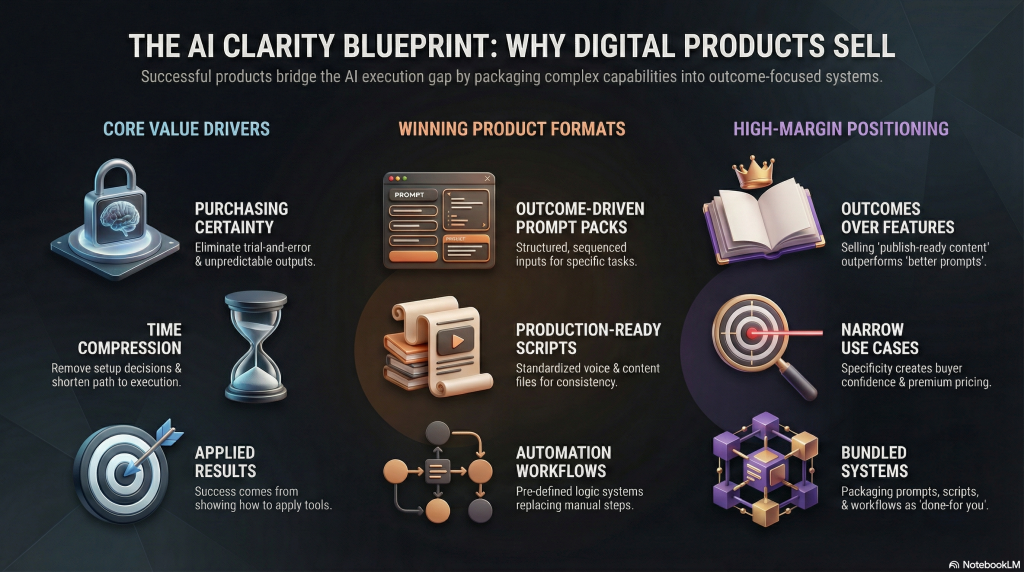
The appeal of AI-based digital products is not rooted in novelty. Most people already have access to AI tools, yet many struggle to use them consistently or effectively. The challenge is not capability, it is decision-making. Faced with too many options, unclear inputs, and unpredictable outputs, users often revert to trial-and-error.
AI-based digital products reduce this friction by narrowing the problem. Instead of asking users to figure out how to use a tool, these products show them how to apply it in a specific context. Prompts, scripts, and workflows act as guardrails, turning open-ended systems into repeatable processes.
This explains why templates outperform general instruction. A written explanation still requires interpretation, while a structured prompt or script can be used immediately. Buyers are not purchasing information; they are purchasing certainty. The value lies in knowing that a process has already been tested, organized, and refined.
Another factor is time compression. AI tools promise speed, but speed only materializes when the inputs are clear. Well-designed AI-based products shorten the path from idea to output by removing setup decisions. This makes them especially appealing in environments where consistency matters more than experimentation.
In practical terms, AI-based digital products sell because they translate possibility into execution. They do not compete with AI tools, they complete them.
What Actually Sells in AI-Based Digital Products
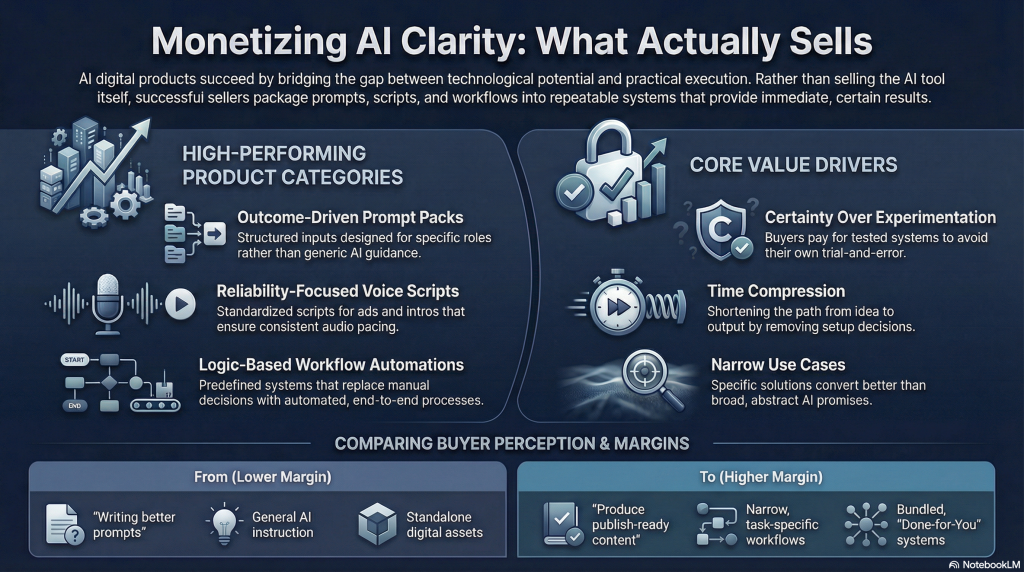
Not all AI-related digital products perform equally. Products that sell consistently share one trait: they turn open-ended tools into specific, repeatable actions. The market favors assets that reduce thinking, setup, and experimentation.
The strongest-performing products fall into three broad categories.
AI Prompt Packs
Prompt packs sell when they are designed around outcomes, not features. A loose collection of prompts rarely performs well. Buyers are looking for structured inputs that guide AI toward predictable results.
Effective prompt packs typically:
- Focus on one task or role, such as writing emails, ads, or long-form content
- Include sequencing, so prompts build on each other instead of standing alone
- Reduce ambiguity by defining tone, format, or constraints clearly
The value of a prompt pack is not the text itself, but the thinking embedded in it. Buyers pay because someone else has already tested, refined, and organized the prompts into a usable system.
Voice Scripts and Training Files
Voice-related AI products sell because they remove friction at the production stage. Generating audio content sounds simple in theory, but in practice it requires consistent scripting, pacing, and tone.
Products in this category perform best when they:
- Provide scripts designed for specific formats, such as ads, intros, or explainers
- Standardize voice style so outputs sound cohesive across multiple uses
- Help users avoid rewriting or re-recording content repeatedly
These products appeal to users who value consistency over creativity. The promise is not originality, but reliability.
Automation and Workflow Systems
Automation-based AI products sell when they replace manual decisions with predefined logic. Instead of asking users to design workflows themselves, these products offer ready-to-use systems that connect inputs to outputs automatically.
High-performing workflow products:
- Solve one repetitive problem rather than automating everything
- Combine prompts with automation steps to create end-to-end processes
- Emphasize clarity and setup simplicity over flexibility
These systems are often positioned as time-saving tools, but their real value lies in removing uncertainty. Buyers know exactly what will happen once the workflow is in place.
Across all three categories, the pattern is consistent. Products that sell well do not ask buyers to “learn AI.” They allow buyers to use AI immediately, within a clearly defined boundary.
Who Buys AI-Based Digital Products (And Why)
Buyers of AI-based digital products are not looking for innovation or novelty. They are looking for predictable output. Across roles and industries, the motivation is consistent: reduce uncertainty, save time, and avoid repeated experimentation.
The strongest demand comes from people who already understand the value of AI but don’t want to spend time configuring it from scratch.
Marketers and Growth Teams
These buyers care about speed and consistency. They need AI outputs that fit specific formats, channels, or campaigns without constant revision. Prompt packs, scripts, and workflows allow them to move from idea to execution with fewer decisions and less rework.
Bloggers, Publishers, and Content Operators
For content-driven businesses, consistency matters more than creativity. These buyers use AI to maintain output volume while preserving structure and tone. Products that standardize writing, research, or publishing workflows appeal because they reduce burnout and keep production steady.
Solopreneurs and Small Operators
Individuals running lean operations value systems over tools. They purchase AI-based products to replace manual processes and avoid building custom setups themselves. The appeal lies in having a working framework that fits into an existing workflow with minimal adjustment.
Across all segments, the buying decision is practical. AI-based digital products succeed when they remove friction from work that already needs to be done. Buyers are not investing in learning AI, they are investing in using it with confidence.

How AI-Based Digital Products Are Packaged and Delivered
AI-based digital products sell best when delivery is simple and predictable. Buyers expect immediate access and minimal friction, especially when the product is designed to save time. Complex delivery systems undermine the very value these products promise.
Most successful sellers package AI-based products as usable assets, not gated experiences. The format depends on how often the product is used and whether it needs updates.
Downloadable Assets
Prompt packs, scripts, and static workflow files are often delivered as downloadable documents or archives. This approach works well for products that don’t require ongoing changes. Buyers can store them locally and integrate them into their existing processes without additional setup.
Access-Based Systems
Some products are delivered through access links rather than direct downloads. This is common for workflow systems, template libraries, or products that evolve over time. Access-based delivery allows updates without requiring buyers to re-purchase or re-download files.
Bundled Systems
Higher-performing products are frequently packaged as bundles rather than single assets. A bundle might include prompts, scripts, instructions, and examples working together as one system. This increases perceived value while reducing confusion about how pieces fit together.
From a seller’s perspective, delivery tools are chosen for reliability and automation. The goal is to remove manual steps, protect access, and ensure a smooth buyer experience. Platforms and tools enable this process, but they remain secondary to the clarity of the product itself.
When delivery works well, it fades into the background. Buyers focus on results, not mechanics and that is exactly the point.
How AI-Based Digital Products Are Positioned for Higher Margins
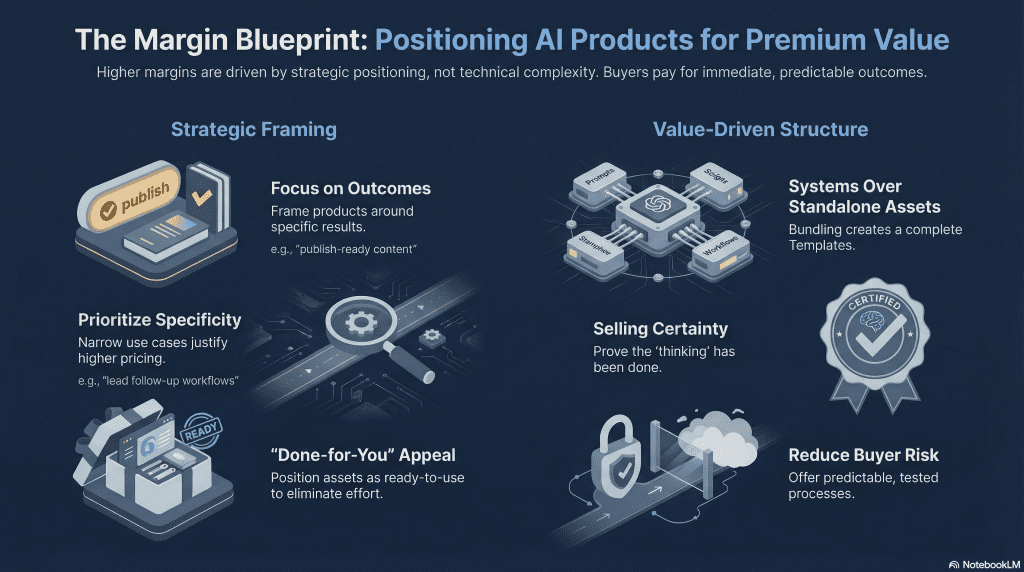
Higher margins in AI-based digital products are driven by positioning, not complexity. Two products can use the same underlying AI tools and still perform very differently depending on how clearly the value is framed. Buyers pay more when the product reduces risk, decision-making, or time investment.
The most effective positioning strategies focus on outcomes rather than features.
Outcome-Based Framing
Products that promise a clear result convert better than those that describe functionality. For example, a prompt pack positioned around “writing better prompts” is less compelling than one positioned around “producing publish-ready content in less time.” Buyers want to know what changes after they use the product.
Narrow Use Cases
Broad AI products tend to feel abstract. Narrow products feel actionable. A workflow designed for one task such as lead follow-ups, content repurposing, or customer responses creates confidence because the buyer immediately understands where it fits. This specificity justifies higher pricing.
Systems Over Single Assets
Bundles and systems consistently outperform standalone files. When prompts, scripts, and workflows are packaged together as a single process, the product feels complete. Buyers are less concerned with price when they perceive they are purchasing a working solution rather than individual components.
“Done-for-You” Positioning
Products framed as ready-to-use reduce perceived effort. Buyers are more willing to pay when they believe implementation will be immediate and predictable. This does not require removing flexibility, only removing setup decisions.
In practice, higher margins come from reducing uncertainty. AI-based digital products sell at a premium when buyers believe the thinking has already been done for them.
Conclusion
AI-based digital products succeed because they solve a practical problem that access to AI alone does not. While tools continue to improve, the difficulty of applying them consistently remains. Prompts, scripts, and systems bridge that gap by turning flexible technology into predictable outcomes.
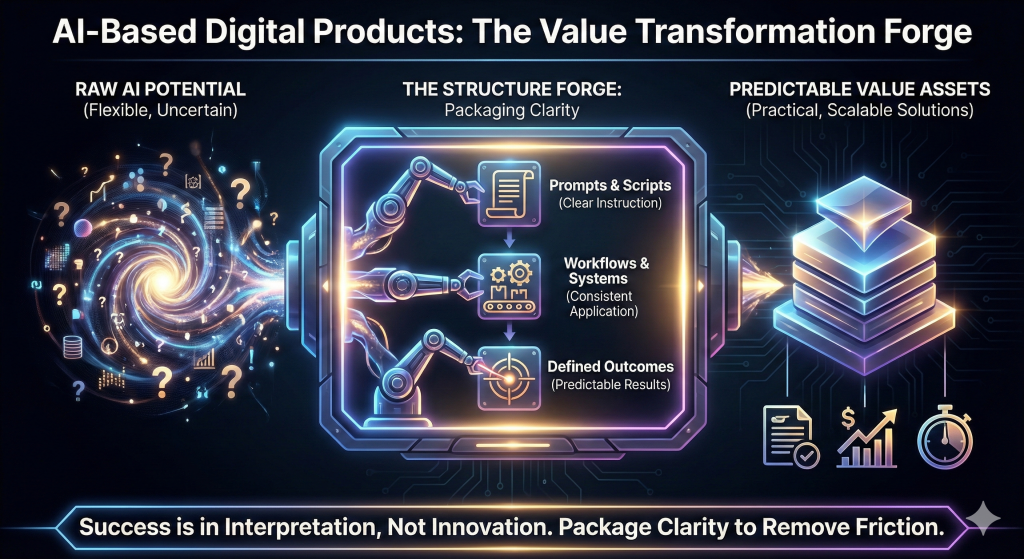
What sells in this category is not innovation, but interpretation. Products that package clear thinking into usable formats allow buyers to move faster with fewer decisions. This is why narrowly defined prompt packs, voice scripts, and workflow systems outperform broad or abstract AI offerings.
For sellers, the opportunity lies in identifying points of friction and removing them through structure. When AI-based digital products are positioned around outcomes and delivered simply, they scale without adding operational complexity. Tools and platforms support this process, but the value is created in how clearly the solution is defined.
AI-based digital products are not about chasing trends. They are about packaging clarity in a market where uncertainty is common and that is why they continue to sell.
Frequently Asked Questions
What qualifies as an AI-based digital product?
AI-based digital products are assets that help people use AI more effectively, not tools that perform AI tasks themselves. These products typically include prompts, scripts, workflows, or systems that guide AI toward specific outcomes.
Do I need technical or AI expertise to sell these products?
No advanced technical skills are required. Most successful AI-based digital products are built from applied experience testing prompts, refining scripts, or organizing workflows rather than from deep technical knowledge of AI systems.
Are AI-based digital products still profitable if AI tools are widely available?
Yes. Availability of tools does not eliminate demand for guidance. As AI becomes more accessible, the value shifts toward clarity, structure, and application, which is what these products provide.
What is the easiest AI-based digital product to start with?
Prompt packs focused on a narrow task are often the simplest starting point. They require minimal setup, are easy to test, and can be refined quickly based on feedback.
How are AI-based digital products typically delivered?
Most are delivered as downloadable files, access-based systems, or bundled assets. The goal is immediate, automated access that allows buyers to use the product without additional setup or manual support.
How do these products fit into a larger digital product strategy?
AI-based digital products often work best as part of a broader system. They can be sold individually, bundled together, or used as entry-level products that lead to higher-value offerings.

0 Comments