Introduction
Survey apps are built around a simple exchange. You share your opinions, and in return, you earn small rewards.
That simplicity is what makes them easy to try.
You can sign up quickly, access surveys from your phone or computer, and start earning without any specific skills. The process feels straightforward and accessible.
But the structure behind it matters.
Most surveys pay very little. You may not qualify for every survey you attempt. And the time required to earn even small amounts can add up quickly.
This does not make survey apps useless. It means their value depends on how you use them.
This guide ranks the 10 best survey apps in 2026 based on usability, consistency, and realistic earning potential. The goal is not to highlight the highest payouts, but to show which apps are actually worth using under real conditions.
- Survey apps are legitimate platforms, but earnings remain low across all options
- You are paid per survey, and disqualifications reduce overall efficiency
- Some apps offer better consistency and smoother experience than others
- Differences between apps are small, but they affect long-term usability
- Survey apps work best as a spare-time activity, not a reliable or scalable income source
Disclaimer: I am an independent Affiliate. The opinions expressed here are my own and are not official statements. If you follow a link and make a purchase, I may earn a commission.
1. Swagbucks
Swagbucks ranks highly because it combines surveys with multiple other earning methods. You are not limited to surveys, which makes the platform more consistent when survey availability drops or disqualifications increase.
The survey experience itself is reliable but not exceptional. There are usually enough opportunities, but disqualifications are frequent and payouts often feel average for the time required. Its main advantage is not better surveys. It is that you can keep earning in other ways when surveys are not worth doing.
The trade-off is focus. Because it offers many features, the platform can feel crowded compared to simpler, survey-only apps.
Best for: users who want flexibility and do not want to rely only on surveys for progress.
What works: multiple earning options help maintain steady progress even when surveys are limited or inefficient.
What doesn’t: survey payouts are inconsistent, and frequent disqualifications reduce overall efficiency.
Verdict: Swagbucks is one of the most usable platforms overall, even if its survey experience alone is not the strongest.

2. InboxDollars
InboxDollars ranks closely with Swagbucks, but with a simpler structure. It focuses more on surveys and offers, and it pays in cash instead of points, which makes earnings feel more direct.
That difference is mostly psychological. The underlying payouts are similar.
The survey experience is comparable to Swagbucks. There are regular opportunities, but disqualifications are common and time-to-reward can feel uneven. Where InboxDollars stands out is its more straightforward layout. It is less cluttered, which can make it easier to focus on surveys without distraction.
The trade-off is flexibility. With fewer earning methods, there are fewer alternatives when surveys are not worth your time.
Best for: users who prefer a simpler, cash-based system without the extra features.
What works: direct cash earnings make progress easier to track, and the platform is easier to navigate.
What doesn’t: fewer earning options reduce flexibility, and survey efficiency is still inconsistent.
Verdict: InboxDollars is a cleaner alternative to Swagbucks, but offers less flexibility when surveys are limited.

3. Survey Junkie
Survey Junkie ranks highly because it focuses almost entirely on surveys. Unlike broader platforms, it removes distractions and keeps the experience centered on one thing.
That focus makes a difference.
The platform is cleaner and easier to navigate than multi-purpose apps. You can log in, see available surveys, and start quickly. There is less friction in the process, which improves usability.
The survey experience is steady but not dramatically better in terms of payouts. Disqualifications still happen, and earnings per survey remain modest. The advantage is consistency and simplicity, not higher pay.
The trade-off is limitation. When surveys are not available or not worth your time, there are no meaningful alternatives within the platform.
Best for: users who want a clean, survey-first experience without extra features.
What works: simple interface, easy access to surveys, and a more focused workflow.
What doesn’t: no alternative earning methods, and survey payouts remain low with frequent disqualifications.
Verdict: Survey Junkie is one of the best pure survey apps, but its value depends entirely on survey availability.

4. Pinecone Research
Pinecone Research ranks higher than most survey apps because it focuses on consistency rather than volume. It offers fewer surveys, but they are more predictable in both structure and payout.
That difference matters.
Surveys are typically consistent in length, pay a fixed amount, and rarely disqualify you after starting. This reduces wasted time, which is one of the biggest issues with survey apps.
The limitation is availability. Surveys are less frequent, and access to the platform is more restricted. You will not have a constant stream of opportunities.
The trade-off is simple. You get a more reliable experience, but far fewer chances to earn.
Best for: users who want predictable surveys with minimal wasted time.
What works: consistent payouts and low disqualification rates make each completed survey more reliable.
What doesn’t: limited availability and restricted access reduce how often you can earn.
Verdict: Pinecone Research is one of the most efficient survey apps per task, but not one you can use frequently.

5. YouGov
YouGov ranks differently from most survey apps because it focuses on longer, opinion-based surveys tied to research and public data. It is less about volume and more about structured participation.
That difference matters.
Surveys are typically more detailed and less frequent. You are not constantly checking for new opportunities. Instead, you receive surveys periodically, and they tend to follow a more consistent format with fewer mid-survey disqualifications.
The experience is more stable, but also slower. Earnings build gradually, and it can take time to reach a payout threshold.
The trade-off is pace. You get a more predictable experience, but much lower activity compared to higher-volume apps.
Best for: users who prefer fewer, more structured surveys without constant checking.
What works: lower disqualification rates and a more consistent survey format improve reliability.
What doesn’t: low survey frequency and slow earning pace make progress gradual.
Verdict: YouGov is one of the more stable survey apps, but it is slow and limited in how much you can earn.

6. Toluna
Toluna ranks as a mid-tier survey app because it combines surveys with a community-based platform. It offers more activity than lower-frequency apps, but with less consistency in survey quality.
That difference matters.
Surveys are available regularly, but the experience can feel uneven. Some surveys are straightforward, while others take longer than expected for the reward. Disqualifications still occur, and the time-to-reward ratio is not always clear upfront.
The platform also includes polls and community interactions, which add activity but do not contribute much to earnings.
The trade-off is consistency. You get more frequent opportunities, but less predictability in value.
Best for: users who want regular survey access and do not mind variability in payouts.
What works: steady survey availability and a more active platform compared to lower-frequency apps.
What doesn’t: inconsistent survey value and extra features that do not meaningfully increase earnings.
Verdict: Toluna offers more activity than many apps, but the uneven payouts make it less efficient overall.

7. LifePoints
LifePoints ranks as a steady but unremarkable survey app. It offers consistent access to surveys, but without a strong advantage in payout or efficiency.
That difference matters.
Surveys are available regularly, which makes the platform easy to use on a consistent basis. However, the experience is similar to many mid-tier apps. Disqualifications occur, and the reward per survey does not stand out relative to the time required.
The platform is simple and easy to navigate, which helps reduce friction. But beyond that, there is little that separates it from competitors.
The trade-off is differentiation. You get reliability in access, but not in value.
Best for: users who want a simple, consistent survey app without extra features.
What works: regular survey availability and a clean, easy-to-use interface.
What doesn’t: average payouts and frequent disqualifications limit overall efficiency.
Verdict: LifePoints is reliable but does not offer a clear advantage over other survey apps.

8. Opinion Outpost
Opinion Outpost ranks as a straightforward survey app with a focus on simplicity. It does not try to add extra features, which makes the experience more direct.
That difference matters.
Surveys are usually easy to access, and the platform is quick to navigate. You can log in, start a survey, and move through tasks without much friction. However, like most survey apps, disqualifications are still common, and payouts remain modest.
The experience is efficient in terms of usability, but not in terms of earnings. You spend less time navigating, but the return per survey is still limited.
The trade-off is depth. You get a clean experience, but no additional ways to improve your earnings.
Best for: users who want a simple, no-friction survey experience.
What works: easy navigation and quick access to surveys reduce wasted time between tasks.
What doesn’t: low payouts and lack of alternative earning methods limit overall value.
Verdict: Opinion Outpost is easy to use, but it does not offer a meaningful advantage in earnings.

9. Branded Surveys
Branded Surveys ranks slightly above average because it focuses on survey volume and consistency. It offers frequent opportunities, which makes it easier to stay active on the platform.
That difference matters.
Surveys are usually available throughout the day, and the platform is structured to keep users engaged. Compared to lower-volume apps, you spend less time waiting for new opportunities. However, the experience still follows the same pattern. Disqualifications happen, and payouts per survey remain modest.
The platform also includes a bonus system tied to activity, which can slightly improve overall earnings if you use it consistently.
The trade-off is efficiency. You get more surveys, but not necessarily better ones.
Best for: users who want consistent access to surveys and are willing to stay active.
What works: high survey availability and bonus incentives help maintain steady progress over time.
What doesn’t: payouts remain average, and disqualifications still reduce overall efficiency.
Verdict: Branded Surveys is one of the more active platforms, but higher volume does not always translate into better value.
10. PrizeRebel
PrizeRebel ranks as a flexible but less structured survey platform. It offers surveys along with offers and small tasks, similar to broader reward apps, but with less polish.
That difference matters.
Survey availability is generally steady, and the platform allows you to stay active. However, the experience can feel inconsistent. Some surveys are reasonable, while others offer low payouts relative to the time required. Disqualifications are also common.
The platform includes multiple earning options, which adds flexibility. But like similar apps, these options do not always improve efficiency.
The trade-off is structure. You get more ways to earn, but a less refined and predictable experience.
Best for: users who want a flexible platform and are comfortable navigating variability.
What works: multiple earning options and steady survey availability provide ongoing activity.
What doesn’t: inconsistent survey quality and a less polished interface reduce overall usability.
Verdict: PrizeRebel is usable and flexible, but less consistent than higher-ranked platforms.
How Much You Can Realistically Earn
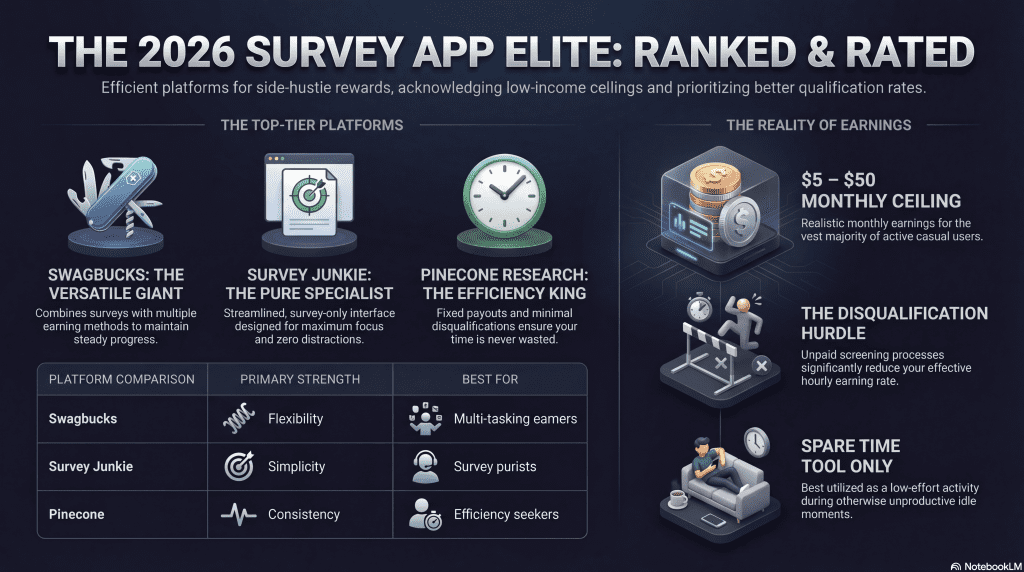
Survey apps have a low earning ceiling, regardless of which platform you use.
Most users earn between $5 and $50 per month.
In many cases:
- Around $5–$20 with casual use
- Higher amounts require more time and consistent activity
What Affects Your Earnings
Your results depend on a few key factors:
- Survey availability: some apps provide more opportunities than others
- Qualification rate: disqualifications reduce your effective earnings
- Time spent: more activity increases total earnings, but not efficiency
Even with these factors, the increase is limited. The structure does not allow for large gains.
What Hourly Earnings Look Like
Survey apps do not pay hourly, but it is useful to think in those terms.
In practice:
- Many surveys pay small amounts
- Time spent qualifying or getting disqualified adds up
This often results in a low effective hourly rate, especially compared to other online work.
The Reality Across All Apps
There are differences between platforms, but they are not large.
- Some apps offer more surveys
- Some reduce wasted time slightly
- Some are easier to use
But none of them change the core model.
You are completing small tasks for small rewards.
The Right Expectation
Survey apps are best understood as:
- A way to earn small amounts in spare time
- A system with limited upside
- A low-effort, low-return activity
If you expect meaningful income, the results will feel disappointing. If you expect small, incremental rewards, they become easier to evaluate.
How to Choose the Right Survey App
The differences between survey apps are small, but choosing the right one can improve your overall experience.
The goal is not to find the highest-paying app. It is to reduce wasted time and make the process more consistent.
Focus on Survey Availability
Some apps offer more frequent surveys than others.
This matters because:
- More availability means less waiting
- You spend less time checking for new opportunities
If an app has limited surveys, it becomes harder to use consistently.
Pay Attention to Disqualification Rates
Disqualifications are one of the biggest inefficiencies.
Some platforms:
- Screen users earlier
- Reduce time spent on surveys you will not qualify for
Others allow you to start and then disqualify you later, which wastes more time.
Evaluate Time vs Reward
Not all surveys are worth completing.
You should consider:
- Estimated time
- Reward amount
Over time, this helps you avoid low-value surveys and improve efficiency.
Consider Platform Simplicity
A simpler platform reduces friction.
This includes:
- Clear survey listings
- Easy navigation
- Faster access to tasks
Complex platforms can slow you down, even if they offer more features.
Decide Between Variety vs Focus
Some apps offer:
- Surveys only (cleaner experience)
Others offer:
- Surveys plus offers, cashback, and tasks
The choice depends on preference.
- If you want simplicity, choose focused apps
- If you want flexibility, choose broader platforms
The Practical Approach
Most users benefit from using 2 to 3 apps, not just one.
This helps:
- Increase survey availability
- Reduce downtime
- Balance strengths and weaknesses
Using too many apps adds complexity without improving results.
Are Survey Apps Worth It?
Survey apps can be worth it, but only within clear limits.
The value depends less on the app you choose and more on how you use it.
When They Are Worth It
Survey apps make sense when:
- You are using spare time that would otherwise go unused
- You are not relying on the income
- You are comfortable with small, slow earnings
In this context, they provide a simple way to turn idle time into small rewards.
When They Are Not Worth It
They become inefficient when:
- You are trying to earn meaningful income
- You are spending large amounts of time on them
- You expect consistent or predictable results
In these cases, the return does not justify the time.
The Trade-Off
The core trade-off is simple:
- Easy to start → no skills or experience required
- Low earning potential → rewards remain small
You gain accessibility, but you give up earning power.
The Real Answer
Survey apps are not a strong way to make money.
They are a tool for small, occasional earnings.
If you use them with that understanding, they can be useful. If you expect more, they will feel like a poor use of time.

Conclusion
Survey apps are simple to understand once you see how they work in practice.
You complete surveys, earn small rewards, and repeat the process. Over time, those rewards build slowly, but they remain limited.
The differences between apps matter, but only to a point. Some offer more surveys, some reduce wasted time, and some are easier to use. None of them change the core structure.
That is what defines the experience.
Survey apps are not designed to generate meaningful income. They are designed to collect opinions at scale while paying users small amounts for participation.
If you use them occasionally and with low expectations, they can be useful. If you try to rely on them or maximize them beyond their limits, they become inefficient.
So the question is not which app pays the most.
It is whether this type of system fits how you want to use your time.
Frequently Asked Questions
What are survey apps?
Survey apps are platforms that pay users small rewards for completing surveys, usually based on opinions, habits, or consumer behavior.
How do survey apps work?
You receive survey invitations, attempt to qualify, complete the survey if eligible, and earn a reward once it is finished.
How much can you earn from survey apps?
Most users earn between $5 and $50 per month, depending on time spent, survey availability, and qualification rates.
Why do survey apps disqualify you?
Surveys are targeted to specific user profiles. If you do not match the required criteria, you are screened out before completing the survey.
What are the best survey apps?
Some of the most commonly used include:
- Swagbucks
- InboxDollars
- Survey Junkie
- Pinecone Research
The differences between them are in usability and consistency, not large earning potential.
Are survey apps legit?
Yes. Most major survey apps are legitimate and pay real rewards, but the earnings are small.
Can you use survey apps as a full-time income?
No. Survey apps are not designed to provide stable or scalable income. They work as a small, spare-time activity.
How can you earn more with survey apps?
You can improve results by:
- Using multiple apps
- Choosing higher-value surveys
- Staying consistent
However, the overall earning potential remains limited.
Are survey apps worth it?
They can be worth it for small, occasional earnings. They are not a reliable way to make money.

0 Comments