Introduction
A lot of marketing activity looks productive on the surface.
There are campaigns running, traffic coming in, and metrics moving. But that does not always translate into something concrete.
Direct response marketing focuses on a different standard.
Instead of measuring activity, it looks at whether a specific action happens, something that can be clearly measured and tied back to the campaign.
In this guide, we’ll break down what direct response marketing is, how it works, what makes it different from other approaches, and what affects whether it produces results.
- Direct response marketing focuses on measurable action, not just visibility or engagement
- Effectiveness depends on alignment between outcome, offer, message, and action
- A clear and relevant offer has the biggest impact on whether people respond
- Strong campaigns make the next step obvious and easy, reducing friction
- Results come from clarity and alignment, not from adding more complexity
- Performance can be measured directly, making improvement possible over time
- Most failures come from unclear direction or poor audience fit, not design or reach
Disclaimer: I am an independent Affiliate. The opinions expressed here are my own and are not official statements. If you follow a link and make a purchase, I may earn a commission.

What Direct Response Marketing Actually Is
Direct response marketing is a type of marketing focused on getting a specific action from the audience.
That action can be a purchase, a signup, a click, or any step that can be directly tied to the message.
What defines it is not the channel or the format, but the expectation of a response. The message is created with the intention that the person seeing it will do something next.
Instead of measuring success by how many people saw a campaign or interacted with it, direct response marketing looks at whether people acted on it in a clear and measurable way.
Because of that, it is built around outcomes. The message, the offer, and the call to action are all shaped with the same goal: to make the next step obvious and easy to take.

How Direct Response Marketing Works
Direct response marketing works by linking a marketing message to a clearly defined result.
Before the campaign is written or launched, the desired result is already known. The campaign is built to produce that result, whether that means generating a sale, capturing a lead, getting a click, or prompting another measurable step.
From there, the communication is shaped around one job: moving the audience toward that response.
The message introduces the opportunity. The offer gives the audience a reason to care. The next step is presented in a way that is easy to understand and easy to take. Nothing in the campaign is there by accident. Each part supports the same outcome.
This is what makes the process more direct than many other forms of marketing.
The campaign is not judged mainly by how much attention it gets or how visible it becomes. It is judged by whether it produces the response it was built to generate.
That also makes it easier to evaluate.
Because the intended result is defined in advance, the campaign can be measured against it. You can see whether people responded, how often they responded, and whether the campaign is performing well enough to keep, improve, or replace.
In practical terms, direct response marketing works by narrowing the gap between communication and outcome. The message is not simply meant to inform or persuade in a broad sense. It is meant to lead to a specific action that can be observed and measured.
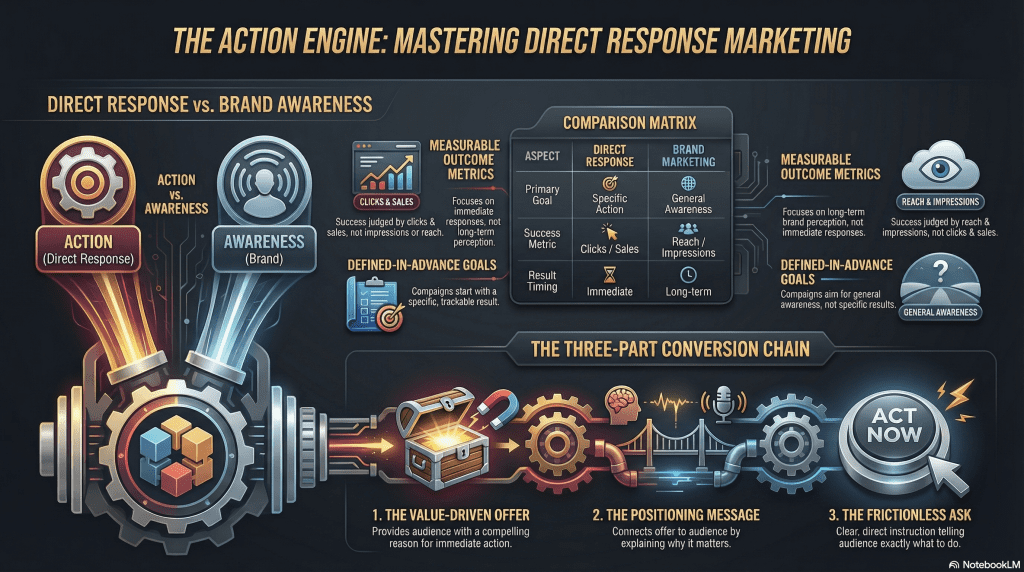
What Makes It Different From Other Types of Marketing
Direct response marketing is different because it is built around a defined outcome, not general exposure.
Most marketing aims to increase visibility, build recognition, or influence how a brand is perceived over time. The results are often indirect and harder to connect to a single action.
Direct response marketing takes a more direct approach.
The campaign is created with a specific result in mind, and that result is used to judge whether it worked. The focus is not on how many people saw the message, but on how many people acted on it.
Direct Response vs Brand / Awareness Marketing
| Aspect | Direct Response Marketing | Brand / Awareness Marketing |
|---|---|---|
| Primary Goal | Generate a specific action | Build awareness or perception |
| Focus | Immediate response | Long-term influence |
| Success Metric | Measurable actions (clicks, signups, sales) | Reach, impressions, engagement |
| Timing of Results | Immediate or short-term | Gradual and long-term |
| Message Style | Clear, direct, action-oriented | Broader, often narrative-driven |
| Evaluation | Based on response rate and outcomes | Based on visibility and brand lift |
The Outcome Is Defined in Advance
In many types of marketing, success is evaluated after the campaign runs.
In direct response marketing, the expected result is set from the beginning.
This creates a clearer standard. The campaign either produces the intended response, or it does not.
Performance Is Measurable
Because the outcome is specific, it can be tracked.
You can measure:
- how many people responded
- what actions they took
- how effective the campaign was
This makes it easier to evaluate performance and improve over time.
The Message Is Built to Lead Somewhere
In broader marketing, a message may aim to inform, entertain, or create interest.
In direct response marketing, the message has a clear direction.
It is written to lead the audience toward a next step, not just to communicate an idea.
The Focus Is on Action, Not Exposure
Exposure can still happen, but it is not the goal.
The goal is action.
A campaign that reaches many people but produces little response is not considered effective. A campaign that reaches fewer people but generates consistent action is.
The Core Difference
Direct response marketing is not defined by where it appears or how it looks.
It is defined by what it is expected to produce.
That expectation changes how campaigns are created, how they are measured, and how their success is judged.

The Role of the Offer, the Message, and the Ask
Direct response marketing depends on how well three parts work together:
- the offer
- the message
- and the ask
These are not separate pieces. They form a single chain. If one is weak or unclear, the entire campaign is affected.
The Offer Gives People a Reason to Care
The offer is what the audience receives in exchange for taking action.
It answers a simple question:
why should someone do this?
This could be:
- a product
- a discount
- a resource
- or access to something
If the offer does not feel useful or relevant, the campaign struggles regardless of how well it is presented.
The Message Explains and Positions the Offer
The message connects the offer to the audience.
It explains:
- what the offer is
- why it matters
- and who it is for
The goal is not to say everything. It is to make the offer easy to understand and easy to consider.
If the message is unclear or too broad, people lose interest before reaching the next step.
The Ask Tells People What to Do Next
The ask is the step the audience is expected to take.
It could be:
- “sign up”
- “buy now”
- “get access”
This needs to be clear and direct.
If people do not know what to do next or if the step feels unclear or complicated—they are less likely to act.
These Three Parts Work Together
A strong campaign aligns all three:
- the offer gives value
- the message explains that value
- the ask turns it into action
If one part is missing or weak, the path breaks.
For example:
- a strong offer with a weak message may be ignored
- a clear message with a weak offer may not motivate action
- a strong offer and message with an unclear ask may create hesitation
The Core Idea
Direct response marketing works best when the offer, the message, and the ask are aligned.
When they are, the decision becomes easier.
When they are not, the campaign may get attention but fail to produce results.
Why the Offer Often Determines the Outcome
In direct response marketing, the offer carries more weight than most people expect.
It is often the deciding factor between a campaign that produces results and one that gets ignored.
The Offer Sets the Value of the Action
Every response requires a trade.
The audience is being asked to:
- give attention
- share information
- or spend money
The offer determines whether that exchange feels worth it.
If the value is not clear or not compelling, people have no reason to act.
A Strong Offer Can Carry a Campaign
When the offer is clear and relevant, the rest of the campaign becomes easier.
The message does not need to over-explain.
The decision feels more straightforward.
In some cases, a strong offer can still perform well even if other parts of the campaign are average.
A Weak Offer Is Hard to Fix
If the offer is vague, generic, or not aligned with the audience, the campaign struggles.
Even with:
- strong copy
- good design
- or high visibility
people may still choose not to act.
This is because the issue is not how the offer is presented, it is the offer itself.
Relevance Matters More Than Size
A strong offer is not always the biggest or most impressive one.
It is the one that fits the audience and the situation.
An offer that solves a specific problem or matches a clear need will often perform better than something broader or less targeted.
The Core Idea
In direct response marketing, the offer is not just one part of the campaign.
It is the foundation.
When the offer is clear and relevant, the rest of the campaign has a stronger chance of working.
When it is not, the campaign becomes much harder to make effective.

Why Some Campaigns Get a Response and Others Don’t
Two campaigns can look similar on the surface and produce very different results.
The difference usually comes down to alignment how well the campaign fits the audience, the situation, and the action it is asking for.
The Audience Has to Be the Right Fit
A campaign can be clear and well-written, but still fail if it reaches the wrong people.
If the audience:
- is not interested
- does not need the offer
- or is not ready to act
then response will be low.
Direct response marketing works best when the message reaches people who already have some level of interest or intent.
The Message Has to Be Easy to Understand
If people have to stop and figure out what is being offered, many will not continue.
The message should make it clear:
- what is being offered
- why it matters
- and what to do next
Confusion slows decisions, and slower decisions lead to fewer responses.
The Timing Has to Make Sense
Even a strong campaign can underperform if the timing is off.
If the audience is:
- not actively looking
- not ready to decide
- or not in the right context
they are less likely to act.
When timing aligns with intent, response improves.
Trust Affects the Decision
People are more likely to act when they feel confident about what they are seeing.
If something feels unclear, exaggerated, or unfamiliar, hesitation increases.
Clarity and consistency help reduce that hesitation.
Friction Can Reduce Response
Even small obstacles can lower results.
This includes:
- too many steps
- unclear instructions
- or unnecessary effort
The easier it is to act, the more likely people are to follow through.
The Core Pattern
Campaigns tend to work when:
- the right audience sees them
- the message is clear
- the offer makes sense
- and the action is easy to take
When one or more of these are missing, the campaign may get attention but fail to produce a response.

How Direct Response Marketing Shows Up in the Real World
Direct response marketing is not tied to a single format.
It appears in different places, but the underlying idea stays the same: a message is presented with the expectation that the audience will take a specific action.
It Often Appears as a Clear Next Step
In many cases, direct response marketing shows up where a decision is expected.
For example:
- a page asking for a signup
- an email prompting a click
- an ad leading to a specific action
The common pattern is not the format, but the intent behind it.
There is always a defined next step.
The Same Approach Across Different Channels
Even though the formats change, the structure remains consistent.
You can see it in:
- email campaigns
- paid advertisements
- landing pages
- direct mail
- SMS messages
Each one presents:
- a message
- an offer
- and a clear action
The channel changes, but the logic does not.
It Is Often Part of a Larger Flow
Direct response marketing is rarely isolated.
It usually connects to something else.
For example:
- an ad leads to a page
- a signup leads to a series of emails
- an email leads to a purchase
Each step is designed to move the person forward.
The response is not always the final step. Sometimes it is the beginning of a longer sequence.
It Can Look Different, But Behave the Same
Two campaigns can look completely different and still follow the same structure.
One might be:
- a short message with a simple offer
Another might be:
- a longer page with more explanation
But both are built to guide the audience toward a specific action.
The difference is in presentation, not in how they work.
The Core Pattern
Direct response marketing shows up anywhere a message is connected to a clear, measurable action.
The format can change. The structure stays consistent.
That is why it can be applied across different channels without changing its core approach.
How to Create a Direct Response Campaign
Creating a direct response campaign starts with clarity.
Not in the design or the copy but in what the campaign is meant to produce.
Define the Outcome First
Before anything else, decide what action the campaign should generate.
This needs to be specific.
It could be:
- a purchase
- a signup
- a request
This step sets the direction. Without it, the campaign becomes unfocused.
Identify the Audience
The campaign needs to match the people it is reaching.
This includes:
- what they are interested in
- what they need
- and how ready they are to act
A campaign that does not align with the audience will struggle, even if everything else is well executed.
Shape the Offer
The offer gives the campaign its value.
It should be:
- clear
- relevant
- and connected to the audience
This is what makes the action worth taking.
Build the Message Around the Offer
The message explains and positions the offer.
It should:
- make the offer easy to understand
- show why it matters
- and lead naturally to the next step
The goal is clarity, not complexity.
Make the Next Step Clear
The action should be obvious.
The audience should know:
- what to do
- and what happens when they do it
If this is unclear, response drops.
Deliver the Campaign Through the Right Channel
The channel affects how the message is received.
It should match:
- where the audience is
- and how they prefer to engage
The same campaign can perform differently depending on where it appears.
Measure and Adjust
Once the campaign is live, the response needs to be tracked.
This shows:
- what is working
- what is not
- and where improvements can be made
Adjustments are usually made to:
- the message
- the offer
- or the process
Over time, this improves performance.
The Core Process
A direct response campaign is built step by step:
- define the outcome
- align with the audience
- create a relevant offer
- communicate it clearly
- make the action easy
- measure the result
Each step supports the same goal: generating a clear and measurable response.

Best Practices That Improve Results
Direct response marketing does not improve by adding more.
It improves by making what is already there clearer, more relevant, and easier to act on.
Keep the Outcome Clear
Every campaign should stay focused on one defined result.
If multiple actions are introduced, the path becomes less clear and response tends to drop.
Clarity at this level makes the rest of the campaign easier to build.
Make the Offer Specific
General offers are easy to ignore.
A more specific offer helps people understand:
- what they are getting
- and why it matters
The clearer the value, the easier the decision.
Match the Message to the Audience
The message should reflect what the audience already cares about.
If the message feels disconnected from their situation, it becomes harder to engage with.
Alignment improves both understanding and response.
Reduce Unnecessary Friction
Small obstacles can lower performance.
This includes:
- too many steps
- unclear instructions
- or asking for more information than needed
Simplifying the process makes it easier to follow through.
Make the Next Step Obvious
People should not have to figure out what to do.
The action should be clear, visible, and easy to take.
When the next step is obvious, more people complete it.
Focus on Clarity Over Style
Well-designed campaigns can still underperform if the message is unclear.
Clarity tends to have a greater impact than presentation.
The goal is to make the message easy to understand, not just visually appealing.
Use Results to Improve the Campaign
Direct response marketing allows for clear feedback.
The results show:
- what is working
- what needs adjustment
Small changes, based on actual response, can improve performance over time.
The Core Idea
Better results usually come from improving clarity, alignment, and ease of action not from adding complexity.
When those are in place, the campaign becomes more effective without becoming more complicated.

Common Mistakes That Hurt Performance
Direct response marketing can look simple, but small issues can significantly reduce results.
Most of these problems are not obvious at first. They come from how the campaign is structured and how well it aligns with the audience.
Starting Without a Clear Outcome
If the campaign does not have a defined action, everything else becomes unclear.
The message may exist, the offer may be present, but without a clear outcome, there is no direction.
This often leads to activity without results.
Using a Weak or Unclear Offer
If the offer does not feel useful or relevant, people have no reason to act.
This can happen when the offer is:
- too general
- poorly explained
- or not connected to the audience
No amount of improvement in design or messaging can fully compensate for this.
Trying to Do Too Much at Once
When a campaign asks for multiple actions, it divides attention.
For example:
- sign up
- explore
- learn more
- browse
The more options there are, the less likely people are to take any one of them.
Overcomplicating the Message
If the message takes too long to understand, people lose interest.
This often happens when:
- too much information is included
- the main point is not clear
- or the structure is difficult to follow
Clarity is more important than detail.
Ignoring Audience Fit
Even a well-built campaign can fail if it reaches the wrong audience.
If people do not see the offer as relevant to them, they will not respond.
This is not a messaging problem, it is a mismatch.
Making the Next Step Unclear or Difficult
If people do not know what to do next, or if the process feels complicated, response drops.
This includes:
- unclear calls to action
- too many steps
- or unnecessary friction
The easier it is to act, the more likely people are to do it.
Focusing on Appearance Over Outcome
A campaign can look polished and still underperform.
Design and presentation matter, but they do not replace:
- a clear offer
- a relevant message
- and an easy path to action
When appearance becomes the focus, performance often suffers.
The Core Pattern
Most mistakes come from a lack of alignment.
When the outcome is unclear, the offer is weak, or the message does not fit the audience, the campaign struggles.
When these are aligned, results tend to improve.
Final Thoughts
Direct response marketing is straightforward in concept, but it depends on how well everything is aligned.
The structure itself is not complex. A campaign presents something, asks for an action, and measures what happens next.
What makes the difference is how clearly that is done.
If the outcome is well defined, the offer makes sense, and the path to action is easy to follow, the campaign has a stronger chance of working. If any of those are unclear, performance drops, even if the campaign looks well put together.
This is why direct response marketing often feels simple on the surface but requires careful execution.
It is not about adding more elements or making things more elaborate. It is about making each part clear, relevant, and connected to the same goal.
When that alignment is in place, results become easier to understand and easier to improve over time.

Frequently Asked Questions
What is direct response marketing?
Direct response marketing is a type of marketing focused on getting a specific, measurable action from the audience, such as a purchase, signup, or click.
Is direct response marketing only used online?
No. It can be used both online and offline. It appears in digital channels like email and ads, as well as in formats like direct mail, print, and television.
How is it different from traditional marketing?
The main difference is the focus on action. Direct response marketing is designed to produce a clear outcome, while other types of marketing often focus on awareness or long-term perception.
What kind of actions does it aim to generate?
It depends on the campaign, but common actions include:
- making a purchase
- signing up
- clicking a link
- requesting information
Can direct response marketing work for any business?
It can be applied in many contexts, but it works best when there is a clear action to take and a defined audience to target.
How do you measure success in direct response marketing?
Success is measured by the number of people who take the intended action, such as conversions, signups, or sales.
Is it the same as sales-focused marketing?
Not exactly. While it often supports sales, it can also be used for lead generation, engagement, or moving people to the next step in a process.

0 Comments