Most businesses don’t actually have a lead problem. They have a trust problem. A relevance problem. A strategy problem.
They chase cold audiences, blast generic emails, and burn budget on ads that get clicks but zero customers. Then they wonder why their calendar is empty.
Meanwhile, the businesses that grow consistently in 2025? They aren’t louder, they’re clearer. They don’t buy attention; they earn it. They use systems that attract the right people, at the right time, with a message that makes the sale feel like the next logical step, not a pitch.
The Shift Nobody Talks About For years, the “hustle” worked. You could cold DM enough people or spend enough on ads to force growth. That era is over. I’ve seen the data shift firsthand: In 2025, privacy laws are tighter, ad costs are higher, and skepticism is at an all-time high. The “spray and pray” method isn’t just inefficient anymore, it’s dangerous to your brand.
This guide breaks down the lead generation strategies that actually work right now, the ones helping businesses build predictable growth instead of chasing trends.
If you want to understand how real lead systems are built (and stop relying on luck), you’re in the right place.
Key Takeaways
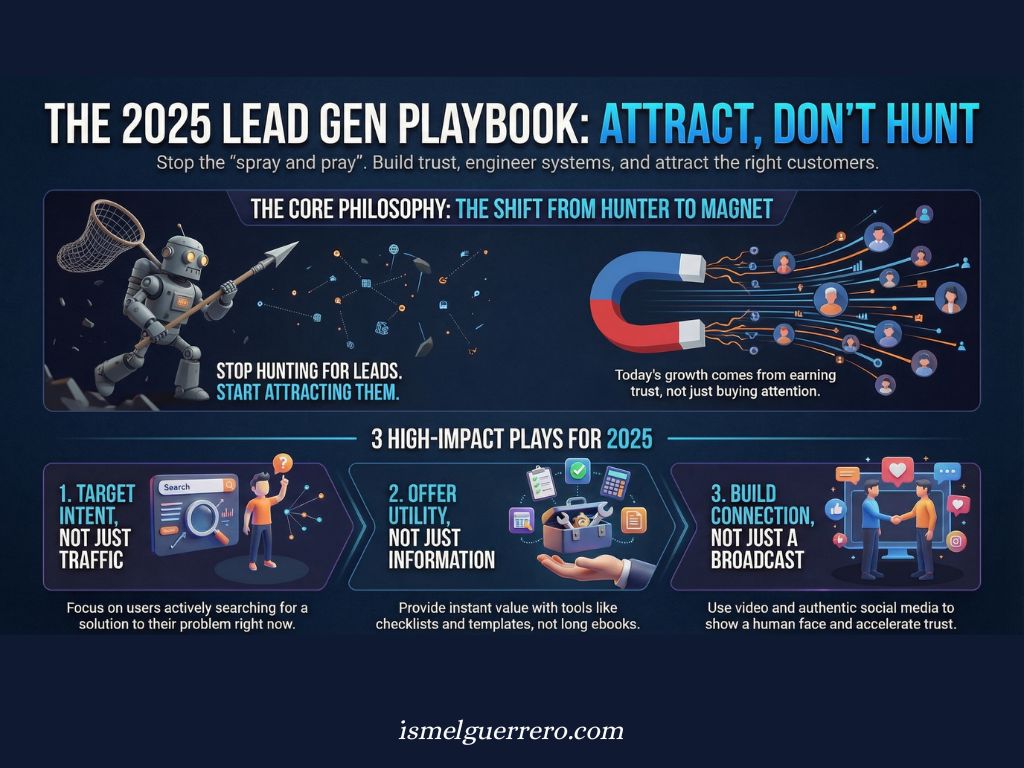
The 2025 Playbook
- Strategy Beats Hustle: A well-structured funnel beats random outreach every time. You don’t need more leads; you need better mechanisms to capture them.
- The “Trust First” Rule: In a world of AI spam, the business that builds human connection fastest wins.
- Systems vs. Tactics: Tactics (like running a Facebook ad) expire. Systems (like an automated nurture sequence) compound over time.
- Integration is King: The best results come when SEO, content, and email work together as a single engine, not separate silos.
Disclaimer: I am an independent Affiliate. The opinions expressed here are my own and are not official statements. If you follow a link and make a purchase, I may earn a commission.
Lead Generation Strategies Overview (The 2025 Context)
Lead generation is more than just a marketing tactic; it is the engine behind consistent business stability.
Without a clear system, most businesses end up in “survival mode” relying on luck, referrals, or random viral posts to get customers. When you build a proper strategy, you move from hunting for clients to attracting them.
In 2025, the game has changed. The strategies that worked five years ago (mass outreach, generic eBooks) are seeing diminishing returns. To win today, you need to understand the shift from “Quantity” to “Quality.”
The Evolution of Lead Generation
Here is how the smartest companies are pivoting their strategies right now.
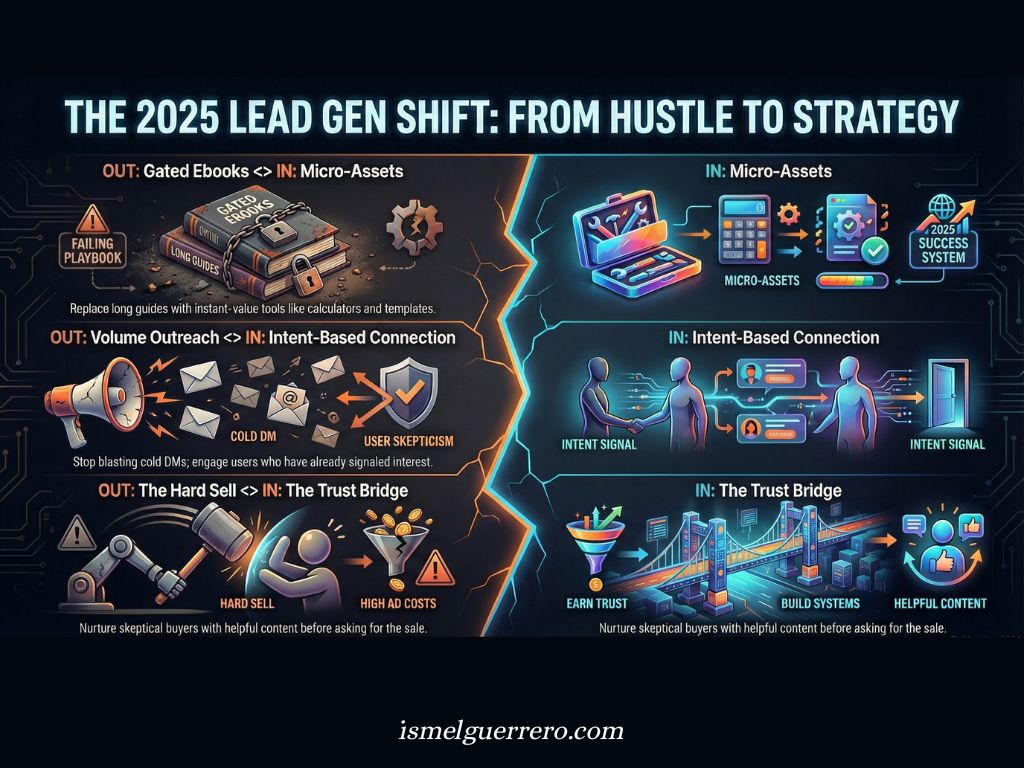
| The Old Way (Outdated) | The New Way (2025) | Why the Shift? |
|---|---|---|
| Gated Ebooks: Asking for an email to read a generic 50-page PDF. | Ungated Value & Micro-Assets: Giving away tools, templates, or calculators that offer instant results. | People are tired of clutter. They value utility and speed over “information.” |
| Volume Outreach: Blasting 100 cold DMs or emails a day. | Intent-Based Connection: engaging only with people who have signaled interest (e.g., visited pricing page). | Privacy laws and spam filters block mass outreach. Relevance is the only way through. |
| The “Hard Sell”: Pushing for a demo/call immediately. | The “Trust Bridge”: Nurturing leads with educational content before asking for the sale. | Buyers are skeptical. They research on their own before talking to sales. |
The Core Philosophy: Systems Over Luck
Every strategy we are about to cover relies on one principle: Integration.
You don’t need SEO or Ads or Email. You need them to talk to each other.
SEO captures the intent.
Content builds the trust.
Automation closes the gap.
Top Lead Generation Strategies for 2025
These are the strategies driving real growth right now. They work because they combine timeless marketing principles with modern tools and buyer behavior.
You don’t need to do all of them. You just need to execute the right ones for your specific business model.
1. Search Engine Optimization (SEO): Intent Over Volume
Most people get SEO wrong because they chase “Traffic.” Traffic doesn’t pay the bills; Intent does. In 2025, a visitor searching for “how to fix a leaky pipe” is worth 100x more than someone searching for “history of plumbing.”
The 2025 Playbook:
- Target “Commercial Intent” Keywords: Stop writing generic blog posts. Focus on keywords that signal a desire to buy or solve a problem immediately (e.g., “Best CRM for real estate agents” vs. “What is a CRM”).
- Build “Content Clusters”: Don’t write one lonely article. Create a “Pillar Page” covering a broad topic, then link out to 5-10 supporting articles. Google rewards topical authority, not random posting.
- Optimize for the “Zero-Click”: Google’s AI often answers the question directly on the search page. Structure your content to win the “Featured Snippet” so you capture the click before the user scrolls.
Pro Insight: Organic search traffic converts 4–6x higher than paid traffic because the user sought you out. It is the highest quality lead you can get.
2. Paid Advertising: The “Offer” Ecosystem
Paid ads are the fastest way to get data, but they are also the fastest way to lose money if your funnel is broken. Most businesses don’t have an ad problem; they have an offer problem. A great ad driving traffic to a boring “Contact Us” page will fail 100% of the time.
The 2025 Playbook:
- Google Ads for “Capture”: Use Google Search ads for high-intent queries where people are actively looking for a solution right now.
- Meta/TikTok for “Discovery”: Use social ads to interrupt people with a “Pattern Interrupt” creative. You aren’t selling the product here; you are selling the click to your lead magnet.
- The “Bridge Page” Rule: Never send cold traffic to your homepage. Send them to a dedicated landing page that matches the exact promise made in the ad.
3. Social Media: Connection, Not Broadcast
Social media is no longer just a megaphone; it is a two-way funnel. The algorithm now rewards engagement (comments/DMs) more than passive views. If you are just posting links to your blog, you are invisible.
The 2025 Playbook:
Short-Form Video (Reels/Shorts): Use video to overcome skepticism. People buy from faces they recognize. A 60-second video answering a common customer objection builds more trust than a 1,000-word article.
The “Hand-Raiser” Post: Instead of linking to a lead magnet, write a post about the problem and ask people to comment a specific word (e.g., “Comment ‘SYSTEM’ and I’ll send you the guide”). This boosts reach and starts a conversation.
LinkedIn for B2B Authority: Stop pitching in DMs. Post insights that solve specific industry problems. When people comment, view their profile that is your lead list.
4. Lead Magnets: The “Micro-Asset” Strategy
The days of the 50-page “Ultimate Guide” are over. In 2025, attention spans are short. If your lead magnet feels like homework, nobody will download it. The best lead magnets today are Micro-Assets: tools that solve a specific problem in under 5 minutes.
The 2025 Playbook:
- Utility Over Information: Don’t give them a book to read; give them a tool to use. Think: Calculators, Notion Templates, Swipe Files, or 1-Page Checklists.
- The “Specific Pain” Rule: A lead magnet titled “How to Lose Weight” will fail. A lead magnet titled “The 5-Minute Breakfast Plan for Busy Dads” will convert. Specificity sells.
- Instant Gratification: The user should be able to consume the value immediately after entering their email. If they have to wait until the weekend to read it, you’ve already lost them.
5. Email Marketing Automation: The “Silent Salesman”
Most businesses treat email like a megaphone blasting the same newsletter to everyone. That is a fast way to the spam folder. Modern email marketing is about behavior. It’s not about sending emails when you want to talk; it’s about sending emails when they are ready to listen.
The 2025 Playbook:
- The “Welcome” Bridge: Your first 3 emails are critical. Don’t just deliver the lead magnet. Use a “Soap Opera Sequence” to introduce your brand, tell your story, and bridge the gap between their problem and your paid solution.
- Behavioral Segmentation: Stop treating all leads the same. If someone clicks a link about “SEO Services,” tag them as interested in SEO and send them relevant case studies. If they click “Pricing,” send them a demo offer.
- The “9-Word” Revival: Every few months, send a text-only email to cold leads asking a simple question: “Are you still looking for help with [Problem]?” It’s conversational, personal, and gets massive response rates.
6. Retargeting Campaigns: The “Omnipresence” Effect
Here is a brutal truth: 96% of visitors will leave your site without taking action. If you don’t have a plan to get them back, you are wasting your ad budget. Retargeting isn’t just about “reminding” them; it’s about overcoming their specific objections.
The 2025 Playbook:
- Platform Mirroring: If they found you on Google, retarget them on Instagram. Seeing your brand across multiple platforms creates the “Omnipresence Effect” making you look like the market leader, even if you’re a small team.
- The “Testimonial” Retarget: Don’t just show the product again. Show a video testimonial of a happy customer. They already know what you sell; now they need to believe it works.
- Frequency Caps are Mandatory: There is a fine line between “top of mind” and “stalker.” Cap your ads so users don’t see them more than 3-5 times a day. Annoyance kills brands.
Data Point: According to Wordstream, retargeted visitors are 70% more likely to convert than first-time visitors. It is often the highest ROI spend in your entire marketing budget.
7. Video Marketing: The “Trust Accelerator”
Text persuades, but video bonds. In a world of AI-generated text, seeing a human face is the ultimate trust signal. But don’t confuse “Video Marketing” with trying to go viral. You don’t need a million views; you need the right views from the right prospects.
The 2025 Playbook:
- The “VSL” (Video Sales Letter): Place a 90-second video at the top of your landing page. Walk through the problem, the solution, and the proof. Data shows pages with video convert 80% higher.
- Vertical Video as a Funnel: Use TikTok/Reels/Shorts for top-of-funnel reach, but always pin a comment with a specific Call to Action (e.g., “Check the link in bio for the free template”). Don’t leave them on the platform.
- The “Objection Killer”: Record short Loom videos answering the top 5 reasons people don’t buy from you. Send these via email to leads who are stuck in your pipeline. It works because it feels personal, not automated.
8. AI & Automation: Speed to Lead
The era of “I’ll get back to you in 24 hours” is dead. If you don’t respond to a lead within 5 minutes, your odds of closing them drop by 80%. You cannot scale human hustle. You must use automation to bridge the gap between “Lead Captured” and “Conversation Started.”
The 2025 Playbook:
- The “Qualifier” Bot: Don’t use chatbots just to say “Hi.” Use them to qualify. Ask 3 questions (e.g., Budget, Timeline, Needs) before letting them book a call. This protects your sales team from bad leads.
- Instant SMS Acknowledgment: Email open rates are 20%; SMS open rates are 98%. As soon as a lead comes in, trigger an automated SMS: “Hey [Name], just got your request. Sending the info to your email now. Quick question?”
- Lead Scoring: Stop calling every lead. Use AI to score them based on activity (Did they visit the pricing page? Did they open 3 emails?). Only spend human time on “Hot” leads.
9. Landing Page Optimization: The “One Job” Rule
Your landing page has one job: To get the conversion. It is not a brochure. It is not a homepage. It is a digital salesperson that never sleeps. Most landing pages fail because they are “leaky”, they give the user too many options.
The 2025 Playbook:
- The 1:1 Ratio: Every landing page should have a 1:1 Conversion Ratio. That means there is only one clickable link on the page: The CTA button. Remove the navigation bar, the social icons, and the footer links. Trap the focus.
- The “Above the Fold” Test: A user should know exactly what you offer, who it’s for, and what to do next without scrolling a single pixel. If they have to scroll to find the “Submit” button, you are losing money.
- Social Proof Proximity: Place your best testimonial or “Trusted By” logos directly underneath the Call to Action button. This reduces anxiety exactly at the moment of decision.
Pro Insight: Don’t guess what works, test it. Changing a headline from “Sign Up” to “Get My Free Plan” can increase conversions by 30%. In 2025, A/B testing isn’t advanced; it’s mandatory.
Best Lead Generation Strategies by Industry (The “Core Trio”)
There is no “universal” lead generation strategy. A $50 eCommerce product requires a completely different funnel than a $10,000 consulting package.
The secret to winning isn’t trying to do everything; it’s finding your “Core Trio”, the three strategies that lock together to form a complete system for your specific business model.
Here is the 2025 Playbook for the four major business types:
1. Coaches & Consultants (High Ticket / Relationship-Based)
You sell expertise, which means you are actually selling Trust. No one swipes a credit card for $5,000 without believing you are the authority.
- The Core Trio: LinkedIn (Authority) + Video/Webinar (Trust) + Email Automation (Nurture)
- The Playbook: Use LinkedIn text posts to attract attention. Funnel that attention to a 15-minute “Case Study Video” (VSL). Follow up with daily/weekly emails until they book a strategy call.
2. eCommerce Brands (Volume / Visual-Based)
You sell products, so you need Attention and Retargeting. The buying cycle is fast, so you need to capture impulse and reduce cart abandonment.
- The Core Trio: Meta/TikTok Ads (Discovery) + SMS Marketing (Recovery) + UGC (Social Proof)
- The Playbook: Run video ads using User Generated Content (UGC) to stop the scroll. Capture phone numbers early (e.g., “10% off for text alerts”). Use SMS to recover abandoned carts instantly.
3. B2B & SaaS Companies (Long Cycle / Logic-Based)
You sell solutions to problems. B2B buyers don’t buy on impulse; they buy after Research. Your job is to be the answer to their questions.
- The Core Trio: SEO (Intent) + LinkedIn Outreach (Connection) + Content Ledger (Education)
- The Playbook: Dominate the search results for “Best [Tool] for [Industry]” keywords. Use LinkedIn to connect with decision-makers at target companies. nurture them with white papers or in-depth guides that prove your ROI.
4. Local Businesses (Service / Geography-Based)
You sell convenience and reliability. Your customers are looking for help Nearby and Now.
- The Core Trio: Local SEO (Google Maps) + Review Management (Reputation) + Google Search Ads (Capture)
- The Playbook: Optimize your Google Business Profile to rank in the “Map Pack.” Run simple Google Search ads for urgent keywords (e.g., “Emergency Plumber Tampa”). Automate a text message after every job asking for a 5-star review to keep your ranking high.
Key Insight: The biggest mistake businesses make is “Strategy Envy.” An eCommerce store shouldn’t try to be a LinkedIn thought leader, and a local plumber doesn’t need a TikTok dance strategy. Stay in your lane and dominate your Core Trio.
The Next Wave: Lead Generation in 2025 and Beyond
The future of lead generation isn’t about chasing every new AI tool, it’s about adapting to a fundamental shift in buyer psychology.
In 2025, the “Gatekeepers” (Google, Meta, LinkedIn) are getting more expensive, and the “Robots” (AI content) are making the internet noisier.
To win in this environment, you must build Owned Moats channels where you control the relationship, the data, and the trust.
Here are the four shifts redefining the playbook right now:
1. Founder-Led Content (The “Human” Moat)
In an ocean of AI-generated articles, “Corporate Voice” is dead. Buyers don’t trust logos; they trust leaders.
We are seeing a massive shift where the Founder’s personal LinkedIn/Twitter profile generates more leads than the official Company Page.
- The Playbook: Stop hiding behind the brand. Have your CEO or Founder post “Build in Public” content, sharing the ugly lessons, the wins, and the raw opinions.
- Why It Works: It bypasses the “Sales Filter.” When a human shares a struggle, we lean in. When a brand shares a press release, we scroll past.
2. Zero-Party Data (The “Data” Moat)
Third-party cookies are gone. If you are relying on Facebook to find your customers, you are renting your future.
Smart companies are using Interactive Micro-Assets (quizzes, calculators) to collect “Zero-Party Data”, data the user willingly gives you.
- The Playbook: Instead of a generic popup, run a “Assessment Quiz” (e.g., “What is your Management Style?”). The user gets a personalized report; you get their job title, budget, and pain point all with their consent.
- Why It Works: It changes the dynamic from “Tracking” (creepy) to “Asking” (helpful).
3. Community-Led Growth (The “Algorithm” Moat)
Social media algorithms can cut your reach to zero overnight. The only insurance policy is an owned community (Slack, Circle, Discord).
This moves your leads from an “Audience” (rented land) to a “Community” (owned land).
- The Playbook: Don’t build a community around your product; build it around the problem your product solves. (e.g., A CRM company shouldn’t build a “CRM User Group”; they should build a “Sales Leaders Mastermind”).
- Why It Works: Peers trust peers 10x more than they trust vendors. If you own the room where they talk, you own the influence.
4. Conversational Conversions (The “Speed” Moat)
Forms are friction. Asking a high-intent buyer to fill out 7 fields and “wait for a rep” is a great way to lose them to a competitor who offers live chat.
2025 is the era of “No-Form” Lead Gen.
- The Playbook: Replace your “Contact Us” form with a conversational bot that books meetings directly. Use tools like Intercom or Drift to qualify leads in real-time and route them to a human instantly.
- Why It Works: Speed to Lead. The vendor who responds first wins up to 50% of the deals.
Summary: The 2025 Maturity Model
| Strategy | Old School (Dying) | New School (Thriving) |
|---|---|---|
| Trust Source | The Brand Logo | The Founder’s Face |
| Data Source | Bought Lists / Cookies | Zero-Party Quizzes |
| Engagement | Broadcast (Newsletter) | Community (Slack/Circle) |
| Capture Method | Static Form (7 Fields) | Conversational Chat |
The Bottom Line: You don’t need to adopt all of these. But if you aren’t building at least one of these moats (Personal Brand, Owned Data, or Community), you are vulnerable to the next algorithm update.
The ROI Matrix: Cost, Speed, and Scale
In lead generation, there is an “Iron Triangle”: Fast, Cheap, and Scalable. You can rarely have all three at once.
- SEO is Cheap and Scalable, but Slow.
- Paid Ads are Fast and Scalable, but Expensive.
- Outreach is Fast and Cheap, but Hard to Scale.
| Strategy | Speed to Results | Financial Cost | Scalability | The Hidden “Tax” |
|---|---|---|---|---|
| Paid Ads (Meta/Google) | Instant (24-48 Hours) | High ($1k+/mo min) | High (Just add budget) | Margin Tax: As you scale spend, your cost per lead usually rises. |
| SEO & Content | Slow (6–12 Months) | Low (Time/Tools) | Infinite (Compound interest) | Patience Tax: You work for months with zero visible reward. |
| Cold Outreach (DM/Email) | Fast (Days) | Low (Tools only) | Low (Human bottleneck) | Rejection Tax: It requires high emotional resilience to handle “No.” |
| Lead Magnets / Funnels | Medium (Weeks) | Medium (Design/Tech) | High (Automated) | Optimization Tax: Requires constant testing to keep converting. |
| Micro-Influencers | Medium (Weeks) | Medium (Product/Fee) | Medium (Relationship heavy) | Vetting Tax: Finding the right partners takes massive manual effort. |
Strategic Allocation: The “Barbell Strategy”
The biggest mistake businesses make is going “All In” on a slow strategy (SEO) and going broke before it works, or going “All In” on ads and burning their margin.
To win in 2025, use the Barbell Strategy:
- Safe/Slow Side (40% Effort): Build your SEO and Organic Brand. This is your retirement fund. It pays you dividends in 12 months.
- Fast/Aggressive Side (40% Effort): Run Paid Ads or Outreach. This is your cash flow. It pays the bills today.
- Experimental (20% Effort): Test wildcards like TikTok, AI Automations, or new platforms. This is your lottery ticket.
The Golden Rule: Never rely on a “Slow” strategy (SEO) to solve an urgent cash flow problem. If you need leads this week, you must pay for them (Ads) or hustle for them (Outreach).
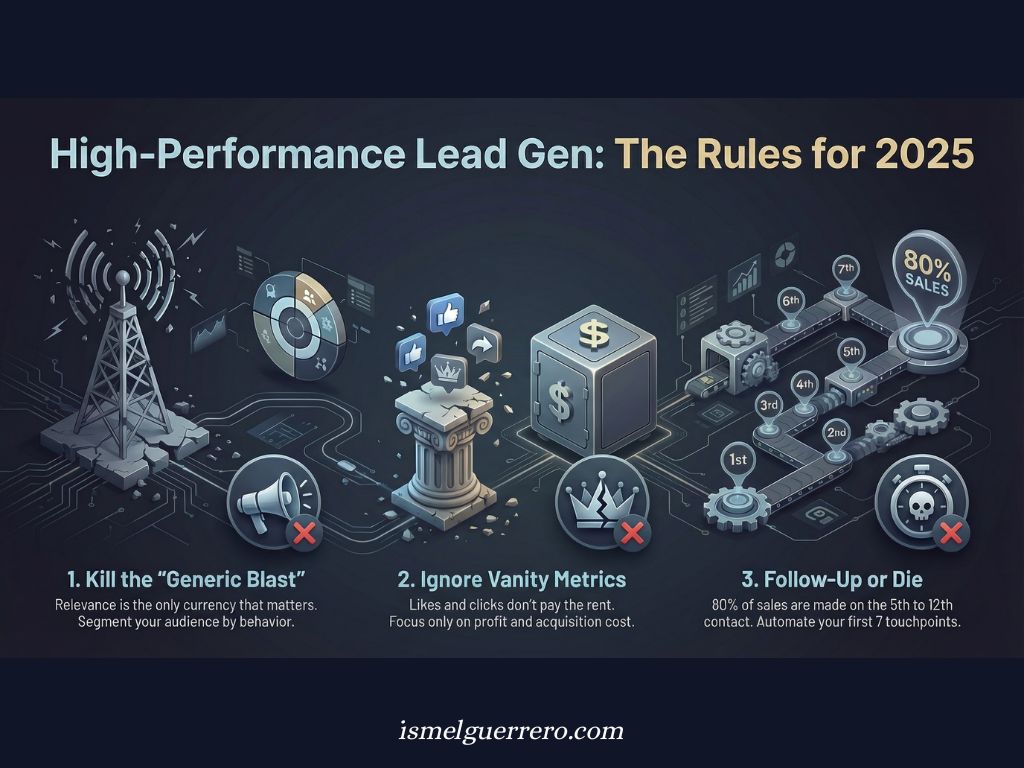
The 5 Rules of High-Performance Lead Generation
Strategies get you started; execution keeps you in business.
After auditing hundreds of funnels, I’ve found that the difference between a campaign that flops and one that scales isn’t usually the tool, it’s the discipline.
Here are the 5 non-negotiable rules for 2025:
1. Rule of Radical Relevance (Kill the “Blast”)
Generic marketing is the fastest way to burn a list. In 2025, relevance is the only currency that matters.
- The Mandate: Never send the same email to your entire list unless it’s a major company update.
- The Fix: Segment by behavior, not just demographics. If they clicked a link about “Pricing,” send them a case study. If they clicked “Blog,” send them education.
2. The “North Star” Metric (Ignore Vanity)
Likes, opens, and clicks are “Vanity Metrics.” They make you feel good, but they don’t pay the rent.
- The Mandate: You only care about two numbers: CPL (Cost Per Lead) and CAC (Cost to Acquire a Customer).
- The Fix: If an ad gets cheap clicks but expensive customers, turn it off. If an ad gets expensive clicks but loyal customers, scale it up. Profit is the only scorecard.
3. The “Beat the Control” Mindset
A lead generation system is never “finished.” It is either improving or decaying.
- The Mandate: Always have a “Challenger” running against your “Champion.”
- The Fix: If your landing page headline is converting at 10%, run a second version (The Challenger) to see if you can hit 12%. Small 1-2% bumps compound into thousands of dollars over a year.
4. Omnichannel Alignment (The “Echo” Effect)
Your prospect shouldn’t feel like they entered a different universe when they click an ad and land on your website.
- The Mandate: “Ad Scent” must match “Page Scent.”
- The Fix: Use the exact same headline, colors, and imagery on your landing page that you used in your ad. Any disconnect causes the user to subconsciously trust you less.
5. The Rule of 7 (Follow-Up or Die)
48% of salespeople never follow up with a prospect. 80% of sales are made on the 5th to 12th contact.
- The Mandate: Automation must cover the first 7 touchpoints.
- The Fix: Build a “Safety Net” sequence. If a lead goes quiet, have an automated email sequence that checks in on days 1, 3, 7, 14, and 30. Be there when they are ready, not just when they opt-in.
The “Go-Live” Protocol: Your 2025 Checklist
| Component | The Diagnostic Question | Status |
|---|---|---|
| 1. The ICP | Can you describe your target buyer’s pain point in one sentence? (Not their age/location, but their problem?) | ⬜ |
| 2. The Micro-Asset | Do you have a Lead Magnet that solves a specific problem in under 5 minutes? (No generic ebooks). | ⬜ |
| 3. The Landing Page | Does the page have a 1:1 Ratio (One Goal, One Button, No Navigation)? | ⬜ |
| 4. The “Trust” Sequence | Do you have at least 3 emails pre-loaded to nurture the lead immediately after signup? | ⬜ |
| 5. The Tracking | Are your Google Analytics and Ad Pixels installed and verified to trigger on conversion? | ⬜ |
| 6. The Traffic Source | Have you selected one primary channel (SEO or Ads) to focus on first? (Don’t try to do both on Day 1). | ⬜ |
Bottom Line: You don’t need a complex 50-step funnel. You need these 6 things working in perfect harmony. Once this foundation is set, scaling is just a math problem.

The Tools: Building Your 2025 Tech Stack
A carpenter doesn’t buy every tool in the hardware store; he buys the ones he needs to build the house. In lead generation, “Tool Bloat” is a real problem. You don’t need a $500/month CRM if you are just starting.
Here are the two optimized stacks I recommend based on your stage of growth.
1. The “Solopreneur” Stack (Budget: <$100/mo)
Focus: Efficiency and Low Overhead.
- Capture: Carrd or Systeme.io (Free/Cheap landing pages).
- Nurture: ConvertKit (Kit) (Best for creator newsletters and simple automations).
- Design: Canva (For creating lead magnet PDFs and ad creatives).
- The Glue: Make.com (Cheaper than Zapier for simple automations).
2. The “Growth” Stack (Budget: $500+/mo)
Focus: Scale, Data, and Team Management.
- Intelligence: Ahrefs or Semrush (For deep SEO and competitor spying).
- Capture: Unbounce or Webflow (For high-performance, A/B testable pages).
- CRM: HubSpot or ActiveCampaign (For complex lead scoring and sales pipelines).
- Enrichment: Clay or Apollo (To find emails and enrich B2B data automatically).
Pro Rule: The tool doesn’t fix the strategy. If your offer sucks, HubSpot can’t save you. Nail the offer on a napkin before you build it in software.
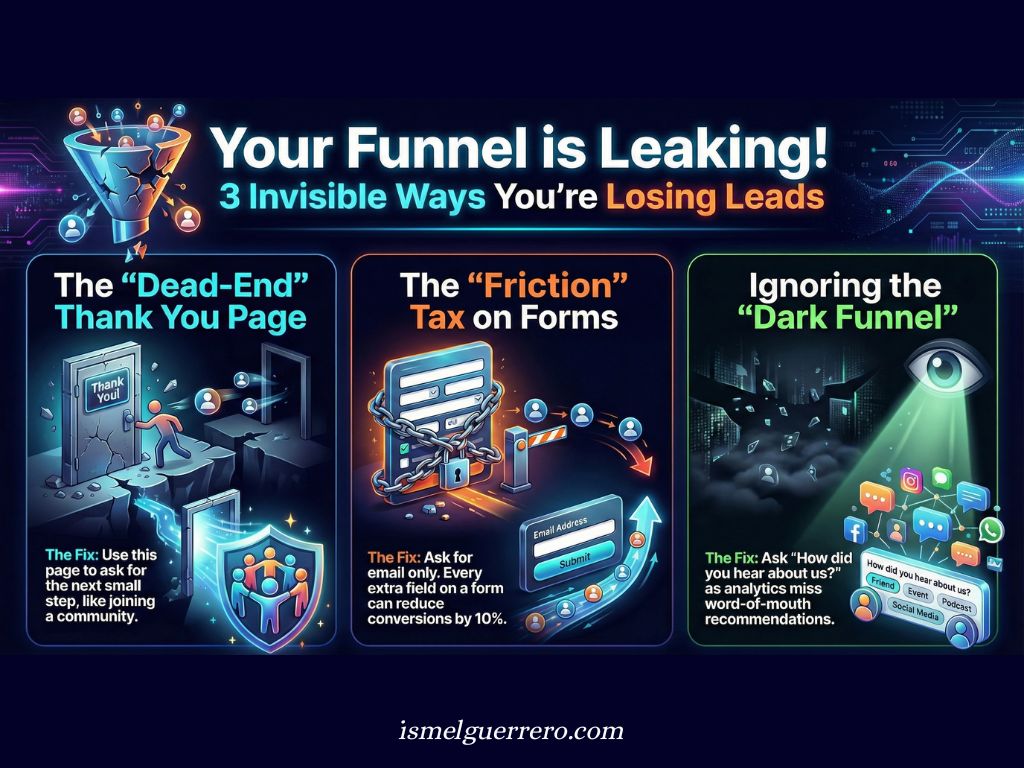
The “Invisible Leaks”: Why You Are Losing Leads
You have the tools, the ads, and the landing page… but the numbers are still low. Why? Usually, it’s not a broken strategy, it’s a tactical leak. Here are the three most common places where money silently drips out of your funnel.
1. The “Dead End” Thank You Page
The Mistake: A user opts in, and you show a page that says, “Thanks! Check your email.” The Fix: The “Thank You” page is the most valuable real estate you have. The user is psychologically “compliant”, they just said yes.
- Move: Use this page to ask for a small next step: “Join our Facebook Group,” “Book a Discovery Call,” or “Follow me on LinkedIn.” Don’t let the momentum die.
2. The “Friction” Tax
The Mistake: Asking for: First Name, Last Name, Phone, Job Title, and Revenue on a cold traffic form. The Fix: Every extra field reduces conversion by ~10%.
- Move: Ask for Email Only first. Use enrichment tools (like Clearbit/Apollo) to find the rest of the data later, or ask for more details after you have built trust.
3. Ignoring the “Dark Funnel”
The Mistake: Obsessing over Google Analytics attribution (“Google Ads brought this lead”). The Fix: Analytics can’t track word-of-mouth, podcasts, or slack communities (The Dark Funnel).
- Move: Add a simple field to your form: “How did you hear about us?” You will be shocked at how many people say “A friend told me” or “I saw your tweet 3 months ago.” Data tools lie; customers tell the truth.
Conclusion: Stop Hunting, Start Attracting
Lead generation is not a magic trick. It is not about “hacking” an algorithm or finding a secret button in Facebook Ads Manager.
It is a system.
It is the discipline of showing up where your customers are, offering them genuine value (not fluff), and building a bridge of trust strong enough for them to walk across.
You now have the playbook.
- You know that Intent (SEO) beats Volume.
- You know that Micro-Assets beat Ebooks.
- You know that Systems beat Hustle.
The businesses that win in 2025 won’t be the ones shouting the loudest. They will be the ones who built the quiet, consistent engines that turn strangers into friends, and friends into customers.
Don’t try to implement all 9 strategies tomorrow. Pick your Core Trio. Build your Moat. And stop chasing leads start engineering a system that attracts them.
Frequently Asked Questions
1. What is the single most effective lead generation strategy in 2025?
There is no “magic bullet,” but the highest ROI strategy right now is the “Micro-Asset” Funnel. Instead of forcing users to read a long ebook, give them a specific tool (calculator, template, or checklist) that solves one immediate problem. This builds trust faster than any other method.
2. I have a small budget. Where should I start?
Don’t try to be everywhere. Use the “Core Trio” approach. If you have more time than money, focus on SEO (writing intent-based content) and Social Media (building a personal brand). If you have a small budget but need fast results, run highly targeted Google Search Ads to capture people actively looking for your solution.
3. Why are my leads not converting into customers?
It is usually a Nurture problem, not a lead problem. Most businesses capture the email and immediately ask for a sale. You need a “Bridge Sequence” , a series of 3-5 automated emails that provide value, handle objections, and build trust before you pitch the main offer.
4. How long does it take to see results?
It depends on the channel (remember the “Iron Triangle”):
- Paid Ads: Instant results (24–48 hours), but costs money.
- Outreach: Fast results (Days), but requires manual labor.
- SEO & Content: Slow results (6–12 months), but builds long-term equity.
- Recommendation: Use ads for cash flow today while you build SEO for stability tomorrow.
5. Is “Cold Outreach” (DMs/Email) dead?
Generic “spam” outreach is dead. However, “Sniper” Outreach is very alive. Sending 10 hyper-personalized videos to your dream clients will always outperform sending 1,000 copy-paste templates. Quality beats volume in 2025.
6. What metrics should I actually track?
Ignore “Likes” and “Impressions.” Focus on two numbers:
- CPL (Cost Per Lead): How much does it cost to get an email?
- CAC (Customer Acquisition Cost): How much does it cost to get a paying client? If your CAC is lower than your Customer Lifetime Value (LTV), you have a winning system.

2 Comments
Lead Generation: The Ultimate Guide to Growing Your Business - Ismel Guerrero. · January 23, 2025 at 1:05 pm
[…] Next, to learn more go here Top Strategies for Lead Generation. […]
Lead Generation Funnel: How to Build and Optimize for Maximum Conversions - Ismel Guerrero. · January 25, 2025 at 12:26 am
[…] Learn More Effective Methods to Attract and Convert. […]