Introduction
Personal branding shapes how people see you long before they click an affiliate link. It tells your audience what you stand for, how you think, and why they should listen. In a space where thousands of creators talk about the same tools and programs, your brand becomes the filter that helps buyers decide who they trust.
Affiliate marketing works on recommendation power. People do not choose the best link, they choose the most credible voice. That is why personal branding plays such a central role. It strengthens trust, clarifies your message, and creates familiarity that carries across platforms.
This guide explains what personal branding means for affiliates, why it influences conversions, and how to build a brand that feels consistent and recognizable. You will learn the practical steps, the common mistakes, and the mindset shifts that help you stand out without pretending to be someone else.
When your brand reflects the value you bring, promoting offers becomes easier and more natural. This article shows you how to get there.
Key Takeaways
Personal Branding in Affiliate Marketing
- Personal branding shapes trust, which is the core driver of affiliate conversions.
- A clear brand helps you stand out in crowded niches by showing how you think and who you help.
- Consistent messaging across platforms creates familiarity that builds long-term credibility.
- Strong branding supports higher-value recommendations because buyers feel confident in your guidance.
- Affiliates grow faster when they lead with education, transparency, and authentic experiences.
- Your brand becomes a long-term asset that reduces reliance on algorithms and protects the audience you build.
Disclaimer: I am an independent Affiliate. The opinions expressed here are my own and are not official statements. If you follow a link and make a purchase, I may earn a commission.
What Personal Branding Means in Affiliate Marketing
Personal branding in affiliate marketing is the process of shaping how your audience understands your voice, values, and expertise. It is not about logos or color schemes. It is the reputation you build through your content, your consistency, and the way you help people make decisions.
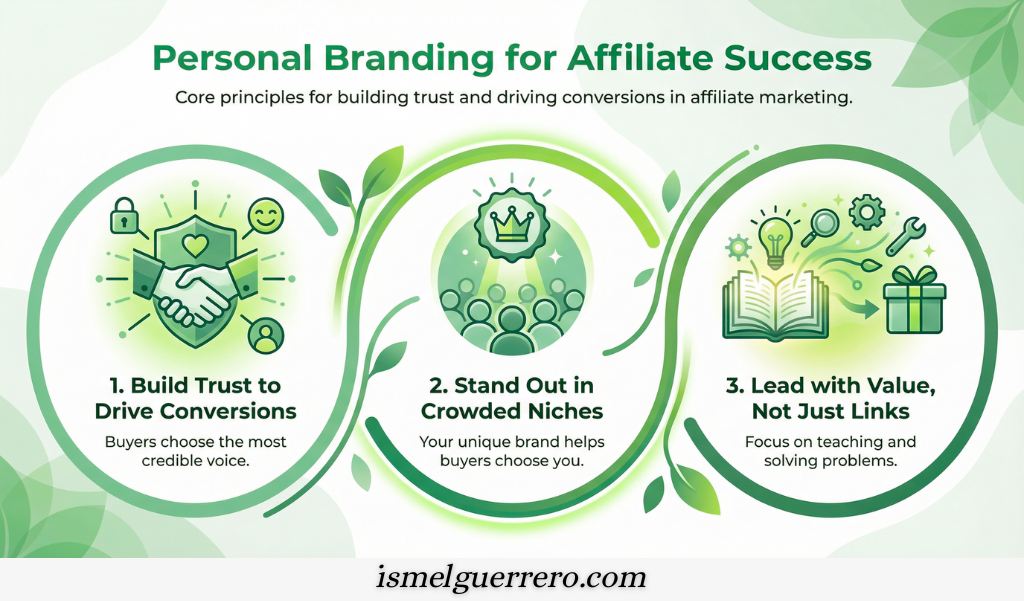
At its core, personal branding answers three questions for the buyer. Who is this person. Why should I trust their recommendations. How do they approach the problems I am trying to solve. When those answers feel clear, people are more comfortable following your guidance, especially when the product carries real cost or complexity.
Branding also gives structure to your content. It shapes your tone, the topics you cover, and the perspective you bring to each recommendation. Readers start to expect a certain level of clarity or honesty or depth from you. When that pattern stays consistent, familiarity grows, and familiarity reduces friction at every stage of the buying process.
Affiliate marketing rewards trust more than traffic. A strong personal brand turns your content from generic information into guidance that feels reliable and human. That is what sets you apart in markets where many creators say the same things in the same way.
A short reflection. Personal branding is not built overnight. It forms through repeated moments in which your audience feels understood and supported. Those moments create attachment, and attachment is what drives long-term conversions.

Why Personal Branding Is Essential for Affiliates
Personal branding is not a bonus in affiliate marketing. It is the engine behind trust, differentiation, and long-term conversions. When your audience knows who you are and what you stand for, every recommendation carries more weight.
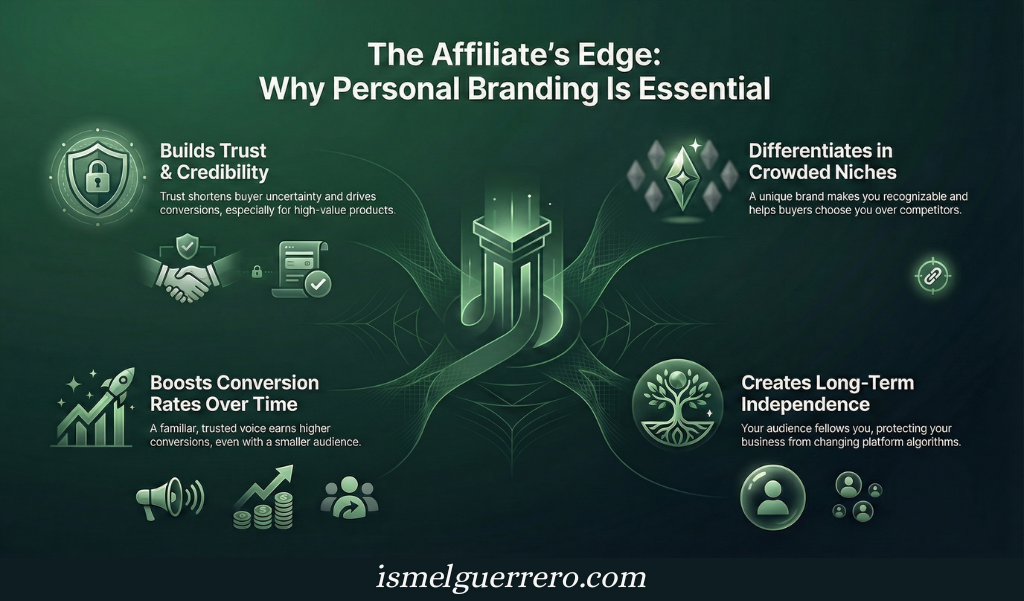
Trust and credibility drive conversions
Affiliate marketing only works when people believe your recommendations come from real experience or thoughtful evaluation. A strong personal brand provides that foundation. It helps buyers feel confident that you understand the problem they are trying to solve and that you are not promoting products at random.
Trust shortens research time, reduces uncertainty, and supports conversions, especially for products that require careful decision making.
Differentiation in crowded niches
Many affiliates promote the same tools and programs. Without personal branding, you blend in with everyone else. Your brand creates separation by highlighting your point of view, your style, and the specific audience you serve. That clarity makes it easier for buyers to choose you over someone offering similar information.
Differentiation is not about volume. It is about being recognizable for the value you bring.
Higher conversion rates over time
A familiar voice earns more responses than a new one. When your audience has followed your work for weeks or months, they depend on your guidance. They know your standards. They understand how you evaluate products. That familiarity leads to higher conversion rates, even with a smaller audience.
A strong brand compounds. Each positive interaction builds on the last.
Long-term independence from algorithms
Platforms shift, ranking factors change, and traffic sources rise and fall. A personal brand gives you stability across those changes because people follow you, not just your content. If your brand feels consistent and reliable, your audience stays connected whether you publish on a blog, a channel, or an email list.
Brand loyalty protects your business from volatility that affects unbranded creators.
How Personal Branding Influences Buyer Behavior
Buyers rarely make decisions based on features alone. They rely on the person guiding them, the clarity of the information, and the confidence they feel in the recommendation. Personal branding shapes each of these moments, often without the buyer noticing. When your brand feels familiar and trustworthy, decision making becomes easier for your audience.
Perceived expertise reduces risk
People want assurance that the product they are considering will actually solve their problem. When your content shows experience, thoughtful analysis, or personal insight, you become a source of stability. Buyers feel safer choosing through you because your brand reduces uncertainty.
They are not just buying the product. They are buying your judgment.
Consistent voice builds familiarity
A recognizable voice gives readers something to return to. Whether your tone is analytical, practical, or story driven, consistency strengthens the relationship. Familiarity builds comfort, and comfort makes it easier for buyers to trust your recommendations when they reach a decision point.
A steady voice becomes part of your value.
Storytelling creates emotional connection
Stories help buyers understand who you are and how you think. When you explain how you solved a problem, learned something difficult, or chose a product, your audience connects that experience to their own. This emotional link makes your guidance feel grounded, not transactional.
Connection influences decisions more than polished arguments.
Authority shapes recommendations
When your brand signals expertise, even in a narrow niche, your recommendations carry more weight. Buyers want to follow someone who can simplify choices and highlight the real differences between options. Authority does not require perfection; it requires clarity and honest perspective.
A clear brand turns suggestions into guidance that people trust.
How to Build a Strong Personal Brand as an Affiliate
Personal branding does not require a dramatic reinvention. It grows from clarity, consistency, and a willingness to show how you think. When you understand who you help and how you guide them, your brand becomes a natural extension of your work. These steps help you build a brand that feels steady, recognizable, and trustworthy.
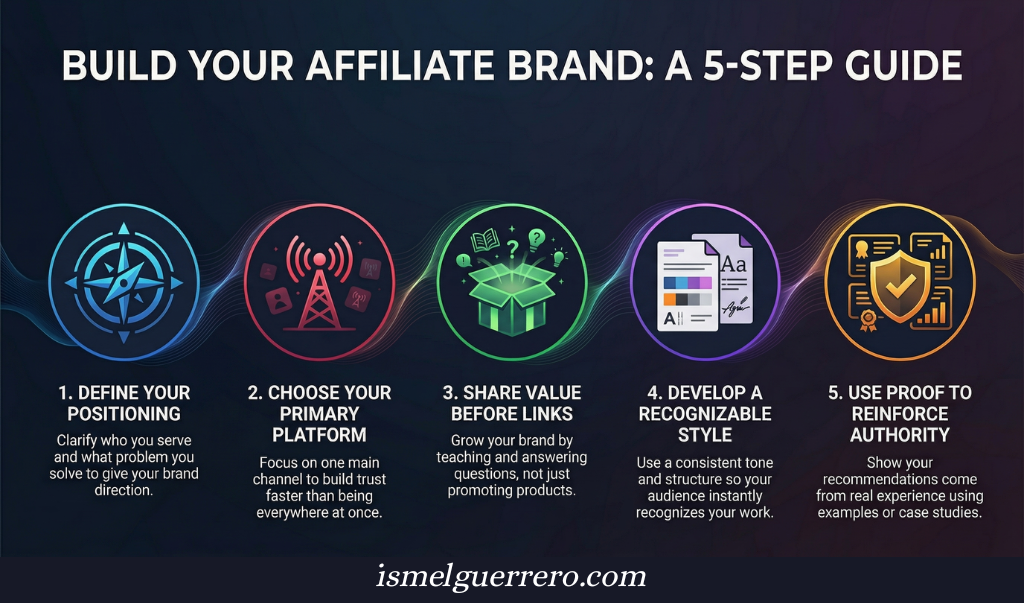
Define your positioning
Positioning is the foundation of your brand. It explains who you serve, what problem you focus on, and the perspective you bring to it. When your positioning is clear, your content feels sharper and your audience knows exactly why they are following you.
A simple question helps: what transformation do you help people make. The answer gives your brand direction.
Choose your primary platform
You do not need to be everywhere. You need one platform where your voice can grow. It might be a blog for long-form guidance, YouTube for demonstrations, or email for deeper connections. Choose the channel that matches your strengths and audience behavior. Once that home base is strong, expanding becomes easier.
Consistency builds trust faster than broad reach.
Share value before sharing links
Your brand grows through the help you provide, not the products you promote. Focus on answering questions, demonstrating solutions, and explaining decisions. When your audience sees consistent value, they trust your recommendations more naturally.
Teaching first sets the tone for your brand.
Develop a recognizable style
Style shapes how your audience experiences your content. It includes your tone, your pacing, your structure, and the way you break down ideas. A distinct style does not have to be dramatic. It only needs to be consistent. Over time, your audience recognizes your work by the way you explain things.
A recognizable style becomes a signature.
Use proof to reinforce authority
Proof helps your brand feel reliable. You can use your own experiences, transparent process notes, case studies, or real examples from using the product. Proof does not need to be complicated. It simply needs to show that your recommendations come from understanding, not guesswork.
Authority grows when buyers see how you reach your conclusions.

Common Mistakes Affiliates Make With Personal Branding
Personal branding strengthens an affiliate business when it is built with intention. Many creators struggle because they focus on visibility rather than trust, or speed rather than clarity. Understanding these common mistakes helps you avoid patterns that weaken credibility and slow growth.
Trying to copy big creators
Imitating successful voices may feel practical, but it creates a brand that blends into the crowd. Audiences recognize when a style feels borrowed, and borrowed identities make recommendations feel less trustworthy. Your perspective, even if still developing, carries more weight than someone else’s blueprint.
A genuine voice builds deeper loyalty than a polished imitation.
Inconsistent messaging across platforms
When your tone or advice shifts between channels, audiences struggle to understand what you stand for. Inconsistency creates confusion, and confusion reduces trust. A steady brand message helps buyers feel confident that your guidance remains reliable wherever they follow you.
Clarity grows when your message matches across every touchpoint.
Only posting reviews or promotions
A brand built solely on product reviews feels transactional. Without educational or experience-based content, the audience never learns how you think, which makes every recommendation feel shallow. Value-driven content expands your brand beyond affiliate links and makes your voice more memorable.
Teaching creates trust. Promotions create awareness. You need both in balance.
Hiding behind anonymity for too long
It is possible to grow anonymously, but hiding your identity makes it harder to build authority in niches that depend on trust. Buyers want to know who is speaking to them, especially when the product carries a cost or risk. Even simple personal details or transparent reasoning help bridge the gap.
A brand becomes stronger when people feel connected to the person behind it.
Personal Branding vs. Affiliate Reputation: What’s the Difference
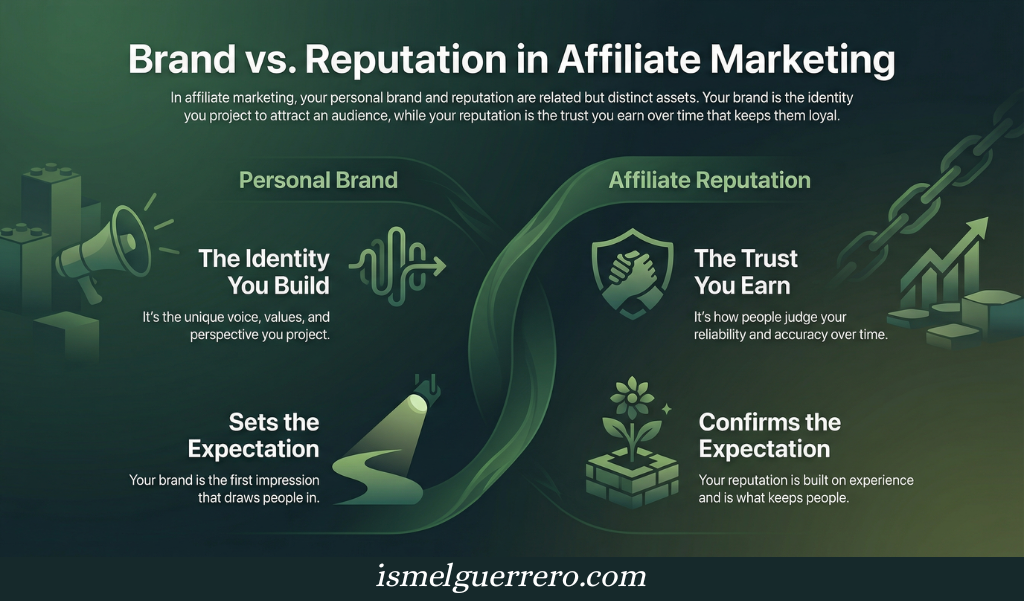
Personal branding and affiliate reputation often get blended together, but they are not the same. Your brand represents the identity you build through your voice, values, and perspective. Your reputation reflects how people judge your actions, your reliability, and the accuracy of your recommendations. Both matter, and both influence how buyers respond to your content.
Branding shapes perception before someone reads a full article or watches a complete video. It is the first impression, the tone, and the sense of clarity you create. Reputation develops through experience. It grows when buyers follow your advice, see consistent value, or observe how you evaluate products over time.
A strong personal brand draws people in, but your reputation is what keeps them. When both work together, your audience sees you as someone worth returning to, learning from, and trusting with more significant decisions. That balance is especially important in niches where confusion, complexity, or risk play a part in the buying journey.
A short reflection. Your brand sets the expectation. Your reputation confirms it. When the two align, every recommendation carries more weight.

Does Personal Branding Affect High-Ticket Affiliate Marketing
Personal branding becomes even more important when you promote high-ticket products. These offers carry higher price points, longer decision cycles, and buyers who expect clarity before investing. People will only follow a premium recommendation when they feel confident in the person making it. That is where a strong brand makes the difference.
High-ticket buyers look for guides, not promoters. They want to understand how you think, why you choose certain solutions, and what experience informs your advice. A familiar voice reduces hesitation because the buyer already knows your standards. They trust your evaluation more than a generic review from a stranger.
A clear personal brand also helps buyers filter information. Premium products often come with competing claims, complex features, and varying results. When your brand consistently highlights honest insights and balanced reasoning, audiences rely on you to simplify the noise and point them in the right direction.
The connection is simple. As the price of the product increases, the level of trust required increases with it. Personal branding builds that trust long before the buyer reaches a purchase decision. When your brand aligns with steady value and transparent communication, high-ticket recommendations feel natural rather than forced.
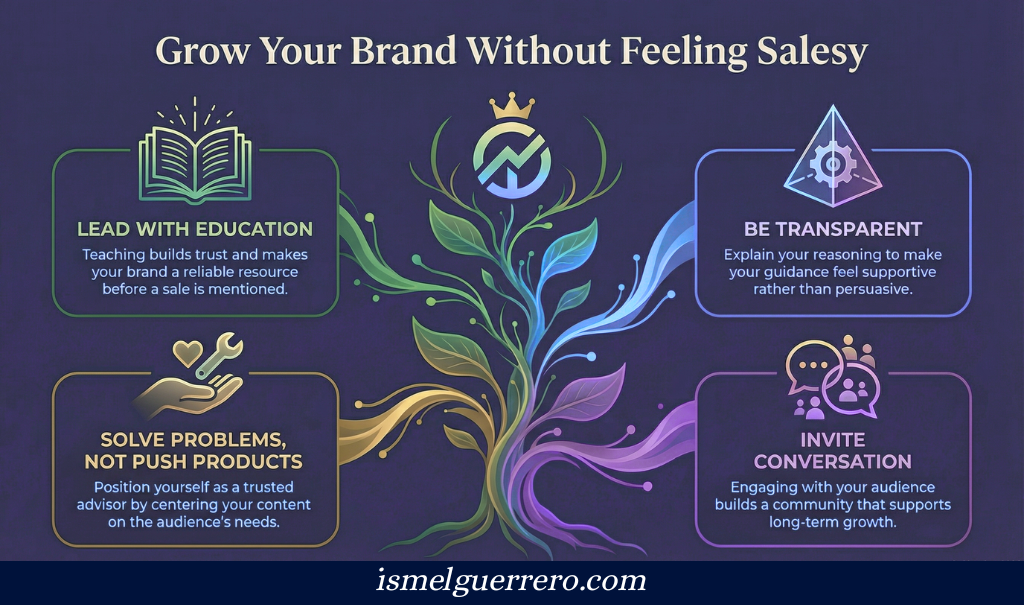
How to Grow Your Brand Without Feeling “Salesy”
Many affiliates avoid personal branding because they worry about sounding pushy. The good news is that strong branding does not depend on hard selling. It grows through clarity, consistency, and the way you help people understand their options. When your content focuses on real problems and grounded insight, trust develops naturally.
Lead with education
Educational content lowers barriers because the reader receives value without needing to commit. When you explain concepts, compare solutions, or share lessons learned, your brand becomes reliable. Buyers return to voices that help them understand the decisions they need to make.
Teaching builds trust long before a link appears.
Use transparent recommendations
Transparency removes pressure. When you explain why you recommend something, how it compares to alternatives, and who it is best suited for, the buyer feels respected. Clear reasoning makes your brand more credible, and credible voices never come across as overly promotional.
Openness makes your guidance feel supportive rather than persuasive.
Focus on solving problems, not pushing offers
A strong brand centers the reader’s needs. When your content begins with the problem and follows with practical steps, the recommendation becomes a natural part of the solution. This approach positions you as an advisor instead of a seller, which strengthens loyalty over time.
Problem solving always feels more authentic than product pushing.
Invite conversation
Brands grow faster when audiences feel included. Encourage questions, ask for feedback, or share your thought process. Even small interactions build connection. When people feel seen, they trust your guidance more, and your recommendations land with less resistance.
Conversation creates community, and community supports long-term growth.
Conclusion
Personal branding sits at the center of sustainable affiliate marketing. It shapes how people perceive your voice, how they evaluate your recommendations, and whether they return to you when they need guidance. A clear brand helps you stand out in crowded niches, and a consistent message builds familiarity that carries across platforms. Over time, that familiarity becomes trust, and trust is what moves buyers toward confident decisions.
You do not need a complex identity to build a strong brand. You only need clarity about who you help, the problems you focus on, and the perspective you bring. When your content reflects those choices, your brand grows naturally. Each article, video, or email becomes another point of connection, another chance for your audience to understand how you think.
Personal branding also protects your work from constant platform shifts. When people follow you because of your voice and values, your influence extends beyond any single channel. That stability gives you space to refine your approach and strengthen your authority without chasing trends.
The next step is simple. Choose the message you want to be known for, share it consistently, and build trust through steady value. When your brand aligns with the needs of your audience, affiliate recommendations feel natural, and your business becomes easier to sustain.
FAQs About Personal Branding in Affiliate Marketing
Do I need a personal brand to succeed in affiliate marketing?
A strong personal brand is not mandatory, but it makes growth easier. Branding builds trust, and trust influences how buyers respond to your recommendations. Affiliates with clear branding often convert better than those who rely solely on volume.
Can beginners build a personal brand without experience?
Yes. Beginners can build credibility by documenting what they learn, sharing practical insights, and staying consistent. You do not need expert status to be trustworthy. You only need clarity and honesty about your journey.
Do I need to show my face to build a personal brand?
Not always. Many affiliates succeed with voice-only content or written content. What matters most is consistency in tone, message, and value. Visibility helps, but connection comes from clarity, not appearance.
How long does it take to build a recognizable personal brand?
It varies. Some affiliates see momentum within a few months, while others take longer. Brands grow through repeated interactions, so steady publishing and clear messaging often accelerate the process.
Can I promote multiple niches with one personal brand?
It is possible, but more challenging. A focused brand is easier for audiences to understand and trust. If your topics differ significantly, consider creating subtopics that still connect to a central theme.
Does personal branding help with high-ticket affiliate marketing?
Yes. Premium buyers expect guidance from someone they trust. A strong brand reduces risk, clarifies your perspective, and supports higher-value decisions.
What is the biggest mistake to avoid when building a personal brand as an affiliate?
The most common mistake is focusing on promotions instead of value. When your content only highlights products, your brand feels transactional. Leading with education helps your message stand out.

0 Comments