A higher price does not automatically make a digital product more valuable. Buyers still need a strong reason to pay more.
High-ticket digital products are higher-priced digital offers designed for buyers who need more than a basic solution. They can include advanced courses, software, memberships, professional resources, digital systems, and hybrid programs that combine digital content with additional support.
The opportunity is not limited to people who create products from scratch. You can build your own digital product, sell an existing product under the appropriate resale rights, or promote another company’s product through an affiliate program. Each model gives you different levels of control, responsibility, and earning potential.
This guide explains what high-ticket digital products are, why buyers pay more for them, who they are best suited for, the main types available, and the different ways you can sell or promote them. It also covers the pros and cons, product evaluation, pricing, marketing, sales methods, platforms, and common mistakes to avoid.
- High-ticket digital products are relatively expensive offers within their market, but there is no universal price that automatically makes a product high ticket.
- Buyers may pay more for specialized knowledge, advanced functionality, convenience, access, support, or solutions to problems that matter enough to justify a larger investment.
- You do not have to create a digital product yourself. Depending on the product and licensing model, you may create your own, obtain rights to resell an existing product, or promote one as an affiliate.
- Master Resell Rights describe what a license allows you to do with a product. They do not determine whether the product is valuable, profitable, or high ticket.
- Higher revenue per sale does not automatically mean higher profit. Marketing costs, platform fees, fulfillment, support, refunds, commissions, and other expenses still matter.
- Pricing should reflect the product, market, buyer value, alternatives, costs, and positioning rather than an arbitrary high-ticket threshold.
- Marketing and sales methods should match the complexity of the buying decision. Not every high-ticket digital product requires a webinar, funnel, or sales call.
- The strongest high-ticket offer is one that gives the right buyer a credible reason to pay more, regardless of whether you created, licensed, or promote the product.
Disclaimer: I am an independent Affiliate. The opinions expressed here are my own and are not official statements. If you follow a link and make a purchase, I may earn a commission.
What Are High-Ticket Digital Products?
High-ticket digital products are digital offers sold at a relatively high price compared with typical alternatives in the same market.
There is no universal dollar amount that defines them.
A $500 course might represent a significant purchase in one market, while a $500 annual software subscription could be relatively inexpensive in another. The price needs to be understood in relation to the product category, target customer, available alternatives, and value being offered.
That is why defining every product above $500 or $1,000 as high ticket is too simplistic.
High-ticket digital products usually involve a more considered buying decision. As the financial commitment increases, buyers may spend more time comparing alternatives, examining what is included, looking for evidence, evaluating support, and deciding whether the product solves a problem important enough to justify the price.
Common Examples
Examples can include:
- Advanced online courses and certification programs
- Business and professional software
- SaaS subscriptions
- Premium memberships and paid communities
- Specialized databases and research products
- Digital toolkits, systems, and resource libraries
- High-value templates or asset bundles
- Hybrid programs combining digital resources with training, feedback, or support
Distinguishing Products from Services
The category should also be distinguished from digitally delivered services.
A self-paced course, software platform, template library, or research database is fundamentally a digital product. One-to-one coaching, consulting, or done-for-you marketing may be delivered online, but the primary thing being purchased is human expertise or labor. Those are services, even when digital resources are included.
Hybrid offers sit between the two. A training program might combine recorded lessons, templates, live group sessions, and individual feedback. The digital components remain products, while the live support adds a service element.
High Ticket Does Not Mean Expensive for the Sake of Being Expensive
Price alone does not create value.
A basic course does not become a premium product simply because its price changes from $99 to $999. The same applies to templates, memberships, software, and other digital offers.
The buyer still needs a reason to pay more.
That reason might come from greater depth, specialized functionality, better access, significant time savings, professional utility, stronger support, exclusive resources, or a solution to a problem that carries meaningful consequences.
Disclaimer: I am an independent Affiliate. The opinions expressed here are my own and are not official statements. If you follow a link and make a purchase, I may earn a commission.

Why People Pay More for Digital Products
People do not pay more simply because a product is labeled premium.
They pay more when the offer provides enough additional value to justify the higher cost.
That value can come from several places.
Specialized Knowledge
Some digital products organize expertise that would otherwise take considerable time to find, understand, and apply.
A basic course may explain a subject broadly. A higher-priced program may go deeper into a specialized skill, industry, process, or use case that serves a narrower audience.
The value comes from relevance and depth, not simply from having more lessons.
Time Savings
A digital product can be valuable when it helps the buyer avoid unnecessary research, trial and error, or repetitive work.
Software, templates, databases, operating systems, and structured training can all reduce the amount of time needed to reach a useful outcome.
The larger the cost of doing something slowly or incorrectly, the easier it may be for the buyer to justify paying for a better solution.
Advanced Functionality
Some digital products cost more because they provide capabilities that lower-priced alternatives do not.
This is common with software, analytics platforms, professional tools, and specialized systems.
The buyer may be paying for automation, integrations, collaboration features, security, data access, or other functionality that becomes important as their needs become more complex.
Access and Support
The digital product itself may be only part of the offer.
Higher-priced programs sometimes include:
- Expert feedback
- Live training
- Technical support
- Private communities
- Implementation assistance
- Direct access to specialists
- Additional tools or resources
These additions increase the amount of human involvement and can change the economics of the offer substantially.
Business or Professional Utility
A product can command a higher price when it supports work that has meaningful financial or operational consequences.
A business may pay more for software that helps manage customers, reduce errors, improve reporting, or support critical workflows.
A professional may pay more for specialized training or resources that improve how they perform a valuable skill.
The price is easier to evaluate when the buyer can connect the product to a practical use case.
Convenience and Consolidation
Sometimes buyers are not paying for information they could never find elsewhere.
They are paying to have the information, tools, process, and support organized in one place.
A well-designed system can reduce fragmentation and make implementation easier.
That convenience can have real value, especially for buyers who already know what they need but do not want to assemble the solution themselves.
The important distinction is that a high price needs a clear reason behind it.
The reason may be expertise, functionality, access, time savings, support, convenience, or another form of value. Different products justify premium pricing in different ways.
Who High-Ticket Digital Products Are For
High-ticket digital products are not automatically the right choice for every buyer or every seller.
The model works best when the product, price, audience, and buying decision make sense together.
From the Buyer Side
A higher-priced digital product may be appropriate when the buyer has a meaningful problem that simpler alternatives do not solve well enough.
That could include someone who:
- Needs specialized knowledge rather than introductory information
- Values time savings or faster implementation
- Requires advanced features or professional-grade tools
- Wants more support or access than a basic product provides
- Has a clear business, professional, or personal reason for paying more
- Can reasonably afford the purchase without depending on unrealistic outcomes to justify it
The buyer should also be able to understand what makes the premium option different.
If a $100 product solves the same problem just as well as a $1,000 offer, the higher price may be difficult to justify.
That is why high-ticket selling should not begin with the assumption that the buyer needs the most expensive option.
Sometimes the right recommendation is a lower-priced product.
From the Seller Side
High-ticket digital products may also fit sellers who understand a specific market well enough to explain why a more expensive offer exists.
That can include:
- Creators building their own products
- Businesses selling software or digital tools
- Marketers selling licensed digital products
- Affiliates promoting premium offers
- Educators packaging advanced training
- Publishers connecting specialized audiences with relevant products
The common requirement is not the business model.
It is the ability to match a worthwhile product with an audience that has a genuine reason to consider it.
Higher prices also create higher expectations.
The seller may need stronger positioning, clearer product information, better support, more credible evidence, and a more deliberate sales process.
A high-ticket model therefore makes the most sense when the seller can support the buying decision rather than relying on price, scarcity, or promotional language to create perceived value.
When High Ticket May Not Be the Best Fit
A lower-priced product may be better when:
- The problem is simple
- The buyer only needs a basic solution
- The market is highly price-sensitive
- The product is easy to evaluate without additional support
- The offer does not provide enough differentiation to justify a premium
- The seller cannot support the expectations created by the higher price
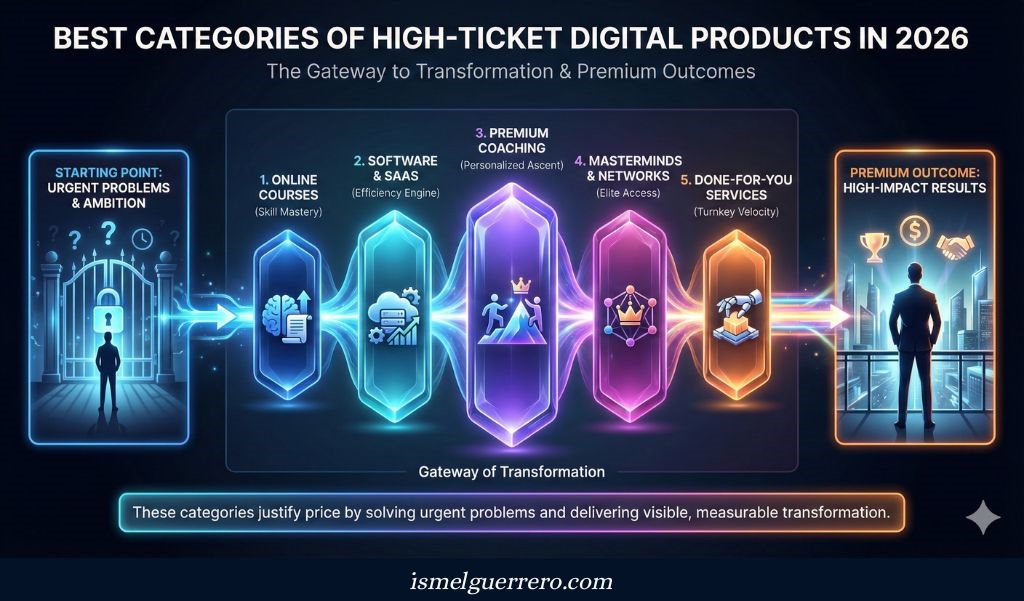
Types of High-Ticket Digital Products
High-ticket digital products can take many forms.
The strongest examples usually provide more depth, functionality, access, or utility than lower-priced alternatives in the same category.
Online Courses and Certification Programs
Advanced courses can become high-ticket products when they provide structured training around a specialized skill or professional outcome.
The higher price may reflect:
- Greater depth
- Expert instruction
- Assessments
- Certification preparation
- Feedback
- Cohort participation
- Live components
- Additional resources
The value should come from the quality and usefulness of the training, not simply from the number of modules included.
Software and SaaS
Software can fit the high-ticket category when the product serves complex business or professional needs.
Examples include tools for:
- Customer relationship management
- Marketing automation
- Analytics
- Data management
- Cybersecurity
- Workflow automation
- Project management
- Specialized professional operations
Pricing may be based on monthly subscriptions, annual contracts, users, usage, features, or a combination of these factors.
Unlike a course or downloadable product, the value may come primarily from ongoing functionality rather than information.
Memberships and Paid Communities
A premium membership may combine digital resources with continuing access.
That can include:
- Training libraries
- Research
- Private communities
- Expert sessions
- Industry updates
- Templates
- Networking opportunities
- Ongoing support
The recurring nature of the offer changes the value equation.
The buyer is not only evaluating what they receive on the first day. They are also evaluating whether the membership will continue to provide enough value to justify staying subscribed.
Premium Templates, Systems, and Toolkits
Templates are often associated with low-cost digital products, but larger systems can support much higher prices.
For example, a premium toolkit might include:
- Multiple templates
- Standard operating procedures
- Workflows
- Checklists
- Calculators
- Dashboards
- Automation files
- Training on implementation
The value comes from how the pieces work together to solve a larger problem.
A single spreadsheet may not justify a high price. A complete operating system for a specific business function might.
Research, Data, and Professional Resources
Specialized information can also become a high-ticket digital product.
Examples include:
- Industry databases
- Market research
- Professional directories
- Proprietary datasets
- Investment or business research
- Technical documentation
- Competitive intelligence
- Specialized reference libraries
These products are often valuable because collecting, organizing, or maintaining the information requires expertise, time, or access that the buyer may not have.
Hybrid Digital Programs
Some high-ticket offers combine a digital product with a meaningful service component.
A program might include:
- Recorded training
- Templates and resources
- Live group sessions
- Expert feedback
- Implementation reviews
- Technical assistance
- Private support
These offers sit between a pure digital product and a service.
The distinction matters.
If most of the value comes from the digital material, the offer still behaves largely like a product. If most of the value comes from direct human work, it is more accurate to describe it as a service supported by digital resources.

Do You Have to Create the Product Yourself?
Creating your own product gives you the most control, but it is only one way to make money with high-ticket digital products.
You can also sell an existing product when the license gives you resale rights or promote another company’s product through an affiliate program.
These models can look similar from the outside because each involves marketing a digital offer. The important differences are ownership, pricing control, customer responsibility, and how you earn.
Create Your Own Digital Product
Creating the product yourself gives you control over the entire offer.
You decide:
- What problem the product solves
- Who it is for
- What is included
- How it is positioned
- What it costs
- Where it is sold
- How customers receive support
- How the product changes over time
You also keep the revenue from customer sales after payment processing, platform fees, marketing costs, taxes, refunds, fulfillment, and other expenses.
The trade-off is responsibility.
You need to research the market, create the product, establish the sales process, handle customer expectations, and maintain the offer.
This route generally makes the most sense when you have knowledge, intellectual property, software, data, a system, or another asset you can turn into a product that solves a defined problem.
Sell a Product With Resale Rights
Another option is to obtain a digital product under a license that allows you to resell it.
The exact rights depend on the license.
Common terms include Resell Rights, Master Resell Rights, and Private Label Rights. They are related, but they do not necessarily give the buyer the same permissions.
A resale license may determine:
- Whether you can sell the product
- Whether you can change the product
- Whether you can change the branding
- Whether you can set your own price
- Where the product can be sold
- Whether your customers receive resale rights
- Which claims or marketing materials you are allowed to use
This is why the license matters as much as the product itself.
What Master Resell Rights Mean
Master Resell Rights, commonly shortened to MRR, generally allow the license holder to resell a digital product and, depending on the specific terms, may also allow customers to receive resale rights themselves.
That does not mean every MRR license works the same way.
Some products restrict pricing, branding, editing, marketplaces, advertising methods, or how resale rights can be transferred. The individual license determines what you are actually allowed to do.
MRR also says nothing about whether the product is valuable.
A weak product does not become a strong business opportunity because resale rights are attached to it. The product still needs an audience, useful content, credible positioning, and a reason for someone to buy it.
Competition can also matter. If many sellers have access to the same product with similar marketing materials, differentiation becomes harder.
For a deeper explanation of the licensing model, its terminology, and how the rights work, see our complete guide to Master Resell Rights (MRR).
Promote a High-Ticket Product as an Affiliate
Affiliate marketing takes a different approach.
Instead of purchasing resale rights, you promote another company’s product under its affiliate program.
When an eligible referral becomes a customer, you receive a commission according to the program terms.
The merchant usually controls:
- The product
- Pricing
- Checkout
- Fulfillment
- Refunds
- Customer support
- Affiliate terms
The affiliate focuses primarily on attracting relevant buyers and helping them understand whether the product fits their needs.
This reduces the responsibility of creating or fulfilling the product, but it also gives you less control.
The company can change its prices, commission structure, product, terms, or affiliate program.
How the Three Models Differ
| Model | Product Ownership | Pricing Control | Fulfillment | How You Earn |
|---|---|---|---|---|
| Create your own | You own the product | You control it | Your responsibility | Revenue from customer sales |
| Licensed resale | Original creator retains underlying ownership; you receive licensed rights | Depends on the license | Depends on the arrangement | Revenue from permitted resales |
| Affiliate promotion | You do not own the product | Usually controlled by the merchant | Merchant handles it | Commission from eligible referrals |
None of the three models is automatically better.
Creating your own product offers more control but requires more development and responsibility. Licensed resale can reduce the need to build from scratch, but your rights and differentiation depend heavily on the license and product. Affiliate marketing removes most product-fulfillment responsibility but leaves more of the business under the merchant’s control.
The right model depends on what you want to own, how much control you need, and which responsibilities you are prepared to take on.
Pros and Cons of High-Ticket Digital Products
High-ticket digital products can create attractive revenue opportunities, but the larger price also changes the economics and expectations surrounding each sale.
They should be evaluated as a business-model trade-off rather than an automatic improvement over lower-priced offers.
Potential Advantages
More Revenue Per Completed Sale
A higher selling price can generate more revenue from each completed transaction.
For example, reaching $10,000 in revenue requires five $2,000 sales but 200 $50 sales.
That mathematical difference can make a high-ticket model attractive when reaching or serving large numbers of customers is difficult.
It does not mean the five higher-priced sales will be easier or more profitable to obtain.
Fewer Transactions for the Same Revenue Target
Because each transaction is larger, the business may need fewer customers to reach a particular revenue level.
That can be useful for specialized markets, limited-capacity businesses, or products serving narrow professional audiences.
The trade-off is that each lost sale represents a larger share of expected revenue.
More Room for Product Depth and Support
Higher pricing can support more extensive product development, specialized features, expert involvement, onboarding, or customer support.
That can create a stronger product when those additions genuinely improve the buyer’s experience.
It can also increase fulfillment costs.
Strong Fit for Specialized Markets
A broad consumer audience is not required for every digital-product business.
Some products solve narrow professional, technical, or business problems where a smaller group of buyers may still support a viable offer.
The market still needs enough demand to support the price and sales volume required by the business.
Recurring Revenue Is Possible
Software, memberships, databases, and other subscription products may generate recurring revenue when customers continue paying for access.
Recurring billing can make revenue more predictable, but only when customers remain subscribed and the product continues providing enough value to retain them.
Potential Drawbacks
Buyers May Need More Information
As the financial commitment increases, buyers may spend more time comparing alternatives and evaluating whether the product is worth the cost.
That can require more detailed content, demonstrations, case studies, sales conversations, or support before purchase.
Higher Buyer Expectations
A higher price can raise expectations around:
- Product quality
- Usability
- Customer support
- Onboarding
- Reliability
- Communication
- Results promised in the marketing
If the experience does not match the positioning, dissatisfaction can be more consequential.
Customer Acquisition Can Be Expensive
High-ticket products do not eliminate marketing costs.
Paid advertising, content creation, affiliate commissions, sales calls, webinars, software, and other acquisition methods can consume a significant portion of revenue.
A larger selling price matters only when the economics remain healthy after those costs.
Revenue Can Be Concentrated
A business with relatively few high-value customers can become dependent on individual transactions.
Losing one customer may have a larger effect on revenue than losing one buyer in a high-volume, lower-priced business.
That makes pipeline management and diversification important.
Poor Products Carry Greater Reputational Risk
A buyer who spends a substantial amount on a disappointing product has more at stake.
That matters for creators, resellers, and affiliates.
Promoting a weak high-ticket product may generate a larger commission or sale today while damaging the trust needed for future business.
What Makes a High-Ticket Digital Product Worth Selling?
A high-ticket product should be evaluated before you decide how to market it.
The same basic question applies whether you created the product, licensed it for resale, or found it through an affiliate program:
Does this product give the right buyer enough value to justify the price?
Several factors help answer that question.
It Solves a Meaningful Problem
The strongest products address something the buyer genuinely cares about.
That could involve:
- Saving time
- Improving a business process
- Learning a valuable skill
- Accessing specialized information
- Automating repetitive work
- Reducing complexity
- Gaining capabilities unavailable in simpler products
The problem does not have to be dramatic.
It does need to matter enough that the buyer has a reason to spend more to solve it.
There Is Evidence of Buyer Demand
Interest alone is not enough.
Look for signs that people already spend money, search for solutions, compare products, ask questions, or express dissatisfaction with existing alternatives.
Useful signals include:
- Search behavior
- Existing competitors
- Product reviews
- Customer discussions
- Industry communities
- Marketplace activity
- Existing paid solutions
- Direct conversations with potential buyers
Competition is not automatically negative.
Existing competitors can show that buyers already recognize the problem and pay to solve it.
The question is whether there is room for the product you are considering and whether you can reach the right audience.
The Product Quality Supports the Price
Review the actual product rather than relying on the sales page.
Consider:
- Depth and accuracy
- Ease of use
- Design where it affects usability
- Product updates
- Customer support
- Documentation
- Delivery
- Reliability
- Limitations
- Refund policy
If you are an affiliate or reseller, this step is particularly important because your reputation becomes connected to a product you did not create.
A large commission or resale margin does not compensate for a poor customer experience.
The Offer Is Different Enough to Matter
Buyers need a reason to choose one solution over another.
Differentiation can come from:
- Specialized audience
- Unique functionality
- Better implementation
- Stronger support
- Better organization
- Proprietary information
- Useful bonuses
- Convenience
- Clearer positioning
This becomes especially important with licensed digital products.
If dozens of sellers offer the same MRR product using the same graphics, sales copy, and price, the buyer has little reason to choose one seller over another.
Resale rights create permission to sell. They do not create differentiation.
The Claims Are Credible
A premium product does not justify exaggerated promises.
Be careful with claims involving:
- Income
- Business growth
- Career advancement
- Investment returns
- Health
- Guaranteed outcomes
- Time required to achieve a result
Evidence should support the specific claim being made.
Strong positioning comes from explaining what the product actually does and who it can help, not from expanding every benefit into a guaranteed transformation.
The Economics Work for Your Monetization Model
The financial evaluation changes depending on how you are involved with the product.
If You Create the Product
Consider:
- Development cost
- Marketing cost
- Payment processing
- Platform fees
- Support
- Fulfillment
- Refunds
- Sales costs
- Gross margin
You control more of the economics, but you also carry more of the expenses.
If You Sell With Resale Rights
Consider:
- License cost
- Permitted selling price
- Pricing restrictions
- Competition
- Payment processing
- Marketing costs
- Customer support obligations
- Whether you can modify or reposition the product
A product with a large theoretical markup may still be unattractive if hundreds of sellers offer the exact same thing.
If You Promote as an Affiliate
Consider:
- Commission amount or percentage
- Whether commissions are one-time or recurring
- Cookie or attribution window
- Refund and reversal policy
- Program restrictions
- Product conversion potential
- Traffic acquisition and content costs
The highest commission is not automatically the best affiliate opportunity.
A lower-paying product with stronger audience fit can be more valuable than an expensive offer that your audience has little reason to buy.
The Product Can Stand Without the Income Opportunity
This is especially important when evaluating digital products sold with resale rights.
Ask:
Would the product still be useful if the buyer could not resell it?
If the answer is yes, the resale rights may simply be an additional benefit.
If nearly all of the perceived value comes from the promise that the next buyer can sell the same product again, examine the offer, market demand, and income claims much more carefully.

How to Price a High-Ticket Digital Product
Pricing matters only when you control the price.
If you created the product, you usually have that control. If you are reselling under a license, the license may limit what you can charge. Affiliates generally do not control the merchant’s pricing.
For creators and eligible resellers, the goal is not to find a magical high-ticket number. It is to set a price that fits the product, buyer, market, and economics.
Start With Buyer Value
Price should reflect what the product helps the buyer accomplish, not just what it cost to create.
A digital product may justify a higher price when it provides:
- Specialized knowledge
- Significant time savings
- Valuable functionality
- Access to information that is difficult to obtain elsewhere
- Support or implementation help
- A solution to an expensive or persistent problem
The key is relevance.
A product can provide real value without being worth the same amount to every buyer.
Compare Real Alternatives
Buyers do not evaluate your product in isolation.
They may compare it with:
- Competing digital products
- Lower-priced tools
- Free information
- Hiring a professional
- Doing the work manually
- Delaying the purchase
- Doing nothing
Understanding those alternatives helps you determine whether your price is realistic.
Competitor pricing can provide useful context, but copying another seller’s price does not prove that your offer has the same value.
Account for Your Costs
Digital products can have lower physical fulfillment costs than many traditional products, but they are not cost-free.
Depending on the model, expenses may include:
- Product development
- Licensing fees
- Advertising
- Affiliate commissions
- Platform subscriptions
- Payment processing
- Sales commissions
- Customer support
- Software
- Refunds and chargebacks
- Ongoing updates
A high selling price is useful only when enough revenue remains after those costs.
Consider Pricing Tiers
Not every customer needs the same version of the offer.
A tiered structure can separate different levels of value.
For example:
- Standard access
- Premium access with additional resources
- Higher-tier access with implementation support or expert feedback
The difference between tiers should be meaningful.
Adding filler bonuses simply to justify a more expensive package weakens the offer.
Use Payment Plans Carefully
Payment plans can reduce the amount a buyer needs to pay upfront.
They may be useful for products with a larger purchase price, but they also introduce trade-offs.
Consider:
- Processing fees
- Failed payments
- Cash-flow timing
- Refund policies
- Administrative complexity
- Whether the total payment-plan price differs from the one-time price
Payment plans should make the purchase structure clearer, not hide the total cost.
Charm Pricing vs. Round Pricing
Prices such as $97, $497, and $997 are common in digital marketing.
This is a form of charm pricing, where the seller uses a price slightly below a round number.
That does not mean $997 is automatically more effective than $1,000.
A round price such as $1,000, $2,500, or $5,000 may fit some premium offers better, while a non-round price may fit others.
The better approach is to treat pricing format as something to test rather than a rule.
How to Market High-Ticket Digital Products
Marketing high-ticket digital products starts before the sales page.
The buyer needs enough context to understand the problem, recognize why the product may be relevant, and decide whether it deserves further evaluation.
That requires more than repeating benefits.
Understand Buyer Intent
Not every potential customer is at the same stage.
Some people are still learning about the problem.
Others are comparing approaches.
Some already know which type of product they want and are deciding between specific options.
Your marketing should reflect those differences.
Informational content can help early-stage buyers understand the problem.
Comparisons, reviews, pricing pages, demonstrations, and case studies are more useful when the buyer is closer to making a decision.
Create Content That Reduces Uncertainty
Higher-priced products often create more questions.
Good content helps answer them before the buyer reaches checkout.
Useful formats include:
- Detailed guides
- Product reviews
- Comparisons
- Tutorials
- Demonstrations
- Case studies
- Pricing explanations
- Use cases
- Alternatives
- Frequently asked questions
The strongest content helps the buyer understand both where the product fits and where it does not.
Use SEO to Reach Problem-Aware Buyers
Search can be particularly useful when buyers actively research a problem, product category, or comparison before purchasing.
Instead of targeting only broad traffic terms, consider queries around:
- Specific problems
- Product comparisons
- Alternatives
- Pricing
- Features
- Use cases
- Reviews
- Implementation
A smaller number of highly relevant visitors can be more useful than a larger audience with little commercial intent.
Use Email to Continue the Evaluation
Email can help maintain contact with people who are interested but not ready to buy immediately.
Useful emails can:
- Answer common questions
- Explain how the product works
- Share relevant examples
- Compare options
- Clarify pricing
- Address implementation concerns
- Announce genuine product updates or deadlines
The purpose is to provide useful context, not to manufacture urgency.
Demonstrate the Product When Possible
Some digital products are easier to understand when buyers can see them in use.
Demonstrations can include:
- Software walkthroughs
- Course previews
- Sample lessons
- Template examples
- Product tours
- Live demonstrations
- Free trials
Showing the product can reduce uncertainty more effectively than adding more promotional copy.
Use Social Media and Communities for Context
Social platforms can help people become familiar with your expertise, product, or point of view before they encounter a direct offer.
Useful activity can include:
- Educational posts
- Short demonstrations
- Answers to common questions
- Industry observations
- Customer use cases
- Discussion of relevant problems
Communities can also help when the product serves a defined professional or interest group.
The objective is not to turn every interaction into a sales pitch. It is to become relevant to people who may eventually need the product.
Paid Traffic Can Work, but the Economics Matter
Paid advertising can accelerate reach, but it does not fix weak positioning or poor product-market fit.
Before scaling paid traffic, understand:
- Cost per lead
- Cost per acquisition
- Conversion rate
- Average order value
- Refund rate
- Gross margin
- Customer lifetime value where relevant
A high-ticket price can support higher acquisition costs, but only when the margin and conversion economics remain healthy.
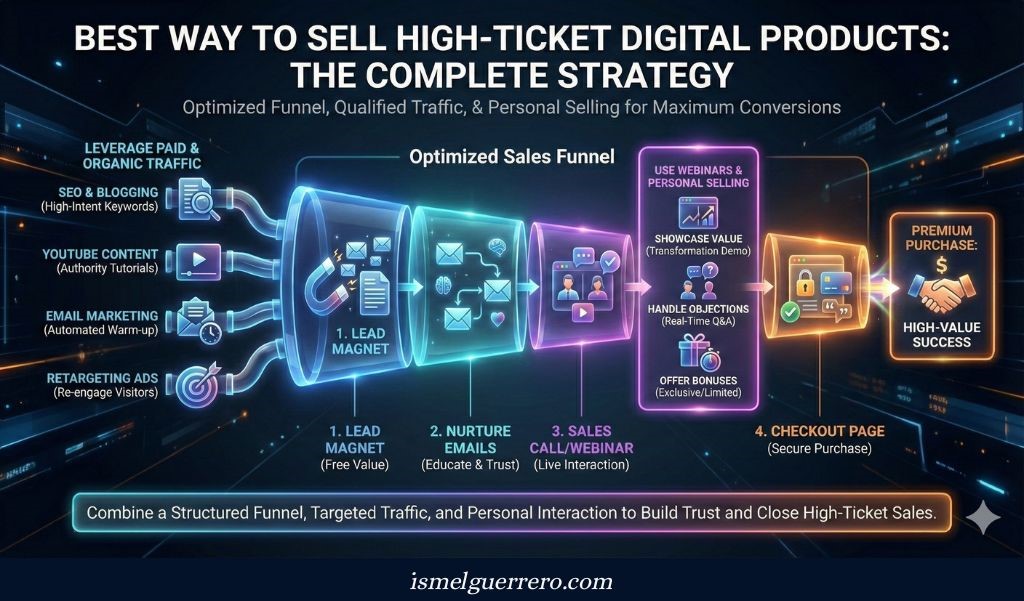
How to Sell High-Ticket Digital Products
Marketing creates awareness and interest.
Selling helps an interested buyer evaluate the offer and complete the purchase.
The right sales process depends on the product.
A $1,500 self-serve course may sell through a detailed product page. A complex enterprise software product may require demonstrations, technical evaluation, and multiple conversations.
High ticket does not automatically mean sales call.
Direct Checkout
Some buyers can evaluate the product without speaking with anyone.
Direct checkout may work when:
- The offer is easy to understand
- Pricing is clear
- The product is standardized
- Buyers can review enough information independently
- The perceived risk is manageable
A strong product page should explain:
- What the product is
- Who it is for
- What is included
- Price
- Delivery
- Support
- Refund or cancellation terms
- Important limitations
The checkout process should make the commitment clear.
Product Demonstrations and Trials
Demonstrations are useful when the product’s value is easier to understand through use.
Software is the clearest example.
A prospect may need to see:
- Interface
- Workflow
- Features
- Integrations
- Reporting
- Setup requirements
Trials can also help buyers evaluate fit directly.
The goal is not to show every feature. It is to demonstrate the parts relevant to the buyer’s problem.
Webinars and Workshops
Webinars can work when education is part of the buying process.
A useful webinar might:
- Explain the problem
- Teach part of the method
- Demonstrate the product
- Answer common questions
- Clarify who the offer is for
- Present the next step
The webinar should still stand on useful information even if the attendee does not buy.
Sales Calls and Consultations
A conversation can make sense when the product is expensive, complex, customized, or dependent on buyer fit.
The purpose should be diagnosis and clarification.
A useful sales conversation explores:
- What the buyer needs
- What they have already tried
- What matters most
- Whether the product fits
- What implementation requires
- What the buyer should expect
- What concerns remain
Not every prospect should be pushed toward a purchase.
If the product is not a fit, that is useful information.
Make the Next Step Clear
The buying process should not become confusing near the end.
The next step may be:
- Complete checkout
- Start a trial
- Sign an agreement
- Schedule onboarding
- Invite another decision-maker
- Review a proposal
- Decide not to proceed
Clarity reduces unnecessary friction.
Follow Up With a Reason
Follow-up can help when the buyer still has an open decision.
Useful reasons include:
- Sending information they requested
- Answering a question
- Clarifying pricing
- Following up after a demo
- Confirming whether they want to continue
- Reminding them of a real deadline
Repeated messages with no new purpose can become pressure.
Onboarding Is Part of the Sale
The sale is not complete from the customer’s perspective when payment is processed.
The buyer still needs to receive what was promised and understand what happens next.
Good onboarding can include:
- Access instructions
- Setup guidance
- Product orientation
- Support information
- Expectations
- Next steps
A high-ticket product creates a higher expectation that the transition from purchase to use will be clear.
That matters whether you created the product yourself or are responsible for delivering it under a resale arrangement. Affiliates usually do not control onboarding, which is another reason to evaluate the merchant’s customer experience before promoting the offer.
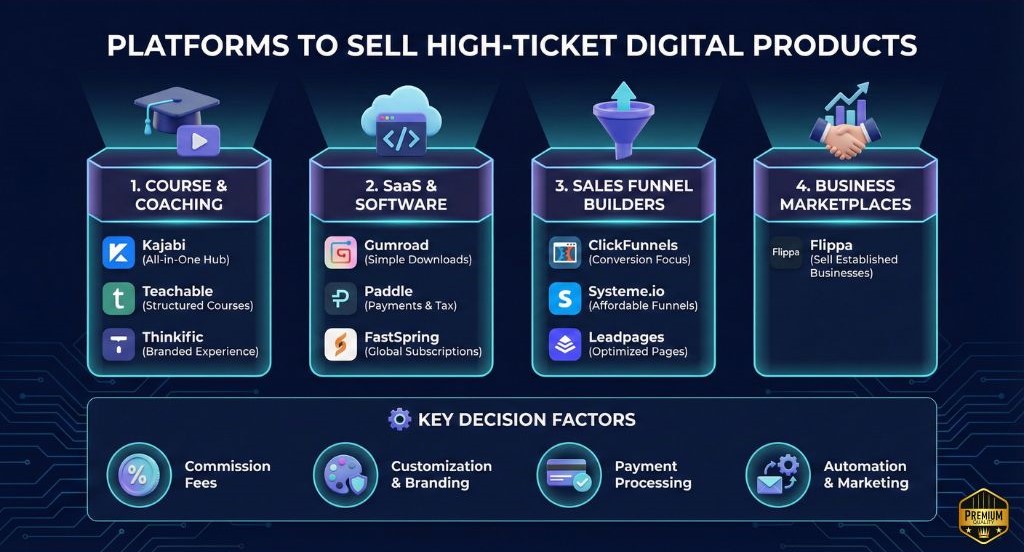
Platforms for Selling High-Ticket Digital Products
The best platform depends on what you are selling and how customers need to receive it.
A course creator, SaaS company, MRR reseller, and affiliate may all work with high-ticket digital products, but they do not need the same infrastructure.
Start with the business model before choosing the software.
Course, Membership, and Knowledge Platforms
Creators selling courses, memberships, communities, coaching-supported programs, or downloadable resources may benefit from platforms that combine product delivery with payments and customer management.
Common options include Kajabi, Teachable, and Thinkific.
Kajabi combines digital products, communities, websites, funnels, email, checkout, and other marketing functions within the same platform. Teachable supports courses, coaching products, memberships, and digital downloads, while Thinkific focuses primarily on creating and selling courses and communities.
These platforms can reduce the number of separate systems required to launch a product.
That does not make an all-in-one platform automatically better.
Consider:
- Product type
- Monthly cost
- Transaction fees
- Checkout options
- Payment plans
- Course or membership delivery
- Email capabilities
- Affiliate functionality
- Customization
- Customer experience
A creator who needs only simple delivery and checkout may not benefit from paying for an extensive marketing suite.
Software and Subscription Commerce
Software products have different requirements.
A SaaS company may need:
- Recurring billing
- Subscription management
- Trials
- Plan upgrades and downgrades
- Invoicing
- Tax handling
- Fraud management
- International payments
Platforms such as Paddle and FastSpring are designed around software and digital commerce rather than course creation.
Both operate as Merchant of Record providers, meaning they can take responsibility for areas such as payment processing, tax collection and remittance, and other transaction-related obligations while supporting subscriptions and digital-product sales.
This can simplify international selling, but the fees and level of control should still be compared with alternatives.
Funnel and Checkout Tools
Some sellers need more control over the marketing and checkout process than a traditional course platform provides.
A funnel or checkout system can support:
- Landing pages
- Lead capture
- Sales pages
- Order forms
- Upsells
- Email follow-up
- Webinar registration
- Multiple offer stages
These tools can be useful when the product requires a more structured path from initial interest to purchase.
They are not a requirement for high-ticket selling.
A complicated funnel cannot compensate for poor product-market fit, unclear pricing, or weak buyer value.
Selling Products With MRR or Other Resale Rights
Licensed digital products can often be sold through many of the same checkout and delivery tools used for original products.
The more important question is what the license permits.
Before choosing a platform, confirm:
- Where you are allowed to sell the product
- Whether marketplace selling is permitted
- Whether you can change the price
- Whether you can modify the branding
- How files must be delivered
- Whether customers receive resale rights
- Whether specific license documents must accompany the product
Do not assume that purchasing an MRR product gives unrestricted selling rights.
The platform handles the transaction. The license determines what you are legally permitted to sell and how.
For a deeper explanation of these licensing rules, see our guide to Master Resell Rights (MRR).
Affiliate Marketing Requires Different Infrastructure
Affiliates usually do not need to host, deliver, or process payment for the underlying digital product.
The merchant handles those functions.
Instead, the affiliate may need:
- A website or publishing platform
- Email marketing
- Analytics
- Affiliate-link tracking
- Search or social content
- Disclosure practices
- Conversion reporting
This is an important distinction.
A creator or reseller needs infrastructure to complete and fulfill the sale. An affiliate primarily needs infrastructure to reach the right audience and send qualified referrals to the merchant.
Choose the Platform Around the Business Model
Do not choose a platform simply because it is popular in the digital-product market.
Start with what the buyer needs to experience.
A course may need structured lessons and student access. Software needs account provisioning and subscription management. An MRR product may require straightforward checkout and file delivery. An affiliate may not need product delivery at all.
The best platform is the one that supports the transaction without adding unnecessary complexity.
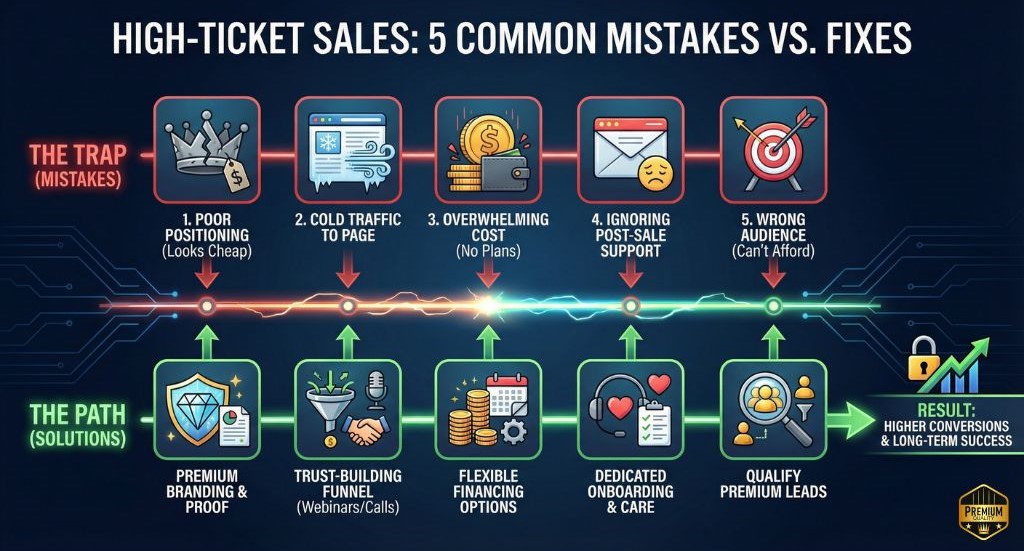
Common Mistakes With High-Ticket Digital Products
Many problems with high-ticket digital products begin before the marketing campaign or sales funnel.
They start with the product, positioning, economics, or assumptions behind the offer.
Charging More Without Creating Enough Value
A higher price needs a reason.
Changing a $99 product to $999 does not make the product more useful.
If the premium version provides greater depth, functionality, support, access, convenience, or another meaningful benefit, explain the difference clearly.
If the difference is mostly branding and promotional language, buyers may struggle to justify the price.
Choosing a Product Because of the Price or Commission
Creators can become attracted to higher selling prices.
Affiliates can become attracted to larger commissions.
Resellers can become attracted to large theoretical markups.
None of those factors establishes buyer demand.
Start with the product and audience.
A smaller commission or lower-priced product that solves a real problem can be more valuable than an expensive offer with weak fit.
Ignoring License Terms
This is particularly important for MRR, Resell Rights, and PLR products.
Do not assume that buying the product gives you unrestricted rights.
The license may control:
- Editing
- Branding
- Pricing
- Distribution
- Marketplace use
- Resale-right transfer
- Promotional methods
Read the actual license before building a sales strategy around the product.
Assuming Resale Rights Create Demand
Permission to sell something does not create a market for it.
An MRR product may be easy to acquire while still being difficult to differentiate from hundreds of identical offers.
Evaluate the product as though resale rights did not exist.
- Would the end customer still want it?
- Would they still find it useful?
- Would the price still make sense?
Those questions reveal whether the product has value beyond the resale opportunity itself.
Making Unsupported Income or Outcome Claims
High-ticket marketing often becomes aggressive when sellers try to justify a larger price.
Be particularly careful with claims involving:
- Income
- Revenue
- Career advancement
- Business growth
- Investment returns
- Health outcomes
- Guaranteed savings
- Guaranteed results
Evidence needs to support the specific claim being made.
A successful customer example does not establish what every buyer should expect.
Using Artificial Scarcity
Real scarcity can be explained.
Examples include:
- Limited live-session capacity
- A genuine enrollment deadline
- A scheduled cohort start
- A documented pricing change
- Limited inventory for a service component
Artificial countdowns and invented deadlines create pressure without changing the underlying value of the product.
The buyer should be able to distinguish a genuine constraint from a sales tactic.
Selling to the Wrong Buyer
A strong product can still fail when the audience is wrong.
A beginner may not need enterprise software.
A casual hobbyist may not need advanced professional training.
A small business may not benefit from a system designed for large organizations.
High-ticket selling becomes easier when the product matches the buyer’s actual level, needs, and budget.
Underestimating Support and Fulfillment
Digital does not mean effortless.
High-ticket customers may need:
- Technical assistance
- Onboarding
- Product updates
- Account support
- Implementation guidance
- Refund handling
- Community management
Creators and resellers should account for those responsibilities before setting the price.
Affiliates should evaluate whether the merchant provides an experience they are comfortable recommending.
Assuming a Funnel Can Fix a Weak Product
Funnels can organize a buying journey.
They cannot create genuine product value.
If buyers do not understand the offer, the first step is not necessarily another email sequence, webinar, upsell, or landing page.
Review:
- The problem
- Product
- Audience
- Price
- Differentiation
- Evidence
Marketing systems work better when those fundamentals already make sense.
Confusing Revenue With Profit
High-ticket products can generate more revenue per sale.
That does not mean every sale produces a large profit.
Creators may have development, marketing, support, affiliate, platform, and fulfillment costs.
Resellers may have licensing and acquisition costs.
Affiliates may spend significant amounts producing content or acquiring traffic before earning a commission.
Evaluate what remains after the relevant costs rather than focusing only on the transaction value.
Conclusion
High-ticket digital products are not simply ordinary digital products with larger price tags.
The higher price needs to be supported by something meaningful to the buyer, whether that is specialized knowledge, advanced functionality, professional utility, access, support, convenience, or a solution to a problem worth paying more to solve.
There is also more than one way to participate in the market. You can create your own product, sell an existing product under appropriate resale rights, or promote another company’s product as an affiliate. Each route changes how much control you have, which costs you carry, and what responsibilities come with the sale.
The same principle applies across all three models: evaluate the product before evaluating the earning opportunity.
A large commission does not make a poor affiliate offer attractive. MRR does not create demand for a weak product. A premium price does not turn a basic product into a premium solution.
Start with the buyer and the problem. Then evaluate the product, business model, economics, pricing, and sales process around that reality.
When those pieces fit together, high-ticket digital products can support a viable business without relying on exaggerated promises or pricing tricks. When they do not, a higher price only makes the weaknesses more expensive.
Frequently Asked Questions
What Is Considered a High-Ticket Digital Product?
A high-ticket digital product is a relatively expensive digital offer compared with typical alternatives in the same market.
There is no universal price threshold. What counts as high ticket depends on the product category, target buyer, market expectations, and the value being offered.
Do High-Ticket Digital Products Have to Cost $1,000 or More?
No fixed amount determines whether a digital product is high ticket.
A $500 product may represent a substantial purchase in one market, while a $1,000 product may be relatively modest in another. The better measure is how significant the purchase is for the intended buyer and how it compares with similar solutions.
What Are Examples of High-Ticket Digital Products?
Examples can include advanced online courses, certification programs, business software, SaaS subscriptions, premium memberships, specialized databases, professional research, digital systems, and larger template or resource bundles.
Hybrid programs may also combine digital resources with live support, feedback, or training.
Can I Sell a Digital Product I Did Not Create?
Yes, but you need the appropriate rights or business arrangement.
You may be able to sell an existing product under a resale-rights license, including certain Master Resell Rights arrangements. Another option is affiliate marketing, where you promote the product and earn a commission rather than reselling it yourself.
Always check the specific license or affiliate terms before promoting or selling the product.
What Is the Difference Between MRR and Affiliate Marketing?
Master Resell Rights generally give you a license to resell a digital product according to specific terms. Depending on the license, your customers may also receive resale rights.
Affiliate marketing works differently. You refer customers to the merchant and receive a commission when an eligible referral converts. You generally do not own the product, control the price, or fulfill the sale.
Are MRR Products High Ticket?
Some can be, but MRR itself does not determine the price.
Master Resell Rights describe the permissions attached to the product. An MRR product can be low priced, mid priced, or high ticket depending on the offer and market.
The resale rights also do not establish product quality or demand.
Are High-Ticket Digital Products More Profitable?
Not automatically.
A higher selling price increases revenue per completed sale, but profitability depends on costs such as customer acquisition, product development, licensing, affiliate commissions, platform fees, payment processing, support, refunds, and fulfillment.
The relevant question is what remains after those costs.
Can Beginners Sell High-Ticket Digital Products?
Yes, but a beginner still needs to understand the product, audience, pricing, and sales process.
Starting with one clearly defined market and a product that solves a specific problem is usually more manageable than trying to sell several unrelated premium offers.
Do I Need a Sales Call to Sell a High-Ticket Digital Product?
Not necessarily.
Some high-ticket products can sell through a detailed product page, demonstration, free trial, webinar, or direct checkout.
Sales calls become more useful when the offer is complex, customized, expensive, or requires qualification before purchase.
How Do I Know if a High-Ticket Digital Product Is Worth Selling?
Start with the buyer.
Look at the problem being solved, existing demand, product quality, price, competing alternatives, differentiation, support, reputation, and the economics of your particular business model.
If you would struggle to explain why the product is worth buying without mentioning the commission, resale rights, or earning opportunity, that is a sign to evaluate the offer more carefully.
What Platform Should I Use to Sell High-Ticket Digital Products?
The right platform depends on what you are selling.
Course and membership creators may need hosting, checkout, student access, and community features. SaaS businesses need subscription billing and account management. MRR resellers may need checkout and digital delivery, while affiliates generally need publishing, email, analytics, and tracking rather than product fulfillment.
Choose the platform around the business model rather than the popularity of the software.

2 Comments
Digital Products: Guide to Selling, Marketing, and Scaling for 2025 - Ismel Guerrero. · March 16, 2025 at 7:19 pm
[…] Next, check out our High Ticket Digital Products Guide. […]
High Ticket Sales: How to Close Premium Clients - Ismel Guerrero. · April 12, 2025 at 12:29 pm
[…] offerings exist across a wide range of industries — learn more about different high ticket products and services to find the right fit for your […]