Search visibility used to be easier to picture. A person entered a query, reviewed a list of results, and chose which page to visit.
AI search changes that path. A generative system can retrieve information from several sources, compare it, and produce an answer before the user visits any website. The system may cite its sources, mention a brand without linking to it, or use information without making the original contribution obvious.
Generative engine optimization, or GEO, addresses this new visibility problem. It focuses on making useful information easier for AI search systems to discover, understand, verify, and represent accurately.
That does not mean writing for machines or chasing every new AI search tactic. Effective GEO begins with a more demanding question: Does this page contain information that deserves to become part of the answer?
- GEO improves a source’s chances of contributing to generated answers. Visibility may include citations, links, mentions, or accurate representation inside an AI-produced response.
- GEO does not replace SEO. AI search systems still depend on accessible pages, clear site architecture, relevant content, and many of the same signals that support traditional search visibility.
- Being discoverable is only the first requirement. A source must also contain information that is relevant, credible, understandable, and useful to the answer being created.
- Original contributions create stronger reasons to use a source. Firsthand research, expert analysis, transparent comparisons, practical examples, and maintained reference material offer more than summaries of existing pages.
- Citation-friendly writing preserves context. Important claims should be direct, supported, and qualified so they remain accurate when extracted from the surrounding page.
- GEO performance cannot be reduced to one ranking. Useful measurements include AI search impressions, source citations, brand mentions, representation accuracy, referral visits, and business outcomes.
Disclaimer: I am an independent Affiliate. The opinions expressed here are my own and are not official statements. If you follow a link and make a purchase, I may earn a commission.
What GEO Actually Optimizes
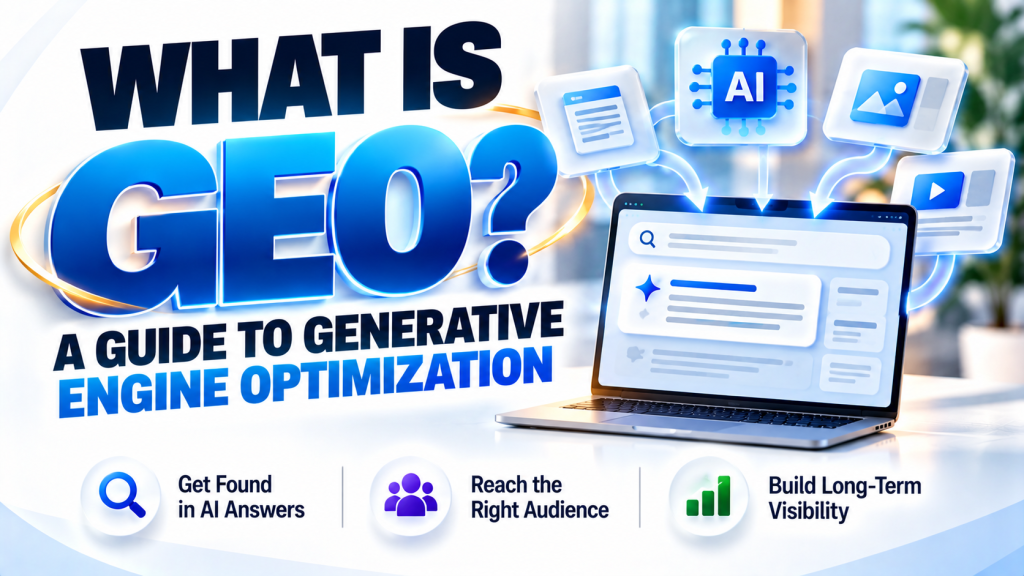
GEO stands for generative engine optimization. It describes the process of improving how a source appears, contributes, or is represented in answers produced by generative search systems.
The term became widely known through the research paper GEO: Generative Engine Optimization. The researchers proposed a framework for measuring the visibility of sources inside generative responses, where information from several websites may be combined into one answer.
This is an important distinction. Traditional search visibility is often associated with a page’s position in a ranked list. Generative visibility can take several forms:
- A source may be cited next to a specific statement.
- A page may be linked as supporting material.
- A brand, product, person, or organization may be mentioned.
- Information from a source may influence the answer without receiving a prominent citation.
- A source may appear in one response but disappear when the query is phrased differently.
GEO therefore deals with more than whether a page ranks. It considers whether the information can be found, selected, attributed, and represented correctly.
The term is still evolving. Search platforms do not use one standard retrieval process, citation method, or visibility metric. The original GEO research introduced a framework for improving and measuring source visibility, but it did not establish a universal formula that applies to every generative system.
AI Search Creates a Different Visibility Problem
A traditional search result gives the user a set of pages to evaluate. A generative answer performs more of that evaluation before presenting the response.
This creates three separate visibility challenges.
The source must be retrievable. The system needs to know the page exists and must be able to access or receive information about it.
The information must be useful to the answer. A page can be indexed and still contribute nothing distinctive to the response.
The source must be represented accurately. Even when information is selected, the final answer may simplify it, combine it with other material, or remove qualifications that were important to the original meaning.
A page can therefore succeed at one level and fail at another. It might be technically accessible but too generic to use. It might contain original information but explain it unclearly. It might influence an answer but receive no visible attribution.
That is why GEO cannot be treated as a simple extension of keyword placement. It is partly a technical visibility problem, partly a content quality problem, and partly a source credibility problem.

How AI Search Finds and Uses Sources
Every platform has its own systems, data sources, and product rules. The exact process is rarely visible from the outside. Still, source-based generative search generally depends on three broad stages.
Discovery and access
Before a system can use a page, it needs a path to that page or its information.
For search-connected AI products, discovery may depend on web crawlers, search indexes, data partnerships, third-party search providers, or other retrieval systems. Blocking the relevant crawler can limit how a platform accesses the content.
Technical SEO still matters at this stage. Important pages should be accessible, internally linked, indexable where appropriate, and available in a format the intended platform can process.
Platform controls are not identical. For example, OpenAI explains that publishers should allow OAI-SearchBot if they want their content to be considered for summaries and snippets in ChatGPT search. Its publisher guidance also explains how ChatGPT referral visits can be identified.
Retrieval and passage selection
After discovering possible sources, the system must decide which documents or passages are relevant to the question.
Some generative search experiences use retrieval-augmented generation. The model receives information retrieved from an index or another search system before producing its response. Some systems also issue several related searches to collect information about different parts of a complex question.
A query about choosing accounting software, for example, might cause the system to look for pricing, business size, integrations, reporting capabilities, support options, and implementation requirements. A page does not need to repeat every version of the original query. It needs to offer useful information for one or more parts of the decision.
Google describes how its AI search features may use retrieval and related query fan-out to identify supporting web pages. The exact sources shown can vary because different questions, models, and search paths may produce different results.
Synthesis and attribution
Once information has been retrieved, the system creates the answer.
It may summarize one source, reconcile several sources, compare competing claims, or select one explanation over another. Citations may appear next to individual statements, in a list of supporting links, or elsewhere in the interface.
This stage creates the central limit of GEO. A publisher can improve the source, but it cannot fully control the final synthesis.
The system decides:
- Which sources to use.
- Which passages matter.
- How much context to retain.
- Which sources receive visible attribution.
- How the answer is worded.
- Whether a citation or link is displayed.
GEO can reduce avoidable ambiguity. It cannot guarantee that an external system will interpret or cite the source exactly as its publisher intended.
GEO, SEO, and AEO Solve Different Parts of the Problem
SEO, AEO, and GEO are often discussed as separate disciplines. In practice, they overlap.
| Approach | Primary focus | Main question |
|---|---|---|
| SEO | Visibility in search systems and organic results | Can the page be discovered, understood, and considered relevant? |
| AEO | Clear responses to direct questions | Can a system identify a concise and accurate answer? |
| GEO | Source use inside a generated response | Can the source contribute to, support, or be cited in a synthesis? |
SEO (Search Engine Optimization)
SEO provides much of the foundation.
If a page cannot be crawled, indexed, understood, or trusted, its opportunity to appear in search-connected AI experiences may be limited.
AEO (Answer Engine Optimization)
AEO focuses more closely on the answer itself.
It encourages direct definitions, clear explanations, useful summaries, and language that addresses a specific question without forcing the reader to search through the page.
GEO (Generative Engine Optimization)
GEO considers the broader role of the source.
The system may not need one short answer. It may need evidence, comparisons, qualifications, original findings, or supporting context from several parts of a page.
A Source Has to Be Worth Retrieving
A page cannot create meaningful visibility merely by arranging familiar information into a new order.
Generative systems can already summarize common knowledge. If a page repeats the same basic explanations found across dozens of websites, there may be little reason to select or cite that particular source.
Source-worthy content contributes something identifiable.
That contribution might include:
- Original research or proprietary data.
- A firsthand test, experience, or observation.
- Expert analysis that explains why something happens.
- A maintained reference page with current information.
- A transparent comparison based on clear criteria.
- A useful definition for a poorly explained concept.
- A case study that includes context, decisions, and limitations.
- A practical framework that helps the reader evaluate a problem.
- A tool, calculator, dataset, or other usable resource.
Originality does not always require a large research budget. A small company can document lessons from its own work, publish anonymized patterns from customer questions, test commonly repeated advice, or explain a process that larger competitors describe only in general terms.
Google’s guidance for AI search emphasizes unique, useful content that adds something beyond easily reproduced summaries. This is not a separate AI writing formula. It is a reason to publish information that people and search systems cannot obtain from any interchangeable page.
Make Important Claims Easy to Verify
A source becomes easier to trust when the reader can see where its claims come from.
Consider the difference between these statements:
Shorter articles perform better in AI search.
In our analysis of 250 cited pages, articles under 1,500 words received more citations for definition-based queries. The same pattern did not appear for product comparisons.
The second statement is more useful because it identifies the evidence, scope, and limitation. It does not turn one observation into a universal rule.
Strong claims usually make five things clear:
- What is being claimed. The conclusion should not be hidden beneath vague wording.
- What supports it. Name the research, source, method, experience, or observation.
- Where it applies. Explain the industry, audience, location, platform, or situation.
- When it applies. Add dates when freshness changes the meaning.
- What limits it. Keep important exceptions close to the claim.
This does not mean every paragraph should be reduced to a small “AI-friendly chunk.” Short passages can be useful, but splitting complex ideas into isolated statements can destroy the context that makes them accurate.
The goal is not maximum extractability. It is safe extractability. A statement should remain understandable and defensible if a system uses it outside the full page.
Build GEO Around the Pages You Already Need
A common response to AI search is to create a separate page for every question or prompt variation. That approach can produce a large collection of thin, repetitive pages.
A better starting point is to identify the pages that already matter to the audience and improve their source value.
These may include:
- Cornerstone guides that explain an important subject.
- Product or service pages that contain precise factual information.
- Research pages with data and methodology.
- Comparison pages that support a real decision.
- Documentation that answers implementation questions.
- Case studies that show how a result was achieved.
- Expert commentary on issues where interpretation matters.
Each page should have a clear purpose. Related questions can be answered when they strengthen that purpose, but the page should not become a warehouse for every phrase a person might enter into a search box.
This approach protects the publication from producing content that exists only for a platform. It also creates pages that remain useful when search interfaces, models, or terminology change.
A Practical GEO Workflow
GEO becomes more manageable when it is treated as an editorial and technical process rather than a collection of isolated tactics.
1. Identify questions that require synthesis
Start with questions that cannot be answered well by a definition alone.
Comparisons, recommendations, planning questions, troubleshooting problems, and research-based decisions often require several pieces of information. These are natural areas where a generative system may assemble an answer from multiple sources.
Record the main question, the decisions behind it, and the evidence a trustworthy answer would need.
2. Audit the current source landscape
Review which pages and organizations are already being cited or mentioned for those questions.
Do not limit the audit to your own website. Look at trade publications, research organizations, government resources, discussion communities, video sources, company documentation, and expert commentary.
The purpose is not to copy what appears. It is to identify the information the current source landscape already provides and the gaps it leaves unresolved.
3. Decide what your source can contribute
Before creating or revising a page, define the contribution. Ask:
- What do we know from direct experience?
- What evidence can we publish?
- What can we explain more clearly?
- Which claim needs better qualification?
- What information is outdated or poorly maintained elsewhere?
- What decision can we help the reader make?
If the only contribution is another summary of existing summaries, the page may need a stronger reason to exist.
4. Put evidence close to the claim
Do not force readers or retrieval systems to connect a statement in one section with its support several screens away.
When possible, place the relevant statistic, source, example, date, method, or qualification near the claim it supports. Use descriptive link text so the relationship is clear.
This improves human trust while reducing the chance that an extracted statement loses its basis.
5. Maintain technical access
Confirm that priority pages can be discovered and processed by the platforms that matter to the organization. Review:
- Crawl and index controls.
- Canonical URLs.
- Internal linking.
- Page rendering.
- Important information hidden inside scripts or images.
- Structured data accuracy.
- Relevant crawler permissions.
- Snippet and preview controls.
Technical access creates eligibility, not guaranteed inclusion. A crawlable page still needs a useful contribution.
6. Strengthen independent confirmation
A company can publish accurate information about itself, but independent references may help systems and readers evaluate that information.
Earned coverage, expert citations, legitimate reviews, research partnerships, and mentions from relevant organizations can strengthen the source environment around a topic or entity.
The goal is not to manufacture mentions. It is to give credible people and publications something worth evaluating, discussing, or referencing.
7. Monitor representation and revise
Review how important topics, claims, products, and entities appear across relevant AI search experiences. Look for:
- Incorrect descriptions.
- Missing qualifications.
- Outdated facts.
- Weak or absent citations.
- Competitor claims presented without context.
- Questions for which no strong source appears.
- Pages receiving visibility but failing to satisfy visitors.
Use those observations to improve the underlying source. Avoid reacting to one answer as if it were a permanent ranking. Generated responses can change with the prompt, user, date, model, location, and available sources.
GEO Is Not a Special Markup Strategy
Emerging fields attract shortcuts. GEO has produced claims about special files, ideal word counts, artificial content “chunking,” guaranteed schema types, and large networks of manufactured mentions.
These ideas confuse technical eligibility with source value.
Structured data can still support established search features when it accurately describes visible content. It does not guarantee inclusion in a generated answer.
Clear sections and descriptive headings help readers navigate a page. They should not be used to break every thought into tiny fragments.
An llms.txt file may be used or tested by certain services, but it is not a universal visibility requirement. Google specifically states that it does not require special AI files or markup for its generative search features.
Producing a page for every prompt variation is also risky. A large number of unoriginal pages does not make a website more authoritative. Google warns that using generative tools to create many pages without adding value may violate its scaled content abuse policies.
The better principle is simple: improve the information, not the illusion of optimization.

How to Measure GEO Performance
There is no universal GEO ranking. A generated response can vary across prompts and platforms, and a source can influence an answer without receiving a click.
Measurement therefore requires several signals.
AI search visibility
Track whether important pages appear as citations, links, or supporting sources for a defined set of questions.
Google now provides a generative AI performance report in Search Console. The report includes impressions from supported AI search features and allows site owners to review performance by page, date, country, and device. Google explains the available data in its Generative AI performance report documentation.
Citation and mention presence
Record when the organization, website, research, products, experts, or original claims appear in generated responses.
A mention is not the same as a citation. Track them separately so a brand reference does not get mistaken for linked source visibility.
Representation accuracy
Review whether the answer describes the source correctly.
A prominent mention can be harmful if the information is outdated, misleading, or missing an important qualification. Accuracy should therefore be measured alongside visibility.
Referral traffic
Use analytics to identify visits from AI search platforms when referral information is available.
Traffic remains important, but it should not be the only measure. Some users may discover a brand through a generated answer and return later through branded search, direct navigation, or another channel.
Assisted outcomes
Look for changes in actions that may follow AI discovery, including:
- Branded searches.
- Product page visits.
- Email signups.
- Demo requests.
- Downloads.
- Leads.
- Sales conversations.
- Conversions attributed to AI referrals.
These signals require careful interpretation. They can help show whether visibility is reaching the right audience, but they do not prove that one citation caused the outcome.
Performance over time
Use a stable group of representative questions and test them on a regular schedule.
Record the platform, date, query, source links, brand mentions, and notable inaccuracies. A repeated sample is more useful than a screenshot of one favorable response.
What GEO Cannot Control
GEO can improve a source’s eligibility, usefulness, and clarity. It cannot force a platform to retrieve or cite it.
A strong source may still be omitted because of:
- Query wording.
- Product-specific source preferences.
- Index or crawler limitations.
- Geographic or account differences.
- Freshness requirements.
- Personalization.
- Model updates.
- Interface changes.
- Competing sources.
- Variations in generated responses.
This uncertainty does not make GEO meaningless. It changes how the work should be managed.
GEO is best treated as probability and quality control. The objective is to increase the likelihood that a system can find and use accurate information while reducing the likelihood that the source will be misunderstood.
Any service promising guaranteed AI citations, permanent placement, or universal visibility is offering more certainty than the systems allow.
Strong GEO Starts With a Strong Source
The most durable GEO strategy does not begin with an AI search hack. It begins with information that deserves to be found.
Make the page accessible. Give it a clear purpose. Contribute something that is not interchangeable with every competing result. Support important claims. Preserve necessary context. Keep time-sensitive information current. Then monitor how external systems represent it.
SEO helps the source become discoverable. Answer-focused writing helps individual explanations become clear. GEO brings those pieces together around a broader concern: whether the source can play a useful and trustworthy role in a generated answer.
The platforms will continue to change. A strong source remains valuable because it gives both people and machines a better foundation for understanding the subject.
Frequently Asked Questions
Is GEO replacing SEO?
No. GEO depends on many SEO foundations, including crawlability, indexability, relevance, site structure, and content quality. GEO adds attention to how a source contributes to generated answers, but it does not remove the need for search optimization.
Can a small website compete in generative search?
Yes, when it contributes information larger websites do not provide. Firsthand expertise, specialized data, local knowledge, original tests, and clearly documented experience can give a small publisher a legitimate reason to be used as a source.
Should every article be rewritten for GEO?
No. Prioritize pages that support important topics, decisions, products, research, or recurring questions. Revise a page when its contribution, evidence, clarity, freshness, or technical access can be improved.
Does AI-generated content hurt GEO performance?
The use of AI does not automatically make content weak. The problem is publishing unoriginal or unreliable material that adds little for the reader. AI-assisted content still needs human judgment, factual review, useful evidence, and a clear reason to exist.
How long does GEO take to produce results?
There is no fixed timeline. Discovery, indexing, source selection, platform updates, and the competitiveness of the topic can all affect visibility. Measure changes over repeated samples rather than expecting a predictable ranking date.

0 Comments