Introduction
Multi-level marketing can look unusually accessible compared with starting a business from scratch.
The product already exists. The company provides the brand, ordering system, compensation plan, and often some form of training. Instead of developing an offer and building an operation from zero, a new participant can enter an established system and begin selling.
That simplicity is part of the appeal.
It can also make an MLM opportunity easy to evaluate at the wrong level.
A low enrollment cost says little about what participants eventually earn. A recognizable product does not prove that customers will buy it at the required price. Successful distributors show that substantial income is possible for some people, but their results do not tell a new participant what is reasonably likely.
In this guide, you’ll look beyond the pitch and learn how to evaluate MLM as a real business opportunity, so you can decide whether it deserves your time, money, and effort.
- MLM can be easier to start than a traditional business, but that convenience comes with less control.
- Compensation can depend on far more than personal sales, including team volume, ranks, and qualification rules.
- Gross commissions can look impressive until product purchases, fees, events, and other expenses are deducted.
- Top-earner stories show what is possible, not what most participants are likely to experience.
- Real products do not automatically make an MLM legitimate. The compensation structure and customer demand matter.
- Recruitment pressure, recurring purchases, vague income disclosures, and exaggerated earnings claims deserve scrutiny.
- MLM may offer flexibility, but it can be a poor fit if you need predictable income or want to build assets you control.
- The real test is whether the expected return justifies the money, time, risk, and opportunities you give up.
Disclaimer: I am an independent Affiliate. The opinions expressed here are my own and are not official statements. If you follow a link and make a purchase, I may earn a commission.

What Is Multi-Level Marketing?
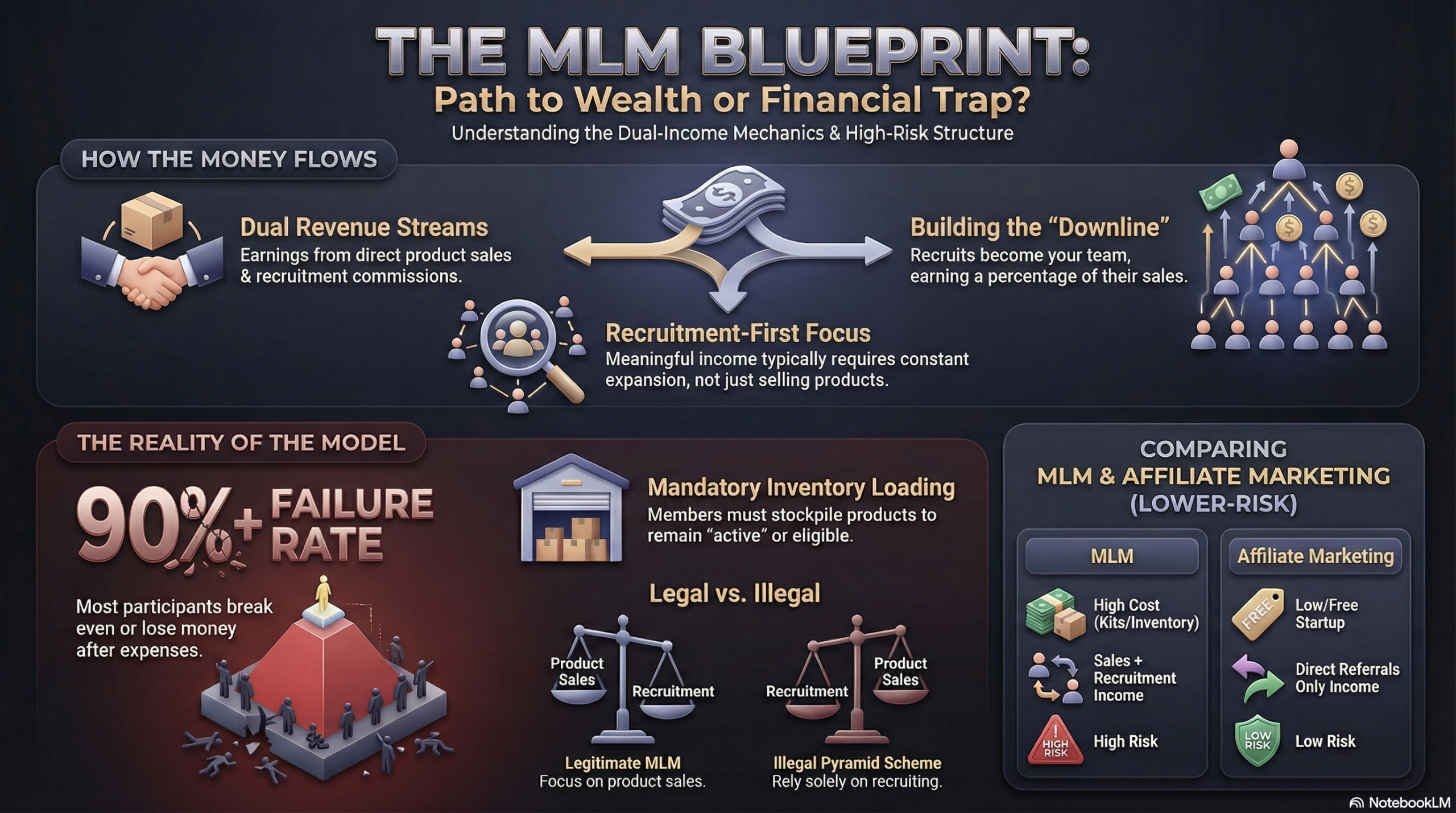
Multi-level marketing, commonly shortened to MLM, is a sales model in which independent participants sell a company’s products or services and may also earn compensation connected to sales generated through other participants in their organization.
Companies use different names for these participants, including:
- Distributor
- Representative
- Associate
- Consultant
- Independent contractor
The basic structure separates MLM from a traditional salaried job.
You are generally not hired as an employee receiving a fixed wage. Instead, compensation depends on activity defined by the company’s plan.
The FTC’s consumer guidance on multi-level marketing describes two common ways MLM participants may earn money: selling products to retail customers and earning commissions connected to purchases and retail sales generated through their sales network.
Where the Multi-Level Part Comes In
Suppose you join an MLM and sell products directly to customers.
Those are your personal sales.
If you introduce another participant to the business, that person may become part of your downline. Additional people recruited beneath them can create further levels.
Your upline consists of participants above you in the organization.
Depending on the compensation plan, sales activity generated across some of those levels may contribute to commissions, bonuses, rank qualifications, or other rewards.
That layered structure creates the “multi-level” component.
Recruiting someone does not necessarily mean you receive money simply because they joined. The actual compensation depends on what the company’s plan rewards.
MLM, Network Marketing, and Direct Selling
The terminology around this industry is not perfectly standardized.
Network marketing is commonly used as another name for MLM, although some businesses use the term more broadly for relationship-based selling.
Direct selling describes selling products or services directly to consumers rather than relying primarily on traditional retail stores.
An MLM may use direct selling, but direct selling does not automatically require a multi-level compensation structure.
The practical issue is not which label appears in the presentation. What matters is how participants are expected to sell, recruit, purchase, and earn.
How Does Multi-Level Marketing Work?
Joining an MLM usually means entering a business system designed by someone else.
The company controls the product, brand, compensation structure, and participation rules. Your role is to generate activity inside that system.
Although details vary, the process often follows a recognizable pattern.
Joining the Company
A new participant typically registers with the MLM and agrees to its distributor terms.
Depending on the company, starting may involve:
- An enrollment fee
- Starter materials
- Initial products
- Training
- Access to a distributor portal
- Other participation requirements
Do not assume every MLM has the same startup structure.
The important question is what you must spend before you can realistically begin selling and what expenses continue afterward.
Selling Products or Services
Retail sales are the most straightforward source of potential revenue.
A participant may earn through a retail margin, commission, or another arrangement when a customer purchases the company’s product.
For example, a distributor might buy at one price and sell at another, or the customer might order directly through a company-managed website that attributes the transaction to the distributor.
The exact mechanics depend on the program.
Building a Downline
Many MLM opportunities also encourage participants to introduce other people to the business.
Those recruits can become part of the distributor’s organization.
As the network expands, the compensation plan may connect additional rewards to sales volume generated through that group.
This is where MLM begins to differ substantially from ordinary retail selling.
Generating Enough Activity to Qualify
Revenue does not necessarily flow from every sale occurring somewhere beneath you.
Compensation plans may impose conditions involving:
- Personal sales
- Team sales
- Monthly volume
- Rank
- Number of active participants
- Organizational structure
- Other qualification rules
A participant therefore needs to understand more than the advertised commission percentages.
They need to understand what must happen before those percentages apply.
Disclaimer: I am an independent Affiliate. The opinions expressed here are my own and are not official statements. If you follow a link and make a purchase, I may earn a commission.

How Does the MLM Business Model Function?
Multi-level marketing works by combining a company’s existing infrastructure with a network of independent participants who sell its products or services.
The company typically controls the product, brand, ordering system, fulfillment, participation rules, and compensation plan. Participants focus primarily on generating sales and, depending on the program, building a distributor organization.
That division of responsibilities can make MLM easier to enter than creating an independent business from scratch. It also means participants operate inside a system they do not fully control.
Independent Participants Handle Much of the Selling
Rather than relying only on traditional retail stores or an internal sales force, an MLM can use independent distributors to reach customers directly.
Those participants may sell through:
- Personal referrals
- Social media
- Events
- Existing relationships
- Online storefronts
- Other company-approved channels
The specific methods vary by company, but the basic idea remains the same: participants become part of the distribution and sales network.
The Company Provides the Infrastructure
Much of the underlying business already exists before a participant joins.
The company may provide:
- Products or services
- Branding
- Payment processing
- Ordering systems
- Fulfillment
- Marketing materials
- Training
- Distributor support
That existing infrastructure reduces some of the work required to get started.
The trade-off is control. Participants generally do not decide what products are created, how prices are set, or how the compensation system changes.
Incentives Direct Participant Activity
The compensation plan determines which activities can produce income.
Personal retail sales may generate commissions or margins. Team sales can contribute additional compensation. Ranks, bonuses, and qualification requirements may create further incentives.
Those rules matter because they influence what participants spend their time trying to accomplish.
A plan centered on retail selling creates different incentives from one where meaningful earnings depend heavily on building a large distributor organization.
That is why understanding the compensation plan is essential before evaluating the opportunity.
Customer Demand Still Has to Exist
Expanding a distributor network does not automatically create a healthy retail business.
Customers still need a reason to buy the product or service.
A useful question is:
Would people continue buying this product at this price if there were no income opportunity attached to it?
Strong genuine demand gives participants something customers already want to purchase. Weak demand can make the business increasingly dependent on activity inside the distributor network itself.
That distinction becomes important when evaluating both the economics and the risks of an MLM.
The next step is understanding exactly how the compensation plan turns that activity into commissions, bonuses, and potential income.

How Do MLM Compensation Plans Work?
The compensation plan determines how activity becomes money.
That makes it one of the most important documents to understand before joining.
A recruiting presentation may simplify the model into “sell and build a team.” The actual plan can be considerably more complicated.
Retail Commissions
Personal retail sales may generate a direct margin or commission.
This is the part of the model most similar to ordinary selling.
If a customer buys a product because they want the product, the distributor may receive compensation tied to that transaction.
Retail demand matters because it tells you whether the product has an economic reason to exist outside the business opportunity itself.
Team or Downline Volume
Some plans also track sales or purchasing activity across the distributor organization.
That activity may be measured through points, volume, credits, or another internal system.
A participant might qualify for a percentage of certain sales generated within the downline.
The number of levels involved can depend on rank and plan design.
Ranks and Bonuses
MLM compensation plans often contain additional layers beyond basic commissions.
A participant may be able to reach higher ranks or qualify for bonuses by meeting particular conditions.
Those requirements can involve combinations of:
- Personal volume
- Team volume
- Active distributors
- Organizational structure
- Sales targets
- Rank advancement
Higher ranks may unlock additional compensation.
The important question is what behavior those requirements encourage.
Active Status and Purchase Requirements
Some plans require a participant to meet certain activity thresholds to remain eligible for commissions or bonuses.
Those thresholds may be satisfied through retail sales, personal purchases, team activity, or a combination of factors.
This is a section of the compensation plan worth reading carefully.
A requirement connected to genuine customer demand creates different economics from one that regularly pushes participants to purchase products they cannot profitably resell or genuinely use.
A Simple MLM Compensation Example
Consider a purely hypothetical plan.
Suppose you generate $800 in eligible personal retail sales during one month.
At a hypothetical 20% commission, that produces:
$800 × 20% = $160
Your eligible team generates another $2,000 in sales volume.
If the hypothetical plan pays you 5% on that eligible volume:
$2,000 × 5% = $100
Your gross compensation would be:
$160 + $100 = $260
That still is not profit.
Suppose you spent:
- $50 on samples
- $35 on shipping
- $40 on software and sales tools
- $25 on other business expenses
Your expenses total $150.
That leaves:
$260 compensation – $150 expenses = $110 before taxes
The percentages above are illustrative, not typical MLM rates.
The useful lesson is the distinction between sales volume, gross commissions, expenses, and net income.
A large sales organization can sound impressive while producing much less actual profit than the headline numbers suggest.

What Are the Pros and Cons of MLM?
MLM combines some features that can simplify getting started with limitations that matter more as you try to build meaningful income.
The correct comparison is not “good business versus bad business.”
It is a set of trade-offs.
Potential Advantages
An Existing Product and Business System
You do not need to invent or manufacture your own offer before trying to sell.
The company may also provide ordering, payment processing, fulfillment, and distributor systems that would take time and money to build independently.
That can reduce the setup required to begin selling.
The trade-off is that the product and much of the underlying infrastructure remain under the company’s control.
Flexible Participation
Many participants can decide when and how much time to devote to selling.
That may make MLM easier to combine with other work.
Flexibility still does not guarantee profitable demand.
Training and Community
Access to sales training, mentors, and a distributor community may help someone gain experience with prospecting or communication.
The value of that training should be assessed separately from the economics of joining.

Potential Disadvantages
Limited Business Control
MLM participants generally do not control major parts of the business.
The company may determine:
- Product selection
- Pricing
- Commission rates
- Bonus structures
- Brand rules
- Distributor policies
- Product availability
A change in company policy can affect a business you spent years building.
Earnings Can Be Difficult to Predict
MLM income can depend on more than personal retail sales.
Team activity, ranks, qualifications, downline structure, volume requirements, and participant retention can all affect what a particular level of effort produces.
That makes projected earnings difficult to judge from commission percentages alone.
Expenses Can Accumulate
A low enrollment fee does not establish a low total cost.
Ongoing expenses may involve:
- Product purchases
- Samples
- Shipping
- Conferences
- Travel
- Training
- Software
- Marketing
- Advertising
Small recurring expenses matter when commissions are modest.
Personal Networks Can Become Part of Customer Acquisition
Many participants initially turn to friends, family, coworkers, or social contacts.
Some people are comfortable with that approach.
Others may dislike mixing business recruitment with personal relationships.
Neither reaction determines whether MLM is financially viable, but it affects whether the selling model fits the participant.
You May Build Inside an Asset You Do Not Own
An independent entrepreneur can potentially create assets such as:
- A brand
- Proprietary products
- An email list
- Intellectual property
- A website
- Transferable operating systems
MLM participants may build valuable customer relationships and sales skills, but much of the commercial infrastructure remains controlled by the parent company.
That difference becomes important when comparing MLM with building a business you own more directly.

How Much Money Can You Make With MLM?
Individual MLM earnings can vary enormously.
That makes exceptional success stories a poor tool for estimating what a new participant is likely to experience.
A top-ranked distributor earning substantial commissions proves that someone reached that result.
It does not reveal how many people tried, what they spent, how long they participated, or what the typical participant received.
Income disclosure data provides a more useful starting point.
What Income Disclosure Statements Can Tell You
Some MLM companies publish income disclosure statements showing participant compensation.
These disclosures can contain useful information, but the presentation matters.
Look beyond the largest earnings number on the page.
Questions worth asking include:
- What percentage of participants received no compensation?
- What did the median participant earn?
- Is only an average provided?
- Are inactive participants excluded?
- Are people who earned zero excluded from some calculations?
- Are earnings shown before expenses?
- How many people reached the highest ranks?
- What period does the data cover?
The answers can produce a very different impression from a recruiting presentation.
What the FTC Found in 70 MLM Income Disclosures
The FTC examined 70 publicly available MLM income disclosure statements and found substantial problems with how participant earnings were presented.
According to the FTC’s analysis of MLM income disclosures, most participants represented in the reviewed disclosures received $1,000 or less per year, which is less than $84 per month. In at least 17 of the MLMs, most participants received no payments at all.
Expenses create another complication.
The FTC found that many disclosures did not adequately account for participant expenses, even though those costs can reduce or exceed the compensation participants receive.
Those findings do not establish the earnings of every person in every MLM.
They do show why typical participant data deserves much more weight than isolated high-earner examples.
Average Income Can Hide What Most People Experience
Imagine ten participants.
Nine earn $0.
One earns $100,000.
The average income is:
$100,000 ÷ 10 = $10,000
Nobody in the group actually earned $10,000.
The average is mathematically correct, but it does not describe a typical participant.
A median, rank distribution, and percentage receiving zero compensation can provide important context.
Gross Compensation Is Not Profit
Suppose an MLM income disclosure says a participant received $3,000 during the year.
That figure becomes much less informative if you do not know what they spent.
If operating the business cost $2,700, the financial outcome is very different from keeping the full $3,000.
A simple way to evaluate the economics is:
Net income = compensation received – business expenses
Track actual expenses rather than assuming the opportunity is inexpensive because the enrollment fee was low.
Earnings Claims Deserve Scrutiny
Income claims can appear through more than explicit salary figures.
Luxury vehicles, travel, expensive homes, job-quitting stories, and descriptions of financial freedom can all influence what a prospective participant expects.
The FTC continues to take action involving allegedly deceptive MLM earnings representations. In a 2026 case involving senior LifeWave participants, the agency alleged that recruiting pitches promoted substantial earnings even though LifeWave’s 2024 disclosure stated that 79% of active participants received no commission payments that year. The FTC’s LifeWave enforcement announcement illustrates why income claims should be compared with documented participant results.
The useful question is not whether the person making the presentation earned substantial money.
It is what the evidence suggests a prospective participant should reasonably expect.

Is Multi-Level Marketing Legal?
The legality of an MLM cannot be determined simply by looking for a product catalog.
Multi-level compensation structures are not automatically illegal. At the same time, a company does not become lawful merely because it sells real products or describes itself as network marketing.
How the business operates matters.
A Real Product Does Not Settle the Question
One of the most common misconceptions is that MLMs are legal while pyramid schemes have no real product.
Pyramid schemes can sell genuine products and services.
The FTC’s business guidance concerning multi-level marketing specifically explains that an MLM can sell real, even high-quality, products and still operate as a pyramid scheme.
That means the correct question is not:
Does the company sell something?
A better question is:
What behavior does the compensation structure actually reward?
Compensation Incentives Matter
The FTC evaluates MLM structures based on the overall operation rather than a single percentage or mechanical test.
Relevant factors can include:
- Marketing representations
- Participant experiences
- The compensation plan
- Recruitment incentives
- Purchasing requirements
- How participants actually make money
- Who purchases the products and why
A written policy saying the company values retail sales does not resolve the issue if the economic incentives push participants in another direction.
Retail Demand Is Important
Suppose people purchase the company’s products because they genuinely want to use them.
That creates real consumer demand.
Now consider a different situation where participants purchase products primarily because they need volume to qualify for a rank, bonus, or recruitment-related reward.
Those transactions raise different economic questions.
The FTC refers to purchases made to qualify for compensation or advancement rather than to satisfy genuine personal or retail demand as inventory loading in its MLM guidance.
Not every participant purchase creates a legal problem.
The reason behind the purchasing and the incentives created by the compensation structure matter.
Recruitment Is Not the Only Question
Recruitment exists in the MLM model.
Its presence alone does not tell you whether a particular operation is unlawful.
The problem becomes more serious when access to significant rewards depends on building a recruiting organization and the plan encourages participant purchasing or recruitment more strongly than genuine retail selling.
That distinction is why MLM legality cannot be reduced to a simple slogan.
What Red Flags Should You Watch for in an MLM?
A red flag does not automatically prove that a company is an illegal pyramid scheme.
It tells you where more investigation is needed.
The strongest warning signs concern the economics of the opportunity rather than the enthusiasm of the person presenting it.
Extraordinary Income Claims
Be cautious when recruiting material centers on:
- Quitting your job quickly
- Financial freedom
- Luxury travel
- Expensive vehicles
- Large monthly income
- Early retirement
- Income requiring very little work
Ask for the company’s current income disclosure.
Then compare the presentation with what participants actually received.
Recruitment Dominates the Explanation
Building a team may be part of the model.
The concern grows when every path to meaningful earnings ultimately depends on adding more participants beneath you.
Ask whether you can build a financially worthwhile business through genuine retail customers without constructing a large downline.
Purchases Are Needed to Stay Qualified
Read the rules around:
- Autoship
- Personal volume
- Active status
- Rank advancement
- Bonus eligibility
Then determine how those requirements can realistically be met.
A system that works only when participants regularly buy more than they can use or profitably sell deserves serious scrutiny.
The Product Has Weak Demand Outside the Opportunity
Remove the compensation plan from the equation for a moment.
Would customers still buy the product?
Would they pay the same price?
Could you repeatedly sell it to people who have no interest in becoming distributors?
These questions test whether the underlying retail proposition can stand on its own.
The Income Disclosure Is Difficult to Interpret
Pay attention when an income statement:
- Emphasizes top earners
- Makes zero earners difficult to identify
- Uses averages without useful context
- Excludes substantial groups of participants
- Ignores business expenses
- Buries important qualifications in fine print
Complex businesses sometimes require complex disclosures.
Complexity should not make basic participant outcomes impossible to understand.
You Are Pressured to Join Quickly
A business opportunity should survive careful research.
Pressure to make an immediate decision limits your ability to examine:
- Compensation
- Expenses
- Refunds
- Product demand
- Company history
- Income disclosures
The stronger the opportunity, the less it should depend on preventing you from studying it.

When Does MLM Make Sense, and When Doesn’t It?
MLM is easier to evaluate when you stop asking whether a certain personality type can succeed and start examining the circumstances of the opportunity.
Sales ability matters.
So do demand, costs, compensation, customer acquisition, control, and opportunity cost.
MLM May Make More Sense When the Product Has Genuine Demand
A strong starting point is a product you understand and would be comfortable selling even without the recruitment opportunity.
That does not guarantee a profitable MLM business.
It does reduce reliance on convincing other people to join simply to create economic activity.
The Costs Need to Be Manageable
You should know what you are committing before participating heavily.
Calculate:
- Startup expenses
- Monthly expenses
- Required purchases
- Sales costs
- Travel
- Events
- Marketing
- Other recurring costs
Money you cannot afford to lose should not be justified through optimistic projections.
Direct Selling Should Fit How You Want to Work
MLM usually involves selling.
Some opportunities also involve recruiting and supporting other participants.
Someone who dislikes prospecting, customer acquisition, or conversations about the business opportunity may find the day-to-day work very different from the lifestyle presented in promotional materials.
You Have a Customer Acquisition Strategy You Can Build
Joining an MLM gives you a product to sell. It does not automatically give you customers.
Relying only on friends, family, cold outreach, or repeatedly promoting the parent company’s brand can leave your business dependent on channels you may not want to use long term.
A more durable approach is to build attention around the market you serve.
That might include:
- Helpful content
- A personal brand
- Search traffic
- An email list
- Social media
- A niche community
- Educational resources
The goal is not to hide the MLM relationship or make the company’s products appear to be your own.
It is to give people a reason to follow you because your content helps them with a problem they already care about. When a product or business opportunity genuinely fits that need, it can become one offer within the relationship rather than the entire reason the audience exists.
This approach can also create assets that remain useful if you later change products, companies, or business models.
You would still need to follow the MLM company’s rules around branding, advertising, product claims, and promotion.
Building your own audience does not guarantee success. It can, however, reduce dependence on constantly pushing the parent company’s brand or relying entirely on your existing personal network.
The Compensation Plan Should Work Without Heroic Assumptions
Do not build your financial forecast around immediately reaching a high rank.
Use conservative assumptions.
Estimate what happens if:
- Retail sales grow slowly
- Some recruits leave
- Customers do not reorder
- You remain at a lower rank
- Expenses continue
- Your available hours are limited
A business model should be evaluated through realistic conditions, not its theoretical maximum.
MLM Makes Less Sense When You Need Predictable Income
MLM compensation is generally tied to sales activity rather than guaranteed hours or wages.
Someone who needs a specific amount of income every week or month may need a model with greater predictability.
That does not mean another entrepreneurial model automatically guarantees income.
It means the uncertainty needs to fit your financial situation.
It May Be a Poor Fit When Full Business Ownership Is the Goal
MLM can provide a ready-made system, and participants can still build useful assets such as their own content, audience, reputation, or customer relationships.
The core business infrastructure, however, remains largely outside their control.
You generally do not decide:
- Which products the company sells
- How those products are priced
- How commissions are calculated
- When compensation rules change
- Which distributor policies apply
- Whether a product or program continues
If your larger goal is to own the product, set the pricing, control the business model, and build an asset that can operate independently of another company’s compensation system, a different model may align more closely with that objective.
Alternatives to Multi-Level Marketing
Rejecting one MLM opportunity does not mean rejecting entrepreneurship.
Different business models solve different problems and require different capabilities.
The useful comparison is not which one sounds easiest.
It is which model gives you the combination of economics, control, risk, and work that fits what you are trying to build.
Affiliate Marketing
Affiliate marketing involves promoting another company’s product and receiving a commission when your referral produces a qualifying action or sale.
There is no downline.
Your income comes from referrals rather than building multiple levels of distributors.
That removes the recruiting structure, but it does not remove business risk.
Affiliates still need:
- Traffic
- Content
- An audience
- Search visibility
- Advertising
- Another customer acquisition method
They also depend on companies that can change commission rates or program terms.
The trade-off is different from MLM, not nonexistent.
Freelancing or Consulting
A service business can be attractive when you already have a marketable skill.
Instead of earning through someone else’s compensation plan, you sell your expertise directly to clients.
That can provide greater control over:
- Pricing
- Positioning
- Client selection
- Services
- Delivery
The limitation is capacity.
More clients often require more time unless the service becomes systemized or expanded through a team.
Digital Products
Digital products allow you to create an asset that can often be sold repeatedly.
Examples include:
- Templates
- Guides
- Courses
- Software
- Creative assets
This model offers greater control over the product and pricing.
It also creates more responsibility.
You must solve product development, positioning, customer acquisition, delivery, and support yourself.
Ecommerce
Ecommerce allows entrepreneurs to sell products without a multi-level distributor compensation structure.
Depending on the model, you may control:
- Product selection
- Pricing
- Branding
- Customer experience
- Marketing
Inventory, fulfillment, advertising, returns, and competition create their own challenges.
Again, the advantage is not that ecommerce is easy.
The economics and ownership structure are simply different.
Compare Control, Not Just Startup Difficulty
MLM can appear easier at the beginning because someone else has already built much of the system.
Alternatives may require more initial creation.
That extra work can also produce assets you control more directly.
For an entrepreneur, that trade-off deserves as much attention as startup cost.

Is Multi-Level Marketing Worth It?
Whether an MLM is worth joining depends less on the success stories attached to the opportunity and more on what the business is likely to require from you.
By this point, the important factors should be clearer. Genuine customer demand matters. So do participant earnings, ongoing expenses, purchasing requirements, compensation rules, and the amount of control you would actually have.
An attractive presentation can make the opportunity feel simple. The economics usually tell a more useful story.
Evaluate the Opportunity, Not the Person Recruiting You
A recruiter can be sincere.
They may genuinely like the product and believe in the company. Some may even be earning substantial income themselves.
None of that establishes what the opportunity is likely to produce for you.
Look instead at the business behind the presentation.
A stronger opportunity should have products people genuinely want to buy, a compensation plan you can understand, reasonable participation costs, and income information that gives ordinary participants enough context to judge typical results.
Pay particular attention to recurring purchases, qualification requirements, and expenses that can reduce commissions before they become actual profit.
The goal is not to prove that the MLM cannot work.
It is to determine whether the numbers make sense without relying on unusually successful outcomes.
Consider What Else You Could Build With the Same Resources
Every business opportunity has an opportunity cost.
Suppose you have $2,000 and ten hours per week available.
Those resources could go toward MLM, but they could also be used to develop a service, learn a marketable skill, build an affiliate business, create a digital product, start an ecommerce operation, or grow something you already own.
None of those alternatives guarantees success.
The difference is what you would be building and how much control you would have over it.
An MLM may give you a ready-made product and operating system. Another business may require more work upfront but leave you with greater control over the product, pricing, customer relationships, brand, or other assets you create.
That trade-off deserves to be part of the decision.
Let the Economics Earn Your Confidence
The fact that some participants make money does not settle whether MLM is worth joining.
A better opportunity should still make sense under realistic assumptions.
Consider what the typical participant earns, what you are likely to spend, how much selling or recruiting the plan requires, and how dependent your income would be on decisions made by the parent company.
Then compare that expected return with the time and resources you would have to commit.
This does not mean every MLM is illegal or that every participant will lose money.
It means the opportunity should earn your confidence through understandable economics, genuine demand, and realistic expectations rather than through promises about what might happen at the highest levels.
For an entrepreneur, that is ultimately the standard that matters: not whether MLM can work, but whether this particular opportunity is a better use of your time, money, and effort than the alternatives available to you.
Conclusion
Multi-level marketing can remove several barriers that make starting a business difficult.
The product exists, the brand exists. The ordering infrastructure and compensation system already exist.
Those conveniences do not determine whether joining is a good financial decision.
A serious evaluation starts with genuine customer demand, participant earnings, expenses, qualification requirements, compensation incentives, and the amount of control you would actually have.
Look beyond the highest earner in the presentation.
Examine what ordinary participants experience and what the opportunity would require from you.
The final question is not simply whether someone can succeed in MLM.
It is whether this particular opportunity is the best use of your entrepreneurial time, money, and effort.
Frequently Asked Questions
What Is Multi-Level Marketing?
Multi-level marketing is a sales model in which independent participants sell a company’s products or services and may also earn compensation connected to sales generated through other participants in their distributor organization.
The exact compensation structure varies by company.
Is MLM Legal?
MLM is not automatically illegal.
Whether a particular operation crosses into an unlawful pyramid scheme depends on how its compensation structure and incentives work in practice.
A real product alone does not establish that the structure is lawful.
Is MLM the Same as a Pyramid Scheme?
No.
Some MLMs are legitimate businesses, while some operate as illegal pyramid schemes.
The distinction cannot be reduced to whether the company sells products. The compensation structure, recruitment incentives, participant purchasing, and genuine customer demand all matter.
Can a Pyramid Scheme Sell Real Products?
Yes.
The presence of real products or services does not automatically prevent a business from operating as a pyramid scheme.
How participants are rewarded and what the structure encourages are more important than the existence of a product catalog.
Can You Make Money in MLM Without Recruiting?
That depends on the company’s compensation plan.
A legitimate MLM should provide a way to earn through genuine retail sales without requiring recruitment simply to access compensation.
However, the amount that can realistically be earned from retail activity varies by opportunity.
How Much Do MLM Participants Usually Earn?
There is no universal earnings figure that applies to every MLM.
Income varies by company, participant, rank, sales activity, and expenses.
When evaluating an opportunity, look for the median compensation, percentage of participants receiving nothing, rank distribution, and whether reported figures account for business expenses.
What Costs Should You Consider Before Joining an MLM?
Potential costs can include enrollment, products, shipping, samples, events, training, software, travel, advertising, and recurring purchase requirements.
Calculate expected ongoing expenses rather than judging the opportunity only by its initial signup cost.
Is Network Marketing the Same as MLM?
The terms are often used interchangeably.
Some businesses use “network marketing” more broadly for relationship-based or direct selling, so the label alone does not tell you how a particular compensation structure works.
What Are the Main MLM Red Flags?
Warning signs include extraordinary earnings promises, strong pressure to recruit, recurring purchases needed to qualify for compensation, weak retail demand, unclear income disclosures, and pressure to join quickly.
A red flag is a reason to investigate further rather than automatic proof that a company is illegal.
Is MLM the Same as Affiliate Marketing?
No.
Affiliate marketing generally pays commissions for qualifying referrals to another company’s products or services.
MLM can combine personal sales with compensation tied to activity across multiple levels of distributors.
Is MLM a Good Business for Beginners?
The existing product and infrastructure can make MLM appear accessible to beginners.
However, ease of entry does not establish favorable economics.
A beginner should still evaluate demand, compensation, expenses, selling requirements, control, and opportunity cost before joining.
What Should You Check Before Joining an MLM?
Review the compensation plan, income disclosure, recurring costs, product demand, purchase requirements, refund policies, and cancellation terms.
You should also understand how much participants typically receive, how many receive nothing, and whether the business can produce meaningful retail income without depending on aggressive recruitment.

4 Comments
MLM Recruiting Software: Compare Top Tools for Network Growth - Ismel Guerrero. · November 1, 2025 at 11:20 pm
[…] or marketing platforms, these tools are designed specifically for the workflows and challenges of multi-level marketing where scale, consistency, and simplicity matter more than […]
Top MLM Companies in 2025: Which Are Legit and Which to Avoid - Ismel Guerrero. · December 3, 2025 at 8:56 pm
[…] For a deeper look at the MLM model itself, how it works, the pros and cons, and whether it’s really worth joining check out our full guide: Multi-Level Marketing: Still Worth It or a Waste of Time? […]
MLM Recruiting Exposed: Tactics, Psychology, and the Real Numbers - Ismel Guerrero. · December 20, 2025 at 9:27 pm
[…] is one of the most commonly taught strategies in multi-level marketing (MLM). In many organizations, representatives are encouraged to grow their income by introducing others […]
Network Marketing: How It Works and How to Build It Smarter - Ismel Guerrero · August 13, 2026 at 4:13 pm
[…] For a deeper look at earnings, compensation, legality, red flags, and whether the model is worth joining, see our guide to multi-level marketing. […]