Recruiting is a commonly taught growth strategy in multi-level marketing, or MLM.
In many organizations, representatives are encouraged to build income by introducing others to the business model and expanding a downline. That process is often supported with scripts, message templates, training calls, social media prompts, and repeatable outreach systems.
Product sales may still be part of the model, but recruiting often receives special attention because downline activity can affect rank, team volume, bonuses, and long-term earning potential.
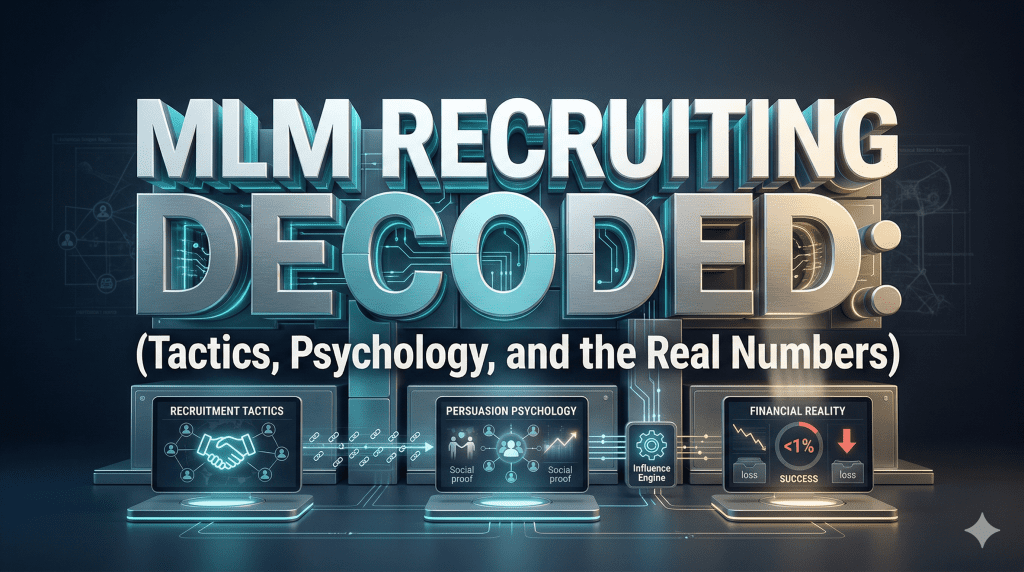
This guide breaks down how MLM recruiting is commonly taught, why certain messages can feel persuasive, what the income data shows, and what to watch for before joining or promoting an MLM.
- MLM recruiting is often presented as a simple, repeatable process, but the real issue is what the compensation plan rewards in practice.
- Recruiting itself is not automatically the problem. The concern grows when income depends too heavily on recruitment, participant purchases, or keeping a downline active instead of genuine product or service demand.
- Common tactics such as curiosity posts, personal compliments, private calls, upline introductions, and copied scripts can lower resistance before the full business details are clear.
- MLM recruiting can feel persuasive because it often blends sales psychology with personal relationships, making a business promotion feel like personal encouragement.
- Success stories and rank examples should not replace typical earnings data, expense review, or a clear explanation of how most participants are paid.
- Duplication can help MLM teams scale outreach, but it can also pressure new representatives to copy messages before they fully understand the business, risks, or ethical concerns.
- Before joining or promoting an MLM, study the compensation plan, expected costs, retail demand, income disclosures, recruiting expectations, and whether the model fits your values.
Disclaimer: I am an independent Affiliate. The opinions expressed here are my own and are not official statements. If you follow a link and make a purchase, I may earn a commission.
Why Does Recruiting Get So Much Attention in MLM?
Recruiting gets attention in MLM because many compensation plans are built around teams, ranks, and downline volume.
That does not mean every participant joins to recruit.
Some people join for product discounts, personal use, community, or part-time selling. Others may want to build a larger business. The structure can serve different motivations, but the income opportunity is often presented through the possibility of team growth.
This happens through the upline and downline model.
When a representative recruits someone into the business, that person may become part of the recruiter’s downline. If the recruit buys products, sells products, stays active, or recruits others, some of that activity may count toward the upline’s volume, bonuses, or rank qualifications.
That can make recruiting feel like the path to scale.
A representative can sell products one customer at a time. A growing downline may create activity across many people. That is why team growth, duplication, and outreach often appear in MLM training materials, onboarding calls, private groups, and leadership events.
The careful distinction is important.
Recruiting is not automatically unlawful. The concern grows when compensation is tied too heavily to recruitment or participant purchases instead of genuine product or service demand from ultimate users.
The FTC’s business guidance on multi-level marketing says MLMs are evaluated by how they operate in practice, including the incentives created by the compensation structure.

How Does MLM Recruiting Usually Work?
MLM recruiting usually follows a repeatable process.
The exact steps vary by company and team, but the pattern is often similar. A representative looks for interest, starts a conversation, moves the prospect toward more information, and then teaches new recruits to repeat the same process.
Identifying Potential Prospects
A representative usually starts by identifying people who may be open to the opportunity.
This can include friends, family, former coworkers, social media followers, customers, or people who have shown interest in the product or service.
In many cases, the first audience is the representative’s warm market. These are people who already know them, which can make the first conversation easier to start.
Creating Curiosity
The first contact is often light.
It may be a direct message, a comment, a social post, a voice note, or an invitation to learn more. The message may not explain the full business immediately.
Instead, it may create curiosity first.
The person might be invited to ask for details, reply to a post, or continue the conversation privately.
Moving the Conversation Private
Once someone shows interest, the conversation often moves into a more private setting.
That may be a direct message, phone call, video call, webinar, group chat, team presentation, or short video.
This gives the representative more control over the explanation. It can also allow an upline leader or team member to help present the opportunity, answer objections, or explain the next step.
Presenting the Opportunity
The opportunity is often framed through a mix of product use, lifestyle goals, mentorship, community, flexibility, income potential, or personal development.
Some presentations focus on the product first. Others focus more on the business opportunity, team culture, or future income potential.
This is the point where clarity matters most.
The prospect should understand what company is involved, what the product or service is, how commissions are earned, what costs are required, and whether recruiting is expected.
Inviting a Decision
If the prospect stays interested, the conversation usually moves toward a decision.
That decision may involve buying a starter kit, enrolling as a customer, joining as a representative, attending another call, reviewing the compensation plan, or speaking with an upline leader.
A clear process should give the person enough information to decide without pressure.
If the person is rushed before understanding the costs, requirements, or compensation plan, that is a warning sign.
Teaching the New Recruit to Repeat the Process
After someone joins, the process often repeats.
New representatives may be taught to make a contact list, post on social media, invite people to calls, use message templates, and duplicate the same outreach system.

What MLM Recruiting Tactics Are Commonly Used?
MLM recruiting tactics often follow familiar patterns.
They are usually used to make the opportunity feel personal, approachable, low-pressure, or time-sensitive. Some tactics are direct. Others are indirect.
The issue is not that every tactic is automatically wrong.
The issue is whether the person receiving the message has enough clear information to evaluate the opportunity honestly.
The “I Thought of You” Message
This message can feel personal and flattering.
A representative might say:
“I came across something I think you would be amazing at.”
Or:
“I thought of you immediately because you would be so good at this.”
Framing the offer as a personal compliment can lower skepticism and make the message feel less like a sales pitch.
That can be effective because the prospect feels selected.
It can also feel misleading if the same message is sent to many people with little real personalization.
Curiosity Posts on Social Media
Curiosity posts create interest without naming the company or explaining the opportunity.
A representative might post:
“Grateful I said yes to this side business.”
Or:
“Just paid for groceries with income from my phone.”
The post can encourage people to ask, “What is it?”
Once someone comments or sends a message, the representative can move the conversation into a private pitch.
This can make the interaction feel more natural because the prospect initiated the conversation. But the post can still function as a way to create interest in the business.
The Invite-Only Video Call
Many representatives avoid explaining the full opportunity in public comments or short messages.
Instead, they invite prospects to a private video call, webinar, launch event, or “quick info session.”
That format can make the opportunity feel more serious and organized. It can also create group momentum because the prospect sees other people attending, reacting, and expressing interest.
A call can be useful when it explains the business clearly.
It becomes a concern when it hides costs, avoids direct questions, or relies on excitement before the person understands the compensation structure.
Borrowed Credibility
New representatives may be taught to introduce prospects to a more experienced upline leader.
They might say:
“I am working with someone who has built a six-figure business.”
Or:
“You should meet my mentor. She knows this business inside and out.”
This shifts attention away from the new representative’s limited experience and toward someone with more authority.
Borrowed credibility can be legitimate when the upline provides accurate information.
It becomes risky when the prospect is encouraged to trust status, lifestyle, or income claims without seeing typical results, costs, and disclosures.
Message Duplication
Many MLM teams share scripts inside group chats, training portals, or onboarding materials.
These scripts may tell new representatives what to say when inviting someone, following up, answering objections, or asking for referrals.
Duplication makes outreach easier to scale.
It also makes messages feel less personal when many people use the same wording. If a script could be sent to anyone, it may not reflect real interest in the person receiving it.
The tactic may be efficient, but efficiency does not make the message personal or appropriate.

What Is the Psychology Behind MLM Recruiting?
MLM recruiting can feel persuasive because it often combines familiar sales psychology with personal relationships.
A message from a friend, cousin, coworker, or former classmate can feel less like marketing, even when it is part of a business strategy. That relationship can lower skepticism before the details are fully explained.
The psychology is not unique to MLM.
Identity, social proof, urgency, future pacing, and small commitments appear in many forms of sales and marketing. In MLM, those triggers can feel especially persuasive because the pitch often happens inside an existing relationship.
Identity Framing
Many pitches begin with a compliment.
- “You are such a natural leader.”
- “You would be perfect for this.”
- “You already inspire people.”
This connects the opportunity to the prospect’s identity.
The message does not only say, “Join this business.” It suggests that joining would confirm something positive about who the person already is.
That can feel encouraging.
It can also make the prospect more willing to listen before they understand the costs, requirements, or likelihood of earning income.
Social Proof
Recruiting often uses stories of people who are winning.
A representative may mention a teammate who paid off debt, left a job, bought a car, reached a new rank, or built a large team.
These stories can create the impression that success is visible and reachable.
The problem is that success stories can be atypical. A few strong outcomes do not show what most participants earn, how long it took, what expenses were involved, or how much recruiting was required.
Success stories should not replace typical earnings data.
Future Pacing
Future pacing links a small decision today to a much larger future outcome.
A pitch might say:
“It is only a small starter kit.”
Or:
“Imagine where you could be six months from now.”
This makes the present risk feel smaller because the prospect is encouraged to picture future success.
Future pacing can be motivating.
It can also distract from practical questions about product demand, monthly costs, retail sales, and the actual work required.
Escalating Commitment
As someone moves through the recruiting process, they may be asked to make small commitments.
- Attend a call
- Watch a video
- Join a group chat
- Buy a starter kit
- Make a first post
- Send the first messages
Each action can make the next step feel more natural.
The person may begin to feel invested before they have fully evaluated the opportunity.
This is how momentum can turn into pressure.
The sunk-cost effect becomes more relevant after someone has already invested money, time, or social standing and continues partly because walking away would make that investment feel wasted.
Scarcity and Urgency
Some recruiting messages create urgency.
- “Enrollment closes tonight.”
- “I only have two spots left.”
- “Our team is locking arms with a few new people this week.”
Real deadlines can exist.
But artificial scarcity is risky when the opportunity is actually available most of the time.
Urgency can push people to decide before they understand the plan. A legitimate opportunity should still make sense after someone has time to read the compensation plan, review costs, and ask direct questions.

What Do Common MLM Recruiting Scripts Reveal?
Common MLM recruiting scripts reveal how the conversation is being framed.
They can show whether the pitch is based on clarity, curiosity, social pressure, borrowed credibility, or urgency.
| Tactic or Script | Psychological Trigger | What It Reveals |
|---|---|---|
| “I thought of you for this.” | Identity framing | The message makes the prospect feel personally selected. |
| “This side business helped with bills this month.” | Curiosity | The post creates an information gap that invites questions. |
| “You should meet my mentor.” | Borrowed credibility | The pitch relies on someone else’s experience or status. |
| “Only a few spots are open.” | Scarcity | The message pressures the prospect to decide quickly. |
| “Just watch this short video.” | Low-commitment step | The next action is framed as easy and low-risk. |

The Real Numbers Behind MLM Recruiting
To understand MLM recruiting, it helps to look at the math, not just the messaging.
Recruiting presentations often highlight possibility. They may focus on rank advancement, team growth, lifestyle flexibility, or the success of top performers.
Income disclosures usually tell a more cautious story.
Earnings Are Often Concentrated
MLM income can appear uneven.
A smaller group of higher-ranking participants may receive much larger payments than most participants shown in the disclosure. Many others may receive little, receive nothing, or spend more than they receive after costs.
This matters because recruiting presentations often highlight the top of the structure.
A prospect needs to know whether the examples being shown are typical or exceptional.
Expenses Can Change the Picture
Reported income is not the same as profit.
A participant may have expenses such as:
- Starter kits
- Monthly product purchases
- Autoship orders
- Website fees
- Samples
- Shipping
- Training events
- Advertising
- Travel
- Promotional materials
Even modest expenses can change the result if income is low.
That is why any income discussion should include costs, not just commissions.
Rank Advancement May Depend on Team Activity
In many MLM plans, higher income potential is connected to rank.
Rank may depend on personal volume, team volume, active recruits, leadership legs, or other requirements.
This can make recruiting feel necessary, even when the company also emphasizes product sales.
A representative may begin by wanting to sell a product. Over time, the path to higher rank may push them toward building and maintaining a team.
How Turnover Can Increase Recruiting Pressure
When representatives stop ordering, selling, or participating, team volume may decline and ranks may become harder to maintain.
That can create pressure to keep bringing in new people.
A downline can change as people become inactive or leave, which may create ongoing pressure around activity, retention, and new recruiting.

Why Does Duplication Create Recruiting Pressure?
Many MLM training systems emphasize duplication.
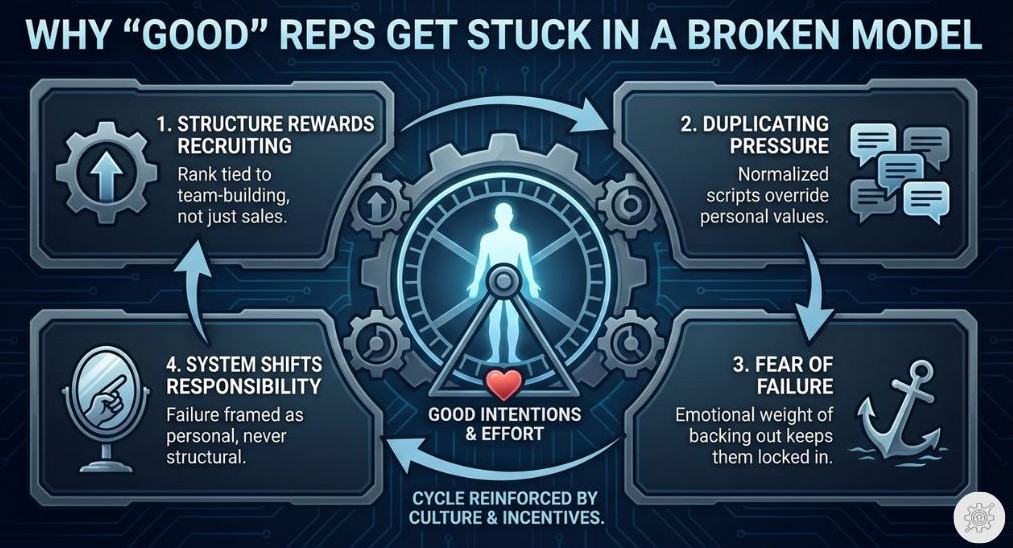
Duplication means new representatives are taught to repeat a simple process: use the same scripts, invite people to the same calls, post similar content, and guide prospects through the same steps.
The promise is simplicity.
If the system is easy to copy, more people can follow it.
But duplication creates pressure because the system depends on repetition.
A message that is easy to repeat may become generic. A strategy that works for a confident leader may feel uncomfortable for a new representative. A script that sounds polished in training may feel manipulative when used on a friend.
The System Rewards Repetition
Many MLM training systems try to grow teams by teaching representatives to repeat the same actions.
That is why scripts, onboarding guides, message challenges, daily posting plans, and team calls are common.
The risk is that new representatives may copy tactics before they understand the legal, ethical, or relational consequences.
They may learn what to say before they understand what they are promising.
Pressure Can Move Down the Line
In some teams, poor results may be explained mainly as a problem with effort, consistency, attitude, or willingness to follow the system.
Some of that advice may be practical.
But it can also shift attention away from structural problems, such as weak customer demand, high costs, low margins, unclear compensation rules, or recruiting-heavy incentives.
When every failure is treated as a mindset problem, the model itself is never examined.
Personal Relationships Carry the Cost
MLM recruiting often starts with warm contacts.
That may include friends, family, former coworkers, church communities, school connections, or social media followers.
This can make early outreach easier.
It can also make rejection more personal.
A person may not only be saying no to a business offer. They may be trying to protect a relationship from becoming transactional.
That is one reason friends and family sometimes react negatively to recruiting messages. They may feel that a normal relationship has become a prospect list.
What MLM Recruiting Practices Should You Avoid?
Recruiting can be handled with clarity or with pressure.
The difference matters.
Whether you are evaluating an MLM pitch or already involved in one, these practices should raise concern.
Copy-Paste Messages Without Context
Mass-sending generic messages may feel efficient, but it often feels transactional.
If the same message could be sent to anyone, it probably does not show real interest in the person receiving it.
A thoughtful message should explain why the conversation makes sense for that specific person.
Income Hints Without Context
Phrases such as “this changed my life,” “I replaced my income,” or “I made thousands quickly” can attract attention.
They can also mislead if they do not explain whether the result is typical, what expenses were involved, how long it took, or how much recruiting was required.
Income claims should be specific, supported, and properly qualified.
If they cannot be explained clearly, they should not be used.
Lifestyle Posts Without Clarity
Lifestyle posts can create curiosity, but vague content can also hide important details.
A post about freedom, travel, groceries, confidence, or time with family may not explain the company, the product, the costs, the compensation plan, or the work required.
Curiosity can start a conversation.
Clarity should carry it.
Artificial Scarcity
False urgency damages trust.
If enrollment is always open, the message should not suggest that someone must act tonight. If there are no real limits, a claim about limited spots is just pressure.
A good decision should survive careful review.
Avoiding Direct Questions
A prospect has a right to ask simple questions.
- How much does it cost?
- How are commissions earned?
- Do I need to recruit?
- How much do most people make after expenses?
- Can I earn from product or service sales alone?
- What happens if I stop ordering?
If the answer is always “you will learn that on the call,” that is a warning sign.
A clear business should be explainable before someone joins.
Ignoring Fit
Not everyone wants to sell, recruit, post online, attend calls, or build a team.
Pressuring someone who is not interested can damage the relationship and the representative’s credibility.
Respecting a no is not a weakness.
It is part of ethical selling.
What Should You Do If MLM Recruiting Does Not Fit You?
Feeling uncomfortable with recruiting does not mean you failed.
It may mean the business model does not fit your values, personality, goals, or preferred way of earning.
Start With Honest Questions
Start with honest questions.
- Would I be proud to use these tactics with close friends or family?
- Am I earning from genuine customer demand or mostly from team activity?
- Do I understand my expenses after commissions?
- Would I promote this product or service if there were no recruiting opportunity?
- Do I feel clear when I explain the compensation plan?
- Do I feel pressured to keep going because I already invested time or money?
Pause Before Recruiting
If the answers make you uneasy, pause before recruiting more people.
You do not need a dramatic exit. You can stop sending messages, review your costs, read the compensation plan again, and decide whether the model still makes sense.
Consider Other Ways to Earn
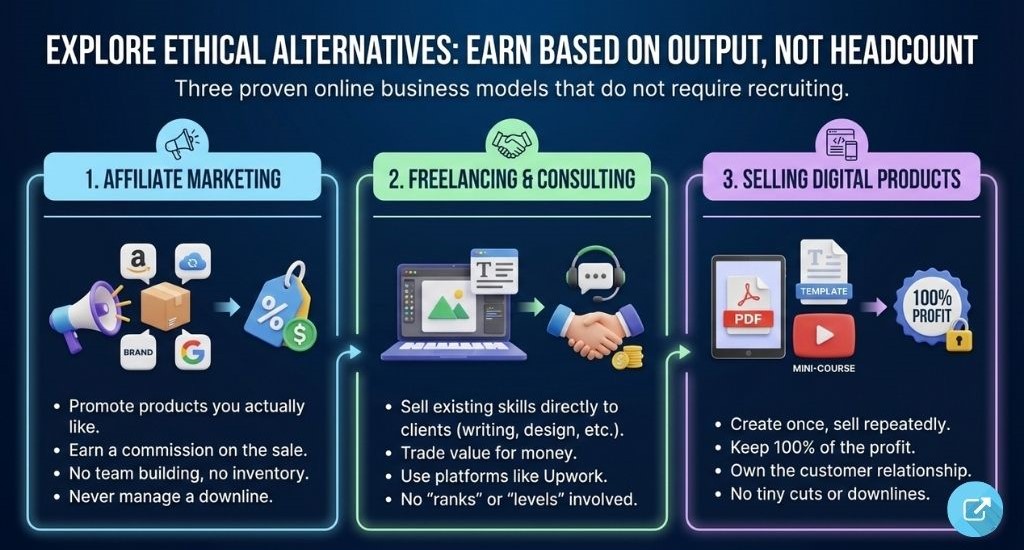
You can also consider other ways to earn that do not require building a downline.
Affiliate marketing, freelancing, consulting, and digital products all come with their own challenges. They are not automatic paths to income. But they do not depend on recruiting others into the same compensation structure.
Conclusion
MLM recruiting is often presented as simple.
Send the message. Invite the person. Share the story. Duplicate the system. Build the team.
But the reality is more complex.
Recruiting tactics can feel persuasive because they combine psychology, personal relationships, and repeatable scripts. Those tools can create momentum, but they can also create pressure, confusion, and unrealistic expectations.
The numbers deserve equal attention.
Income disclosures show why rank stories, lifestyle posts, and recruiting claims should be examined carefully. Reported commissions do not always show expenses, typical outcomes, or the amount of recruiting required.
Understanding MLM recruiting does not require judgment. It requires clarity.
Before joining or promoting an MLM, look past the script. Study the compensation plan. Ask how most people earn. Review the costs. Look for genuine product or service demand. Pay attention to whether the business depends more on customer value or on continuously adding new participants.
A recruiting system can look polished and still deserve questions. The best decision is the one you can make with full information.
Frequently Asked Questions
Is It Possible to Succeed in MLM Without Recruiting?
It may be possible, but it can be difficult depending on the company’s compensation plan.
Some representatives focus mostly on product or service sales. However, in many MLMs, higher income potential is tied to team volume, rank advancement, or downline activity.
If you want to avoid recruiting, read the compensation plan carefully and ask whether meaningful earnings are realistic from customer sales alone.
Is MLM Recruiting Illegal?
MLM recruiting is not automatically illegal.
The issue is how the business works in practice. A plan raises concern when compensation depends more on recruiting new participants than on genuine product or service demand from ultimate users.
What Is Attraction Marketing in MLM Recruiting?
Attraction marketing is a recruiting approach that tries to draw prospects in through content instead of direct pitching.
In MLM, this often includes lifestyle posts, personal stories, product results, business wins, or vague curiosity posts that encourage people to ask for more information.
The risk is that attraction marketing can hide the business relationship if the person does not clearly disclose that they benefit financially.
How Do I Respond If Someone Uses These Tactics on Me?
Ask direct questions.
You can ask what company it is, what the product costs, how commissions are earned, whether recruiting is required, how much most participants make after expenses, and whether there is an income disclosure statement.
A clear opportunity should not require you to decide before seeing the details.
How Many People Do I Need to Recruit to Make a Full-Time Income?
There is no universal number.
It depends on the company’s compensation plan, product pricing, customer demand, rank rules, expenses, team activity, and retention.
Be cautious of anyone who gives a simple number without showing typical earnings, costs, team activity, and available retention information.
Why Do Friends and Family React Negatively to MLM Recruiting Scripts?
They may feel that the relationship has become transactional.
Many people can recognize copy-paste messages, vague curiosity posts, or pressure-based invitations. Even if the representative is sincere, the recipient may feel like they were placed into a sales funnel instead of approached as a person.
What Should I Do If I Feel Uncomfortable Recruiting?
Pause before sending more messages.
Review the compensation plan, track your expenses, and ask whether the business model fits your values. You can also focus on customer sales if the company allows it and if there is genuine demand.
If recruiting is required for the income you want and that does not feel right to you, the model may not be a good fit.
What Should I Check Before Joining an MLM?
Review the compensation plan, startup costs, monthly requirements, refund rules, product pricing, customer demand, income disclosure statement, and whether most training focuses on selling products or recruiting new participants.
Also ask whether you can earn meaningful income from customers without building a downline.

0 Comments