Introduction
Lead magnets are the most important asset most people never build.
They’re not just freebies. They’re the first step in building trust, collecting leads, and turning interest into income.
A great lead magnet stops your best prospects from slipping away. It gives them a reason to engage, stick around, and take the next step, whether you’re selling a product, promoting an offer, or building an audience from the ground up.
This guide breaks down exactly what lead magnets are, why they still matter, how to create one that actually converts, and how to turn attention into long-term results.
Key Takeaways
- A lead magnet works when it solves one clear problem and delivers a quick win.
- The best formats are checklists, templates, video trainings, quizzes, and short guides.
- Every lead magnet should connect directly to the product or offer you plan to sell.
- Headline, design, and landing page copy all influence how well it converts.
- Promotion is just as important as creation. Your lead magnet should show up everywhere your audience already is.
Disclaimer: I am an independent Affiliate. The opinions expressed here are my own and are not official statements. If you follow a link and make a purchase, I may earn a commission.

What Is a Lead Magnet?
A lead magnet is a specific marketing offer exchanged for a prospect’s contact information.
It acts as the bridge between anonymous website traffic and an identifiable audience. The concept relies on a deliberate trade. A business offers a resource, tool, or incentive that a visitor considers worthwhile. In return, the visitor provides information, usually an email address that allows the business to establish contact.
Distinct From Free Content
Free content and lead magnets serve related but distinct purposes. An ungated article may attract visitors, answer questions, and establish credibility. A lead magnet introduces a formal exchange that moves an anonymous visitor into a measurable relationship with the business.
A Practical Example
Consider a firm that provides accounting services to small businesses. Anyone can read their public articles about managing business expenses. However, the firm could also offer a downloadable cash flow planning worksheet that requires an email address to access.
The Mutual Benefit
Someone who wants the worksheet completes a signup form and receives the resource. For the individual, this provides immediate access to a needed solution. For the company, it creates a clear signal of interest and an opportunity for continued, relevant communication.
Why Lead Magnets Still Matter
Most website visitors will not make a purchase or commitment during their first visit. A lead magnet provides a compelling reason for those visitors to stay connected with the business until they are ready to make a decision.
When executed correctly, lead magnets serve several vital functions:
Independent Audience Access
Relying entirely on social media platforms or search engine algorithms leaves a business vulnerable to sudden changes in visibility. Collecting contact information allows a business to reach its audience directly and reliably.
Demonstrated Competence
Trust is difficult to establish through promotional copy alone. Providing a useful tool, clear framework, or practical resource proves the business understands the prospect’s problem before ever asking for a purchase.
Extended Decision Windows
Purchasing decisions often require time and research. A lead magnet initiates a relationship, giving the business a structured way to send educational follow-up material that helps the prospect evaluate their options over days or weeks.
Clear Signals of Interest
The specific resource a visitor requests reveals what they are trying to accomplish. This context allows the business to send highly relevant information suited to the prospect’s current needs, rather than relying on generic communication.
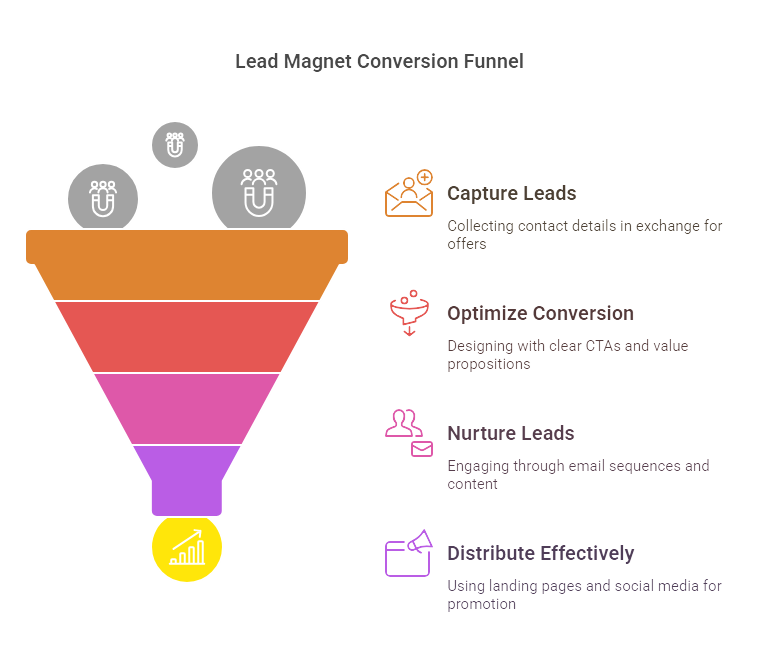
Choosing the Right Lead Magnet Format
The format of a lead magnet should match what the prospect is trying to accomplish at that exact moment.
Some audiences need a quick reference to complete a task today, while others need deep education before making a complex purchasing decision. Choosing the right format removes friction and increases the likelihood that the resource will actually be consumed.
Here is how different formats align with different audience needs:
Checklists and reference sheets
A checklist reduces complexity by breaking a larger process into mandatory steps. This format works well for audiences who already understand what they need to do but want to avoid missing critical details. It provides immediate utility because the user can apply it the moment they download it.
Example: A 10-point website accessibility audit checklist.
Templates and frameworks
Templates eliminate the friction of starting from scratch. They appeal to prospects who are ready to execute a task but need a reliable starting point. To be effective, a template must be formatted for the software the audience actually uses, such as a specific spreadsheet program or design tool.
Example: A 12-month content calendar template for Google Sheets.
Focused guides and playbooks
While a checklist tells someone what to do, a guide explains how to do it. This format is useful for audiences who need to understand a methodology or strategy before they can take action. To maintain effectiveness, the scope should remain narrow, solving one specific problem rather than attempting to teach an entire industry.
Example: A guide to structuring initial client consultation calls.
Video demonstrations and webinars
Some concepts are difficult to explain through text alone. Video allows a business to visually demonstrate software, teach a complex framework, or establish a personal connection. Because video requires a heavier time commitment from the viewer, the pacing must remain focused on the promised outcome rather than general background information.
Example: A 15-minute screen-share demonstrating how to clean up a specific database error.
Software trials and product samples
For physical products or software, direct experience is often the strongest proof of competence. A trial allows the prospect to evaluate the solution against their specific use case. However, a trial only works if the business provides a guided onboarding experience so the user does not abandon the product out of confusion.
Example: A 14-day trial of inventory management software with sample data pre-loaded.
Diagnostic quizzes and assessments
Interactive tools ask the user to provide specific inputs to receive a personalized result. This format helps a prospect evaluate their current situation or identify gaps in their approach. For the business, the inputs provide valuable context that can be used to send highly relevant follow-up communication based on the user’s specific result.
Example: A brief assessment evaluating a company’s readiness for remote work transitions.
Shopify’s guide to lead magnets illustrates how different businesses use formats such as quizzes, samples, discounts, worksheets, webinars, and personalized reports.
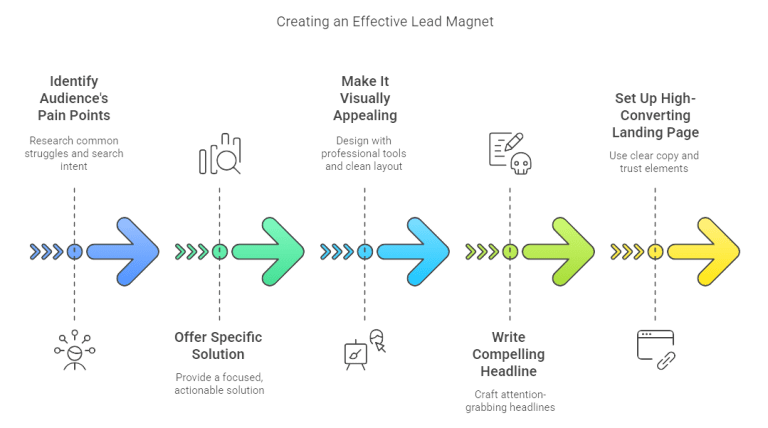
How to Build an Effective Lead Magnet
Creating a lead magnet requires more than simply packaging existing content into a document. It requires a deliberate process to ensure the final resource solves a real problem and functions correctly.
Here is the step-by-step process for building an effective offer:
1. Identify a specific audience bottleneck.
Do not guess what the audience needs. Investigate the actual friction points that bring people to the business. Review customer support tickets, listen to sales call transcripts, and monitor community discussions. Look for a specific, recurring problem that can be solved with a single resource.
2. Define a narrow scope.
Give the reader enough material to fulfill the offer’s exact promise without introducing unnecessary homework. If the promise is to help them audit their website’s SEO, the tool should provide an auditing checklist. It should not force them to read a 20-page history of search engine algorithms first. A smaller resource that is entirely consumed is always more effective than a massive guide that is abandoned halfway through.
3. Choose the most efficient format.
Look at the identified problem and decide whether the user needs to read something, calculate something, or try something. If they need to organize data, build a spreadsheet template. If they need to understand a complex methodology, record a video breakdown. Match the format to the task to remove as much friction as possible.
4. Title the resource around the outcome.
The name of the lead magnet should clearly explain what it helps the user accomplish. A title like “The Ultimate Marketing Guide” is vague and appeals to a generic audience. “The 12-Month Content Calendar Template” tells the prospect exactly what they are getting and why they need it. The title should set an honest expectation.
5. Test usability and delivery.
A broken resource destroys trust instantly. If a template is advertised as ready to use, the recipient should not discover that essential spreadsheet formulas are broken. Before launching the campaign, ensure all download links, access codes, mobile layouts, and interactive elements function perfectly. The delivery page must immediately provide what was promised without requiring the user to navigate a complicated sales process first.

Strategies for Distributing a Lead Magnet
A completed resource only generates leads if it reliably reaches the right audience. Relying on a single announcement or a generic website link is rarely enough to sustain a campaign.
The business must place the offer where the target audience already goes to solve their problems. Here are the primary channels for distributing a lead magnet effectively:
Dedicated destination pages.
Before sharing the asset across the internet, it needs a standalone landing page. This provides a single, clean URL that can be linked from podcasts, social media profiles, or partner newsletters. The page should clearly state the offer’s value and request the necessary contact information without the distraction of standard website navigation.
Contextual website placement.
Visitors reading an article about a specific problem are highly receptive to a tool that helps them solve it. Instead of relying entirely on intrusive site-wide pop-ups, embed the offer directly within relevant content. For example, a checklist for optimizing site speed should appear inside an article about website performance, where the reader’s intent perfectly matches the offer.
Social media problem-solving.
Simply posting a link with a command to “download now” rarely works on platforms designed to keep users on the feed. Instead, share a portion of the lead magnet’s value—such as one step from a framework or one insight from an industry report. The complete resource is then offered as the logical next step for users who want to implement the idea.
Partner audiences and guest appearances.
Presenting the lead magnet to someone else’s established audience is often the fastest way to build initial momentum. Offering the resource at the end of a podcast interview, guest lecture, or industry webinar provides an immediate, low-friction way for a new audience to transition into the business’s ecosystem.
Paid advertising campaigns.
If the lead magnet addresses a high-value problem and the business has a proven follow-up sequence, paid ads can accelerate distribution. Because the prospect is only being asked for an email address rather than an immediate financial transaction, lead magnets generally see lower cost-per-acquisition rates than direct product advertisements.
Common Lead Magnet Mistakes to Avoid
A lead magnet can generate a high volume of signups and still fail to produce a return on investment. Even well-designed resources fall short when the underlying campaign strategy is flawed.
Here are the most common strategic errors that prevent lead magnets from contributing to meaningful business results:
Broad or vague promises
If a lead magnet attempts to solve every problem, it appeals to no one specifically. A vague promise attracts a random audience or gets ignored entirely. The offer must speak to a specific bottleneck. For example, a “Guide to Better Marketing” is too broad, whereas “5 Client-Closing Email Scripts” addresses an immediate, recognizable need.
Overwhelming scope
A common misconception is that a longer resource is inherently more valuable. In reality, delivering a 50-page ebook when the user only needs a quick reference creates unnecessary homework. If the resource is too dense to finish, the consumption rate drops, and the user never experiences the promised value. One specific, achievable outcome is always more effective than excessive information.
Audience misalignment
A campaign fails when the lead magnet solves a problem unrelated to the business’s core product. If an enterprise software company offers a lead magnet designed for solo freelancers, they are building a list of people who will never have the budget for their actual services. The lead magnet must serve as a logical first step toward the ultimate purchase.
Dead-end delivery
Delivering the resource on a blank thank-you page wastes a moment of high attention. The user has just demonstrated trust by handing over their contact information. A strong delivery page immediately provides the resource, but also suggests a logical next step, such as reading a related article, watching a video, or viewing a relevant core offer.
Orphaned leads
Collecting contact information is useless if the business fails to establish an automated follow-up sequence. Delivering the asset and then going silent forces the prospect to forget who the business is. By the time the business finally reaches out weeks later, the initial interest has vanished.
Conclusion: Lead Magnets Turn Traffic Into Trust
Lead magnets are more than just list-building tools. They are the first impression, the first promise, and often the first turning point in your relationship with a future customer.
When done right, they create momentum. They shift someone from passive visitor to active subscriber. From cold leads to warm opportunities.
Whether you’re selling digital products, promoting affiliate links, or building a personal brand, the right lead magnet helps you move people forward without pitching too early or pushing too hard.
Start simple. Focus on one real problem. Offer one clear win. Then put it everywhere your audience is already paying attention.
You don’t need a massive list. You need the right people saying yes.
Ready to see what high-converting lead magnets actually look like?
Check out our Lead Magnet Examples That Drive Results and get inspired with proven formats you can use today.
Frequently Asked Questions
Does a lead magnet always have to be free?
Lead magnets are generally provided without a direct purchase price, though access requires contact information. Some physical offers, such as product samples or printed books, may require shipping charges, which should always be disclosed clearly before the user enters their information.
Should a lead magnet form ask for a name, or just an email address?
Every additional form field creates friction and typically lowers the overall conversion rate. Requesting only an email address will generate the highest volume of signups. However, if the follow-up strategy relies on personalized outreach or a sales call, requesting a first name or phone number is necessary, even if it results in fewer total leads. The business should only ask for the information it will actually use.
Should every business use a lead magnet?
No. Lead magnets are useful when an audience needs an additional resource to understand a problem or evaluate complex options. Businesses whose customers primarily want immediate pricing, booking, or purchasing options like local emergency services, restaurants, or retail benefit more from direct conversion processes and clear pricing pages.
How often should a lead magnet be updated?
There is no universal schedule. Updates depend on the format and the subject matter. A template based on stable principles may remain useful for years. However, resources covering software features, pricing, legal regulations, or market data require frequent review to ensure the business is not distributing outdated or inaccurate information.

3 Comments
Lead Magnets Examples: Best Lead Magnets for Different Niches - Ismel Guerrero. · February 19, 2025 at 7:09 pm
[…] For a deeper dive into the fundamentals of lead magnets, read our Lead Magnets guide. […]
Best Lead Generation Tools for 2025 (Free & Paid) - Ismel Guerrero. · April 15, 2025 at 11:48 pm
[…] out our Guide to Lead Generation and build a pipeline that runs on […]
PLR Explained: The Complete Guide - Ismel Guerrero · June 21, 2026 at 8:16 am
[…] rewriting sections and adding your branding, you can sell them as standalone guides, use them as lead magnets, or include them in course […]