An audience can enjoy your content without having a reason to buy anything from you.
Learning how to monetize your content means creating that connection. Whether you publish articles, videos, newsletters, podcasts, or social posts, the right approach depends on what your audience wants and what you can offer. Some models earn revenue from attention. Others turn your knowledge, creative work, or personal help into something people can purchase.
These nine methods will help you understand the options, compare their tradeoffs, and choose a practical starting point.
- A large audience is not a requirement for every model. Services and focused products can serve a smaller group of suitable buyers, while advertising depends more heavily on viewing volume.
- The offer should match the reason people consume your content. Product comparisons can support affiliate recommendations. Tutorials can lead to templates or implementation help.
- Recurring payments require an ongoing reason to renew. A paid newsletter needs useful publishing, while a community also needs participation and moderation.
- Automated delivery does not eliminate the work. Digital products still need promotion, support, and updates. Advertising still depends on traffic and platform eligibility.
- Revenue alone does not show whether a model is worthwhile. Fees, refunds, fulfillment costs, and delivery time affect what remains.
- One focused test can guide the next decision. Buying behavior gives you stronger evidence than adding several offers and hoping one attracts customers.
Disclaimer: I am an independent Affiliate. The opinions expressed here are my own and are not official statements. If you follow a link and make a purchase, I may earn a commission.
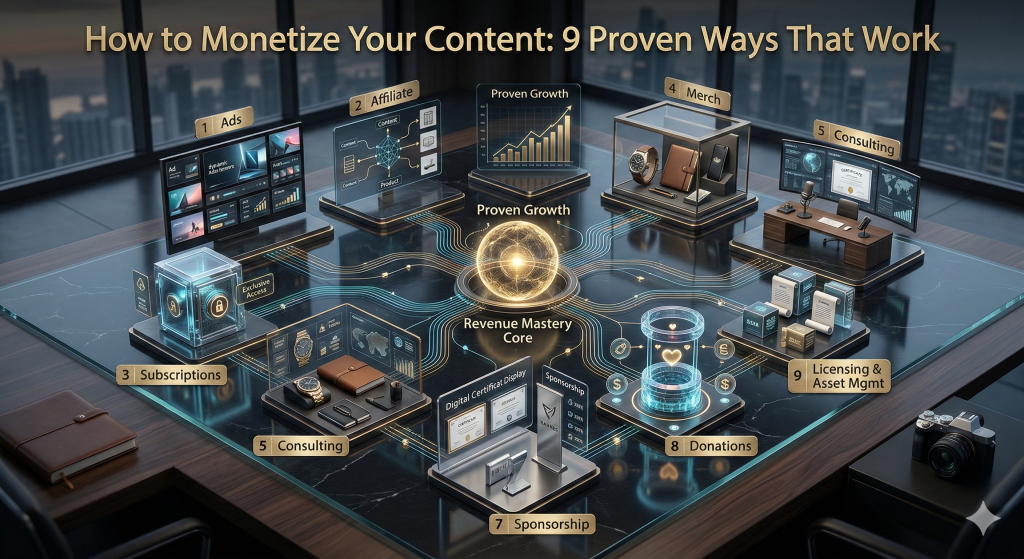
What You Are Actually Monetizing
Content monetization means earning revenue from your content or from the demand and relationships it creates.
Sometimes the content itself is what people buy. A paid newsletter, educational course, or licensed photograph fits that description. In other cases, free content helps someone choose a product or decide to hire you.
Three overlapping categories make the options easier to understand:
- Attention: Advertisers and sponsors pay to reach your audience.
- Assets: Customers purchase resources or creative work you produce.
- Access: Customers pay for your time, personalized help, or participation in a community.
Affiliate marketing connects content to another business’s offer. It depends on relevant recommendations and qualifying customer actions, rather than attention alone.
These categories can overlap. A membership might include both a resource library and live feedback. A tutorial could introduce a digital product while demonstrating your ability to provide a service.
For example, a creator publishing email-writing tutorials could recommend an email platform, sell editable templates, or offer welcome-sequence writing. Each model serves a different buying need, even though the content covers the same subject.
The useful starting point is identifying what someone would pay for and how your content helps them recognize its relevance.
9 Ways to Monetize Your Content
1. Affiliate Marketing: Connect Recommendations to Purchases
Affiliate marketing lets you earn commissions from qualifying purchases or other actions attributed to your referral.
It can fit reviews, comparisons, tutorials, and resource guides where people are evaluating a product. An article about photography lighting, for example, could explain suitable equipment for different situations and include relevant affiliate links.
Your recommendation should help readers make a decision. Explain who the product suits, where it falls short, and why you included it. Distinguish your own experience from information you researched.
To test the model, start with one relevant recommendation in content that already addresses a purchasing decision. Track qualifying actions alongside clicks. A link receiving attention without generating purchases may indicate a mismatch between the audience, recommendation, and offer.
The merchant controls the product, attribution rules, and commission terms. A purchase does not automatically qualify for payment. Amazon’s Associates Program Operating Agreement, for example, ties commissions to qualifying activity and compliance with its program rules.
2. Sponsored Content: Offer Brands a Relevant Placement
Sponsored content involves a brand compensating you to feature its product, service, or message.
That placement could appear in a newsletter, podcast, video, article, or social post. Its commercial appeal comes from the connection between your audience and the people the brand wants to reach.
A newsletter for independent designers, for instance, could approach a company selling design software. A relevant audience strengthens the proposal, but you still need to show what the brand would receive.
Prepare a concise pitch with your typical reach, audience information, placement format, and proposed deliverables. Use actual figures rather than your best-performing post as though it represents normal results.
An initial test could be one clearly defined placement with a closely matched brand. Before agreeing, establish the content requirements, revisions, payment timing, exclusivity, and any permission to reuse your work.
Sponsorship revenue involves pitching and negotiation. Payment is not necessarily upfront, and an unsuitable partnership can weaken the editorial relationship you have built. Clear disclosure is part of the arrangement, as discussed later in this guide.
3. Advertising: Earn From Ads Around Your Content
Advertising generates revenue from advertisements shown alongside or within eligible content.
This can suit a blog, video channel, or other publication with enough viewing activity to justify the effect on the audience experience. However, there is no universal traffic figure that makes advertising worthwhile.
Audience location, advertiser demand, content suitability, and ad placement can affect results. You also need to consider whether ads interfere with reading, slow a website, or distract from a more relevant offer.
Start by checking the requirements for the program you intend to use. Being able to display ads and earning enough to justify them are separate questions.
On YouTube, earlier access to certain fan-funding and Shopping features differs from eligibility for advertising revenue sharing. The latter requires 1,000 subscribers plus either 4,000 qualified watch hours over 12 months or 10 million qualified public Shorts views over 90 days, along with other requirements and review. YouTube’s eligibility guidance explains the distinction.
For websites, Journey’s requirements include at least 1,000 premium sessions over 30 days, a connected GA4 account, and additional content and audience conditions. Meeting the minimum does not guarantee approval.
4. Digital Products: Package Something People Can Use
Digital products turn your knowledge or creative work into a resource customers can purchase.
Examples include guides, templates, workbooks, courses, and downloadable design assets. This model can fit content that helps people complete a specific task or understand a subject they want to apply.
A creator teaching newsletter writing might sell an editable planning workbook with instructions and completed examples. The paid resource gives readers a structure they can use in their own work.
The reason to buy should be clear. Better organization, reusable materials, worked examples, or a well-designed learning sequence can distinguish a product from scattered free information.
Begin with a focused resource around a need you have observed. Show a sample, explain what buyers receive, and test the offer before building a large collection.
Digital delivery lets you sell the same resource repeatedly, but promotion, customer support, updates, and selling costs remain part of the business. Building a product establishes that it exists. Purchases help establish whether the offer appeals to its intended buyers.
5. Services and Consulting: Help People Apply What You Teach
Services connect your content to work you can perform for a client. Consulting connects it to advice you are qualified to give.
A copywriter could publish an article about welcome emails and offer welcome-sequence writing. A designer could explain common website problems and introduce a defined design audit.
This model can be suitable when you already have a marketable skill and can reach people who need it. Your content helps prospective clients assess how you think and whether your approach fits their problem.
Make the offer specific. Explain the deliverable, who it serves, what information you need from the client, and what is outside the scope. Relevant samples can help people evaluate your ability before making an inquiry.
Test one service tied to a topic your content already covers. Track qualified inquiries and completed projects, then compare the revenue with the time spent acquiring clients, delivering work, and handling revisions.
Services can be a practical starting point, but they are not universally the fastest route to revenue. The fit depends on your capabilities, offer, and access to suitable clients.
6. Paid Memberships and Communities: Create a Reason to Renew
Memberships charge for continuing benefits such as premium articles, a paid newsletter, a resource library, feedback sessions, or community participation.
Paid content and paid communities serve different needs. A newsletter subscriber may want useful analysis without interacting with anyone. A community member may primarily want discussion, feedback, and access to peers.
For example, a writing newsletter could publish a monthly collection of annotated examples. A community could provide scheduled opportunities for members to submit work and exchange feedback.
Choose benefits you can sustain. Offering unlimited personal access can create more work than the membership price supports.
A limited paid pilot lets you test the delivery schedule and member experience before expanding. Look beyond initial sign-ups. Participation and renewals help reveal whether people continue to find the offer worthwhile.
Recurring billing can simplify payment collection, but retaining members still requires attention. A resource subscription needs maintenance and useful additions. A community also needs moderation and enough activity to make participation worthwhile.
7. Merchandise and Physical Products: Extend Your Work Into an Item
Physical products can give an audience something useful to own or a way to connect with your creative work.
Options include printed workbooks, books, art prints, clothing, and merchandise tied to a recognizable theme. A creator teaching organization could offer a printed planner. An illustrator could sell prints of original artwork.
The product needs a reason to exist beyond displaying your logo. That reason might be practical use, visual appeal, or a connection to something your audience already appreciates.
Start with one item and order a sample. Check its quality, then calculate what remains after production, shipping you cover, and selling fees. Consider how questions, damaged orders, and other customer issues will be handled.
Print-on-demand can reduce the need to buy inventory in advance. It does not remove the work of choosing products, reaching buyers, and managing the customer experience. Printful’s print-on-demand model, for example, handles printing, packaging, and shipping while the seller develops and markets the offer.
8. Licensing and Paid Syndication: Sell Permission to Reuse Your Work
Licensing allows another organization to use your content under agreed terms. Paid syndication involves compensation for distributing or republishing your work elsewhere.
This can suit articles, photographs, illustrations, videos, or educational materials with a clear use for a business or publisher. A company might pay to include an original tutorial in its training library.
An arrangement to republish content for exposure is different from a paid agreement. Syndication does not automatically generate revenue.
To explore this model, choose an existing piece with a specific commercial use and identify organizations that might need it. A targeted proposal should explain how the material fits their publication, training, or communication needs.
Clarify the permitted use, duration, editing rights, exclusivity, attribution, and payment. Included third-party photos, music, or other assets also need attention before you offer reuse rights.
The U.S. Copyright Office explains copyright ownership and licensing, including how permission can allow others to use protected work.
9. Voluntary Support and Pay What You Want: Let People Contribute
Voluntary support allows people to contribute toward work they appreciate without requiring a purchase. Pay what you want lets customers choose their payment for an offered resource, sometimes above a stated minimum.
These approaches can fit independent writing, educational resources, creative projects, or tools people use repeatedly.
A creator maintaining a free reference library, for example, could add an optional support link explaining what contributions help maintain. Someone offering a downloadable resource could let customers choose an amount above its minimum price.
Keep the distinction clear between supporting free work and buying a product. Explain whether any benefits are included.
You can begin with one visible support option on a useful resource and assess contributions over time. Voluntary payments can fluctuate, so avoid treating them as predictable revenue before you have evidence.
Platforms can support several arrangements. Ko-fi’s payment guidance distinguishes recurring tips from membership benefits and explains how its pay-what-you-want listings work.

How to Choose the Right Monetization Model
Begin with the reason people consume your content and what they might reasonably want next.
Someone reading a product comparison may be evaluating a purchase. Someone following a tutorial may want reusable materials or help implementing it. Someone returning for your analysis may consider a paid subscription.
Use those connections to narrow the options.
| Method | Audience need it can serve | Work you need to maintain |
|---|---|---|
| Affiliate marketing | Help choosing a relevant product | Recommendations and program terms |
| Sponsored content | A relevant brand introduction | Brand relationships and campaign delivery |
| Advertising | Access to content supported by ads | Publishing, traffic, and eligibility |
| Digital products | A resource for learning or completing a task | Promotion, support, and updates |
| Services and consulting | Help applying knowledge to a specific situation | Client acquisition and delivery |
| Memberships and communities | Continuing content, feedback, or participation | Publishing, member support, and moderation |
| Physical products | A useful item or connection to creative work | Product quality and customer experience |
| Licensing and paid syndication | Content an organization can reuse | Prospecting, permissions, and agreements |
| Voluntary support | A way to sustain work people appreciate | Maintaining the work and communicating its purpose |
Once you have a suitable option, test it through a clear sequence:
Test Through a Clear Sequence
- Define one paid offer. State who it serves, what it includes, and why someone would choose it.
- Connect it to relevant content. Place the offer where the reader has enough context to understand its use.
- Make the next action clear. Explain how to purchase, inquire, subscribe, or contribute.
- Assess the response and delivery work. Compare buying behavior with the costs and effort involved.
Choose measurements that fit the model.
Affiliate clicks are different from attributed purchases. Membership sign-ups are different from renewals. A service generating revenue may still need changes if delivery consumes too much time.
Also separate revenue from profit.
Processing fees, platform charges, production costs, refunds, and other expenses affect what remains. Consider your time separately, including the hours spent promoting and fulfilling the offer.

Mistakes That Can Weaken Your Monetization Efforts
Building Too Much Before Testing Demand
A large course or membership library can take substantial work before you learn whether anyone wants the offer.
A focused resource, clearly scoped service, or limited membership pilot gives you a smaller commitment to evaluate. General enthusiasm is encouraging, but willingness to purchase is stronger evidence of commercial demand.
Confusing Audience Attention With Buying Intent
People can enjoy your content without wanting the product attached to it.
Look for a useful connection between the content and the offer. Adding an unrelated promotion because it pays a higher commission does little to explain why the reader should consider it.
Relying Entirely on One Platform
A platform can influence how people find your content and whether you can use its monetization features.
Maintain your original files and, where practical, your own website and permission-based subscriber relationships. Those assets can give you more options if you change providers or need a different distribution approach.
Assuming Content Volume Establishes Eligibility
Publishing more material does not remove a platform’s quality requirements.
AI can assist with production, but the finished work still needs to meet the relevant standards. YouTube’s channel monetization policies address mass-produced, repetitive, and reused content, while recognizing that creative tools can support original work.
Leaving Paid Relationships Unclear
Readers should be able to recognize when a recommendation involves compensation.
An affiliate disclosure or sponsorship notice needs wording and placement people can understand. The FTC’s endorsement guidance emphasizes clear, conspicuous disclosure close to the relevant recommendation. A general notice elsewhere on a website should not be assumed to cover every placement.
Conclusion
Monetizing content starts with a credible connection between what people consume and what someone has a reason to pay for.
Choose a model that fits that connection and that you can deliver well. Then use purchases, qualified inquiries, renewals, costs, and delivery experience to guide your next decision.
You can expand later. A focused starting point makes it easier to understand what deserves more work and what needs to change.
Frequently Asked Questions
Can I Monetize Content I Published Previously?
Yes. Review older content for offers that fit the reader’s purpose, such as a relevant recommendation, resource, or service. Update outdated information before adding the offer, and make sure the connection still makes sense.
Do I Need My Own Website to Start?
Not necessarily. A social profile, newsletter, or channel can introduce a paid offer. A website can give you a central place to explain your work and help people find related resources, but it does not replace reaching suitable buyers.
Should I Charge for Information That Is Available Free?
Explain what the paid offer adds. That could be reusable materials, careful organization, worked examples, or personal help. The reason to buy should be clear enough that customers understand the difference before purchasing.
How Long Should I Test a Monetization Method?
There is no single useful deadline for every model. Assess whether the offer has reached suitable people, whether they understood it, and what actions they took. A test with little relevant exposure cannot tell you much about demand.
Can I Combine Different Monetization Methods?
Yes. Related methods can serve different needs within the same audience. Introduce additional offers when you can explain their purpose clearly and maintain the work they require.

0 Comments