Introduction
SEO for affiliate marketing is about attracting the right kind of traffic, not just more traffic. The goal is to rank for search terms where users are already close to a buying decision and guide them toward relevant affiliate offers with trust and clarity.
This is where affiliate SEO often breaks down. Many sites focus on volume keywords, thin reviews, or generic content that struggles to compete. Others underestimate how competitive and intent-driven affiliate search results really are.
This guide explains how SEO works specifically for affiliate marketing, what makes it different from standard SEO, and how to build traffic that has a real chance of converting.
Key Takeaways
- Affiliate SEO focuses on buyer intent, not informational traffic alone.
- Successful affiliate sites align keywords, content type, and monetization tightly.
- SEO remains one of the most sustainable traffic sources for affiliates when done correctly.
- Thin or templated content is the most common reason affiliate sites fail to rank.
- Results take time, but SEO compounds more reliably than paid traffic for affiliates.
Disclaimer: I am an independent Affiliate. The opinions expressed here are my own and are not official statements. If you follow a link and make a purchase, I may earn a commission.
What Makes SEO for Affiliate Marketing Different
SEO for affiliate marketing is driven by commercial intent, not general curiosity. Most affiliate pages compete in search results where users are actively comparing options, prices, or solutions. That means you are rarely competing with simple blog posts. You are competing with other sites that want the same conversion.
Another key difference is content expectations. Informational SEO can succeed with surface-level explanations. Affiliate SEO cannot. Pages need to demonstrate usefulness, specificity, and credibility. Search engines tend to reward content that helps users make a decision, not content that simply repeats features or specs.
Competition also behaves differently. Affiliate keywords often attract established sites, media publishers, and brand-owned pages. This raises the bar for content quality, structure, and authority. Ranking usually requires clearer intent alignment and stronger supporting signals than informational content does.
Monetization adds another layer of pressure. Affiliate pages must balance persuasion with trust. Overly aggressive calls to action, thin reviews, or obvious templating can hurt both rankings and conversions. SEO success depends on earning confidence before asking for a click.
The takeaway is simple. Affiliate SEO works best when content is built to help users decide, not just to attract traffic. When intent, usefulness, and trust line up, rankings and conversions follow more naturally.

Why SEO Is Still One of the Best Affiliate Traffic Sources
SEO remains effective for affiliate marketing because it aligns naturally with buyer intent. When someone searches for product comparisons, reviews, or alternatives, they are often close to making a decision. Ranking for these terms puts your content in front of users at the right moment.
Another advantage is durability. Unlike paid traffic, SEO does not stop the moment you pause spending. Well-targeted affiliate pages can generate consistent traffic and commissions over time, even with minimal ongoing input. This compounding effect makes SEO especially attractive for affiliates with limited budgets.
SEO also gives you control. You are not dependent on ad platforms, rising costs, or constant testing just to maintain visibility. As long as your content remains useful and relevant, it can continue to perform.
Most importantly, SEO supports trust-building. Search-driven content allows you to educate, compare, and guide users before presenting an affiliate offer. That context increases conversion rates and reduces reliance on aggressive promotion.
The combination of intent, longevity, and trust is why SEO continues to outperform many other traffic sources for affiliate marketing when approached strategically.
How Affiliate SEO Actually Works
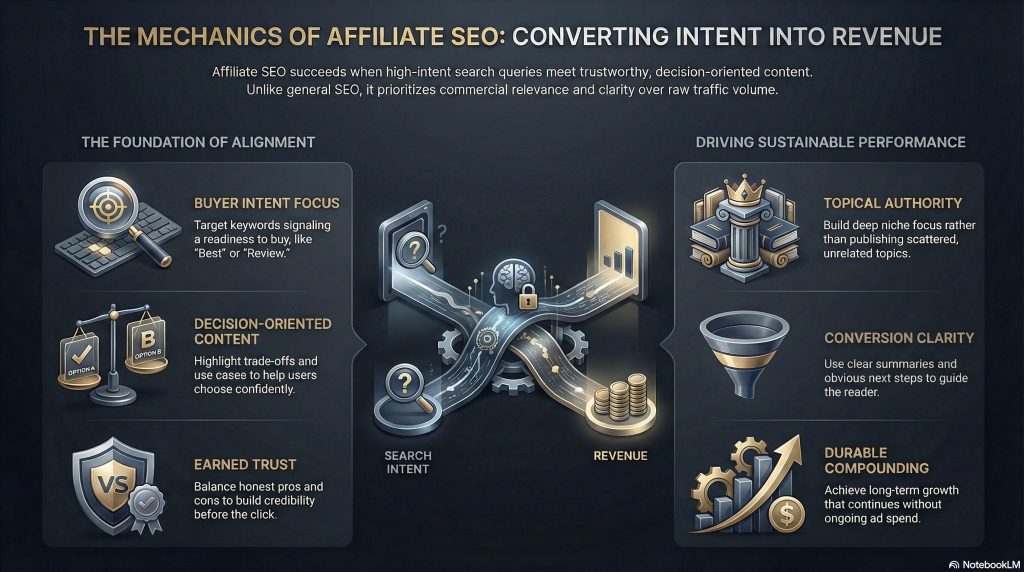
Affiliate SEO works when your site consistently shows up for searches tied to real purchase decisions and helps users choose with confidence. Rankings come from alignment. Conversions come from clarity. Revenue comes from combining both without forcing either.
The mechanics are not complicated, but they are easy to misapply. Success depends on getting a few fundamentals right and reinforcing them across your site.
Buyer Intent Shapes Everything
Affiliate SEO starts with intent, because intent determines whether traffic has value. Searches that signal comparison, evaluation, or readiness to buy perform very differently from purely informational queries. When a user searches with the goal of choosing, your content has a chance to earn both rankings and clicks.
This is why affiliate sites focus on reviews, comparisons, alternatives, and “best” queries. These searches imply a decision is coming. Informational content can support an affiliate site, but it rarely drives revenue on its own unless it clearly leads into a commercial context.
If intent and monetization are misaligned, the page struggles no matter how strong the SEO fundamentals look on paper.
Content Must Help Users Decide
Affiliate SEO favors content that reduces uncertainty. That means explaining differences, highlighting trade-offs, and guiding users toward the option that fits their situation. Pages that simply describe products or repeat marketing claims rarely perform well long term.
The strongest affiliate content is structured for decision-making. It anticipates questions, compares options using clear criteria, and makes recommendations based on use cases rather than hype. This makes the page more useful to readers and more competitive in search results.
When content genuinely helps users choose, rankings tend to follow more naturally.
Trust Is a Ranking and Conversion Signal
Trust plays a dual role in affiliate SEO. It affects how users behave on the page, and it influences how search engines evaluate usefulness. Content that feels biased, thin, or templated loses credibility quickly.
Trust is built through specificity and balance. Clear pros and cons, realistic expectations, and honest guidance signal that the page exists to help, not just to monetize. Overly aggressive calls to action or exaggerated claims usually hurt both engagement and performance.
Affiliate SEO works best when recommendations feel earned rather than pushed.
Authority Determines How Competitive You Can Be
Most affiliate keywords live in crowded search results. Media sites, established niche publishers, and brand-owned pages often compete for the same terms. Authority is what allows an affiliate site to compete in those spaces.
Authority comes from topical focus, internal structure, and external validation. Sites that cover a niche thoroughly, connect related pages logically, and earn relevant links send stronger trust signals to search engines. Isolated pages without support struggle to rank, even if the content itself is solid.
In affiliate SEO, authority is often the difference between a page that ranks on page two and one that holds a top position.
Clarity Drives the Click
Affiliate conversions depend less on persuasion and more on clarity. Users click when the next step feels obvious and justified. Pages that summarize recommendations clearly, explain who each option is for, and remove lingering doubts convert more reliably.
High-performing affiliate pages guide rather than pressure. They help users feel confident in their choice, then present the affiliate link as the natural next action. When clarity is strong, conversion rates improve without sacrificing trust.
Affiliate SEO succeeds when users feel informed, not rushed.
What Affiliate SEO Relies on to Perform Consistently
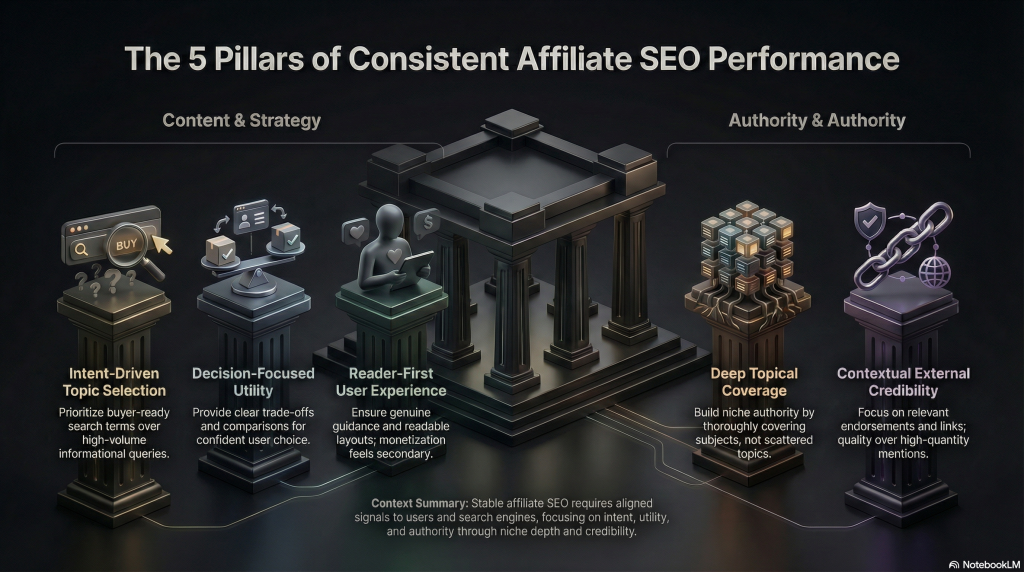
Affiliate SEO holds up over time when a site sends clear signals to both users and search engines. Those signals come from how topics are chosen, how content is built, and how the site earns credibility. When these signals align, performance becomes more stable and less fragile.
Intent-Driven Topic Selection
Affiliate sites perform best when they focus on topics that justify monetization. This does not mean every page needs to sell, but it does mean commercial pages should exist for a clear reason. Topics that reflect comparison, evaluation, or readiness to choose tend to support affiliate models far better than broad informational subjects.
Traffic alone is not the goal. The goal is relevance. Pages that attract visitors who are already deciding convert more reliably and are easier to support with SEO over time.
Content That Proves Usefulness
Affiliate SEO favors pages that demonstrate effort and usefulness. That usually means explaining differences, outlining trade-offs, and helping users understand what actually matters when choosing. Pages that simply summarize features or restate product claims rarely perform well long term.
Usefulness also shows up in structure. Clear sections, logical ordering, and summaries that help users orient themselves make content easier to evaluate. When users can quickly understand why a page exists and how it helps them, engagement improves naturally.
Coverage That Signals Focus
Affiliate sites gain strength when they show clear topical focus. Covering a niche thoroughly sends a stronger signal than publishing scattered content across unrelated subjects. Supporting pages, related comparisons, and follow-up content all help reinforce relevance.
This kind of coverage benefits both search engines and users. Search engines see a site that understands its topic. Users see a resource instead of a one-off article.
Credibility Beyond the Page
Competitive affiliate SEO almost always depends on signals outside the page itself. Mentions, links, and references from relevant sites help establish credibility. These signals tell search engines that the site’s recommendations are recognized elsewhere, not just self-published.
Quantity matters less than context. A few strong, relevant endorsements usually outweigh many weak ones. Affiliate sites that earn trust externally tend to hold rankings longer.
Pages That Respect the Reader
User experience plays a quiet but important role. Pages that are readable, focused, and not overloaded with ads or links tend to perform better. When monetization feels secondary to guidance, trust improves.
Affiliate SEO benefits when pages feel built to help first and monetize second. That balance supports both rankings and conversions without constant adjustment.

The Affiliate SEO Process From Start to Scale
Affiliate SEO becomes easier to manage when you think in phases rather than tactics. Each phase has a different goal, and confusing those goals is what causes most frustration early on.
Starting With a Focused Niche
Affiliate SEO works best when a site starts narrow. A clear niche makes keyword selection easier, content more coherent, and authority faster to build. Broad sites struggle because they compete with established publishers before earning trust.
At this stage, the priority is not volume. It is relevance. A small set of well-aligned topics creates a foundation you can expand later.
Building Foundational Content
Early content should focus on pages that justify the site’s existence. These are usually high-intent commercial pages supported by a small number of informational articles that clarify concepts, comparisons, or use cases.
The goal here is not perfection. It is coverage and consistency. Publishing useful, well-structured content regularly sends stronger signals than waiting to produce “ultimate” pages that never ship.
Strengthening Signals Through Optimization
Once content exists, optimization starts to matter more. This includes improving structure, tightening intent alignment, enhancing internal links, and updating weak sections. Small improvements compound when applied across multiple pages.
This phase often unlocks early traction. Rankings move, impressions increase, and patterns begin to emerge around what works and what does not.
Expanding Coverage Strategically
As authority grows, the site can expand into more competitive topics. This is where scaling happens. New pages build on existing relevance instead of starting from zero. Supporting content fills gaps and reinforces topical focus.
Expansion works best when guided by data. Keywords with impressions but low rankings, pages that almost convert, and topics competitors rank for all point toward logical next steps.
Reinforcing Authority Over Time
Scaling affiliate SEO is less about publishing faster and more about reinforcing trust. Updating content, earning relevant links, and maintaining consistency help protect rankings as competition increases.
At this stage, maintenance matters as much as growth. Sites that revisit and improve existing pages often outperform those that only chase new ones.
Affiliate SEO scales when each phase builds on the last without rushing ahead. A steady progression from focus to coverage to authority creates results that last longer and require fewer resets.

Common SEO Mistakes Affiliate Marketers Make
Most affiliate SEO failures come from a small number of repeat mistakes. These issues often look harmless at first, but they compound over time and limit both rankings and revenue.
Targeting Keywords Without Clear Intent
A common mistake is choosing keywords based on volume instead of intent. High-traffic informational queries can inflate analytics while producing little to no affiliate income. When keywords do not imply comparison or evaluation, monetization feels forced and conversions stay low.
Affiliate SEO performs best when keywords justify the presence of affiliate links. If the intent does not support a decision, the page usually underperforms.
Publishing Thin or Templated Content
Many affiliate sites rely on repetitive structures with minimal differentiation. Pages that reuse the same intro, format, and talking points signal low effort to both users and search engines. Over time, these pages struggle to rank or lose visibility.
Search engines tend to reward content that demonstrates original effort, clear reasoning, and real usefulness. Templates can help with consistency, but they cannot replace substance.
Ignoring Trust Signals
Affiliate pages that push links too aggressively often undermine their own credibility. Overloaded calls to action, exaggerated claims, or missing context make users hesitant. That hesitation shows up as poor engagement and weak conversions.
Trust signals come from balance. Honest pros and cons, clear explanations, and realistic recommendations help users feel confident instead of pressured.
Trying to Scale Too Early
Scaling before earning traction is another common problem. Publishing dozens of pages without focus or authority often spreads effort too thin. Without a clear niche or supporting content, individual pages struggle to gain momentum.
Affiliate SEO rewards patience early on. Focused coverage and gradual expansion outperform rapid, unfocused publishing.
Treating SEO as a One-Time Task
Some affiliate marketers publish content and move on. Over time, competitors update, products change, and search results evolve. Pages that are never revisited often lose relevance and rankings.
Ongoing improvement matters. Updating content, refining intent alignment, and strengthening internal links help protect performance as competition increases.
Avoiding these mistakes does not guarantee success, but it removes many of the hidden barriers that prevent affiliate SEO from working in the first place.

When SEO Makes Sense for Affiliate Marketing
SEO is not the right growth channel for every affiliate project. It works best under specific conditions, and understanding those conditions upfront saves time and frustration.
You Are Willing to Play a Long Game
Affiliate SEO rewards patience. Rankings take time to earn, especially in competitive niches. If you need immediate traffic or revenue, SEO will feel slow and uncertain. If you can invest consistently and wait for compounding returns, SEO becomes far more attractive.
This channel favors steady effort over quick wins.
Your Niche Has Search-Driven Buying Behavior
SEO works best when people actively search before making a purchase. Products and services that invite comparison, research, or evaluation are strong fits. If buyers rely mostly on impulse or social discovery, SEO may struggle to drive meaningful results.
Search demand needs to exist at the decision stage, not just at the awareness stage.
You Can Create Decision-Helpful Content
Affiliate SEO performs when content genuinely helps users choose. That requires clarity, structure, and a willingness to explain trade-offs. If your approach relies on thin summaries or surface-level reviews, SEO becomes harder to sustain.
The ability to publish useful, decision-oriented content consistently matters more than publishing volume.
You Want Traffic You Can Own
SEO makes sense when you want a traffic source that is not tied to ongoing ad spend. While algorithms change, well-built affiliate sites often hold value longer than paid campaigns that stop the moment budgets pause.
This makes SEO especially appealing for affiliates looking to build durable assets rather than short-term campaigns.
You Can Support the Site Beyond Publishing
Successful affiliate SEO usually involves more than writing pages once. Updating content, expanding coverage, improving structure, and earning credibility all play a role. If you can support the site over time, SEO becomes more reliable.
SEO tends to fail when it is treated as a set-and-forget tactic.
When these conditions are in place, SEO becomes one of the most effective channels for affiliate marketing. When they are not, other traffic sources may produce better results with less friction.

Realistic Expectations for Results
SEO for affiliate marketing works, but it does not work quickly or evenly. Setting realistic expectations early helps you make better decisions and avoid abandoning strategies that are actually progressing.
Early results are usually subtle. In the first few months, growth often shows up as impressions, partial rankings, or movement on lower-competition keywords rather than traffic spikes or revenue. This phase is about validation, not payoff.
Meaningful traffic typically follows consistency. As content accumulates, internal links strengthen, and search engines better understand your site’s focus, rankings begin to stabilize. For many affiliate sites, this takes several months of steady publishing and refinement.
Revenue lags traffic. Even when pages start ranking, conversions improve gradually as content is refined, trust builds, and intent alignment tightens. It is common to see pages rank before they convert well. Optimization usually bridges that gap.
Competition also affects timelines. Less competitive niches can show traction sooner. Crowded affiliate spaces often require more authority, stronger content, and more patience. Comparing timelines across niches usually leads to false conclusions.
The most reliable expectation is this. Affiliate SEO compounds. Progress feels slow at first, then accelerates as pages support each other and authority builds. Sites that commit to steady improvement outperform those that chase fast wins and reset too often.
Conclusion
SEO for affiliate marketing works when it is treated as a long-term system, not a shortcut. The strongest affiliate sites earn visibility by aligning search intent with genuinely helpful content and supporting it with consistency and credibility.
The common thread across successful affiliate SEO is restraint. Traffic is targeted, not chased. Content is built to help users decide, not just to rank. Monetization supports the experience instead of overwhelming it. Over time, this balance produces rankings that hold and revenue that compounds.
Affiliate SEO rewards clarity, patience, and focus. When those are in place, it remains one of the most durable ways to grow affiliate income.

Frequently Asked Questions
How long does SEO take to work for affiliate marketing?
Most affiliate sites see early signals like impressions and partial rankings within a few months. Meaningful traffic and revenue usually take longer, especially in competitive niches. SEO compounds over time rather than delivering quick spikes.
Is SEO better than paid ads for affiliate marketing?
SEO and ads serve different purposes. Ads can produce faster results but stop when spending stops. SEO takes longer but can deliver ongoing traffic without continuous cost. Many affiliates use SEO for durability and ads for testing or short-term gains.
Can new affiliate sites still rank in Google?
Yes, but competition matters. New sites rank faster in focused niches with clear intent alignment and useful content. Crowded affiliate spaces require more authority and patience.
How many pages does an affiliate site need to succeed?
There is no fixed number. Some sites perform well with a small set of high-quality pages. Others require broader coverage. What matters is relevance, usefulness, and consistency rather than page count alone.
Do affiliate links hurt SEO?
Affiliate links themselves do not hurt SEO when used responsibly. Problems arise when pages are thin, overly promotional, or built primarily for monetization instead of user value.

0 Comments