Introduction
Affiliate networks are often one of the first things new affiliate marketers encounter, yet they’re also one of the most misunderstood. Some people think they’re required to start affiliate marketing, while others assume they’re the same as affiliate programs. Neither is entirely true.
Understanding what affiliate networks do and where they fit into the affiliate marketing ecosystem can make choosing products, managing partnerships, and earning commissions much easier. The right network can save time, simplify tracking, and give you access to hundreds of brands from a single platform.
This guide explains what affiliate networks are, how they work, how they differ from affiliate programs, and what to look for when choosing one. By the end, you’ll have a clear understanding of whether an affiliate network is the right choice for your affiliate marketing strategy.
- Affiliate networks help affiliates find offers, generate tracking links, monitor performance, and receive payouts from one platform.
- An affiliate network is different from an affiliate program because a network gives access to multiple merchants, while a program usually belongs to one brand.
- The right network depends on your niche, content type, traffic source, payout preferences, and experience level.
- Strong affiliate networks offer relevant merchants, reliable tracking, clear reporting, fair payout terms, and useful affiliate support.
- Bigger networks are not always better. The best choice is the network that gives you quality offers your audience actually wants.
- Many affiliates use both networks and direct affiliate programs to balance convenience, offer variety, and stronger brand relationships.
Disclaimer: I am an independent Affiliate. The opinions expressed here are my own and are not official statements. If you follow a link and make a purchase, I may earn a commission.

What Is An Affiliate Network?
An affiliate network is a platform that connects affiliates with multiple brands in one place. Instead of applying to each company’s affiliate program separately, affiliates can use a network to find offers, apply to merchants, generate tracking links, monitor performance, and receive payments through a central dashboard.
For merchants, affiliate networks provide a way to recruit affiliates and manage performance-based partnerships at scale. For affiliates, they simplify the process of finding products or services to promote without having to build direct relationships with every brand.
The main value of an affiliate network is convenience. It brings offer discovery, tracking, reporting, and payouts into one system so affiliates can spend less time managing logistics and more time creating useful content.
Affiliate Networks vs Affiliate Programs: What’s The Difference?
An affiliate network gives you access to multiple merchants through one platform. An affiliate program is usually managed by one brand and only gives you access to that brand’s products or services.
For example, a network may let you apply to several software, retail, travel, or finance brands from one account. A direct affiliate program only connects you with one company.
Neither option is automatically better. Affiliate networks are useful when you want variety, centralized tracking, and easier offer discovery. Direct affiliate programs can be better when you want a closer relationship with one brand, custom terms, or higher commissions.
How Do Affiliate Networks Work?
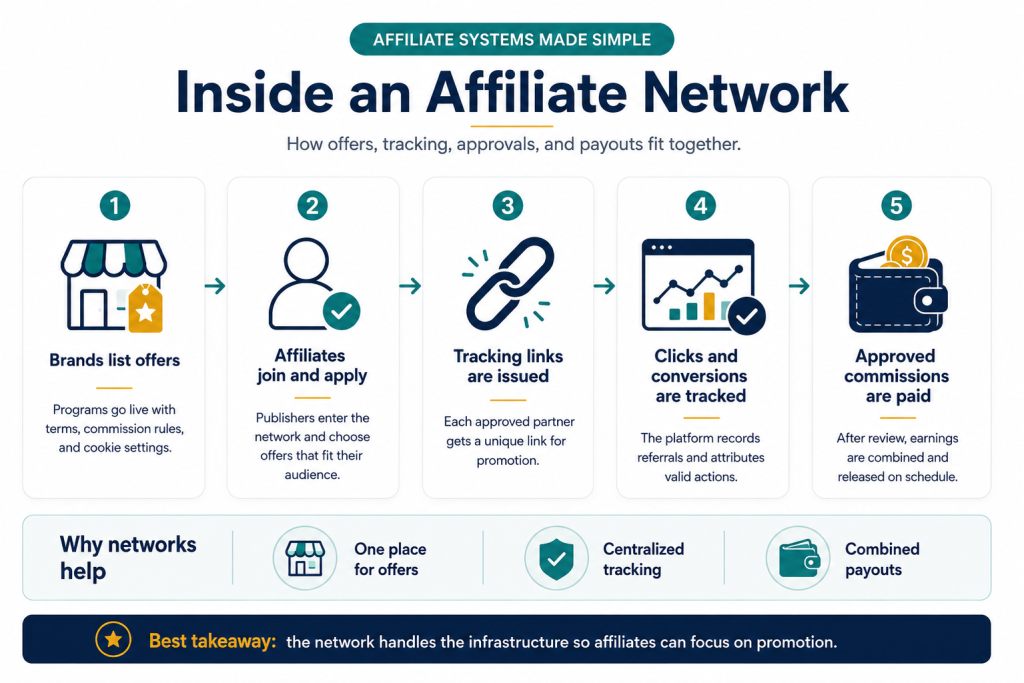
Affiliate networks manage the connection between merchants, affiliates, and customers. They provide the platform that tracks referrals, records conversions, and determines when commissions should be paid.
The process usually follows a clear sequence.
Merchants List Their Offers
Brands join the network and make their affiliate programs available to approved publishers. They set the commission rate, cookie duration, conversion rules, promotional restrictions, and other terms affiliates must follow.
Affiliates Join The Network
Affiliates create an account and provide information about their website, audience, content, and traffic sources. The network may review the application before granting access to its marketplace.
Joining the network does not always mean automatic approval for every merchant. Some brands require a separate application before affiliates can promote their offers.
Affiliates Apply To Relevant Programs
Once accepted, affiliates can browse merchants and compare available opportunities. They can review commission structures, product categories, program terms, and approval requirements before applying.
The strongest choices are usually the offers that fit the affiliate’s audience, not simply the ones with the highest payouts.
The Network Generates Tracking Links
After a merchant approves the affiliate, the network provides unique tracking links. These links identify which affiliate sent the visitor and connect qualifying actions to the correct account.
Affiliates can place these links in articles, videos, emails, resource pages, social media content, or other approved channels.
The Network Tracks Clicks And Conversions
When someone clicks an affiliate link, the network records the referral. If that person completes a qualifying action, such as making a purchase or submitting a form, the network attributes the conversion according to the program’s tracking rules.
Cookie duration, attribution method, and merchant terms all influence whether the affiliate receives credit.
The Merchant Verifies The Conversion
Conversions are usually reviewed before commissions are approved. A merchant may delay approval until the return, cancellation, or refund period has passed.
Invalid transactions, duplicate leads, refunded purchases, or activity that violates the program’s rules may be rejected.
The Network Processes The Payment
Once commissions are approved, the network adds them to the affiliate’s account. Payments are typically issued according to a fixed schedule after the affiliate reaches the minimum payout threshold.
Because the network can combine earnings from several merchants into one payment, affiliates do not need to manage separate invoices or payment schedules for every brand they promote.

Why Affiliates Use Networks
Affiliate networks reduce the administrative work that comes with managing several brand partnerships.
Instead of handling separate applications, dashboards, tracking systems, and payout schedules, affiliates can manage much of that activity from one place.
Access To Multiple Merchants
A single network can provide access to hundreds or thousands of brands across different industries. This makes it easier to compare offers, test products, and find programs that match your audience.
Centralized Tracking And Reporting
Networks combine clicks, conversions, commissions, and performance data inside one dashboard. Affiliates can see which offers are working without logging into several separate accounts.
Consolidated Payments
Rather than receiving small payments from multiple merchants on different schedules, affiliates can often receive one combined payment from the network once they reach the payout threshold.
Easier Offer Discovery
Affiliate networks make it easier to browse available programs by category, commission type, product, or merchant. This can save time, especially for affiliates who are still exploring which offers fit their content.
Built-In Tools And Resources
Many networks provide deep-linking tools, product feeds, banners, promotional materials, and reporting features that make it easier to create and manage affiliate campaigns.
The main advantage is efficiency. Affiliate networks do not guarantee better products or higher earnings, but they can make it easier to organize partnerships, monitor performance, and manage several offers without unnecessary complexity.
How To Choose The Right Affiliate Network
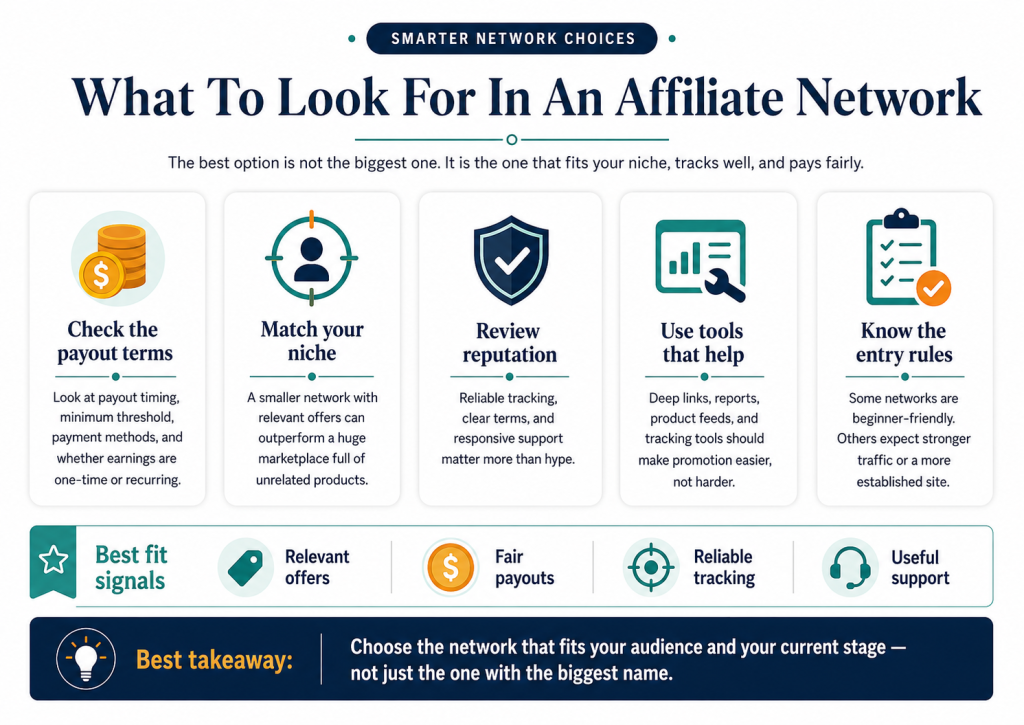
The right affiliate network is not always the largest or most popular one. It is the network that gives you access to relevant merchants, reliable tracking, fair payout terms, and the support you need to promote offers effectively.
Commission Structure And Payout Terms
Start by reviewing how affiliates earn money. Some programs pay a percentage of each sale, while others offer fixed payments for leads, signups, trials, or subscriptions.
Look beyond the headline commission rate. Check the payout schedule, minimum payment threshold, available payment methods, refund policy, and whether commissions are one-time or recurring. A lower commission from a reliable offer can be more valuable than a larger payout that rarely converts.
Product And Niche Relevance
A network is only useful if it includes products your audience actually needs. Browse the merchant directory before committing and look for offers that fit your niche, content, and audience intent.
Strong relevance makes recommendations easier to explain and more likely to convert. A large network with thousands of unrelated merchants may offer less value than a smaller platform with several strong options in your category.
Network Reputation And Support
Research the network’s reputation before sending traffic through it. Look for clear terms, reliable payments, accurate tracking, responsive support, and a history of working with reputable merchants.
Good support becomes especially important when commissions are missing, links stop working, or program terms change. Some networks also provide account managers who can help affiliates find offers and resolve issues.
Affiliate Tools And Resources
Useful tools can make campaigns easier to manage. Depending on your content strategy, look for features such as deep linking, product feeds, real-time reporting, custom tracking, promotional materials, and conversion data.
The best tools are the ones you will actually use. A complicated dashboard is not an advantage if it makes basic reporting harder to understand.
Approval Process And Entry Requirements
Some affiliate networks are open to beginners, while others prefer established websites, active audiences, or specific traffic levels. Review the application requirements before applying.
Also remember that approval for the network does not guarantee approval for every merchant inside it. Brands may review your content, niche, traffic sources, and promotional methods separately.
Choose a network that fits your current stage. You can always apply to more selective platforms later as your audience and content grow.

Popular Affiliate Networks To Know
Affiliate networks differ in their available brands, reporting tools, approval processes, and partnership models. The right platform depends on your niche, audience, promotional methods, and the products you want to recommend.
The following platforms are established options worth knowing. They are not ranked, and inclusion does not mean every network will suit every affiliate.
Awin
Awin is a global affiliate platform that connects content creators, publishers, influencers, and other partners with brands across a wide range of industries.
Affiliates can use the platform to discover relevant advertisers, apply to their programs, create trackable links, and monitor results. Its large advertiser base may be useful for publishers who want access to offers across several categories rather than relying on one direct brand partnership.
Joining Awin does not automatically provide access to every advertiser. Individual brands can review applications and decide which affiliates they want to work with. Before applying, review the available advertisers and confirm that the platform includes offers that fit your audience.
CJ Affiliate
CJ Affiliate is an established affiliate marketing platform that connects publishers with brands and provides the technology needed to manage those relationships.
Publishers can use CJ to find advertisers, build partnerships, access performance data, and monetize content through tracked referrals. The platform may be particularly relevant to affiliates with an established website, defined audience, or clear content strategy.
Advertisers within CJ manage their own partnership decisions, so acceptance into the platform does not guarantee approval for every program. Affiliates should evaluate each advertiser’s products, commission terms, promotional rules, and audience fit before applying.
Impact
Impact is a partnership management platform that supports affiliate, creator, influencer, referral, and other commercial partnerships.
Its marketplace allows affiliates and creators to discover brands that match their audiences and apply to partnership opportunities. The platform also provides campaign reporting and alerts that help partners monitor performance and respond to changes.
Impact may appeal to affiliates who want to develop closer or more varied brand partnerships rather than rely only on a traditional catalog of affiliate offers. However, each brand controls its application requirements, commission structure, contract terms, and promotional rules.
Rakuten Advertising
Rakuten Advertising operates an affiliate network that connects publishers with brands and provides tools for managing affiliate activity.
Its publisher platform allows affiliates to find brand partnerships, create tracking links, and review performance through a centralized dashboard. This can simplify campaign management for publishers working with several advertisers.
The value of Rakuten Advertising depends on whether its current advertisers align with your niche and audience. Review its available programs and individual advertiser terms before deciding whether it belongs in your affiliate strategy.
ClickBank
ClickBank is an ecommerce platform and affiliate marketplace where product sellers list offers that affiliates can choose to promote.
Affiliates can browse the marketplace by category and review information such as average payout, rank, and Gravity score. These metrics can help compare marketplace activity, but they should not replace careful research into the product, seller, sales page, refund policy, and customer experience.
ClickBank may be useful for affiliates looking for marketplace-based offers with different commission arrangements. Product quality and audience relevance can vary between sellers, so every offer should be evaluated individually before it is recommended.
Bottom Line: These networks provide useful starting points, but the platform name should never be the only reason to join. Compare the available merchants, product quality, tracking, payment terms, support, and audience fit before investing time in any network.
Common Mistakes When Choosing An Affiliate Network
Choosing the wrong affiliate network can waste time, weaken your recommendations, and make it harder to earn consistent commissions.
Most problems begin when affiliates focus on popularity or payout size instead of fit.
Choosing A Network Because It Is Popular
A well-known network is not automatically the right one for your niche. Its merchant catalog may be large but still offer few products that match your audience.
Review the available merchants before joining. Relevance matters more than name recognition.
Chasing The Highest Commission Rates
High commissions can look attractive, but they do not guarantee strong earnings. A product with a generous payout may convert poorly, create refunds, or provide a weak customer experience.
Consider product quality, conversion potential, and audience fit alongside the commission rate.
Ignoring Payout Terms
Affiliates sometimes focus on how much they can earn without checking when or how they will be paid.
Review the minimum payout threshold, payment schedule, supported payment methods, currency fees, and any conditions that may delay commissions.
Applying To Too Many Merchants
Access to many programs can encourage affiliates to promote too many products at once. This often leads to scattered content and shallow recommendations.
Start with a small number of relevant merchants. Learn their products, understand the terms, and create useful content before expanding.
Skipping The Program Rules
Each merchant may have different restrictions on paid advertising, email promotion, branded keywords, coupon use, link placement, and social media.
Ignoring these rules can lead to rejected commissions or account removal. Read the terms before promoting any offer.
Assuming Every Merchant Is Reliable
Affiliate networks provide access to merchants, but they do not guarantee that every product or customer experience is strong.
Research each company separately. Review the product, sales process, refund policy, customer support, and reputation before recommending it to your audience.
The right network should make affiliate marketing easier to manage, not give you more offers than you can evaluate responsibly. Choose carefully, start small, and prioritize merchants you can recommend with confidence.

Conclusion
Affiliate networks can make affiliate marketing easier by bringing offer discovery, tracking, reporting, and payouts into one platform. That convenience is valuable, especially when you want to work with several merchants without managing each partnership separately.
But the network itself does not determine your success. What matters most is the quality of the merchants, the relevance of the offers, the reliability of the tracking, and how well the products fit your audience.
Choose a network that supports your niche, review each merchant carefully, and start with a small number of offers you understand well. The right affiliate network should simplify your work, not distract you with more options than you can use effectively.
Frequently Asked Questions
What Is The Best Affiliate Network For Beginners?
The best network depends on your niche, content platform, and audience. Beginners should look for relevant merchants, clear reporting, reasonable payout terms, and an approval process that matches their current experience.
Do Affiliate Networks Cost Money To Join?
Most affiliate networks are free to join. Some may require identity verification, an active website, an established audience, or a small registration fee. Always review the application terms before signing up.
How Do Affiliate Networks Make Money?
Affiliate networks usually charge merchants fees for using their platform, tracking referrals, managing partnerships, and processing payments. The exact fee structure varies by network.
Can You Join More Than One Affiliate Network?
Yes. Many affiliates use several networks to access different merchants and commission opportunities. However, joining too many at once can make tracking, reporting, and content planning harder to manage.
Are Affiliate Networks Better Than Direct Affiliate Programs?
Not always. Networks offer convenience, access to multiple merchants, and centralized payments. Direct programs may offer closer brand relationships, custom support, or better commission terms. Many affiliates use both.
What Should You Look For Before Joining An Affiliate Network?
Review the merchant selection, commission structures, cookie durations, attribution rules, payout thresholds, payment methods, reporting tools, support, and network reputation.
Does Joining A Network Mean You Can Promote Every Merchant?
No. Some merchants approve affiliates automatically, while others review applications individually. They may consider your niche, content quality, traffic sources, audience, and promotional methods.
How Long Does It Take To Get Paid?
Payment timing depends on the network and merchant. Commissions may remain pending until the merchant verifies the transaction and the refund period ends. The network then pays according to its schedule and minimum payout threshold.

1 Comment
Affiliate Marketing Platforms: Best Places to Start in 2025 - Ismel Guerrero. · April 13, 2025 at 11:00 pm
[…] Check out how affiliate networks work and where to find offers. […]