Introduction
AI writing tools are everywhere. Some promise better SEO. Others focus on speed, creativity, or research. With so many options, choosing the right one can feel harder than writing the content yourself.
The truth is simple. No AI writing tool is best for everyone. Each one is built for a different type of user and workflow.
This guide compares the best AI writing tools available right now. You’ll see what each tool does well, where it falls short, and which type of user it fits best. By the end, you’ll know exactly which tool makes sense for your goals.
Key Takeaways
- The best AI writing tool depends on your workflow, not the hype.
- Some tools excel at long-form content, others at marketing copy or speed.
- Pricing models vary widely, from subscription tiers to usage-based plans.
- Structured comparison matters more than feature lists.
- The right tool should support your strategy, not replace your thinking.
Disclaimer: I am an independent Affiliate. The opinions expressed here are my own and are not official statements. If you follow a link and make a purchase, I may earn a commission.
What AI Writing Tools Can Actually Do for You
AI writing tools are not all built for the same purpose. Some focus on speed. Others focus on structure, SEO, or editing. The right tool depends on what you are trying to improve.
Here’s what these tools can realistically help you with:
Write First Drafts Faster
Most AI writing tools reduce drafting time. Instead of starting from a blank page, you generate a structured first version and refine it.
This is useful for:
- Blog posts
- Email campaigns
- Product descriptions
- Social media content
Speed is the entry benefit. Editing still matters.
Improve Structure and Clarity
Many tools help organize ideas into logical sections. This is especially helpful for long-form content and SEO-focused writing.
If structure slows you down, AI can accelerate the outlining phase.
Generate Marketing Copy Variations
AI writing tools excel at producing multiple angles quickly.
You can generate:
- Headlines
- Hooks
- Calls to action
- Ad variations
This reduces creative fatigue.
Assist With Editing and Refinement
Some tools specialize in rewriting, grammar correction, and tone adjustments. They improve polish rather than generating content from scratch.
Support Research and Summarization
Advanced tools can summarize documents, extract insights, or help analyze large text inputs. This supports content strategy and planning.
The Best AI Writing Tools Right Now
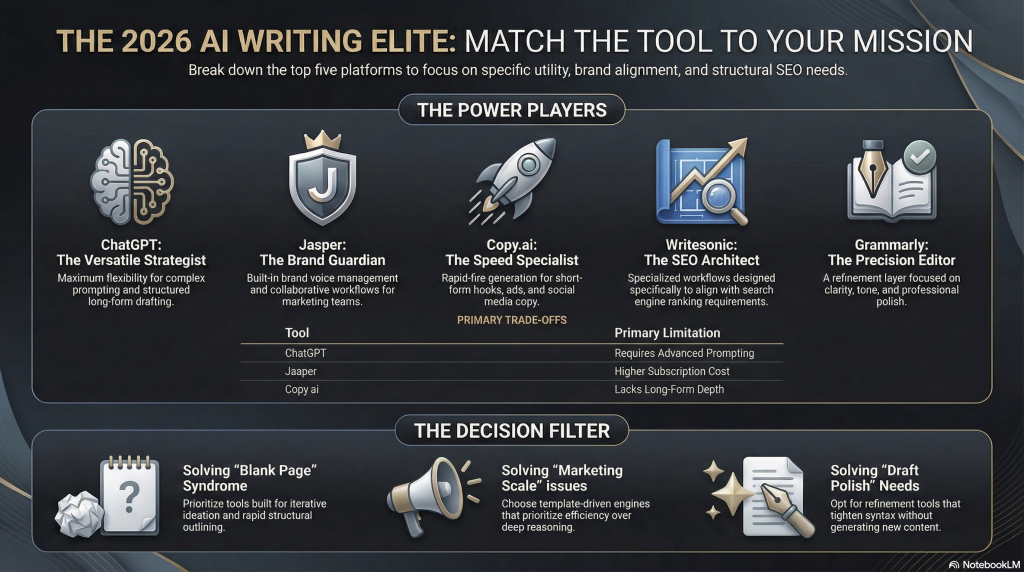
The best AI writing tool depends on what you actually need to produce. Some platforms prioritize flexibility. Others focus on marketing workflows, SEO, or editing precision. Instead of looking for a universal winner, the smarter move is to match the tool to your writing goals.
Here are some of the strongest AI writing tools available today and where each one fits best.
1. ChatGPT by OpenAI
Best for: Versatile content creation and structured long-form writing
ChatGPT is one of the most adaptable AI writing tools on the market. It works across a wide range of use cases, from blog posts and email campaigns to research summaries and structured outlines.
Its biggest strength is flexibility. You can guide tone, depth, and structure through prompting, which makes it useful for both creative and analytical tasks. It performs especially well when you provide clear instructions and defined output formats.
However, ChatGPT does not come pre-packaged with SEO scoring or heavy marketing templates. Users who rely on it must supply strategic direction themselves.
Strengths
- Highly adaptable across formats and industries
- Strong reasoning and long-form drafting capability
- Suitable for both individuals and teams
- Scales well with structured prompts
Limitations
- Requires thoughtful prompting for best results
- No built-in SEO scoring system
- Brand voice consistency depends on user input
Ideal for: Content creators, strategists, consultants, and businesses that want control and flexibility.
2. Jasper
Best for: Marketing-driven teams and brand consistency
Jasper is built with marketing workflows in mind. It provides structured templates for ads, landing pages, product descriptions, and campaign copy. For businesses producing conversion-focused content at scale, this structure can save significant time.
One of Jasper’s standout features is brand voice management. Teams can train the tool to reflect specific tones and messaging guidelines, which helps maintain consistency across departments.
The tradeoff is flexibility. Jasper performs best inside its intended workflows and may feel rigid for open-ended content creation.
Strengths
- Strong marketing templates
- Brand voice customization
- Designed for collaborative teams
- Campaign-focused workflows
Limitations
- Higher subscription cost
- Less flexible for exploratory writing
- May feel structured rather than free-form
Ideal for: Marketing teams, agencies, and businesses prioritizing conversion and consistency.
3. Copy.ai
Best for: Fast short-form marketing content
Copy.ai focuses on speed and simplicity. It excels at generating short-form content such as headlines, product descriptions, email hooks, and social media copy.
Its interface is straightforward, which makes it easy for beginners to get started quickly. For fast idea generation and rapid variation testing, it performs well.
However, it is not built for deep long-form content or complex structured writing. Longer articles often require significant editing and refinement.
Strengths
- Quick content generation
- Easy-to-use interface
- Strong for marketing copy and variations
Limitations
- Less suited for detailed long-form writing
- Can feel repetitive across outputs
- Limited depth without heavy editing
Ideal for: Solo marketers, startups, and small teams focused on quick campaign content.
4. Writesonic
Best for: SEO-oriented blog and website content
Writesonic positions itself as an SEO-friendly AI writing tool. It integrates workflows designed for blog posts, landing pages, and website copy with optimization in mind.
For users focused on search traffic, this structured approach can be helpful. It provides blog generation tools and content frameworks aimed at ranking performance.
Output quality can vary depending on topic complexity, and content often benefits from human refinement before publication.
Strengths
- SEO-focused content workflows
- Blog and article generation support
- Broad range of content formats
Limitations
- Output consistency varies
- May require editing for authority tone
- SEO tools do not replace strategy
Ideal for: Bloggers, affiliate marketers, and small businesses focused on organic growth.
5. Grammarly
Best for: Editing, clarity, and tone refinement
Grammarly differs from most tools on this list. It is primarily an AI-powered editor, not a full drafting engine.
It improves grammar, sentence clarity, tone consistency, and readability across emails, documents, and web content. For professionals who already produce their own drafts, Grammarly acts as a refinement layer.
It does not generate long-form content at the same level as dedicated AI writing platforms, but it significantly improves polish and professionalism.
Strengths
- Strong grammar and tone correction
- Real-time suggestions across platforms
- Helpful clarity and conciseness feedback
Limitations
- Limited long-form generation
- More of an enhancement tool than a content engine
Ideal for: Professionals, executives, and writers who want to improve clarity and polish in existing drafts.
This breakdown highlights a critical point. AI writing tools are not interchangeable. Each one solves a slightly different problem. The best choice depends on whether you need flexibility, marketing structure, SEO support, or editing precision.

The Top 5 AI Writing Tools (Compared by Use Case)
No AI writing tool wins every category. The right choice depends entirely on your daily workflow. Do you need to write long articles, fast social posts, or polished emails?
Use the table below to compare the top tools at a glance. Then, read the specific breakdown for your role.
| Tool | Best For | Key Strength | Biggest Limitation | Cost Rating |
|---|---|---|---|---|
| ChatGPT | Creators & Strategists | Maximum flexibility across all formats. | Requires strong prompting skills. | Low |
| Jasper | Marketing Teams | Brand voice control and team collaboration. | High price and rigid templates. | High |
| Copy.ai | Solo Marketers | Fast generation for short-form ads and emails. | Lacks depth for long-form articles. | Medium |
| Writesonic | SEO Bloggers | Built-in workflows for search engine ranking. | Requires heavy editing for a natural tone. | Medium |
| Grammarly | Professionals | Fixes grammar, clarity, and tone mistakes. | Does not write articles from scratch. | Low |
Which AI Writing Tool Makes Sense for You
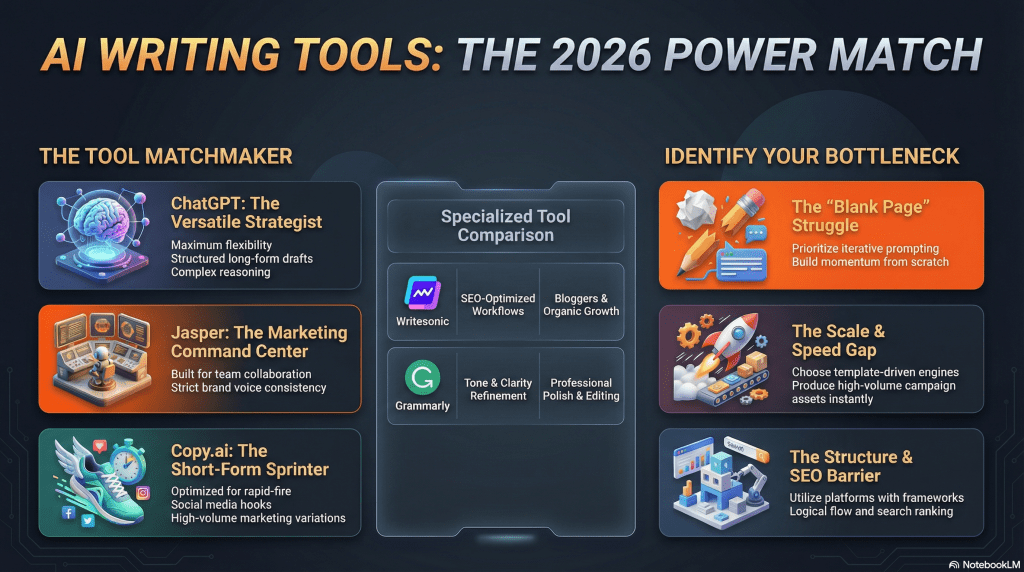
Choosing the right AI writing tool is less about features and more about fit. The real question is not which tool is best. It is which tool solves your biggest bottleneck.
Instead of starting with platforms, start with your problem.
If You Struggle With Blank Pages
Your issue is ideation and momentum.
You need a tool that helps you:
- Generate structured drafts quickly
- Expand rough ideas into outlines
- Turn bullet points into full sections
In this case, flexibility matters more than built-in templates. Look for a tool that allows detailed prompting and iterative refinement.
If Your Content Lacks Structure
Your issue is organization.
You may write well, but your content feels scattered or inconsistent. You need support with:
- Logical flow
- Section breakdowns
- Clear formatting
Prioritize tools that handle structured outputs well and allow you to guide tone and depth.
If You Create High-Volume Marketing Content
Your issue is scale.
You need speed, repeatability, and variation. Look for:
- Template-driven workflows
- Campaign-based content generation
- Fast headline and hook creation
Efficiency matters more than deep reasoning in this case.
If SEO Is Your Primary Concern
Your issue is alignment with search intent.
You need help organizing content around:
- Keywords
- Headings
- Content depth
Remember that no tool replaces SEO strategy. But some make it easier to structure content in a way that supports ranking.
If You Already Write Well but Need Polish
Your issue is refinement.
You want help tightening sentences, improving tone, and correcting grammar. In this case, drafting power matters less than editing precision.
The Decision Filter
Ask yourself one clear question:
Where do I lose the most time in my writing process?
Is it thinking? Structuring? Scaling? Optimizing? Editing?
The right AI writing tool should reduce friction at that exact point. When it does, it feels like leverage. When it does not, it feels like extra work.
Common Mistakes When Choosing AI Writing Tools
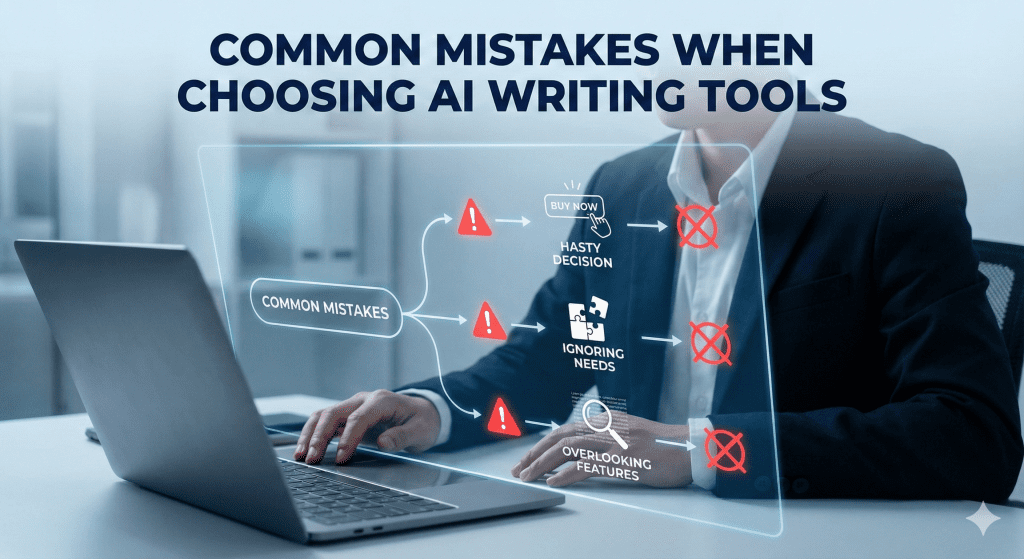
Choosing the wrong AI writing tool usually does not fail immediately. It fails slowly. You start noticing friction, inconsistent output, or wasted time. Most of that frustration comes from a few predictable mistakes.
Choosing Based on Hype Instead of Workflow
Many tools market themselves as all-in-one solutions. That sounds appealing, but it rarely holds up in practice.
Before choosing a tool, define your primary need:
- Drafting long-form content
- Producing marketing campaigns
- Improving SEO structure
- Editing and polishing
If you do not define your workflow first, every tool will feel impressive for five minutes.
Expecting the Tool to Replace Strategy
AI writing tools assist. They do not replace thinking.
No tool can:
- Define your brand positioning
- Build a content strategy
- Understand your audience automatically
- Guarantee search rankings
If you expect the software to make strategic decisions, you will be disappointed.
Ignoring Output Quality Consistency
One good output does not prove long-term value.
Test tools across:
- Different topics
- Different tones
- Short and long formats
Consistency matters more than occasional brilliance.
Underestimating Editing Time
AI speeds up drafting. It does not eliminate editing.
If you assume the content will be publish-ready without review, you risk:
- Generic messaging
- Factual errors
- Tone mismatches
- Brand inconsistency
Plan for refinement as part of the workflow.
Choosing Based Only on Price
Cheaper is not always better. More expensive is not always better either.
The real question is value. Does the tool reduce time, improve output, or simplify systems enough to justify its cost?
A lower subscription fee does not help if it doubles your editing time.
Choosing the right AI writing tool is less about features and more about alignment. When the tool matches your workflow, it feels supportive. When it does not, it feels like extra work.
Conclusion
AI writing tools are not interchangeable. Each one solves a different problem.
Some help you think and draft. Others help you scale marketing campaigns. Some focus on SEO structure. Others improve clarity and polish. The best tool is not the one with the most features. It is the one that aligns with your workflow.
Before choosing, define what you need most. Speed. Structure. Ranking support. Editing precision. Once that is clear, the decision becomes simple.
AI writing tools work best as accelerators, not replacements. They reduce friction. They expand output capacity. They help you move faster. But strategy, judgment, and quality control still belong to you.
Choose the tool that supports your process, and you will get far more value than chasing the latest trend.

FAQs About AI Writing Tools
Are AI writing tools better than human writers?
No. AI writing tools assist with speed and structure, but they do not replace human judgment, creativity, or strategy. The strongest results usually come from combining AI drafting with human editing and oversight.
Can AI writing tools help with SEO?
Yes, but indirectly. Some tools support SEO workflows and keyword structuring. However, they do not replace a full SEO strategy. Rankings depend on research, intent alignment, authority, and competition, not just generated content.
Do AI writing tools produce original content?
Most AI writing tools generate unique phrasing based on patterns in their training data. However, originality does not guarantee accuracy or strategic quality. Always review content before publishing.
How much editing do AI-generated drafts require?
It depends on the tool and the topic. For simple marketing copy, editing may be light. For long-form blog posts or technical content, you should expect to refine structure, tone, and factual accuracy.
Which AI writing tool is best for beginners?
Tools with simple interfaces and structured templates are easier for beginners. However, more flexible tools offer greater long-term value if you are willing to learn how to guide them properly.
Are AI writing tools worth paying for?
They can be, if they reduce your drafting time or increase output quality. The key question is not price, but return on workflow efficiency. If the tool saves hours each week, it often justifies the cost.
Can AI writing tools maintain brand voice?
Some platforms offer brand voice customization. Even so, maintaining strong brand consistency still requires human review and clear messaging guidelines.
Should you rely entirely on AI for content creation?
No. AI works best as an accelerator, not a replacement. Strategy, positioning, and final editorial decisions should remain human-driven.

0 Comments