Introduction
The AIDA copywriting formula stands for Attention, Interest, Desire, and Action. It is one of the most established persuasion frameworks in marketing because it maps directly to how people move from awareness to decision.
Shorter formulas focus only on pain or contrast, the AIDA framework structures the entire persuasion journey. It captures attention, builds curiosity, deepens emotional investment, and then guides the reader toward a clear next step.
Because of its structured progression, the AIDA framework is widely used in sales pages, landing pages, email campaigns, advertisements, and product launches. In this guide, you’ll learn how the Attention-Interest-Desire-Action framework works, why it remains effective, and how to apply it correctly with practical examples.
Key Takeaways
- AIDA stands for Attention, Interest, Desire, and Action.
- The framework guides readers from awareness to decision in four structured stages.
- Attention captures focus, Interest builds curiosity, Desire creates emotional motivation, and Action directs the next step.
- AIDA works well for longer-form persuasion such as sales pages and product launches.
- Each stage must build logically on the previous one to maintain momentum.
- Weak transitions between stages reduce clarity and conversion power.
- AIDA can incorporate other frameworks like PAS or BAB inside its structure.
Disclaimer: I am an independent Affiliate. The opinions expressed here are my own and are not official statements. If you follow a link and make a purchase, I may earn a commission.
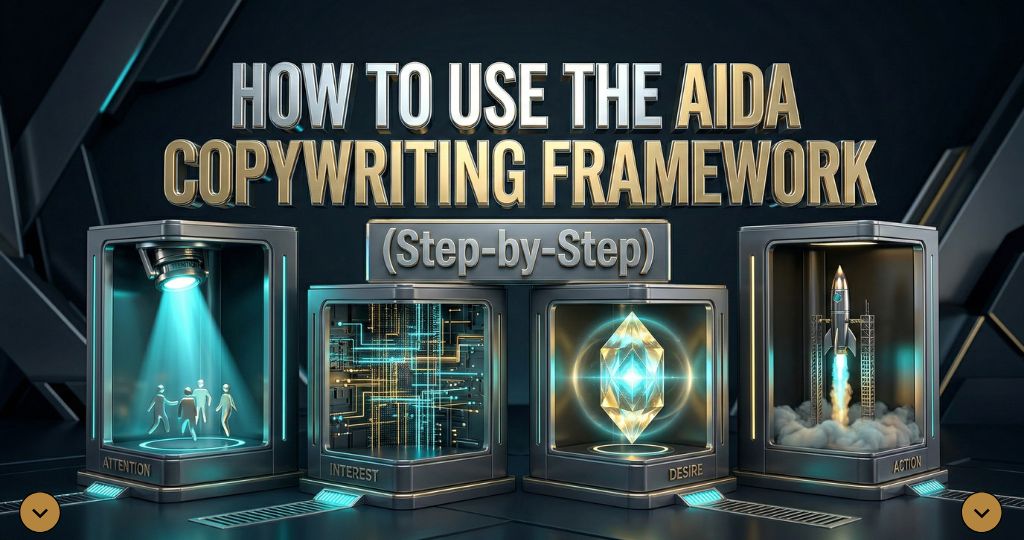
What Is the AIDA Model?
The AIDA framework is a four-stage copywriting framework that guides a reader from initial awareness to final action. It organizes persuasion into a logical progression that mirrors how decisions are made.
The structure is simple:
- Attention: Capture focus immediately.
- Interest: Build curiosity and relevance.
- Desire: Strengthen emotional motivation.
- Action: Direct the next step clearly.
Unlike shorter frameworks that focus on a single psychological trigger, AIDA manages the full persuasion journey. It does not assume the reader is already convinced or problem-aware. Instead, it moves them step by step.
For example:
Attention: Struggling to turn website traffic into paying customers?
Interest: Most businesses focus on traffic growth but ignore conversion optimization.
Desire: Imagine increasing revenue without spending more on ads.
Action: Download our conversion framework and start optimizing today.
Each stage builds on the previous one. If Attention fails, nothing else matters. If Desire is weak, Action feels optional.
AIDA provides structure where persuasion needs sequence, not just intensity.

Why AIDA Works in Marketing Psychology
AIDA works because it follows the natural progression of attention and decision-making.
People rarely move from awareness to action instantly. They require stimulation, validation, emotional investment, and then direction. AIDA structures that movement deliberately.
1. It Captures Attention First
Without attention, persuasion fails.
The Attention stage interrupts distraction. It often uses:
- A bold claim
- A direct question
- A surprising statistic
- A strong benefit
This stage is not about explaining. It is about earning focus.
2. It Builds Interest Through Relevance
Once attention is secured, Interest deepens engagement.
Here, you clarify the problem, context, or opportunity. The reader begins to see themselves in the message. Logical explanation and specificity matter at this stage.
Interest prevents early drop-off.
3. It Converts Interest Into Desire
Desire is emotional. It answers the question: “Why should I care enough to act?”
This stage highlights benefits, outcomes, and transformation. It may include:
- Social proof
- Feature-to-benefit translation
- Future pacing
- Outcome visualization
Desire shifts the message from informational to motivational.
4. It Directs Clear Action
After motivation builds, Action provides direction.
The reader must know exactly what to do next:
- Buy now
- Download the guide
- Book a demo
- Subscribe
Without a clear Action step, momentum dissipates.
AIDA works because it respects sequence. It does not assume readiness. It earns attention, builds engagement, creates motivation, and then channels that motivation into movement.
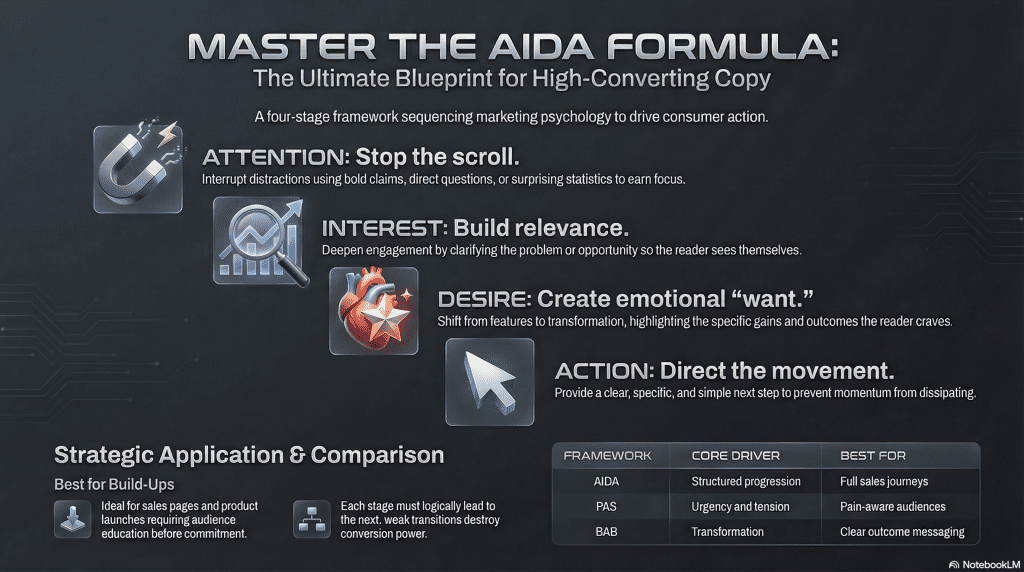
How to Use the AIDA Formula Step by Step
AIDA works best when each stage builds momentum. Weakness in one stage reduces the effectiveness of the entire sequence.
Here is how to apply it correctly.
1. Attention: Interrupt and Capture Focus
The goal of Attention is simple. Earn the reader’s focus immediately.
This can be done with:
- A bold statement
- A clear benefit
- A direct pain point
- A compelling question
Weak example: Welcome to our website.
Stronger example: Struggling to convert traffic into paying customers?
Attention should create curiosity or recognition. It should make the reader want to continue.
2. Interest: Deepen Engagement
Once attention is secured, you must hold it.
Interest explains why the message matters. It expands on the problem or opportunity and adds context.
Weak interest: We help businesses grow.
Stronger interest: Most businesses invest heavily in traffic but ignore conversion optimization, leaving revenue on the table.
Interest builds logical relevance. It prevents the reader from disengaging.
3. Desire: Create Emotional Motivation
Desire turns curiosity into wanting.
Here, you highlight benefits and outcomes rather than features. Show what changes for the reader.
Weak desire: Our software includes analytics dashboards.
Stronger desire: Track exactly where leads drop off and increase conversions without increasing ad spend.
Desire focuses on transformation. It answers, “What do I gain?”
4. Action: Direct the Next Step Clearly
After building motivation, you must provide direction.
Action should be:
- Clear
- Specific
- Simple
Weak action: Learn more.
Stronger action: Start your free trial today.
Without a defined next step, persuasion loses momentum.
When executed correctly, AIDA flows naturally:
Capture focus → Build relevance → Increase motivation → Direct movement.
The structure is straightforward. Precision in execution makes it powerful.

AIDA Examples in Different Contexts
Below are examples of how AIDA adapts to different industries and formats while maintaining the same psychological progression.
Example 1: SaaS Landing Page
Attention: Struggling to turn website visitors into qualified leads?
Interest: Most companies focus on driving traffic but overlook the friction inside their conversion funnel.
Desire: Imagine increasing revenue from your existing traffic without raising your ad budget.
Action: Start your free trial and optimize your funnel today.
Example 2: Ecommerce Product Page
Attention: Tired of headphones that die halfway through your workday?
Interest: Most wireless earbuds sacrifice battery life for compact design.
Desire: Experience 30 hours of uninterrupted audio with fast charging that keeps you moving.
Action: Order now and get free shipping.
Example 3: B2B Consulting Email
Attention: Your sales pipeline looks busy, but revenue growth feels flat.
Interest: Without a structured qualification process, your team spends time on low-intent prospects.
Desire: Picture a predictable pipeline filled with qualified buyers ready to move forward.
Action: Book a strategy call to redesign your sales process.
Example 4: Newsletter Signup
Attention: Marketing advice feels scattered and overwhelming.
Interest: Most content offers tactics without clear structure or execution steps.
Desire: Get one practical framework each week you can apply immediately.
Action: Subscribe to the newsletter today.
Across all examples, the sequence remains consistent:
Capture focus. Build relevance. Increase motivation. Direct action.
The format changes. The psychological progression does not.

Common Mistakes When Using AIDA
AIDA is structured and reliable. When misused, it becomes either too long, too vague, or too mechanical.
Here are the most common mistakes.
Failing to Earn Real Attention
Many writers mistake headlines for hooks.
Weak attention: Welcome to our product page.
Strong attention: Still struggling to generate consistent leads from your website?
Attention must interrupt. If the first stage fails, the rest of the structure never gets read.
Confusing Interest With Desire
Interest explains. Desire motivates.
A common mistake is stacking features in the Interest stage without translating them into outcomes.
Interest builds understanding. Desire builds wanting.
If you move to Action without creating Desire, conversions drop.
Rushing to Action Too Early
Some copy jumps from Attention directly to Action.
Without building Interest and Desire, the call to action feels premature. Readers need a reason to act, not just instruction.
Sequence matters.
Making the Action Vague
Weak calls to action reduce momentum.
Weak: Click here.
Stronger: Start your free 14-day trial today.
Action must be specific and clear. The reader should know exactly what happens next.
Overcomplicating the Structure
AIDA should guide persuasion, not inflate it.
Some writers overextend each stage with unnecessary repetition. When the message becomes bloated, engagement drops.
Clarity is more persuasive than length.
AIDA is powerful because it respects psychological progression. Skip a stage, blur the stages, or overload them, and performance weakens.
When to Use AIDA
AIDA works best when persuasion requires structure and progression.
Because it guides readers from awareness to action step by step, it is especially effective when the audience is not fully convinced yet.
Use AIDA for Sales Pages
Sales pages often need to build a complete argument.
AIDA allows you to:
- Capture attention with a strong headline
- Build interest through problem explanation
- Develop desire with benefits and proof
- Direct action with a clear offer
It works well for medium to long-form copy.
Use AIDA for Product Launches
Launch messaging often requires education before conversion.
AIDA helps move prospects from initial curiosity to strong motivation. Each stage prepares the reader for the next.
It prevents overwhelming the audience with information too early.
Use AIDA in Email Sequences
Email campaigns often unfold over multiple messages.
One email can focus on Attention and Interest. The next can build Desire. The final email can emphasize Action.
AIDA adapts well to multi-step persuasion.
Use AIDA When the Audience Is Not Fully Problem-Aware
Unlike PAS, which assumes existing discomfort, AIDA can guide someone who is earlier in the awareness stage.
It builds context before asking for commitment.
When AIDA May Not Be Ideal
AIDA may feel excessive when:
- The message needs extreme brevity.
- The audience already feels intense urgency.
- The format is very short, such as a one-line ad.
In those cases, frameworks like PAS or BAB may provide sharper compression.
AIDA excels when persuasion requires sequence, clarity, and buildup.

AIDA vs PAS vs BAB: Choosing the Right Framework
All three frameworks guide persuasion, but they emphasize different psychological levers.
Here is a clear comparison:
| Framework | Core Structure | Primary Driver | Best For |
|---|---|---|---|
| AIDA | Attention → Interest → Desire → Action | Structured progression | Full sales journeys |
| PAS | Problem → Agitate → Solve | Urgency and tension | Pain-aware audiences |
| BAB | Before → After → Bridge | Contrast and transformation | Clear outcome messaging |
The Core Difference
AIDA manages the entire persuasion sequence from awareness to decision. It builds momentum gradually.
PAS compresses persuasion around discomfort and relief. It intensifies urgency quickly.
BAB contrasts present reality with a better future, then connects them with a solution. It emphasizes transformation more than pressure.
In simple terms:
- AIDA builds.
- PAS intensifies.
- BAB contrasts.
When AIDA Is Stronger
Use AIDA when:
- The audience is not fully convinced.
- You need to educate before converting.
- The offer requires context and buildup.
It works well for longer-form copy where persuasion unfolds in stages.
When PAS Is Stronger
Use PAS when:
- The problem is already felt.
- Urgency drives action.
- The stakes are clear and immediate.
It accelerates motivation by amplifying consequences.
When BAB Is Stronger
Use BAB when:
- The transformation is simple and clear.
- You want concise persuasion.
- The tone should feel optimistic rather than urgent.
It performs well in short-form messaging and headline-level transformation.
Strong copywriters do not commit to one framework exclusively. They select the structure that best matches audience awareness and emotional positioning.
Conclusion
The AIDA copywriting formula remains effective because it respects how decisions unfold.
- It captures attention before asking for commitment.
- It builds interest before presenting benefits.
- It creates desire before directing action.
That sequence matters.
When you apply AIDA correctly, persuasion feels natural rather than forced. Each stage prepares the reader for the next. Momentum builds logically instead of relying on pressure.
Use AIDA when your message requires structure. When your audience needs context. When the offer benefits from progression rather than compression.
The framework is simple. Execution determines impact.
Strong persuasion is not about using more words. It is about guiding attention, motivation, and action in the right order.

Frequently Asked Questions
What does AIDA stand for?
AIDA stands for Attention, Interest, Desire, and Action. It is a four-stage copywriting model that guides readers from awareness to decision in a structured sequence.
Is AIDA still relevant in modern marketing?
Yes. Despite being one of the oldest persuasion frameworks, AIDA remains effective because it aligns with how people process information and make decisions. Modern formats like landing pages, email funnels, and ads still follow its progression.
Can AIDA be used in short-form content?
Yes, but it must be compressed. In short formats like ads or social posts, each stage may be condensed into a single sentence. The sequence still applies, even when the format is brief.
How is AIDA different from PAS?
AIDA builds persuasion step by step from awareness to action. PAS focuses more heavily on amplifying a problem before presenting a solution. AIDA works well for full sales journeys, while PAS works best when urgency is already present.
What is the most important stage in AIDA?
Each stage is essential, but Attention and Desire are often the most critical. Without attention, nothing gets read. Without desire, action feels optional. However, skipping any stage weakens the overall structure.
Can AIDA and other frameworks be combined?
Yes. Many copywriters combine frameworks. For example, the Desire section of AIDA can incorporate a PAS or BAB structure to deepen motivation before presenting the final action.

1 Comment
Ad Copy That Converts: How Strategists Write High-Conversion Ads - Ismel Guerrero · July 2, 2026 at 6:43 pm
[…] AIDA works best when the audience needs a clear path from first attention to action. […]