Introduction
Conversion Rate Optimization, commonly known as CRO, is the process of increasing the percentage of visitors who take a desired action on your website. That action could be making a purchase, booking a call, subscribing to a newsletter, or downloading a resource.
Most businesses focus on driving more traffic. Fewer focus on converting the traffic they already have.
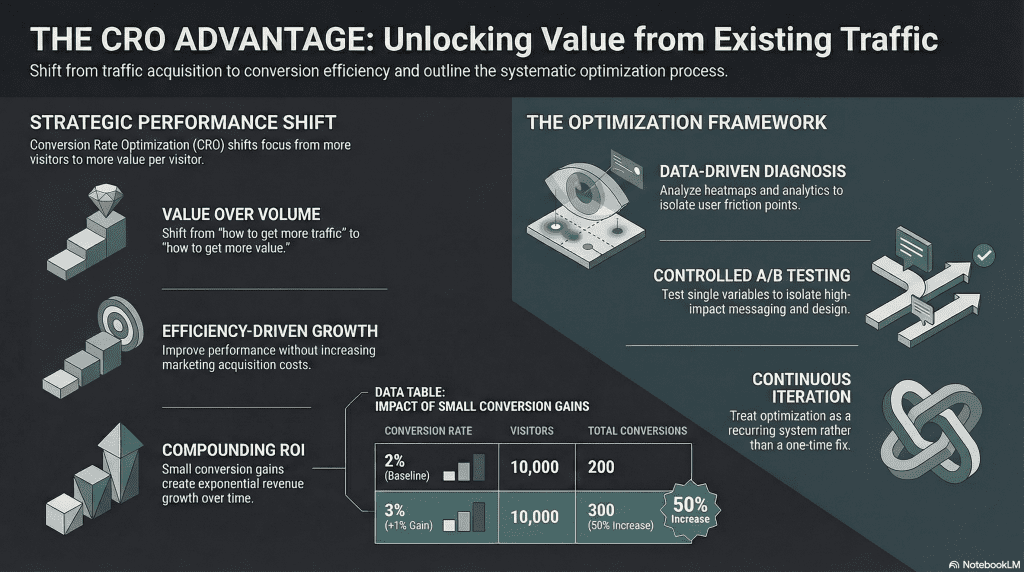
CRO shifts the strategy from “more visitors” to “more value per visitor.” Instead of spending more on ads or SEO, you improve how effectively your site turns attention into revenue.
This guide explains what conversion rate optimization is, how it works, and how to apply proven CRO strategies to increase conversions systematically.
Key Takeaways
- Conversion Rate Optimization increases the percentage of visitors who take a desired action.
- CRO focuses on improving performance without increasing traffic.
- Small conversion improvements can significantly increase revenue over time.
- Effective CRO relies on data, testing, and user behavior analysis.
- A structured CRO process includes research, hypothesis creation, testing, and iteration.
- CRO impacts landing pages, ecommerce stores, SaaS platforms, and lead generation funnels.
- Optimization works best when treated as an ongoing system, not a one-time fix.
Disclaimer: I am an independent Affiliate. The opinions expressed here are my own and are not official statements. If you follow a link and make a purchase, I may earn a commission.
What Is Conversion Rate Optimization?
Conversion Rate Optimization, or CRO, is the systematic process of increasing the percentage of website visitors who complete a desired action.
A conversion can be:
- A product purchase
- A form submission
- A demo booking
- A newsletter signup
- A free trial registration
The conversion rate is calculated using a simple formula:
Conversion Rate = (Conversions ÷ Total Visitors) × 100
For example, if 1,000 people visit your page and 50 make a purchase, your conversion rate is 5%.
CRO focuses on improving that percentage.
Instead of asking, “How do we get more traffic?” CRO asks, “How do we get more value from the traffic we already have?”
It involves analyzing user behavior, identifying friction points, testing improvements, and implementing changes that increase the likelihood of action.
CRO is not guesswork. It is data-driven optimization.
When applied correctly, even small improvements in conversion rate can generate significant revenue growth without increasing marketing spend.

Why Conversion Rate Optimization Matters
Conversion Rate Optimization matters because traffic alone does not guarantee revenue.
If your website attracts visitors but fails to convert them, growth becomes expensive. You spend more on ads, content, and SEO just to maintain performance.
CRO changes the equation.
Instead of increasing acquisition costs, you improve efficiency.
1. It Maximizes Existing Traffic
If your site converts at 2% and you improve it to 3%, that is a 50% increase in conversions without adding new traffic.
The math compounds quickly.
More conversions from the same number of visitors increases revenue while keeping acquisition costs stable.
2. It Lowers Customer Acquisition Cost (CAC)
When conversion rates improve, you generate more customers per marketing dollar.
That reduces your effective cost per acquisition and improves profitability.
In paid media, even small improvements can significantly impact return on ad spend.
3. It Increases Return on Marketing Investment
CRO strengthens every marketing channel:
- SEO traffic becomes more valuable.
- Paid ads generate stronger ROI.
- Email campaigns drive higher returns.
Optimization amplifies the performance of your entire funnel.
4. It Creates Compounding Gains
CRO is not a one-time adjustment. It is an ongoing process.
Small improvements layered over time create exponential growth. A series of 5% improvements across multiple funnel stages can dramatically increase total revenue.
Compounding works in optimization just as it does in finance.
5. It Aligns Marketing With User Behavior
CRO forces businesses to understand how users actually behave.
Instead of guessing, you analyze data:
- Where users drop off
- Where friction appears
- What messaging resonates
This creates clarity and improves decision-making across marketing and product teams.
Conversion Rate Optimization matters because it shifts focus from volume to performance.
Traffic builds opportunity. Optimization unlocks value.
How Conversion Rate Optimization Works
Conversion Rate Optimization works by identifying friction in the user journey and systematically removing it.
Every website has friction. It may be unclear messaging, confusing navigation, weak calls to action, slow load times, or trust gaps. CRO focuses on diagnosing these barriers and improving them through testing.
At a high level, CRO operates through three core mechanisms:
1. Understanding User Behavior
Before changing anything, you analyze how visitors interact with your site.
This includes:
- Where users click
- Where they scroll
- Where they exit
- Which pages convert
- Which pages underperform
Behavioral insights reveal patterns. Data replaces assumptions.
2. Identifying Friction and Opportunity
Once patterns are visible, you look for drop-off points.
For example:
- High traffic but low conversions
- Strong engagement but low checkout completion
- High cart additions but frequent abandonment
Each friction point represents an opportunity.
CRO is not about random improvements. It targets specific bottlenecks in the funnel.
3. Testing Changes Systematically
Optimization relies on experimentation.
Instead of redesigning everything at once, CRO tests controlled variations, such as:
- Headline changes
- Call-to-action placement
- Form length reduction
- Layout adjustments
- Trust signals
Testing isolates variables and measures performance impact.
Winning variations are implemented. Losing variations are discarded.
The Core Principle
CRO works because it treats performance as measurable and improvable.
- You observe behavior.
- You form a hypothesis.
- You test.
- You implement.
- You repeat.
Optimization becomes a system rather than a guess.
The Conversion Rate Optimization Process Step by Step
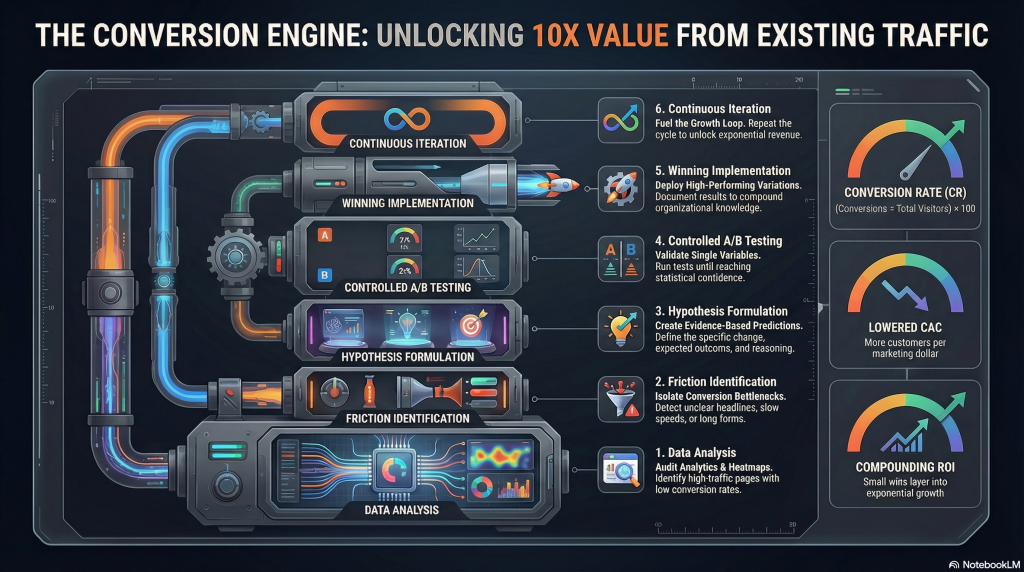
Effective CRO follows a structured process. Random changes rarely produce consistent results. Optimization requires discipline.
Here is the step-by-step framework.
1. Collect and Analyze Data
Start with evidence.
Use analytics tools to identify:
- High-traffic pages with low conversion rates
- Funnel drop-off points
- Pages with high bounce rates
- Checkout abandonment rates
Combine quantitative data with qualitative insights such as:
- Heatmaps
- Session recordings
- User surveys
The goal is clarity before action.
2. Identify Friction Points
Once you understand user behavior, isolate bottlenecks.
Common friction areas include:
- Unclear headlines
- Weak calls to action
- Long forms
- Slow page speed
- Lack of trust signals
Each friction point represents a testable opportunity.
3. Form a Hypothesis
Every optimization change should begin with a hypothesis.
For example:
If we simplify the headline to clarify the main benefit, conversion rate will increase because visitors will understand the offer faster.
Strong hypotheses include:
- The change
- The expected outcome
- The reasoning
Clarity prevents random testing.
4. Run Controlled A/B Tests
Test one meaningful variable at a time.
Examples:
- Headline variation
- Button color or placement
- Short vs long form
- Pricing page layout
Allow tests to run long enough to gather statistically meaningful data.
Avoid stopping tests early due to short-term fluctuations.
5. Implement Winning Variations
Once a test reaches statistical confidence and produces a clear winner, implement the improvement.
Document results.
Optimization knowledge compounds over time.
6. Repeat the Cycle
CRO is continuous.
After implementing one improvement, return to data collection and identify the next opportunity.
Small improvements across multiple funnel stages can dramatically increase total conversions.
The CRO process works because it removes guesswork and replaces it with structured experimentation.
Data → Hypothesis → Test → Implement → Iterate.

Key CRO Metrics to Track
Conversion Rate Optimization depends on accurate measurement. Without tracking the right metrics, optimization becomes guesswork.
Here are the most important CRO metrics.
1. Conversion Rate
This is the core metric.
Conversion Rate = (Conversions ÷ Total Visitors) × 100
It measures the percentage of visitors who complete a desired action.
Track it at multiple levels:
- Overall site conversion rate
- Landing page conversion rate
- Funnel-stage conversion rate
Granularity reveals opportunity.
2. Bounce Rate
Bounce rate measures the percentage of visitors who leave after viewing only one page.
A high bounce rate often signals:
- Misaligned traffic
- Weak headlines
- Slow load times
- Poor user experience
Bounce rate helps diagnose top-of-funnel friction.
3. Click-Through Rate (CTR)
CTR measures how often users click on a specific element, such as:
- A call-to-action button
- A pricing link
- A promotional banner
Low CTR often indicates weak messaging or poor placement.
4. Cost Per Acquisition (CPA)
CPA measures how much it costs to acquire one conversion.
When conversion rates increase, CPA typically decreases, improving profitability.
CRO directly impacts acquisition efficiency.
5. Average Order Value (AOV)
AOV tracks the average revenue per transaction.
CRO does not only improve conversion rate. It can also increase:
- Upsells
- Cross-sells
- Bundled purchases
Increasing AOV multiplies revenue impact.
6. Cart Abandonment Rate
For ecommerce businesses, cart abandonment reveals friction in checkout.
High abandonment may indicate:
- Unexpected costs
- Complex forms
- Limited payment options
- Trust issues
Reducing abandonment significantly increases revenue.
7. Customer Lifetime Value (CLV)
CLV measures the long-term value of a customer.
CRO improvements that attract higher-quality customers can increase retention and lifetime revenue.
Optimization should focus on sustainable growth, not short-term spikes.
Tracking these metrics creates visibility across the funnel.
Measure performance. Identify friction. Test improvements.
CRO becomes powerful when metrics guide decisions.
Real Examples of Conversion Rate Optimization
CRO becomes clearer when you see how small changes produce measurable gains. Below are real-world style examples across different business models.
Example 1: Landing Page Headline Optimization
Problem: A SaaS company drives paid traffic to a landing page, but conversion rates remain below 2%.
Observation: Users leave quickly. Heatmaps show low engagement above the fold.
Test:
Replace a vague headline:
“Advanced Marketing Platform”
With a benefit-driven headline:
“Generate More Qualified Leads Without Increasing Ad Spend”
Result: Conversion rate increases from 1.9% to 3.1%.
Why It Worked: The revised headline clarified value immediately. Visitors understood the benefit within seconds.
Clarity reduces friction.
Example 2: Ecommerce Checkout Simplification
Problem: High cart abandonment rate at 72%.
Observation: Checkout required account creation and multiple form fields.
Test:
- Enable guest checkout
- Reduce required form fields
- Display trust badges near payment section
Result: Cart abandonment decreases to 58%. Revenue increases without additional traffic.
Why It Worked: Removing friction at the final stage improves completion rates.
Ease increases conversion.
Example 3: Call-to-Action Button Testing
Problem: A B2B service page receives traffic but few demo requests.
Test:
Change CTA text from:
“Submit”
To:
“Book My Free Strategy Call”
Result: Demo bookings increase by 24%.
Why It Worked: The revised CTA clarified the outcome and reduced ambiguity.
Specificity increases action.
Example 4: Pricing Page Layout Adjustment
Problem: Users view pricing but do not select a plan.
Test:
- Highlight the most popular plan
- Add a short value summary under each pricing tier
- Display customer testimonials below pricing
Result: Plan selection increases by 18%.
Why It Worked: Social proof and visual emphasis reduced decision friction.
Guidance increases confidence.
The Pattern Across All Examples
In each case:
- Traffic stayed constant.
- A single friction point was addressed.
- A controlled change was tested.
- Measurable improvement followed.
CRO works because it focuses on precision, not volume.
Small improvements compound when applied consistently.
Common Conversion Rate Optimization Mistakes
CRO improves performance when applied systematically. When applied incorrectly, it wastes time and produces misleading results.
Here are the most common mistakes.
Testing Without Data
Many businesses begin testing based on opinion rather than evidence.
Changing headlines, layouts, or colors without analyzing user behavior often produces inconsistent results.
Optimization should begin with:
- Analytics review
- Funnel analysis
- Behavioral data
Data guides priorities.
Changing Too Many Variables at Once
If you redesign an entire page in one test, you cannot isolate what caused improvement or decline.
Strong CRO isolates variables.
Test one meaningful change at a time. Clear causation produces reliable insights.
Ending Tests Too Early
Short-term fluctuations can create false winners.
Tests need sufficient traffic and statistical confidence before conclusions are drawn.
Stopping early often leads to implementing changes that do not sustain performance.
Ignoring User Intent
Traffic sources matter.
If users arrive from high-intent search queries, messaging should reflect purchase readiness. If traffic is informational, aggressive calls to action may reduce conversions.
Optimization must align with intent.
Focusing Only on Design
Design matters, but messaging often has greater impact.
Headlines, value propositions, trust signals, and calls to action frequently influence conversion more than visual tweaks.
Optimization should balance:
- UX improvements
- Copy refinement
- Trust enhancement
Treating CRO as a One-Time Project
CRO is not a redesign phase. It is an ongoing system.
User behavior evolves. Competitors adjust. Market expectations change.
Continuous iteration maintains performance.
CRO fails when treated casually. It succeeds when approached as disciplined experimentation.

CRO Tools and Platforms
Conversion Rate Optimization relies on data and testing. The right tools make friction visible and experimentation measurable.
Below are the most commonly used CRO tool categories and examples.
1. Analytics Tools
Analytics tools help you understand traffic behavior and conversion performance.
Google Analytics
Tracks traffic sources, user flow, bounce rate, and conversion events.
Adobe Analytics
Used by larger organizations for advanced segmentation and reporting.
Analytics provides the foundation for identifying opportunity.
2. A/B Testing Platforms
Testing tools allow you to experiment with variations and measure impact.
Optimizely
Enables controlled experiments across web and product environments.
VWO
Supports A/B testing, multivariate testing, and user behavior analysis.
Testing platforms isolate variables and validate hypotheses.
3. Heatmap and Behavior Tools
Behavioral tools reveal how users interact with your pages visually.
Hotjar
Provides heatmaps, session recordings, and on-site surveys.
Crazy Egg
Offers click tracking and scroll mapping to highlight engagement zones.
These tools uncover friction that analytics alone may miss.
4. User Feedback and Survey Tools
Direct feedback clarifies intent and hesitation.
Typeform
Creates interactive surveys for qualitative insights.
Qualtrics
Supports advanced research and customer feedback collection.
Feedback helps explain why users behave the way they do.
5. Performance and Speed Tools
Page speed directly affects conversion rates.
Google PageSpeed Insights
Evaluates load speed and provides optimization recommendations.
Improving load time reduces abandonment and increases engagement.
The Key Principle
Tools do not improve conversion rates by themselves.
Data reveals patterns.
Testing validates hypotheses.
Implementation drives results.
CRO tools enable visibility and experimentation. Strategy determines impact.
Conclusion
Conversion Rate Optimization transforms traffic into measurable growth.
Instead of focusing only on acquisition, CRO improves how effectively your website converts attention into action. It identifies friction, tests improvements, and compounds small gains across the funnel.
Traffic creates opportunity. Optimization unlocks revenue.
The most successful businesses treat CRO as a system. They collect data, form hypotheses, run controlled experiments, implement improvements, and repeat the cycle. Over time, incremental improvements create exponential results.
CRO does not rely on guesswork. It relies on disciplined experimentation and user insight.
When you improve conversion rates, every marketing channel becomes more profitable. Ads generate stronger returns. SEO traffic becomes more valuable. Email campaigns convert more efficiently.
Optimization multiplies performance.

Frequently Asked Questions
What is a good conversion rate?
A good conversion rate depends on industry, traffic source, and business model. Ecommerce sites often average between 2% and 4%, while high-intent landing pages may convert at much higher rates. The key is improving your baseline over time rather than chasing arbitrary benchmarks.
How long should an A/B test run?
An A/B test should run long enough to reach statistical significance. This depends on traffic volume and conversion frequency. Ending tests too early can produce misleading results. As a rule, allow tests to run for at least one full business cycle to account for behavioral variations.
Is CRO only for ecommerce websites?
No. CRO applies to any site with a measurable goal, including SaaS platforms, lead generation sites, service businesses, and content publishers. If your website has a desired action, it can be optimized.
What is the difference between SEO and CRO?
SEO focuses on increasing traffic through search visibility. CRO focuses on increasing the percentage of visitors who convert. SEO drives volume. CRO improves efficiency. Together, they maximize performance.
What causes low conversion rates?
Common causes include:
- Unclear value proposition
- Weak calls to action
- Slow page speed
- Complex checkout processes
- Lack of trust signals
- Mismatched user intent
Identifying the root cause requires data analysis and testing.
How often should you perform conversion rate optimization?
CRO should be continuous. User behavior changes, competition evolves, and market conditions shift. Treat optimization as an ongoing system rather than a one-time project.

0 Comments