TikTok Shop affiliate marketing gives creators a way to earn commissions by promoting products already sold through TikTok Shop. You do not need to create a product, manage inventory, or handle shipping. Your job is to choose relevant products, create helpful content, and guide viewers toward a buying decision they feel good about.
The opportunity is real, but it is not automatic. Beginners need the right niche, trustworthy products, clear videos, and honest recommendations. This guide explains how TikTok Shop affiliate marketing works, how to choose products, what content to create, and how to build trust before you try to sell.
- TikTok Shop affiliate marketing lets creators earn commissions by promoting products listed on TikTok Shop.
- You do not need to own inventory, ship orders, or run a full ecommerce store.
- Product fit matters more than chasing the highest commission rate.
- Strong affiliate content shows the product in use and helps viewers make a clearer buying decision.
- A focused niche makes your recommendations easier to trust and easier for the right audience to understand.
- Beginners should track clicks, orders, comments, saves, and commissions instead of judging videos by views alone.
- Clear affiliate disclosure protects your credibility and helps viewers understand when you may earn a commission.
Disclaimer: I am an independent Affiliate. The opinions expressed here are my own and are not official statements. If you follow a link and make a purchase, I may earn a commission.
What TikTok Shop Affiliate Marketing Is
TikTok Shop affiliate marketing is a way for creators to earn commissions by promoting products that sellers already list on TikTok Shop.
You do not need to create the product, store inventory, pack orders, or manage shipping. The seller handles the product and fulfillment. You focus on choosing the right items and creating content that helps people understand whether those items are worth buying.
In simple terms, you act as the bridge between the product and the buyer.
That bridge matters. A product page can show photos, prices, and reviews, but your content can show the product in real life. You can explain how it works, who it is for, what problem it solves, and what buyers should know before they order.
The basic flow looks like this:
- A seller lists a product on TikTok Shop.
- You choose a product that fits your niche and audience.
- You create a video, livestream, or product-linked post.
- A viewer clicks the product link through your content.
- You earn a commission when the sale qualifies under TikTok Shop’s rules.
The best affiliate creators do not simply post links and hope people buy. They build trust by showing products clearly, explaining them honestly, and recommending items that make sense for the people watching.
That is why TikTok Shop affiliate marketing connects closely with broader affiliate marketing. The tool is TikTok Shop, but the core skill is the same: match the right product with the right audience through useful content.
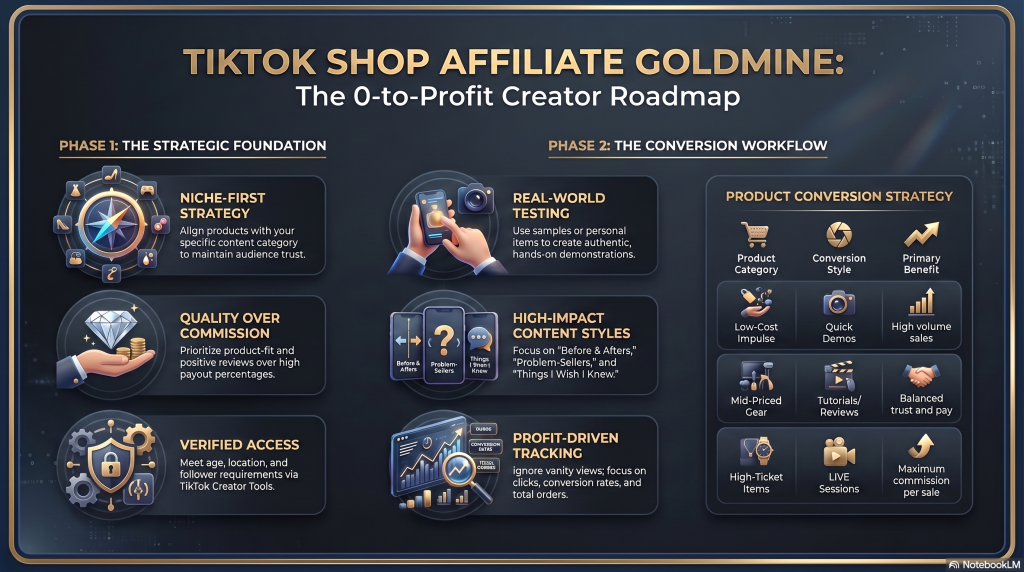
How the TikTok Shop Affiliate Program Works
The TikTok Shop affiliate program connects three groups: sellers, creators, and shoppers.
Sellers list products on TikTok Shop and make some of those products available for affiliate promotion. Creators choose products from the affiliate marketplace, create content around them, and add product links to videos, livestreams, or eligible placements. Shoppers can then buy through those links without leaving the TikTok shopping experience.
Here is the basic process from start to finish:
- Get access to TikTok Shop creator tools
First, you need access to TikTok Shop’s creator or affiliate features. Eligibility can depend on your country, age, account status, follower count, identity verification, and TikTok Shop’s current requirements.
Before you build a content plan around the program, check your TikTok account or TikTok Shop Creator tools to see which features you can use. - Browse products in the affiliate marketplace
Once you have access, you can review products that sellers have opened to affiliates. You may see product categories, prices, commission rates, sample options, seller details, and performance information when available.
Do not choose products only because the commission looks attractive. A product still needs to fit your niche, make sense for your audience, and give you something useful to show on camera. - Choose a product that fits your audience
Product fit matters more than product volume.
A home organization creator should focus on storage, cleaning, small-space solutions, and household tools. A beauty creator should stay close to skincare, makeup tools, hair care, and personal care products.
When the product matches the audience, the recommendation feels natural. When it does not, even a good product can feel random. - Test or research the product before promoting it
The strongest content usually comes from real experience.
If you can request a sample, buy the product, or use something you already own, you can create better demos and more honest reviews. You can show how the product works, what surprised you, where it performs well, and what buyers should know before ordering.
If you cannot test the product yet, study the listing, reviews, seller reputation, shipping details, and common buyer questions before you create content. - Create content that explains the product clearly
Your content should make the product easy to understand.
A good affiliate video does not just say, “Buy this.” It shows the product in use, explains the problem it solves, and gives the viewer enough context to decide whether it fits their needs.
Demos, reviews, tutorials, before-and-after videos, comparisons, and livestreams can all work when they help the viewer make a better decision. - Add the product link
When you post eligible content, you can tag or link the product through TikTok Shop’s affiliate tools.
This creates a direct path from your content to the product page. The link matters, but it does not sell by itself. The content has to create the interest, trust, and clarity that make someone want to click. - Earn commission on qualifying sales
When someone buys through your eligible product link, video, or livestream, you may earn a commission if the sale qualifies under TikTok Shop’s rules.
The amount depends on the product price, commission rate, and program terms. Returns, cancellations, refunds, and policy rules can affect what you actually receive. - Track results and improve
After you post, watch more than views.
Product clicks, orders, commissions, comments, saves, shares, and buyer questions all give you clues. These signals help you understand which products, hooks, and video formats are worth repeating.
Over time, successful affiliate marketing becomes less about guessing and more about testing what your audience actually responds to.
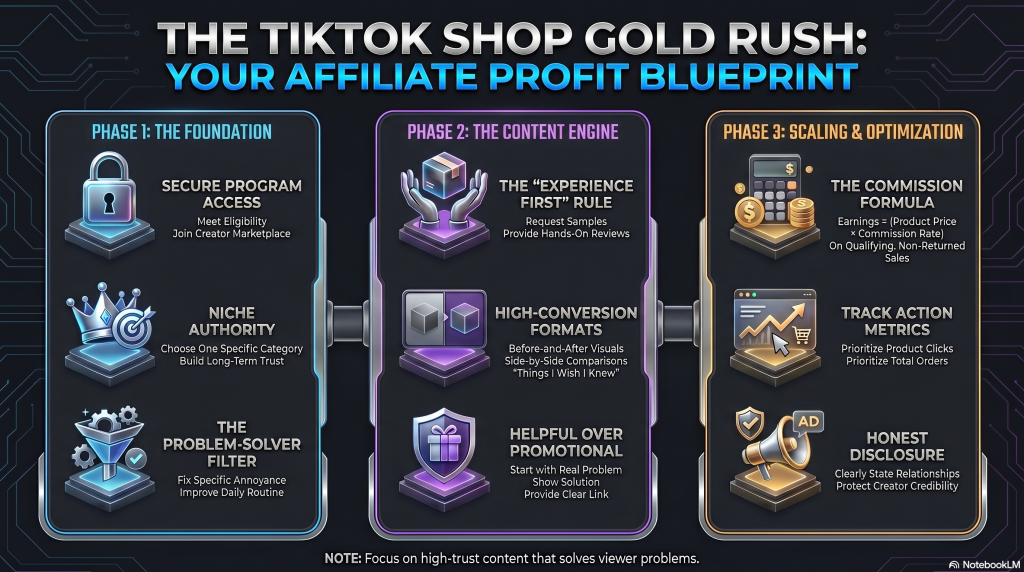
TikTok Shop Affiliate Requirements Creators Should Check
Before you plan your content around TikTok Shop affiliate marketing, check whether your account can actually use the creator and affiliate features.
Requirements can change by country, account type, and TikTok Shop policy updates. In the U.S., TikTok says Shop creators generally need to be at least 18, based in the United States, pass identity verification when required, follow TikTok Shop policies, and meet the follower rules for their creator type.
For regular Affiliate Creators, TikTok currently lists 1,000 followers as the follower requirement. Official Shop Creators can bind to their own TikTok Shop without a minimum follower requirement, but they can only promote products from that bound shop. Marketing Accounts can bind without a minimum follower requirement for self-selling, but they need 5,000 followers to promote products from other sellers through the TikTok Shop Product Marketplace.
That distinction matters because not every creator account has the same access. A beginner may qualify for one feature but not another. For example, a creator might be able to promote through a limited program before gaining full access to more product options, shoppable videos, LIVEs, or campaigns.
TikTok also uses account quality signals. Some product categories require creators to meet extra standards before they can add those products to showcases, videos, or livestreams. These standards can include Creator Health Rating, Promotion Performance Score, recent sales history, and the ability to create high-quality ecommerce content.
The safest move is simple: check the requirements inside your own TikTok account before choosing products or building a posting schedule. Look at your TikTok Shop Creator tools, product marketplace access, account health, and any limits on shoppable videos or livestreams.
Meeting the requirements only gives you access. It does not guarantee clicks, sales, or commissions. The real work starts after approval, when you choose products carefully, create useful content, and protect the trust of the people watching.

Who TikTok Shop Affiliate Marketing Makes Sense For
TikTok Shop affiliate marketing can be a good fit if you enjoy creating content that explains, reviews, tests, or demonstrates products.
You do not need to be a huge influencer to start. Smaller creators can still earn trust when they focus on a clear niche and help the right audience solve specific problems. A helpful product demo for the right viewer can be more powerful than a broad video that reaches people who do not care.
This path usually works best for creators who like practical content. That may include beauty tutorials, home organization ideas, kitchen tool demos, pet product reviews, fitness accessories, cleaning routines, or everyday problem-solving videos.
It can also work for beginners who want to build a focused account from scratch. In that case, the goal is not to promote every trending product. The goal is to become known for a specific type of recommendation.
TikTok Shop affiliate marketing is not a good fit for someone who wants quick commissions without testing products, learning the platform, or building trust. It takes product research, content consistency, and patience. Some videos may lead to clicks and sales. Others may teach you what your audience does not want.
At its best, this model rewards creators who want to be useful first and promotional second. When your audience feels that you are helping them make a better buying decision, your product recommendations become easier to trust.

How to Choose Products People Actually Want
The products you choose will shape your results more than almost anything else.
A strong product gives you something useful to show, explain, compare, or demonstrate. A weak product forces you to sell too hard because there is not enough real value to talk about.
Start with audience fit. If your content focuses on home organization, your products should connect to storage, cleaning, small spaces, or household routines. If your content focuses on beauty, your products should connect to skincare, makeup tools, hair care, or personal care.
When the product fits your audience, the recommendation feels natural. When it does not, the video can feel random, even if the product itself is good.
Look for products that solve a clear problem. Strong TikTok Shop affiliate products usually help someone save time, reduce mess, fix an annoyance, improve a routine, or get a better result. The easier the problem is to understand, the easier the product is to explain on camera.
A drawer organizer is easy to show. A stain remover is easy to test. A kitchen tool that saves prep time is easy to demonstrate. The viewer should quickly understand why someone would want it.
You should also check the product’s reviews, seller reputation, shipping expectations, price, and return concerns before promoting it. A high commission does not help much if buyers complain about poor quality, slow delivery, confusing sizing, or weak results.
Your audience may not blame the seller first. They may blame you for recommending it.
Price also matters. Low-cost products can work well for impulse buys because viewers need less convincing. Higher-priced products usually need more proof, more explanation, and more trust.
| Product type | Best for | Content needed | Main risk |
|---|---|---|---|
| Low-cost impulse buys | Quick demos and simple problem-solving videos | Fast visuals and a clear use case | Lower commission per sale |
| Mid-priced products | Reviews, tutorials, and comparisons | More explanation and stronger proof | Viewers may need more time to decide |
| Higher-ticket products | Livestreams, repeat videos, and detailed reviews | Trust, credibility, and clear value | Harder to convert cold viewers |
Before you promote a product, ask yourself:
- Would this product make sense for my audience?
- Can I show it clearly in a video or livestream?
- Does it solve a real problem?
- Are the reviews strong enough?
- Does the seller look reliable?
- Is the price reasonable for the value?
- Would I feel comfortable recommending it to someone I know?
If the answer is yes, you have a stronger product to work with.
The best product is not always the one with the highest commission. It is the one you can recommend clearly, honestly, and repeatedly without hurting your credibility.

Why Your Niche Matters More Than Random Trends
Your niche gives your TikTok Shop content direction.
Without a clear niche, your account can feel scattered. One day you promote a kitchen gadget, the next day a skincare tool, then a pet product. Even if those products are useful, viewers may not know what to expect from you.
A focused niche helps people understand why they should follow you. It also helps TikTok understand what kind of content you create and who may want to see it.
Think of your niche as a filter. It helps you decide which products belong on your account and which ones you should skip.
For example, a home organization creator can promote drawer dividers, closet storage, cleaning tools, label makers, and small-space solutions. Those products all connect to the same audience need. A beauty creator can focus on skincare tools, makeup organizers, hair products, and personal care items. Again, the recommendations feel connected.
That connection builds recognition. Over time, viewers start to associate you with a specific kind of help. They know what problems you solve, what products you test, and what type of recommendation they can expect from you.
A niche also makes product research easier. Instead of chasing every trending item in the marketplace, you can focus on products that fit your audience. That saves time and protects trust.
You can still expand later. A home organization account might add cleaning products. A fitness account might add meal prep tools. A beauty account might add travel organizers.
The key is relevance. Every product should feel like it belongs in the same world as the content your audience already came for.
When your niche is clear, your recommendations feel less like random selling and more like helpful curation. That is where trust starts to grow.

What TikTok Shop Affiliate Content Should Look Like
Strong TikTok Shop affiliate content does more than show a product. It helps the viewer understand why the product matters.
A good video answers a few quiet questions in the viewer’s mind:
- What is this?
- How does it work?
- Would this help me?
- Is it worth checking out?
The best format depends on the product, but most high-performing affiliate content usually fits one of these patterns.
Product demos
Product demos work well because people can see the item in action.
Instead of saying a cleaning tool works, show it cleaning. Instead of saying an organizer saves space, show the messy drawer before and the cleaner result after.
The more visible the result, the easier it is for viewers to understand the value.
Honest reviews
Reviews build trust when they sound balanced.
Share what you liked, what surprised you, and what someone should know before buying. You do not need to make the product sound perfect. One honest limitation can make the whole recommendation feel more believable.
For example, you might say, “This works best for smaller drawers,” or “The setup took a few minutes, but the result was worth it.”
Problem-solution videos
This format gives the product a clear reason to exist.
Start with a problem your audience already understands. Then show how the product helps solve it.
For example:
“My bathroom counter was always cluttered, so I tried this organizer.”
That opening works because the viewer understands the problem before you introduce the product.
Before-and-after videos
Before-and-after content works when the product creates a visible change.
This format can work especially well for cleaning, organization, beauty, home products, fitness accessories, and practical tools. The key is to keep the result honest. Do not exaggerate what the product can do.
Comparison videos
Comparison videos help viewers make decisions.
You can compare two similar products, show the difference between a basic and upgraded version, or explain which product makes more sense for a specific situation.
This positions you as helpful, not pushy.
“Things I wish I knew” videos
This format works because it feels like advice from someone who has already tested the product.
You can explain sizing, setup, best use cases, limitations, quality, or who the product is not for. These details help viewers avoid disappointment and make a better buying decision.
TikTok Shop LIVE sessions
Livestreams can work well when a product needs more explanation, demonstration, or trust.
A LIVE session gives you more room to answer questions, show the product from different angles, repeat the main benefits, and respond to buyer concerns in real time. This can be especially useful for higher-priced products or items that people want to see before buying.
The main rule is simple: make the content useful before you make it promotional.
Show the product clearly. Explain it simply. Mention honest details. Help the viewer decide. When your content does that, the product link feels like a helpful next step instead of a hard sell.

A Simple Video Structure Beginners Can Use
A strong TikTok Shop affiliate video does not need to be complicated. It needs to make the product easy to understand fast.
Use this structure when you are not sure what to post:
- Start with a real problem
Open with something your audience can recognize right away.
For example, “My bathroom drawer was always a mess,” or “I kept wasting time looking for this one kitchen tool.”
The problem gives the viewer a reason to care. - Show the product in use
Do not just hold the product up to the camera.
Use it, open it, set it up, test it, or show the result. Viewers need to see what the product actually does before they feel interested enough to click. - Explain what changed
Make the benefit clear.
Did it save space, make a routine easier, solve an annoying problem, or help something look cleaner, faster, or more organized?
Keep this part simple. The viewer should understand the value without needing a long explanation. - Add one honest detail
This is where trust is built.
Mention something useful, even if it is not a major selling point. You might say, “It works best for smaller drawers,” “The setup took a few minutes,” or “I would not use it for heavier items.”
That kind of detail makes the recommendation feel real. - Point to the product
End with a clear next step.
You do not need to pressure anyone. A calm line works better: “I linked it here if you want to check it out.”
The goal is not to make every video sound like an ad. The goal is to help viewers quickly understand the product, decide whether it fits their needs, and know where to find it if they want to learn more.

How to Use TikTok SEO to Help Shoppers Find Your Videos
TikTok Shop affiliate content should not depend only on the For You feed. Many people use TikTok like a search engine when they want product ideas, reviews, comparisons, tutorials, and real examples before they buy.
That means your content needs clear signals. TikTok should be able to understand what the video is about, and viewers should be able to understand it quickly too.
Use simple keywords in natural places:
- Say the product type in the video when it fits.
- Add the product name or category in on-screen text.
- Use a caption that describes the problem and product clearly.
- Answer common buyer questions in follow-up videos.
- Use comments as ideas for new search-focused content.
For example, “drawer organizer review” gives TikTok more context than “this changed my kitchen.” The second phrase may work as a hook, but the first phrase tells the platform and the viewer what the video is actually about.
You can combine both:
“Drawer organizer review: this helped fix my messy kitchen drawer.”
That phrasing gives you the searchable product category and the real-life problem in one sentence.
The same idea works across niches. A beauty creator might use “heatless curls tutorial.” A pet creator might use “dog toy for heavy chewers.” A cleaning creator might use “stain remover test.”
The goal is not to stuff keywords everywhere. The goal is to make the topic clear. When your video title, caption, spoken words, and product link all point to the same idea, the content becomes easier to understand and easier to find.
TikTok SEO works best when it supports helpful content. Use keywords to guide the right viewer to the right product, then let your demo, review, or explanation build the trust.

How to Share Affiliate Links Without Sounding Spammy
TikTok is usually the main place to create TikTok Shop affiliate content, but some creators may also have access to shareable affiliate links.
Those links can help you recommend products outside a regular TikTok video or livestream. The key is to use them with context. A link should answer a real question, support helpful content, or make it easier for someone to find a product you already explained.
You might share affiliate links in places like:
- Instagram Stories
- A newsletter
- A Facebook group
- A private community
- A product roundup
- A direct message when someone asks for the link
The link should fit the platform and the conversation.
A newsletter gives you room to explain the product in more detail. Instagram Stories work better for quick visuals and short notes. A Facebook group may work well when someone asks for a specific recommendation and your answer is genuinely helpful.
Do not just drop a link and disappear. That feels random, and it can make your content look spammy.
Instead of saying, “Here’s the link,” give people a reason to care.
For example:
“This is the drawer organizer I used in the video. It works best for smaller kitchen drawers, so check the size before ordering.”
That kind of sentence gives the link context. It explains what the product is, who it fits, and what the buyer should check before making a decision.
Affiliate links should support your recommendation, not replace it. Your content still needs to do the work of explaining the product clearly. The link simply gives people a next step after they understand why the product may be useful.
Used well, affiliate links make buying easier. Used poorly, they make your content feel like a sales pitch in a cheap suit.
What to Track After You Start Posting
Once you start posting TikTok Shop affiliate content, do not judge success by views alone.
Views can show reach, but they do not tell you whether the right people are watching, clicking, or buying. A video with fewer views can still perform well if it attracts shoppers who are ready to act.
Track the signals that show real buying interest.
Product clicks
Product clicks show how many viewers felt interested enough to tap the product link.
If a video gets views but very few clicks, the product may not be clear enough. The hook may be too broad, the demo may be too weak, or the viewer may not understand why the product matters.
Orders
Orders show whether people are buying after they click.
If you get clicks but few orders, look at the product page, price, reviews, shipping details, and the promise your video made. Sometimes the content creates interest, but the product page does not create enough confidence.
Commission
Commission shows what your content actually earns from qualifying sales.
Track commission by product and by content type when possible. This helps you see which products deserve more videos and which ones are not worth repeating.
Comments and questions
Comments reveal what viewers still need to know.
If people keep asking about size, setup, quality, color, shipping, or how the product works, those questions can become new videos. A good comment section often gives you your next content plan for free. Tiny miracle, honestly.
Saves and shares
Saves and shares can show deeper interest.
Someone may save a video because they want to come back later. They may share it because the product solves a problem for a friend, partner, parent, or coworker.
Repeat performance
One good video is helpful. A repeatable pattern is better.
Look for products, hooks, formats, and problems that work more than once. If a drawer organizer demo performs well, try another angle on the same product. If a “things I wish I knew” format gets strong clicks, test that format with similar products.
The goal is to learn what your audience responds to, then create more content around the products and angles that show promise.
Do not chase every spike. Study the patterns. That is where better decisions come from.
Common Beginner Mistakes That Hurt Trust
Most beginners do not struggle because TikTok Shop affiliate marketing is too complicated. They struggle because they treat it like a shortcut instead of a skill.
The goal is not to squeeze a sale out of every viewer. The goal is to become someone your audience trusts when they need a useful recommendation.
Promoting too many random products
Random products make your account feel confusing.
If one video promotes a kitchen gadget, the next promotes a skincare tool, and the next promotes a pet product, viewers may not understand what your account is about. Even worse, they may stop seeing your recommendations as intentional.
A clear niche gives your content a pattern. That pattern helps people know why they should follow you.
Choosing products only for the commission
A high commission rate can look exciting, but it does not make a product worth promoting.
If the product is low quality, hard to explain, overpriced, or wrong for your audience, the higher payout will not help much. A lower-commission product that people actually want can perform better and protect your credibility.
Commission matters. Product fit matters more.
Making every video sound like an ad
People do not open TikTok hoping to watch a sales pitch.
They want ideas, entertainment, answers, demonstrations, and useful recommendations. If every video starts and ends with pressure to buy, viewers may tune out fast.
Show the product. Explain the problem. Share what you noticed. Let the recommendation feel like help, not a hard push.
Copying other creators too closely
It is smart to study what works. It is risky to copy it too closely.
Copied content often feels flat because it lacks your own experience, voice, and point of view. Use successful videos as inspiration, then make the idea specific to your product, audience, and style.
Your audience does not need a duplicate of another creator. They need your clear take.
Ignoring product reviews
Before you promote anything, check what buyers are saying.
Look for patterns in reviews. Pay attention to complaints about quality, sizing, shipping, packaging, durability, or weak results. One bad review may not matter. Repeated complaints should make you pause.
Your audience may connect a bad buying experience back to your recommendation, even if the seller caused the problem.
Overstating what the product can do
Do not turn a useful product into a miracle product.
Clear, honest claims are easier to trust. Say what the product helped with, show the result, and avoid promising outcomes you cannot prove.
A product does not need to sound perfect to be worth recommending.
Giving up too soon
One video usually is not enough to judge a product.
Sometimes the first angle fails, but a second angle works. A demo may fall flat, while a comparison or “things I wish I knew” video gets stronger clicks.
Test different hooks, formats, and explanations before deciding a product is not worth promoting.
Forgetting that trust is the real asset
A single commission is never worth damaging your reputation.
TikTok Shop affiliate marketing works best when viewers believe you are trying to help them make a better decision. That trust grows slowly, but it can disappear quickly.
Choose carefully. Explain clearly. Disclose honestly. Recommend products you would feel comfortable standing behind.

Trust, Disclosure, and Responsible Promotion
TikTok Shop affiliate marketing depends on trust.
If viewers feel misled, they may not only skip the product. They may stop trusting your recommendations altogether. That is a much bigger loss than one missed commission.
When you promote a product and may earn a commission, make that relationship clear. A simple disclosure works:
“I may earn a commission if you buy through my link.”
You can also say:
“This is linked through TikTok Shop, and I may earn a commission.”
The disclosure should be easy to notice before someone acts on your recommendation. Do not hide it at the end of a long caption, bury it in a pile of hashtags, or rely on vague wording that viewers may not understand.
Disclosure also does not replace honesty.
You still need to show the product accurately, explain what it does, and avoid claims you cannot support. If the product has a limitation that matters, mention it. If it works best for certain people, say so. If the size, setup, material, or use case could affect the buyer’s decision, make that clear.
A product does not need to sound perfect to be worth recommending. In many cases, one honest detail makes the recommendation feel more credible.
Trust is bigger than one sale. Recommend products you can explain clearly, disclose when you may earn money, and help viewers decide whether the product actually fits their needs.
That is how affiliate content becomes useful instead of pushy.
A Simple Beginner Action Plan
TikTok Shop affiliate marketing becomes easier when you treat it like a testing process, not a guessing game.
Start small. Learn what your audience responds to. Then repeat the products, formats, and angles that show real promise.
Step 1: Pick one clear niche
Choose one category you can talk about consistently.
Good beginner niches can include home organization, beauty tools, kitchen products, pet items, cleaning products, fitness accessories, or everyday problem-solving products.
The goal is not to trap yourself forever. The goal is to give your account a clear direction.
Step 2: Find five relevant products
Start with a small group of products instead of trying to promote everything.
Look for items that fit your niche, solve a clear problem, have solid reviews, and give you something useful to show on camera.
Five products is enough to test without overwhelming yourself.
Step 3: Study each product before posting
Before you create content, understand what the product does and why someone would care.
Read the product page. Check the reviews. Look for common questions. Notice any limitations. Pay attention to sizing, setup, shipping concerns, and buyer complaints.
The better you understand the product, the easier it is to create content that feels useful.
Step 4: Create multiple videos per product
One video is rarely enough to judge a product.
Test different angles, such as:
- A product demo
- An honest review
- A problem-solution video
- A before-and-after video
- A comparison
- A “things I wish I knew” video
Each angle teaches you something different about what your audience wants.
Step 5: Track the right signals
After posting, look beyond views.
Watch product clicks, orders, commissions, comments, saves, shares, and repeated questions. These signals show whether viewers are only watching or actually considering the product.
A lower-view video with strong clicks can be more valuable than a viral video that does not send shoppers anywhere.
Step 6: Repeat what shows promise
When a product or format works, do not move on too quickly.
Create another video with a new hook, a different use case, or a clearer explanation. Strong results often come from refining what already works, not constantly starting from zero.
Your first goal is not to master every part of TikTok Shop affiliate marketing. Your first goal is to build a simple loop: choose a relevant product, create useful content, track the response, and improve the next post.
Conclusion: Build Trust Before You Try to Sell
TikTok Shop affiliate marketing is not just about finding products and adding links. It is about helping people make better buying decisions.
That starts with choosing products that make sense for your audience. From there, your job is to show how the product works, explain who it is for, and be honest about anything buyers should know before ordering.
The creators who last are usually not the ones who promote everything. They are the ones who become known for useful recommendations in a clear category.
Start with one niche. Test a small group of relevant products. Create honest content. Track what people respond to. Then improve one video, product, and angle at a time.
When trust comes first, the selling feels more natural, and your audience has a better reason to listen the next time you recommend something.

FAQs About TikTok Shop Affiliate Marketing
What is TikTok Shop affiliate marketing?
TikTok Shop affiliate marketing lets creators promote products sold through TikTok Shop and earn a commission when someone buys through an eligible video, livestream, or product link.
You do not create the product or handle shipping. Your role is to create helpful content that shows the product, explains the value, and helps viewers decide whether it fits their needs.
Do I need my own product to become a TikTok Shop affiliate?
No. You can promote products from sellers who make their items available through TikTok Shop affiliate tools.
The seller handles the product, listing, order, and fulfillment. You focus on choosing relevant products, creating content, and making honest recommendations.
How many followers do I need for TikTok Shop affiliate marketing?
Follower requirements can depend on your country, account type, and TikTok Shop’s current rules.
Some creator types may need a minimum follower count before they can access affiliate features or the product marketplace. The safest place to confirm your eligibility is inside your TikTok account or TikTok Shop Creator tools.
How do TikTok Shop affiliates get paid?
TikTok Shop affiliates earn commissions when someone makes a qualifying purchase through their eligible product link, video, or livestream.
The commission amount depends on the product price, commission rate, and program terms. Returns, cancellations, refunds, and policy rules can affect what you actually receive.
Do I need to buy products before promoting them?
Not always, but testing the product usually leads to better content.
Some sellers may offer samples. Other times, you may need to buy the product yourself or start with products you already own. Having the product in hand helps you show real use, share specific details, and build trust.
What are the best products to promote on TikTok Shop?
The best products are easy to explain, easy to show, and relevant to your audience.
Look for products that solve a clear problem, have solid reviews, match your niche, and give you something useful to demonstrate on camera. A high commission is helpful, but product fit matters more.
Can beginners make money with TikTok Shop affiliate marketing?
Beginners can earn commissions, but results are not guaranteed.
Success depends on product research, content quality, consistency, trust, and testing. Some videos may bring clicks and sales, while others may only teach you what your audience does not want.
Do I need to show my face?
No. Some creators show their face, while others use hands-on demos, product close-ups, voiceovers, screen recordings, or lifestyle footage.
What matters most is clarity. Viewers need to understand what the product is, how it works, and why it may be useful.
Can I promote TikTok Shop products outside of TikTok?
Some creators may have access to shareable affiliate links that can be used outside TikTok.
When you share those links, give them context. A link works better when it supports a recommendation, answers a question, or points people to a product you already explained.
Do I need to disclose that I earn a commission?
Yes. If you may earn a commission or receive another benefit from promoting a product, make that clear to viewers.
A simple line works: “I may earn a commission if you buy through my link.” Clear disclosure protects trust and helps viewers understand your relationship to the product.
Is TikTok Shop affiliate marketing worth it?
It can be worth learning if you enjoy creating product-focused content and helping people make buying decisions.
It is not a shortcut or guaranteed income source. It works best when you choose a clear niche, recommend useful products, create honest content, and improve based on what your audience responds to.

0 Comments