Introduction
PLR websites have evolved. In 2026, they are no longer simple download hubs. They are leverage tools for creators who want to move faster without sacrificing quality.
If you are building digital products, lead magnets, or client resources, PLR allows you to skip the slowest part of the process. You start with structured content instead of a blank document, then reshape it to match your brand, voice, and audience.
That advantage matters more now. Competition is higher. Audiences expect relevance and clarity. Platforms reward originality and usefulness, not recycled content.
This means the outcome depends less on using PLR and more on choosing the right sources and transforming what you download.This guide covers the top PLR websites to use in 2026, including free and premium options. You will see which platforms are still worth your time, how they differ, and how to turn PLR into digital products that support real growth instead of adding to unused folders.
Key Takeaways
- PLR websites are shortcuts to done-for-you digital products from eBooks and templates to courses and coaching materials all ready to customize and resell.
- Not all PLR platforms are the same: some focus on quantity (big libraries), while others specialize in quality, niche-specific content.
- Free PLR websites are great for testing, but scaling your business usually requires upgrading to paid platforms with fresher, more unique assets.
- Choosing the right PLR website matters: the best platform depends on your niche, goals, and whether you need quick lead magnets, polished client resources, or products to sell.
- Your results depend on transformation: success with PLR comes from rebranding, bundling, and repurposing content, not just downloading it.
Disclaimer: I am an independent Affiliate. The opinions expressed here are my own and are not official statements. If you follow a link and make a purchase, I may earn a commission.
What Are PLR Digital Products?
Before choosing a PLR website, it helps to know what you’re actually getting.
PLR (Private Label Rights) digital products are ready-made resources that come with a license allowing you to edit, rebrand, and resell them as your own. Instead of creating everything from scratch, you can start with pre-built content and tailor it to your brand and audience.
Typical PLR formats include:
- Ebooks & guides
- Templates (planners, social media, funnels, landing pages)
- Courses & video trainings
- Checklists, workbooks, and journals
- Email sequences or slide decks
Some PLR is free, while others are premium and polished. The key isn’t just downloading it, it’s how you rebrand and repurpose it so it feels original to your audience.
Pro Tip: Always check the license. Some PLR files allow resale, while others limit you to personal or educational use.
For a deeper dive into types of PLR and how to use them, see our full PLR Digital Products Guide.
Top PLR Websites at a Glance
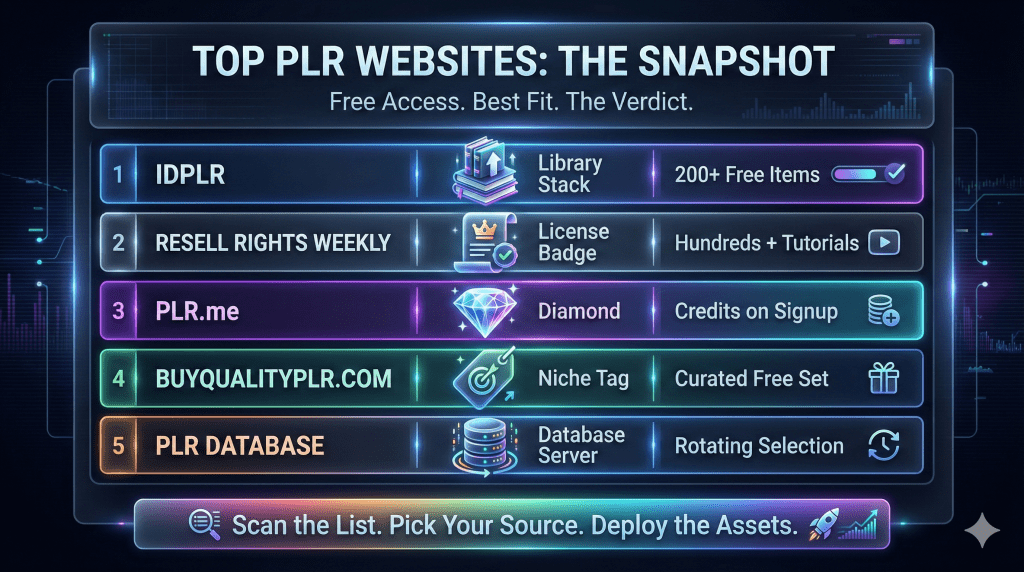
This snapshot compares leading PLR sources side-by-side. It highlights free access, best-fit users, and a one-line verdict so the detailed reviews that follow can focus on depth, caveats, and use cases.
| Platform | Free Access | Best For | Quick Take |
|---|---|---|---|
| IDPLR | 200+ free items | Variety-seekers and beginners | Huge library across niches; expect to update older assets. |
| Resell Rights Weekly | Hundreds of free PLR/MRR | Marketers who want rights flexibility + tutorials | PLR + MRR plus training; free tier is limited. |
| PLR.me | Free credits on signup | Coaches, wellness, personal development | Polished, pro content; credits add up at scale. |
| BuyQualityPLR.com | Small curated free set | Entrepreneurs testing a niche | Clean, niche-focused files; most inventory is paid. |
| PLR Database | Rotating free items | Content teams needing breadth | Massive archive; free selection changes frequently. |
What’s next: The reviews unpack quality signals, licensing nuances, and practical ways to deploy each platform’s assets. Use this grid as the shortlist; the next section makes the pick.
The Best Free PLR Websites to Start With in 2026
Free PLR websites are still useful in 2026, but only when you use them with the right expectations. They work best for testing ideas, building simple lead magnets, or learning how PLR licensing and customization actually works.
What they are not ideal for is selling untouched products or building long-term authority without heavy editing.
Below are the free PLR platforms that still make sense to use, along with when each one fits and where you need to be careful.
1. IDPLR
IDPLR remains one of the largest PLR libraries available. Its biggest strength is volume. You get access to hundreds of free products across business, marketing, health, and personal development.
This makes it useful for exploration. If you are testing niches or looking for base material to repurpose into blog posts, emails, or outlines, IDPLR gives you options quickly.
The tradeoff is freshness. Many assets are older and require updates to language, examples, and positioning before use.
Best for: Beginners who want variety and are willing to rewrite.
Watch out for: Publishing anything without significant edits.
2. Resell Rights Weekly
Resell Rights Weekly stands out because it mixes PLR with Master Resell Rights and includes training. This makes it more educational than most free PLR platforms.
The free tier gives access to a rotating selection of products and tutorials that explain how resell rights actually work in practice. That guidance alone makes it valuable if you are new.
Content quality varies, but the platform does a better job than most at explaining usage rights clearly.
Best for: Marketers who want clarity around resell rights and monetization.
Watch out for: Assuming all products allow the same resale permissions.
3. PLR.me
PLR.me is one of the few PLR platforms where quality is the main selling point. The free access comes through credits rather than unlimited downloads, which encourages intentional selection.
The content is especially strong in coaching, wellness, mindset, and personal development. Worksheets, slide decks, and client-ready tools are where this platform shines.
Because credits are limited, free access works best when you need one or two strong assets rather than a full library.
Best for: Coaches and service providers who need polished materials.
Watch out for: Credit usage adds up quickly if you download in bulk.
4. BuyQualityPLR.com
BuyQualityPLR leans premium, but its free samples are worth using strategically. The content is clean, focused, and formatted better than most free PLR.
This makes it a good place to test how a niche might respond to a specific topic or offer before investing in paid assets.
The free selection is small, but that is part of the appeal. It keeps you focused.
Best for: Entrepreneurs validating ideas or building quick lead magnets.
Watch out for: Expecting a large free library.
5. PLR Database
PLR Database offers access to a massive archive, with free items rotating regularly. You will find articles, ebooks, scripts, and marketing content across many niches.
This platform works best when you need breadth. It is useful for content teams or creators who want to break down PLR into smaller pieces like blog posts or email drafts.
Quality varies, so selection and editing are critical.
Best for: Content-heavy projects that require volume.
Watch out for: Using assets without vetting relevance or accuracy.
Bottom Line: Free PLR platforms are entry points, not end solutions. They help you learn, test, and move faster, but they demand more transformation work.
How to Choose the Right PLR Website for Your Goals
Not all PLR websites are built for the same outcome. Some are designed for volume. Others are designed for polish. Choosing the wrong type leads to wasted time, unused downloads, and content that never gets published.
Use the criteria below to decide quickly and confidently.
Content Freshness and Relevance
PLR does not need to be brand new, but it does need to be relevant. Check how often a platform adds new material and whether the language feels current.
Older content can still work if the core ideas are evergreen. What matters is whether you can realistically update the examples, tone, and positioning without rewriting everything.
If a library feels frozen in time, skip it.
License Clarity and Transparency
PLR, MRR, and RR are not interchangeable. A trustworthy platform clearly explains what you can do with each product.
You should know:
- Whether you can resell the content.
- Whether you can give resell rights to buyers.
- Whether there are restrictions on platforms, ads, or niches.
If licensing terms are vague or buried, that is a risk you do not need to take.
Editable Source Files
A locked PDF limits you. Editable files give you control.
Look for formats like Word documents, Google Docs, Canva templates, PowerPoint slides, or other source files that allow full customization. The easier it is to edit, the more likely you are to actually use the content.
If rebranding feels hard, execution slows down.
Niche Fit Over Library Size
A massive library sounds appealing, but most creators only use a small percentage of what they download.
A focused platform that serves your niche often delivers better results than a general archive. Content that already speaks to your audience reduces how much rewriting you need to do.
Less clutter leads to faster decisions.
Pricing Model That Matches Your Workflow
PLR platforms usually fall into three pricing models: free access, credit-based systems, or subscriptions.
Free access works well for testing. Credit systems make sense when you need a few high-quality assets. Subscriptions are best if you publish content consistently.
The best model is the one that supports how often you create, not the one that looks cheapest upfront.
Choosing a PLR website is not about finding the “best” platform. It is about finding the one that fits your current stage and goals.
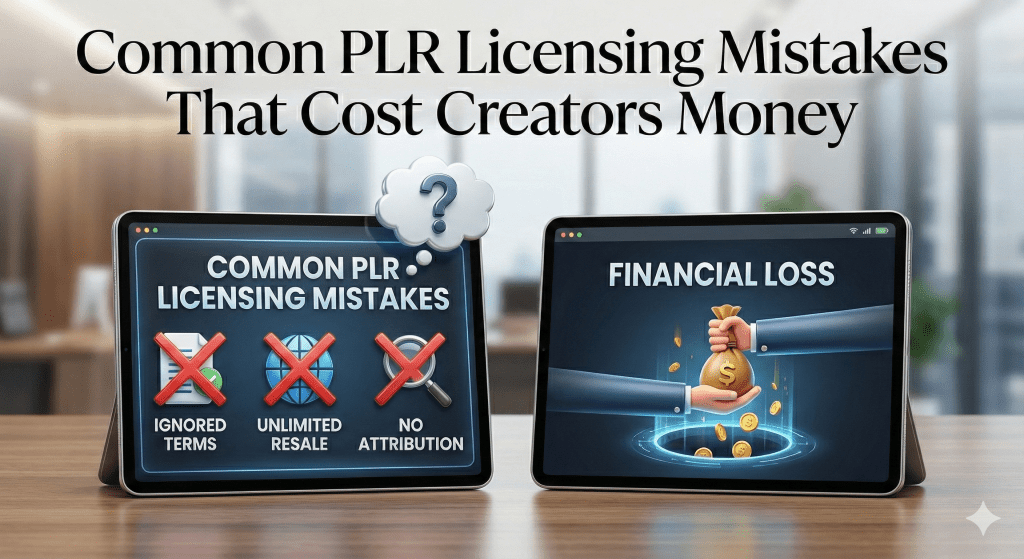
Common PLR Licensing Mistakes That Cost Creators Money
Most PLR problems are not content problems. They are license problems.
Creators lose time, issue refunds, or pull products down because they assumed rights they did not actually have. In 2026, that risk is higher because PLR is used across funnels, ads, marketplaces, and client programs.
These are the mistakes that cause the most damage.
Assuming PLR Means “Do Anything You Want”
PLR allows modification and reuse, but it does not always allow resale in every form. Some licenses permit personal use and lead magnets but restrict selling the content as a standalone product.
If you plan to sell, bundle, or redistribute, you need confirmation in writing. If the license does not clearly say you can resell, assume you cannot.
Confusing PLR, MRR, and RR
The labels sound similar, but the rights are not.
PLR usually allows editing and rebranding.
MRR allows resale and passing resale rights to buyers.
RR allows resale, but buyers cannot resell.
Promising the wrong rights to customers is a fast way to create legal and trust issues. Always match what you sell to what the license allows.
Selling Content “As-Is”
Many licenses technically allow resale without changes, but that does not mean it is a good idea. Selling unedited PLR leads to refunds, complaints, and brand damage.
Even when it is allowed, it is rarely effective.
PLR works best when it is transformed. Editing protects both your reputation and your results.
Ignoring Platform Restrictions
Some PLR licenses ban use on certain platforms. Common restrictions include:
- Uploading to public marketplaces.
- Using the content in paid ads.
- Making health, income, or legal claims.
If you ignore these limits, you can lose accounts or have products removed. Always scan the restriction section before publishing.
Missing Attribution or Copyright Requirements
A small number of PLR products require attribution or specific copyright language unless you purchase an upgraded license. This is easy to miss and hard to fix after launch.
Before publishing, check whether you are required to keep or remove any notices.
PLR licenses are not suggestions. They are contracts.
Reading the license before you customize saves far more time than fixing problems after a product goes live.
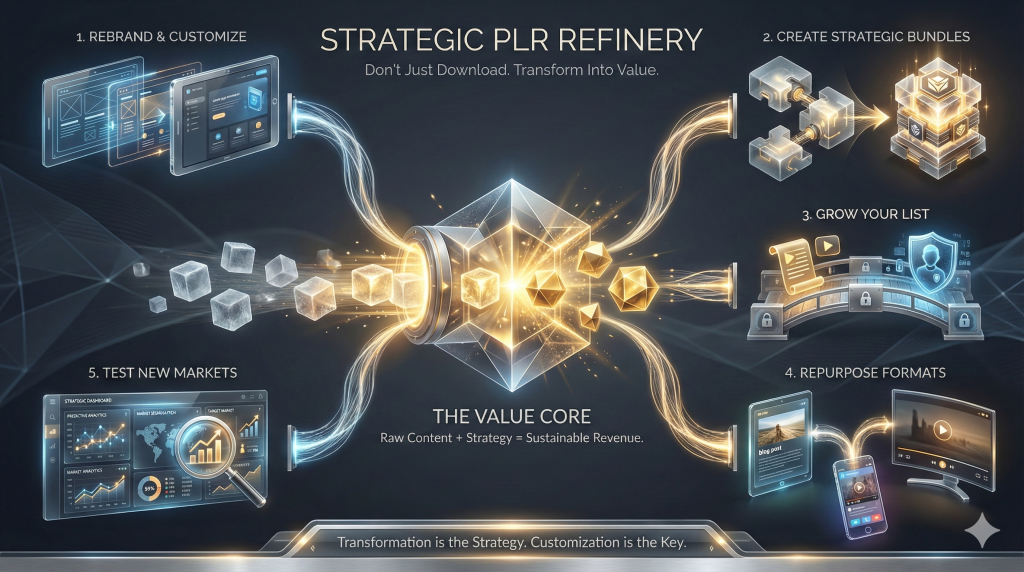
How Smart Creators Use Free PLR Without Looking Generic
Free PLR only becomes a problem when it is treated like a finished product. The creators who get results use PLR as a base, then reshape it so completely that it no longer feels borrowed.
The difference is not effort. It is intent.
Start With Positioning, Not Editing
Before you touch the text, decide who the content is for and what problem it solves. Most PLR is written broadly. Your job is to narrow it.
Clarify:
- Who this is specifically for.
- What stage they are in.
- What outcome they want next.
Once positioning is clear, the edits become obvious.
Rewrite the Opening and Closing First
The introduction and conclusion signal ownership. If those sections still sound generic, the rest will too.
Rewrite the opening to speak directly to your audience’s situation. Rewrite the ending to guide them toward your next step, whether that is an opt-in, offer, or follow-up action.
You do not need to rewrite every sentence to make PLR feel original. You need to rewrite the anchors.
Change the Structure, Not Just the Words
Surface-level rewrites are easy to spot. Structural changes are not.
Reorder sections. Combine ideas. Remove parts that do not serve your goal. Add a short framework or checklist that reflects how you think.
When the structure changes, the content stops feeling recycled.
Add Context Only You Can Provide
This is where PLR turns into an asset.
Add:
- Real examples from your work.
- Commentary on why something matters.
- Warnings based on experience.
- Clarifications PLR usually skips.
Context builds trust. Generic information does not.
Use PLR as a Source, Not a Script
PLR works best when it feeds other formats. One guide can become:
- A lead magnet.
- A short email sequence.
- A workshop outline.
- Several blog posts.
When PLR is broken apart and reused across formats, it becomes unrecognizable. That is a good thing.
Free PLR is not the issue. Passive use is.
When you treat PLR as raw material and apply judgment, structure, and intent, it becomes faster than starting from scratch and safer than publishing generic content.
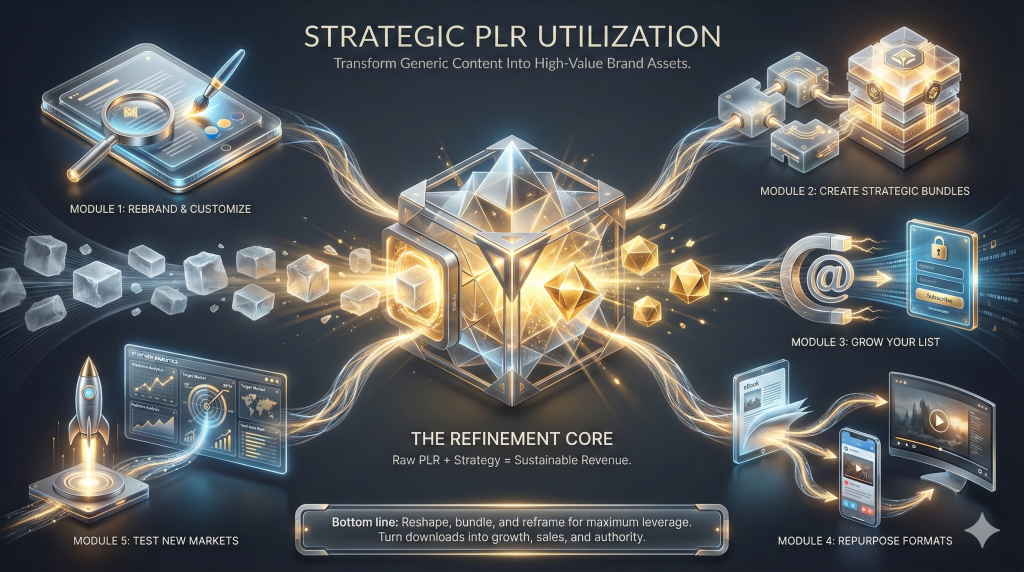
Free vs Paid PLR Websites (What Changes at Scale)
Free and paid PLR websites serve different purposes. The difference becomes clearer as soon as you move from experimenting to building repeatable offers.
At a small scale, both can work. At a larger scale, the gaps become obvious.
What Free PLR Is Good For
Free PLR lowers friction. It lets you move quickly without committing money or long-term plans.
Free platforms are useful when you want to:
- Test a new niche or topic.
- Create a basic lead magnet.
- Practice rebranding and restructuring content.
- Build internal drafts or outlines.
The tradeoff is sameness. Free PLR is widely accessible, which means many creators may be using the same base material. Heavy customization is not optional. It is required.
Where Free PLR Starts to Break Down
As you scale, free PLR shows its limits.
You will spend more time editing outdated language. Design quality may feel inconsistent. Licensing restrictions can limit where and how you sell.
Most importantly, free content rarely feels client-ready without significant work.
This does not make it bad. It just makes it situational.
What Paid PLR Changes
Paid PLR platforms invest more upfront. That investment usually shows up in:
- Cleaner writing and structure.
- Better design and formatting.
- More specific niche focus.
- Clearer licensing terms.
Because fewer people access paid libraries, the risk of duplication is lower. You also spend less time fixing and more time adapting.
For creators selling to clients or running paid funnels, that time difference matters.
When Paid PLR Makes Sense
Paid PLR becomes the better choice when you:
- Publish content consistently.
- Sell digital products or programs.
- Deliver materials directly to clients.
- Care about polish and perceived value.
It does not eliminate the need to customize, but it reduces friction.
Free PLR helps you learn and test. Paid PLR supports execution and scale.
The smartest approach is not choosing one forever. It is knowing when to switch, based on your goals and volume.
PLR Action Plan (Get Started in 48 Hours)
Speed matters. One of the biggest advantages of PLR isn’t just saving money, it’s skipping weeks of creation time. But to make it work, you need structure.
Otherwise, you’ll download files, forget about them, and nothing changes.
That’s where this quick-start plan comes in.
Follow these steps in order, and you’ll go from “just downloaded” to “launched and live” in under two days.
💡 Action Plan at a Glance
Step-by-step PLR implementation plan you can execute within 2 days.
| Step | What to Do | Why It Matters | End Goal |
|---|---|---|---|
| 1. Pick a PLR Website | Choose a trusted site like PLR.me, IDPLR, or Resell Rights Weekly. | Avoids wasting time on low-quality or unsafe content. | You know your source is reliable. |
| 2. Select a Product | Grab a checklist, eBook, or template in your niche. | Keeps focus aligned with your audience’s real needs. | You have one solid asset to work with. |
| 3. Customize It | Update the title, branding, visuals, and examples. | Turns generic PLR into something that feels original. | You’ve got a branded piece of content. |
| 4. Repackage for Value | Break it into smaller assets or bundle with extras. | Increases perceived value and usability. | Your offer feels premium, not cookie-cutter. |
| 5. Launch & Promote | Publish it as a lead magnet, bonus, or paid product. | Execution beats storage — results only come after launch. | Your PLR is live, growing your list or revenue. |
Why This Works
Most people get stuck at “download and sit.” By giving yourself just 48 hours and a clear action plan, you’ll actually put PLR to work instead of hoarding it.
The power of PLR isn’t in the files themselves, it’s in how fast you can transform them into something that carries your brand and delivers value to your audience.

Conclusion
PLR websites are not about shortcuts. They are about leverage.
In 2026, the creators who win with PLR are not the ones who download the most files. They are the ones who choose better sources, understand licensing clearly, and transform content with intent.
Free PLR platforms make sense when you are testing ideas, learning the process, or moving quickly with low risk. Paid PLR platforms earn their place when quality, polish, and scale start to matter. Neither approach replaces strategy. Both support it when used correctly.
The real value of PLR shows up when you stop treating it as finished content and start using it as structured raw material. With clear positioning, thoughtful edits, and a defined use case, PLR becomes a faster way to build lead magnets, products, and resources that feel aligned with your brand.
Used carelessly, PLR creates noise. Used deliberately, it creates momentum.
The difference is not the platform you choose. It is how intentionally you use what you download.

FAQs About PLR Websites
Are PLR products really free to use and resell?
Some are, but not all. Free PLR products often come with limits on resale, redistribution, or commercial use. You must check the license attached to each product. “Free” refers to cost, not permission.
If resale rights are not clearly stated, assume they are restricted.
Is it legal to rebrand and sell PLR digital products?
Yes, when the license explicitly allows it. That is the core purpose of Private Label Rights. You can usually edit the content, apply your branding, and sell it under your name.
Problems arise when creators skip the license or assume all PLR works the same way.
How can I tell if a PLR website is trustworthy?
Reliable PLR platforms share three traits:
- Clear licensing terms written in plain language.
- A history of regular updates or maintained libraries.
- Transparent ownership and contact information.
Well-established platforms like PLR.me and IDPLR have earned trust by being consistent about rights and access.
Can I use PLR content to build my email list?
Yes. Rebranded PLR makes effective lead magnets when it solves a clear problem and includes your positioning.
The key is transformation. Always customize the title, introduction, examples, and call to action. Never give away untouched PLR files.
What niches work best with PLR products?
Evergreen niches perform best because the core problems do not change quickly. These include personal development, health and wellness, online business, productivity, relationships, and finance.
That said, PLR works in almost any niche when it is properly adapted to a specific audience and outcome.
What is the biggest downside of using free PLR?
Sameness. Because free PLR is widely accessible, many creators may start from the same material.
If you do not rewrite, restructure, and reposition the content, your product can feel generic. That hurts engagement and credibility more than it helps speed.
Can I use AI to improve or rewrite PLR content?
Yes, and it is increasingly common in 2026. AI tools can help rewrite sections, improve clarity, expand ideas, or adapt tone.
AI should support your thinking, not replace it. Combine AI-assisted edits with your own judgment, examples, and structure to avoid producing shallow or repetitive content.
Is PLR content good for SEO?
PLR can support SEO only when it is substantially transformed. Publishing lightly edited PLR rarely performs well because search engines prioritize originality and usefulness.
Strong results come from expanding the content, changing structure, adding unique insights, and targeting specific search intent.
Are PLR websites safe to use?
Yes, when you use established platforms with clear licensing. Avoid sites that offer vague rights, outdated content, or no explanation of ownership.
Safety comes from understanding what you are allowed to do before you publish.
What is the real difference between free and paid PLR websites?
Free PLR is best for learning and testing. Paid PLR is better for scale and polish.
Paid platforms usually offer fresher content, better formatting, clearer licensing, and lower duplication risk. The right choice depends on your stage and how you plan to use the content.

4 Comments
The Ultimate Guide to PLR Products and Master Resale Rights: Free PLR Downloads to Boost Your Business. - Ismel Guerrero. · January 9, 2025 at 10:44 pm
[…] […]
PLR Marketing Digital: A Comprehensive Guide. - Ismel Guerrero. · January 24, 2025 at 10:48 am
[…] To learn more about PLR digital products, check out the Top 5 websites. […]
Lead Magnets 101: What They Are & How to Use Them - Ismel Guerrero. · February 18, 2025 at 8:42 pm
[…] Next, check out our article to learn the top five websites you can grab plr digitals products. […]
Freelance Digital Marketing: How to Start & Succeed in 2025 - Ismel Guerrero. · April 25, 2025 at 7:42 pm
[…] Need quick content for your freelance clients? Check out the best PLR Websites. […]