A 365-day affiliate cookie sounds attractive. But is a program with a year-long tracking window necessarily better than one offering just 90 days?
Not always.
Cookie duration determines how long a referral may remain eligible for attribution after someone clicks your affiliate link. A longer window can give potential customers more time to research a product, compare alternatives, and make a purchasing decision.
That matters when promoting products people don’t necessarily buy immediately, particularly business software, professional tools, and subscription services.
Fortunately, several established companies offer affiliate programs with long cookie durations, including tracking windows of 90, 120, 180, and even 365 days.
In this article, we’ll compare nine affiliate programs offering extended tracking windows, examine their commission structures, and explore what makes each one worth considering.
Key Takeaways
Some affiliate programs provide up to a year of referral tracking. Pabbly advertises a 365-day cookie, while HubSpot and WP Engine offer 180-day windows.
Longer cookies are particularly relevant to products with longer buying decisions. Business software buyers may spend weeks comparing features, pricing, and alternatives before purchasing.
Recurring commissions can be more significant than an extended cookie window. Programs such as Pabbly, LiveChat, and Thinkific offer ongoing commissions on qualifying customer payments rather than a single purchase.
A long cookie doesn’t guarantee referral credit. Last-click attribution, tracking restrictions, and eligibility requirements can prevent a later purchase from generating a commission.
Not every program is equally accessible. Semrush has published audience requirements, while other programs have fewer entry restrictions or different promotional rules.
The best program depends on the audience you’re reaching. Product relevance, commission terms, and the customer’s purchasing process matter alongside cookie duration.
Disclaimer: I am an independent Affiliate. The opinions expressed here are my own and are not official statements. If you follow a link and make a purchase, I may earn a commission.
Affiliate Programs With Long Cookie Durations at a Glance
The following affiliate programs advertise tracking windows of at least 90 days, with different commission structures and eligibility requirements.
Affiliate Program
Cookie Duration
Commission Structure
Best Suited For
Important Consideration
Pabbly
365 days
30% recurring on qualifying payments
Automation and online business audiences
Specialized software market
HubSpot
180 days
30% recurring for up to 12 months
CRM, sales, and marketing audiences
Affiliate program excludes direct client-referral arrangements
WP Engine
180 days
One-time, plan-dependent commissions
WordPress and website audiences
Affiliate links must be placed on owned domains
Semrush
120 days
Fixed commissions for qualifying sales and trials
SEO and digital marketing audiences
Published traffic and audience requirements
LiveChat / Text
120 days
20% recurring, with a higher tier
E-commerce and customer support audiences
Requires relevant business-focused traffic
GetResponse
90 days
40%–60% recurring for up to 12 months
Email marketing and online business audiences
New program differs from older affiliate arrangements
Zoho
90 days
15%–20% on qualifying revenue for up to 12 months
Small business software audiences
Existing customers and subsequent product purchases may be excluded
Pipedrive
90 days
20%–30% revenue share for 12 months
Sales and CRM audiences
Approval and performance tiers apply
Thinkific
90 days
30% recurring on standard paid plans
Educators and course creators
Later affiliate clicks can replace attribution
Affiliate Programs With Long Cookie Durations
1. Pabbly: 365-Day Cookie
Pabbly offers business software for automation, email marketing, subscription billing, and related operations.
Its products serve entrepreneurs and organizations looking to simplify repetitive processes, connect applications, and manage aspects of their businesses.
Cookie duration365 days
Commission structure30% recurring on qualifying payments while the referred customer remains active.
Pabbly stands out because it combines an unusually long tracking window with an ongoing commission arrangement.
Its published terms allow a referral to qualify when someone signs up and becomes a paying customer within 365 days of clicking an affiliate link.
That gives affiliates considerably more time than a conventional 30-day window to receive credit for a qualifying customer.
The program may be particularly relevant to websites, educators, and content creators publishing tutorials about business automation, productivity, and online business tools.
For example, a tutorial demonstrating how to connect a lead generation form with an email marketing system could introduce Pabbly as one possible solution.
Why it’s worth considering
The combination of a year-long cookie and recurring commissions makes it attractive for publishers serving people who are actively evaluating automation software.
What to consider
The long tracking period does not create demand for the product. An audience interested in automation and business systems is likely to be more relevant than one seeking general online income opportunities.
HubSpot provides customer relationship management (CRM), marketing, sales, and customer service software.
Its platform helps businesses manage customer information, organize sales activities, communicate with prospects, and maintain customer relationships.
Cookie duration180 days
Commission structure30% recurring for up to 12 months on qualifying referrals.
HubSpot is a strong example of where an extended cookie window makes practical sense.
Choosing a CRM or marketing platform can involve comparing several products, understanding integrations, reviewing pricing, and considering how the software fits existing business processes.
A 180-day window allows more time for that evaluation than a shorter tracking period.
HubSpot’s affiliate program is designed primarily for content creators, software reviewers, educators, and other publishers who recommend its products to an audience.
An established blog covering CRM software, sales processes, or digital marketing could have natural opportunities to introduce HubSpot through tutorials and product comparisons.
Why it’s worth considering
It combines a substantial referral window with commissions on qualifying subscription payments over the customer’s first year.
What to consider
HubSpot distinguishes its affiliate program from its Solutions Partner Program. Agencies and consultants referring clients through direct service relationships may need the separate partner arrangement.
That distinction matters if your business primarily recommends software to clients rather than publishing content for an independent audience.
The HubSpot Affiliate Program confirms the 180-day cookie, commission structure, and differences between its partner arrangements.
3. WP Engine: 180-Day Cookie
WP Engine provides managed WordPress hosting for websites, businesses, developers, and agencies.
Its affiliate program allows approved partners to receive commissions for referring customers who purchase qualifying hosting plans.
Cookie duration180 days
Commission structureOne-time payments based on the hosting plan purchased.
WP Engine deserves consideration because website hosting is a purchase that can involve meaningful comparison.
A website owner considering a hosting change may investigate performance, technical support, migration requirements, and pricing before committing to a new provider.
The 180-day tracking window accommodates a longer research process.
WP Engine’s commission model is different from the recurring programs elsewhere on this list. Affiliates receive a one-time commission for a qualifying new hosting purchase rather than continuing payments throughout the customer’s subscription.
This makes it particularly relevant to publishers focused on WordPress, web development, website management, or hosting comparisons.
Why it’s worth considering
It offers a long referral window for a specialized purchase, with commissions determined by the hosting plan rather than a small percentage of every future payment.
What to consider
WP Engine restricts where affiliates can place their tracking links.
Its documentation states that affiliate links must be placed on domains the affiliate owns. Someone promoting through a YouTube channel or social media platform may need to direct visitors to an owned landing page first.
The program also does not pay affiliate commissions on hosting upgrades or add-ons, and commission eligibility is subject to referral validation.
Semrush provides tools for search engine optimization, keyword research, competitive analysis, content marketing, and online visibility.
Its products are used by marketers, website owners, SEO professionals, and agencies.
Cookie duration120 days
Commission structureFixed commissions for eligible purchases and certain free-trial activations.
Semrush is relevant to affiliates who publish content for people already interested in digital marketing.
A comparison of SEO tools, for example, could introduce Semrush to readers actively researching software for a particular task.
Its 120-day tracking window allows time for potential customers to explore the platform, compare alternatives, and decide whether the software meets their requirements.
Unlike a recurring commission arrangement, Semrush primarily rewards specific qualifying actions.
The published affiliate program advertises commissions ranging from $100 to $300 for eligible sales, along with $10 for qualifying free-trial activations. The exact reward depends on the product and program conditions.
Why it’s worth considering
Semrush combines a recognizable SEO software offering with a longer referral period and defined payments for qualifying actions.
What to consider
The program is selective about affiliate applications.
For content publishers, Semrush states that websites should generally attract at least 1,000 unique visitors per month. Social media channels should also have a meaningful organic audience, typically around 1,000 followers or comparable engagement.
An established SEO website may be a suitable candidate, while a newly launched website without meaningful traffic may not meet the requirements.
The Semrush Affiliate Program provides the tracking window, commission details, application standards, and promotional restrictions.
5. LiveChat / Text: 120-Day Cookie
LiveChat is a customer communication platform that allows businesses to interact with website visitors through online chat.
Its broader Text partner program also includes products such as ChatBot, HelpDesk, and Text.
Cookie duration120 days
Commission structure20% recurring on qualifying customer payments, increasing to 22% on new licenses after five paying referrals.
LiveChat offers a useful combination of a long cookie window and ongoing subscription commissions.
Its products address practical business needs, particularly customer support, online sales conversations, and communication with website visitors.
A publisher teaching e-commerce, customer service, or website management could introduce LiveChat when discussing ways businesses handle customer inquiries.
The program also has a noteworthy accessibility advantage.
Unlike Semrush, which publishes audience requirements, the Text Affiliate Partner Program states that affiliates can join without an application review or minimum audience size.
That makes the program easier to explore for publishers who are still developing their content platforms.
Why it’s worth considering
The combination of 120-day tracking, recurring commissions, and relatively accessible enrollment makes it worth evaluating for affiliates with business-focused audiences.
What to consider
The 22% commission tier applies to new licenses after reaching the required number of paying referrals. It should not be assumed that existing referrals automatically move to the higher rate.
The recurring arrangement also depends on customers remaining subscribed.
GetResponse provides email marketing and automation software for businesses, creators, and online marketers.
Its platform supports email campaigns, subscriber management, automated communication, and related marketing activities.
Cookie duration90 days under the current program.
Commission structure40%–60% recurring for up to 12 months on qualifying referred customer payments.
GetResponse is relevant to affiliates who publish content about email marketing, lead generation, newsletters, and online business systems.
For example, a guide comparing email marketing platforms could introduce GetResponse to readers who are actively choosing software for their business.
Its commission structure is one of the more important reasons to consider the program.
New affiliates start at 40% of qualifying customer payments for up to 12 months. Higher tiers of 50% and 60% become available after meeting specified referral thresholds.
Those percentages should not be confused with the cookie duration.
The 90-day window concerns referral tracking. The 12-month period concerns how long eligible customer payments can generate commissions after a qualifying referral.
Why it’s worth considering
GetResponse combines an extended tracking period with a comparatively substantial percentage-based commission arrangement for relevant email marketing audiences.
What to consider
GetResponse recently revised its affiliate program and moved its newer arrangements to PartnerStack.
Its current program page and PartnerStack listing specify a 90-day cookie, although an older GetResponse help article still references 120 days. Affiliates with legacy arrangements may also have different commission terms.
For a new applicant, the current program documentation is the appropriate starting point.
Zoho offers a broad range of business software, including CRM, accounting, email, project management, and other operational applications.
Its affiliate program provides opportunities to promote products serving different business needs.
Cookie duration90 days
Commission structure15%–20% of qualifying revenue for up to 12 months, depending on affiliate tier.
Zoho’s broad product collection is both an advantage and a consideration.
An affiliate with an audience of small business owners may find relevant products across several categories. However, promoting a large software portfolio is not necessarily more effective than recommending one specific product to a well-matched audience.
For example, a publisher focused on customer relationship management could concentrate on Zoho CRM rather than attempting to cover every Zoho application.
The program also illustrates why cookie duration should not be evaluated separately from qualification rules.
Zoho generally requires the referred customer to sign up within 90 days of clicking the affiliate link and complete an eligible initial purchase within 90 days after signup.
Why it’s worth considering
Zoho offers a long tracking window and multiple business software categories, creating opportunities for publishers serving specialized business audiences.
What to consider
Its commission rules include meaningful restrictions.
Existing paid Zoho customers generally do not qualify. Referrals must also satisfy data-center and other eligibility requirements.
Importantly, the commission arrangement does not automatically extend to subsequent purchases of different Zoho products by the same referred customer.
The Zoho Affiliate Program explains its 90-day cookie, commission tiers, and qualifying purchase conditions.
8. Pipedrive: 90-Day Cookie
Pipedrive provides CRM software focused on helping businesses organize sales pipelines, manage opportunities, and maintain structured sales processes.
Its affiliate program is particularly relevant to publishers serving sales professionals, entrepreneurs, and small business owners.
Cookie duration90 days
Commission structureA standard 20% revenue share for the first 12 months of qualifying customer payments, with a 30% tier and custom arrangements for eligible partners.
Pipedrive’s appeal is its specific product focus.
Rather than promoting a broad collection of business applications, affiliates can concentrate on sales pipeline management and the problems businesses face when organizing prospective customers.
For example, a publisher explaining how to track sales leads could compare CRM options and discuss where Pipedrive fits.
Its 90-day window provides time for readers to assess features, evaluate pricing, and determine whether the software suits their business.
Why it’s worth considering
Pipedrive offers a defined product category, a three-month tracking window, and a commission structure that rewards qualifying subscription payments over the customer’s first year.
What to consider
Applicants must be accepted into the program, and higher commission tiers depend on eligibility and performance.
The program also pays commissions for a defined 12-month period rather than indefinitely while a customer remains subscribed.
That distinction matters when comparing it with programs offering ongoing commissions for the life of a qualifying customer relationship.
Thinkific provides software for creating, managing, and selling online courses and educational products.
Its platform serves educators, coaches, subject-matter experts, and entrepreneurs developing online education businesses.
Cookie duration90 days
Commission structure30% recurring on qualifying standard paid plans while the referred customer remains subscribed. Thinkific Plus follows a separate arrangement.
Thinkific stands out because its affiliate program combines an extended tracking period with a commission model that can continue beyond the customer’s first year.
That differs from programs such as HubSpot, Pipedrive, and GetResponse, which limit the normal commission period on new referrals.
Thinkific is most relevant to publishers creating content about online courses, educational products, and selling knowledge online.
A tutorial about planning an online course, for example, could include a comparison of course platforms and explain when Thinkific is worth evaluating.
Why it’s worth considering
The 90-day cookie and ongoing commissions can make the program relevant to affiliates with audiences interested in online education.
What to consider
Thinkific uses referral attribution rules that can affect whether an original affiliate receives credit.
If a potential customer clicks another affiliate’s link before signing up, attribution may move away from the original referral.
There’s also an important distinction between Thinkific’s own affiliate program and the affiliate programs operated by individual course creators using Thinkific. Those separate programs can have different cookie durations and rules.
A long cookie duration was the primary qualification for this list, but it wasn’t enough by itself.
We focused on affiliate programs with publicly documented tracking periods of at least 90 days and considered whether their products and commission arrangements were relevant to identifiable audiences.
The selection was based on five factors:
Cookie duration: The program advertises a tracking window of at least 90 days.
Commission structure: The payment arrangement is identifiable, including whether commissions are one-time, limited-duration, or ongoing.
Product relevance: The company offers products that serve an identifiable market.
Program accessibility: Application requirements, audience thresholds, and promotional restrictions are reasonably clear.
Attribution and eligibility: The published terms provide enough information to identify important conditions affecting referral credit.
The list is concentrated in business software because several programs in this category publish extended tracking windows and structured commission arrangements.
That concentration is worth acknowledging. These are not necessarily the best affiliate programs for audiences interested in consumer products, travel, fashion, or unrelated markets.
Why Cookie Duration Matters in Affiliate Marketing
An affiliate cookie helps a merchant identify the source of a visitor who arrives through a referral link.
The duration establishes the period during which that tracking information may remain valid for attribution.
This matters because customers do not always purchase on their first visit.
Someone researching CRM software might explore a product, compare competitors, discuss the purchase with colleagues, and return several weeks later.
A longer tracking window may allow the original affiliate to receive credit when that customer eventually completes a qualifying action.
How Cookie Duration Affects Referral Attribution
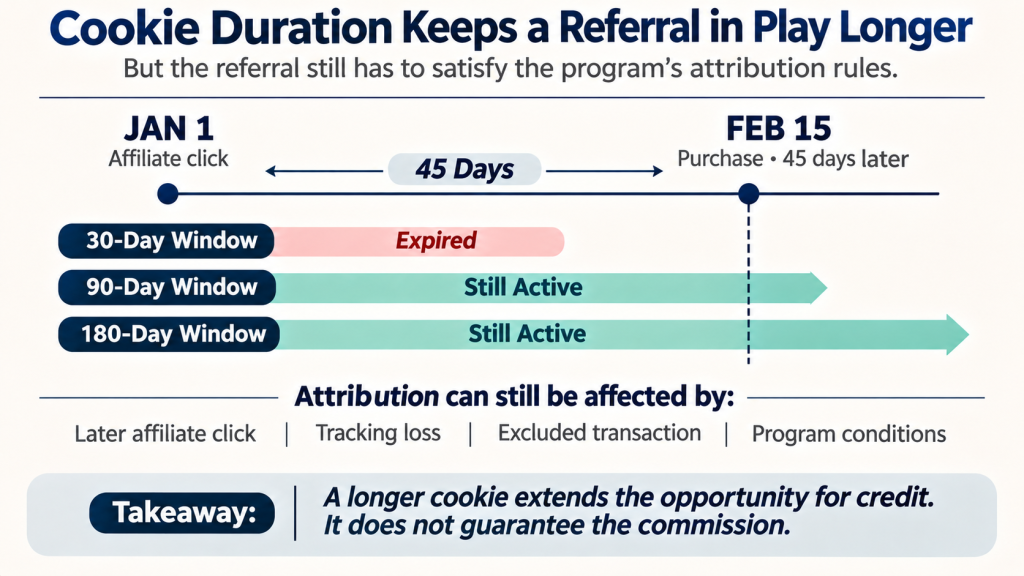
Consider someone who clicks an affiliate link on January 1 and purchases the recommended product on February 15.
Approximately 45 days have passed.
Under a straightforward cookie-based attribution model:
A 30-day cookie would generally have expired before the purchase.
A 90-day cookie could still be valid.
A 180-day cookie would also remain within its advertised tracking period.
This illustrates the advantage of an extended window.
However, the actual qualifying event matters.
Some programs track whether a customer signs up within the cookie window. Others require a purchase within a specified period or apply additional conditions after signup.
Zoho, for example, specifies separate deadlines for the initial signup and the subsequent qualifying purchase.
Consequently, comparing cookie durations without examining those requirements can create a misleading impression of how much time a referral actually has to qualify.
An advertised cookie duration does not establish an unconditional right to commissions on every later purchase.
Several circumstances can affect attribution.
A later affiliate click may replace the original referral. Under last-click attribution, the commission can be credited to a different affiliate if the customer clicks another eligible referral link before converting.
Tracking information may not remain available. Browser settings, cookie restrictions, device changes, and other technical limitations can interfere with tracking.
The transaction may be excluded. Existing customers, canceled orders, self-referrals, or purchases outside the program’s qualifying products may not generate commissions.
The referral may need to satisfy additional conditions. Some programs require specific signup methods, paid subscriptions, customer retention periods, or other eligibility requirements.
This is why the actual program terms matter more than the cookie duration displayed in an affiliate program directory.
How to Choose an Affiliate Program Beyond Cookie Duration
Once you’ve identified programs with extended tracking windows, the next step is determining which ones fit your audience and promotional approach.
A useful comparison begins with the product itself.
If your audience consists of WordPress website owners, WP Engine may be a more natural recommendation than sales CRM software. If you publish content about developing online courses, Thinkific is likely to be more directly relevant.
The product needs to match an actual interest or purchasing decision.
Next, consider how the program compensates affiliates.
A one-time commission can be appropriate for a specific purchase. Recurring commissions may be attractive when customers continue paying for a subscription, but the value of that arrangement depends on the customer’s payment history and the program’s rules.
The customer’s decision-making process also matters.
A longer cookie may be useful for products that require research, consultation, or approval before purchase. For products that customers routinely buy immediately, the additional tracking period may offer less practical value.
Finally, examine the program’s conditions before applying.
For example:
If you’re building a new publishing platform, LiveChat’s lack of a minimum audience requirement may make it more accessible than Semrush.
If you work directly with business clients, HubSpot’s Solutions Partner Program may be more appropriate than its content-focused affiliate program.
If social media is your primary promotional channel, WP Engine’s owned-domain linking restriction needs to be considered before developing a campaign.
If recurring commissions are important to you, compare how long each program pays on a referred customer’s purchases rather than assuming every subscription-based program pays indefinitely.
These differences can materially affect which program is suitable even when two companies offer the same cookie duration.
Conclusion
Affiliate programs with long cookie durations can provide an advantage when potential customers need time to evaluate products before purchasing.
The programs covered here demonstrate that extended tracking windows are available alongside several different commission models, from one-time hosting referrals to ongoing payments on qualifying software subscriptions.
But the longest cookie isn’t automatically the most valuable one.
A program with a shorter window may be more worthwhile if its products closely match your audience and its commission arrangement fits the way customers purchase.
Understanding those differences allows you to evaluate affiliate programs on more than the number of days advertised.
FAQ
Frequently Asked Questions
What Is Considered a Long Cookie Duration in Affiliate Marketing?
There is no universal definition. A tracking window of 90 days or longer is a useful threshold when looking for extended-duration affiliate programs, although what counts as long depends on the product category and typical customer purchasing process.
Are 90-Day Affiliate Cookies Good?
A 90-day cookie gives a referral approximately three months to qualify under the program’s tracking rules. That can be useful for products customers research before purchasing, provided the program’s attribution and eligibility requirements are satisfied.
Do Longer Cookie Durations Mean More Affiliate Commissions?
Not necessarily. A longer tracking window may allow additional delayed purchases to qualify, but commissions still depend on customer behavior, the product being promoted, the attribution model, and the program’s conditions.
What Happens When an Affiliate Cookie Expires?
Once the tracking window expires, the original affiliate click may no longer qualify for attribution. Some programs separately track registered leads or customer signups, so the consequences depend on the program’s specific rules.
Do Affiliate Programs Offer Lifetime Cookies?
Some programs advertise lifetime referral tracking, but the meaning and conditions vary. Lifetime cookies should not be confused with lifetime recurring commissions, which refer to payments on qualifying customer activity rather than the initial tracking period.
Can Another Affiliate Receive Credit After Someone Clicks My Link?
Yes. In programs using last-click attribution, a later eligible affiliate click can replace the original referral. The exact treatment depends on the merchant’s attribution rules.
I'm Ismel Guerrero, an internet marketer with experience in affiliate marketing, content creation, lead generation, and email marketing.
I've worked on my own online projects, written over 100 articles, created more than 80 lead magnets, and generated over 1,000 leads. Along the way, I've learned that understanding the fundamentals matters more than chasing the next system or shortcut.
Right now, I'm focused on using AI to research ideas, create content, and make everyday marketing tasks easier, while creating simple systems and tools that entrepreneurs can put to work in their own businesses.
My long-term vision is to help entrepreneurs develop valuable skills, create useful content, and build digital assets they can leverage, so they can approach online business with greater clarity, confidence, and independence.
A high commission can make an affiliate program look like the obvious choice. But the rate tells you little if the product does not solve a problem your readers actually have. Choosing an affiliate program Read more
A larger commission can make one conversion more valuable. It does not make that conversion easier to earn. High-ticket affiliate marketing focuses on promoting higher-value products and services that can generate larger commissions from successful Read more
A large commission looks attractive. It means little if your audience has no reason to buy the product. High-ticket affiliate programs can pay substantially more per conversion because the underlying products, subscriptions, or services carry Read more


0 Comments