Introduction: The Appeal vs The Reality
The Amazon Affiliate Program is often presented as a simple way to earn money online.
You recommend products, share a link, and earn a commission when someone makes a purchase.
At a glance, it feels straightforward. There is no need to create your own product. You do not handle payments, shipping, or customer support. And because Amazon sells almost everything, there is no shortage of products to promote.
That combination makes it appealing, especially for beginners.
But there is a gap between how the model sounds and how it actually works in practice.
Joining the program is easy. Earning consistently is not.
Income does not come from placing links alone. It depends on whether people see your content, trust your recommendations, and choose to act on them. Without those pieces in place, the system remains inactive.
If you approach the Amazon Affiliate Program with realistic expectations, it can become a structured way to build income over time. If you expect quick or passive results, it will likely feel slow and unpredictable.
This guide explains how the program works, what drives results, and what you can realistically expect from it.
- The Amazon Affiliate Program allows you to earn commissions by referring people to products through affiliate links
- Earning meaningful income depends on traffic, trust, and content quality, even though it is easy to join
- You are connecting the right audience to the right recommendations, not selling products directly
- Most commissions are small, so results rely on volume, consistency, or higher-priced products
- Content that matches user intent performs best, especially decision-stage content
- Early results are often slow, and many people underestimate the time it takes to gain traction
- You do not control commission rates, platform rules, or the customer relationship
- It works best as a long-term system, not a quick or passive income method
- Best results come when it is integrated into content you are already creating
Disclaimer: I am an independent Affiliate. The opinions expressed here are my own and are not official statements. If you follow a link and make a purchase, I may earn a commission.
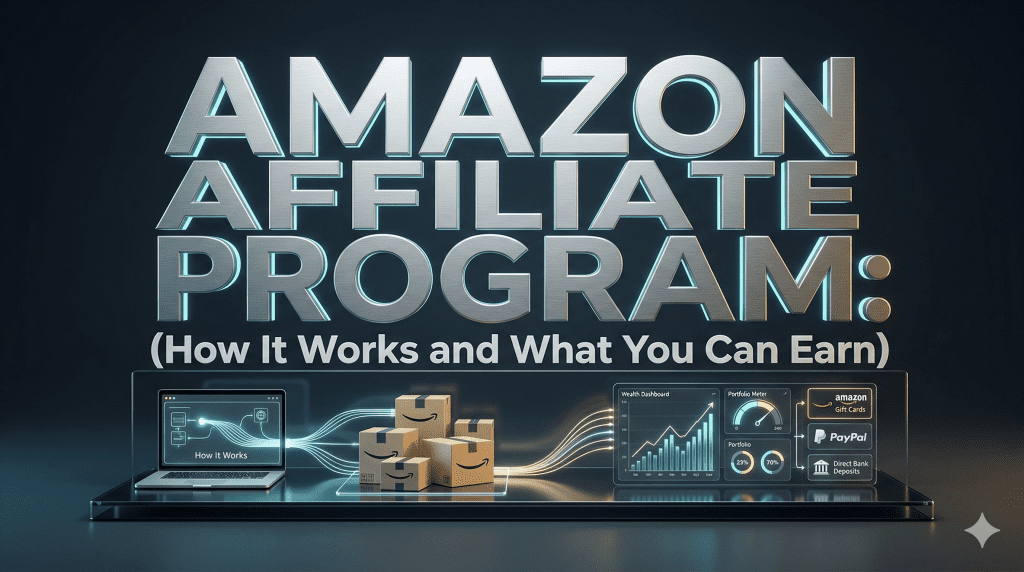
Amazon Affiliate Program: The Core Model (In Plain Terms)
At its core, the Amazon Affiliate Program is not about selling products. It is about referring people to products they are already considering.
Your role is simple:
You create content that introduces, explains, or recommends a product. Within that content, you include a unique affiliate link. When someone clicks that link and makes a purchase, you earn a commission.
That’s the entire model.
But there are a few important details that shape how it actually works.
First, you are not responsible for the sale itself. Amazon handles everything after the click—product pages, checkout, payments, and delivery. Your only role is to connect the right person to the right product.
Second, the commission is not tied to effort. It is tied to outcomes. You can spend hours creating content, but if no one clicks or buys, you earn nothing. On the other hand, a single piece of content can generate earnings repeatedly if it continues to reach the right audience.
Third, you do not control the system. Amazon sets:
- Commission rates
- Tracking rules
- Program policies
These can change over time, which directly affects your earnings.
So while the structure is simple, the dependency is not.
You are relying on three things working together:
- Your content reaching people
- Those people trusting your recommendation
- Amazon converting that interest into a purchase
If any one of these breaks down, the system stops producing results.
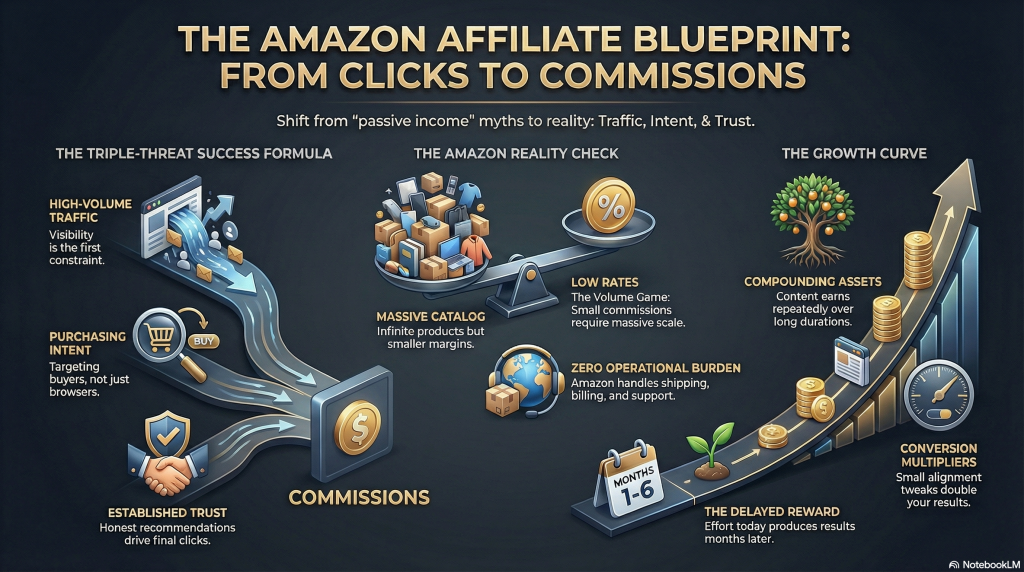
Where Affiliate Income Really Comes From
It’s easy to assume that affiliate income comes from sharing links.
In reality, it comes from three underlying factors working together: traffic, intent, and trust.
If one of these is missing, results are limited no matter how many links you use.
Traffic
Before anything else, people need to see your content.
No visibility means:
- No clicks
- No purchases
- No earnings
Traffic usually comes from:
- Search engines (people looking for answers or products)
- YouTube or video platforms
- Social media
This is the first constraint most beginners run into.
You can create useful content and still earn nothing if no one finds it.
Intent
Not all visitors are the same.
Some people are just browsing. Others are actively deciding what to buy.
This difference matters more than traffic volume.
For example:
- Someone searching “what is a mechanical keyboard” is learning
- Someone searching “best mechanical keyboard under $100” is closer to buying
Affiliate income comes primarily from people with decision intent.
If your content reaches the wrong audience, clicks may happen but purchases often won’t.
Trust
Even with traffic and intent, there is one more step.
The person has to trust your recommendation.
People are cautious when clicking product links. They want to feel confident that:
- The recommendation is relevant
- The information is accurate
- The suggestion is not purely promotional
Trust is built through:
- Clear explanations
- Honest pros and limitations
- Content that prioritizes usefulness over persuasion
Without trust, visitors hesitate. And hesitation reduces conversions.
The Key Relationship
Affiliate income is not driven by effort alone. It is driven by alignment:
- Traffic brings people in
- Intent determines whether they are ready
- Trust influences whether they act
When all three are present, results improve. When one is missing, the system weakens.

The Content–Conversion Relationship
Creating content is not the same as generating income.
What matters is how your content connects to a reader’s decision process.
Some content informs. Some content converts. Understanding the difference is what makes affiliate marketing work.
Informational vs Decision Content
Not all content is written with the same purpose.
Some content helps people learn:
- What something is
- How it works
- Why it matters
This type of content attracts attention, but it does not always lead to purchases.
Other content helps people decide:
- Which option to choose
- Whether something is worth buying
- What fits their specific situation
This is where affiliate income usually happens.
The key difference is timing.
Informational content reaches people early.
Decision content reaches them when they are closer to acting.
How Content Leads to Clicks
People do not click affiliate links just because they are present.
They click when the recommendation feels like a natural next step.
For example:
- A clear explanation builds understanding
- A comparison reduces uncertainty
- A recommendation feels justified
When content is structured this way, the link becomes part of the solution not an interruption.
Why Most Content Fails
A common issue is mismatch.
Content may:
- Attract the wrong audience
- Answer the wrong question
- Introduce products too early or without context
When that happens:
- Traffic does not convert
- Links are ignored
- Effort does not translate into results
The problem is not always the product or the platform. It is often the connection between the content and the reader’s intent.
The Core Idea
Affiliate content works when it aligns with the reader’s position in the decision process.
- Too early → interest, but no action
- Too late → decision already made elsewhere
When the timing and context are right, even simple content can perform well.
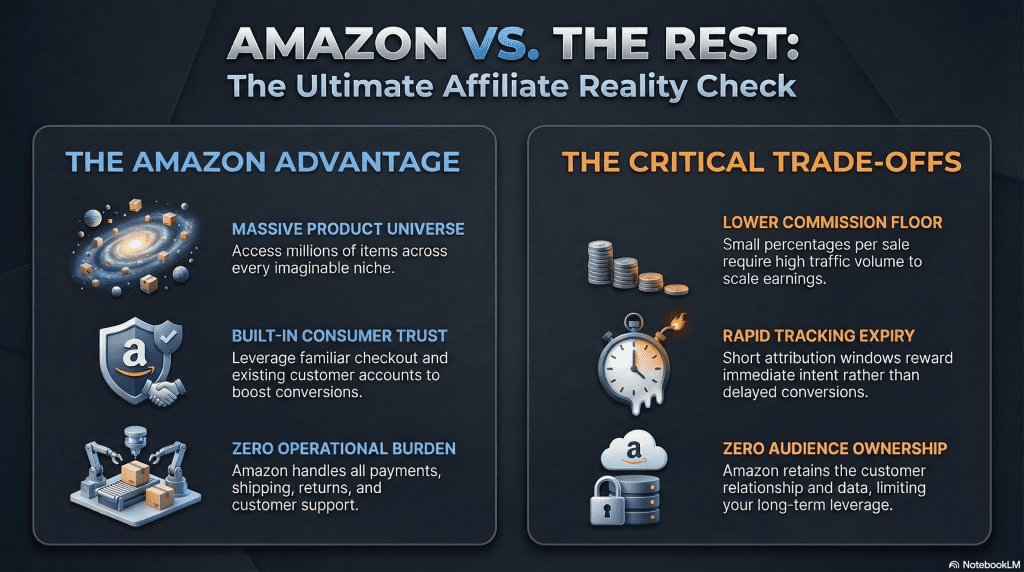
What Makes Amazon Different From Other Affiliate Programs
Not all affiliate programs work the same way.
Amazon stands out because of its accessibility and scale, but those advantages come with clear trade-offs.
Understanding this difference helps set the right expectations from the start.
Product Selection
Amazon offers one of the largest product catalogs available.
You can promote:
- Everyday household items
- Electronics
- Books
- Niche or specialized products
This makes it easy to find products that match almost any topic or audience.
You are not limited by inventory or partnerships. If it exists on Amazon, you can usually promote it.
Built-In Trust
Amazon is a familiar platform.
Most people:
- Already have an account
- Are comfortable purchasing
- Trust the checkout process
This reduces friction.
When someone clicks your link, they are not being introduced to something new. They are continuing a process they already understand.
That familiarity improves the likelihood of conversion.
Commission Rates
This is where the trade-off becomes clear.
Amazon’s commission rates are relatively low compared to many other affiliate programs.
In many cases:
- You earn a small percentage per sale
- Lower-priced items generate very small commissions
This means volume matters more than individual transactions.
Short Tracking Window
Amazon typically uses a short tracking period.
If someone clicks your link:
- You only earn if they purchase within a limited time window
This limits delayed conversions.
Unlike some programs that track referrals for weeks, Amazon focuses on immediate action.
Ease vs Limitation
The overall structure comes down to a simple trade-off:
- Easy to start → Minimal barriers, wide product access
- Harder to scale → Lower commissions, less control
Amazon removes many of the technical and logistical challenges.
But in exchange, it limits how much you earn per sale and how much control you have over the process.
The Core Difference
Amazon is designed for accessibility, not optimization.
It is one of the easiest affiliate systems to join and use. But it is not the most flexible or highest-paying.
That balance is what defines how it fits into a larger strategy.

Realistic Earnings: What Actually Scales
Earnings in the Amazon Affiliate Program are not random. They follow a predictable structure.
Understanding that structure is what helps you evaluate whether your efforts are moving in the right direction.
Why Small Commissions Add Up Slowly
Most products on Amazon generate relatively small commissions.
That means a single sale usually does not make a meaningful difference.
Instead, earnings build through accumulation:
- Multiple clicks
- Multiple purchases
- Over time
This creates a slow upward curve rather than immediate results.
The Role of Product Price
Not all products contribute equally.
Lower-priced items:
- Are easier to sell
- Generate smaller commissions
Higher-priced items:
- Convert less often
- Generate larger commissions per sale
Both can work, but they behave differently.
Some content focuses on volume. Other content focuses on fewer, higher-value transactions.
Conversion Rate as a Multiplier
Conversion rate is the percentage of visitors who make a purchase after clicking your link.
Small changes here have a large impact.
For example:
- Better product alignment
- Clearer explanations
- More relevant recommendations
These do not increase traffic but they increase results from the same traffic.
This is one of the most overlooked factors.
The Time Factor
Affiliate earnings do not appear immediately.
Content takes time to:
- Get indexed
- Gain visibility
- Build trust with readers
There is often a delay between effort and outcome.
This delay is why many people assume the system is not working when it simply has not had time to develop.
The Core Pattern
Earnings grow when multiple factors compound:
- Content brings traffic
- Traffic creates clicks
- Clicks lead to purchases
- Purchases generate commissions
Each step builds on the previous one.
If one step is weak, the entire system produces less.

The Early Phase Most People Underestimate
The beginning of the Amazon Affiliate Program is often the most discouraging part.
Not because the system is complicated, but because results are slow to appear.
No Traffic, No Results
At the start, your content has little to no visibility.
That means:
- Few or no clicks
- No purchases
- No earnings
Even well-written content can sit unnoticed for a while.
This is not a sign that the system is broken. It is a normal part of the process.
The Learning Curve
Early on, there are multiple things happening at once:
- Learning what kind of content works
- Understanding how to match products to intent
- Figuring out how to present recommendations clearly
Most of this is not obvious at the beginning.
Progress comes from adjusting based on what does and does not work not from getting everything right immediately.
Why Many People Quit Here
This phase creates a disconnect between effort and reward.
You may:
- Publish content
- Add affiliate links
- See little to no outcome
Without visible feedback, it feels like nothing is happening.
This is where most people stop.
What Progress Actually Looks Like
Early progress is subtle.
Instead of income, you may notice:
- A few impressions or views
- Occasional clicks
- Small increases in traffic over time
These signals are easy to overlook, but they indicate movement in the right direction.
Earnings usually come later, after these early signs begin to build.
The Core Reality
The early phase is not about earning.
It is about building the conditions that make earning possible.
That includes:
- Content that can be found
- Recommendations that make sense
- A structure that supports future growth
Once those are in place, results become more likely.

Structural Limitations of the Program
The Amazon Affiliate Program is simple and accessible, but it operates within fixed constraints.
These are not obstacles you can optimize away. They are part of how the system is designed.
Understanding them early helps you avoid unrealistic expectations.
Limited Control Over Commissions
You do not set how much you earn per sale.
Amazon determines:
- Commission percentages
- Category rates
- Payment structure
These can change at any time.
Even if your content performs well, your earnings can shift based on decisions outside your control.
You Do Not Own the Customer Relationship
When someone clicks your affiliate link, they move into Amazon’s environment.
From that point:
- You do not control the experience
- You do not collect customer information
- You cannot follow up directly
The relationship stays with Amazon, not with you.
This limits long-term leverage.
Platform Dependency
Your earnings rely on multiple external systems:
- Amazon’s affiliate program
- Your traffic source (search engines, platforms, etc.)
If either changes:
- Traffic can drop
- Conversions can shift
- Income can fluctuate
You are building on top of systems you do not control.
No Direct Scaling Mechanism
There is no built-in way to significantly increase earnings without increasing reach.
You cannot:
- Raise your commission rate
- Upsell customers
- Increase order value directly
Growth depends on:
- More traffic
- Better conversion
- Or both
This keeps the model tied to volume.
The Core Constraint
The program is designed for simplicity and reach not control.
It allows you to participate in a large system, but not shape it.
That trade-off is what makes it accessible, and also what limits how far it can scale on its own.
Amazon Affiliate Program: Strategic Advantages (When Used Correctly)
Despite its limitations, the Amazon Affiliate Program has clear advantages when it is used in the right context.
These advantages are not about quick results. They are about how easily it fits into a broader system.
Low Barrier to Entry
Getting started does not require much.
You do not need:
- Your own product
- Inventory
- Customer support systems
You can begin with:
- A basic content platform
- A clear topic or niche
This makes it one of the most accessible ways to enter online monetization.
No Product Responsibility
You are not responsible for what happens after the click.
Amazon handles:
- Payments
- Shipping
- Returns
- Customer service
This removes operational complexity.
Your only focus is connecting people to products that match their needs.
Flexible Integration Into Content
Affiliate links can be added to content naturally.
They can fit into:
- Reviews
- Comparisons
- Tutorials
- Resource lists
This allows monetization to happen alongside useful information, rather than replacing it.
Wide Product Coverage
Because Amazon sells such a large range of products, you are not limited to a narrow category.
You can:
- Stay within a niche
- Or expand into related areas over time
This flexibility makes it easier to adapt your content as your audience evolves.
Works Well as a Layer, Not a Standalone Strategy
One of the biggest advantages is how easily it can be combined with other efforts.
For example:
- A blog can include affiliate links alongside informational content
- A YouTube channel can recommend products within tutorials
In this way, the program becomes part of a larger system not the entire system.
The Core Advantage
The Amazon Affiliate Program is not powerful because of high payouts.
It is useful because of how easily it fits into content you are already creating.
When used this way, it becomes a practical and low-friction way to monetize attention.

Common Mistakes People Make (And How to Avoid Them)
The Amazon Affiliate Program is simple on the surface, but small missteps can quietly limit your results.
Most of these mistakes are not obvious at first. They come from misunderstanding how the system actually works.
Treating It Like a Quick Way to Earn
Many people expect to see results soon after getting started.
This often leads to:
- Rushing content
- Adding links without context
- Focusing on output instead of usefulness
How to avoid it:
Focus on building content that answers real questions or solves specific problems. Think in terms of long-term usefulness, not immediate returns.
Choosing Products Before Understanding the Audience
It’s common to pick products first and then try to build content around them.
This usually creates weak connections.
How to avoid it:
Start with the audience:
- What are they trying to solve?
- What decisions are they trying to make?
Then introduce products as part of that solution.
Using Too Many Affiliate Links
Adding more links may seem like it increases opportunities to earn.
In practice, it often does the opposite.
Content can start to feel:
- Overly promotional
- Less focused
- Less trustworthy
How to avoid it:
Use fewer links, but place them where they make sense. Each link should feel like a natural next step, not an interruption.
Ignoring Why People Are Visiting
Not all traffic has the same intent.
If visitors are:
- Learning
- Exploring
- Not ready to buy
They are less likely to convert.
How to avoid it:
Match your content to the reader’s stage:
- Informational content for learning
- Decision-focused content for buying
This alignment improves results without needing more traffic.
Relying on One Source of Traffic
Depending entirely on one platform can create instability.
If that source changes:
- Traffic can drop
- Earnings can follow
How to avoid it:
Over time, expand how people find your content:
- Search
- Video
- Social
This creates more stability and reduces reliance on a single source.
The Core Pattern
Most mistakes come from focusing on visible elements:
- Links
- Products
- Output
Instead of the underlying factors:
- Audience
- Intent
- Trust
When those are aligned, the system works more effectively.

When This Model Fits (And When It Doesn’t)
The Amazon Affiliate Program is not universally effective.
It works well in certain situations and poorly in others. Understanding where it fits helps you decide whether it is worth your time.
When It Fits
The model works best when your approach aligns with how it is designed.
When You Are Already Creating Content
If you are already:
- Writing articles
- Making videos
- Sharing recommendations
Then affiliate links can be added naturally.
In this case, you are not creating content just to monetize. You are monetizing content that already has a purpose.
When You Are Willing to Think Long-Term
This model develops gradually.
Content takes time to:
- Reach people
- Build visibility
- Generate consistent results
If you are comfortable with that timeline, the system becomes more predictable.
When You Focus on a Specific Topic or Niche
Broad, unfocused content makes it harder to connect with the right audience.
When you stay within a clear topic:
- Your content becomes more relevant
- Your recommendations feel more consistent
- Trust builds more easily over time
This improves both engagement and conversions.
When You Prioritize Help Over Promotion
Affiliate content performs better when it is built around usefulness.
When your goal is to:
- Answer questions
- Reduce confusion
- Help people decide
Product recommendations become part of the solution, not the focus.
When It Doesn’t Fit
There are also clear situations where this model becomes inefficient.
If You Need Immediate Income
This is not a fast-return system.
There is:
- A delay before results
- Uncertainty in early stages
If you need consistent income quickly, this model will not meet that need.
If You Do Not Want to Create Content
Affiliate marketing depends on content.
Without it:
- There is no visibility
- No traffic
- No opportunity to earn
If content creation is not something you want to do, this model will feel difficult to sustain.
If You Expect High Earnings Per Sale
Most commissions are relatively small.
This means:
- You need volume
- Or time
- Or both
If you expect each action to generate meaningful income, the structure will feel limiting.
If You Want Full Control
You are working within someone else’s system.
You do not control:
- Commission rates
- Platform rules
- Customer experience
If control and predictability are important, this can be a constraint.
The Core Fit
This model works best when there is alignment between:
- Your content
- Your audience
- Your expectations
When those match the structure of the program, it becomes easier to use effectively.
When they don’t, it tends to feel frustrating or inefficient.

The Long-Term View
The Amazon Affiliate Program is not designed for immediate results. Its value comes from how it develops over time.
Understanding this changes how you approach it.
Content as an Asset
Each piece of content you create has the potential to continue working after it is published.
Over time, it can:
- Be discovered by new readers
- Generate clicks
- Lead to purchases
This means your effort is not tied to a single moment. It can produce results repeatedly if the content remains relevant.
Gradual Compounding
Growth does not usually happen in large jumps.
Instead, it builds through small, consistent gains:
- One article starts getting traffic
- Another begins to rank
- A few pieces start generating clicks
Individually, these may seem minor. Together, they begin to add up.
This is where the system starts to feel more stable.
Why Consistency Matters More Than Intensity
Publishing a large amount of content in a short time can feel productive.
But consistency tends to be more effective than bursts of effort.
Regular output allows you to:
- Improve your content over time
- Learn what works
- Build a more reliable foundation
The goal is not speed. It is continuity.
The Time Gap Between Work and Results
One of the most important things to understand is the delay between effort and outcome.
You may:
- Create content today
- See results weeks or months later
This gap can make it feel like nothing is happening, even when progress is underway.
Recognizing this helps you stay aligned with the process.
The Core Perspective
The Amazon Affiliate Program works best when treated as a system that develops over time.
Not every piece of content will perform. Not every effort will lead to immediate results.
But consistent, useful content builds a base that can generate ongoing returns.
That is where the long-term value comes from.
Final Thoughts
The Amazon Affiliate Program is simple in concept, but it relies on conditions that take time to build.
You recommend products, share links, and earn commissions when purchases happen. That part does not change.
What determines the outcome is everything around it.
- Whether your content reaches the right people
- Whether it aligns with what they are looking for
- Whether they trust what you are recommending
Without those elements, the system stays inactive. With them, it begins to produce results gradually, not instantly.
It is not a shortcut to income. It is a model that rewards consistency, relevance, and clarity over time.
For some, that makes it a useful addition to content they are already creating. For others, the delayed results and small margins may not justify the effort.
So the question is not whether the Amazon Affiliate Program works.
It does.
The more useful question is whether your approach matches what the system requires. If it does, it can become a steady part of a larger strategy. If not, it will likely feel slow and limited.

Frequently Asked Questions
What is the Amazon Affiliate Program?
The Amazon Affiliate Program, also known as Amazon Associates, allows you to earn commissions by referring people to products on Amazon through unique affiliate links.
How do you get paid?
You earn a percentage of purchases made through your affiliate links. Once qualifying sales are confirmed, earnings are added to your account and paid out according to Amazon’s payment schedule.
Do you need a website to get started?
You need a platform where you share content, such as a website, blog, YouTube channel, or social media account. A traditional website is common, but not required.
How long does it take to earn money?
It depends on how quickly your content gains visibility. For many people, it takes weeks or months before seeing consistent results.
How much can you realistically earn?
Earnings vary widely. Some people earn very little, while others build consistent monthly income over time. Results depend on traffic, content quality, and how well your recommendations match what people are looking for.
Is it beginner-friendly?
Yes in terms of getting started. However, earning meaningful income requires learning how to create effective content and attract the right audience.
Do you need experience to succeed?
No prior experience is required, but you do need to develop an understanding of how content, traffic, and audience intent work together.
Can this replace a full-time income?
For most people, no. It can grow into a meaningful income stream over time, but it is not designed to provide fast or predictable full-time earnings.

0 Comments