Introduction
Before-After-Bridge, often shortened to BAB, is a simple copywriting framework designed to move readers from frustration to solution in three clear steps. It works by contrasting a current problem with a better future, then positioning your offer as the path between the two.
Unlike longer persuasion models, BAB focuses on emotional contrast. It highlights what is not working, paints what could be working, and introduces the bridge that connects the two states.
Because it is direct and flexible, the Before-After-Bridge formula appears in sales pages, email campaigns, landing pages, and even short-form posts. In this guide, you’ll learn how BAB works, why it persuades so effectively, and how to use it correctly with real examples.
Key Takeaways
- Before-After-Bridge (BAB) is a three-step copywriting formula that moves readers from problem to solution.
- The “Before” defines the current pain or frustration your audience experiences.
- The “After” paints a clear, desirable future state.
- The “Bridge” introduces your offer as the path between the two.
- BAB works because it creates emotional contrast and future pacing.
- The framework is flexible and effective for emails, landing pages, ads, and social posts.
- Strong contrast between Before and After increases persuasive impact.
Disclaimer: I am an independent Affiliate. The opinions expressed here are my own and are not official statements. If you follow a link and make a purchase, I may earn a commission.
What Is the Before-After-Bridge Framework?
The Before-After-Bridge framework is a copywriting structure that guides a reader from their current problem to a desired outcome using a clear transition.
It follows a simple sequence:
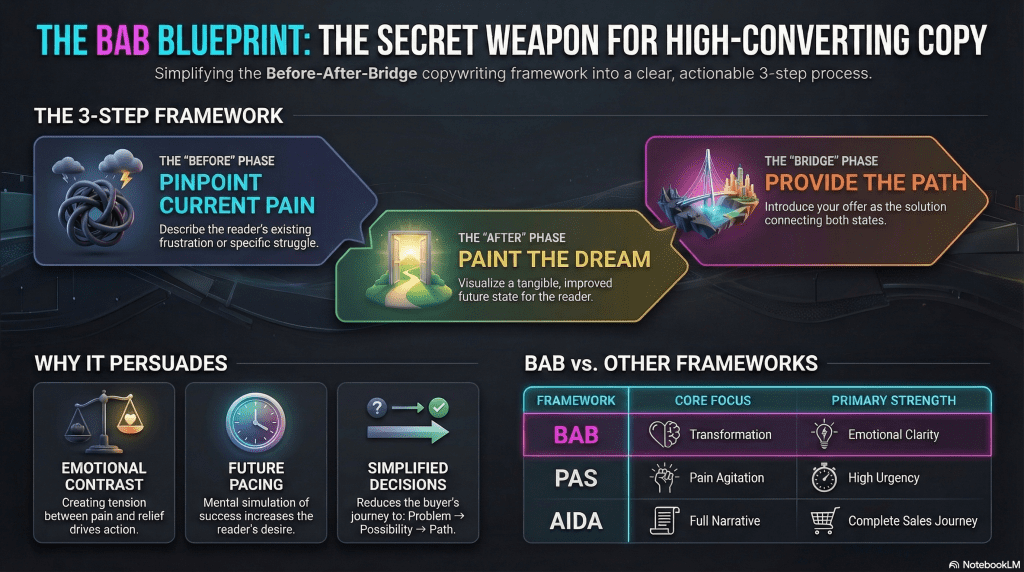
- Before: Describe the reader’s current situation, pain, or frustration.
- After: Paint a vivid picture of the improved future they want.
- Bridge: Present your product, service, or idea as the path that connects the two.
The power of BAB lies in contrast. By placing the current struggle next to the desired transformation, you create tension. The bridge then resolves that tension.
Unlike more complex persuasion models, BAB focuses on clarity. It does not rely on long storytelling or heavy logic. It relies on emotional movement.
In its simplest form, the structure looks like this:
Before: You’re struggling with inconsistent sales and unpredictable revenue.
After: Imagine predictable monthly income and a clear pipeline of qualified leads.
Bridge: Our lead generation system helps you build and automate that pipeline.
Three steps. Clear progression. Direct persuasion.
Why Before-After-Bridge Works in Persuasion
Before-After-Bridge works because it mirrors how people make decisions.
People act when they feel a gap between where they are and where they want to be. BAB makes that gap visible.
1. It Creates Emotional Contrast
The “Before” highlights friction, frustration, or dissatisfaction. The “After” introduces relief, clarity, or success.
Placing these two states side by side increases psychological tension. Humans naturally seek resolution when they perceive contrast. The bridge becomes the logical release.
2. It Uses Future Pacing
The “After” stage encourages readers to imagine themselves experiencing a better outcome.
This mental simulation increases desire. When readers picture the improved state clearly, motivation strengthens. The bridge then feels like a practical step rather than a sales pitch.
3. It Simplifies the Decision
Complex copy can overwhelm. BAB reduces persuasion to three movements:
Problem → Possibility → Path
Clarity lowers resistance. When readers understand the transformation and the route to achieve it, the decision feels manageable.
4. It Aligns With Natural Story Structure
Most narratives follow a similar arc:
Current struggle → Desired resolution → Action taken
BAB compresses that structure into a concise persuasive formula. That makes it effective in short formats such as emails, ads, and landing page sections.
Before-After-Bridge works not because it is clever, but because it aligns with how people think about change.
How the Before-After-Bridge Formula Works Step by Step
The strength of BAB lies in execution. Each stage has a specific purpose. Weakness in one stage reduces the impact of the entire structure.
Here is how to apply it correctly.
1. Before: Define the Current Reality
The “Before” stage describes the reader’s existing situation. This is where you identify pain, frustration, inefficiency, or missed opportunity.
Be specific. Vague discomfort does not create urgency.
Weak example: You’re not getting results.
Stronger example: You’re publishing content every week but seeing little traffic or revenue.
The goal is recognition. The reader should think, “That’s me.”
Do not exaggerate. Describe the problem clearly and accurately.
2. After: Paint the Desired Outcome
The “After” stage introduces the improved future state. This is not just the absence of pain. It is a tangible upgrade.
Weak example: Things are better.
Stronger example: Imagine publishing content that attracts qualified leads and generates consistent monthly revenue.
Specific outcomes increase desire. Make the transformation concrete.
Avoid unrealistic promises. The future state should feel achievable, not fantasy-driven.
3. Bridge: Present the Path
The “Bridge” connects the current struggle to the improved outcome.
This is where you introduce your product, service, system, or idea.
Weak bridge: Buy now.
Stronger bridge: Our content strategy framework helps you turn weekly posts into a predictable lead engine.
The bridge should feel like a logical next step, not a pushy demand.
Keep it clear. Explain how the solution creates the transformation.
When all three stages work together, the structure flows naturally:
Current frustration → Desired improvement → Practical solution.
The formula is simple. Precision is what makes it persuasive.

Before-After-Bridge Examples
The best way to understand BAB is to see it in action. Below are examples across different industries and formats.
Example 1: SaaS Product
Before: You’re managing projects across spreadsheets, Slack messages, and endless email threads. Deadlines slip. Communication breaks down.
After: Imagine tracking every task, deadline, and conversation in one organized dashboard where your entire team stays aligned.
Bridge: Our project management platform centralizes your workflow so nothing falls through the cracks.
Example 2: Fitness Coaching
Before: You’re working out consistently but not seeing noticeable changes. Progress feels slow and inconsistent.
After: Picture a structured training plan tailored to your body and goals, delivering measurable strength and visible results.
Bridge: Our personalized coaching program designs a data-driven fitness plan that accelerates your progress.
Example 3: Newsletter Signup
Before: You’re trying to grow your business, but you feel overwhelmed by scattered marketing advice.
After: Imagine receiving one concise strategy email each week that shows you exactly what to implement next.
Bridge: Subscribe to our weekly newsletter for practical marketing frameworks you can apply immediately.
Example 4: B2B Consulting Service
Before: Your sales team works hard, but your pipeline feels unpredictable and difficult to forecast.
After: Picture a clear, repeatable sales process that generates consistent qualified leads every month.
Bridge: Our revenue operations consulting builds and installs that system inside your organization.
Across all examples, the structure remains consistent:
- Identify the friction.
- Present the upgrade.
- Introduce the path.
The context changes. The psychological movement stays the same.

Common Mistakes When Using Before-After-Bridge
BAB is simple. That simplicity makes it easy to misuse.
Here are the most common mistakes that weaken its persuasive impact.
Making the “Before” Too Generic
If the current situation feels vague, readers will not recognize themselves in it.
Weak: You’re struggling with marketing.
Stronger: You’re publishing weekly content but seeing little traffic, engagement, or revenue.
Specific problems create emotional connection. Generic discomfort does not.
Creating an Unrealistic “After”
The “After” stage should feel desirable but achievable.
Weak: Imagine making millions overnight.
Stronger: Imagine generating consistent monthly revenue from content that attracts qualified leads.
Overpromising reduces credibility. The future state should feel possible with effort, not magical.
Making the Bridge a Hard Sell
The bridge should feel like a natural solution, not a demand.
Weak: Buy now before it’s too late.
Stronger: Our framework shows you how to structure your content so it attracts and converts consistently.
If the bridge feels aggressive, resistance increases. If it feels logical, momentum continues.
Ignoring Emotional Contrast
BAB works because of contrast. If the difference between Before and After is minimal, persuasion weakens.
The reader should clearly feel the shift from friction to relief.
Without strong contrast, the bridge lacks urgency.
Using BAB Without Understanding the Audience
The framework depends on accurate diagnosis. If you misunderstand the audience’s pain or desire, the entire structure collapses.
Research matters. Clarity matters. Relevance matters.
Before-After-Bridge is powerful because it is direct. Its effectiveness depends on precision, not length.
When to Use Before-After-Bridge
Before-After-Bridge works best when you need clarity and momentum. It is ideal for situations where the reader already feels friction and is open to change.
Because the structure is concise, it performs especially well in shorter formats.
Use BAB in Landing Pages
Landing pages benefit from direct contrast. You can open with the “Before” to show empathy, follow with the “After” to create desire, and introduce your offer as the bridge.
It quickly answers the reader’s core question: “What changes if I take this step?”
Use BAB in Email Campaigns
BAB fits naturally into promotional emails.
Start with a pain point your subscriber recognizes. Paint the improved outcome. Then position your offer as the next action.
Its simplicity keeps emails focused and persuasive without feeling long or complicated.
Use BAB in Ads and Social Posts
In paid ads or short-form posts, space is limited. BAB provides structure without excess explanation.
You can condense it into just a few lines:
Before: Struggling with inconsistent leads?
After: Imagine predictable monthly growth.
Bridge: Download our lead generation blueprint.
Short. Clear. Actionable.
Use BAB for Product Launch Messaging
When introducing something new, BAB helps frame transformation quickly. It shifts attention from features to outcomes.
Instead of listing specifications, you highlight the problem solved and the future unlocked.
When BAB May Not Be Ideal
BAB is less effective when:
- The audience is unaware of the problem.
- The solution requires deep education first.
- The buying decision depends heavily on data and comparison.
In those cases, frameworks like PAS or AIDA may provide more depth.
Before-After-Bridge excels when clarity matters more than complexity.

BAB vs PAS vs AIDA
Before-After-Bridge is not the only copywriting framework. Understanding how it compares to other models helps you choose the right structure for the situation.
Here is a simplified comparison:
| Framework | Structure | Best For | Strength |
|---|---|---|---|
| BAB | Before → After → Bridge | Clear transformation messaging | Emotional contrast and clarity |
| PAS | Problem → Agitate → Solve | Pain-driven persuasion | Intensifies urgency |
| AIDA | Attention → Interest → Desire → Action | Longer-form sales copy | Full persuasion sequence |
BAB vs PAS
PAS focuses heavily on amplifying the problem before presenting the solution. It increases emotional tension by emphasizing consequences.
BAB, by contrast, moves quickly from problem to possibility. It feels lighter and more optimistic. If you want to motivate through hope rather than pressure, BAB is often the better choice.
BAB vs AIDA
AIDA is broader and more structured. It walks the reader through a complete persuasion journey from awareness to action.
BAB is more compact. It is ideal for shorter formats or sections within longer copy. In fact, you can embed a BAB structure inside an AIDA framework.
Choosing the Right Framework
Use BAB when:
- The audience already feels the problem.
- You need concise persuasion.
- The transformation is clear and simple.
Use PAS when urgency must be heightened. Use AIDA when you need a full sales narrative.
Each framework has a role. The best copywriters select based on context, not preference.
Conclusion
Before-After-Bridge is powerful because it simplifies persuasion into a clear transformation.
It begins with the reader’s current reality. It introduces a better future. It presents a logical path between the two. That movement mirrors how people think about change.
When used correctly, BAB sharpens your message. It forces clarity. It shifts focus from features to outcomes. And it keeps your copy grounded in emotional contrast rather than complexity.
You do not need longer copy to persuade. You need clearer movement.
Start by identifying the real “Before.” Define a believable “After.” Then position your solution as the bridge that connects them.
The framework is simple. Precision is what makes it persuasive.

Frequently Asked Questions
What does Before-After-Bridge stand for?
Before-After-Bridge stands for a three-step copywriting framework: describe the current problem (Before), present the improved future state (After), and introduce the solution that connects them (Bridge). It is designed to move readers from frustration to action in a clear, logical progression.
Is Before-After-Bridge better than AIDA?
Neither framework is universally better. BAB is simpler and works well for concise messaging or transformation-focused offers. AIDA is broader and more structured, making it effective for longer sales copy. The right choice depends on context and audience awareness.
Can you use BAB in short-form content?
Yes. BAB works especially well in short formats like ads, social posts, and promotional emails. Because it focuses on contrast and clarity, it can be condensed into just a few lines while maintaining persuasive impact.
How long should a Before-After-Bridge section be?
BAB can be as short as three sentences or expanded into several paragraphs. Length depends on complexity. Simple offers require less explanation. More complex solutions may need additional detail in the Bridge stage.
What makes a strong “Before” stage?
A strong Before stage is specific and relatable. It accurately reflects the reader’s current frustration or limitation. If readers do not recognize themselves in the Before, the rest of the structure loses impact.
Can BAB be combined with other frameworks?
Yes. Many copywriters embed a BAB structure inside larger frameworks like AIDA or PAS. For example, the Desire section in AIDA can follow a Before-After-Bridge sequence to clarify transformation.

0 Comments