A popular niche is not always a profitable one.
The best affiliate marketing niches combine buyer demand, credible products, realistic competition, and enough content potential to support consistent growth.
High commissions matter little if the audience is difficult to reach or the products are hard to recommend with confidence.
This guide covers seven strong affiliate niche categories, the opportunities and risks within each, narrower entry points, key niche trade-offs, and a practical process for choosing the right one.
- The best affiliate niche combines active buyer demand, credible products, realistic competition, and content you can produce consistently.
- Strong categories include SaaS and automation, finance and money management, health and fitness, professional education, creator tools, enthusiast products, and practical home products.
- High commissions do not guarantee strong earnings. Product quality, conversion rates, audience access, and customer retention also matter.
- Recurring commissions can be valuable, but only while customers remain subscribed and the program continues honoring its terms.
- Beginners usually have a better chance by targeting a focused audience or problem instead of entering a broad market.
- Finance, health, and income-related niches require greater accuracy, stronger evidence, and more careful claims.
- Demand, competition, content potential, and affiliate programs should be validated before making a large investment.
Affiliate disclosure: This article may contain affiliate links. If you make a purchase through one of these links, we may earn a commission at no additional cost to you.

What Makes an Affiliate Marketing Niche Profitable?
A profitable affiliate niche connects an active audience with products that solve a meaningful problem.
Six factors determine whether that opportunity is practical.
Buyer Demand
People must already care about the problem.
Demand may appear through searches, active communities, marketplace reviews, popular videos, product discussions, or paid advertising. The strongest niches usually address recurring needs or important decisions rather than passing curiosity.
Commercial Intent
Traffic creates value only when part of the audience is willing to act.
People comparing products, researching prices, looking for alternatives, or checking features are usually closer to a purchase than those reading broad informational content.
Strong affiliate niches support both educational and commercial topics. Educational content builds understanding and trust. Reviews, comparisons, and buying guides help readers make decisions.
Strong Affiliate Programs
A viable niche needs reputable products with workable affiliate terms.
Review the commission model, cookie period, conversion requirements, payment reliability, refund risk, product quality, and promotional restrictions. Do not evaluate a program by its advertised payout alone.
Affiliate programs may offer one-time payments, recurring commissions, or different rewards for sales, leads, and trials. Compare the full payment structure rather than judging a program by its headline commission.
Realistic Competition
Competition often confirms that buyers and affiliate programs exist.
The goal is not to find a market without competitors. It is to find a credible entry point.
Look for smaller specialist publishers, outdated comparisons, weak product demonstrations, underserved audiences, or questions that existing content answers poorly. Opportunities may also exist outside search through video, email, social media, or professional communities.
Content Sustainability
A niche must support more than a few product articles.
It should provide room for reviews, comparisons, tutorials, buying guides, troubleshooting content, demonstrations, and educational resources.
Product access also matters. It is difficult to publish credible equipment reviews without testing the products. Software may be more accessible when trials, screenshots, and demonstrations are available.
Trust Requirements
Every recommendation requires trust, but the consequences of inaccurate advice differ.
Finance, health, legal, and income-related topics can affect a reader’s money, safety, or well-being. These niches require stronger sourcing, careful qualifications, clear disclosures, and appropriate editorial review.
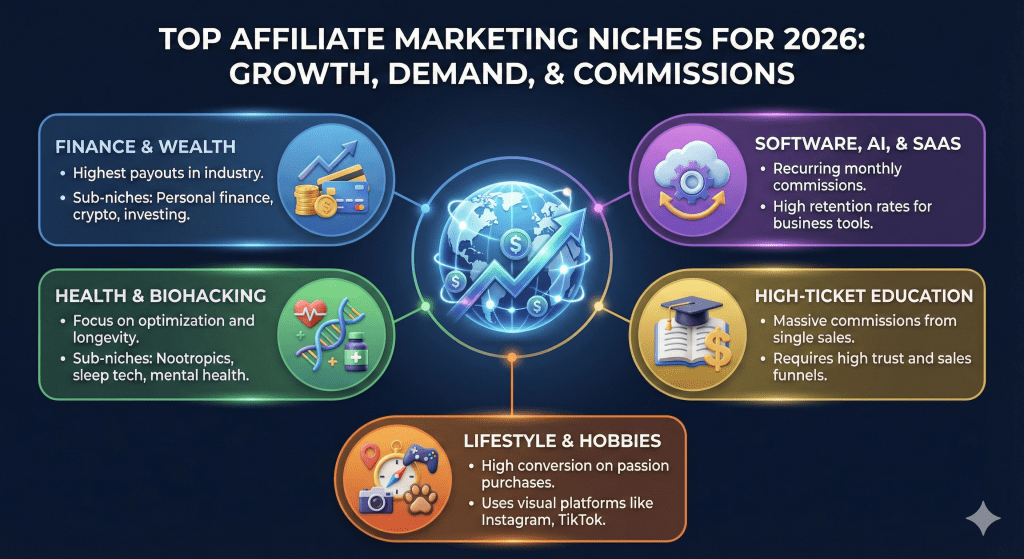
What Are the Best Affiliate Marketing Niches?
No category is universally best.
The following niches offer a useful combination of buyer demand, product variety, content potential, and affiliate opportunities. Their suitability still depends on your expertise, audience, platform, and competitive position.
1. SaaS, AI Tools, and Automation
Software is a natural affiliate category because customers often research products carefully before subscribing.
Businesses and independent professionals want to know whether a tool fits their workflow, integrates with existing systems, and provides enough value to justify its cost. This creates strong opportunities for comparisons, demonstrations, tutorials, and alternatives.
Potential sub-niches include:
- AI writing and research tools
- Workflow automation
- Email marketing platforms
- Customer relationship management software
- Project management tools
- Analytics platforms
- Customer support systems
The strongest content usually focuses on a clear audience or task.
A generic article about the best project management software may face established competitors. A detailed comparison of project management tools for small architecture firms gives the content a more specific purpose.
Useful formats include product comparisons, integration guides, workflow tutorials, pricing breakdowns, and alternatives pages.
The main challenge is credibility. Repeating the company’s feature page does not create a useful review. Readers need original testing, screenshots, practical demonstrations, and clear explanations of limitations.
Software content also requires maintenance. Features, prices, integrations, and program terms can change.
2. Finance and Money Management Tools
Finance attracts strong commercial intent because people compare costs, features, eligibility requirements, and risks before choosing a product.
The category extends beyond investing. It can include budgeting, business banking, bookkeeping, taxes, credit monitoring, invoicing, and financial education.
Potential sub-niches include:
- Budgeting applications
- Tax software
- Bookkeeping platforms
- Business banking
- Credit monitoring services
- Invoicing tools
- Money management for specific audiences
The most useful content helps readers make a defined decision.
Examples include budgeting apps for freelancers, bookkeeping software for small agencies, tax tools for independent contractors, and business accounts for sole proprietors.
Comparisons should use consistent criteria such as fees, eligibility, account features, security, support, and practical limitations. Calculators, templates, and checklists can support educational content without forcing a recommendation into every article.
Finance is highly competitive and trust-heavy. Avoid promising returns, minimizing risk, or presenting promotional language as impartial advice. Clearly distinguish general education from personalized financial guidance.
3. Health, Wellness, and Fitness Products
Health, wellness, and fitness cover recurring goals involving exercise, sleep, mobility, recovery, stress management, and general well-being.
This category requires a clear separation between general wellness recommendations and claims about diagnosing, treating, or preventing medical conditions.
Potential sub-niches include:
- Home fitness equipment
- Fitness and nutrition applications
- Sleep trackers
- Recovery tools
- Mobility products
- Meditation platforms
- Ergonomic products
Visual demonstrations are especially useful.
Readers benefit from seeing how equipment is assembled, how an application works, what information a tracker provides, and whether a product fits a realistic routine.
Strong formats include equipment comparisons, app walkthroughs, setup tutorials, feature explanations, and recommendations for defined user needs.
Personal experience does not prove that a product will produce the same result for everyone. Reviews should explain what the product does, what it does not do, and when professional guidance may be appropriate.
4. Business Education and Career Skills
People invest in education when they believe it can help them qualify for a role, develop a practical skill, or perform better in their work.
This category includes courses, certifications, bootcamps, memberships, coaching platforms, and job-search tools.
Potential sub-niches include:
- Coding bootcamps
- Professional certifications
- Freelancing education
- Sales and marketing training
- E-commerce programs
- Leadership development
- Interview preparation
A useful course review should examine the curriculum, instructor credibility, prerequisites, cost, time commitment, assessment methods, refund policy, and career relevance.
Comparisons can also help readers choose between self-paced courses, instructor-led programs, bootcamps, and formal certifications.
The main risk is overpromising. A course may teach a skill, but it cannot guarantee employment, clients, business growth, or income. Evaluate the educational product rather than repeating the transformation suggested by its marketing.
Coursera currently allows approved affiliates to promote thousands of courses and Specializations, providing one example of the breadth available within the education category.
5. Creator, Content, and Online Business Tools
Creators need tools to plan, produce, publish, distribute, manage, and monetize content.
That creates a direct connection between educational content and relevant product recommendations. A newsletter guide can compare email platforms. A podcast tutorial can evaluate recording software. A course-building guide can assess hosting platforms.
Potential sub-niches include:
- Video editing tools
- Newsletter platforms
- Podcast software
- Course platforms
- Community platforms
- Design tools
- Digital product platforms
This category should remain separate from general SaaS through its audience and purpose.
SaaS content should focus primarily on business operations, productivity, sales, and workflows. Creator-tool content should focus on publishing, audience growth, community management, and monetization.
Demonstration-led content works particularly well. Useful formats include setup guides, platform comparisons, migration tutorials, pricing breakdowns, and creator-specific workflows.
Companies such as Shopify currently operate affiliate programs for eligible publishers serving entrepreneurial audiences, while Adobe offers an affiliate program for eligible subscriptions. These are examples of creator and business platforms publishers may evaluate, not proof that every product in the category is suitable.
6. Pets, Hobbies, and Enthusiast Products
Pets, gaming, photography, music, crafts, travel, and outdoor activities do not share one audience.
They belong in the same broad affiliate category because they often share similar commercial characteristics. Buyers are highly involved, markets contain many products, and readers actively seek detailed comparisons before purchasing or upgrading equipment.
Potential sub-niches include:
- Pet food and insurance
- Smart pet devices
- Gaming equipment
- Photography gear
- Music equipment
- Craft tools
- Outdoor and travel products
Hands-on experience matters.
Strong content includes product comparisons, beginner buying guides, upgrade recommendations, setup tutorials, compatibility explanations, and maintenance guides.
A photography publisher may focus on lenses for one camera system. A pet publisher may specialize in products for senior dogs. These focused positions are more coherent than covering every product within a broad enthusiast market.
Retail commission rates may be lower than many software or financial payouts. Publishers may need higher purchase volume, repeat orders, more expensive products, or several revenue sources.
Product access can also create a barrier. Readers expect evidence when a review discusses durability, comfort, build quality, or performance.
7. Sustainable and Practical Home Products
Home products can solve clear problems involving energy use, water quality, storage, comfort, waste, durability, and maintenance.
Some buyers are motivated by environmental concerns. Others care more about convenience, resilience, product lifespan, or potential cost savings. Strong content distinguishes between those motivations.
Potential sub-niches include:
- Solar generators
- Water filters
- Composting systems
- Energy-monitoring devices
- Home air-quality products
- Reusable household products
- Durable home goods
Useful formats include product comparisons, installation guides, maintenance instructions, cost analyses, durability tests, and certification explanations.
Visual content can be valuable because readers want to understand size, setup, noise, storage requirements, and everyday use.
Avoid vague claims such as “green,” “clean,” or “eco-friendly.” Explain the evidence behind the description, such as energy consumption, material sourcing, repairability, product lifespan, certification, or reduced disposable use.
A product should not be described as sustainable simply because its marketing uses that language.
Affiliate disclosure: This article may contain affiliate links. If you make a purchase through one of these links, we may earn a commission at no additional cost to you.
Narrower Affiliate Niches Worth Exploring
A narrower niche can provide clearer positioning and more specific content.
It should not automatically be described as low competition. A focused market may still contain strong competitors, weak monetization, or limited demand.
Digital Minimalism and Focus Tools
This category may include app blockers, privacy software, focus tools, screen-time systems, and distraction-free devices.
The opportunity lies in helping a defined audience use technology more intentionally. Monetization must be validated carefully because some readers may be more interested in habits and philosophy than products.
Remote Team Operations
Potential products include documentation platforms, asynchronous video tools, global payroll services, onboarding software, and scheduling systems.
The strongest content addresses a specific operational need, such as onboarding distributed agency employees or documenting processes across international teams.
Professional experience can improve credibility because readers expect practical workflows rather than generic software summaries.
AI Workflows for Specific Professions
Profession-specific AI content can be more useful than broad coverage because it connects the product to a clear workflow and audience.
Potential audiences include recruiters, teachers, consultants, coaches, real estate professionals, accountants, and designers.
The content must consider accuracy, privacy, client confidentiality, professional standards, and the need for human review.
Home Office Ergonomics
This niche combines office furniture, lighting, webcams, microphones, monitor arms, and acoustic products.
A focused position could target home offices for small apartments, workspaces for video consultants, or ergonomic setups for designers.
Credible recommendations often require direct product access, measurements, and hands-on testing.
Audience-Specific Personal Finance
A publisher can focus on the financial needs of freelancers, creators, couples, students, immigrants, contractors, or small business owners.
A defined audience creates more specific questions and product recommendations. It does not reduce the need for financial accuracy and careful sourcing.
High-Paying vs Narrower Niches: Which Is Better?
Different niche models suit different publishers.
| Niche Type | Best For | Main Advantage | Main Risk |
|---|---|---|---|
| High-paying niche | Experienced affiliates and experts | More revenue from each qualified conversion | Strong competition and higher trust requirements |
| Narrower niche | Beginners and specialist publishers | Clear positioning and focused authority | Smaller total audience |
| Recurring-commission niche | Publishers building long-term content assets | Continued payouts while customers remain eligible | Customer churn and changing program terms |
| High-volume niche | Social creators and large publishers | More buyers and product variety | Lower earnings per transaction |
| Trust-heavy niche | Qualified experts | Credibility can become a competitive advantage | Greater accuracy and compliance burden |
| Product-led niche | Hands-on reviewers | Original testing supports buying intent | Product access and testing costs |
A high-paying niche is not automatically more profitable.
Larger commissions may come with stronger competition, expensive customer acquisition, longer sales cycles, or strict approval requirements. A narrower niche may produce smaller payouts but give the publisher a clearer route to a relevant audience.
Recurring commissions also require context. They remain valuable only while referred customers stay subscribed and the program continues honoring the applicable terms.
The right model depends on your expertise, audience access, resources, content format, and tolerance for competition.
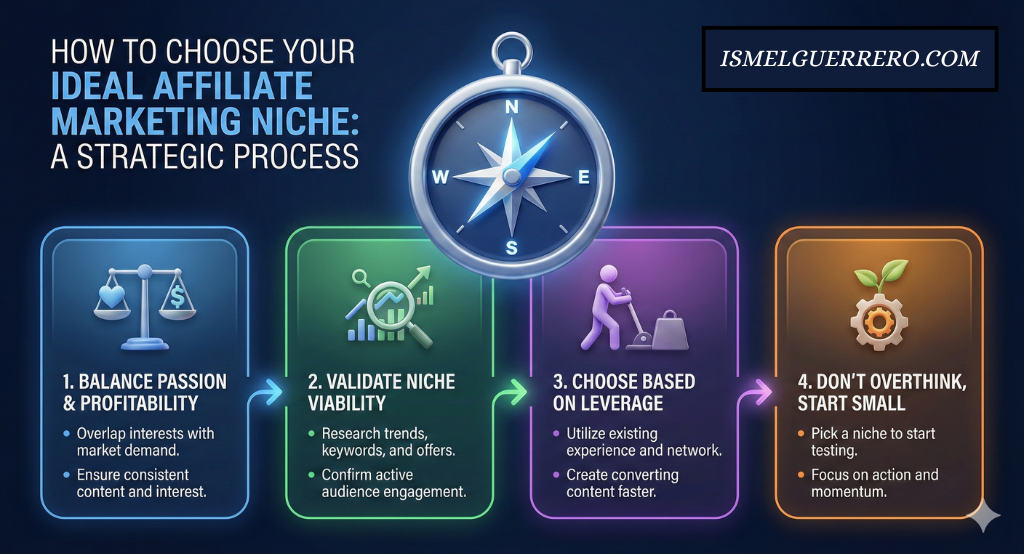
How Do You Choose the Right Affiliate Marketing Niche?
The right niche sits at the intersection of demand, monetization, competition, content ability, and trust.
Use the following criteria before committing.
| Criterion | What to Check | Why It Matters |
|---|---|---|
| Demand | Search activity, stable interest, active communities, and repeated questions | Shows whether an audience exists |
| Buyer intent | Reviews, comparisons, pricing searches, and product discussions | Shows whether the audience considers purchases |
| Affiliate programs | Commission model, tracking, conversion path, and product quality | Shows whether the niche can be monetized |
| Competition | Ranking publishers, content quality, audience gaps, and weak formats | Shows whether a practical entry point exists |
| Content fit | Knowledge, experience, access, and demonstration ability | Shows whether credible content can be sustained |
| Trust burden | Potential consequences of inaccurate recommendations | Shows how much expertise and editorial care the niche requires |
Follow these seven steps to validate the opportunity.
1. Start With an Audience and Problem
Do not build the entire niche around one product.
Products disappear. Affiliate programs close or change their terms. A more durable foundation is:
Audience + Problem + Product Category
For example, “productivity” is too broad. “Productivity tools for independent consultants” identifies both the audience and the type of problem being solved.
The product should serve the audience. It should not define the entire business.
2. Validate Demand
Look for repeated evidence that people care about the problem.
Review search activity, trend stability, active communities, marketplace reviews, popular videos, product discussions, and paid advertisements.
Use several signals rather than relying on one keyword or metric.
Google explains that Trends data is normalized by time and location, which makes it useful for comparing relative interest rather than measuring total market size.
3. Review Available Affiliate Programs
Identify several reputable programs before committing.
Check the commission structure, cookie period, payout requirements, tracking method, refund risk, approval process, product quality, and geographic restrictions.
Review traffic-source compatibility as well. A program may restrict brand bidding, direct linking, email promotion, coupon traffic, social media, or incentivized clicks.
Amazon Associates permits certain paid search activity only when the result directs users to the affiliate’s own site rather than directly to Amazon. This illustrates why promotional rules should be reviewed before choosing a program.
4. Study the Competition
Examine who already reaches the audience and how well they serve it.
Look beyond brand size. Ask whether reviews contain original testing, comparisons are current, specific audiences are represented, and common questions receive complete answers.
A niche becomes more accessible when you can identify a meaningful difference in audience, expertise, evidence, format, or positioning.
5. Choose a Narrow Entry Point
Start where you can become relevant.
Examples include AI tools for recruiters, email platforms for membership businesses, budgeting tools for freelance designers, and home office products for small spaces.
A focused position helps you understand the reader, choose relevant products, and create connected content. You can expand after establishing trust and learning which topics attract qualified visitors.
6. Plan the Content Before Committing
Create a preliminary content map.
Confirm that the niche supports educational guides, reviews, comparisons, tutorials, buying guides, and problem-solving content.
Avoid building the site around dozens of slightly different “best product” articles. A strong content plan helps readers understand the problem before, during, and after the purchase.
7. Test a Small Content Set
Publish a focused group of articles, videos, or newsletter issues before making a large investment.
Measure impressions, affiliate clicks, engagement, conversions, reader questions, and the difficulty of producing credible content.
Do not evaluate a niche through traffic alone. A smaller audience with strong commercial intent may be more valuable than a large audience interested only in general information.
Common Mistakes When Choosing an Affiliate Marketing Niche
A good market can still fail when the publisher approaches it poorly.
Choosing Only by Commission Rate
A large commission means little when the product does not convert or the audience does not trust the recommendation.
Consider qualified traffic, conversion rates, refunds, customer retention, and program reliability alongside the advertised payout.
Picking a Niche Because It Is Trending
A trend may attract attention without creating durable demand.
Look for a persistent audience, problem, or product category beneath the trend. The topic must remain relevant long enough for the publisher to develop content and authority.
Going Too Broad Too Early
Broad positioning makes relevance harder to establish.
“Finance” does not identify an audience or problem. “Budgeting tools for self-employed professionals” does.
Starting narrow does not prevent future growth. It creates a practical entry point.
Ignoring Trust and Compliance
Finance, health, legal, and income-related content can influence important decisions.
Use appropriate evidence, qualify claims, explain limitations, and seek professional review when the subject requires it.
Promoting Weak Products
A strong market cannot compensate for a poor product.
Evaluate the recommendation independently from its commission. Promoting unreliable products may generate short-term revenue, but it can damage reader trust and reduce future conversions.
Depending on One Affiliate Program
Programs can reduce commissions, change eligibility rules, restrict promotional methods, or close.
A resilient niche contains several credible merchants and more than one potential revenue source.
Skipping Affiliate Disclosures
Affiliate relationships should be disclosed clearly and close to the recommendation.
Do not rely only on a general disclosure page or place the explanation where readers are unlikely to notice it.
Choosing a Niche Without Product Access
Credible reviews require evidence.
That evidence may come from direct use, original testing, professional expertise, interviews, demonstrations, or careful research. Rewriting a merchant’s product page does not create an independent evaluation.
Before entering a niche, determine whether you can access the products or gather enough reliable evidence to assess them responsibly.
Best Niche Picks by Affiliate Type
The best direction also depends on how you publish and where your credibility comes from.
| Affiliate Type | Suitable Niche Direction | Why It Fits |
|---|---|---|
| Beginner blogger with product access | Productivity tools, pet products, home office equipment, or focused SaaS | Supports practical content around clear problems |
| YouTube creator | Software demonstrations, creator tools, equipment, and education | Visual testing can support buying decisions |
| SEO publisher | SaaS comparisons, B2B tools, defined finance topics, and specialist products | Search content can target reviews, alternatives, and comparisons |
| Social media creator | Visual products, fitness gear, creator tools, and hobbies | Products can be demonstrated within existing audience content |
| Industry expert | Professional education, specialist software, finance, or health | Existing expertise supports trust and differentiation |
| Newsletter publisher | SaaS, memberships, education, and digital products | Repeated audience contact supports considered recommendations |
| Hands-on reviewer | Technology, home products, pets, equipment, and hobbies | Direct testing produces original evidence |
| Community operator | Professional tools, education, memberships, and specialist products | Community questions reveal needs and purchase intent |
Conclusion
The best affiliate niche is the one you can evaluate, enter, and serve credibly.
Start with one audience and a clear problem. Confirm that people are actively looking for solutions, identify several reputable affiliate programs, and study how existing publishers serve the market.
Then publish a focused set of useful content. Track which topics attract qualified readers, which recommendations earn clicks, and which products convert without compromising trust.
Real audience behavior will provide a better direction than commission rates, broad market labels, or temporary trends. Expand only when the evidence supports the next step.
Next Step: Read our Affiliate Marketing Guide to learn how to turn your chosen niche into your first sale.

Frequently Asked Questions
What Is the Best Affiliate Marketing Niche?
There is no universal best niche. Strong options include SaaS and automation, finance and money management, health and fitness, professional education, creator tools, enthusiast products, and practical home products. The right choice depends on demand, competition, product quality, trust requirements, and your ability to create credible content.
What Is the Most Profitable Affiliate Niche for Beginners?
Beginners are usually better served by a focused sub-niche than a broad, highly competitive market. Productivity tools, home office products, pet products, specialist hobbies, and focused software categories may provide clearer positioning when the publisher has relevant knowledge or product access.
Are AI Tools a Good Affiliate Marketing Niche?
AI tools can support reviews, comparisons, tutorials, and workflow content. The strongest opportunities usually focus on a defined audience or task rather than covering AI products in general.
Is Finance Too Competitive for Affiliate Marketing?
Finance is highly competitive, but focused opportunities may still exist. A publisher can target a specific audience, financial problem, product type, or content format. Relevant expertise and careful sourcing are important.
Should I Choose High-Ticket or Recurring Commissions?
High-ticket programs provide more revenue from each conversion. Recurring programs may continue paying while referred customers remain eligible. The better model depends on conversion rates, product quality, customer retention, audience fit, and program stability.
How Do I Know If a Niche Is Too Competitive?
A niche may be difficult to enter when established brands dominate relevant platforms, existing content is consistently strong, and you cannot identify a clear audience, evidence, expertise, or format advantage. Smaller successful specialists may indicate a more realistic entry point.
Do I Need Personal Experience in an Affiliate Niche?
Personal experience is not required in every niche, but credible evidence is. First-hand product use, professional expertise, original testing, demonstrations, interviews, and careful research can all strengthen content.
Can I Promote Multiple Affiliate Niches at Once?
You can cover several related categories that serve the same audience. Unrelated topics may weaken positioning and make trust harder to build. Start with a focused area before expanding into adjacent needs.
How Long Should I Test a Niche Before Changing Direction?
There is no universal testing period. Publish enough focused content to collect meaningful information about impressions, engagement, affiliate clicks, conversions, and production difficulty. Evaluate the quality of the evidence rather than relying on a fixed number of weeks or months.

0 Comments