Buying a digital product with permission to resell it might seem like a straightforward way to start selling on Etsy. However, having the right to sell a product does not necessarily mean Etsy allows you to list it.
Private Label Rights (PLR) products offer entrepreneurs a practical alternative to creating digital products from scratch. But if Etsy is part of your selling strategy, you need to understand how its marketplace requirements apply to licensed content.
The distinction matters whether you are considering selling ebooks, printable planners, worksheets, or editable templates.
In this guide, we’ll examine what Etsy’s policies say about PLR products, how customization affects their eligibility, and what alternatives you have if your products do not meet the marketplace’s requirements.
- Etsy does not generally allow the direct resale of ready-made PLR digital products. Its requirements for digital downloads emphasize original content created or designed by the seller.
- Commercial resale rights do not override Etsy’s policies. A PLR license may authorize you to sell a product, but the marketplace independently determines whether it qualifies for listing.
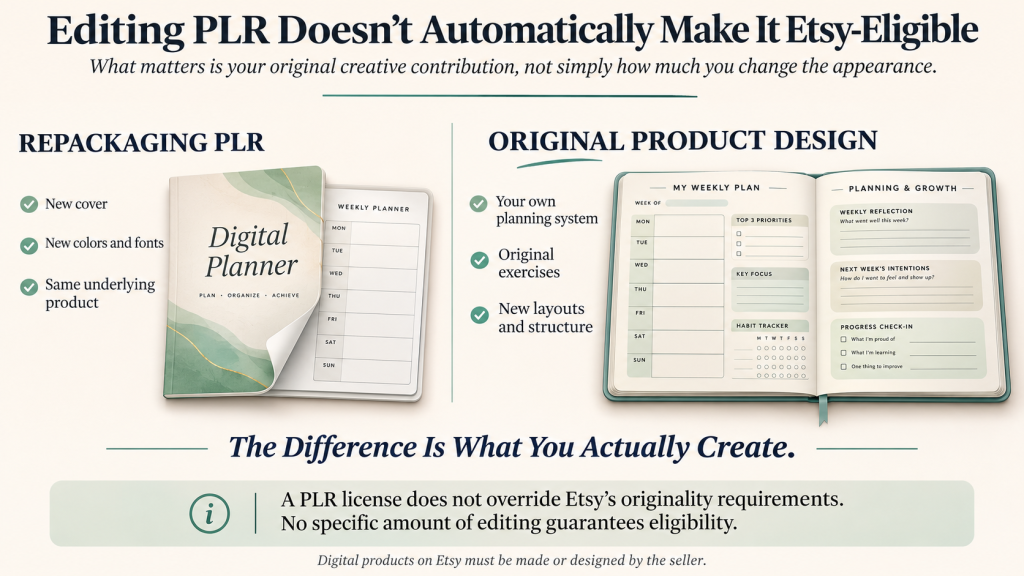
- Rebranding alone does not establish originality. Changing a product’s cover, colors, fonts, or author name does not necessarily make it an original seller-designed product.
- There is no guaranteed customization threshold. Etsy does not specify a percentage of PLR content you must modify to make a product eligible for sale.
- Existing PLR listings are not proof of compliance. A product being available on Etsy does not establish that it meets the marketplace’s requirements.
- Selling through your own website may offer greater flexibility. A dedicated digital store or sales funnel can be a more suitable option for licensed products, provided you comply with the product license and applicable service-provider policies.
Disclaimer: I am an independent Affiliate. The opinions expressed here are my own and are not official statements. If you follow a link and make a purchase, I may earn a commission.
Does Etsy Allow You to Sell PLR Products?
Generally, you cannot purchase a ready-made PLR digital product and resell it unchanged on Etsy as a product you designed.
Etsy operates under marketplace standards that distinguish it from conventional online stores. Its focus is on products that reflect the seller’s creative involvement or qualify under one of its other permitted product categories.
For digital downloads, the relevant category is generally Designed by a seller.
Etsy’s Creativity Standards describe qualifying digital downloads as:
Original content created by the seller, sold as a digital download.
The policy also identifies collections, bundles, scans, and PDF files containing another person’s work as examples of products that do not qualify under this category.
This means purchasing a PLR ebook, planner, or template and uploading it without modification does not generally satisfy Etsy’s requirements, even when the product includes commercial resale rights.
Using licensed materials as part of an independently created digital product is a different consideration. However, Etsy does not provide a blanket exception for customized PLR products.
Disclaimer: I am an independent Affiliate. The opinions expressed here are my own and are not official statements. If you follow a link and make a purchase, I may earn a commission.
PLR Licensing vs. Etsy’s Marketplace Policies
One reason selling PLR products on Etsy can be confusing is that two different sets of requirements apply.
The first comes from the original content provider. The second comes from the marketplace where you intend to sell the product.
What Your PLR License Allows
A Private Label Rights license establishes how you can use purchased or downloaded content.
Depending on its terms, you may be permitted to:
- Modify and rewrite the original content.
- Change its branding and visual presentation.
- Incorporate the material into another product.
- Sell the finished product to customers.
- Distribute the content through specified channels.
These permissions vary between products and providers. Some licenses also prohibit selling editable source files, transferring resale rights, or distributing content through particular marketplaces.
What Etsy Allows
Etsy independently determines which products qualify for its marketplace.
Even when a PLR provider permits commercial resale, Etsy may consider the resulting product ineligible if it does not satisfy its originality requirements.
| Consideration | PLR License | Etsy’s Policies |
|---|---|---|
| Editing | Determines whether you can modify the content | Considers the seller’s original creative contribution |
| Rebranding | May permit changing the product’s identity | Rebranding alone does not establish originality |
| Commercial resale | May authorize selling the product | Determines whether the product qualifies for listing |
| Distribution | May restrict particular sales channels | Establishes requirements for selling through Etsy |
| Customer rights | Determines which permissions you can grant buyers | Does not override the original license |
For example, a PLR provider may authorize you to modify and sell an ebook through your website. That permission does not automatically extend to eligibility on Etsy.
Entrepedia acknowledges this distinction in its guidance on selling PLR products through different platforms, explaining that sellers must comply with marketplace requirements independently of the permissions granted by its license.
Before selling licensed content, both sets of requirements need to be considered.
Can You Sell PLR Products on Etsy After Editing Them?
Customizing a PLR product can improve its usefulness, relevance, and presentation. However, customization does not automatically establish that the finished product meets Etsy’s originality requirements.
The important consideration is the nature of your creative contribution.
Selling Unmodified PLR Products
An unmodified PLR product is essentially an existing digital product being distributed by another seller.
If you purchase a collection of printable planners and upload the same files to your Etsy shop, you have not independently created or designed those planners.
Commercial resale permission from the original provider does not resolve this issue.
Making Minor Changes to PLR Products
Some entrepreneurs customize PLR products by making relatively simple changes, such as:
- Replacing the cover.
- Changing colors and fonts.
- Adding a logo.
- Renaming the product.
- Rewriting a few paragraphs.
- Changing the author name.
These changes may be permitted under the PLR license and can improve the product’s presentation. However, they do not necessarily establish sufficient original creative involvement to meet Etsy’s requirements.
The underlying product may remain substantially the work of another creator.
Using PLR as a Resource for Original Product Creation
A different approach involves using licensed content as supporting material while independently developing a new digital product.
For example, rather than purchasing and rebranding a completed productivity planner, you could use licensed productivity content as a reference while developing your own planning system, exercises, page layouts, and organizational structure.
Your original contribution would extend beyond the product’s appearance and into its actual design and functionality.
This approach is more closely aligned with Etsy’s emphasis on seller-created products. However, the finished item must still qualify under its policies, and the original license must permit your use of the supporting materials.
Etsy’s guidance on eligible products states that digital products must be made or designed by the seller. It does not establish a specific amount of customization that guarantees compliance.
Examples of PLR Products and Their Potential Eligibility on Etsy
Different digital product formats present different considerations when assessing originality.
The following examples illustrate how the seller’s creative involvement can change the nature of the finished product.
| Product Type | Direct PLR Resale | Original Product Development |
|---|---|---|
| Ebooks | Reselling a purchased ebook with a different cover | Writing an original guide using licensed material as a permitted reference |
| Printable planners | Uploading purchased planner pages | Developing your own planning system, layouts, and exercises |
| Worksheets | Selling existing worksheets with new branding | Designing original activities for a specific audience |
| Social media templates | Reselling purchased designs | Creating original layouts using properly licensed supporting assets |
| Workbooks | Repackaging an existing PLR workbook | Developing an original workbook with your own methods and exercises |
| Digital product bundles | Combining purchased PLR products into a collection | Creating a collection of independently designed resources |
How Much Do You Need to Change a PLR Product to Sell It on Etsy?
There is no published rule stating that you must change 20%, 30%, 50%, or any other specific percentage of a PLR product to qualify for sale on Etsy.
Recommendations based on fixed percentages can create a misleading impression of compliance.
Consider an ebook that has been extensively rewritten using different wording but retains the original author’s ideas, organization, examples, and overall structure.
Although the text has changed, the finished product may still rely substantially on someone else’s creative work.
Similarly, changing the appearance of every page in a printable planner does not necessarily mean you independently designed its underlying system.
Originality cannot reliably be measured by counting modified words, pages, colors, or design elements.
Instead, consider what you have independently developed, including the product’s concept, content, structure, functionality, and design.
Etsy’s published Creativity Standards focus on original seller-created content rather than a measurable customization threshold.
If your business strategy depends on reselling substantially unchanged PLR products, trying to meet an arbitrary editing percentage is unlikely to be a reliable approach.
Disclaimer: I am an independent Affiliate. The opinions expressed here are my own and are not official statements. If you follow a link and make a purchase, I may earn a commission.
Why Are So Many PLR Products Listed on Etsy?
Searching Etsy for PLR products may reveal listings for ebooks, templates, planners, digital bundles, and resources advertised with resale rights.
Their presence can make it appear that Etsy explicitly permits the resale of these products. However, a visible listing does not establish that the product complies with marketplace requirements.
Several circumstances could explain what you are seeing:
- The seller may have independently created the original product and is offering PLR licenses to customers.
- The product may include an original design developed by the seller.
- The listing may not yet have been reviewed for compliance.
- The seller may have misunderstood Etsy’s requirements.
There is also an important difference between creating an original product and selling it with a PLR license, and purchasing someone else’s PLR product to resell.
In the first situation, the seller may have created the original content. In the second, the seller is working with content created by another party.
Etsy explains in its Seller Policy that it uses automated systems, manual monitoring, and reports to identify listings that may violate its requirements.
Existing listings should therefore not be used as evidence that a particular selling practice is permitted.
What Are the Risks of Selling Noncompliant PLR Products on Etsy?
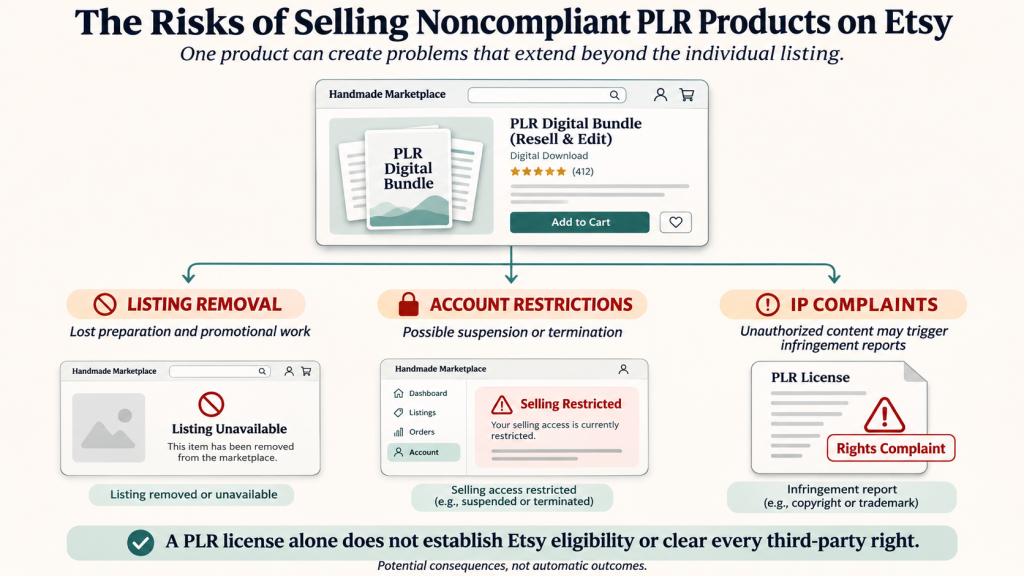
Selling a licensed digital product that does not satisfy Etsy’s requirements can affect more than the individual listing.
For entrepreneurs building a business around the marketplace, it is worth understanding the potential consequences before investing in products, branding, and promotional activities.
Listing Removal
Etsy may remove products that violate its marketplace policies.
A removed listing can represent lost time spent preparing product descriptions, graphics, promotional content, and customer-facing materials.
Account Suspension or Termination
Policy violations may result in restrictions on an Etsy account, including suspension or termination.
This can be particularly disruptive when a business depends heavily on Etsy as its primary source of customers.
Intellectual Property Complaints
A PLR license is only useful if the provider has the authority to grant the relevant permissions.
Products containing unauthorized graphics, copyrighted text, trademarks, or other protected materials may expose sellers to intellectual property complaints.
Reviewing the license and the origin of the content is therefore important, especially when purchasing products from unfamiliar suppliers.
What to Check Before Listing a PLR-Based Product on Etsy
Before investing time in preparing a licensed digital product for Etsy, evaluate whether the product and your intended use are compatible with the marketplace.
Use the following questions as a practical starting point.
| Question | Why It Matters |
|---|---|
| Does the license allow commercial resale? | Establishes whether you have permission to sell the material. |
| Does the license permit your intended modifications? | Determines how you can use the original content. |
| Did you independently create or design the finished product? | Helps assess alignment with Etsy’s originality requirements. |
| Are your changes primarily cosmetic? | Identifies whether the product remains substantially unchanged. |
| Do you have permission to use all included assets? | Helps address potential intellectual property concerns. |
| Can you accurately describe your role in creating the product? | Supports honest representation to customers and the marketplace. |
| Have you reviewed Etsy’s applicable policies? | Helps identify restrictions before publication. |
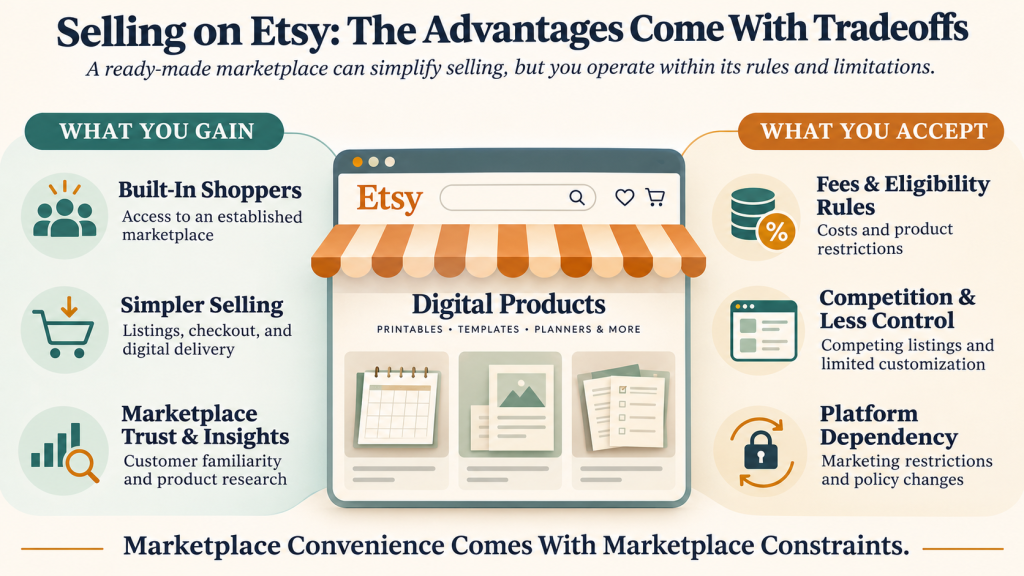
Advantages and Limitations of Selling Digital Products on Etsy
Etsy can be a worthwhile sales channel for digital product creators, particularly those offering original planners, templates, worksheets, and other downloadable resources. However, selling through an established marketplace involves tradeoffs that extend beyond product eligibility.
Understanding these advantages and limitations can help you determine whether Etsy fits your broader business strategy.
Advantages
- Access to an established marketplace: Etsy brings together shoppers who are actively searching for products, giving sellers an opportunity to reach potential customers without having to attract every visitor independently.
- Simplified store setup: Etsy provides the infrastructure for creating product listings, processing transactions, and delivering digital downloads.
- Established consumer trust: Selling through a recognizable marketplace may help reduce some of the uncertainty customers experience when purchasing from an unfamiliar business.
- Product research opportunities: Search results, customer reviews, and competing listings can provide useful insights into customer interests and existing product offerings.
- Lower initial technical requirements: You can begin selling without developing an independent website, checkout system, or digital product delivery infrastructure.
Limitations
- Restricted product eligibility: Etsy’s originality requirements limit the types of PLR and MRR products you can sell through the marketplace.
- Marketplace fees: Listing, transaction, payment processing, and applicable advertising fees can affect your profit margins.
- Direct competition: Customers can easily compare your products with similar offers from other sellers, making differentiation and pricing important considerations.
- Limited control over the sales experience: Your product presentation, checkout process, and promotional activities must operate within Etsy’s marketplace infrastructure.
- Customer marketing restrictions: Access to buyer information does not automatically give you permission to add customers to your email list or send them promotional messages.
- Platform dependency: Changes to marketplace policies, search rankings, fees, or account status can affect your ability to reach customers and sell products.
What to Check Before Listing a PLR-Based Product on Etsy
Before investing time in preparing a licensed digital product for Etsy, evaluate whether the product and your intended use are compatible with the marketplace.
Use the following questions as a practical starting point.
| Question | Why It Matters |
|---|---|
| Does the license allow commercial resale? | Establishes whether you have permission to sell the material. |
| Does the license permit your intended modifications? | Determines how you can use the original content. |
| Did you independently create or design the finished product? | Helps assess alignment with Etsy’s originality requirements. |
| Are your changes primarily cosmetic? | Identifies whether the product remains substantially unchanged. |
| Do you have permission to use all included assets? | Helps address potential intellectual property concerns. |
| Can you accurately describe your role in creating the product? | Supports honest representation to customers and the marketplace. |
| Have you reviewed Etsy’s applicable policies? | Helps identify restrictions before publication. |
Disclaimer: I am an independent Affiliate. The opinions expressed here are my own and are not official statements. If you follow a link and make a purchase, I may earn a commission.
Etsy vs. Your Own Website or Sales Funnel
One of the most important considerations when choosing a sales channel is how much control you want over your business and customer relationships.
| Business Consideration | Etsy | Your Own Website or Funnel |
|---|---|---|
| Customer acquisition | Access to marketplace shoppers | Responsible for attracting your own traffic |
| Product flexibility | Subject to Etsy’s eligibility requirements | Greater flexibility within applicable licenses and policies |
| Branding | Within Etsy’s marketplace structure | Greater control over your brand identity |
| Selling costs | Marketplace and processing fees | Hosting, software, marketing, and processing costs |
| Email list building | Subject to Etsy’s customer data policies | Direct, permission-based subscriber acquisition |
| Sales experience | Standardized marketplace infrastructure | Customizable sales pages, checkout, and offers |
| Follow-up marketing | Subject to marketplace restrictions | Greater control over email campaigns and automation |
| Business dependency | Relies heavily on Etsy’s infrastructure | Greater independence from any single marketplace |
Having your own website or sales funnel does not necessarily make selling digital products easier. You become responsible for attracting visitors, earning their trust, converting them into customers, and maintaining the necessary infrastructure.
However, the work you invest can contribute to developing business assets you have greater control over, including your website, brand, email list, content, and customer relationships.
My Perspective on Selling Digital Products Through Etsy
I see Etsy as a potentially useful sales channel rather than the foundation of an entire digital product business.
For entrepreneurs who create original products, Etsy can complement an existing business and provide another way to reach customers. However, if your strategy revolves around PLR products, building your own website or sales funnel may be a more suitable long-term approach.
An independent sales channel gives you greater freedom to develop offers, create lead magnets, build an email list, introduce complementary products, and establish ongoing relationships with your audience.
These capabilities are particularly valuable because the business you are building extends beyond individual product sales.
Rather than relying exclusively on a marketplace to connect you with customers, you can gradually develop your own audience and the infrastructure needed to serve it.
Etsy can have a place in that strategy, but it does not have to be the center of it.
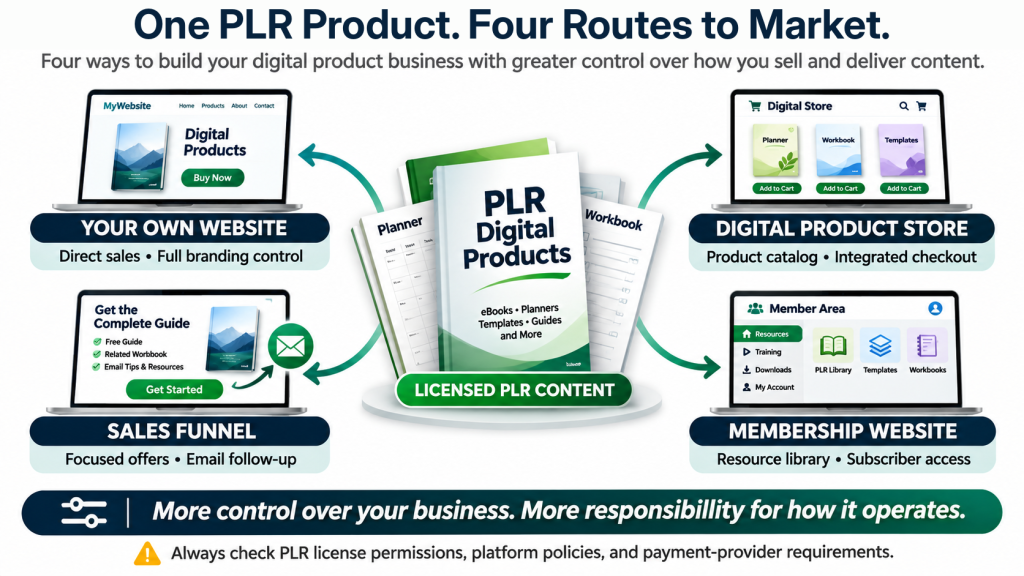
Where Can You Sell PLR Products Instead of Etsy?
If your objective is to resell ready-made PLR products or distribute customized content that does not meet Etsy’s originality requirements, other selling arrangements may provide greater flexibility.
The appropriate option depends on the product license, your business strategy, and the policies of the services you use.
Your Own Website
Selling through your own website gives you greater control over product presentation, branding, pricing, customer relationships, and distribution.
You can create product pages around specific audience needs rather than adapting your entire offer to the requirements of a third-party marketplace.
The main consideration is that you are responsible for attracting potential customers, processing transactions, delivering products, and providing support.
An Independent Digital Product Store
An ecommerce store can be useful when you intend to offer multiple digital products within a specific niche.
Platforms such as Shopify provide infrastructure for operating an independent online store.
However, operating your own storefront does not eliminate every restriction. You still need to follow your product licenses, applicable laws, ecommerce platform requirements, and payment-processing policies.
For example, Shopify’s intellectual property guidance explains that content infringing another party’s legal rights may be removed.
Sales Funnels
A sales funnel may be more suitable when your business focuses on a particular offer rather than a large product catalog.
For example, you could use a licensed guide as a lead magnet, introduce a related paid workbook, and offer additional educational resources through email follow-up, provided each use is permitted.
This arrangement allows you to develop the customer experience around a specific topic or problem.
It also provides an opportunity to build an email list and establish direct relationships with interested customers.
Membership Websites
Suitable PLR products can also be incorporated into membership websites, training libraries, or subscriber resource collections.
This can be particularly relevant when licensed content supports an existing educational program or recurring service.
Before distributing resources through a membership, confirm that the original license permits this type of access and that members are not receiving rights you are unauthorized to grant.
A Note About Other Digital Product Marketplaces
Not every alternative marketplace permits PLR or MRR products.
For example, Gumroad’s prohibited-product guidance explicitly identifies the resale of ebooks carrying PLR or MRR licenses among its restricted activities.
Do not assume that because a platform specializes in digital products, it automatically permits the resale of licensed content.
Review its policies before building your business around it.
Disclaimer: I am an independent Affiliate. The opinions expressed here are my own and are not official statements. If you follow a link and make a purchase, I may earn a commission.
Conclusion
Selling PLR products on Etsy requires more than obtaining commercial resale permissions. The finished product must also satisfy the marketplace’s requirements concerning originality and seller involvement.
If your goal is to resell ready-made digital products with little or no modification, Etsy is generally not a suitable marketplace for that approach.
If you want to develop original digital products and use licensed content as supporting material, Etsy may be worth considering, provided your finished products meet its requirements.
For entrepreneurs whose primary strategy involves reselling or repurposing PLR content, an independent website, digital product store, or sales funnel may offer greater flexibility.
Understanding these differences before choosing a sales channel can help you develop a business strategy that fits both your products and the permissions under which you operate.
Frequently Asked Questions (FAQs)
Is Selling PLR Products on Etsy Illegal?
Not necessarily. Selling properly licensed content may be legally permitted while still violating Etsy’s marketplace policies. Copyright permissions and marketplace eligibility are separate considerations.
Can I Sell MRR Products on Etsy?
Reselling ready-made Master Resell Rights (MRR) digital products generally presents the same originality concerns as reselling unmodified PLR products. Having permission to resell a product does not automatically make it eligible for Etsy.
Can I Sell PLR Products on Etsy if the Provider Says I Can?
The provider can authorize the use and distribution of its own content, but it cannot override Etsy’s marketplace requirements. You must comply with both the product license and Etsy’s policies.
Can I Sell PLR Canva Templates on Etsy?
Purchasing a Canva template with Private Label Rights does not automatically make it eligible for sale on Etsy. The finished product must satisfy Etsy’s originality requirements, and you must have appropriate permissions for any content or design elements included.
Can I Create My Own Digital Product and Sell It With PLR?
Potentially, yes. If you independently created the product and have the authority to grant Private Label Rights, the originality concern is different from reselling purchased PLR content. The product and its listing must still comply with Etsy’s applicable policies.
Does Changing the Cover of a PLR Ebook Make It Eligible for Etsy?
No, not by itself. Changing the cover, title, or branding does not establish that you independently created or designed the underlying content.
Can I Use AI to Rewrite PLR Content for Etsy?
Using AI to rewrite licensed content does not automatically establish originality or marketplace eligibility. You must comply with the original license, contribute qualifying original creative work, and follow Etsy’s applicable AI-related requirements.
Can Etsy Remove a PLR Listing After It Has Already Been Published?
Yes. A listing may be reviewed and removed after publication if Etsy determines that it violates its policies. The ability to publish a listing does not constitute permanent approval.

0 Comments