A lead capture page is a critical tool for converting anonymous website visitors into valuable, identifiable leads. In today’s digital landscape, an effective lead capture strategy is the engine that fuels predictable sales funnels and drives audience growth.
The primary challenge, however, is persuading visitors to willingly exchange their contact information.
This guide provides our complete, field-tested blueprint for engineering high-conversion lead capture systems from audience intent analysis to data-backed offer selection and the technology stack to automate it all.
Key Takeaways
- Focus on capturing the 95% of your audience who aren’t ready to buy immediately by offering genuine value upfront.
- Prioritize interactive lead magnets like quizzes and assessments, which can convert up to 10 times better than static PDFs.
- Use keyword research to uncover audience pain points and identify high-intent ideas for your lead magnets.
- Build a complete funnel system, not just a page, to effectively nurture new leads toward becoming clients.
- Select tools that align with your lead magnet’s format, from intuitive design platforms to advanced quiz builders.
Disclaimer: I am an independent Affiliate. The opinions expressed here are my own and are not official statements. If you follow a link and make a purchase, I may earn a commission.
Why Your Business Needs an Effective Lead Capture Strategy
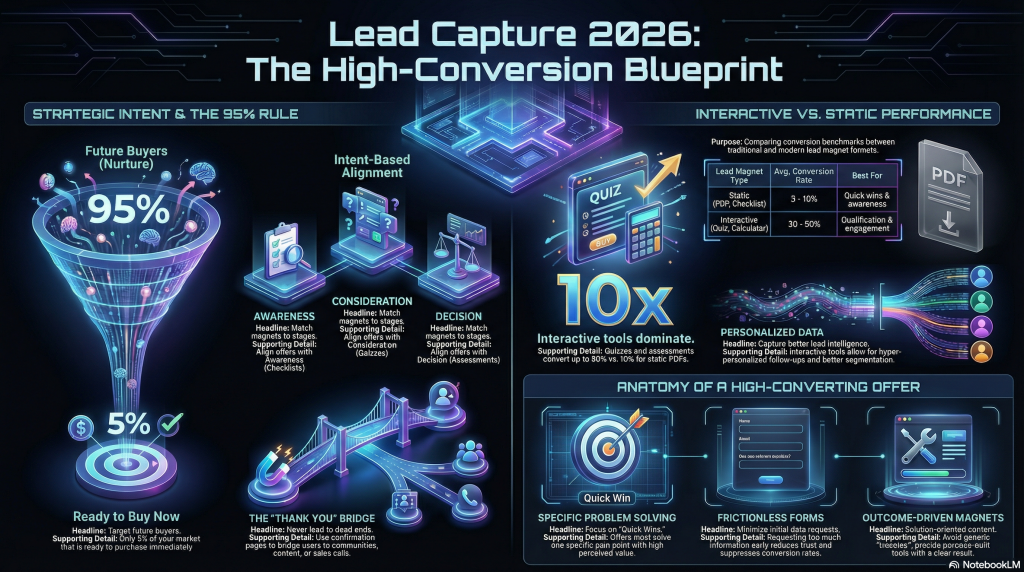
An effective lead capture strategy is a fundamental business growth activity, designed to solve one of the primary challenges in marketing: generating a consistent stream of qualified leads. For many B2B marketers, this remains their single biggest challenge. The solution lies in understanding a core principle of audience behavior known as the “95% Rule.”
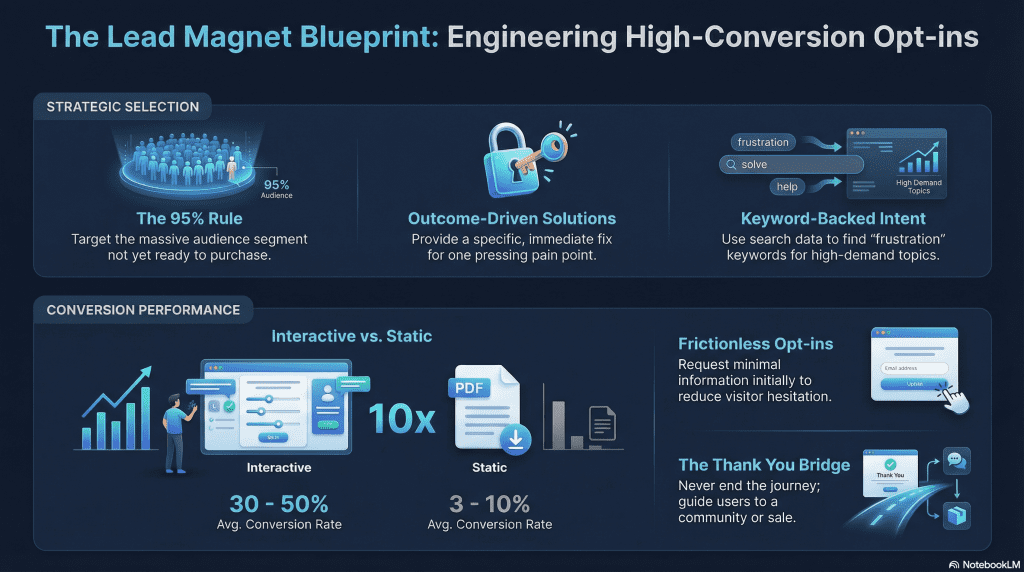
This rule states that in any given market, only 5% of people are ready to buy at this moment. A lead capture page is the essential tool for engaging the other 95%, those who need more time and information. By offering a tangible solution in exchange for their contact details, you can begin to nurture a relationship with this massive, untapped segment of your audience.
The goal isn’t to collect leads; the goal is to attract future clients. Think of your lead magnet as the first step in a relationship, not a transaction. This reframes the entire purpose from a simple data exchange to the beginning of a valuable customer journey.
Ultimately, a lead capture strategy transforms passive website traffic into a valuable, addressable asset, forming the foundation of a predictable and scalable sales funnel. Understanding why this is crucial is the first step; the next is to understand the what, the essential components of a page that successfully captures those leads.
The Anatomy of a High-Converting Lead Capture Page
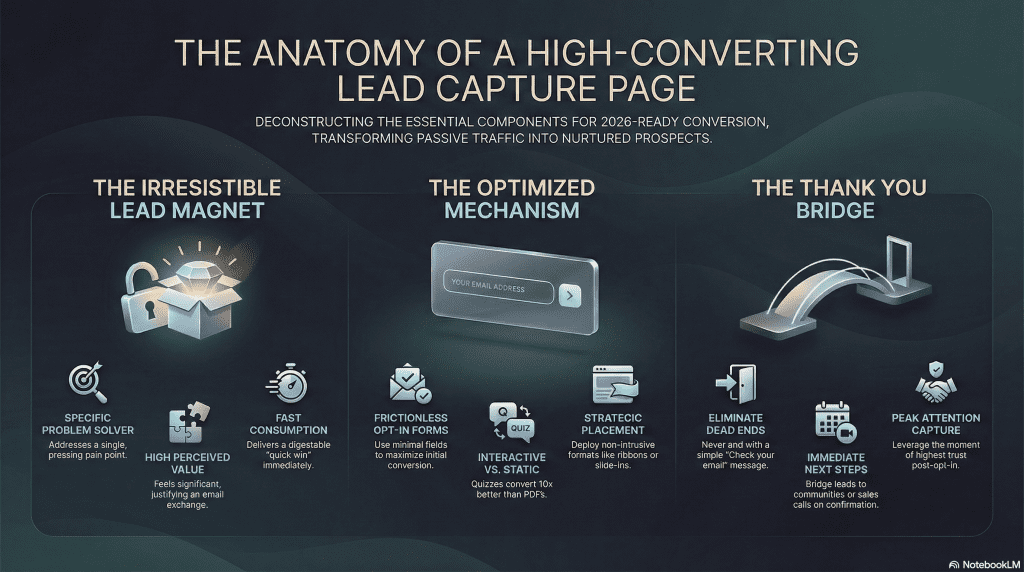
A successful lead capture page is more than just a form; it’s a carefully constructed value exchange designed to be compelling and frictionless. This section deconstructs the two essential components that work together to make this exchange irresistible to your ideal customer.
The Offer: Your Irresistible Lead Magnet
A “lead magnet” is the free, valuable resource you offer in exchange for a visitor’s contact information. Its quality and relevance are the most important factors in your page’s success. An effective lead magnet is not just any freebie; it possesses several key characteristics.
- Specific Focus: It provides a specific solution for a particular problem, rather than being vague or overly broad.
- High Perceived Value: It feels valuable enough that exchanging an email address for it seems like a great deal.
- Solves a Pain Point: It directly addresses a pressing problem, challenge, or question that your target audience has.
- Fast Consumption: It delivers a quick win and is easy for the user to digest, providing immediate value.
The Mechanism: Your Optimized Opt-In Form
The opt-in form is the functional tool used to collect a visitor’s contact information. The design, placement, and timing of this form are critical for maximizing conversions. A poorly designed or intrusive form can deter even the most interested visitors. There are several common types of opt-in forms, each suited for different contexts.
- Pop-up Lightbox
- Slide-in
- Sticky Ribbon
- Inline Form
- Content Lock
- Page Takeover / Scroll Mat
With the core components of the page defined, the next critical step is to choose the most effective type of lead magnet to offer.
💡 Pro Tip: The “Thank You Page” Bridge
Most marketers waste the confirmation page by just saying, “Success! Check your email.”
This is a massive missed opportunity. The moment someone subscribes, their attention and trust are at their peak. Do not let the experience end there.
Use the Thank You page to “bridge” them to the next step immediately:
- The Community Bridge: “While you wait for the email, join our private community here.”
- The Content Bridge: “Read this advanced guide next to get a head start.”
- The Sales Bridge: “Need help implementing this? Book a 15-minute discovery call now.”
The Rule: Never lead a user to a dead end. Always provide a clear next step.

Choosing the Right Lead Magnet: A Data-Backed Comparison
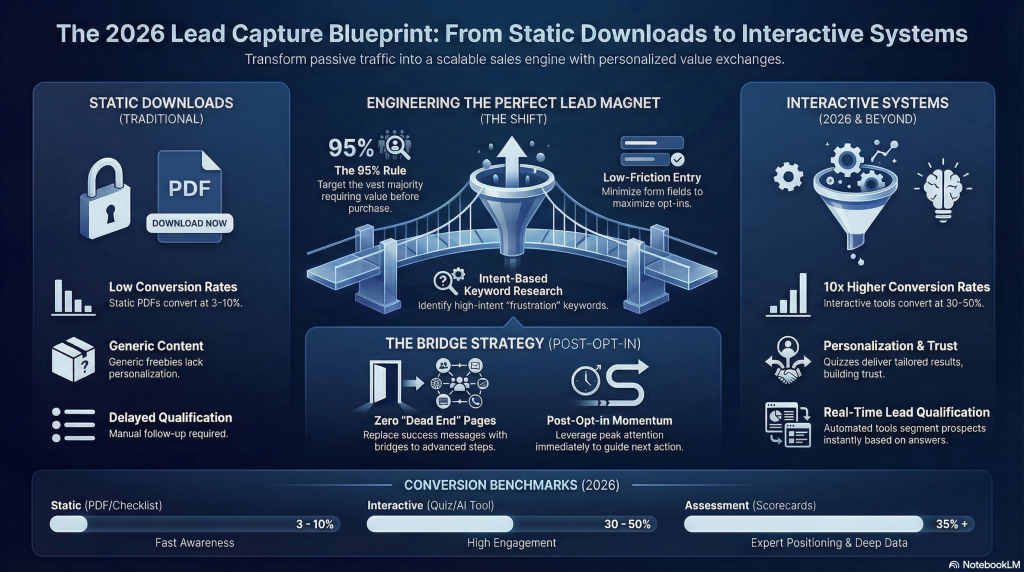
The performance of different lead magnet formats has shifted dramatically. While traditional, static formats can still be effective, data clearly shows that interactive lead magnets generate significantly higher conversion rates by offering a personalized experience. This section compares the two categories to help you make a strategic choice.
| Lead Magnet Type | Average Conversion Rate | Best For |
| Static PDF (eBook, Checklist, Guide) | 3-10% | Quick wins, awareness stage content |
| Interactive (Quiz, Assessment, Calculator) | 30-50% | Lead qualification, high engagement, personalization |
The data is unambiguous: from the exact same amount of traffic, interactive formats can generate up to 10x more qualified leads, dramatically lowering your cost-per-lead.
The strategic impact of this shift cannot be overstated. Consider the case of a career coach who replaced her ’10 Tips for Your Job Search’ PDF (converting at 4%) with a ‘Career Readiness Assessment’ quiz. Her conversion rate skyrocketed to 38%. More importantly, the quiz data allowed for hyper-personalized email follow-ups, doubling her open rates and tripling the number of discovery calls booked all from the same amount of traffic.
Classic Static Lead Magnets
These tried-and-true formats provide immediate, tangible value and are excellent for attracting visitors in the initial “awareness” stage of their journey.
- Checklists & Cheat Sheets: Condensed, actionable guides that simplify a complex process, making it easy for users to follow along.
- Templates & Blueprints: Pre-designed frameworks that save users time and effort, such as resume templates, meal planners, or business roadmaps.
- eBooks & Guides: In-depth resources that establish your expertise on a specific topic and provide comprehensive value.
- Case Studies: Powerful success stories that build trust and credibility by showcasing real-world results you’ve achieved for others.
- Resource Lists: Curated collections of recommended tools, books, apps, or other materials that position you as a trusted guide.
High-Engagement Interactive Lead Magnets
These formats convert at a much higher rate because they offer a personalized, real-time experience that static content cannot match. They don’t just provide information; they engage the user and deliver tailored results.
- Quizzes & Scorecards: Fun, engaging tools that tap into our desire for self-discovery (e.g., “What’s Your Marketing Personality?”). They are excellent for segmenting new leads based on their answers.
- Assessments: More comprehensive than quizzes, these tools provide a detailed analysis and personalized recommendations, positioning you as an expert problem-solver.
- Calculators: Tools that provide instant, personalized value for numbers-based decisions, such as a salary negotiation calculator or a coaching ROI calculator.
- Free AI-Powered Tools: Simple, embeddable tools that solve a specific user problem. These can work 24/7 on your website to capture and qualify leads.
Once you have chosen a format, the next challenge is to generate the perfect idea for the content itself.
How to Choose a Lead Magnet People Will Actually Opt Into
A lead magnet fails most often for one reason: it solves a problem the audience isn’t actively trying to solve right now.
Choosing the right lead magnet is not about creativity. It’s about alignment with existing intent.
The simplest way to make that choice is to look for signals that people already want a downloadable or interactive solution not just information.
Start with Intent, Not Ideas
When someone searches for general information, they are usually browsing. When they search for something they can use, they are much closer to opting in.
High-intent signals include searches that imply:
- A shortcut
- A tool
- A framework
- A diagnostic
- A ready-made asset
For example, someone searching “how bookkeeping works” is learning. Someone searching “bookkeeping spreadsheet” is asking for something they can apply immediately.
That difference matters because lead magnets perform best when they promise immediate, practical relief not education alone.
Match the Lead Magnet to the Problem Stage
Not every visitor is at the same level of awareness. A strong lead capture system works because the offer matches where the visitor is mentally, not because the offer is impressive.
A simple way to align offers with intent:
- Early-stage problems → Checklists, templates, quick-start guides
- Mid-stage uncertainty → Quizzes, scorecards, comparisons
- Late-stage evaluation → Assessments, calculators, demos
The goal is not to move people to a sale immediately. It’s to meet them at the stage they’re already in and give them something that feels useful right now.
Use Demand as a Filter
A practical rule:
If you can’t clearly explain what problem your lead magnet solves in one sentence, it’s not ready.
Strong lead magnets answer one specific question or remove one specific obstacle. Weak ones try to “add value” broadly and end up being ignored.
Before building anything, ask:
- Is this something people already look for?
- Does it save time, reduce uncertainty, or provide clarity?
- Can the value be understood instantly from the title?
If the answer is unclear, the conversion rate usually reflects that.
The Outcome to Aim For
The right lead magnet does three things:
- Feels immediately relevant
- Promises a fast, usable outcome
- Requires no explanation once seen
When those conditions are met, the opt-in becomes a logical next step, not a persuasion challenge.
With the right idea selected, the final step is execution choosing tools that let you deliver that value cleanly and automatically.
Top Tools to Build and Deploy Your Lead Capture System
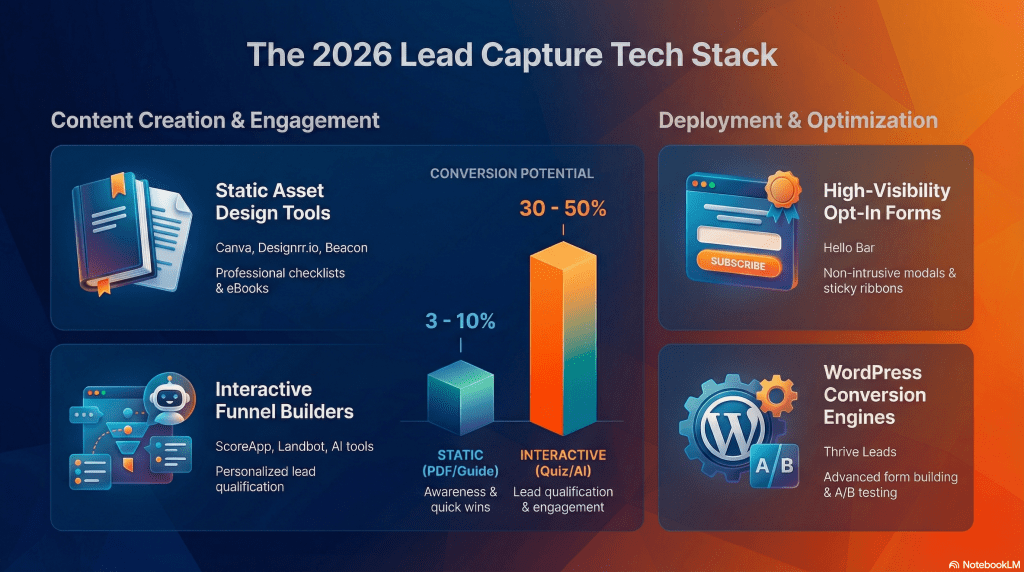
Modern tools have made creating compelling lead magnets and the systems that support them more accessible than ever, even for those without advanced design or development skills. This section provides a curated list of top-tier tools for every stage of the process, from creation to deployment.
Tools for Designing Static Lead Magnets
- Canva: An intuitive drag-and-drop graphic design tool with thousands of professional templates for infographics, reports, checklists, and book covers.
- Designrr.io: A powerful tool that instantly transforms existing content like blog posts or podcasts into polished eBooks, saving you dozens of hours in content creation.
- Beacon: A platform specifically for creating lead magnets like eBooks, checklists, and resource guides with an easy-to-use drag-and-drop editor.
Tools for Building Interactive Lead Magnets
Unlike tools that only generate a static file, these platforms are designed to build a complete funnel. They not only create an engaging, personalized experience but also handle the data collection, segmentation, and automated follow-up that turns a new lead into a nurtured prospect.
- ScoreApp: More than a quiz builder, this platform creates a complete, automated lead-nurturing funnel based on a user’s quiz results.
- Landbot: A tool for creating conversational AI chatbots that can capture leads, ask qualifying questions, and increase visitor engagement.
- RightBlogger’s Tool Studio: A platform that allows you to create your own embeddable, AI-powered lead magnet tools to host on your website.
Tools for Deploying Opt-In Forms
- Hello Bar: A versatile tool that adds non-intrusive but highly visible lead capture forms like hello bars, modals, and sliders that can be customized to match your site’s design automatically.
- Thrive Leads: A comprehensive WordPress plugin for creating any type of opt-in form imaginable, with a powerful built-in A/B testing engine to find your highest-converting designs.
The combination of the right strategy, a compelling offer, and the proper tools creates a powerful lead generation engine for your business.
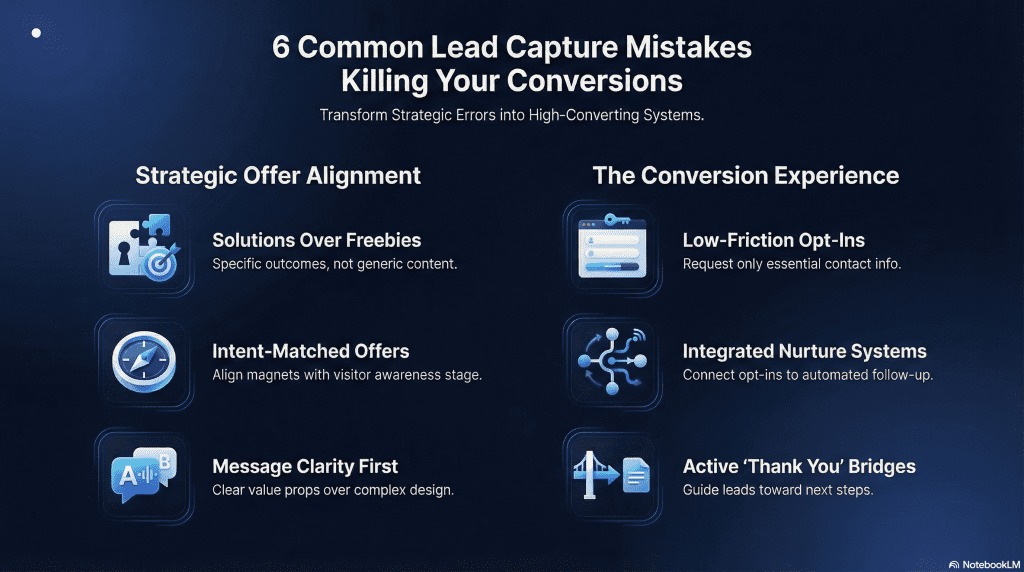
Common Lead Capture Mistakes (and Why They Hurt Conversions)
Even well-designed lead capture pages fail when a few foundational mistakes creep in. These issues are rarely technical, they’re strategic. Below are the most common errors that quietly suppress conversion rates and weaken long-term results, even when traffic is strong.
Treating the Lead Magnet as a Freebie Instead of a Solution
One of the most common mistakes is creating a lead magnet simply because it’s easy to produce. Generic PDFs, broad guides, or recycled blog content often lack a clear outcome. When the offer doesn’t solve a specific problem, visitors have little motivation to exchange their contact information.
High-converting lead magnets are outcome-driven. They promise a clear result, address a defined pain point, and feel purpose-built rather than repurposed.
Asking for Too Much Information Too Early
Long opt-in forms reduce conversions dramatically, especially for first-time visitors. Requesting phone numbers, company size, or detailed personal information before trust is established creates friction and hesitation.
In most cases, an email address alone is enough. Additional data should be collected later, once value has been delivered and engagement is established.
Optimizing the Page but Ignoring the Follow-Up
Many lead capture pages are optimized in isolation, with little thought given to what happens after the opt-in. A strong page paired with weak follow-up emails, generic automation, or no segmentation wastes the opportunity created by the conversion.
Lead capture should be designed as the entry point to a system. If the follow-up doesn’t continue the conversation or build on the promise of the offer, conversion gains quickly erode.
Using One-Size-Fits-All Offers for Different Intent Levels
Not all visitors arrive with the same level of awareness or urgency. Offering the same lead magnet to every visitor regardless of where they are in the journey often results in lower engagement and poor lead quality.
High-performing systems match lead magnets to intent:
- Awareness-stage visitors respond better to simple, fast wins.
- Consideration-stage visitors engage more with interactive or diagnostic tools.
- Decision-stage visitors expect depth, personalization, or proof.
Ignoring intent leads to mismatched expectations and underperforming funnels.
Overemphasizing Design While Undervaluing Clarity
A visually polished page can still underperform if the message is unclear. Overly clever headlines, vague promises, or jargon-heavy copy force visitors to work too hard to understand the value.
Conversion-focused pages prioritize clarity over creativity. Visitors should understand what they’ll get, why it matters, and what to do next within seconds of landing on the page.
Ending the Journey at the Thank You Page
A “Thank you, check your email” page is a dead end. This moment right after opt-in is when attention and trust are at their peak. Failing to guide users forward wastes momentum.
Effective thank you pages act as bridges, directing new leads to:
- Additional high-value content
- Community or social proof
- A low-friction next action (call, resource, or assessment)
Every step should move the relationship forward, not pause it.
Bottom line: Most lead capture failures don’t come from poor tools or lack of traffic. They come from unclear offers, mismatched intent, and incomplete systems. Avoiding these mistakes doesn’t just improve conversion rates, it improves lead quality, engagement, and long-term results.
Conclusion
An effective lead capture page is not a one-off marketing tactic but a strategic system designed to build relationships with your future customers.
As this guide has shown, the key to maximizing conversions in 2026 and beyond is the shift away from generic, static downloads toward personalized, interactive experiences. These modern lead magnets do more than just grow your email list; they qualify leads, segment your audience, and provide immediate, tailored value.
By using the frameworks provided, you can analyze your audience’s true intent and build an offer that addresses their most pressing needs, creating a predictable, automated system that works 24/7 to attract ideal prospects, qualify their needs, and nurture them into your most valuable clients.
Frequently Asked Questions (FAQs)
What is the difference between a lead magnet and a content upgrade?
A lead magnet is a broad offer, like a site-wide quiz, designed to capture leads from your general audience (the 95% not ready to buy). A content upgrade is a hyper-specific resource offered within a single piece of content, designed to convert the most engaged readers of that specific topic. For example, offering a downloadable checklist of a blog post’s steps is a classic content upgrade.
What makes a good lead magnet?
A good lead magnet solves a specific problem for a specific audience. It should have a high perceived value, be easy to consume quickly, and directly address a pain point your ideal customer is experiencing.
How do I promote a lead magnet once it’s created?
You can promote a lead magnet by placing opt-in forms (like pop-ups, sticky ribbons, or inline forms) on relevant pages of your website, creating social media posts that link to it, mentioning it in your email newsletter, and driving traffic to its dedicated landing page through SEO or paid ads.
Are quizzes really better than eBooks for lead generation?
Data shows that interactive lead magnets like quizzes convert significantly better, with average rates of 30-50% compared to 3-10% for static PDFs like eBooks. This is because quizzes offer a personalized, real-time experience that is more engaging and provides tailored value to the user.
What are some good lead magnet ideas for coaches?
Coaches can use a variety of lead magnets, including checklists (“Discovery Call Preparation Checklist”), templates (“Life Vision Planning Workbook”), and assessments (“Career Readiness Assessment”). Interactive quizzes and scorecards are particularly effective for qualifying potential clients.
Do I need coding skills to create an interactive lead magnet?
No. Modern platforms like ScoreApp, Landbot, and RightBlogger’s Tool Studio allow you to build sophisticated interactive quizzes, chatbots, and AI tools using intuitive, no-code interfaces.
How long should an eBook lead magnet be?
An eBook should be concise and focused on delivering a quick win. While there is no magic number, the goal is fast consumption. Instead of an overwhelming 100-page book, aim for a resource that solves one specific problem in a clear and actionable way, which can often be done in 15-30 pages.

0 Comments