Introduction: The Appeal of Promoting a Global Brand
The Nike Affiliate Program stands out for a simple reason.
You are not promoting a marketplace with thousands of unknown products. You are promoting a single brand that most people already recognize.
Nike has built its reputation around performance, design, and identity. For many customers, it is not just about buying a product, it is about choosing a brand they already trust.
That makes the program appealing.
You are not starting from zero. You are working with a name that already carries attention and credibility.
But that advantage can be misleading.
Brand recognition can help with trust, but it does not replace the need for alignment. Not every audience wants Nike products. Not every piece of content naturally fits them. And not every recommendation leads to a purchase.
Like most affiliate programs, the structure is simple.
You recommend products, share tracked links, and earn a commission when purchases happen.
What makes this different is not the model. It is the context in which it operates.
If your content, audience, and positioning align with the brand, the program can work well. If they don’t, the built-in trust of the brand does not make up the difference.
This guide explains how the Nike Affiliate Program works, where its strengths and limits are, and what you can realistically expect from it.
- The Nike Affiliate Program allows you to earn commissions by promoting Nike products through affiliate links, but approval is selective and depends on your content and audience
- Success depends on alignment your content, audience, and the brand need to naturally fit together
- Nike’s brand recognition can support trust, but results still depend on clear, relevant, and well-placed recommendations
- Earnings are driven more by relevance and context than by traffic volume alone
- It works best as a long-term strategy within fitness, sports, or lifestyle-focused content not as a quick way to earn
Disclaimer: I am an independent Affiliate. The opinions expressed here are my own and are not official statements. If you follow a link and make a purchase, I may earn a commission.
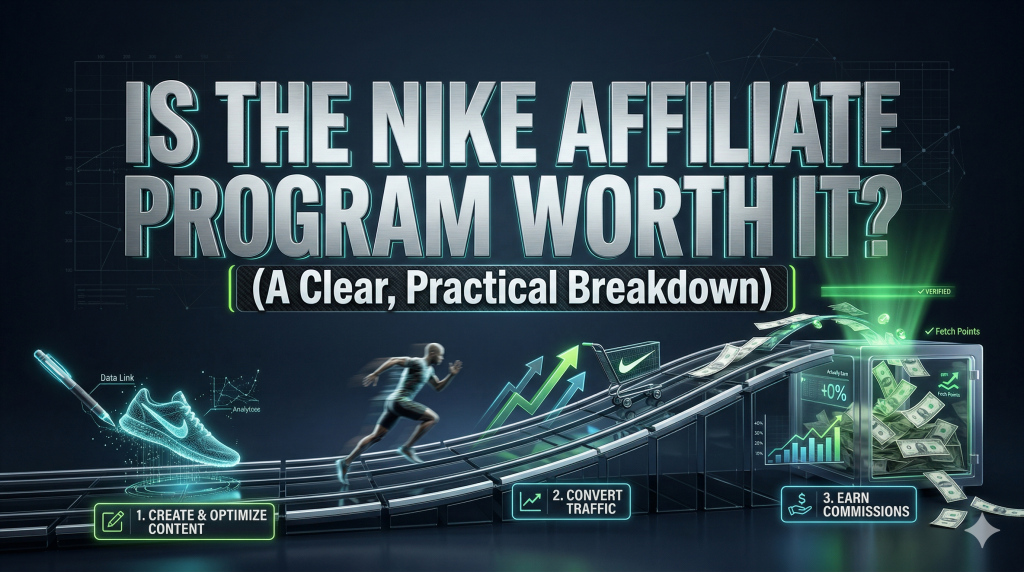
What the Nike Affiliate Program Actually Is
The Nike Affiliate Program allows you to earn commissions by referring customers to Nike products through tracked links.
At a basic level, it works like most affiliate systems.
You create content that features or recommends Nike products. Within that content, you include a unique tracking link. When someone clicks that link and makes a purchase, you earn a percentage of the sale.
But there is an important difference in how the program is structured.
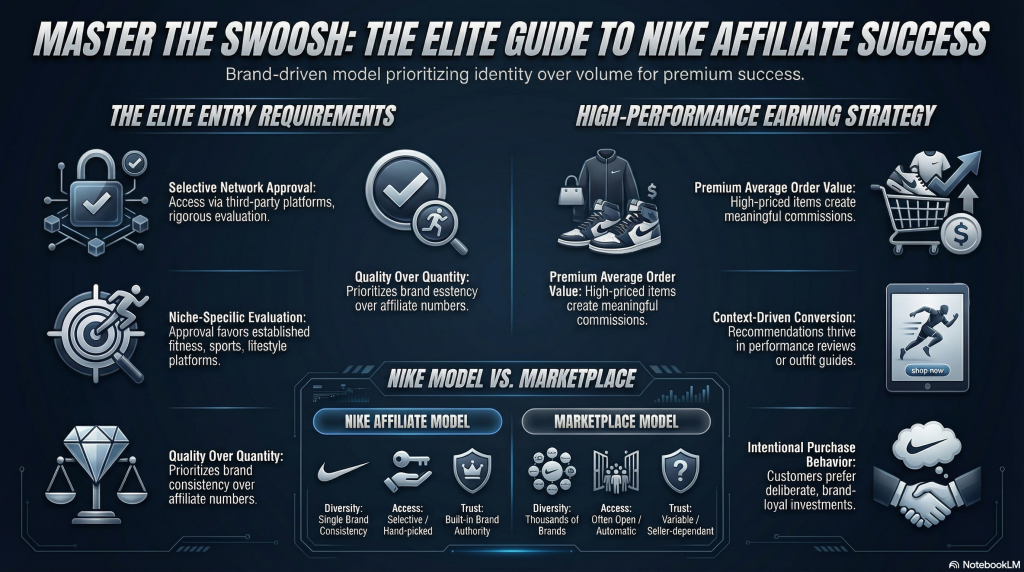
Unlike Amazon, Nike does not run a large, open marketplace-style affiliate system. Instead, its program is typically managed through affiliate networks.
This means:
- You apply through a third-party platform
- Approval is not automatic
- Your content and audience are part of the evaluation
Because of this, access can be more selective.
Nike is not trying to maximize the number of affiliates. It is focused on maintaining brand alignment across the content that promotes its products.
Once approved, the process is straightforward:
- You generate affiliate links for Nike products
- You include them in your content
- You earn commissions on qualifying purchases
From the outside, the system looks simple.
But access, positioning, and audience fit play a much larger role than they do in more open programs.
The Key Difference: A Brand-Driven Model
The Nike Affiliate Program is built around a single brand with a clear identity.
This changes how the program works in practice.
A Focus on One Brand
When you promote Nike products, you are working within a defined product line.
That includes:
- Footwear
- Apparel
- Sports and training gear
All recommendations stay within this ecosystem.
This creates consistency, but it also means your content needs to naturally fit the brand.
Brand Identity Shapes Decisions
Nike is not just a product provider. It represents a specific image and positioning.
For many customers, the decision to buy is influenced by:
- Brand familiarity
- Perceived quality
- Personal identity or lifestyle
Because of this, recommendations are not only about features or price. They are also about how well the product fits the person using it.
Audience Alignment Matters More
Since you are working with a single brand, your audience plays a larger role in results.
The program works best when your audience:
- Is already interested in fitness, sports, or active lifestyles
- Recognizes the brand
- Is comfortable with its pricing and positioning
If that alignment is missing, even well-presented content may not convert.
Less Flexibility, More Consistency
You are not choosing between different brands or alternatives.
Instead, you are:
- Staying within a consistent product line
- Building familiarity over time
- Reinforcing a specific type of recommendation
This can strengthen trust when the fit is right.
But it also means your results depend more on how well your content and audience align with the brand.
The Core Idea
The Nike Affiliate Program is shaped by brand alignment.
Success does not come from offering more options. It comes from matching the right audience with a brand they already value.
When that alignment is present, the process becomes more natural. When it is not, results tend to be limited.
How You Actually Get Accepted (And Why It Matters)
Getting accepted into the Nike Affiliate Program is not just a formality.
Unlike more open affiliate systems, approval is selective. This step plays a direct role in how the program is positioned and who can participate.
The Application Process
To join, you typically apply through an affiliate network that manages Nike’s program.
As part of the application, you may be asked to provide:
- Your website, blog, or content platform
- The type of content you create
- Information about your audience
This is not just for basic verification. It is used to evaluate whether your content aligns with the brand.
Approval Is Not Guaranteed
Not all applications are accepted.
Nike’s program tends to favor:
- Established content platforms
- Clear niches (fitness, sports, lifestyle)
- Content that reflects a certain level of quality and consistency
If your platform is new, unfocused, or not aligned with the brand, approval may be delayed or declined.
Why Selectivity Exists
The goal is not to have as many affiliates as possible.
It is to maintain consistency in how the brand is represented.
This means:
- Content matters
- Positioning matters
- Audience matters
The program is designed to work with creators whose content already fits naturally with what Nike represents.
What This Means in Practice
Approval is not just a starting step. It sets the tone for everything that follows.
If you are accepted:
- Your content is already aligned with the brand
- Your audience is more likely to respond to recommendations
If you are not:
- It usually points to a mismatch in positioning, not just timing
The Core Idea
Getting accepted is part of the filtering process.
It ensures that the program works within a certain context where content, audience, and brand are already aligned.
That alignment is what makes the rest of the system more effective.

Where Earnings Come From in a Brand-Based Program
Earning through the Nike Affiliate Program is not just about sharing product links.
Results come from how well your content, audience, and recommendations align with the brand.
When that alignment is strong, the process feels natural. When it isn’t, even well-placed links may not lead to purchases.
Audience Alignment
The starting point is your audience.
Nike products are typically associated with:
- Fitness and training
- Sports and performance
- Active or lifestyle-focused content
If your audience is already interested in these areas, recommendations feel relevant.
If not, the connection becomes weaker.
People are more likely to engage with products that match their existing interests and habits.
Product Relevance
Not every product fits every context.
Even within the same brand, relevance matters.
For example:
- Running shoes make sense in running-related content
- Training gear fits workout-focused content
- Lifestyle apparel works better in casual or fashion contexts
When the product matches the situation, the recommendation feels logical.
When it doesn’t, it feels forced.
Brand Trust as a Factor
Nike’s reputation can reduce hesitation.
People are often already familiar with:
- The brand name
- The general level of quality
- What the products represent
This can make it easier for someone to move from interest to purchase.
But this only works when the recommendation itself makes sense.
Brand recognition supports the decision, it does not replace it.
The Role of Context
How you present a product matters as much as the product itself.
Recommendations perform better when they are:
- Part of a broader explanation
- Connected to a specific use case
- Introduced at the right moment in the content
This gives the reader a reason to consider the product, rather than just showing it.
The Core Pattern
Earnings come from alignment:
- The right audience sees your content
- The product fits their needs
- The recommendation feels natural
- The brand reinforces the decision
When these elements work together, results improve.
When one is missing, performance tends to drop.

Commission Structure and What It Means
The Nike Affiliate Program offers commissions on qualifying purchases, but how those commissions work is important to understand.
The structure affects how your efforts translate into earnings.
Commission Rates
Nike’s commission rates are typically set through the affiliate network managing the program.
They can vary based on:
- The region
- The specific network
- Occasional promotions or changes
In general, rates tend to be higher than broad marketplace programs, but they are still percentage-based.
This means:
- Higher-priced products generate larger commissions
- Lower-priced items contribute less per sale
The difference becomes noticeable over time.
Fewer, More Intentional Purchases
Nike products are not usually impulse buys.
Customers often:
- Recognize the brand in advance
- Have a general idea of what they want
- Are willing to spend more for perceived quality
This changes how conversions happen.
You may see:
- Fewer purchases overall
- But more intentional decisions
Average Order Value Matters
Nike products often fall into a mid-to-higher price range.
This means a single purchase may include:
- One higher-priced item
- Or multiple related items
As a result, commissions per order can be more meaningful compared to lower-priced products.
But this depends on:
- The type of content
- The audience
- The specific products being promoted
The Timing of the Purchase
Like most affiliate systems, commissions depend on when the purchase happens after the click.
If the customer:
- Clicks your link
- Completes the purchase within the tracking window
You earn a commission.
If the purchase happens later, it may not be attributed to you.
This makes timing and intent more important than exposure alone.
The Core Meaning
The commission structure rewards alignment more than volume alone.
- Higher-value products can increase earnings per sale
- Strong audience fit improves conversion likelihood
- Well-timed recommendations lead to better results
You are not just aiming for more clicks.
You are aiming for the right clicks, those that are more likely to turn into purchases.

Content That Works Best for the Nike Affiliate Program
Not all content performs equally when promoting a single brand.
Because you are working within a defined product line, the way you present products matters more than simply including them.
Content works best when it connects naturally to how the products are used.
Performance-Focused Content
Content built around specific activities tends to perform well.
This includes:
- Running
- Training
- Sports-specific use
In this context, products are introduced as part of performance.
For example:
- What to wear for a certain type of workout
- What gear supports a specific activity
The recommendation becomes part of a practical solution.
Lifestyle and Outfit Content
Nike products are also tied to everyday wear and personal style.
Content that focuses on:
- Outfits
- Casual wear
- Everyday use
can create a different type of connection.
Here, the emphasis is less on performance and more on:
- Appearance
- comfort
- how the product fits into daily life
Product-Focused Reviews
Detailed, experience-based content can help people evaluate specific products.
This may include:
- Fit and comfort
- Durability
- Real-world use
The goal is not just to describe the product, but to give enough context for someone to decide if it suits them.
Comparisons Within the Brand
Since you are working within a single brand, comparisons often happen between similar products.
For example:
- Different types of running shoes
- Variations within a product line
This helps readers understand which option fits their needs, rather than whether to choose the brand itself.
Context Matters More Than Placement
What makes these formats effective is not the format alone, but how the product is introduced.
Strong content:
- Explains the situation
- Identifies the need
- Connects the product to that need
The link comes after the reasoning.
The Core Idea
Content performs best when the product feels like a natural part of the topic.
Not something added on, but something that belongs there.
When the connection is clear, recommendations feel useful. When it isn’t, they are easy to ignore.

The Built-In Advantage (And Its Limit)
The Nike Affiliate Program benefits from something many other programs do not have: a strong, established brand.
This creates an advantage but also introduces constraints.
Both matter equally.
The Advantage: Brand Recognition
Nike is widely recognized.
Most people:
- Are familiar with the brand
- Have expectations about quality
- Do not need to be introduced to it
This reduces friction in the decision process.
When someone sees a Nike product in your content, they are not starting from zero. There is already a level of awareness in place.
This can make recommendations feel more immediate and easier to consider.
The Advantage: Built-In Trust
Brand familiarity often leads to a baseline level of trust.
People may:
- Assume a certain standard of quality
- Feel more comfortable purchasing
- Require less convincing compared to unfamiliar products
This can shorten the path between interest and action when the product fits their needs.
The Limit: Less Flexibility
The same focus that creates consistency also limits your options.
You are working within:
- One brand
- One pricing range
- One style of product positioning
If a product does not fit the reader’s needs or budget, there is no alternative within the same system.
This reduces your ability to adapt in the moment.
The Limit: Not Every Audience Aligns
Nike’s positioning does not appeal to everyone.
Some audiences may:
- Prefer lower-priced options
- Look for different styles or brands
- Not be interested in athletic or lifestyle products
If your audience does not naturally align with the brand, recommendations become harder to justify.
The Balance
The brand gives you:
- Recognition
- Trust
- Consistency
But it also requires:
- Audience alignment
- Careful positioning
- Relevant context
The Core Idea
The strength of the Nike Affiliate Program comes from the brand itself.
But that strength only works when your content and audience already fit within that context.
If they do, the process becomes smoother.
If they don’t, the limitations become more noticeable.
Common Mistakes People Make (And How to Avoid Them)
The Nike Affiliate Program is straightforward in structure, but results depend heavily on how it is used.
Many common mistakes come from treating it too broadly, instead of recognizing that it is a brand-focused system.
Promoting Without Brand Alignment
One of the most common issues is trying to fit Nike products into content where they don’t naturally belong.
This creates a disconnect.
The content may be useful, but the recommendation feels out of place.
How to avoid it:
Make sure your content naturally supports the type of products you are promoting. The connection between the topic and the product should feel obvious, not forced.
Assuming the Brand Will Do the Work
Nike is a strong brand, but it does not replace the need for clear and useful content.
Relying only on brand recognition can lead to:
- Weak explanations
- Shallow recommendations
- Lower engagement
How to avoid it:
Focus on context and usefulness. Explain why the product fits a specific situation, not just what it is.
Ignoring Audience Fit
Not every audience is interested in Nike products.
If your audience:
- Prefers budget options
- Is not focused on fitness or lifestyle content
then recommendations may not resonate.
How to avoid it:
Understand your audience before choosing what to promote. Make sure the products align with their interests, preferences, and expectations.
Treating All Products the Same
Even within a single brand, products serve different purposes.
A general approach can make recommendations feel vague.
How to avoid it:
Be specific.
Explain:
- Who the product is for
- When it should be used
- Why it fits a particular need
Specificity improves clarity and trust.
Focusing on Placement Instead of Context
Simply adding links to content is not enough.
If the product is not introduced properly, it is easy to overlook.
How to avoid it:
Build the reasoning first.
- Describe the situation
- Identify the need
- Then introduce the product as part of the solution
This makes the link feel like a natural next step.
The Core Pattern
Most mistakes come from forcing the model instead of aligning with it.
When content, audience, and product fit together, the system becomes easier to work with.
When they don’t, results tend to be limited regardless of effort.

When the Nike Affiliate Program Makes Sense
The Nike Affiliate Program works best in specific situations.
It is not a general-purpose monetization method. Its effectiveness depends on how well your content and audience align with the brand.
When Your Content Already Fits the Brand
If your content naturally includes:
- Fitness
- Training
- Sports
- Active lifestyle topics
then Nike products can be introduced without forcing them into the conversation.
In this case, recommendations feel like a natural extension of what you are already discussing.
When Your Audience Values Brand and Quality
Some audiences care about:
- Brand reputation
- Design and performance
- Consistency in product experience
If your audience already recognizes and values Nike, the decision process becomes smoother.
You are not trying to convince them to trust the brand, you are helping them choose within it.
When You Can Provide Context, Not Just Mentions
This model works better when you can explain:
- How a product is used
- Who it is for
- Why it fits a specific situation
If your content allows for that level of context, recommendations become more effective.
When You Are Building Within a Clear Niche
Focused content makes alignment easier.
When your content stays within a defined area:
- Your audience expectations are clearer
- Your recommendations are more consistent
- Trust builds more naturally over time
This improves how your content performs overall.
The Core Fit
The Nike Affiliate Program works best when there is a natural connection between:
- What you create
- Who your audience is
- What the brand represents
When that connection is clear, the process feels straightforward and consistent.

When It Doesn’t Make Sense
The Nike Affiliate Program can be effective in the right context, but there are clear situations where it becomes inefficient.
Recognizing these early can save time and effort.
When Your Content Has No Clear Niche
If your content is broad or unfocused, it becomes harder to create a natural connection with the brand.
Without a clear direction:
- Recommendations feel inconsistent
- Audience expectations are unclear
- Product fit becomes weaker
In this situation, it is difficult to build momentum.
When Your Audience Is Price-Focused
Nike products are often positioned at a mid-to-higher price range.
If your audience is primarily looking for:
- The lowest price
- Budget alternatives
- Basic functionality over brand
then recommendations may not resonate.
The issue is not the product, it is the mismatch in expectations.
When Content Does Not Support Product Context
Some types of content do not naturally allow for product recommendations.
If your content:
- Does not involve use cases
- Does not solve practical problems
- Does not include decision-making moments
then adding products can feel forced.
Without context, links are easy to ignore.
When You Expect Immediate Results
Like most affiliate systems, this model takes time to develop.
There is:
- A delay before content reaches people
- A period of low or no activity
- Gradual progress rather than instant results
If you expect immediate returns, the process can feel slow and discouraging.
When You Want Full Control
You are working within a brand’s ecosystem.
You do not control:
- Product pricing
- Brand positioning
- Program structure
If control and flexibility are important, this can feel limiting.
The Core Limitation
The Nike Affiliate Program depends on alignment.
When your content, audience, and expectations do not match the structure of the program, results tend to be limited.
In those cases, the effort required may not justify the outcome.

The Long-Term Role of a Brand-Based Affiliate Program
The Nike Affiliate Program is not designed for quick results. Its value comes from how it fits into a broader, long-term approach.
Understanding this changes how you use it.
Consistency Builds Recognition
When you consistently reference the same brand, something different happens over time.
Your content becomes associated with:
- A specific style
- A consistent level of quality
- A recognizable set of products
This repetition can strengthen how your audience восприives your recommendations.
Instead of introducing something new each time, you are reinforcing something familiar.
Trust Develops Through Repetition
Repeated, consistent recommendations can build a stronger sense of trust.
When your audience sees:
- Similar types of products
- Consistent reasoning behind recommendations
- Clear alignment between content and products
they begin to understand what to expect from you.
This makes future recommendations easier to accept.
Slower Expansion, Stronger Positioning
A brand-based approach does not expand as quickly as broader models.
You are working within:
- A defined product range
- A specific type of audience
- A consistent positioning
This limits rapid growth, but it can strengthen how clearly your content is positioned.
Over time, that clarity can become an advantage.
Works Best as Part of a Larger System
The Nike Affiliate Program is rarely the only monetization method.
It works well when combined with:
- Informational content
- Other affiliate partnerships
- Additional revenue streams
In this context, it becomes one part of a more balanced approach.
The Core Role
The program is not built for scale through variety.
It is built for consistency through alignment.
When used over time, it can support a stable and recognizable content strategy one that grows through clarity rather than expansion.
Conclusion
The Nike Affiliate Program is simple in structure, but it depends heavily on alignment.
You recommend products, share links, and earn commissions when purchases happen. That part is straightforward.
What determines the outcome is everything around it.
- Whether your content fits naturally with the brand
- Whether your audience is already interested in what it offers
- Whether your recommendations feel relevant and well-placed
Brand recognition can support the process, but it does not replace these elements.
When the fit is right, the system feels natural. Recommendations make sense, and the path from content to purchase becomes smoother.
When the fit is not there, the limitations become more noticeable.
This is not a model built on variety or flexibility. It is built on consistency and positioning.
For some, that makes it a strong addition to content they are already creating. For others, it may feel too narrow to be effective on its own.
Frequently Asked Questions
What is the Nike Affiliate Program?
The Nike Affiliate Program allows you to earn commissions by referring customers to Nike products through tracked affiliate links.
How do you join the Nike Affiliate Program?
You typically apply through an affiliate network that manages Nike’s program. Approval depends on your content, audience, and how well they align with the brand.
Do you need a website to apply?
You need a platform where you publish content, such as a website, blog, YouTube channel, or social media account. A website is common, but not required.
How much can you earn?
Earnings vary depending on your traffic, audience alignment, and the types of products you promote. Because commissions are percentage-based, higher-priced products can generate more per sale.
Is it beginner-friendly?
The structure is simple, but access can be more selective. Beginners can succeed, but it is easier if you already have focused content and a defined audience.
How long does it take to see results?
Results are not immediate. It can take time for your content to reach the right audience and start generating consistent clicks and purchases.
Do you only promote Nike products?
Yes. The program is focused on a single brand, so all recommendations stay within Nike’s product range.
Can this replace a full-time income?
For most people, no. It can become a steady income stream over time, but it is not designed for fast or predictable full-time earnings.

0 Comments