Introduction
The PAS copywriting framework stands for Problem-Agitate-Solve. It is one of the most widely used persuasion frameworks in marketing because it focuses directly on pain and resolution.
Unlike broader copy models, PAS works by identifying a specific problem, intensifying the emotional impact of that problem, and then presenting a solution as relief. The structure is simple, but when executed well, it creates urgency and movement.
Because it centers on discomfort before introducing relief, PAS is especially effective in sales pages, emails, landing pages, and paid ads. In this guide, you’ll learn how the Problem-Agitate-Solve formula works, why it persuades so reliably, and how to apply it correctly with practical examples.
Key Takeaways
- PAS stands for Problem-Agitate-Solve, a three-step copywriting formula focused on pain and relief.
- The “Problem” identifies a specific frustration your audience already feels.
- The “Agitate” intensifies the consequences of that problem to create urgency.
- The “Solve” presents your offer as the logical resolution.
- PAS works best when the audience is problem-aware.
- Strong agitation increases motivation, but exaggeration reduces credibility.
- The formula is especially effective in sales pages, landing pages, and direct response ads.
Disclaimer: I am an independent Affiliate. The opinions expressed here are my own and are not official statements. If you follow a link and make a purchase, I may earn a commission.
What Is the PAS Formula?
The PAS formula is a persuasion framework built around three stages: Problem, Agitate, and Solve. It is designed to move readers from discomfort to action by first highlighting a pain point, then intensifying its impact, and finally offering a clear solution.
Here is the structure:
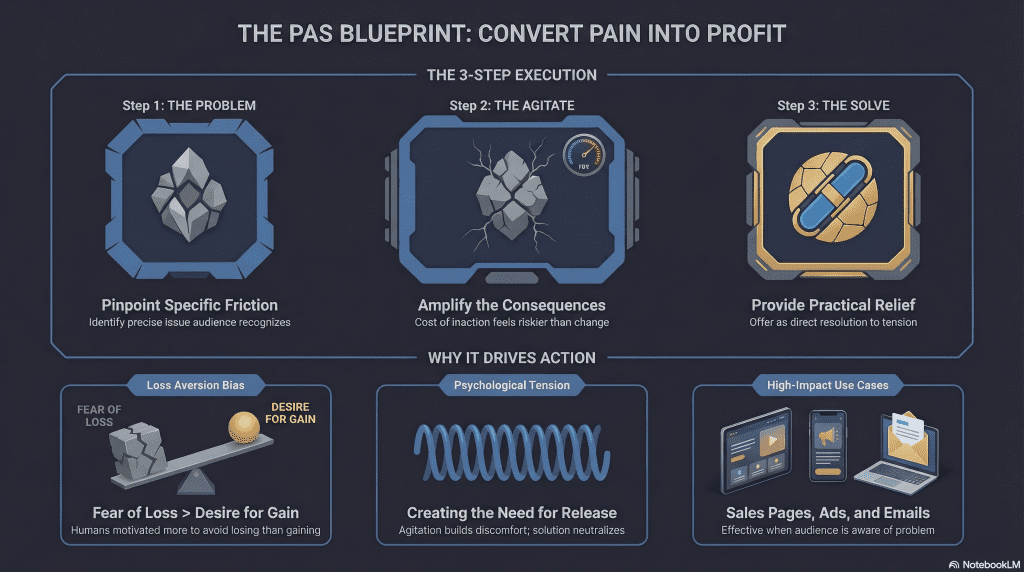
- Problem: Identify a specific issue your audience faces.
- Agitate: Expand on the consequences of that issue. Make the cost of inaction clear.
- Solve: Introduce your product, service, or idea as the relief.
The strength of PAS lies in emotional amplification. While other frameworks introduce benefits quickly, PAS lingers on the problem long enough to increase urgency.
For example:
Problem: Your website gets traffic but generates few leads.
Agitate: Every missed lead represents lost revenue and wasted marketing effort. Over time, that gap compounds.
Solve: Our conversion optimization framework turns passive traffic into qualified inquiries.
Three movements. One clear transition from pain to resolution.
Why PAS Works Psychologically
PAS works because it amplifies motivation before presenting a solution.
People do not act simply because a better option exists. They act when the cost of staying the same feels greater than the cost of change. PAS increases that perceived cost.
1. It Activates Loss Aversion
Humans are more motivated to avoid loss than to pursue gain. The Agitate stage highlights what the reader stands to lose if the problem remains unsolved.
This could be:
- Lost revenue
- Missed opportunities
- Wasted time
- Declining performance
When the consequences become clear, inaction feels risky.
2. It Increases Emotional Tension
The Problem introduces discomfort. The Agitate expands that discomfort.
This builds psychological tension. The reader wants relief. The Solve stage provides that release.
Without agitation, the solution feels optional. With tension, the solution feels necessary.
3. It Clarifies Cause and Effect
PAS connects the reader’s frustration to a specific cause. That clarity reduces confusion.
When readers understand why something is happening and how to fix it, decision-making becomes easier.
4. It Aligns With Decision-Making Under Pressure
Many buying decisions happen when pain reaches a threshold.
PAS accelerates that threshold by helping the reader fully acknowledge the consequences of the problem.
The formula does not create pain. It makes existing pain visible.
How to Use the PAS Framework Step by Step
The effectiveness of PAS depends on precision. Each stage must build momentum toward the next.
Here is how to apply it correctly.
1. Problem: Define the Core Friction
Start by identifying a specific issue your audience already recognizes.
Avoid vague statements.
Weak example: Your marketing is not working.
Stronger example: You’re investing in paid ads, but your cost per acquisition keeps rising while conversions stay flat.
The goal is recognition. The reader should immediately feel understood.
A clear problem creates attention. A precise problem creates relevance.
2. Agitate: Expand the Consequences
Once the problem is defined, deepen it. Show what happens if nothing changes.
Agitation should focus on impact, not drama.
Weak agitation: This is terrible for your business.
Stronger agitation: Every month this continues, you spend more on ads without increasing revenue. Margins shrink. Growth stalls. Your competitors gain ground.
The Agitate stage increases urgency. It makes inaction uncomfortable.
However, avoid exaggeration. If the consequences feel unrealistic, credibility drops.
3. Solve: Introduce the Relief
After tension builds, present your solution as the logical path forward.
The Solve stage should feel like resolution, not pressure.
Weak solve: Buy our software today.
Stronger solve: Our conversion optimization system identifies friction points in your funnel and helps you increase conversions without increasing ad spend.
The solution must directly address the problem described. If it feels disconnected, persuasion weakens.
When executed properly, PAS follows a clear progression:
Recognized problem → Heightened urgency → Practical relief.
The formula is simple. The impact depends on specificity and emotional control.

PAS Examples in Different Contexts
Seeing PAS applied in real scenarios clarifies how flexible the framework is.
Example 1: SaaS Landing Page
Problem: Your team spends hours manually tracking project updates across disconnected tools.
Agitate: Important deadlines slip. Communication breaks down. Productivity suffers. Over time, inefficiencies compound and cost you both time and revenue.
Solve: Our centralized project management platform unifies tasks, timelines, and communication into one streamlined system.
Example 2: Fitness Coaching Email
Problem: You’ve been working out consistently but not seeing noticeable results.
Agitate: Without structured progression, you risk wasting months repeating ineffective routines. Motivation fades when effort does not translate into visible change.
Solve: Our personalized training program builds a progressive plan tailored to your goals and tracks measurable improvement week by week.
Example 3: B2B Consulting Ad
Problem: Your sales pipeline feels unpredictable.
Agitate: When lead flow fluctuates, revenue forecasting becomes guesswork. Hiring decisions stall. Growth plans lose momentum.
Solve: We design and implement a repeatable lead generation system that stabilizes pipeline performance.
Example 4: Newsletter Promotion
Problem: You’re overwhelmed by scattered marketing advice online.
Agitate: Trying random tactics wastes time and creates inconsistent results. Without a clear strategy, progress stalls.
Solve: Subscribe to our weekly strategy newsletter for focused, practical frameworks you can apply immediately.
Across all examples, the structure remains consistent:
Identify friction. Amplify consequences. Present relief.
The format may vary in length, but the psychological progression stays the same.

Common Mistakes When Using The PAS Framework
PAS is powerful because it increases urgency. Used poorly, it can feel manipulative or exaggerated.
Here are the most common mistakes.
Making the Problem Too Broad
If the problem feels generic, readers will not connect with it.
Weak: Your business needs more leads.
Stronger: Your website attracts traffic, but visitors leave without booking calls or requesting demos.
Specificity creates credibility. Broad statements create distance.
Over-Agitating the Problem
The Agitate stage should intensify discomfort, not create artificial drama.
Weak agitation: If you don’t fix this now, your business will collapse.
Stronger agitation: If this continues, your acquisition costs rise while revenue stays flat, squeezing your margins.
When agitation feels unrealistic, trust drops. The goal is clarity, not fear-mongering.
Solving a Different Problem Than You Described
The Solve stage must directly resolve the exact issue introduced earlier.
If your Problem focuses on unpredictable revenue but your solution highlights brand awareness, the connection feels weak.
Consistency across stages is critical.
Introducing the Solution Too Early
Some writers rush to the Solve stage without building tension.
Without enough agitation, the solution feels optional. The reader must first feel the weight of the problem before relief becomes compelling.
Ignoring Audience Awareness
PAS works best when the audience already recognizes the problem.
If readers are unaware or unconvinced that a problem exists, the agitation may feel forced. In those cases, education must come before persuasion.
PAS is effective because it builds pressure before release. Precision and control determine whether it feels persuasive or manipulative.

When to Use The PAS Framework
PAS works best when urgency matters.
Because the framework intensifies discomfort before presenting relief, it is most effective when the audience already feels friction and wants change.
Use PAS in Direct Response Sales Pages
Sales pages benefit from structured tension. When readers are evaluating whether to invest, PAS helps clarify the cost of inaction before introducing the offer.
It works especially well for:
- High-ticket services
- Software solutions
- Performance-based products
Use PAS in Email Promotions
Promotional emails often compete for attention. PAS cuts through noise by immediately addressing a pain point the reader recognizes.
The short structure keeps emails focused:
Problem → Agitate → Solve → Call to Action
Use PAS in Paid Advertising
In ads, space is limited. PAS helps you communicate urgency quickly.
For example:
Problem: Struggling with rising ad costs?
Agitate: Every wasted click reduces your return and limits growth.
Solve: Optimize your campaigns with our proven framework.
Clear tension. Clear relief.
Use PAS When the Audience Is Problem-Aware
PAS performs best when readers already understand they have a problem.
If your audience is unaware or skeptical, you may need educational content before applying PAS. In those cases, frameworks like AIDA may provide more room for explanation.
When PAS May Not Be Ideal
PAS may feel heavy in situations where:
- The product is aspirational rather than problem-driven.
- The audience seeks inspiration instead of relief.
- The messaging needs a lighter tone.
In those cases, frameworks like Before-After-Bridge may feel more optimistic.
PAS is strongest when clarity and urgency matter more than storytelling.
PAS vs BAB: Which Copywriting Framework Should You Use?
Both PAS and Before-After-Bridge focus on transformation, but they approach persuasion differently.
Here is a direct comparison:
| Framework | Core Movement | Emotional Tone | Best For |
|---|---|---|---|
| PAS | Problem → Agitate → Solve | Urgent and tension-driven | Pain-aware audiences |
| BAB | Before → After → Bridge | Contrast-driven and optimistic | Clear transformation messaging |
The Key Difference
PAS increases discomfort before introducing relief. It leans into consequences and urgency.
BAB contrasts current reality with a better future, then connects them. It emphasizes possibility more than pressure.
In simple terms:
- PAS motivates through tension.
- BAB motivates through contrast.
When PAS Is Stronger
Use PAS when:
- The audience already feels pain.
- The stakes are high.
- Urgency drives action.
It works well in direct response copy where immediate movement is the goal.
When BAB Is Stronger
Use BAB when:
- The transformation is clear and desirable.
- You want a lighter persuasive tone.
- The message needs clarity more than pressure.
BAB often feels more aspirational. PAS often feels more urgent.
Many copywriters use both depending on context. The right framework depends on audience awareness and emotional positioning.

Conclusion
The PAS copywriting framework works because it follows a natural psychological progression.
It identifies a real problem. It intensifies the consequences of that problem. Then it introduces a solution as relief.
When used correctly, PAS creates urgency without manipulation. It clarifies what is at stake and makes the path forward obvious. The framework forces precision. You must define the exact friction your audience experiences and connect your solution directly to that tension.
PAS is not about drama. It is about controlled pressure.
Use it when your audience already feels discomfort and needs a clear resolution. Apply it with specificity. Keep the agitation realistic. Align the solution directly with the problem introduced.
The structure is simple. The execution determines its power.

Frequently Asked Questions
What does PAS stand for in copywriting?
PAS stands for Problem-Agitate-Solve. It is a three-step persuasion formula that identifies a problem, intensifies its consequences, and then presents a solution as relief.
Is PAS better than AIDA?
PAS is not universally better. It is more focused on urgency and pain. AIDA provides a broader persuasion journey from attention to action. PAS works best when the audience is already aware of the problem and needs motivation to act.
How long should a PAS section be?
PAS can be as short as three sentences or expanded into multiple paragraphs. The length depends on the complexity of the problem and the sophistication of the audience. The key is maintaining clear progression from tension to resolution.
Can PAS feel manipulative?
It can if the agitation stage exaggerates consequences or uses fear tactics. Effective PAS relies on realistic consequences and accurate problem diagnosis. When grounded in truth, it clarifies urgency rather than manufacturing it.
Where is PAS most effective?
PAS performs well in:
- Sales pages
- Landing pages
- Email promotions
- Paid ads
- Product launch messaging
It is strongest when the reader already feels discomfort and seeks a solution.
Can PAS and BAB be used together?
Yes. You can combine frameworks depending on context. For example, a sales page might open with PAS to establish urgency and later use a BAB section to clarify transformation.

0 Comments