Most people waste months creating digital products. You can launch in days.
PLR digital products hand you the content eBooks, courses, templates, emails and give you the rights to edit, brand, and sell it as your own. No writing, design or blank page syndrome.
Smart entrepreneurs don’t reinvent the wheel. They use PLR to skip the drafting phase and go straight to the selling phase.
But here’s the catch: PLR digital products only work if you use them strategically. If you want results real sales, real growth you need the right content, the right sources, and a method that turns generic files into branded profit engines.
This guide shows you exactly how to do it.
Key Takeaways
- PLR digital products allow entrepreneurs to rebrand, modify, and resell content without creating it from scratch.
- They are ideal for passive income, content marketing, and business scaling with minimal upfront investment.
- Types of PLR products include eBooks, courses, templates, graphics, and software across various industries.
- The quality of PLR content varies, so choosing reputable sources and adding personalization is crucial for success.
- Effective PLR monetization strategies include bundling, upselling, private membership access, and resell rights expansion.
Disclaimer: I am an independent Affiliate. The opinions expressed here are my own and are not official statements. If you follow a link and make a purchase, I may earn a commission.
What Are PLR Digital Products (and Why They’re So Profitable)
PLR short for Private Label Rights are ready-made digital assets that you can legally rebrand, customize, and sell as your own.
Unlike standard digital products where the creator retains all rights, PLR digital products give you the license to edit the content, change the branding, and even repurpose it into entirely new offers. You’re not just distributing someone else’s product you’re turning it into your own.
PLR content exists across nearly every niche, including:
- eBooks and reports
- Online courses and video training
- Email sequences and swipe files
- Templates, checklists, and workbooks
- Graphics, slide decks, and digital planners
Why PLR Is a Fast Track to Passive Income
Instead of spending weeks creating content from scratch, PLR gives you a shortcut. You can launch digital products, build email lists, and test new offers in days not months.
This makes it especially valuable for:
- New entrepreneurs launching digital offers quickly
- Coaches and consultants who need lead magnets or bonuses
- Marketers who want to test new niches without creating everything from scratch
When used strategically, PLR allows you to focus on marketing and monetization not content creation making it one of the most efficient ways to build scalable digital income streams.
⚠️ Note: Always review the specific license terms for each PLR product. Usage rights vary by vendor, and this guide is for educational purposes only.
How to Customize A PLR Digital Product the Right Way
One of the fastest ways to fail with PLR is to use it as-is. That approach almost always leads to generic products, weak engagement, and lost trust.
The real value of PLR is not the content itself. It is the head start it gives you. What determines success is how well you reshape that starting point into something that fits your brand, your audience, and your offer.
Think of PLR as raw material. The customization is what turns it into a sellable asset.
A Practical PLR Customization Checklist
Before you publish or sell any PLR product, walk through these steps. You do not need to do everything perfectly. You do need to do the essentials.
| Step | What to Change | Why It Matters |
|---|---|---|
| Rewrite the Title | Adjust the promise, language, and angle to match your niche | Prevents duplication and improves perceived relevance |
| Replace the Introduction | Add your audience’s pain points, context, or authority | Builds trust and signals ownership immediately |
| Update Examples | Use your own scenarios, case studies, or modern references | Makes the content believable and specific |
| Adjust Structure | Reorder sections, remove filler, add summaries or frameworks | Changes the feel from “template” to “original” |
| Redesign the Layout | Apply your fonts, colors, and formatting | Increases perceived value before anyone reads |
| Add CTAs and Commentary | Insert guidance, next steps, or offers | Turns content into a conversion asset |
Why This Step Is Non-Negotiable
PLR that is lightly edited still feels borrowed. Readers may not know where it came from, but they can sense when content lacks perspective.
Customization solves that problem. It allows you to:
- Sound like a real authority instead of a content curator.
- Align the product with a specific outcome.
- Position the asset as part of a system, not a standalone file.
Even small changes matter. Rewriting the opening and closing sections alone can dramatically change how the product is perceived.
The Goal of Customization
You are not trying to hide that the content was PLR. You are trying to own it.
When the structure reflects how you think, the language matches how you speak, and the examples fit your audience, the origin no longer matters. What matters is usefulness, clarity, and relevance.
That is the difference between PLR that sits in a folder and PLR that becomes a real business asset.
Niche specific customization in action
One of the biggest advantages of PLR is flexibility. The same base content can serve completely different audiences depending on how you frame it.
A generic PLR guide might feel broad or forgettable on its own. But with focused customization, that same file can become a highly targeted offer that feels purpose-built.
Here’s how that plays out in practice.
Example: One PLR Guide, Two Very Different Products
Imagine a standard PLR guide about goal setting. The structure is solid, but the content is general.
On its own, it blends in.
Now watch what happens when the positioning changes.
For a life coach, the guide becomes a personal transformation tool. The language shifts toward mindset, clarity, and self-awareness. You add reflection prompts, journaling exercises, and stories about personal breakthroughs. The outcome is framed as emotional progress and personal alignment.
That same guide is now positioned as a 90-day personal reset plan.
For a business consultant, the focus changes completely. The examples revolve around revenue targets, execution timelines, and accountability. You introduce planning frameworks, KPI tracking, and quarterly reviews. The outcome is framed as measurable growth and operational clarity.
The guide becomes a quarterly growth planning system.
What Actually Changed
The core structure stayed the same. The transformation came from:
- Language tailored to the audience.
- Examples that matched real-world situations.
- Outcomes framed around what each audience values.
- Supporting tools added to reinforce credibility.
This is the real power of PLR. You are not limited to one product per file. You are limited only by how clearly you understand your audience.
When you customize PLR with intent, it stops feeling recycled and starts feeling relevant. That relevance is what drives engagement, trust, and sales.
How to Profit from PLR Digital Products (Proven Monetization Models)
Getting your hands on PLR is easy. Turning it into real income? That’s where strategy comes in. Most people stop at the download, slap a new cover on an eBook, and wonder why it doesn’t sell. The ones who succeed treat PLR as the engine behind their entire business, not just another file on their hard drive.
Here’s how to turn PLR into scalable revenue streams that compound over time.
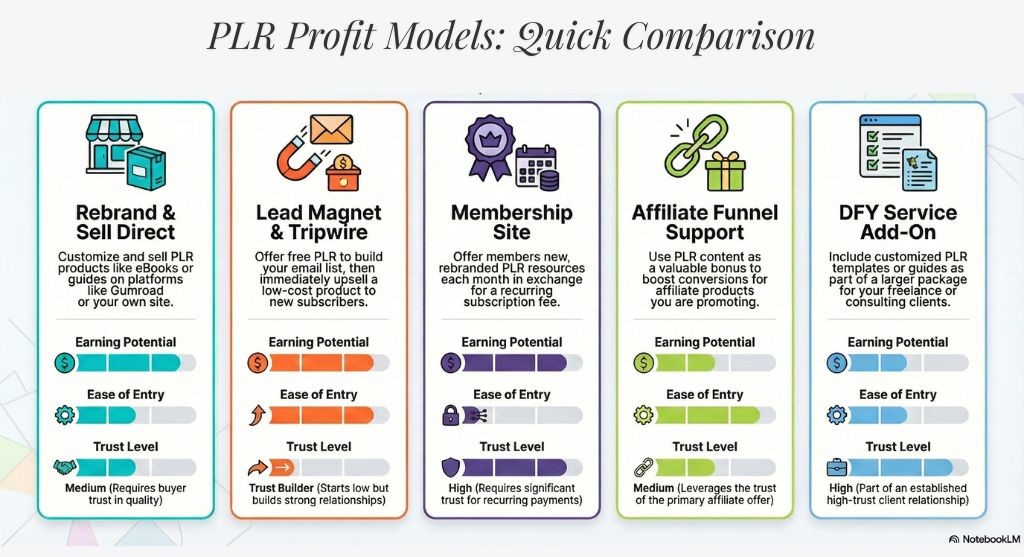
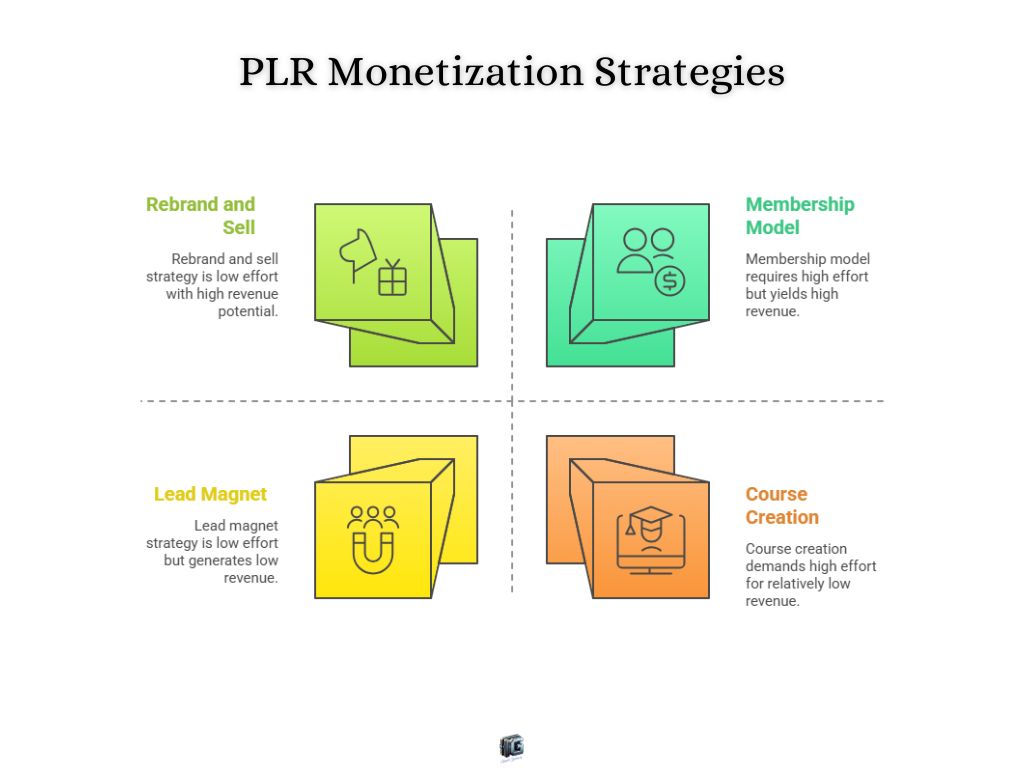
1. Rebrand and Sell as Your Own
Take a PLR eBook or guide, customize the title, refresh the design, and reframe the content around your niche. Then sell it through platforms like Gumroad, Payhip, or your own site.
To increase perceived value, bundle complementary assets for example, an eBook, checklist, and short video walkthrough. This simple shift turns a $20 PLR file into a $97 mini-course that feels completely original.
Pro tip: Always pair your offer with a strong benefit-focused title and clear promise. People buy outcomes, not file formats.
2. Build Your Email List with Lead Magnets
PLR makes it easy to create irresistible free offers. Rebrand a short guide, worksheet, or checklist and offer it in exchange for an email address.
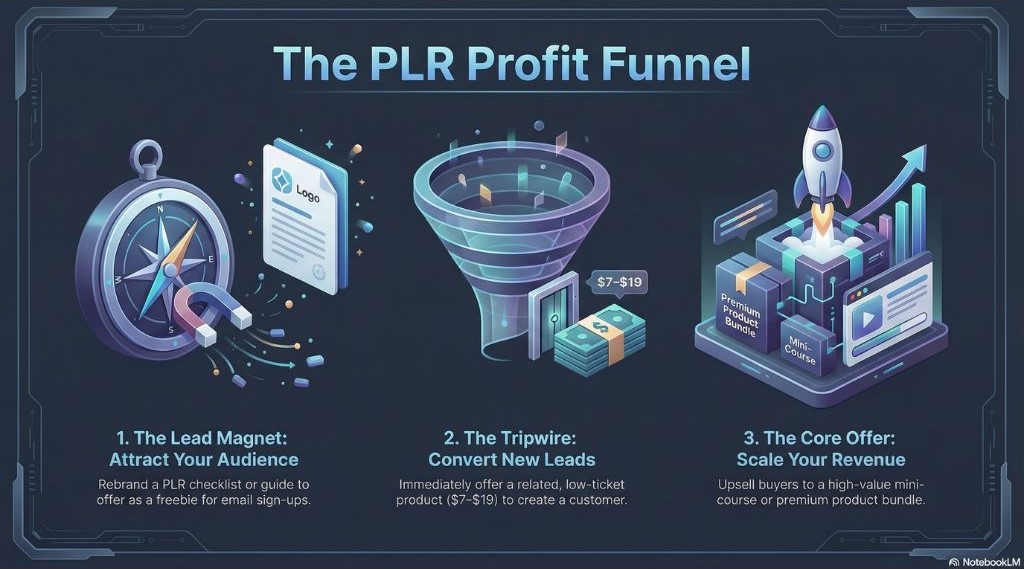
Once someone opts in, introduce a low-ticket offer (a $7–$19 tripwire) to cover ad costs or build instant buyer intent.
Pro tip: Use this formula PLR guide → email opt-in → tripwire → nurture sequence → affiliate offer. It builds authority and cash flow at the same time.
3. Turn PLR into Courses or Workshops
Many PLR packages include outlines, slides, or scripts that you can easily adapt into short video lessons. Record your voice or screen, add branded visuals, and host the material on Teachable, Podia, or Systeme.io.
Position these as “express trainings” or “quick-start courses.” Offer them as low-ticket paid content or bundle them inside a premium coaching program.
Pro tip: Keep each lesson under ten minutes and focus on one transformation per video. Short, actionable content drives completions and referrals.
4. Launch a Membership with Monthly PLR Drops
If you want predictable income, consider turning PLR into a subscription model. Offer members new rebranded resources each month guides, templates, or swipe files.
What your members really pay for is not just content, but curation. Add short intros, frameworks, or Q&A sessions, and you’ll create value that generic PLR sites never can.
Pro tip: Use your first month’s material as a lead magnet to preview what subscribers can expect. This builds momentum before launch.
5. Repurpose for Content Marketing
A single PLR eBook can fuel your content calendar for weeks. Break it into blog posts, email sequences, social media captions, or YouTube scripts.
Editing for tone and modern relevance takes minutes and keeps your content pipeline full without starting from scratch.
Pro tip: Link each piece of repurposed content back to your product or affiliate funnel. Every post should point to an action.
Example: turning one PLR asset into a full funnel
Here is how a single PLR guide can power an entire funnel instead of sitting in a folder.
Free guide: Rebrand the PLR into a focused lead magnet that solves one painful problem.
Opt in page: Write a simple landing page that promises one clear outcome, not a vague bundle of information.
Tripwire: Turn a deeper section of the PLR into a short mini course, checklist pack, or toolkit and sell it for a low price.
Core offer: Position your main product, service, or flagship course as the natural next step.
Upsell or premium bundle: Combine more transformed PLR (workshops, swipe files, templates) into a higher ticket bundle.
You can also layer affiliate offers into this flow. Each email that follows the free guide can teach one lesson, link back to your tripwire, and introduce a relevant tool as an affiliate recommendation. Every piece of content pushes the subscriber toward one of three actions: join, buy, or click.
Why This Works
PLR isn’t a one-size-fits-all product. It’s a flexible framework that adapts to your goals. If you’re just starting, focus on quick wins like lead magnets or tripwires. If you already have an audience, leverage memberships or premium bundles to scale.
The secret is alignment: match the effort you can give with the growth you want. That’s how PLR shifts from another download to a predictable revenue engine.
How to Turn PLR Into High-Value Offers
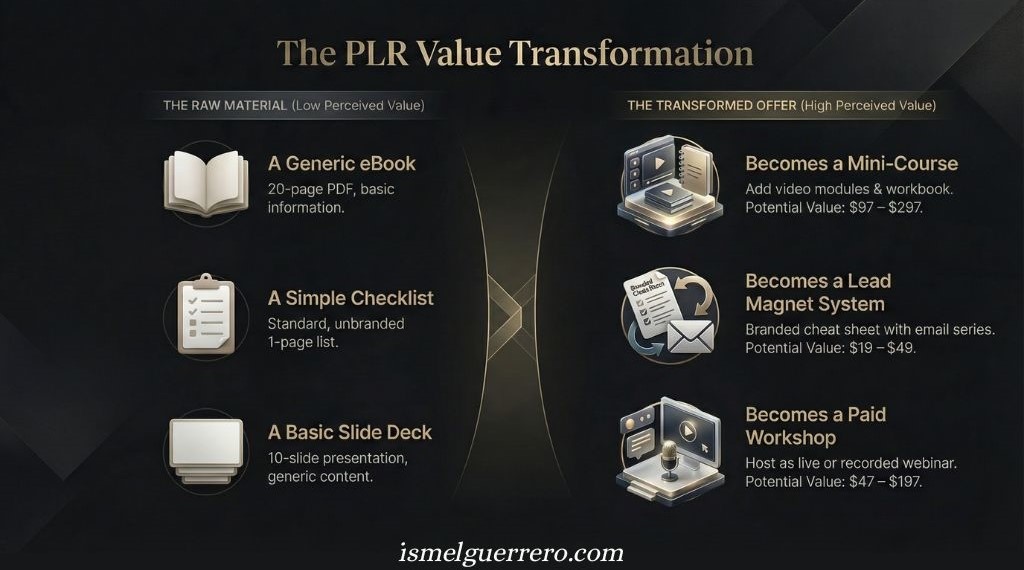
Downloading PLR is only step one. The real magic is in how you transform it. A plain PDF or checklist won’t impress anyone but when you reshape and repackage it, suddenly that same file can become a course, a workshop, or a premium bundle.
This is where most creators miss the point: PLR isn’t about shortcuts, it’s about leverage. You’re not just selling information, you’re creating experiences and outcomes that people actually pay for.
🚀 PLR Digital Product Transformation
| PLR Format | Raw Version | Transformed Offer | Potential Value |
|---|---|---|---|
| Generic | “Time Management” PDF | “The 5-Day Productivity Sprint” Video Workshop | $97 – $297 |
| Checklist | 1-page list | Branded cheat sheet + email follow-up series | $19 – $49 (as tripwire) |
| Slide Deck | 10-slide presentation | Webinar or paid workshop | $47 – $197 |
| Email Sequence | 7 follow-up emails | Complete branded funnel with lead magnet + tripwire | $97 – $297 |
| Templates | Generic Canva or social files | Premium bundle + swipe copy & tutorial | $47 – $147 |
Why This Works
Most people stop at the “download.” That’s why their PLR sits unused. The entrepreneurs who win are the ones who see the bigger play:
- A basic eBook becomes a mini-course that justifies $200+.
- A simple checklist becomes a lead magnet that builds a list of buyers.
- A generic template becomes a premium toolkit when bundled with guidance.
When you transform PLR, you multiply its value and that’s how you turn a $20 file into a $200 asset (or more).
Where to Find High-Quality PLR Digital Products
High-quality PLR is not evenly distributed across the internet. Most of it is concentrated in a small number of established platforms that actively manage their libraries, clarify licensing terms, and update content over time.
These platforms consistently appear in professional PLR sourcing because they meet three baseline standards: usable content quality, maintained libraries, and transparent rights.
PLR.me
PLR.me is known for premium, professionally written content aimed at coaches, consultants, and wellness-focused businesses. Its library emphasizes depth, tone, and presentation, making it one of the more polished PLR sources available.
The platform focuses on personal development topics and avoids generic, mass-market material. Content is typically delivered as eBooks, worksheets, slide decks, and exercises designed for client-facing use.
This makes PLR.me a common sourcing choice for creators who prioritize quality and credibility over volume.
IDPLR
IDPLR is one of the largest general PLR libraries, with thousands of products covering a wide range of niches. Because of its size, content quality is inconsistent, but the platform remains a common sourcing point due to breadth and accessibility.
Its value lies in scale rather than curation. Newer content tends to be more usable, while older material often reflects outdated formatting or approaches.
IDPLR is frequently used when breadth and niche exploration matter more than premium polish.
BuyQualityPLR
BuyQualityPLR positions itself around cleaner formatting and niche-specific packages, particularly in business, marketing, and finance categories.
Unlike large membership libraries, products are sold individually or in focused bundles. This structure makes it easier to evaluate quality on a per-product basis rather than navigating large archives.
The platform is often referenced as a middle ground between premium PLR and high-volume libraries.
BigProductStore
BigProductStore operates as a high-volume PLR membership with frequent updates. Its catalog includes written content, full courses, videos, graphics, templates, and software-related assets.
Because of the platform’s scale, quality varies across product types, but the diversity of formats is a defining feature. It is commonly cited as a sourcing option when variety and asset volume are priorities.
The platform is structured to support ongoing access rather than single purchases.
Resell Rights Weekly
Resell Rights Weekly combines traditional PLR with Master Resale Rights products. This means some content includes licenses that allow downstream resale by buyers.
The platform curates rotating access to products and maintains an archive for paid members. In addition to content, it includes basic educational material around resale rights models.
It is frequently referenced where resale licensing flexibility is part of the sourcing criteria.
Bottom Line:
These platforms represent the most commonly cited and consistently used sources for legitimate PLR digital products. While quality varies by provider and product, sourcing from established libraries reduces risk and provides a clearer starting point than open marketplaces or unknown vendors.
From here, the real differentiator becomes selection and adaptation, not access.

How to Choose and Use PLR Digital Products Wisely
PLR can be a powerful shortcut or a credibility killer. The difference lies in how you source it and how strategically you use it. Treat PLR like a foundation, not a finished product. You’re building on raw material, not publishing it as-is.
Here’s how to get it right:
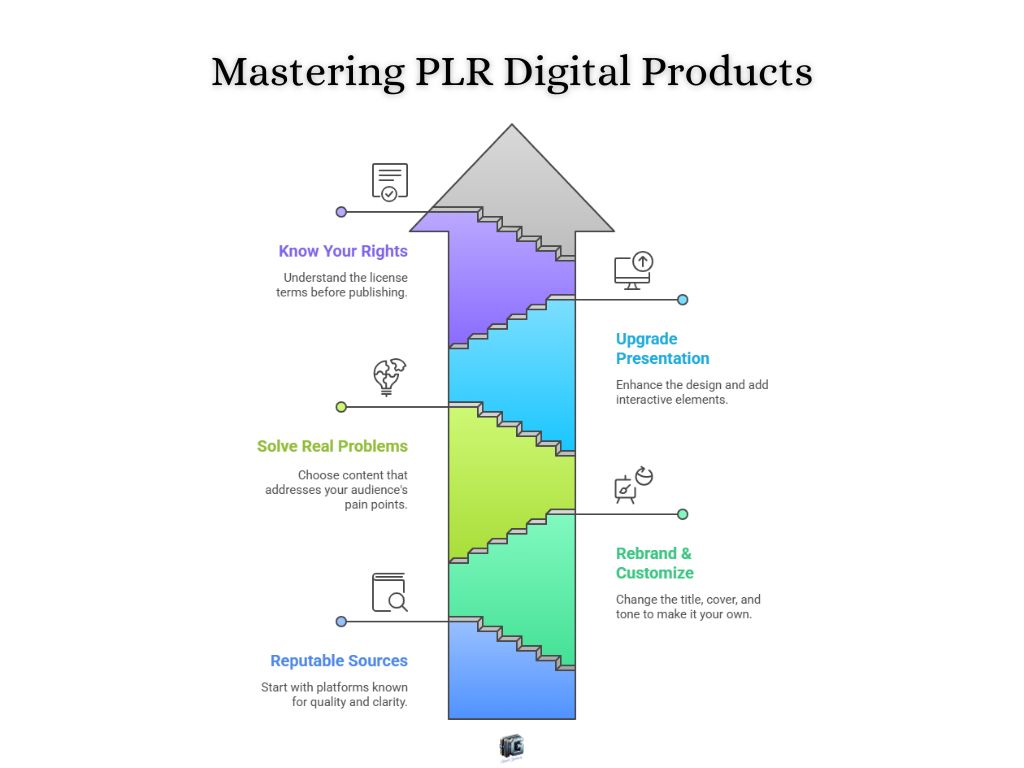
1. Start with Reputable Sources
Not all PLR is worth your time. Many free libraries are filled with recycled, outdated, or poorly written material. That’s why serious creators only buy from platforms with professional formatting, updated topics, and clear license terms.
Ask before downloading:
- Is this content still relevant and accurate?
- Is the writing and design professional?
- Are license rights clearly stated?
If the answer to any of those is no, skip it. The quality of your PLR determines the quality of your reputation.
2. Match Content to Real Market Problems
Even well-written PLR won’t perform if it doesn’t fit your audience. Don’t pick products just because they sound trendy pick them because they solve a specific, relevant pain point.
Before buying or editing, ask:
- Does this solve a real problem my audience faces right now?
- Can it lead naturally into one of my existing products or affiliate offers?
- Does it align with my overall brand and voice?
When the answer is yes, PLR becomes a growth asset not just filler content.
3. Upgrade the Presentation
Your audience will judge the product by how it looks long before they read it. Even if the core content is great, poor visuals make it feel low-value.
Use tools like Canva, Visme, or Notion templates to refresh the design. Update covers, choose modern typography, and use consistent branding.
A simple design upgrade can 3x perceived value turning a $20 file into a $200 digital asset.
You do not need agency level design to pull this off. Use one consistent font pair, one primary brand color, and one accent color. Add simple icons or section dividers to break up text.
Turn walls of text into checklists, frameworks, or step by step visuals. Clean layout and consistent styling make your offer feel premium before anyone reads the first line.
4. Understand License Rights Before You Publish
Each PLR vendor sets unique terms. Some allow full resale and customization; others restrict redistribution or resale rights entirely. Violating those terms can lead to platform bans or legal issues.
Always confirm:
- Can I edit and rebrand this content?
- Can I sell or distribute it publicly?
- Can I grant resale rights to others?
- Are there platform restrictions (e.g., Amazon KDP, Udemy)?
Think of the license as your permission slip and read it like a contract.
Common license mistakes (and what they look like)
Most problems show up when people assume instead of checking. Here are a few examples.
- Uploading an ebook to Amazon KDP when the license clearly says “no public marketplaces.”
- Giving your buyers resale rights on a product that only allows personal use.
- Using PLR video content on a course platform that the license forbids.
- Selling the source files from a bundle that only permits you to sell the finished product.
None of these feel malicious in the moment, but platforms and creators treat them as violations. Reading the license for five minutes is cheaper than losing an account you spent years building.
5. Plan Where It Fits in Your Funnel
Every PLR asset should have a purpose. Is it a lead magnet, a paid product, or a course add-on? Decide that before customizing or launching.
Example funnel structure:
- Free PLR guide → builds your email list
- Low-ticket mini-course → converts leads into buyers
- Premium bundle → scales revenue through upsells
When every asset fits into a system, you stop “using PLR” and start building a business around it.
Bottom Line
PLR isn’t about cutting corners, it’s about accelerating progress. Start with trusted sources, choose products that solve real problems, elevate presentation, and respect the license. When you use PLR with intention, every download becomes an opportunity for leverage, not a liability.
PLR vs DFY Digital Products: What’s the Key Difference?
While PLR (Private Label Rights) and DFY (Done-For-You) digital products are often mentioned in the same breath, they aren’t the same thing and confusing them can lead to some serious missteps, especially when it comes to licensing and resale rights.
PLR digital products give you editable rights. You can modify the content, rebrand it, combine it with other assets, and sell it under your name all depending on the license. You’re essentially handed the source material and creative freedom.
DFY digital products, on the other hand, are ready-to-use but not always re-brandable. They’re often designed to be used as-is like funnel templates, client deliverables, or course bundles. Many DFY tools come with usage rights (to use, install, or deploy), but not the ability to edit, repackage, or resell them unless explicitly stated.
Bottom line: PLR gives you ownership-like flexibility. DFY gives you speed and convenience but often with more restrictions.
When choosing between the two, the right option depends on your business model. If you want to build authority and sell products under your own brand, PLR is the move. If you just want to implement quickly without creating from scratch, DFY might be the shortcut you need.
PLR vs DFY: Which One Fits Your Business Strategy?
| Feature | PLR (Private Label Rights) | DFY (Done-For-You) |
|---|---|---|
| Editable | Yes — full customization allowed | Usually no — use as-is |
| Rebrandable | Yes — sell under your name and brand | Sometimes — depends on license terms |
| Resellable | Often — depending on license | Rarely — typically for personal use only |
| Speed to Launch | Medium — requires some customization | Fast — plug-and-play ready |
| Creative Control | Full — rewrite, repackage, repurpose | Limited — content is fixed |
| Scalability Potential | High — ideal for products, funnels, memberships | Moderate — better suited for fulfillment and speed |
| Best For | Entrepreneurs, coaches, course creators, marketers | Freelancers, service providers, busy implementers |
| Example Use Case | Turn a PLR ebook into a branded digital course | Use a DFY email funnel in a client project |
How to use PLR and DFY together
You do not have to choose between PLR and DFY. The smartest moves combine both.
A few simple plays:
- Use a DFY funnel as the skeleton, then plug in rewritten PLR content for the lead magnet, email sequence, and bonus materials.
- Use PLR training as the base for a workshop, then deliver it through a DFY slide deck or webinar template.
- Use DFY service deliverables for client work, and PLR checklists or guides as bonuses that increase perceived value.
PLR gives you depth. DFY gives you speed. Together they help you launch fast without looking like everyone else.
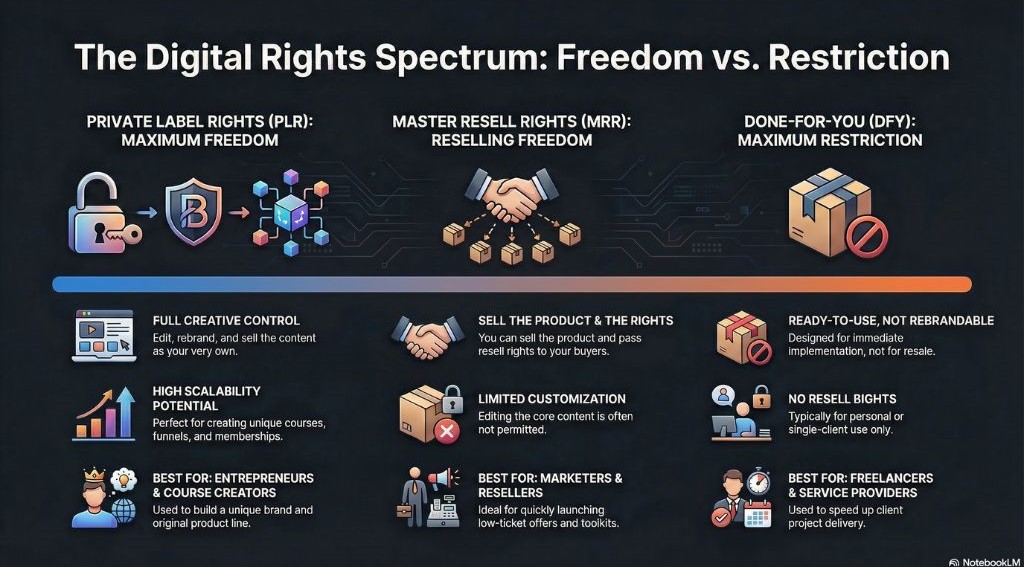
How MRR and resell rights fit into your product strategy
PLR is the most flexible because you can rewrite, repackage, and brand it as your own. MRR and basic resell rights sit next to it on the spectrum. They give you different levers to pull when you want speed, low ticket offers, or simple resale plays.
Here is the practical difference.
- With resell rights, you can sell the product, keep the profit, and usually leave the content as is. You are a retailer, not the creator.
- With master resell rights, you can sell the product and give your buyers the right to resell it too. That turns each sale into a mini business opportunity for them.
- With PLR, you step into the creator role. You change the content, rebrand it, and build your own ecosystem around it.
Used well, MRR and resell rights are powerful for:
- Fast low ticket offers that sit at the front of your funnel.
- Bonus stacks for higher ticket products or affiliate promotions.
- “Starter kit” style products that help your buyers launch quickly.
One smart move is to combine them. Use PLR to create your main branded asset. Then add MRR products as bonuses, toolkits, or resources your customers can resell on their own. You stay the authority while still giving them something they can flip for cash.

My Hard Lesson With PLR Digital Products
When I first discovered PLR products, I thought I had struck gold. Everything was already packaged and written, ready for me to use. I even grabbed the email swipes that came with affiliate programs and sent them out exactly as they were.
And when you’re talking about emails, that duplication doesn’t just make you blend into the noise, it can actually get you flagged as spam and destroy your deliverability. That was the hard lesson for me.
PLR can be a powerful tool, but only if you reshape it, inject your own perspective, and make it uniquely yours. Otherwise, you’re just publishing the same thing everyone else already threw into the world.
At first, it felt like I was saving time but what I didn’t realize was how dangerous that shortcut really was. PLR content used “as is” comes with a hidden cost: duplication. The same words get recycled by hundreds, sometimes thousands of people.
Ismel Guerrero.
Common Mistakes to Avoid With PLR Digital Products
PLR Digital Products are powerful but only if you avoid the traps that sabotage most beginners. Use it wrong, and you’ll look like just another copy-paste marketer. Use it right, and you’ll build authority, grow your income, and save a ton of time in the process.
Here’s what to steer clear of:
1. Publishing Without Customization
This is the fastest way to lose trust. If your audience sees the same eBook title and content floating around online, they’ll tune out or worse, stop trusting your brand.
Fix it: Always rewrite, reformat, and reframe. Make the content unmistakably yours before hitting publish.
2. Choosing Low-Quality PLR
Free doesn’t always mean valuable. Poorly written, outdated, or overly generic PLR makes your brand look cheap.
Fix it: Vet your sources. Only use content you’d be proud to charge for even if it’s free.
3. Ignoring the License Terms
Some licenses let you edit and resell. Others forbid it. Publishing on the wrong platform, or offering resale rights when you’re not allowed, can lead to bans or legal trouble.
Fix it: Read every license. If it’s vague, reach out to the seller before using the product commercially.
4. Using PLR Without a Strategy
Downloading a dozen eBooks won’t grow your business. PLR works when it’s part of a bigger plan like lead generation, course creation, or funnel stacking.
Fix it: Know where each piece fits. Is it a tripwire? A content upgrade? A bonus? Design around the outcome, not the asset.
5. Forgetting Your Brand Voice
Even great content will fall flat if it doesn’t sound like you. Readers want personality. Authority. Connection. PLR is just the scaffolding your voice builds the trust.
Fix it: Infuse your tone, stories, examples, and visuals into every piece. Make it sound like it came from your brain not a dusty PLR archive.
Avoid these mistakes, and PLR becomes a tool not a trap. It’s not about doing less work. It’s about doing the right work faster, with fewer barriers to entry.
Final Thoughts: The Smart Way to Build with PLR Digital Products
PLR digital products aren’t about cutting corners, they’re about building faster with purpose. They let you skip the blank-page struggle and focus on what really drives income: strategy, branding, and positioning.
But leverage only works if you use it wisely. Choose high-quality content, customize it to sound like you, and package it in a way that truly serves your audience. The magic isn’t in the download, it’s in the transformation you bring to it.
When you treat PLR as a system, not a shortcut, you turn every file into fuel for your business: one product becomes a funnel, one idea becomes a membership, one sale becomes recurring income.
Start small. Pick one asset. Personalize it, launch it, learn from it, and improve. Momentum is your real advantage PLR just makes it faster.
Next move: Explore our MRR vs PLR: Digital Products Guide to learn how to expand your resale rights and unlock even more monetization options.

Frequently Asked Questions About PLR Digital Products
What are PLR digital products?
PLR (Private Label Rights) digital products are pre-made assets like eBooks, courses, or templates that you can legally edit, brand, and sell as your own. They’re designed to save time and eliminate the need to create content from scratch.
Can I legally sell PLR products?
Yes, but only if the license allows it. Most PLR content comes with clear usage terms. Some allow full resale and customization. Others restrict certain actions, like offering resale rights or publishing on marketplaces like Amazon.
How do I make PLR content unique?
Rewrite the introduction, change the tone, update examples, and add personal insights. Swap out graphics, reformat the layout, and align everything with your brand’s voice. The more original it feels, the more valuable it becomes.
Where can I sell PLR products?
Popular platforms include Gumroad, Payhip, Shopify, and your own website. You can also use PLR in courses, membership sites, or as lead magnets not just standalone products.
What types of PLR are best for beginners?
Start with ebooks, checklists, templates, and mini-courses. These are easy to customize, low-cost to launch, and work well for building email lists, selling info products, or stacking value into offers.
Can PLR really help build an email list?
Absolutely. A rebranded PLR guide or checklist makes a fast, effective lead magnet. Pair it with a landing page, drive traffic, and start collecting subscribers within a day.
What’s the difference between PLR, MRR, and Resell Rights?
- PLR: Full rights to edit, brand, and resell.
- MRR (Master Resell Rights): You can sell the product, but not always edit or pass on resell rights.
- RR (Resell Rights): You can sell it, but usually can’t edit or give resell rights to your buyers.
Is PLR still profitable in 2026?
Yes, especially if you treat it like a framework, not a final product. Customize it, position it for the right niche, and integrate it into a smart funnel. Done right, PLR is still one of the fastest, lowest-risk ways to create and sell digital products online.

4 Comments
MRR vs PLR: What You Need to Know in 2025 - Ismel Guerrero. · March 20, 2025 at 1:55 pm
[…] Next, read our PLR Digital Products Guide. […]
Top PLR Websites: Free Digital Products to Resell - Ismel Guerrero. · March 30, 2025 at 1:46 pm
[…] Once you see how easy it is to build momentum with PLR, you’ll never go back to starting from scratch again. To learn more check out our PLR Digital Products Guide. […]
Digital Product Ideas: Best Niches & Trending Products for 2025 - Ismel Guerrero. · April 19, 2025 at 2:46 pm
[…] To learn more about PLR Digital Products check out our full guide here. […]
DFY Digital Products: Your Shortcut to Online Income in 2025 - Ismel Guerrero. · April 24, 2025 at 9:32 pm
[…] For a deeper breakdown of PLR digital products and how to monetize them, check out our full PLR Digital Products Guide. […]