Finding a new story idea often feels impossible, especially when every draft starts to sound the same. Fresh prompts can break that cycle by giving you a clear starting point and a small spark to build from. These ideas help you explore new characters, unfamiliar settings, and emotions you might not reach on your own.
Writers use prompts for many reasons. Some want to warm up before a big project. Others want to experiment with a genre they have never tried. You might simply want a way to write without the pressure of perfection.
This guide gives you a curated collection of prompts along with simple instructions for turning each one into a story. You will walk away with ideas you can use today and a method you can return to whenever your imagination needs a steady push.
Key Takeaways
Creative Writing Prompts
- Creative prompts help you move past stalled ideas by giving you a clear moment to explore.
- A prompt works best when you treat it as a seed rather than a full story.
- Writing short scenes from prompts builds confidence and reduces pressure.
- Conflict, stakes, and character desire help a prompt grow into a stronger draft.
- Regular use of prompts can form a simple, sustainable writing habit.
- Different prompt types support different goals, from character development to worldbuilding.
- Extra frameworks offer deeper guidance when you want more structure than a basic prompt provides.
Disclaimer: I am an independent Affiliate. The opinions expressed here are my own and are not official statements. If you follow a link and make a purchase, I may earn a commission.
How to use these creative writing prompts
Writers often treat prompts as tiny stories, but the real value is in how they open a door. A prompt does not need to match your genre or current project. It only needs to spark a moment of curiosity. Once that happens, you can shape the idea into something that feels like yours.
Start by choosing one prompt that creates a quick reaction. Curiosity is a reliable guide. Let the prompt suggest a character, a setting, or a conflict, then write a short scene without trying to plan the entire story. Momentum matters more than structure at this stage.
Beginners may benefit from writing for ten minutes and stopping before they run out of ideas. This builds confidence and prevents overthinking. Experienced writers can use prompts to practice dialogue, raise emotional stakes, or explore a character’s hidden fears.
Prompts work best when they feel like seeds. Take what interests you, adjust what feels off, and let the idea grow at its own pace. The goal is not to follow the prompt perfectly. The goal is to discover a story you would not have reached on your own.

50 creative writing prompts
Character driven prompts
- A character hides a decision that could change their closest relationship.
- A stranger knows the protagonist’s secret before they speak.
- A character discovers a talent they never wanted.
- A quiet person reaches a breaking point during a routine day.
- A character receives a letter written by their future self.
- Someone returns home and finds their room exactly as they left it.
- A character learns the truth behind a family myth.
- A seemingly ordinary habit reveals a dangerous flaw.
Setting based prompts
- A town celebrates a festival that no one remembers creating.
- A deserted train station begins running again after years of silence.
- A city wakes to find every clock frozen at the same moment.
- A storm reveals something buried beneath a neighborhood street.
- A locked garden appears overnight behind an apartment building.
- A remote island shifts location each morning.
- A traveler arrives in a place where maps never match reality.
- A quiet street changes its layout every sunset.
Relationship and emotion prompts
- Two people share a goodbye that neither of them wants.
- A character forgets a memory that someone else refuses to let go.
- A reunion reveals a truth that reshapes an old bond.
- Someone receives a message that was never meant for them.
- A character realizes they misjudged the person they trusted most.
- A friendship ends after a single sentence.
- A character apologizes for the wrong thing.
- Two people work together while avoiding the conflict between them.
Mystery and suspense prompts
- A knock on the door arrives at the same time every night.
- A character finds a clue hidden inside a library book.
- A missing object returns to its place without explanation.
- Someone receives a photograph of themselves in a place they have never been.
- A character discovers footprints that stop suddenly.
- A neighbor behaves differently after a brief disappearance.
- A coded message appears in a public space.
- A character uncovers a lie that everyone else believes.
Fantasy and supernatural prompts
- A ghost asks the protagonist for help with an unfinished task.
- Magic works only when someone speaks a painful truth aloud.
- A prophecy shifts each time it is interpreted.
- A creature protects a small town without anyone noticing.
- A character bargains with a force that listens poorly.
- A doorway appears in a place that should not hold one.
- A mythical being hides among ordinary people.
- A wish comes true in a way that complicates everything.
Sci fi and future prompts
- A character wakes in a world where their choices are predicted in advance.
- A message arrives from a future that no longer exists.
- A city relies on a technology that begins to fail quietly.
- A traveler witnesses the moment a timeline shifts.
- A character meets someone who remembers an alternate version of them.
- A discovery on another planet mirrors a mystery on Earth.
First line or last line prompts
- First line: “The day started like any other until the sky changed color.”
- First line: “I was not supposed to hear what they said next.”
- Last line: “Only then did I understand what the promise truly meant.”
- First and last line match: “I should have turned back when the lights flickered.”
What to do after you choose a prompt
A prompt gives you a starting point, but the story begins when you shape that idea into movement. Begin by writing a short scene that explores the moment of change. The goal is to discover what the character wants, what stands in the way, and how the situation complicates their life.
Expand the idea into a scene
Look for the first moment of tension. This might be a question, a conversation, or a small disruption. Write the event as if you are watching it unfold in real time. Early clarity helps you feel the tone, pace, and direction of the story.
Build conflict early
Conflict does not need to be dramatic. It can be a misunderstanding, a fear, or a choice that carries a consequence. Introduce something that forces the character to respond. A story moves forward when a character cannot stay comfortable.
Create stakes that push characters forward
Ask what the character risks by taking action. Ask what they risk by doing nothing. Stakes can be emotional or practical. When the character feels the pressure, the reader does too.
Draft without editing to keep momentum
Perfection slows discovery. Treat your first draft as exploration. Let the scene change shape. Let the character surprise you. You can refine structure and language once you understand what the story wants to become.
How to turn prompts into a writing habit
A single prompt can spark a scene, but a steady routine builds confidence. Habits form when writing feels manageable, repeatable, and low pressure. Prompts help remove the fear of the blank page and give you something concrete to react to.
Start with one prompt for ten minutes
Set a timer and write until it ends. Ten minutes is long enough to create momentum and short enough to avoid overwhelm. Stop even if you feel like continuing. This creates a sense of return rather than exhaustion.
Keep a rotating prompt journal
Collect the prompts that spark the strongest reactions. Add short notes about what you discovered while writing. A small record of ideas can help you see patterns in the stories you return to.
Use prompts to break writer’s block
Writer’s block often comes from pressure, not lack of imagination. A prompt shifts focus from performance to play. Choose one at random and write the first sentence that comes to mind. Movement often restores clarity.
Treat prompts as pressure free practice
Not every scene needs to become a story. Sometimes the value is in trying a new voice or exploring a character who exists only for a page. Practice strengthens instincts, and instincts guide your larger projects.

Explore more writing prompt ideas
Prompts can grow in many directions once you understand how they work. Some writers want quick story sparks. Others want structural tools that shape character arcs or worldbuilding. The ideas below offer different angles you can use when you want more than a simple starting line.
Dialogue prompts
Use conversations to reveal tension or connection. A single line of dialogue can uncover motive, create conflict, or shift a relationship in a new direction.
Genre blending prompts
Mix two genres to open new possibilities. A romantic mystery, a historical thriller, or a sci fi comedy can lead you into ideas you would not reach inside one category.
Point of view prompts
Change the angle of the story by shifting perspective. A scene told in first person feels intimate. A scene told in third person can widen the emotional distance. Playing with point of view helps you understand the story’s center.
Plot twist prompts
Twists work when the ending feels surprising and fair. Try prompts that plant small clues early. These setups help you practice how to manage expectation, timing, and payoff.
Creative Writing (Story Starters, Character Specs, Worldbuilding)
| # | Prompt_Type_Name | Target_Audience | Usage_Description |
|---|---|---|---|
| 21 | Twist-Ending Flash Fiction Prompt | Fiction Writers | Instructs the AI to craft a short story premise that must end with an unexpected but fair twist. |
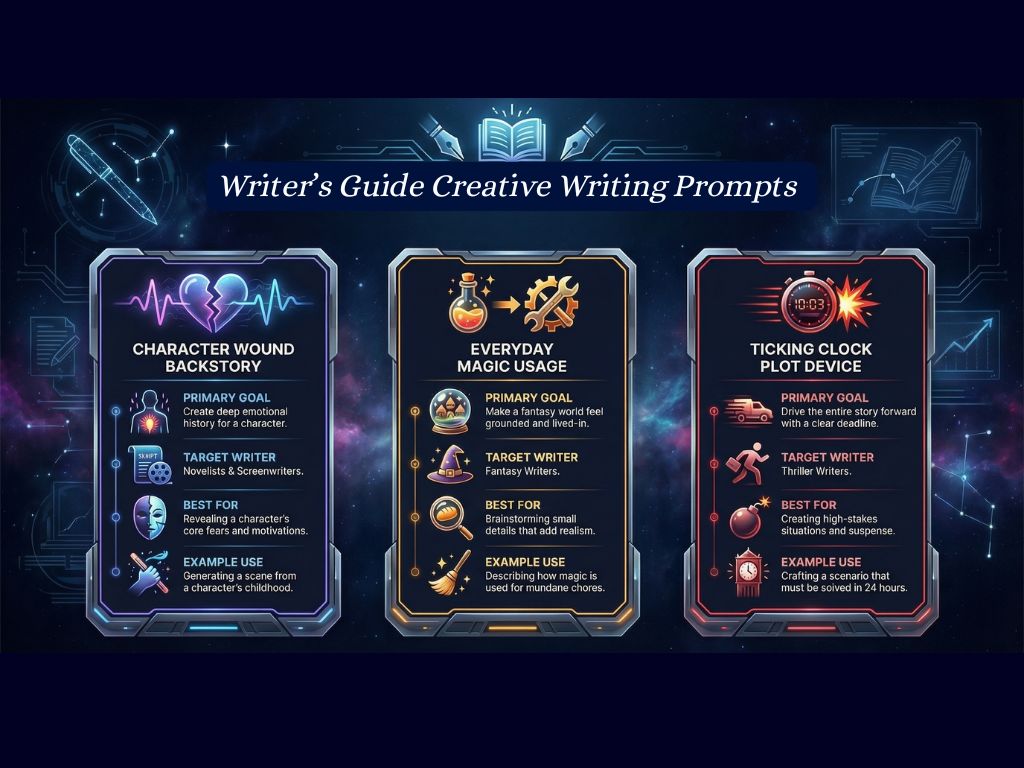
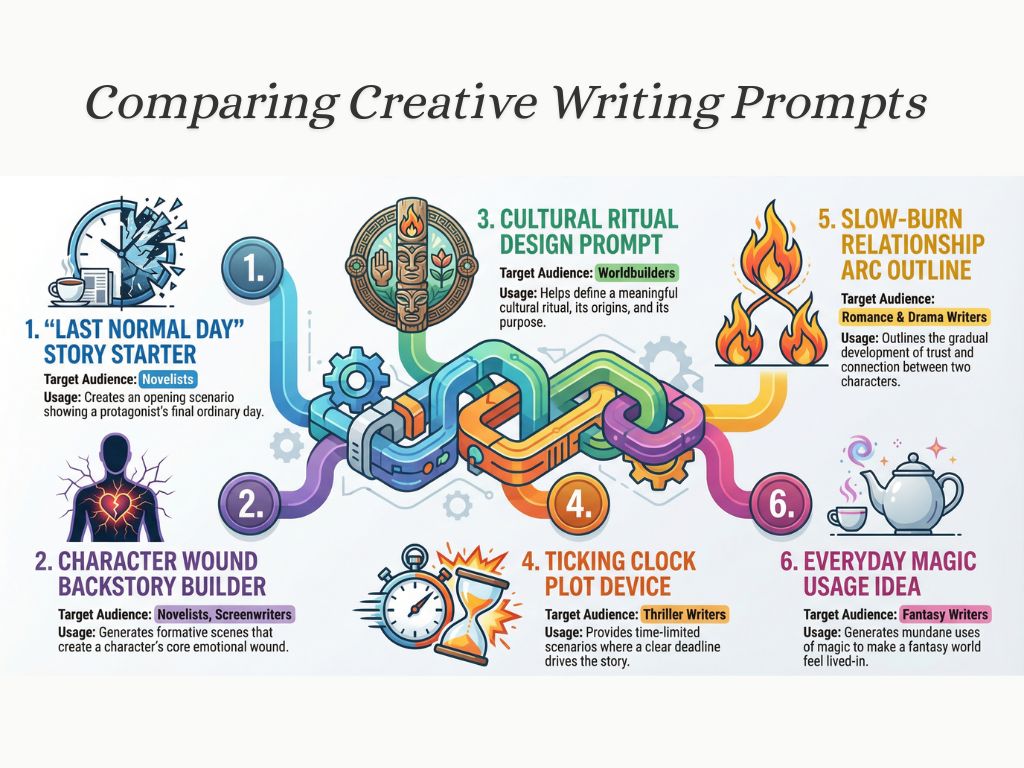
| 22 | “Last Normal Day” Story Starter | Novelists | Creates opening scenarios that show the protagonist’s final ordinary day before everything changes. |
| 23 | Unreliable Narrator Scene Seed | Literary Writers | Produces scene ideas where the main character’s version of events clearly conflicts with reality. |
| 24 | Villain’s Point of View Rewrite | Fiction Writers | Asks the AI to retell a key event from the antagonist’s perspective to deepen moral complexity. |
| 25 | Character Wound Backstory Builder | Novelists, Screenwriters | Generates formative childhood or early-life scenes that create a character’s core emotional wound. |
| 26 | Cast Dynamics Triangle | Series Authors | Helps design a trio of characters with intersecting goals, loyalties, and tensions for ongoing stories. |
| 27 | Dialogue-Only Argument Prompt | Fiction Writers | Requests a scene written only in dialogue to sharpen character voice and subtext. |
| 28 | Internal Monologue Snapshot | Novelists | Produces an internal thought stream for a character facing a difficult choice, revealing hidden fears. |
| 29 | “What They Want vs What They Need” Matrix | Story Planners | Maps character surface goals against deeper needs to guide long-term arcs. |
| 30 | Everyday Magic Usage Idea | Fantasy Writers | Generates mundane, everyday uses of magic that make the world feel lived-in and grounded. |
| 31 | Cultural Ritual Design Prompt | Worldbuilders | Helps define a meaningful ritual, its origins, and how people feel about it in your setting. |
| 32 | Conflicting Historical Accounts Seed | Epic Fantasy Writers | Creates a major event described differently by two cultures, adding realism and tension. |
| 33 | City Built Around a Secret | Worldbuilders | Generates a city concept whose layout, politics, or culture revolve around one hidden truth. |
| 34 | “Rules of Power” Magic System Sketch | Fantasy Authors | Asks the AI to propose limitations, costs, and social impact for a new magic or power system. |
| 35 | Ticking Clock Plot Device | Thriller Writers | Provides time-limited scenarios where a clear deadline drives the entire story. |
| 36 | Constrained Location Story Seed | Short Story Writers | Creates high-stakes situations set in a single confined space to heighten tension. |
| 37 | Alternate History Divergence Point | Speculative Authors | Suggests a single historical event that changed, along with ripple effects to explore. |
| 38 | Silent Character Scene | Literary and Speculative Writers | Prompts a scene where a character cannot speak and must communicate only through action. |
| 39 | Slow-Burn Relationship Arc Outline | Romance and Drama Writers | Generates a multi-beat outline that tracks gradual trust and connection between two characters. |
| 40 | Climactic Showdown Blueprint | Novelists, Screenwriters | Helps plan a final confrontation where internal and external stakes peak at the same time. |

Conclusion
Creative prompts work best when they give you permission to explore. A single idea can lead to a character shift, a new setting, or a moment you did not expect. Writers often discover their strongest scenes when they follow curiosity rather than pressure. This guide is meant to support that process by offering prompts you can return to whenever you need direction.
You now have a set of ideas that can spark short scenes, full stories, or simple practice sessions. Each prompt offers its own doorway into conflict, emotion, or discovery. Your job is to step through the one that pulls you forward. Writing grows through repetition, and small pieces often lead to larger projects.
A steady habit begins when you choose one idea and let it unfold at its own pace. Trust the moments that surprise you. Trust the scenes that come quietly. Over time, these tiny sparks become the foundation of your creative rhythm.
Frequently Asked Questions
What makes a good creative writing prompt
A strong prompt gives you a clear moment to react to without telling you how the story should unfold. It sparks curiosity, suggests conflict, or introduces a question worth exploring. Good prompts leave enough space for your voice to take over.
How long should I write from a single prompt
Most writers find value in ten to twenty minute sessions. This gives you enough time to explore the idea without slowing momentum. You can expand the scene later if it feels promising.
Can beginners use these prompts without planning
Yes. Prompts help new writers focus on discovery rather than structure. Short, unplanned scenes build confidence and reduce the pressure to produce a complete story.
How do I turn a prompt into a full story
Begin by identifying what the character wants and what stands in the way. Expand the first moment of tension into a scene, then let the consequences create the path forward. Story growth often feels clearer once the opening is written.
What if a prompt does not inspire anything
Move on quickly. Not every prompt will match your style or mood. The goal is to find the idea that creates a reaction, not to force creativity from a prompt that feels flat.
Can prompts help with writer’s block
They can. A prompt gives you a specific moment to write toward, which removes the pressure of choosing a topic. Many writers use them as warmups when the blank page feels heavy.
Should I revise scenes that come from prompts
Only if the idea stays with you. Prompt based scenes work well as practice, so not every piece needs polishing. If something in the scene continues to pull your attention, revision can help you discover a stronger story.

0 Comments