Introduction
Using AI in affiliate marketing is no longer a novelty. The open question is whether it actually improves content quality or quietly undermines it. Some publishers see faster production and broader coverage.
Others see thinner pages, weaker trust, and declining performance over time. The difference is not the model or the volume of output. It is how prompts are designed and applied within an affiliate content system.
This article examines where AI prompts add value, where they introduce risk, and how to use them in a way that supports sustainable affiliate content.
Key Takeaways
- AI prompts influence content quality more than the AI tool itself.
- Affiliate content benefits when prompts are designed around reader intent, not output volume.
- Poorly structured prompts often lead to generic pages that struggle to earn trust.
- Different affiliate page types require different prompt logic and constraints.
- Compliance and disclosure are strongest when built into prompts from the start.
Disclaimer: I am an independent Affiliate. The opinions expressed here are my own and are not official statements. If you follow a link and make a purchase, I may earn a commission.
What AI prompts mean in affiliate marketing
In affiliate marketing, prompts function less like commands and more like briefs. They shape how information is framed, what tradeoffs are acknowledged, and how cautious or confident the language becomes. When prompts are vague, the output usually is too. When prompts are specific about audience, purpose, and limits, the content tends to sound considered rather than generic.
This matters because affiliate content sits in a sensitive position. It must explain products clearly without overselling them. A prompt that only asks for benefits pushes the model toward promotional language. A prompt that asks for strengths, limitations, and appropriate use cases encourages balance, which readers tend to trust more.
Another important aspect is consistency. Affiliate sites often publish dozens or hundreds of similar pages. Prompts help standardize structure and evaluation criteria across that content. Without them, tone and depth drift from page to page, which weakens both user experience and perceived authority.
The practical takeaway is simple. In affiliate marketing, prompts are a quality control mechanism. They influence reasoning before a single sentence is written. When treated that way, they support clarity and trust instead of speed alone.
Core types of AI prompts used in affiliate content
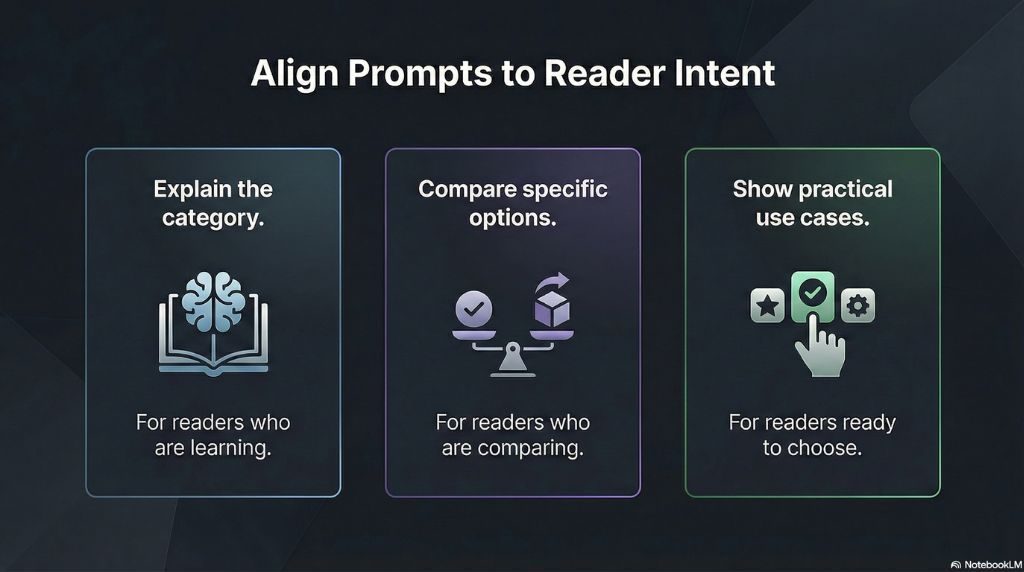
Not all affiliate pages solve the same problem. Some readers are learning, others are comparing, and some are close to choosing. AI prompts work best when they reflect that difference instead of forcing one writing style across every page.
Informational prompts
Informational prompts support early-stage readers who are trying to understand a category before making decisions. These prompts focus on explaining what a product type does, who it is generally for, and where it may fall short.
When written well, they prevent the model from drifting into sales language. The emphasis stays on clarity and context rather than persuasion. This makes them useful for guides, glossaries, and category overviews.
The key insight here is restraint. Informational prompts should limit conclusions and avoid recommendations unless clearly framed as general considerations.
Comparative prompts
Comparative prompts are designed for readers weighing options. They work by forcing consistent criteria across products, such as features, limitations, learning curve, and ideal use cases.
Without this structure, AI tends to favor whichever product appears first or has the most available data. A strong comparative prompt counteracts that bias by requiring balance and tradeoffs on both sides.
The practical benefit is credibility. Readers trust comparisons that acknowledge why one option may not suit everyone.
Review and use-case prompts
These prompts focus on how a product is typically used rather than how it is marketed. They are especially useful for scenario-based content, such as “best for beginners” or “best for small teams.”
The important boundary is honesty. Prompts should avoid implying firsthand testing unless that experience exists. Language should stay observational, using qualifiers like “generally” or “commonly reported.”
The bottom line across all three types is alignment. When prompt logic matches reader intent, the resulting content feels relevant instead of manufactured.

How to structure effective AI prompts for affiliate pages
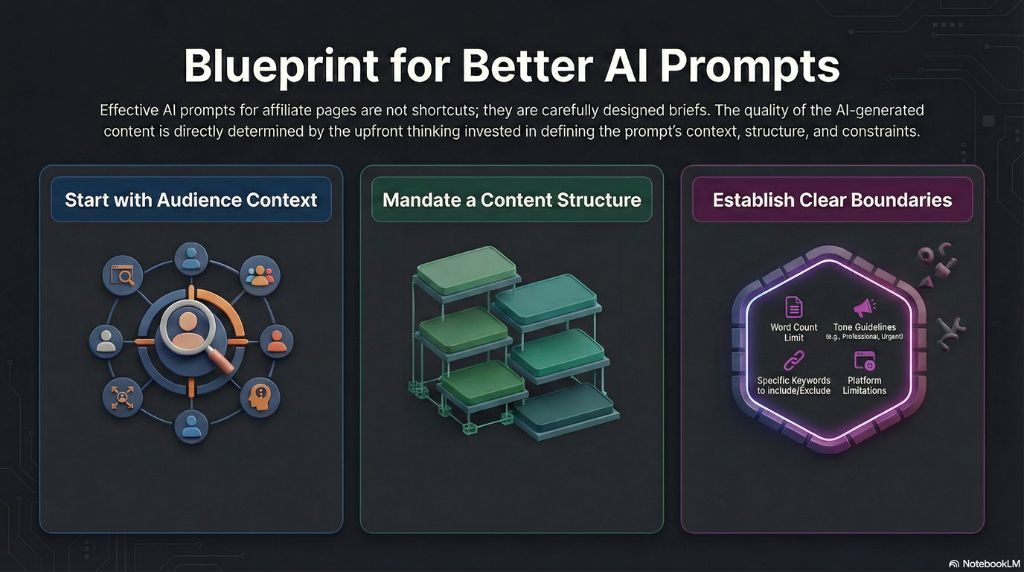
Effective prompts start before any writing happens. They begin with context. Who is the reader, what stage of decision-making are they in, and what question are they trying to resolve? When this context is missing, AI fills the gap with assumptions, which is where content quality usually breaks down.
Structure is the second layer. Strong prompts specify the format the output should follow, such as an explainer, a side-by-side comparison, or a use-case breakdown. This prevents rambling and keeps the content aligned with how readers scan and evaluate affiliate pages. It also reduces the need for heavy rewriting later.
Constraints matter just as much as instructions. Prompts that clearly limit tone, claims, and conclusions tend to produce safer and more trustworthy content. Asking the model to include drawbacks, avoid guarantees, or acknowledge variability leads to more balanced output by design.
A common mistake is treating prompts as shortcuts. Short, vague prompts often save seconds upfront but cost hours in editing. The more clearly a prompt defines scope and boundaries, the more usable the draft becomes. The takeaway is straightforward: good prompts front-load thinking so the writing phase stays controlled and consistent.
SEO considerations when using AI prompts
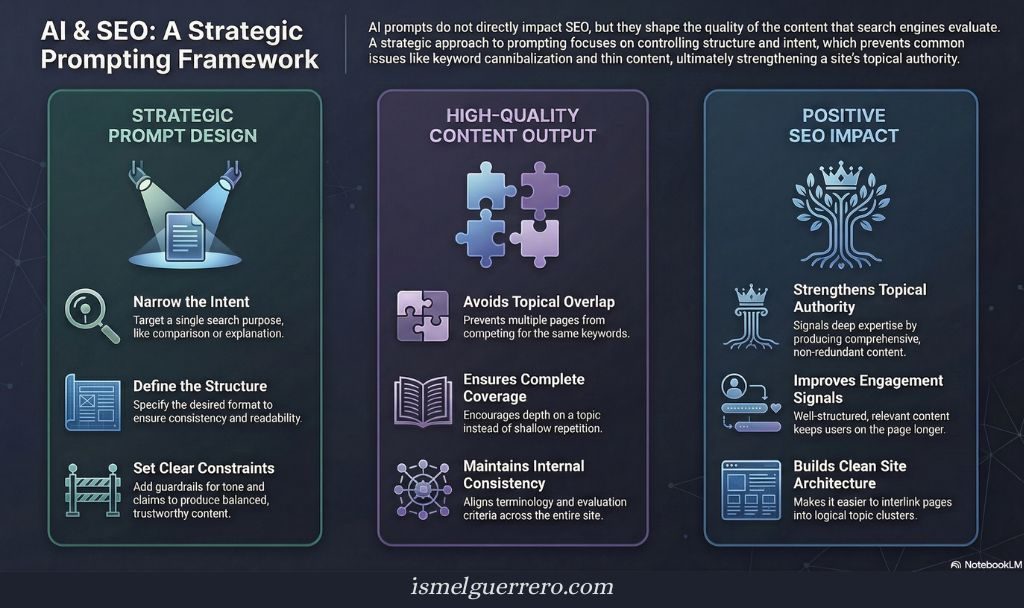
AI prompts influence SEO indirectly through structure, scope, and relevance. Search engines do not evaluate prompts, but they do respond to the patterns prompts create in published content. When prompts are poorly designed, they often generate pages that overlap in topic, repeat phrasing, or fail to fully answer a specific query. Over time, this weakens topical authority.
Well-structured prompts help avoid that problem by narrowing intent. A prompt that clearly targets one search purpose, such as comparison or explanation, reduces keyword cannibalization across similar pages. It also encourages complete coverage of a topic rather than shallow repetition. This supports longer engagement and clearer relevance signals.
Prompts can also reinforce internal consistency. When multiple writers or pages follow the same prompt logic, headings, evaluation criteria, and terminology stay aligned. That consistency makes it easier to interlink related content and build clean pillar and cluster relationships without redundancy.
The main insight is control. SEO gains come from prompts that guide depth and differentiation, not from inserting keywords into instructions. When prompts emphasize intent and structure first, optimization tends to follow naturally.

Compliance and trust considerations in prompt design
Affiliate content operates within clear ethical and regulatory boundaries. AI prompts need to account for those boundaries before any text is generated. When they do not, the output often includes implied guarantees, overstated benefits, or missing disclosures that create unnecessary risk.
The most effective prompts include explicit guardrails. These might instruct the model to avoid promises, acknowledge that results vary, or include neutral language when discussing outcomes. Adding these constraints at the prompt level reduces the likelihood of problematic phrasing and minimizes cleanup during editing.
Disclosure is another area where prompt design matters. Prompts can remind the model to include affiliate disclosure placeholders or neutral transitions that support transparency. While disclosure placement is ultimately a publishing decision, prompts that anticipate it help maintain consistency across pages.
The broader point is trust. Readers are sensitive to tone and implication, even when facts are technically accurate. Prompts that prioritize balance and caution help produce content that feels honest rather than engineered. That perception is central to long-term affiliate performance.
Where AI prompts fit in a sustainable affiliate workflow
AI prompts are most effective when they sit inside a defined editorial process. They work well for outlining, drafting, and maintaining consistency across similar pages. They are far less effective when used as a replacement for judgment, research, or review.
In a sustainable workflow, prompts typically support the early and middle stages of content creation. They help translate intent into structure and turn research notes into readable drafts. Final decisions about accuracy, positioning, and tone still require human oversight, especially for product updates, pricing changes, or nuanced claims.
Prompts also help teams scale without fragmenting quality. When multiple contributors use the same prompt logic, content standards stay aligned even as volume increases. This consistency strengthens reader trust and makes site-wide updates easier to manage over time.
The takeaway is balance. AI prompts are a force multiplier for disciplined teams, not a substitute for editorial control. When integrated thoughtfully, they support efficiency without sacrificing credibility or long-term performance.

Conclusion
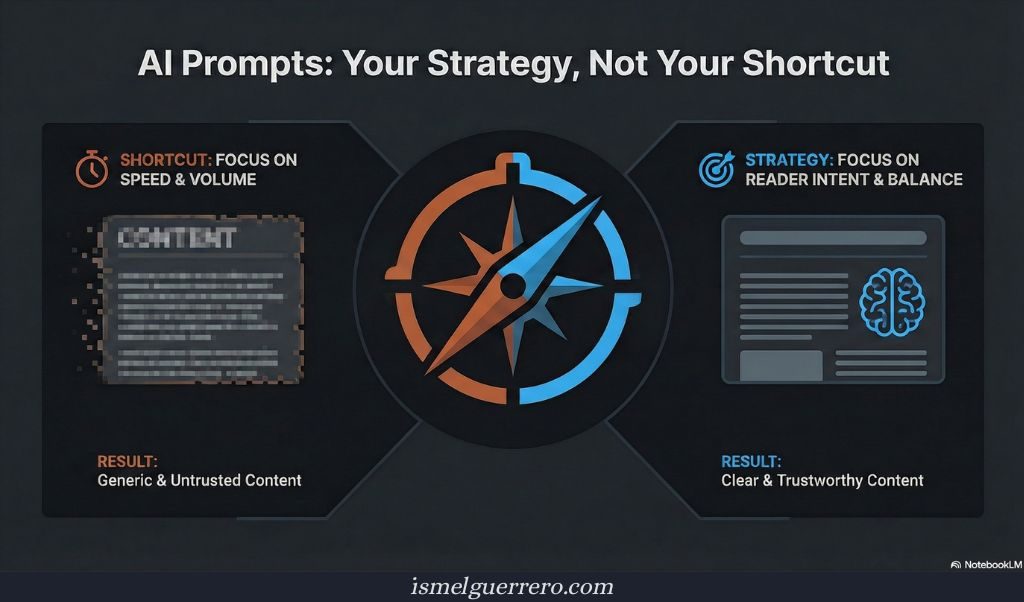
AI prompts are not a shortcut to better affiliate content. They are a way to bring clearer thinking into the writing process before words appear on the page. When prompts are designed around reader intent, balanced evaluation, and clear boundaries, they support content that feels structured and trustworthy.
When they are treated as simple instructions to generate volume, they tend to produce sameness and risk. The difference is not technical. It is editorial.
Used thoughtfully, AI prompts help affiliate marketers scale clarity rather than compromise it.

Frequently Asked Questions
Are AI prompts allowed in affiliate marketing?
Yes, AI-assisted content is generally allowed across major platforms. The key requirement is that affiliate disclosures are clear and claims remain accurate and qualified. Platform policies focus on outcomes, not the tools used.
Do AI prompts replace product research or testing?
No. Prompts can organize existing information, but they cannot substitute firsthand experience, updated pricing checks, or verified performance data. Human review remains essential.
Can AI prompts help affiliate content rank better?
Indirectly, yes. Prompts that improve structure, intent alignment, and completeness can support better engagement signals. They do not guarantee rankings and should not be treated as an SEO tactic on their own.
How detailed should an affiliate prompt be?
Detailed enough to define audience, format, and constraints. Overly short prompts tend to produce generic output, while overly rigid prompts can limit usefulness. Balance matters.
Should affiliate disclosures be included in prompts?
Including disclosure reminders or placeholders in prompts helps maintain consistency. Final placement and wording should still follow applicable guidelines and publishing standards.
Is AI-generated affiliate content trustworthy to readers?
Trust depends on balance, clarity, and transparency, not on whether AI was involved. Content that acknowledges limitations and avoids exaggerated claims tends to earn more confidence over time.

0 Comments