Introduction
Copywriting frameworks are structured models that guide persuasive writing. Instead of guessing how to move a reader toward action, frameworks provide a sequence that aligns with how people process information and make decisions.
Strong copy rarely happens by accident. It follows psychological progression. Attention must be earned. Interest must be built. Desire must be created. Action must be directed.
This guide breaks down the most important copywriting frameworks, explains how they work, compares their strengths, and helps you choose the right structure for your audience and format.
If you want clarity instead of improvisation, frameworks are where you start.
- Copywriting frameworks help organize persuasive messages so readers move from attention and understanding toward belief and action.
- The right framework depends on the reader’s awareness level, the complexity of the offer, the format of the copy, and the main belief the copy needs to build.
- AIDA works well for full persuasion journeys, while PAS works better when the reader already recognizes the problem and needs a stronger reason to act.
- Before-After-Bridge is useful for showing transformation, while FAB helps turn features into clear reader benefits.
- Longer or more complex offers often need frameworks such as PASTOR, ACCA, or 4Ps because they require more trust, education, proof, or emotional context.
- The 4U formula is best used for headlines, hooks, and subject lines rather than full sales messages.
- Copywriting frameworks improve structure and clarity, but they cannot fix a weak offer, poor audience fit, unsupported claims, or copy that does not understand the reader.
Disclaimer: I am an independent Affiliate. The opinions expressed here are my own and are not official statements. If you follow a link and make a purchase, I may earn a commission.
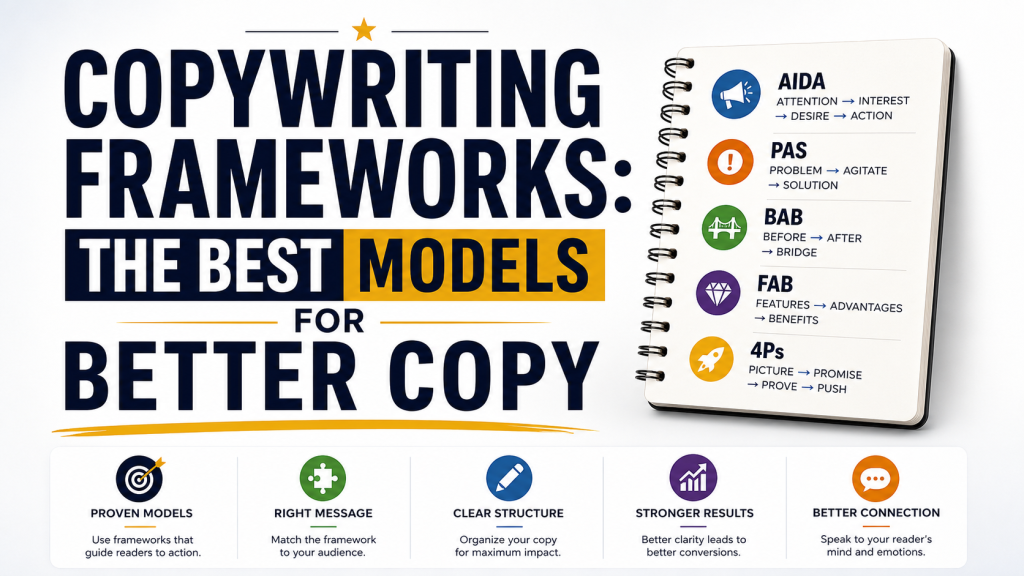
What Are Copywriting Frameworks?
Copywriting frameworks are structured persuasion models that guide how a message unfolds. Instead of writing randomly or relying on intuition, a framework provides a logical sequence that moves the reader toward a decision.
At their core, frameworks organize three things:
- Attention
- Emotion
- Action
They answer questions such as:
- What should I say first?
- When do I introduce benefits?
- How do I build urgency?
- When should I ask for the sale?
Different frameworks emphasize different psychological levers. Some increase tension. Others highlight transformation. Some guide a full awareness journey. Others compress persuasion into a few lines.
Frameworks do not replace creativity. They structure it.
When used correctly, they reduce guesswork and improve clarity. When ignored, messaging often becomes scattered, repetitive, or unfocused.
Copywriting frameworks exist to make persuasion systematic rather than accidental.
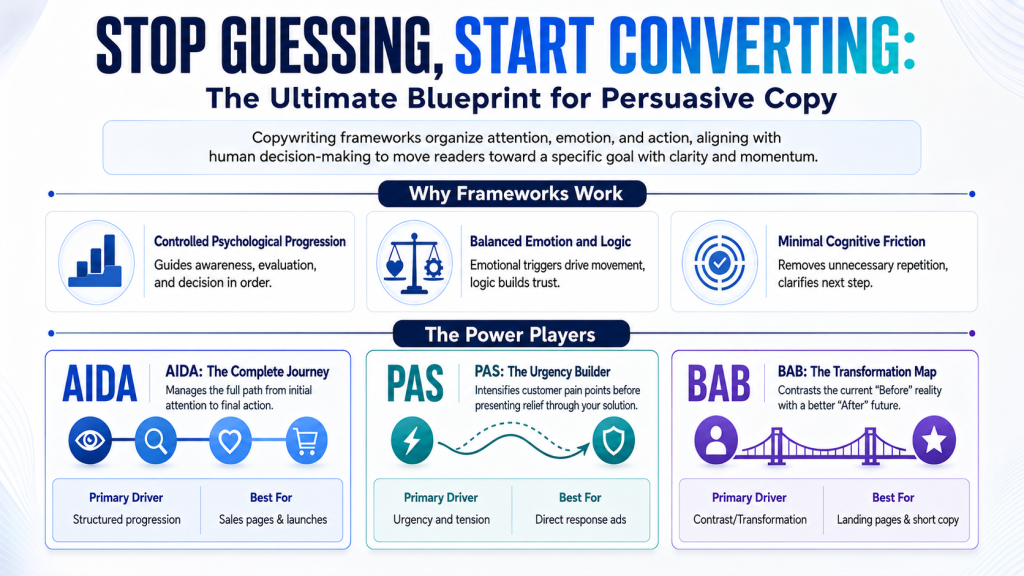
Why Copywriting Frameworks Matter in Conversion
Copywriting frameworks matter because conversion requires structure.
Readers rarely move from awareness to action instantly. They need clarity. They need relevance. They need motivation. Frameworks ensure those elements appear in the right order.
Without structure, messages often:
- Introduce solutions before defining problems
- List features without creating desire
- Ask for action without building urgency
Frameworks prevent these breakdowns.
They create sequence.
For example:
- AIDA builds awareness before asking for commitment.
- PAS increases tension before offering relief.
- Before-After-Bridge highlights transformation before presenting the solution.
Each structure controls psychological flow.
Frameworks also improve efficiency. Instead of rewriting endlessly, you can diagnose where persuasion breaks down. If readers lose interest early, your Attention stage may be weak. If clicks are low, Desire may not be strong enough.
Conversion improves when persuasion becomes deliberate rather than improvised.
Frameworks do not guarantee results. They increase the probability of clarity, momentum, and action.
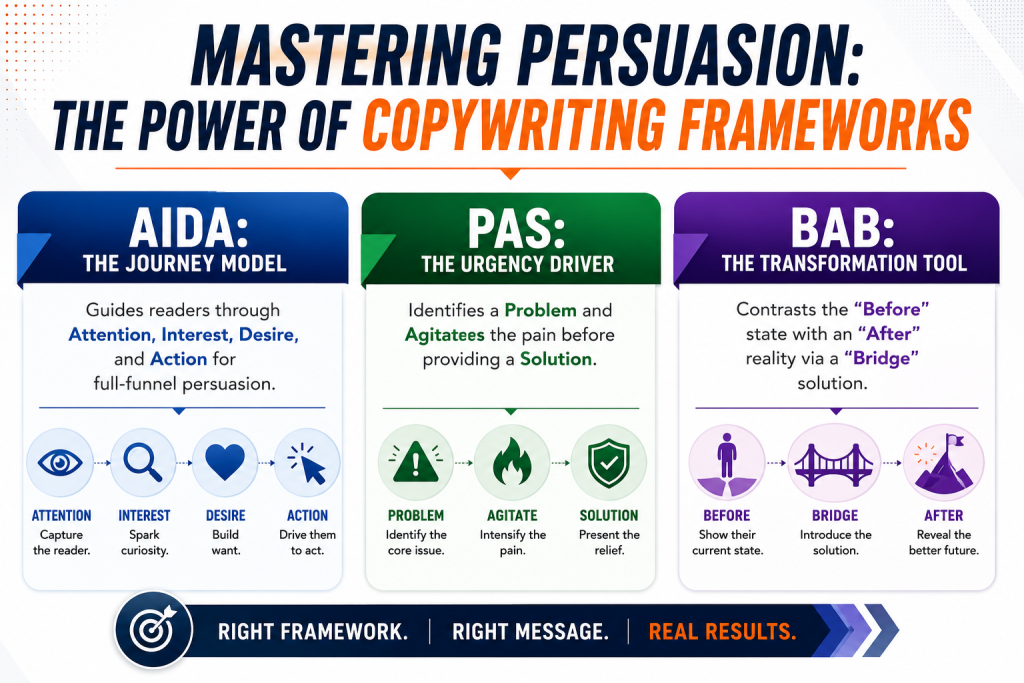
How Copywriting Frameworks Work
Copywriting frameworks work by controlling psychological progression.
Every persuasive message must guide the reader through three core movements:
- Awareness
- Evaluation
- Decision
Frameworks structure these movements intentionally.
They Control Sequence
Order matters in persuasion.
If you present a solution before defining a problem, motivation stays low. If you ask for action before building desire, resistance increases.
Frameworks prevent this misalignment by forcing a clear sequence.
For example:
- AIDA builds from attention to action step by step.
- PAS builds pressure before introducing relief.
- BAB contrasts current reality with a better future before offering the bridge.
Each framework defines what comes first and what follows.
They Align Emotion and Logic
Effective persuasion balances emotional motivation with logical clarity.
Some frameworks emphasize emotional tension, such as PAS. Others emphasize transformation and possibility, such as BAB. AIDA blends emotional buildup with structured progression.
Frameworks ensure emotion appears where it drives movement and logic appears where it supports credibility.
They Reduce Cognitive Friction
When messages feel scattered, readers disengage.
Frameworks reduce friction by:
- Guiding attention deliberately
- Removing unnecessary repetition
- Clarifying the next step
Clarity increases trust. Trust increases conversion.
Copywriting frameworks do not remove creativity. They channel it. Instead of guessing how to persuade, you follow a tested progression that mirrors how people process information.
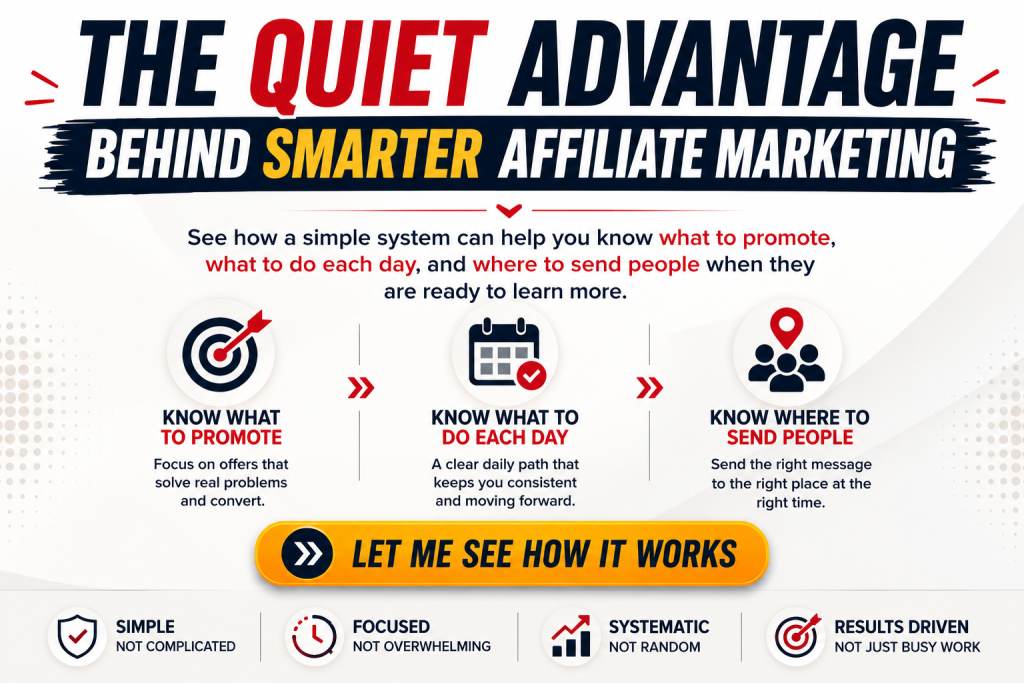
The Most Important Copywriting Frameworks Explained
The most useful copywriting frameworks are not interchangeable.
Each one creates a different persuasive path. Some are better for building desire. Some are better for urgency. Others are better for explaining value, educating a skeptical buyer, or improving a headline.
The goal is not to memorize every model. The goal is to understand what each framework does and when it fits.
AIDA
AIDA stands for Attention, Interest, Desire, Action.
It guides the reader through a full persuasion journey. First, the copy earns attention. Then it builds interest by making the message relevant. Next, it creates desire by connecting the offer to a meaningful outcome. Finally, it directs the reader toward a clear action.
Best for: Full-page persuasion, product launches, email funnels, and multistep campaigns.
Use it when: The reader needs a clear path from awareness to action.
Avoid it when: The reader is already highly motivated and a shorter, more direct structure would be enough.
Main strength: AIDA gives persuasive copy a complete beginning, middle, and end.
PAS
PAS stands for Problem, Agitate, Solve.
It starts by identifying a problem the reader recognizes. Then it makes the consequences, frustration, or emotional weight of that problem more vivid. Finally, it presents the offer as the solution.
Best for: Pain-led ads, sales emails, landing page openings, and problem-aware audiences.
Use it when: The reader already understands the problem but needs a stronger reason to act.
Avoid it when: The audience is unaware, skeptical, or likely to reject pressure-heavy messaging.
Main strength: PAS creates urgency by making the problem harder to ignore.
Before-After-Bridge
Before-After-Bridge shows contrast.
It starts with the reader’s current situation, shows a better future, and positions the offer as the bridge between the two. It is less pressure-driven than PAS because it focuses on transformation rather than tension.
Best for: Transformation-focused sections, social posts, emails, and concise landing page copy.
Use it when: The benefit is easy to visualize and the reader wants a clear improvement.
Avoid it when: The problem is complex and requires more education before the reader understands the value.
Main strength: Before-After-Bridge makes the outcome feel clear and attainable.
4Ps
The 4Ps framework stands for Picture, Promise, Prove, Push.
It begins by helping the reader imagine a situation or result. Then it makes a promise, supports that promise with proof, and pushes the reader toward action.
Best for: Proof-heavy offer presentations, sales pages, and benefit-driven product messaging.
Use it when: You need to combine emotional appeal with credibility.
Avoid it when: You do not have enough proof to support the promise.
Main strength: The 4Ps framework balances imagination, benefit, evidence, and action.
FAB
FAB stands for Features, Advantages, Benefits.
It helps translate product details into reader value. A feature explains what something is. An advantage explains why it matters. A benefit explains what the reader gains from it.
Best for: Product explanations, ecommerce pages, SaaS pages, technical offers, and comparison content.
Use it when: The copy lists features but does not clearly explain why they matter.
Avoid it when: The reader needs emotional persuasion before product details.
Main strength: FAB turns information into value.
PASTOR
PASTOR stands for Problem, Amplify, Story, Transformation, Offer, Response.
It expands the logic of PAS by adding narrative and transformation. The framework begins with a problem, amplifies its importance, uses story to build connection, shows the transformation, presents the offer, and asks for a response.
Best for: Long-form sales pages, high-ticket services, coaching, consulting, and trust-dependent offers.
Use it when: The reader needs emotional context, credibility, and a deeper reason to believe.
Avoid it when: The format is too short for story, proof, and transformation.
Main strength: PASTOR gives long-form persuasion emotional depth and structure.
ACCA
ACCA stands for Awareness, Comprehension, Conviction, Action.
It works well when the reader needs education before they can make a decision. The copy first creates awareness of the issue, then helps the reader understand it, builds conviction, and finally asks for action.
Best for: Complex buying journeys, B2B marketing, technical offers, educational campaigns, and thought leadership.
Use it when: The buyer needs explanation before persuasion.
Avoid it when: The reader already understands the problem and is ready for a direct offer.
Main strength: ACCA builds belief before asking for commitment.
4U Formula
The 4U formula stands for Useful, Urgent, Unique, Ultra-Specific.
It is used to sharpen the first line people see, especially when attention is the main challenge.
Best for: Headlines, hooks, subject lines, and ad angles.
Use it when: You need to improve attention, clicks, or initial curiosity.
Avoid it when: You are writing a full message that needs deeper persuasion beyond the hook.
Main strength: The 4U formula makes a message more specific and harder to ignore.
Each framework solves a different writing problem. AIDA gives structure. PAS creates urgency. Before-After-Bridge creates contrast. FAB clarifies value. PASTOR adds depth. ACCA builds understanding. 4U improves the hook.
The stronger your diagnosis, the stronger your framework choice.

Copywriting Framework Comparison Table
Each copywriting framework creates a different persuasive path. The right choice depends on what the reader already understands, what emotion needs to be activated, and how much space the format gives you.
| Framework | Core Structure | Best Use | Primary Strength | Watch Out For |
|---|---|---|---|---|
| AIDA | Attention → Interest → Desire → Action | Full-page persuasion, launches, email funnels, and multistep campaigns | Creates a complete path from awareness to action | Can feel slower than needed when the reader is already ready to act |
| PAS | Problem → Agitate → Solve | Pain-led ads, emails, landing page openings, and problem-aware audiences | Makes the problem vivid and gives the reader a reason to act | Can feel too heavy if the audience does not yet recognize the problem |
| Before-After-Bridge | Before → After → Bridge | Transformation-focused sections, social posts, emails, and concise landing page copy | Shows a clear contrast between the current state and desired outcome | Can feel thin if the problem requires more education |
| 4Ps | Picture → Promise → Prove → Push | Proof-heavy offer presentations, sales pages, and benefit-driven product messaging | Balances emotional appeal with evidence and action | Weakens when the promise lacks credible proof |
| FAB | Features → Advantages → Benefits | Product explanations, ecommerce pages, SaaS pages, and technical offers | Turns product details into reader-centered value | Can feel dry if used without emotional context |
| PASTOR | Problem → Amplify → Story → Transformation → Offer → Response | Long-form sales pages, high-ticket services, coaching, consulting, and trust-dependent offers | Adds emotional depth, story, and transformation | Requires enough space to develop properly |
| ACCA | Awareness → Comprehension → Conviction → Action | Complex buying journeys, B2B marketing, technical offers, and educational campaigns | Builds understanding before asking for commitment | Can feel too slow for simple or urgent offers |
| 4U Formula | Useful → Urgent → Unique → Ultra-Specific | Headlines, hooks, subject lines, and ad angles | Makes the first line more specific and compelling | Does not structure the full message by itself |
No framework is automatically better than the others.
- AIDA gives you a full persuasive sequence.
- PAS works when the problem already matters.
- Before-After-Bridge clarifies transformation.
- FAB translates value.
- PASTOR adds depth.
- ACCA builds belief.
- 4U improves attention.
The best framework is the one that matches the reader’s awareness, the offer’s complexity, and the format you are writing for.
How To Choose The Right Copywriting Framework
The right copywriting framework depends on the reader, the offer, and the format.
A framework should match the persuasion problem you are trying to solve. If the reader does not understand the problem, the copy needs education. If the reader already feels the problem, the copy may need urgency. If the product is technical, the copy may need clearer value translation.
Start with diagnosis before structure.
Consider The Reader’s Awareness Level
Audience awareness is one of the most important factors.
If readers are unaware of the problem, use a framework that builds understanding before asking for action. AIDA and ACCA work well here because they create progression.
If readers already know the problem but have not acted yet, PAS or PASTOR may fit better. These frameworks make the problem more vivid and position the offer as the next logical step.
If readers understand the problem and want a better outcome, Before-After-Bridge can work well because it makes the transformation clear.
Match The Framework To The Main Persuasive Goal
Different frameworks solve different copy problems.
- Use AIDA when the message needs a complete journey from attention to action.
- Use PAS when the problem is already clear and the copy needs urgency.
- Use Before-After-Bridge when the offer is tied to a clear transformation.
- Use FAB when product features need to become meaningful benefits.
- Use PASTOR when the offer requires story, trust, and emotional depth.
- Use ACCA when the reader needs education before conviction.
- Use 4U when the first job is to improve the headline, hook, or subject line.
The framework should support the purpose of the copy, not just give it a familiar shape.
Consider The Complexity Of The Offer
Simple offers usually need simpler frameworks.
If the reader can understand the offer quickly, a compressed framework like PAS, BAB, FAB, or 4U may be enough.
Complex offers need more explanation. B2B services, high-ticket programs, technical products, and unfamiliar solutions often need frameworks like AIDA, ACCA, 4Ps, or PASTOR because the reader needs more context before taking action.
The more complex the decision, the more carefully the copy needs to build understanding and trust.
Consider The Format
The format limits how much persuasion you can build.
A headline does not have room for AIDA. A short ad may not have room for PASTOR. A full sales page may need more than a simple feature-benefit sequence.
For short formats, use frameworks that compress the message:
- 4U for headlines and hooks
- PAS for short ads and emails
- BAB for concise transformation copy
- FAB for product descriptions
For longer formats, use frameworks that allow more progression:
- AIDA for sales pages and campaigns
- 4Ps for proof-driven offers
- PASTOR for high-trust sales copy
- ACCA for educational or complex buying journeys
A strong framework fits the space it has to work within.
Choose One Primary Framework
You can combine frameworks, but one structure should lead.
For example, a sales page might follow AIDA overall while using FAB inside the product section and 4U for the headline. That works because each framework has a specific job.
Problems happen when too many frameworks compete for control. The copy starts to repeat itself, change direction, or push the reader through several emotional sequences at once.
Choose one main framework first. Then use smaller frameworks only where they support the larger message.
Use The Framework As A Guide, Not A Script
Frameworks are useful because they create order.
They are not meant to make every piece of copy sound the same. A good framework should help you decide what comes first, what needs support, and where the action belongs.
The final copy should still sound natural. The reader should feel the clarity of the structure without noticing the formula behind it.

Common Mistakes When Using Copywriting Frameworks
Copywriting frameworks make writing easier, but they can also make copy weaker when they are used too rigidly.
A framework should support the message. It should not replace clear thinking, audience understanding, or a strong offer.
Choosing A Framework Before Understanding The Reader
The biggest mistake is starting with the formula instead of the reader.
AIDA, PAS, FAB, and every other framework only work when they match the reader’s situation. If the reader does not understand the problem yet, pressure-based copy can feel premature. If the reader is already ready to act, a long educational structure can feel slow.
Start with what the reader knows, feels, doubts, and needs to believe next.
Treating The Framework Like A Fill-In-The-Blank Template
Frameworks are not scripts.
They show the order of persuasion, but they do not write the message for you. If every line sounds like it was forced into a formula, the copy will feel stiff.
The reader should not notice the framework. They should notice that the message is clear, relevant, and easy to follow.
Using Too Many Frameworks At Once
Copy becomes confusing when several frameworks compete for control.
A sales page can use more than one framework, but each one should have a clear role. For example, AIDA can guide the full page, FAB can clarify product value, and 4U can sharpen the headline.
That works because each framework has a specific job. It fails when the copy keeps restarting the persuasion process.
Forcing Urgency Where It Does Not Belong
Some frameworks make it easy to increase pressure.
PAS, PASTOR, and 4U can all create urgency, but urgency must be earned. If the problem is exaggerated or the stakes feel inflated, the copy loses trust.
Good copy makes the reader’s situation clearer. It does not manufacture fear.
Explaining Features Without Translating Value
Feature-heavy copy often sounds informative but fails to persuade.
Readers do not only want to know what a product includes. They want to know why those details matter and how the offer helps them solve a problem, save time, reduce risk, increase confidence, or reach a better outcome.
This is where FAB is especially useful. It forces the copy to move from information to value.
Forgetting Proof
A framework can create a persuasive flow, but proof creates belief.
Claims need support. That support may come from examples, demonstrations, testimonials, product details, case studies, data, guarantees, or clear explanations.
Without proof, even well-structured copy can feel empty.
Making The Call To Action Too Vague
Many pieces of copy build interest and desire, then end weakly.
The reader should know exactly what to do next. That action might be booking a call, starting a trial, downloading a guide, joining a list, comparing plans, or reading the next page.
A strong call to action is specific, natural, and matched to the reader’s stage of awareness.
Using Frameworks To Hide A Weak Offer
No copywriting framework can save an offer people do not want.
Frameworks can clarify value, sharpen positioning, and improve flow. They cannot fix poor audience fit, weak differentiation, unclear pricing, unsupported claims, or a product that does not solve a meaningful problem.
Before blaming the copy, check the offer.
Conclusion
Copywriting frameworks are useful because they bring order to persuasion.
They help you decide what the reader needs to see first, what needs to be explained, where emotion belongs, where proof is needed, and how the message should move toward action.
But the framework is not the strategy by itself.
AIDA, PAS, Before-After-Bridge, 4Ps, FAB, PASTOR, ACCA, and 4U all solve different writing problems. The right choice depends on the reader’s awareness, the complexity of the offer, the format of the copy, and the main belief that needs to be built.
Use frameworks to clarify your thinking, not to force your writing into a formula.
The best copy does not feel like a model. It feels clear, relevant, credible, and easy to act on.
Frequently asked questions
What is a copywriting framework?
A copywriting framework is a structured way to organize persuasive writing.
It helps you decide what the reader needs to see first, how to explain the value of an offer, where proof belongs, and how the message should move toward action.
What is the best copywriting framework?
There is no single best framework.
The right choice depends on the reader’s awareness, the complexity of the offer, the format, and the main persuasive goal.
AIDA works well when the reader needs a complete journey from attention to action. PAS is useful when the problem is already clear and the message needs urgency. Before-After-Bridge works well when the transformation is simple and easy to visualize.
Which copywriting framework is best for beginners?
AIDA and PAS are good starting points.
AIDA helps beginners organize a complete message. PAS is simpler and teaches writers how to connect a recognized problem to a relevant solution.
Start with one framework, apply it to several types of copy, and focus on understanding why each stage is there.
What is the difference between AIDA and PAS?
AIDA guides the reader through a full persuasive sequence: attention, interest, desire, and action.
PAS is more direct. It begins with a problem, makes the consequences or frustration more vivid, and then presents the solution.
AIDA is often a better fit when the reader needs gradual persuasion. PAS works well when the reader already understands the problem and needs a clearer reason to act.
Can you combine copywriting frameworks?
Yes, but one framework should usually lead the overall message.
For example, a sales page might use AIDA as its main structure, FAB inside a product section, and 4U to strengthen the headline.
Combining frameworks works when each one has a specific role. It becomes confusing when several formulas compete to control the same section.
Which framework works well for product descriptions?
FAB is especially useful for product descriptions.
It connects a product’s features to their practical advantages and then explains the benefit the reader receives.
This helps prevent product copy from becoming a list of specifications without a clear reason to care.
Which framework works well for headlines?
The 4U formula is useful for headlines, hooks, and email subject lines.
It encourages writers to make the message useful, urgent, unique, and ultra-specific.
A headline does not need to include all four elements every time, but the formula can help make vague wording clearer and more compelling.
Do copywriting frameworks work for SEO content?
Yes, but they should support the reader’s search intent rather than overpower it.
SEO content usually needs to prioritize clarity, usefulness, and relevance. Copywriting frameworks can still improve introductions, product comparisons, conversion-focused sections, and calls to action.
The goal is to make the content easier to follow without making an informational article feel unnecessarily sales-driven.
Which copywriting framework converts best?
No framework converts best in every situation.
Conversion depends more on audience fit, offer strength, positioning, proof, and execution than on the formula itself.
A well-matched PAS message can outperform a poorly executed AIDA page, just as a clear FAB section can outperform a more elaborate structure when the reader mainly needs help understanding product value.
Can a copywriting framework fix weak copy?
A framework can improve structure, but it cannot fix every problem.
It cannot compensate for a weak offer, poor audience fit, vague positioning, unsupported claims, or a lack of proof.
Frameworks work best when they organize a clear message around a relevant offer and a real reader need.

0 Comments