Starting network marketing does not have to mean turning your personal contacts into a prospect list.
Friends and family may create a few early conversations, but they are a limited market. Building the business around them can also make growth depend too heavily on relationships that were never created for selling or recruiting.
A stronger starting point is to build around relevance.
Choose a market you understand, create a simple presence around the problems that audience already cares about, and give new people a reason to discover you before you ever make an offer.
In this guide, you’ll learn how to start network marketing with a practical system for reaching people beyond your existing circle, so the business can grow without depending on everyone you already know.
- Friends and family can be part of your network, but they do not need to become the foundation of your business.
- A clear market gives you a better starting point than trying to promote products to anyone who might listen.
- Building your own presence helps you attract people around useful ideas and relevant problems before an offer enters the conversation.
- One or two reliable acquisition channels are enough to start. Trying to be everywhere usually creates scattered effort.
- Content works best when it gives people a reason to notice and trust you before you ask them to consider a product or opportunity.
- Product interest and business interest should stay on separate paths until the person shows a reason to explore both.
- A simple follow-up system helps you recognize which conversations deserve attention and which ones should end.
- Early progress should be judged by relevant conversations, customers, follow-up, expenses, and what you are learning about the market, not by activity alone.
Disclaimer: I am an independent Affiliate. The opinions expressed here are my own and are not official statements. If you follow a link and make a purchase, I may earn a commission.
What You Need Before You Start
Before trying to reach new prospects, build a simple presence around the market you want to serve.
That means deciding who you want to help, what subjects you can speak about consistently, and what people should associate with your name.
Your profile, content, and messaging should lead with that value rather than making the network marketing company your entire identity.
The company can provide the product and opportunity later.
Your job first is to create enough relevance that people have a reason to follow, engage, or start a conversation with you before any offer is introduced.
You do not need a large audience or polished brand to begin. You need a clear market, a recognizable presence, and something useful to say.
Step 1. Choose a Market You Understand
Do not begin with the company.
Begin with the people you want to reach.
A clear market gives your content, positioning, and prospecting direction. It also makes it easier to build a presence that attracts people for reasons beyond the opportunity itself.
Choose a group whose problems, interests, or goals you understand well enough to discuss consistently.
For example, someone in the wellness space might focus on busy professionals trying to improve their routines rather than broadly targeting “people who want better health.”
That narrower focus gives you more useful topics to talk about and makes your message easier to recognize.
The product should fit the market naturally.
You are not looking for an audience simply because the company sells something to them. You are looking for a group you can genuinely serve, then introducing the product when it makes sense within that relationship.
Step 2. Build a Simple Personal Presence
Once you know the market, create a presence that makes your focus clear.
You do not need a polished brand or large following. A professional profile, consistent message, and a few useful pieces of content are enough to start.
Your presence should communicate three things:
- Who you help
- What you talk about
- Why someone should keep paying attention
Avoid making the company name, logo, or opportunity the center of everything you publish.
People should first associate you with useful ideas, experience, and perspective in the market you serve.
That gives you something more valuable than immediate promotion: a reason for the right people to follow you before they are ready to hear about a product or business opportunity.
Step 3. Choose Where You Will Find New People
Once your market and personal presence are clear, decide where you will consistently reach people outside your existing circle.
Do not try to be everywhere.
Choose one or two channels where your audience already spends time and where you can realistically show up with useful content or conversations.
That might include:
- Social media
- Search-driven content
- YouTube
- Online communities
- Local networking
- Referrals
- Professional groups
The best channel is not the one with the most users. It is the one that gives you regular access to relevant people and fits how you communicate best.
Your goal at this stage is simple: create a repeatable way for new people to discover you without depending on friends and family.
Step 4. Create Content That Gives People a Reason to Notice You
Content is what turns your presence into something discoverable.
Instead of posting constant company promotions, create around the problems, questions, and interests your market already cares about.
Useful content might include:
- Simple explanations
- Practical tips
- Tutorials
- Personal experience
- Product demonstrations
- Common mistakes
- Comparisons
- Answers to recurring questions
The product does not need to appear in every piece.
Your goal is to become relevant before you become promotional.
When people repeatedly find something useful in what you share, the eventual offer has context. You are no longer introducing a product to a complete stranger.
You are introducing it to someone who already understands what you talk about and why they might want to keep listening.
Step 5. Start Conversations With Relevant Prospects
Once people begin engaging with your content or appearing in the channels you chose, start conversations around the interest that already exists.
Do not lead with the opportunity.
Use the context available.
Someone may have commented on a post, asked a question, mentioned a problem, or shown interest in a topic connected to your market.
Start there.
The first conversation should help you understand whether the person is actually relevant to what you offer.
If the fit is real, you can introduce a product or explain more about what you do.
If it is not, let the conversation remain a conversation.
The goal is not to turn every interaction into a pitch. It is to recognize when genuine interest gives you a reason to take the next step.
Step 6. Separate Product Interest From Business Interest
Not everyone who likes the product will care about the business opportunity.
Treat those as two different paths.
A customer may want to understand the product, compare options, or decide whether it fits a specific need. Keep that conversation focused on the product.
Business interest usually shows up differently.
Someone might ask how you earn, what the work involves, or whether they could do something similar.
That is the point where the opportunity can enter the conversation.
Do not recruit every customer by default.
Let people stay on the path they actually chose. That keeps the interaction clearer and makes the eventual offer more relevant.
Step 7. Track Follow-Up and Early Results
Once conversations start happening, keep a simple record of what each person was interested in and whether a next step makes sense.
You do not need a complicated CRM.
A spreadsheet or basic contact system is enough to track:
- Product interest
- Business interest
- Last conversation
- Follow-up date
- Next step
- Outcome
This prevents good conversations from getting lost and helps you avoid repeatedly contacting people who have already declined.
Also track what your early efforts are producing.
Pay attention to which channels bring relevant people, which content creates real conversations, and whether those conversations turn into customers or business prospects.
The goal is not to obsess over numbers.
It is to learn what is working before you spend more time doing the same thing.
Common Mistakes to Avoid
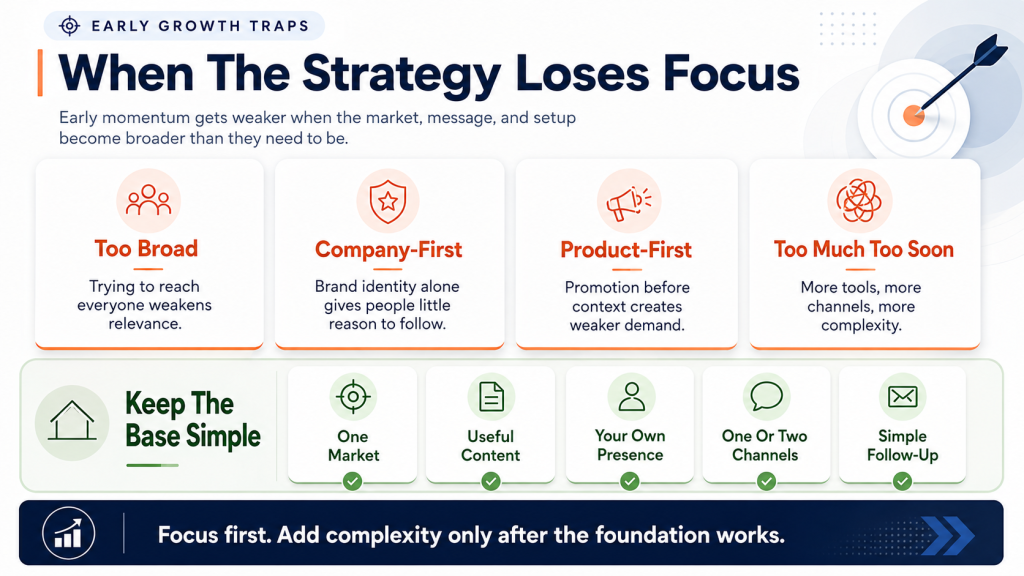
Starting without friends and family works best when the strategy stays focused.
A few mistakes can make the process harder than it needs to be.
Trying to Reach Everyone
A broad message usually creates weak relevance.
Stay focused on the market you chose instead of treating every person as a possible prospect.
Making the Company Your Entire Brand
The company can provide the product and opportunity.
Your presence should still give people a reason to follow you independently of the company name, logo, or promotional material.
Posting Products Before Building Relevance
Constant product posts do not automatically create demand.
Give people useful context first through education, examples, demonstrations, and content connected to the problems they already care about.
Doing Too Much Too Soon
You do not need multiple platforms, complicated funnels, paid tools, or a large content operation on day one.
Start with one market, one or two acquisition channels, a simple content routine, and a basic follow-up system.
Build complexity only when the simpler version gives you a reason to.
Conclusion
Starting network marketing without relying on friends and family requires a different approach from simply working through a contact list.
Begin with a market you understand.
Build a simple presence around useful ideas, choose a small number of places to reach new people, and create content that gives them a reason to notice you before you make an offer.
From there, let relevance guide the conversation.
Product interest can lead toward a customer relationship. Business interest can lead toward the opportunity. Neither path needs to be forced.
Keep the system simple enough to maintain, track what produces real interest, and improve from what you learn.
The goal is not to avoid everyone you already know.
It is to build a business that can grow beyond them.
Frequently Asked Questions
Can You Start Network Marketing Without Friends and Family?
Yes.
Friends and family can be part of your network, but they do not need to become the foundation of your business.
You can reach new people through content, social media, search, communities, referrals, networking, and other channels where your target market already spends time.
How Do Beginners Find Network Marketing Prospects?
Start by choosing a clear market, then look for people who already care about the problems, goals, or product category connected to that market.
Prospects can come from content engagement, referrals, online communities, social platforms, networking, and direct outreach when there is a relevant reason to connect.
Do You Need Social Media to Start Network Marketing?
No.
Social media can make discovery easier, but it is only one channel.
You can also use search-driven content, local networking, referrals, email, communities, professional groups, or other methods that fit your audience and communication style.
What Should You Post When Starting Network Marketing?
Create content around the interests and problems your market already cares about.
Educational posts, practical tips, demonstrations, comparisons, personal experience, and answers to common questions can all give people a reason to follow you.
The company or product does not need to appear in every post.
Should You Promote Yourself or the Network Marketing Company?
Build your own presence while representing the company accurately.
People should have a reason to follow your content, perspective, and experience rather than seeing only company promotions.
The company can become part of the offer without becoming your entire identity.
Should You Focus on Customers or Recruiting First?
Follow the interest the person actually shows.
Someone interested in the product should be treated as a potential customer.
The business opportunity belongs in the conversation when someone begins asking about the work, income structure, or what joining involves.
How Do You Find People Outside Your Personal Network?
Go where relevant people already gather.
That might include online communities, social platforms, search results, local groups, professional networks, events, or audiences built through your own content.
The goal is to expand through relevance rather than simply contacting more strangers.
Do You Need a Website to Start Network Marketing?
Not necessarily.
A clear social profile or another simple online presence can be enough to begin.
A website can become useful later if you want more control over your content, search visibility, email collection, or audience relationships.
How Much Prospecting Should a Beginner Do?
There is no universal number of people you need to contact each day.
Choose a level of prospecting you can maintain while still giving conversations proper attention and follow-up.
Consistency matters more than chasing an arbitrary daily quota.
Should Beginners Use Paid Advertising?
Paid advertising is usually easier to evaluate once you understand your market, message, and customer acquisition process.
Starting with organic content, conversations, referrals, and simple outreach can help you learn what attracts relevant people before adding advertising costs.
What Should You Track When You Are Just Getting Started?
Keep the tracking simple.
Focus on where prospects come from, what they are interested in, whether follow-up makes sense, which conversations become customers or business prospects, and what the process is costing you.
Those early signals can help you decide what deserves more attention.

0 Comments