Introduction
The largest affiliate network is not always the best one for your business.
Some networks offer thousands of advertisers but little relevance to your audience. Others focus on a narrower market, such as SaaS, retail, digital products, or CPA campaigns, and may provide a much stronger fit. The real challenge is knowing which differences matter before you invest time applying, creating content, and promoting offers.
This guide compares the best affiliate networks based on advertiser quality, niche fit, approval requirements, tracking, payments, strengths, and limitations. By the end, you will have a clearer idea of which networks deserve a closer look and which ones may not suit your content or audience.
- The best affiliate network depends on your niche, audience, traffic source, and promotional model.
- Advertiser relevance, tracking reliability, payment terms, and product quality matter more than the size of the network.
- Network approval does not guarantee access to every advertiser, since individual brands set their own requirements and rules.
- Most affiliates should start with one or two well-matched networks and expand only when another platform fills a clear need.
Disclaimer: I am an independent Affiliate. The opinions expressed here are my own and are not official statements. If you follow a link and make a purchase, I may earn a commission.

How We Chose The Best Affiliate Networks
Not every large or well-known network is a strong fit for every affiliate. To compare these options fairly, we looked beyond brand recognition and focused on the factors that affect real-world use.
Each network was evaluated based on:
Advertiser quality and variety
The range and relevance of brands available.
Niche fit
Whether the network serves broad audiences or specializes in areas such as SaaS, retail, digital products, or CPA offers.
Approval process
How easy it is to join the network and apply to individual advertisers.
Tracking and reporting
The clarity and usefulness of performance data.
Commission and payment structure
The types of commissions available and how payments are handled.
Publisher tools and support
Features such as deep linking, campaign discovery, reporting, and account support.
Geographic reach
Whether the network is strongest in one region or supports publishers and advertisers across multiple markets.
Main limitations
The trade-offs affiliates should understand before joining.

Best Affiliate Networks At A Glance
Each affiliate network serves a different type of publisher, audience, and promotional model. Use this comparison to narrow your options before reviewing each network in detail.
| Network | Best For | Network Type | Application Model | Main Trade-Off |
|---|---|---|---|---|
| Awin | Broad advertiser access across industries | Global affiliate network | Network registration with separate advertiser applications | A large catalog requires careful filtering |
| CJ Affiliate | Established publishers and content businesses | Affiliate network | Publisher registration with advertiser-specific partnerships | Better suited to publishers with developed content |
| Impact | Direct relationships with global brands | Partnership marketplace | Affiliates apply to individual brands | Opportunities and terms vary by brand |
| Rakuten Advertising | Global brand and retail partnerships | Affiliate network | Publisher registration with advertiser approval | Program availability varies by market |
| PartnerStack | B2B software and SaaS content | B2B partnership network | Network access with program-specific applications | Less relevant outside B2B and software |
| ClickBank | Digital products and direct-response offers | Affiliate marketplace | Marketplace access with offer-specific conditions | Product quality varies between sellers |
| MaxBounty | CPA marketing and lead generation | Performance marketing network | Affiliate application with campaign-specific approval | Campaign and traffic rules require close attention |
| FlexOffers | Publishers seeking a large advertiser catalog | Affiliate network | Publisher approval with individual program requirements | The number of options can make selection difficult |
| Webgains | Publishers seeking brands across multiple verticals | Affiliate network | Publisher registration with advertiser-specific terms | The strongest opportunities depend on niche and market |
| Tradedoubler | Publishers working across regional and international markets | Affiliate and partner network | Account registration with program applications | Available advertisers vary by country |
These categories are starting points, not guarantees. Each advertiser can establish its own approval requirements, commission terms, promotional restrictions, and geographic availability, even when it operates inside a larger network.
The platforms also differ in focus: PartnerStack specializes in B2B partnerships, Impact connects affiliates directly with brands, ClickBank operates as an affiliate marketplace, and MaxBounty focuses on cost-per-action campaigns.
Top Affiliate Networks Compared
Awin
Best for access to brands across a wide range of industriesAwin is a global affiliate network that connects publishers with brands in sectors such as retail, travel, finance, technology, and telecommunications. Its broad advertiser selection makes it a practical option for bloggers, content creators, comparison sites, and publishers whose recommendations span more than one product category.
Publishers can use Awin to discover advertisers, apply to individual programs, create tracking links, and monitor clicks, sales, and commissions through a central dashboard. The platform also provides reporting tools that help affiliates compare performance across different brands and campaigns.
One of Awin’s main strengths is flexibility. A publisher can begin with a small number of relevant advertisers and add new partnerships as the audience and content strategy develop. This makes the network suitable for both focused niche sites and larger publishers covering several related topics.
The main limitation is that joining Awin does not guarantee access to every advertiser. Brands can establish their own approval requirements, commission structures, promotional rules, and geographic restrictions. A large advertiser directory can also become distracting if affiliates apply to programs without first checking product quality and audience fit.
Awin is worth considering when you want broad brand access without managing separate tracking systems and payment accounts for every partnership. It is less useful when only one direct affiliate program serves your audience better.
CJ Affiliate
Best for established publishers seeking recognized brand partnershipsCJ Affiliate is a global affiliate network that connects publishers with advertisers across retail, travel, technology, finance, and other industries. It is best suited to affiliates who already have a developed website, a defined audience, and a clear plan for promoting relevant products or services.
Publishers can search for advertisers, apply to individual programs, generate tracking links, and monitor performance through the CJ platform. Its Deep Link Generator also allows affiliates to direct readers to specific product or category pages instead of sending every visitor to an advertiser’s homepage.
One of CJ Affiliate’s main strengths is its combination of established advertisers and mature publisher tools. Affiliates can organize several partnerships in one account while using reporting data to compare clicks, conversions, and commission performance.
The main limitation is that joining CJ does not guarantee acceptance into every advertiser program. Each brand can review applications and set its own content, traffic, geographic, and promotional requirements. Publishers with incomplete websites or unclear audience positioning may find it harder to secure the partnerships they want.
CJ Affiliate is worth considering when you have an established content platform and want to build long-term relationships with recognizable advertisers. New affiliates who are still developing their content may find a more accessible network easier to begin with.
Impact
Best for seeking direct, long-term brand partnershipsImpact is not a traditional affiliate network. It is a broader partnership management platform with a marketplace where affiliates, creators, and publishers can discover brands, apply to programs, generate tracking links, and earn commissions from approved partnerships.
The marketplace includes brands across industries such as retail, travel, beauty, fitness, and financial services. Rather than treating every relationship as a standard affiliate offer, Impact gives brands more control over partnership terms, commission structures, campaigns, and promotional requirements.
One of Impact’s main strengths is the level of visibility it provides. Publishers can review opportunities, communicate with brands, monitor performance, and manage multiple partnerships through one platform. This makes it useful for creators who want to move beyond isolated affiliate links and develop more deliberate relationships with companies that fit their content and audience.
The main limitation is that opportunities and approval requirements vary considerably by brand. Joining the marketplace does not guarantee acceptance into individual programs, and publishers may need a clear audience, established content, or a specific promotional plan to secure the partnerships they want.
Impact is worth considering when you want flexibility, direct brand access, and tools that support different types of commercial partnerships. Affiliates looking for the simplest possible marketplace with immediately accessible offers may find a more traditional network easier to navigate.
Rakuten Advertising
Best for established retail, consumer, and international brand partnershipsRakuten Advertising is a global affiliate network that connects publishers with advertisers across multiple industries and markets. Its network includes established brands, making it a relevant option for publishers creating product reviews, buying guides, comparison content, and other commerce-focused resources.
Publishers can register for a free account, search for advertisers, review available offers, and apply to individual programs. Once approved, they can create affiliate links, promote relevant products, track performance, and manage earnings through the platform.
One of Rakuten Advertising’s main strengths is its access to recognized brands. Familiar companies can be easier to introduce naturally because readers may already understand their products and trust their reputation. The platform can be especially useful when brand recognition plays an important role in the buying decision.
The main limitation is that registering with Rakuten Advertising does not provide automatic access to every advertiser. Each company sets its own approval criteria, commission terms, geographic availability, and promotional restrictions. The quality and relevance of available opportunities may also vary depending on the publisher’s country and niche.
Rakuten Advertising is worth considering when your content focuses on retail, consumer products, or brands with an international presence. Affiliates should review the available advertisers before joining rather than assuming the network will contain suitable offers for every audience.
PartnerStack
Best for creating B2B, software, and SaaS contentPartnerStack is a partnership network built specifically for B2B software companies and the publishers, consultants, agencies, and creators who promote them. Its focused marketplace makes it especially relevant to affiliates who publish software reviews, tutorials, comparisons, and business-focused educational content.
Affiliates can use PartnerStack to discover SaaS programs, apply to individual partnerships, generate tracking links, and manage commissions through one account. Depending on the program, affiliates may earn through recurring revenue share, one-time actions, qualified leads, or registered deals.
One of PartnerStack’s main strengths is its ability to track more than a single purchase. Some programs can reward affiliates for recurring subscriptions, renewals, upsells, or actions completed at different stages of the customer journey. This can be valuable in B2B markets, where buying decisions often take longer and customer relationships may continue for months or years. The platform also centralizes reporting and monthly payouts.
The main limitation is its narrow focus. PartnerStack is a strong option for affiliates serving founders, marketers, sales teams, agencies, and other professional audiences, but it offers less value to publishers focused primarily on consumer products, fashion, travel, or general retail.
PartnerStack is worth considering when your audience regularly evaluates software and business tools. Affiliates outside B2B and SaaS will likely find a broader network more useful.
ClickBank
Best for digital products and direct-response campaignsClickBank combines an affiliate marketplace with ecommerce and payment infrastructure. Affiliates can browse offers from independent sellers, generate tracking links, and earn commissions when their referrals complete qualifying purchases or actions.
The marketplace supports both revenue-share and cost-per-action commission models. Revenue share pays the affiliate a percentage of the sale, while CPA offers provide a fixed payment for a qualifying conversion. Individual sellers determine which structure they offer and how much affiliates can earn.
One of ClickBank’s main strengths is accessibility. Affiliates can compare marketplace data, create tracking links, and monitor clicks, conversions, and commissions from one account. ClickBank also states that eligible affiliates can receive payments up to twice per week.
The main limitation is inconsistent offer quality. Products come from independent sellers, so the customer experience, sales claims, refund rates, and promotional materials can vary considerably. Marketplace metrics may help identify active offers, but they do not replace reviewing the product, seller, landing page, and refund policy.
ClickBank is worth considering when you understand direct-response content and are prepared to evaluate each offer carefully. Affiliates who prefer familiar retail brands or tightly managed advertiser relationships may be better served by a traditional network.
MaxBounty
Best for CPA marketing, lead generation, and action-based campaignsMaxBounty is a performance marketing network that connects affiliates with campaigns across multiple industries and geographic markets. Unlike networks built mainly around retail purchases, MaxBounty specializes in cost-per-action offers that pay when a user completes a defined conversion.
Depending on the campaign, that action may be a qualified lead, account registration, app installation, form submission, subscription, or completed sale. This gives affiliates more ways to earn than relying only on product purchases, but it also makes understanding the conversion requirements essential.
One of MaxBounty’s main strengths is its range of performance-based campaigns. It can suit affiliates who use content, email, social media, search marketing, or paid traffic, provided the individual campaign permits that traffic source. The network also assigns affiliate managers who can help publishers identify campaigns and understand promotional requirements.
The main limitation is that CPA campaigns often have detailed rules. Each advertiser may restrict certain traffic methods, countries, keywords, creatives, or promotional claims. A lead can also be rejected if it does not meet the campaign’s qualification standards. Affiliates must understand exactly what counts as a valid conversion before promoting an offer.
MaxBounty is worth considering when you understand targeted traffic and want to earn from leads or other actions beyond direct sales. Affiliates who are completely new to performance marketing may need time to learn its campaign rules and approval process.
FlexOffers
Best for access to a large and varied advertiser catalogFlexOffers is a partner marketing platform that connects publishers, creators, and media companies with more than 12,000 advertiser programs across a wide range of categories. Its broad selection makes it a practical option for affiliates who cover several product types or want to compare offers without managing accounts across many separate networks.
Publishers can use the platform to discover advertisers, apply to relevant programs, create deep links, access product feeds, and monitor performance through real-time reporting. These tools can help affiliates organize multiple partnerships and direct readers to specific products or landing pages.
One of FlexOffers’ main strengths is variety. Affiliates can explore programs across retail, travel, finance, technology, health, business services, and other markets. This can be useful for publishers whose content spans several related categories or whose audience has diverse purchasing needs.
That variety is also its main limitation. A large catalog can encourage affiliates to join too many programs or promote offers without evaluating their relevance, terms, or customer experience. Individual advertisers may also establish their own approval requirements, commission structures, and promotional restrictions.
FlexOffers is worth considering when you want broad advertiser access and tools for managing several partnerships in one place. Affiliates with a highly specialized audience should confirm that the platform has enough strong programs in their niche before applying.
Webgains
Best for international advertisers across retail and consumer marketsWebgains is a global affiliate network that connects publishers with more than 1,800 advertisers across a wide range of industries. Its international reach makes it relevant to affiliates who want to promote brands across several countries rather than focus on a single domestic market.
Publishers can use the platform to discover advertisers, apply to individual programs, create tracking links, and monitor performance. Webgains also emphasizes publisher support, offering guidance intended to help affiliates identify suitable partnerships and improve their campaigns.
One of Webgains’ main strengths is its combination of advertiser variety and geographic reach. The network reports working with publishers and brands across more than 150 countries, which can be useful for websites, creators, and comparison platforms serving audiences in multiple regions.
The main limitation is that the strongest opportunities depend on your niche, location, and audience. A large international network does not guarantee that every publisher will find enough relevant advertisers in each market. Individual brands may also set their own application requirements, commission terms, and promotional restrictions.
Webgains is worth considering when your content reaches European or international audiences and you want access to brands across several consumer categories. Affiliates focused on a highly specialized niche should review the advertiser directory first to confirm that the available programs justify adding another network.
Tradedoubler
Best for brand partnerships across European and international marketsTradedoubler is a partner marketing network that connects publishers, creators, influencers, and other digital partners with brands across multiple industries. Its international presence makes it relevant to affiliates whose content reaches audiences in more than one country or region.
Publishers can search the network’s program directory, find brands that match their content, and apply to become approved partners. Once accepted into a program, they can use trackable links to promote products or services through websites, social media, videos, email, and other permitted channels.
One of Tradedoubler’s main strengths is the range of publisher types it supports. Traditional content websites can use the network alongside creators, influencers, comparison platforms, and other digital businesses. This flexibility may appeal to affiliates who use several content formats rather than relying on one promotional channel.
The main limitation is that available brands and opportunities can vary by country. Joining the network does not guarantee access to every program, and individual advertisers may set their own approval criteria, commission terms, geographic restrictions, and promotional rules. Affiliates should review the program directory for their target market before deciding whether the network offers enough relevant partnerships.
Tradedoubler is worth considering when you serve European or international audiences and want access to programs across several digital channels. Publishers focused on one highly specialized market should first confirm that the available brands align closely with their niche.
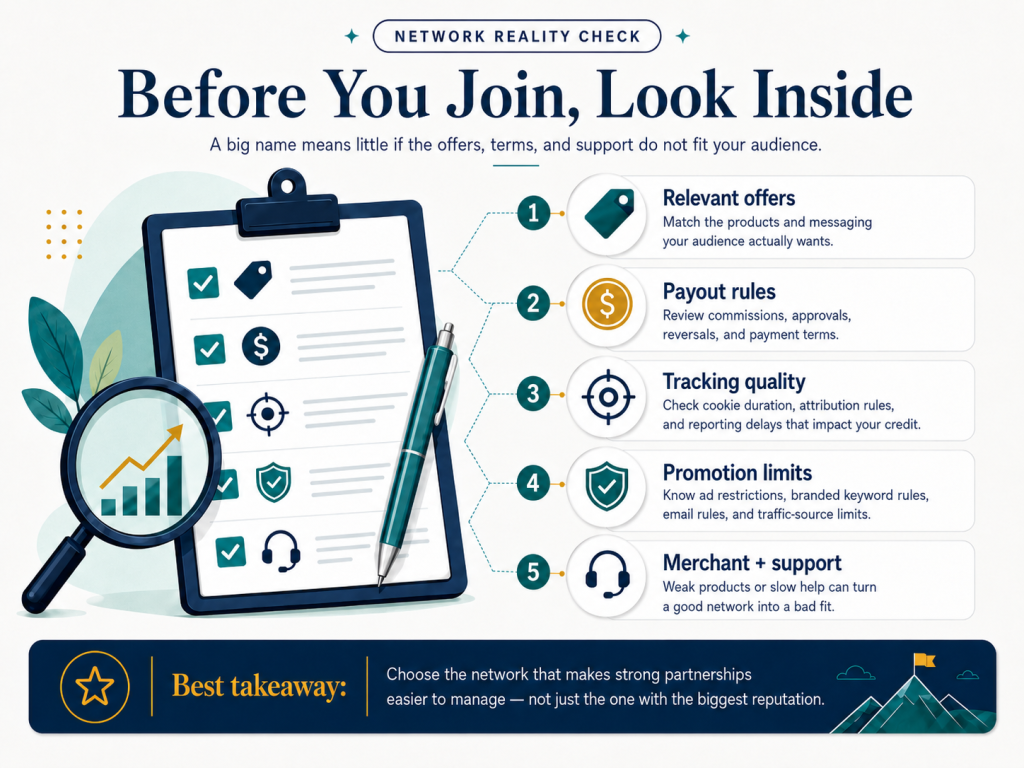
What To Check Before Joining An Affiliate Network
A network may look strong from the outside but still offer little value for your audience. Before applying, review the programs, terms, and tools inside the platform rather than relying on its reputation alone.
Relevant Advertisers
Check whether the network includes brands and products that match your niche. A large advertiser catalog means little if most offers are unrelated to your content or audience.
Commission And Validation Terms
Review how commissions are calculated, when conversions are approved, and which actions can lead to reversals. Pay attention to refund periods, lead requirements, and recurring commission terms where applicable.
Tracking And Attribution
Look at how the network records referrals and assigns credit. Cookie duration, attribution rules, cross-device tracking, and reporting delays can all affect whether a conversion is credited to you.
Payment Conditions
Confirm the payment schedule, minimum payout threshold, supported payment methods, currencies, and possible transaction fees. Clear payment terms help prevent surprises after commissions begin accumulating.
Promotional Restrictions
Individual advertisers may restrict paid search, branded keywords, email promotion, coupon codes, social media, or specific traffic sources. Read the program rules before publishing content or spending money on promotion.
Merchant Quality
The network provides access to advertisers, but it does not guarantee that every product deserves your recommendation. Review the merchant’s reputation, customer experience, refund policy, and sales claims before sending your audience to an offer.
Publisher Support
Reliable support matters when tracking fails, commissions disappear, or program terms change. Check whether the network provides clear documentation, responsive assistance, or access to an account manager.
Disclaimer: I am an independent Affiliate. The opinions expressed here are my own and are not official statements. If you follow a link and make a purchase, I may earn a commission.
How To Improve Your Chances Of Approval
Affiliate networks and advertisers want to understand who you are, what kind of audience you reach, and how you plan to promote their offers. A clear, complete application makes that decision easier.
Apply To Networks That Fit Your Content
Start with networks and advertisers that align with your niche, audience, and promotional methods. A strong match gives the reviewer a clear reason to approve your application.
Applying to every available program usually creates more rejections than opportunities.
Build A Clear Online Presence
Your website, video channel, newsletter, or social profile should make your purpose easy to understand.
Show who the content is for, which topics you cover, and how your recommendations help the audience. Avoid applying with unfinished pages, unrelated content, or profiles that provide little information about your work.
Explain Your Promotion Strategy
Describe how and where you plan to promote affiliate offers. Be specific about the formats you use, such as product reviews, tutorials, comparisons, buying guides, videos, or email content.
Clear answers are more useful than vague phrases such as “digital marketing” or “online promotion.”
Complete Every Application Carefully
Use consistent business or personal information, provide accurate contact details, and answer each question fully. If the network or advertiser asks for more information, respond clearly and professionally.
Small details can affect how reliable and prepared you appear.
Treat Rejection As Feedback
A rejection does not always mean the opportunity is closed permanently. Your content may be too new, the audience may not fit, or the application may need more detail.
Review what you can improve, strengthen your content or positioning, and reapply later when the program allows it. You may also find that another advertiser is simply a better match.
Conclusion
The best affiliate network is not the one with the most advertisers or the highest advertised commissions. It is the one that gives you access to relevant offers, reliable tracking, clear payment terms, and products you can recommend with confidence.
Awin, CJ Affiliate, Impact, Rakuten Advertising, PartnerStack, ClickBank, MaxBounty, FlexOffers, Webgains, and Tradedoubler each serve different publishers and promotional models. Some offer broad advertiser access. Others specialize in SaaS, CPA campaigns, digital products, or regional markets.
Start with one or two networks that align closely with your audience and content. Review the individual advertisers carefully, learn how the platform works, and expand only when another network offers a clear advantage. Strong affiliate partnerships come from fit and judgment, not from collecting as many accounts as possible.

Frequently Asked Questions
What Is The Best Affiliate Network For Beginners?
There is no single best network for every beginner. Awin and FlexOffers may suit publishers who want access to several advertiser categories, while ClickBank may appeal to affiliates interested in marketplace-based offers. The better starting point is the network with relevant programs, understandable terms, and an application process that matches your current content.
Which Affiliate Network Is Best For Bloggers?
The answer depends on the blog’s niche. Awin, CJ Affiliate, FlexOffers, and Rakuten Advertising cover multiple industries, while PartnerStack is more relevant to blogs focused on business software and SaaS. Review the available advertisers before choosing a network based on its name alone.
Which Affiliate Network Is Best For SaaS?
PartnerStack is one of the clearest options for SaaS-focused affiliates because its network is built specifically around B2B partnership programs. It can suit publishers creating software reviews, tutorials, comparisons, and business-focused content.
Which Affiliate Network Is Best For CPA Marketing?
MaxBounty is designed around performance-based CPA campaigns. Its advertisers can pay for actions such as leads, registrations, sales, signups, and app installations. Affiliates should review each campaign’s traffic rules and qualification requirements before promoting it.
Can You Join More Than One Affiliate Network?
In many cases, yes. Affiliates can use multiple networks as long as they follow each platform’s and advertiser’s terms. However, joining too many networks at once can make reporting, content planning, and offer evaluation harder to manage.
Do Affiliate Networks Charge Publishers To Join?
Many networks do not charge a standard membership fee, but registration conditions vary. Some may require identity verification, an active promotional channel, or a small refundable security deposit. Awin, for example, requires a refundable security deposit during publisher registration in some markets.
Do You Need A Website To Join An Affiliate Network?
It depends on the network. Some accept publishers using social media, newsletters, video channels, or other promotional spaces. Others have stricter requirements. CJ Affiliate currently requires an active website with a valid domain for publisher applications.
How Long Does Affiliate Network Approval Take?
Approval time varies by network and advertiser. Some network applications are reviewed quickly, while individual brands may take longer to evaluate your content, audience, traffic sources, and promotional plans. Joining a network also does not guarantee approval for every advertiser inside it.
Are Affiliate Networks Better Than Direct Affiliate Programs?
Not automatically. Networks provide access to multiple advertisers, centralized reporting, and consolidated account management. Direct programs may offer closer communication, specialized support, or terms designed around one brand. Many affiliates use both.
What Happened To ShareASale?
ShareASale was consolidated into Awin in 2025. Awin announced that it had completed the platform upgrade in August 2025, combining the two networks into one global platform. Publishers looking for ShareASale should now review Awin’s current advertiser directory and publisher tools.

3 Comments
Affiliate Networks Explained: How to Choose & Earn in 2025 - Ismel Guerrero. · February 22, 2025 at 8:16 pm
[…] Next, check out our Affiliate Marketing Platforms Guide. […]
My Big Commissions Review: Internet Marketing - Ismel Guerrero. · March 11, 2025 at 1:21 pm
[…] Next, check out the best affiliate marketing programs. […]
Affiliate Marketing 101: How to Start Earning in 2025 - Ismel Guerrero. · May 25, 2025 at 12:24 pm
[…] Check out our Full Affiliate Marketing Platforms Guide. […]