Introduction
Affiliate marketing has become one of the most talked-about ways to make money online, but it is also one of the most misunderstood.
Between promises of effortless passive income and claims that the industry is too competitive to succeed, it can be difficult to separate realistic advice from exaggerated expectations. That confusion leaves many people wondering whether affiliate marketing is still worth pursuing and, more importantly, what it actually takes to succeed.
This guide cuts through the noise. You’ll learn how affiliate marketing works, what happens behind the scenes, the advantages and challenges of the business model, how to get started the right way, and the principles that help successful affiliates build long-term, sustainable income.
- Affiliate marketing is a performance-based business model that rewards affiliates for driving sales, leads, or other qualified actions.
- Success depends on more than sharing affiliate links. Trust, audience alignment, and valuable content are what drive long-term results.
- Understanding how tracking links, cookies, attribution, and commission models work helps you make better decisions as an affiliate.
- Choosing the right niche, products, and promotional channels has a greater impact than simply joining more affiliate programs.
- The most successful affiliates focus on helping people solve problems and make informed buying decisions rather than chasing quick commissions.
- Affiliate marketing offers flexibility and low startup costs, but it also requires consistency, patience, and a long-term mindset.
- By the end of this guide, you’ll have a clear understanding of how affiliate marketing works and the knowledge to decide whether it’s the right business model for you.
Disclaimer: I am an independent Affiliate. The opinions expressed here are my own and are not official statements. If you follow a link and make a purchase, I may earn a commission.
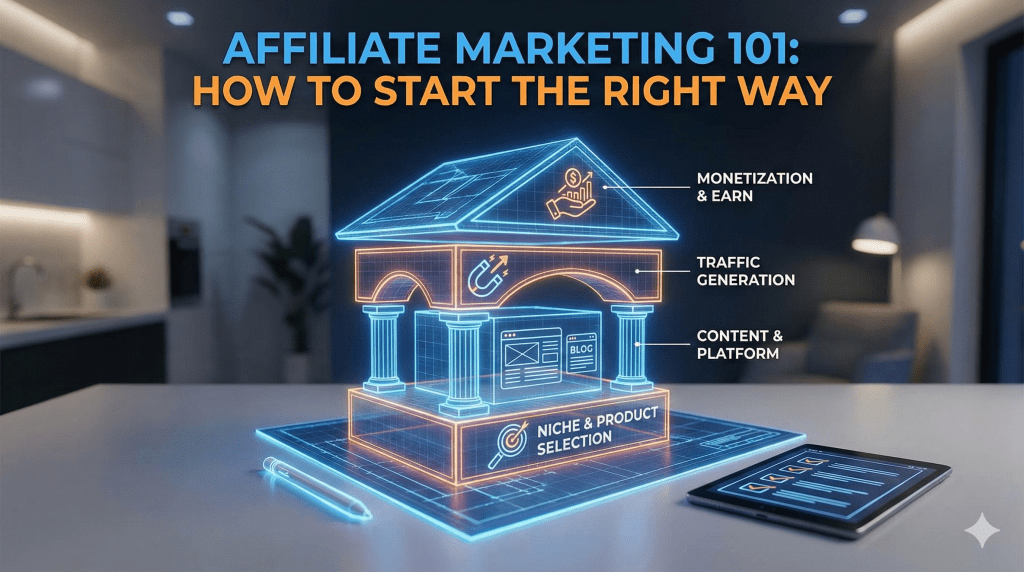
What Is Affiliate Marketing?
Affiliate marketing is a performance-based marketing model where individuals or businesses earn a commission for promoting another company’s products or services. Instead of creating their own products, affiliates recommend solutions they believe will benefit their audience and earn a commission when someone completes a qualifying action, such as making a purchase, signing up for a service, or submitting a lead form.
The concept is straightforward, but it creates value for everyone involved. Businesses gain a cost-effective way to reach new customers, affiliates have an opportunity to monetize their content and expertise, and consumers discover products through recommendations that help them make more informed decisions.
Every affiliate marketing transaction involves four key participants:
- The merchant, who owns the product or service.
- The affiliate, who promotes the offer.
- The customer, who clicks the affiliate link and completes the desired action.
- The affiliate program or network, which tracks referrals and manages commissions.
While the idea is simple, affiliate marketing relies on a system of tracking technology, attribution rules, and commission structures working behind the scenes. Understanding how those pieces fit together is what separates a basic understanding of affiliate marketing from knowing how to use it effectively.
Why Affiliate Marketing Matters
Affiliate marketing matters because it connects businesses, creators, and customers in a way that can benefit all three.
For businesses, it creates a performance-based marketing channel. Instead of paying only for visibility, they can reward affiliates when a specific action happens, such as a sale, signup, or qualified lead.
For affiliates, it creates a way to earn income without building a product from scratch. They can focus on understanding an audience, creating useful content, and recommending products that fit a real need.
For customers, affiliate marketing can make buying decisions easier. A helpful review, comparison, tutorial, or guide can reduce confusion and point them toward a product that fits their situation.
That is why affiliate marketing continues to matter. At its best, it is not about pushing links. It is about connecting the right person with the right solution at the right moment.
How Affiliate Marketing Actually Works
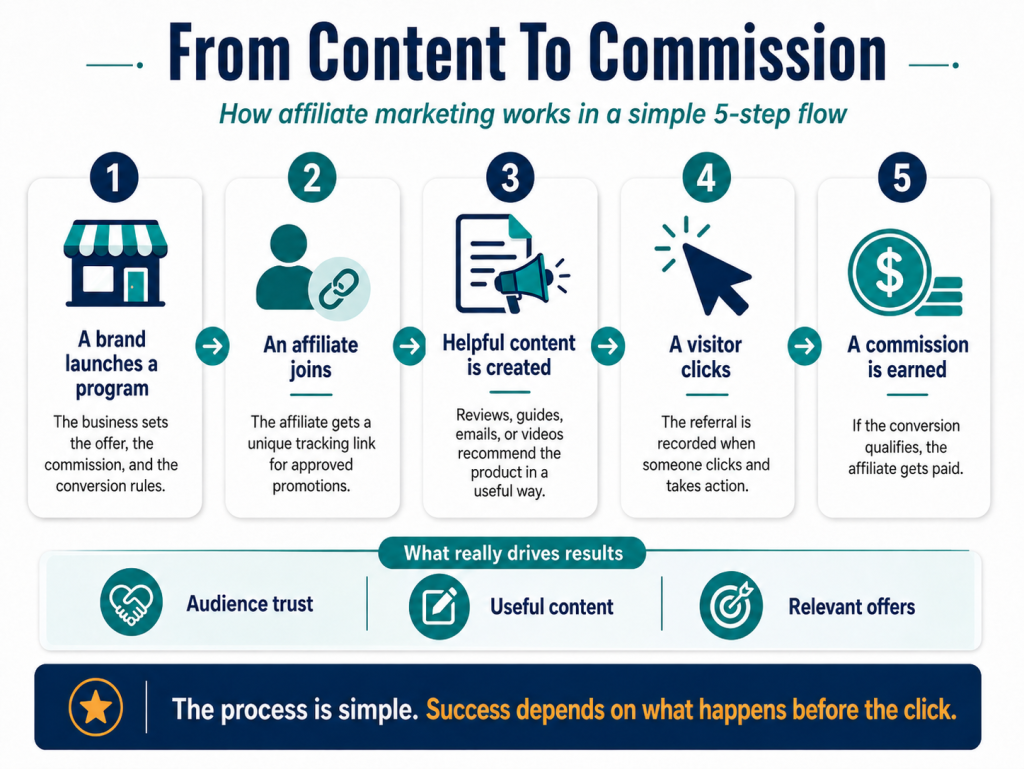
Affiliate marketing works by connecting a business with potential customers through trusted recommendations.
When someone clicks an affiliate’s unique tracking link and completes a qualifying action, the affiliate earns a commission.
Although the process is straightforward, each step plays an important role.
A Business Creates An Affiliate Program
The process begins when a business decides to reward affiliates for promoting its products or services.
The business sets the commission structure, defines what counts as a successful conversion, and provides affiliates with the tools they need to promote its offers.
An Affiliate Joins The Program
Once accepted into the program, the affiliate receives a unique tracking link. This link identifies the affiliate as the source of any qualified referrals.
The Affiliate Creates Valuable Content
Instead of simply sharing a link, the affiliate creates content that helps people solve a problem or make a decision. This may include product reviews, comparison articles, tutorials, buying guides, videos, or email newsletters.
The recommendation should feel like a natural part of the content, not the reason the content exists.
A Customer Clicks The Affiliate Link
When a reader, viewer, or subscriber clicks the affiliate link, the tracking system records the referral. If that person completes the required action within the program’s rules, the affiliate becomes eligible to earn a commission.
The Affiliate Earns A Commission
After the conversion is verified, the affiliate receives the agreed commission. Depending on the affiliate program, this may be a percentage of the sale, a fixed payment, a recurring commission, or another performance-based reward.
The process itself is simple. What determines success is everything that happens before the click. The better an affiliate understands their audience, creates useful content, and recommends relevant products, the more likely that process is to end in a commission.
What Makes Affiliate Marketing Work Behind The Scenes
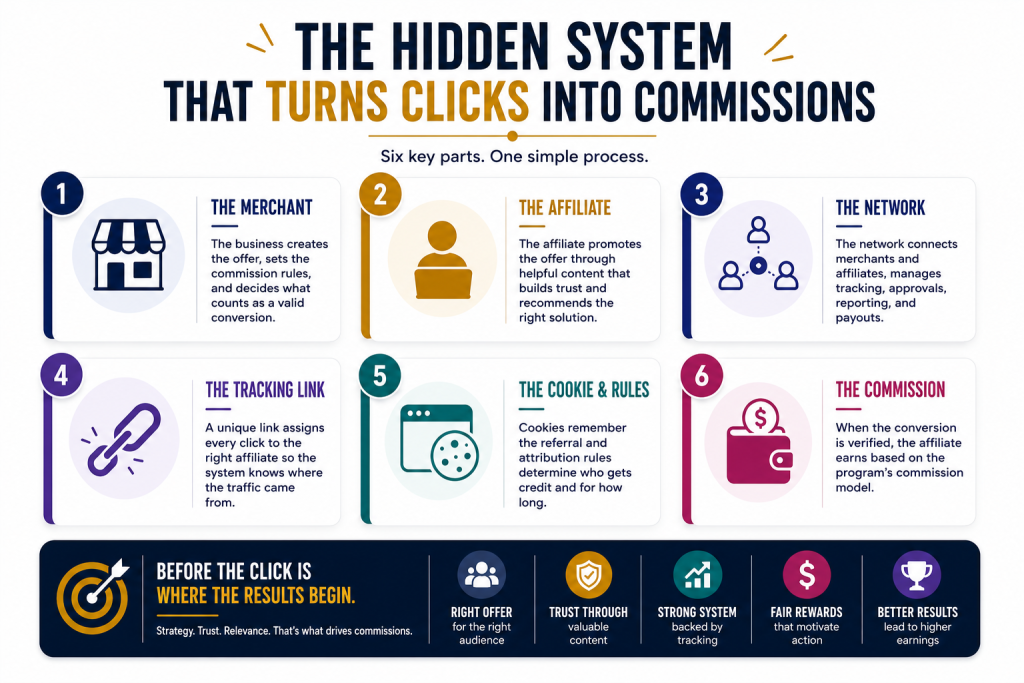
Every affiliate commission depends on more than a link. Behind each referral is a system that tracks where the customer came from, decides who gets credit, and determines how much the affiliate earns.
Merchants
The merchant is the business that owns the product or service. This could be a software company, online store, course creator, financial brand, travel company, or any business that wants affiliates to help drive sales or leads.
Merchants create the offer, set the commission terms, approve affiliates, and decide what counts as a valid conversion.
Affiliates
The affiliate is the person or business promoting the merchant’s offer. Affiliates may be bloggers, YouTubers, newsletter writers, influencers, review sites, comparison websites, or niche publishers.
Their role is to connect the right audience with the right product through useful content and clear recommendations.
Affiliate Networks
An affiliate network acts as the middle layer between merchants and affiliates. It gives affiliates access to multiple programs in one place and helps manage tracking, reporting, approvals, and payouts.
Not every affiliate program uses a network. Some companies run their own programs directly, but networks can make the process easier for both sides.
Tracking Links
Tracking links are unique URLs that identify which affiliate sent a visitor to the merchant’s website. When someone clicks the link, the tracking system records the referral.
Without tracking links, the merchant would not know which affiliate deserves credit for the sale or lead.
Cookies And Attribution
Cookies help affiliate programs remember that a visitor came from a specific affiliate link. If the visitor buys later, the cookie can help connect that sale back to the affiliate.
Attribution rules decide who gets credit. Some programs credit the last affiliate link clicked. Others use different rules. The cookie window also matters because it determines how long after the click a purchase can still count.
Commission Models
Commission models determine how affiliates get paid. Some programs pay a percentage of each sale. Others pay a flat fee for every lead, signup, or purchase.
Common models include pay per sale, pay per lead, recurring commissions, one-time flat fees, and percentage-based commissions.
The best model depends on the product, the audience, and the long-term value of the customer.

The Pros And Cons Of Affiliate Marketing
Affiliate marketing has become one of the most accessible online business models, but like any business, it comes with both opportunities and challenges.
Understanding both sides will help you set realistic expectations and decide whether it aligns with your goals.
| Pros | Cons |
|---|---|
| Low startup costs | Income is not guaranteed |
| No need to create or manage your own products | Building traffic takes time |
| Flexible enough to fit almost any niche | Competition can be high in popular markets |
| Can generate recurring or passive income over time | Affiliate programs can change commissions or terms |
| Easy to scale as your audience grows | Results depend on trust and consistency |
| Multiple ways to promote products | Earnings can fluctuate with traffic and conversions |
The advantages make affiliate marketing attractive to beginners and experienced creators alike. You can start with minimal investment, work from almost anywhere, and build an income stream around content that continues to attract visitors over time.
The challenges are just as important to understand. Affiliate marketing is not a shortcut to easy money. Success depends on attracting the right audience, creating valuable content, choosing products carefully, and continuing to improve as markets, platforms, and customer behavior evolve.
When Affiliate Marketing Makes Sense
Affiliate marketing is a good fit for people who enjoy creating helpful content, solving problems, and building trust with an audience over time. It works especially well for bloggers, YouTubers, educators, niche website owners, and anyone who consistently helps others make informed buying decisions.
On the other hand, if you’re looking for guaranteed income, immediate results, or a business that requires little ongoing effort, affiliate marketing may not meet your expectations.
While the barrier to entry is low, long-term success comes from consistency, patience, and a genuine commitment to helping your audience before earning a commission.
How To Start Affiliate Marketing
Getting started with affiliate marketing is less about joining dozens of affiliate programs and more about building a system that connects the right audience with the right products.
While every affiliate follows a different path, the most successful ones tend to follow the same fundamentals.
Choose A Focused Niche
Start with a niche you can create content around consistently. A good niche has a defined audience, clear problems to solve, and products or services that naturally fit those needs.
The more focused your niche is, the easier it becomes to understand your audience and create content that stands out.
Understand Your Audience
Before recommending any product, take time to understand who you’re trying to help. What problems are they trying to solve? What questions do they ask before making a purchase? What concerns keep them from taking action?
The better you understand your audience, the easier it becomes to recommend products that genuinely add value.
Pick One Primary Platform
Choose one platform where you’ll consistently publish content. This could be a blog, YouTube channel, email newsletter, podcast, or social media account.
You don’t need to be everywhere. Building one platform well is usually more effective than spreading yourself across several channels too early.
Join Relevant Affiliate Programs
Look for affiliate programs that match your niche and your audience’s needs. Product quality, brand reputation, commission structure, and customer experience are often more important than the highest commission percentage.
A recommendation carries your reputation with it. Promote products you would feel comfortable recommending even if there were no commission involved.
Create Valuable Content
Content is what earns attention and builds trust. Reviews, buying guides, tutorials, comparisons, and educational articles help people understand their options and make informed decisions.
The goal is not to sell every visitor. It is to become a reliable source of information that people return to when they need advice.
Drive Qualified Traffic
People need to discover your content before they can click an affiliate link. Traffic can come from search engines, YouTube, social media, email marketing, podcasts, or other channels.
Focus on attracting people who are already interested in the topic rather than chasing large amounts of untargeted traffic.
Measure And Improve
Affiliate marketing is an ongoing process of learning and refinement. Track which content attracts visitors, which affiliate links receive clicks, and which recommendations generate commissions.
Use those insights to improve your content, strengthen your recommendations, and focus your effort on the strategies that deliver the best results.
How To Choose The Right Affiliate Programs
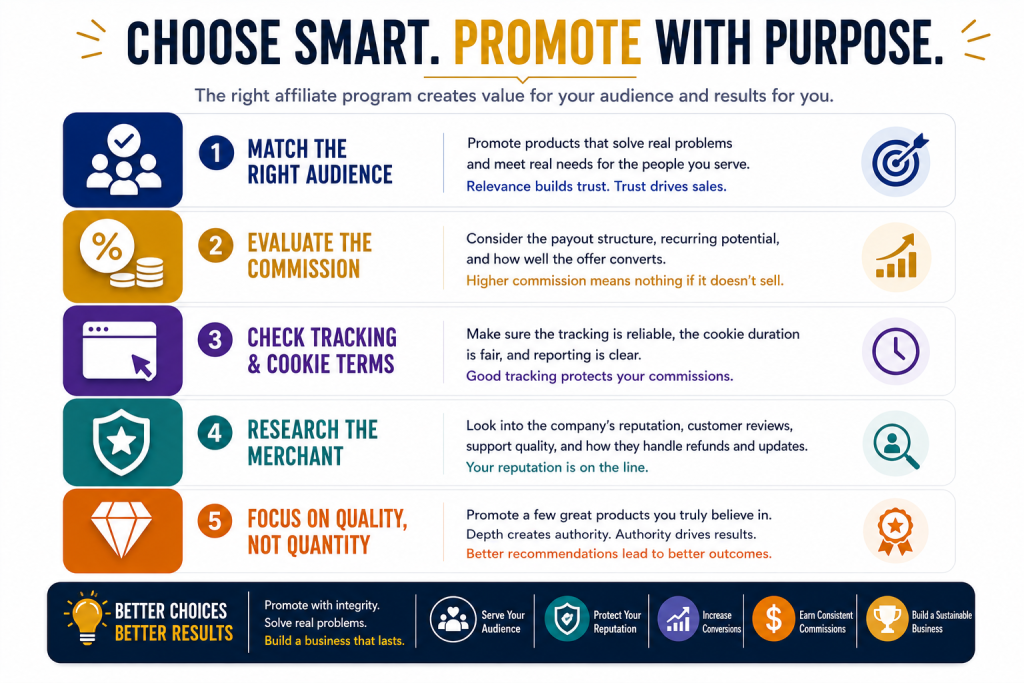
Not all affiliate programs are worth promoting. The right program is not necessarily the one with the highest commission. It is the one that best serves your audience while offering a reliable earning opportunity.
Choosing affiliate programs carefully from the beginning can improve conversions, strengthen your credibility, and help you build a more sustainable business.
Look For Products That Fit Your Audience
Every recommendation should solve a real problem or meet a genuine need. Before joining a program, ask yourself whether the product naturally fits the audience you serve.
If the recommendation feels forced, your audience will notice. Relevance almost always outperforms a higher commission rate.
Evaluate The Commission Structure
Commission rates are important, but they are only one part of the equation. Consider how the program pays affiliates, whether commissions are one-time or recurring, and whether the earning potential matches the effort required to promote the product.
Sometimes a lower commission on a product with strong demand and high conversion rates can outperform a higher-paying offer that rarely sells.
Check Tracking And Cookie Duration
Reliable tracking ensures you receive credit for the referrals you generate. Review how long the program’s cookie lasts, how conversions are attributed, and whether reporting is transparent.
Programs with accurate tracking and reasonable cookie durations generally provide a better experience for affiliates.
Research The Merchant’s Reputation
Your recommendation reflects your reputation. Before promoting any product, research the company behind it. Read customer reviews, evaluate the buying experience, and consider how the company handles support, refunds, and updates.
Even a great commission is not worth recommending a product that creates a poor customer experience.
Focus On Quality Over Quantity
Many beginners believe they need dozens of affiliate programs to increase their income. In reality, promoting a smaller number of high-quality products often produces better results.
When you know the products well and understand who they are best suited for, your recommendations become more helpful, more credible, and more likely to convert.

Popular Ways To Do Affiliate Marketing
There is no single “best” way to do affiliate marketing. The right approach depends on where your audience spends time, how they prefer to consume content, and the types of products you promote.
Many successful affiliates eventually combine multiple channels, but most start by mastering one.
Blogging And SEO
A blog is one of the most effective long-term affiliate marketing channels. By creating helpful articles, reviews, tutorials, and buying guides, you can attract people who are actively searching for solutions.
While SEO takes time, well-written content can continue generating traffic and commissions long after it is published.
Product Reviews
Product reviews help people evaluate whether a product is worth buying. A useful review goes beyond listing features by explaining who the product is for, where it performs well, its limitations, and how it compares to alternatives.
Honest reviews build far more trust than overly promotional ones.
Comparison Articles
Comparison articles help readers choose between two or more products. They work particularly well because the audience has already decided to buy something and simply needs help choosing the right option.
Clear comparisons, objective criteria, and balanced recommendations make this type of content especially valuable.
YouTube
Video allows affiliates to demonstrate products, answer questions, and build trust through real-world examples. Tutorials, walkthroughs, product reviews, and demonstrations can help viewers understand how a product works before making a purchase.
For many products, seeing them in action is more persuasive than reading about them.
Email Marketing
Email gives affiliates a direct way to stay connected with their audience. Instead of relying entirely on search engines or social media algorithms, you can continue educating subscribers, sharing valuable content, and recommending products when they are genuinely relevant.
The strongest email campaigns prioritize helping subscribers rather than constantly selling to them.
Social Media
Social media can help affiliates build awareness, engage with their audience, and introduce products naturally through short-form videos, educational posts, live streams, and community discussions.
While social platforms are excellent for discovery, they usually perform best when they support a website, YouTube channel, or email list.
Resource Pages
A resource page brings together the products, tools, and services you genuinely recommend in one organized location. Rather than scattering recommendations across dozens of articles, readers can quickly find your favorite resources in a single place.
When maintained regularly, resource pages can become one of the most visited sections of an affiliate website.
What Makes Affiliate Marketing Successful
Successful affiliate marketing is not built on a single tactic. It comes from combining the right audience, the right content, the right products, and a long-term approach.
While every affiliate’s strategy is different, the underlying principles remain remarkably consistent.
Build Trust Before You Sell
Trust is the foundation of affiliate marketing. People are far more likely to act on a recommendation when they believe it is made in their best interest rather than for a commission.
That trust is earned by being honest, transparent, and willing to explain not only who a product is for, but also who it is not for.
Match Products To Audience Needs
The highest-paying product is not always the best product to recommend. Successful affiliates focus on relevance first.
When a recommendation solves a real problem at the right stage of the customer’s journey, it feels helpful instead of promotional. That alignment leads to stronger engagement, higher conversions, and long-term credibility.
Create Content That Solves Problems
Affiliate links rarely convince people to buy. Helpful content does.
Whether you’re writing a buying guide, publishing a product review, creating a tutorial, or comparing two solutions, your content should answer questions, reduce uncertainty, and help readers make confident decisions.
The product should feel like the natural next step, not the purpose of the content.
Stay Consistent And Keep Improving
Affiliate marketing rewards consistency more than perfection. Every article you publish, every video you create, and every recommendation you make teaches you something about your audience.
As you continue creating content, analyzing results, and refining your approach, small improvements begin to compound. Over time, that consistency becomes one of your biggest competitive advantages.

Common Affiliate Marketing Mistakes To Avoid
Many affiliate marketers struggle not because the business model is flawed, but because they make avoidable mistakes that weaken trust and limit long-term growth. Recognizing these mistakes early can save you time, improve your results, and help you build a more sustainable affiliate business.
Treating Affiliate Links As The Strategy
Affiliate links are simply tracking tools. By themselves, they have no persuasive power.
People click affiliate links because the content around them answers a question, solves a problem, or helps them make a confident decision. Focus on creating value first, then introduce the recommendation as a natural next step.
Promoting Products You Don’t Understand
Recommending products you know little about makes it difficult to provide meaningful advice. Readers quickly recognize generic recommendations that offer little beyond marketing claims.
Whenever possible, promote products you have used, researched thoroughly, or understand well enough to explain honestly, including their strengths, limitations, and ideal use cases.
Chasing High Commissions Instead Of Relevance
A generous commission does not automatically make a product worth promoting. If the recommendation doesn’t fit your audience’s needs, conversions will suffer and trust may be lost.
Long-term success comes from recommending products because they solve a problem, not because they pay the highest commission.
Ignoring Transparency
Being open about your affiliate relationships helps build credibility with your audience. A clear affiliate disclosure shows readers that you value honesty and allows them to make informed decisions.
Transparency strengthens trust. Trying to hide affiliate relationships usually has the opposite effect.
Expecting Results Too Quickly
Affiliate marketing rarely produces significant results overnight. Building content, attracting traffic, earning trust, and improving conversions all take time.
Many beginners quit before their efforts have a chance to compound. Those who stay consistent, learn from their results, and continue improving are far more likely to build lasting success.
The common thread behind these mistakes is simple: they prioritize commissions over value. The affiliates who succeed over the long term focus on helping people first, knowing that trust is the foundation every commission is built on.

Real-World Examples Of Affiliate Marketing
Affiliate marketing looks different across industries, but the principle never changes.
An affiliate creates valuable content, recommends a relevant product or service, and earns a commission when someone takes a qualifying action through their affiliate link.
A Technology Blog
A technology website publishes in-depth reviews of laptops, software, web hosting, or productivity tools.
Readers visit because they’re researching a purchase, and the affiliate recommends products that best fit different needs and budgets.
A Fitness Creator
A fitness creator shares workout routines, nutrition advice, and training tips while recommending equipment, supplements, or fitness apps they genuinely use or trust. The products support the content rather than overshadow it.
A Personal Finance Website
A personal finance website compares budgeting apps, credit cards, investing platforms, or insurance providers. Since readers are making important financial decisions, detailed comparisons, transparent disclosures, and balanced recommendations are essential.
A Travel Blog
A travel blogger creates destination guides, itineraries, and packing lists while recommending hotels, booking platforms, travel insurance, luggage, or travel gear. The affiliate links appear naturally where readers are already looking for practical recommendations.
A YouTube Channel
A YouTube creator demonstrates software, cameras, kitchen appliances, or other products through tutorials, reviews, and side-by-side comparisons. By showing products in real-world situations, viewers gain confidence before making a purchase.
Although the products, audiences, and platforms vary, the underlying strategy remains the same. The most successful affiliates earn commissions by helping people make informed decisions, not by convincing them to buy something they do not need.
Conclusion
Affiliate marketing is more than a way to earn commissions. It is a business model built on helping people discover solutions that genuinely meet their needs.
While the process itself is relatively simple, long-term success depends on understanding how the system works, choosing the right products, creating valuable content, and earning your audience’s trust. The affiliates who achieve consistent results are not the ones who promote the most products. They are the ones who provide the most value.
Whether your goal is to build a side income or grow a full-time online business, affiliate marketing offers a flexible path with relatively low barriers to entry. Focus on serving your audience first, stay consistent, and continue improving your content over time. When you do, commissions become the result of the value you create rather than the goal that drives every decision.
Frequently Asked Questions
Is Affiliate Marketing Legit?
Yes. Affiliate marketing is a legitimate business model used by companies of all sizes to reach new customers. Affiliates earn commissions by promoting products or services and receiving credit when someone completes a qualifying action through their unique tracking link.
Can Beginners Make Money With Affiliate Marketing?
Yes, but success rarely happens overnight. Beginners who choose a focused niche, create valuable content, and consistently help their audience solve problems are more likely to earn commissions than those who focus only on promoting products.
Do You Need A Website To Start Affiliate Marketing?
No. You can promote affiliate products through YouTube, email newsletters, podcasts, or social media. However, a website gives you greater control over your content, helps you build long-term search traffic, and creates an asset you own.
How Much Money Can You Make With Affiliate Marketing?
There is no fixed income. Earnings depend on factors such as your niche, audience size, content quality, traffic, conversion rates, and the affiliate programs you promote. Some affiliates earn a few hundred dollars per month, while others build full-time businesses.
Is Affiliate Marketing Passive Income?
Affiliate marketing can generate passive income, but it is not passive in the beginning. Creating content, building an audience, and optimizing your strategy all require ongoing effort. As your content library grows, older content can continue generating traffic and commissions.
What Is The Best Affiliate Marketing Strategy For Beginners?
Start with one niche, one primary platform, and a small number of relevant affiliate programs. Focus on creating helpful content that answers real questions, then recommend products that naturally support the solutions you’re providing.
How Long Does It Take To Earn Your First Affiliate Commission?
There is no universal timeline. Some affiliates earn their first commission within weeks, while others take several months. Your results depend on the quality of your content, the amount of targeted traffic you generate, and how well your recommendations align with your audience’s needs.
Can You Do Affiliate Marketing Without Spending Money?
Yes. Many successful affiliates begin with free publishing platforms and organic traffic sources. While paid tools and advertising can accelerate growth, they are not required to learn the fundamentals or earn your first commission.

13 Comments
Best Affiliate Marketing Platforms for Beginners: Where to Start and Succeed - Ismel Guerrero. · February 6, 2025 at 11:09 pm
[…] you’re completely new to affiliate marketing, start with our Beginner’s Guide to Affiliate Marketing to understand how the business model […]
Best Niches for Affiliate Marketing: Profitable & High-Paying Niches - Ismel Guerrero. · February 7, 2025 at 10:03 pm
[…] you are new to affiliate marketing, check out our Affiliate Marketing 101 to get started with the […]
Pinterest Affiliate Marketing: An In-Depth Guide to Success. - Ismel Guerrero. · February 8, 2025 at 3:39 pm
[…] Next, check out our full affiliate marketing guide here. […]
Ad Copy: How to Write Compelling Ads That Convert - Ismel Guerrero. · February 22, 2025 at 9:38 am
[…] Next, you might want to read our affiliate marketing guide. […]
Affiliate Marketing for Beginners: Start Your Journey With The Ultimate Guide - Ismel Guerrero. · March 11, 2025 at 1:06 pm
[…] Next, check out our Affiliate Marketing 101 Guide. […]
High Ticket Affiliate Marketing for Beginners: A Step-by-Step Guide - Ismel Guerrero. · March 28, 2025 at 11:30 am
[…] If you’re not yet familiar with the basics, this guide explains affiliate marketing step by step. […]
AI Affiliate Marketing: The Ultimate Guide in 2025 - Ismel Guerrero. · March 31, 2025 at 8:29 pm
[…] To learn more read our affiliate marketing full guide. […]
Crypto Affiliate Programs: Your Path to Earning Passive Income in Cryptocurrency. - Ismel Guerrero. · April 11, 2025 at 7:21 pm
[…] new to this space, it’s helpful to first understand how affiliate marketing works in general—Affiliate Marketing 101 is a great place to […]
OLSP System Review: Real Opportunity or Total Waste - Ismel Guerrero. · April 11, 2025 at 11:10 pm
[…] to affiliate marketing? Check out our complete Affiliate Marketing guide to learn the basics and start your journey the right […]
The Beginner's Roadmap to Affiliate Marketing Commissions - Ismel Guerrero. · April 13, 2025 at 1:03 am
[…] If you want to dive even deeper into the basics, check out our full Affiliate Marketing Guide. […]
Faceless Marketing: The Strategy Taking Over the Internet - Ismel Guerrero. · May 13, 2025 at 5:57 pm
[…] Read our Affiliate Marketing Guide and our High-Ticket Affiliate Marketing […]
Affiliate Marketing Strategies That Actually Work in 2026 - Ismel Guerrero. · January 26, 2026 at 7:42 pm
[…] Many affiliates rely on isolated tactics that work briefly but fail to scale or compound. Effective affiliate marketing is built on repeatable models that align traffic, content, and […]
Influencer Marketing: How Attention Turns Into Influence and Sales - Ismel Guerrero. · February 22, 2026 at 1:40 pm
[…] Affiliate marketing is performance-based by design. Compensation depends on measurable actions such as sales or signups. […]