Introduction
Ad copy used to be about clever lines and catchy formulas. In 2026, it plays a much bigger role. It is one of the few levers left that can reliably fight ad fatigue. Audiences scroll faster, platforms recycle formats, and targeting keeps getting noisier. Copy now carries the weight of differentiation.
High-conversion ad copy does more than persuade someone to click. It qualifies the right people and quietly repels the wrong ones. When messaging aligns with intent and emotion, fewer clicks turn into more revenue. Customer acquisition cost drops because the audience self-selects before the sale even begins.
This guide breaks down how professional strategists approach ad copy today. Not as a writing exercise, but as a system. You will see how intent, platform logic, psychology, and testing work together to turn messaging into a long-term growth asset.
Key Takeaways
- High-conversion ad copy reduces CAC by filtering for high-quality leads before the click.
- Modern ads win by matching buyer intent and emotional state, not by following rigid formulas.
- Visual hooks, narrative clarity, and low-friction offers work as a single system.
- Platform context determines tone, structure, and copy temperature.
- Advanced frameworks outperform AIDA in high-pain or high-stakes markets.
- Strong copy comes from testing, review mining, and disciplined iteration, not guesswork.
- AI supports scale and variation, but human judgment drives emotional precision.
Disclaimer: I am an independent Affiliate. The opinions expressed here are my own and are not official statements. If you follow a link and make a purchase, I may earn a commission.
How Strong Ad Copy Helps Prevent Ad Fatigue
Ad fatigue is often treated as a targeting problem, but creative and messaging play a major role. Meta describes creative fatigue as what happens when an audience has seen the same creative too many times, which can make people less likely to engage with the ad.
Strong ad copy helps prevent that pattern from setting in too quickly.
Most ads fail because they feel familiar before they feel relevant. Audiences recognize the pattern within seconds. Same hook, same promise, same urgency. Once that happens, attention drops, even if the offer is strong.
Effective copy gives the audience a new reason to pause. It can reframe the problem, surface a sharper pain point, or present the outcome from a more specific angle. The offer may stay the same, but the message feels fresh because the reader sees it differently.
There is also a quality side to this. Broad copy attracts broad attention. Precise copy attracts people who recognize the problem and are more likely to care about the solution. That can improve the quality of traffic entering the funnel, even when total click volume is lower.
This is why copy should be treated as a growth lever, not only as a creative asset. It shapes who pays attention, how they understand the offer, and whether the next step feels relevant. In crowded feeds, strong messaging does more than earn clicks. It helps keep the ad from becoming invisible.
The Three Pillars Behind Every High-Performing Ad
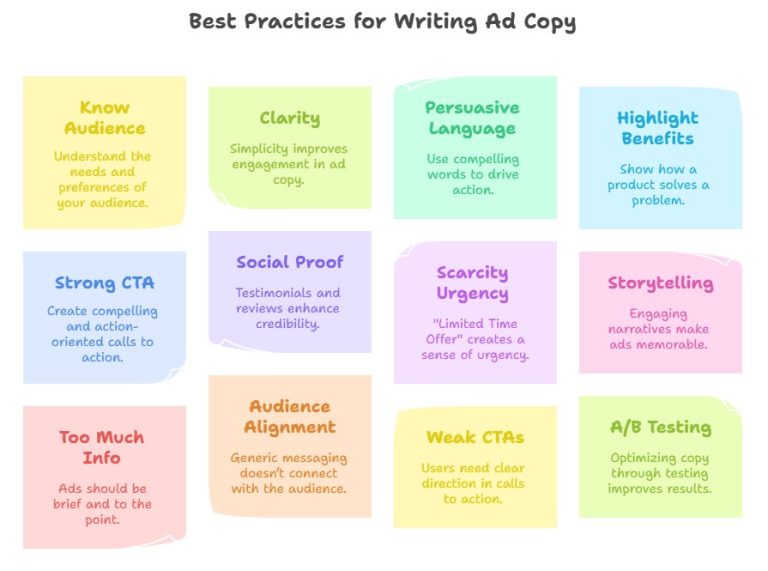
High-conversion ad copy looks simple on the surface. Underneath, it follows a tight structure. When ads fail, it is usually because one of these pillars is missing or out of sync. When all three work together, performance compounds.
The Visual Hook. How Copy and Design Stop the Scroll
The hook is not just a headline. It is the moment where copy and visual signal the brain to pause.
People do not read ads. They scan patterns. Your hook must interrupt that pattern fast. This happens when the visual sets context and the copy delivers contrast.
A bold claim without visual support feels like noise. A strong visual without clear copy feels vague.
Effective hooks do one of three things well:
- They challenge an assumption the audience already holds.
- They surface a specific pain the audience recognizes instantly.
- They promise a clear outcome without explaining how yet.
Clarity matters more than cleverness. If the hook needs interpretation, the scroll continues.
The Core Narrative. Why Outcomes Beat Benefits
Benefits explain value. Outcomes show transformation.
Modern buyers are overloaded with feature lists and benefit claims. What cuts through is a clear picture of life after the problem is solved. Outcomes answer the unspoken question: “What changes for me if this works?”
A benefit says what the product does.
An outcome shows what the buyer becomes, gains, or avoids.
Strong ad copy builds a short narrative arc:
- Current state. Frustration, risk, or inefficiency.
- Desired future state. Relief, progress, or advantage.
- The product as the bridge, not the hero.
When buyers see themselves in the story, persuasion becomes unnecessary.
The Low-Friction Offer. CTAs That Feel Inevitable
Most CTAs fail because they ask for too much, too soon.
A low-friction offer feels like the natural next step in the story. It matches the reader’s awareness level and emotional state.
Cold audiences need curiosity-driven actions. Warm audiences need validation. Hot audiences need clarity and speed.
High-performing CTAs reduce psychological cost:
- They remove pressure instead of adding urgency.
- They frame action as exploration, not commitment.
- They align with the promise already made in the copy.
When the offer fits the narrative, clicking feels logical, not risky.
How Buyer Mindset Changes Everything About Your Copy
Great ad copy fails when it ignores context. People do not arrive on platforms in the same mental state. Intent changes by environment, and copy must adapt to that reality.
Ambition-Driven Platforms vs Escapism-Driven Platforms
Some platforms attract users who want to improve something. Others attract users who want to escape something.
On ambition-driven platforms like LinkedIn and Google, users are already problem-aware. They are thinking about growth, efficiency, skills, or solutions. Copy that performs well here is direct, structured, and outcome-focused. It respects the reader’s time and speaks in professional language.
On escapism-driven platforms like Instagram and TikTok, users are not looking to solve problems. They are looking to feel something. Entertainment comes first. Copy must blend into the feed, feel native, and lead with story instead of logic. If it feels like an ad, it loses.
The mistake many teams make is using the same message everywhere. The offer stays the same, but the framing must change.
Matching Copy Temperature to Awareness Level
Intent alone is not enough. You also need to match copy temperature to awareness.
Cold audiences do not know they need you. Warm audiences are exploring options. Hot audiences are ready to decide.
Each state requires a different approach:
- Cold copy sparks curiosity and reframes the problem.
- Warm copy builds credibility and shows differentiation.
- Hot copy removes friction and clarifies action.
When temperature and platform align, copy feels relevant instead of intrusive. That relevance is what turns passive scrolling into active engagement.
Copy Frameworks That Match Different Buyer States
No single copywriting framework works for every ad. AIDA is still useful because it gives copy a simple persuasion sequence: attention, interest, desire, and action.
The limitation is not that AIDA is wrong. The limitation is that it does not always explain which emotion, tension, or proof point the ad should lead with.
That is why professional copywriters choose frameworks based on buyer awareness, problem intensity, and offer complexity.
AIDA For Basic Persuasion Flow
AIDA works best when the audience needs a clear path from first attention to action.
It helps structure the ad so each line has a job. The hook earns attention. The body builds interest. The value proposition creates desire. The CTA gives the reader a clear next step.
AIDA is especially useful for simple offers, direct-response ads, landing page sections, and campaigns where the buyer already understands the category.
Its weakness is that it can become generic when used as a rigid formula. If the copy only follows the sequence without a sharp insight, the ad may feel predictable.
P.A.S. For High-Pain Problems
P.A.S. works best when the audience already feels a clear problem.
It starts by naming the problem. Then it shows the cost of leaving that problem unresolved. Only after the tension is clear does the solution appear.
This structure works well in markets where delay is expensive. Finance, health, operations, productivity, and business growth often respond to this approach because the buyer is already aware that something needs to change.
P.A.S. should still be used with restraint. The goal is not to create fear. The goal is to make an existing pain easier to recognize and act on.
Before–After–Bridge For Showing Transformation
Before–After–Bridge works well when the buyer needs to see the difference between where they are now and where they want to be.
The “before” describes the current frustration. The “after” shows a realistic future state. The “bridge” explains how the product, service, or offer helps the reader move between the two.
This framework is effective because it makes change feel concrete. Instead of listing features, it helps the reader picture a better outcome.
The product should not dominate the story. It should act as the bridge between the reader’s current problem and the result they want.
Feature–Benefit–Outcome For Sharper Value Translation
Features explain what something is. Benefits explain why it matters. Outcomes explain why the buyer should care now.
| Feature | Benefit | Outcome |
|---|---|---|
| Automated reporting | Saves time | You stop staying late to close the books |
| AI optimization | Improves performance | Campaigns stabilize without daily micromanagement |
| Centralized dashboard | Better visibility | Decisions feel confident instead of reactive |
This is where many ads improve quickly. The copy becomes more persuasive when it moves from product-centered language to buyer-centered outcomes.
AIDA can still organize the overall flow. These frameworks add precision inside that flow.

The Psychology That Actually Moves People to Click
High-conversion ad copy works because it aligns with how people already make decisions. It does not rely on clever wording. It relies on behavioral truth.
Loss Aversion. Why Avoiding Pain Beats Promising Gain
People act faster to avoid loss than to pursue upside.
This does not mean fear-based copy. It means honest framing. When copy shows what staying the same will cost in time, money, or momentum, attention sharpens. The risk feels real because it already exists.
Effective loss framing stays grounded:
- Missed opportunity instead of exaggerated threat.
- Ongoing friction instead of dramatic failure.
- Quiet inefficiency instead of catastrophe.
When buyers recognize the loss as familiar, action feels justified.
Social Identity. “This Is for People Like Me”
People do not buy products. They join groups.
Strong copy signals identity early. It makes the reader feel seen, not targeted. This happens through language choices, examples, and values, not labels.
Social identity shows up when copy:
- Names a specific role, stage, or mindset.
- Uses insider language without excluding newcomers.
- Reflects how the audience talks about their own problems.
When readers feel the message was written for someone like them, trust forms before proof appears.
Information Gain. Standing Out in a Sea of Generic Ads
Most ads say the same thing with different words. That sameness is invisible.
Information gain means offering a perspective the reader has not considered yet. It reframes the problem instead of repeating it. This is especially important in a world saturated with AI-generated copy.
High-performing ads often teach something small:
- A new way to think about the problem.
- A misunderstood cause behind poor results.
- A counterintuitive insight that feels true once stated.
When the copy gives value before the click, the click feels earned.

A Strategist’s Workflow for Testing and Scaling Copy
Great ad copy is built through iteration, not inspiration. Strategists treat copy like a system that improves through disciplined testing and fast feedback loops.
Why Headlines Deserve 80 Percent of Your Testing Budget
The headline carries the heaviest load in any ad. If it fails, nothing else matters.
Before changing visuals, offers, or body copy, test multiple hooks. Small shifts in framing can produce large swings in click-through rate because the headline determines whether the ad earns attention at all.
Strong testing discipline focuses on:
- One variable at a time.
- Clear success metrics, usually CTR first.
- Fast elimination of underperformers.
This approach keeps learning clean and prevents false conclusions.
Review Mining. Finding the Language Your Customers Already Use
The most persuasive copy is rarely invented. It is discovered.
Customer reviews on Reddit, Amazon, and forums reveal how people describe problems in their own words. These phrases carry emotional weight because they are lived, not imagined.
Effective review mining looks for:
- Repeated frustrations.
- Emotional descriptors tied to outcomes.
- Objections that delay purchase.
When your copy mirrors this language, it feels familiar and credible.
Using CTR and CPC to Kill or Scale Copy
Data protects you from attachment.
Click-through rate shows whether the message resonates. Cost per click reveals whether relevance aligns with platform expectations. When CTR is low, the hook is weak. When CPC is high, the message is misaligned with intent.
Winning teams move fast:
- Pause losing variants early.
- Double down on angles that outperform.
- Refresh hooks before fatigue sets in.
Copy scales when decisions are unemotional and consistent.
Google Ads defines click-through rate as clicks divided by impressions and average CPC as total click cost divided by total clicks.
Where AI Fits and Where It Quietly Breaks Conversion
AI has changed how fast teams can produce ad copy. It has not changed what makes copy convert. The difference matters.
AI as a Variations Engine, Not a Strategist
Used well, AI accelerates ideation. It creates angles, rewrites hooks, and expands test volume without burning human time. This makes it valuable in the early stages of exploration and during scaling.
Where AI performs best:
- Generating multiple headline angles from one insight.
- Rewriting proven copy for different platforms.
- Stress-testing clarity and simplicity.
AI increases speed. It does not set direction.
The Cost of Emotional Flatness in AI-Only Copy
Most AI-generated ads fail for one reason. They sound correct but feel empty.
Emotion requires judgment. It requires knowing when to be restrained, when to provoke, and when to stay quiet. AI tends to average language. That average tone is easy to ignore.
In 2026, audiences recognize generic copy instantly. When ads feel templated, trust drops. Engagement follows.
The highest-performing teams use AI for leverage and humans for calibration. Strategy stays human. Emotion stays human. AI supports execution, not meaning.

Conclusion. Why Messaging Compounds Over Time
High-conversion ad copy is not a tactic. It is an asset.
When messaging aligns with intent, emotion, and platform logic, it improves everything downstream. Lead quality rises. Sales conversations shorten. Customer acquisition cost falls. These gains compound because strong copy teaches you who your audience really is.
The long-term advantage does not come from writing more ads. It comes from learning faster than competitors and refining a voice that attracts the right people consistently.
The next step is simple. Audit your top three ads. Identify which pillar is weakest. Rewrite with intent, outcome, and friction in mind. Small shifts here produce outsized returns.

Frequently Asked Questions
What makes ad copy “high-conversion” today?
Relevance. High-conversion ad copy matches buyer intent, emotional state, and platform context. It filters for the right audience instead of chasing volume.
Is AIDA still useful at all?
It works in simple markets. In competitive or high-stakes niches, it often feels predictable. Modern frameworks focus more on tension, transformation, and clarity.
How long should ad copy be?
As long as it needs to be to move the reader forward. Cold audiences need short curiosity hooks. Warm audiences tolerate more context.
Can AI fully replace human copywriters?
No. AI increases speed and volume. Humans provide strategy, judgment, and emotional precision. Conversion depends on the latter.
What should I test first when ads underperform?
Start with the headline. The hook controls attention. Fixing it often improves results without changing anything else.
For a full glossary of marketing terms, visit our Marketing Glossary.

0 Comments