Choosing between Shopify and Etsy is not just a platform decision. It is a decision about how you want to sell.
Etsy gives you access to a marketplace where people already search for handmade, vintage, craft, personalized, and unique products. That makes it useful for sellers who want faster exposure without building a full ecommerce website first.
Shopify works differently. It gives you the tools to build your own online store, shape the customer experience, control your branding, and grow a business outside of a marketplace.
Neither option is automatically better. Etsy can help you get discovered faster, but it gives you less control. Shopify gives you more ownership, but you need a clear plan to bring traffic to your store.
In this guide, we’ll compare Shopify and Etsy across pricing, setup, branding, traffic, long-term growth, and seller fit so you can choose the platform that matches how you actually want to build your business.
- Etsy is usually easier for new sellers who want marketplace exposure. You can list products inside an existing marketplace instead of building a full store from scratch.
- Shopify is usually better for sellers who want more control. You can customize your store, shape the customer journey, build your brand, and manage more of the buying experience.
- Etsy can help with discovery, but competition is built in. Your products can appear where shoppers already search, but they may also appear near similar products from other Etsy sellers.
- Shopify gives you more ownership, but it does not bring traffic for you. You need a plan for SEO, paid ads, social media, email marketing, partnerships, or another traffic source.
- Pricing works differently on each platform. Etsy charges marketplace-style selling fees, while Shopify uses a monthly plan plus payment processing and possible app costs.
- Etsy fits products that match marketplace demand. Handmade goods, vintage items, craft supplies, personalized gifts, printables, templates, and niche creative products often make more sense there.
- Shopify fits sellers who want to build beyond a marketplace. It works well for brands that want repeat customers, stronger customer relationships, larger product catalogs, and long-term growth.
- Many sellers use both platforms. Etsy can help with discovery, while Shopify can become the main brand-owned store.
Disclaimer: I am an independent Affiliate. The opinions expressed here are my own and are not official statements. If you follow a link and make a purchase, I may earn a commission.
What Shopify and Etsy Are
Shopify and Etsy both help people sell online, but they work in different ways.
Shopify is an ecommerce platform. It gives sellers the tools to build their own online store, add products, accept payments, manage orders, customize the shopping experience, and connect other sales channels. In other words, Shopify gives you the infrastructure to run a store that belongs to your brand.
Etsy is an online marketplace. Instead of building a standalone store from scratch, sellers create listings inside Etsy’s existing marketplace. Etsy is known for handmade products, vintage goods, craft supplies, personalized items, gifts, and creative digital products.
That difference matters because it shapes everything else.
With Shopify, you are building your own store and customer experience.
With Etsy, you are placing your products in front of shoppers who are already browsing the marketplace.
The simple version is this: Shopify helps you build a store. Etsy helps you list products inside an existing marketplace.
The Main Difference Between Shopify and Etsy
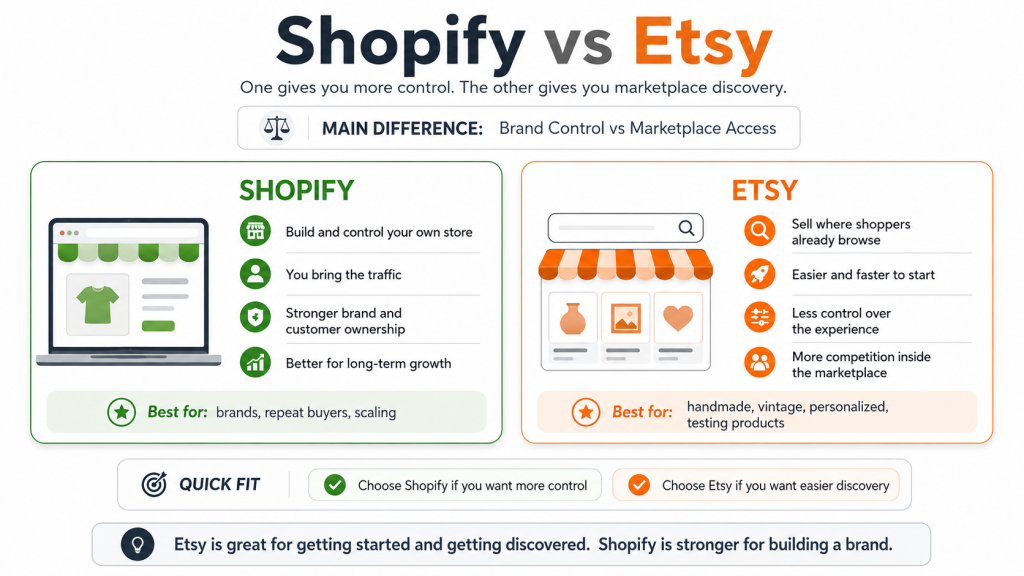
The main difference between Shopify and Etsy is ownership versus marketplace access.
With Shopify, you control more of the selling experience. You decide how the store looks, how products are organized, how customers move through the site, what your brand says, and how you follow up after the sale.
That control is powerful, but it comes with responsibility. A Shopify store does not automatically come with shoppers. You need a plan to bring people in through search, social media, paid ads, email, partnerships, content, or another traffic source.
Etsy works the other way around.
With Etsy, you get access to a marketplace where buyers already search for certain kinds of products. That can make it easier to get early visibility, especially if your products match what Etsy shoppers already want.
The trade-off is control. Your shop lives inside Etsy’s marketplace, your listings follow Etsy’s format, and shoppers can easily compare your products with similar listings from other sellers.
So the choice is not really about which platform is better.
It is about what you need more right now: access to existing shoppers or control over your own store.
Shopify vs Etsy at a Glance
Shopify and Etsy can both help you sell online, but they are built for different selling styles. Shopify gives you more control over the store. Etsy gives you more access to shoppers inside an existing marketplace.
| Factor | Shopify | Etsy |
|---|---|---|
| Platform type | Ecommerce store platform | Online marketplace |
| Best for | Building a brand-owned store | Selling marketplace-friendly products |
| Main advantage | Control over your store and customer experience | Access to shoppers already searching |
| Traffic | You bring your own traffic | Etsy can help with marketplace discovery |
| Branding | Strong control over design and presentation | Limited control inside Etsy’s marketplace format |
| Setup | More flexible, but takes more work | Faster and simpler to start |
| Fees | Monthly plan, payment processing, and possible app costs | Listing fees, transaction fees, payment processing, and possible ad fees |
| Customer relationship | More control over customer data and follow-up | More limited because the sale happens inside Etsy |
| Competition | You compete across search, ads, social, and other channels | You compete directly with similar Etsy listings |
| Long-term fit | Better for building a standalone ecommerce brand | Better for testing products and reaching marketplace shoppers |
Bottom Line: Etsy is easier to enter, but Shopify gives you more room to build.
Shopify vs Etsy: How Pricing and Fees Compare
Pricing works differently on Shopify and Etsy, so the cheaper option depends on how you sell.
Shopify uses a subscription model. You pay a monthly plan to run your store, then you may also pay payment processing fees, app costs, theme costs, and possible third-party transaction fees depending on your setup. Shopify’s public pricing page lists Basic, Grow, Advanced, and Plus plans, with card rates that vary by plan and region.
Etsy uses a marketplace fee model. You do not need the same kind of monthly subscription to open a standard Etsy shop, but you pay fees tied to listings and sales. Etsy’s fee policy lists a $0.20 listing fee and a 6.5% transaction fee on the listing price plus amounts charged for shipping and gift wrapping.
Etsy sellers may also pay payment processing fees, which vary by country. If a sale comes through Etsy Offsite Ads, Etsy may charge an additional advertising fee. Etsy says sellers under $10,000 in Etsy sales over the past 365 days pay a 15% Offsite Ads fee, while sellers at or above that threshold pay 12%.
How Payments Affect Your Costs
Payment processing matters because platform fees are only one part of what sellers pay.
With Shopify Payments, sellers can accept payments directly through Shopify. When sellers use Shopify Payments, Shopify says they are not charged third-party transaction fees on orders processed through Shopify Payments, Shop Pay, Shop Pay Installments, or PayPal Express. If sellers use certain third-party payment providers instead, additional Shopify transaction fees may apply.
With Etsy Payments, sellers get paid through Etsy’s payment system. Etsy says Etsy Payments is the primary way to get paid on the platform, and enrolling in Etsy Payments is part of opening a shop. Etsy also charges payment processing fees on each transaction made through Etsy Payments, and those rates vary by country.
The practical difference is simple: Shopify Payments can help Shopify sellers avoid extra third-party transaction fees, while Etsy Payments is the built-in payment system Etsy sellers use to receive funds from marketplace sales.
The Bottom Line: Shopify usually costs more upfront because you are paying to build and run your own store. Etsy can be easier to test because the starting cost is lower, but fees become more important as order volume grows.

Shopify Pros and Cons
Shopify gives sellers more control than Etsy, but it also asks more from you. It is not just a place to list products. It is a full store system that you have to build, manage, and grow.
Shopify Pros
Shopify gives you more brand control. You can use your own domain, design your storefront, customize product pages, write your own brand story, and create a shopping experience that feels like your business instead of a marketplace profile.
Shopify gives you more control over the customer journey. You can guide visitors from your homepage to product pages, collections, checkout, email signups, upsells, bundles, and follow-up offers. That makes it easier to build a repeat-customer strategy.
Shopify gives you more room to grow. As your business expands, you can add more products, connect apps, sell across different channels, build email flows, publish blog content, run ads, and improve your store over time.
Shopify helps you build a business people remember. When customers buy from your Shopify store, they interact with your brand first. That matters if your goal is to build long-term recognition instead of relying only on marketplace search.
Shopify Cons
Shopify does not bring traffic for you. A beautiful store will not matter if no one visits it. You need a plan for SEO, social media, paid ads, email marketing, partnerships, content, or another traffic source.
Shopify takes more setup work. You need to choose a theme, organize products, write store pages, configure payments, set up shipping or delivery, install the right tools, and make the site feel trustworthy.
Shopify can become more expensive as you grow. The monthly plan is only part of the cost. Apps, premium themes, email tools, subscriptions, paid ads, and outside services can increase your total spend.
Shopify gives you more responsibility. You control the store, but you also manage the full experience. That includes design, traffic, conversion, customer support, retention, and ongoing optimization.
The bottom line: Shopify is stronger when you want control, branding, and long-term growth, but it works best when you are ready to treat your store like a real business system.
Etsy Pros and Cons
Etsy gives sellers access to an existing marketplace, which can make it easier to start and test product demand.
But that marketplace access comes with limits. You get visibility opportunities, but you do not control the full selling environment.
Etsy Pros
Etsy can help you get discovered faster. People already search Etsy for handmade, vintage, craft, personalized, giftable, and creative products. That gives new sellers a place to meet buyers who already have shopping intent.
Etsy is easier to set up than a full ecommerce store. You can create a shop, add listings, upload photos, write descriptions, set prices, and start selling without building an entire website first.
Etsy works well for testing product ideas. Because the setup is simpler, Etsy can help you see which products get views, favorites, and sales before you invest in a bigger store or brand system.
Etsy has built-in marketplace trust. Buyers already know how Etsy works. Reviews, shop history, and marketplace familiarity can help reduce friction for first-time customers.
Etsy Cons
Etsy gives you less control over branding. Your shop can have its own style, but it still lives inside Etsy’s marketplace. The customer experience feels like Etsy first and your brand second.
Etsy puts your products next to competitors. Even when shoppers find your listing, they may see similar products nearby. That can make price, reviews, photos, and listing optimization feel like a constant battle.
Etsy gives you less ownership over the customer relationship. Because the sale happens inside Etsy, you have fewer options for building the full customer journey, capturing email subscribers, and creating repeat-buyer systems.
Etsy fees can stack up. Listing fees, transaction fees, payment processing fees, and possible ad fees can reduce margins, especially as sales volume grows.
The bottom line: Etsy is strong for discovery, testing, and marketplace-friendly products, but it gives you less control over branding, customer relationships, and long-term business ownership.
How to Choose Between Shopify and Etsy
The best choice depends on what you need most right now: marketplace discovery, brand control, or both.
Choose Etsy if you want a simpler way to start selling and your products fit what shoppers already search for on the marketplace. Etsy makes sense when you sell handmade items, vintage goods, personalized products, craft supplies, printables, templates, or giftable products.
It is also a strong option if you want to test demand before building a full ecommerce store.
Choose Shopify if you want to build a brand you control. Shopify makes more sense when you care about custom design, customer relationships, email marketing, repeat purchases, SEO, landing pages, larger product catalogs, and long-term scalability.
It is also a better fit if your products do not fit neatly into Etsy’s handmade, vintage, craft, or creative marketplace categories.
Use both if you want Etsy to help with discovery and Shopify to become your main brand-owned store.
In that setup, Etsy can bring early buyers, while Shopify gives you a place to build stronger customer relationships and grow beyond marketplace search.
The simplest way to decide is this: start with Etsy if your biggest need is exposure. Choose Shopify if your biggest need is ownership. Use both if you want discovery and control working together.
Shopify vs Etsy for Beginners
Etsy is usually easier for beginners because the selling environment is already built.
You do not need to design a full website, create a homepage, install apps, or build a complete customer journey before listing your first product. You can open a shop, upload product photos, write descriptions, set prices, and start learning how buyers respond.
That makes Etsy useful when you are still figuring out your product, pricing, photos, keywords, shipping, or digital delivery process.
Shopify has a steeper learning curve, but it teaches you to think like a store owner from the beginning. You need to choose a theme, organize products, create key pages, set up checkout, think about branding, and decide how people will find your store.
That extra work can feel heavier at first, but it also gives you more control.
For most beginners, the decision comes down to this:
Start with Etsy if you want to test products faster inside an existing marketplace. Start with Shopify if you already know you want to build a brand-owned store and you are ready to create your own traffic plan.
Shopify vs Etsy for Branding
Shopify gives sellers more room to build a recognizable brand.
With Shopify, your store can have its own domain, homepage, product pages, colors, fonts, images, navigation, blog content, email signup forms, and checkout experience. The customer is interacting with your business first, not a marketplace.
That matters when you want people to remember your brand, come back to your website, join your email list, or buy from you again later.
Etsy gives you some branding options, but they are more limited. You can customize your shop name, logo, banner, product photos, descriptions, and about section, but the overall shopping experience still belongs to Etsy.
That means customers may remember that they bought something on Etsy before they remember your actual shop name.
This does not make Etsy bad for branding. Etsy can still help build trust through reviews, strong product photography, consistent listings, and a clear shop style. But Shopify gives you more control over how the brand looks, feels, and grows over time.
The Bottom Line: Etsy can help people find your products. Shopify gives you more room to make them remember your brand.
Shopify vs Etsy for Long-Term Growth
Shopify is usually stronger for long-term growth because it gives you more control over the business system.
You can build traffic through SEO, paid ads, social media, email marketing, content, affiliates, partnerships, and repeat-customer campaigns. You can also test product pages, improve conversion rates, create bundles, add subscriptions, launch new collections, and build a customer journey that fits your brand.
That flexibility matters as your business grows. You are not only trying to make one sale. You are building a store that can bring customers back again and again.
Etsy can also support long-term sellers, especially when your products fit the marketplace well and your listings perform in search. Strong photos, reviews, keywords, pricing, and product quality can help an Etsy shop grow over time.
But Etsy growth still happens inside Etsy’s environment. Your shop depends on marketplace search, Etsy’s rules, buyer behavior, competition, and platform changes.
That is the main difference.
Etsy can help you grow inside a marketplace. Shopify gives you more room to grow beyond one.

Selling Digital Products on Shopify and Etsy
Shopify and Etsy can both work for digital products, but they fit different selling models.
Etsy can work well for simple digital downloads that match marketplace demand. This includes printables, planners, templates, invitations, SVG files, digital art, worksheets, and design files. It is strongest when buyers are already searching for that type of product on Etsy.
Shopify can work better when you want to build a larger digital product business. It gives you more control over product pages, bundles, email funnels, upsells, customer accounts, repeat purchases, and the full buying experience.
Shopify also supports digital products through digital download apps. Its free Digital Downloads app lets sellers upload digital files such as videos, songs, and graphic art as products in their store, and sellers can also add digital files or links to products.
The important difference is how you plan to grow.
Etsy is stronger when the product can be found through marketplace search.
Shopify is stronger when the business depends on brand trust, owned traffic, email marketing, repeat buyers, and a broader product ecosystem.
Digital sellers should also be careful with Etsy’s rules. Etsy’s Creativity Standards list examples of digital items that do not qualify as seller-designed, including a bundle, collection, scan, or PDF of someone else’s work and AI prompt bundles.
For simple seller-created downloads, Etsy can be a strong place to start.
For courses, memberships, bundles, digital libraries, and products supported by email marketing, Shopify is usually the stronger long-term platform.
The main improvement I made was splitting the Shopify app detail into its own paragraph and linking directly to the Shopify and Etsy sources.

When Using Shopify and Etsy Together Makes Sense
For many sellers, the best choice is not Shopify or Etsy. It is using both platforms with different jobs.
Etsy can work as a discovery channel. It helps you reach shoppers who are already searching for handmade, vintage, personalized, craft, printable, or giftable products.
Shopify can work as your brand-owned store. It gives you a place to build deeper customer relationships, collect email subscribers, create stronger product pages, run promotions, and grow repeat purchases.
This setup works best when you do not treat both platforms the same way.
Your Etsy shop should focus on marketplace search, strong listing photos, clear keywords, reviews, and products that match buyer intent.
Your Shopify store should focus on brand trust, customer experience, email capture, bundles, content, and long-term retention.
The goal is not to duplicate effort. The goal is to let each platform do what it does best.
Etsy can help people find you. Shopify can help people remember you.
Final Verdict: Shopify vs Etsy
Shopify and Etsy are both strong platforms, but they are built for different kinds of sellers.
Etsy is the better fit if you want a simpler way to start selling and your products match what people already search for in the marketplace. It can help you test demand, reach early buyers, and sell without building a full ecommerce website first.
Shopify is the better fit if you want to build a brand-owned store with more control over design, customer experience, marketing, and long-term growth. It takes more work upfront, but it gives you more room to shape the business around your own brand.
The decision comes down to your current stage.
- If you are testing products, Etsy may be the easier start.
- If you are building a brand, Shopify gives you the stronger foundation.
- If you want both discovery and ownership, use Etsy and Shopify together with a clear role for each platform.
Etsy is better for getting found. Shopify is better for building something you control.
FAQs About Shopify and Etsy
Is Shopify better than Etsy?
Shopify is better if you want more control over your store, branding, customer experience, and long-term growth. Etsy is better if you want marketplace exposure and a simpler way to start selling. The better option depends on whether you need control, discovery, or both.
Is Etsy cheaper than Shopify?
Etsy can be cheaper to start because a standard shop does not require the same monthly store subscription as Shopify. However, Etsy charges listing fees, transaction fees, payment processing fees, and possible advertising fees. Shopify has a monthly plan, but it gives you more control over your store and customer experience.
Can I sell on both Shopify and Etsy?
Yes. Many sellers use Etsy for marketplace discovery and Shopify as their main brand-owned store. This works best when each platform has a clear role. Etsy can help new customers find your products, while Shopify can help you build stronger customer relationships and repeat purchases.
Does Shopify bring traffic like Etsy?
No. Shopify helps you build and run your own online store, but it does not bring marketplace traffic the way Etsy can. Shopify sellers need a traffic plan, such as SEO, paid ads, social media, email marketing, partnerships, content, or an existing audience.
Is Etsy good for beginners?
Yes. Etsy can be good for beginners because it is easier to set up than a full ecommerce website. You can list products, test demand, learn what buyers respond to, and start selling inside an existing marketplace.
Is Shopify good for handmade products?
Yes. Shopify can work well for handmade products, especially when you want to build a brand around them. Etsy may help with early discovery, but Shopify gives you more control over presentation, customer relationships, and long-term growth.
When should I move from Etsy to Shopify?
You should consider Shopify when you want more control over branding, customer retention, email marketing, custom product pages, and the overall customer experience. You do not need to leave Etsy completely. Many sellers keep Etsy as a discovery channel while building Shopify as their main store.
Which is better for digital products?
Etsy can work well for simple digital products like printables, templates, planners, invitations, and design files that match marketplace demand. Shopify may be better if you want to build a larger digital product business with bundles, courses, memberships, email funnels, or repeat customers.
Which is better for print on demand?
Shopify is usually stronger for building a print-on-demand brand because it gives you more control over positioning, product pages, apps, pricing, and marketing. Etsy can still work for print-on-demand products if they fit Etsy’s rules and buyer expectations.
Should I start with Etsy or Shopify?
Start with Etsy if you want to test products quickly and need marketplace exposure. Start with Shopify if you already want to build a brand, own more of the customer experience, and commit to driving your own traffic.

0 Comments