A focused sales funnel and a full ecommerce store can both lead to a purchase, but they create very different buying experiences.
That difference sits at the center of ClickFunnels vs Shopify. ClickFunnels is built around guiding visitors through a deliberate sales journey, while Shopify is built around running an online store where customers can browse, compare products, build a cart, and buy across different channels.
The choice is not simply funnels versus ecommerce. Both platforms can sell physical and digital products, support checkout, and handle important parts of the customer journey. What separates them is how those capabilities are organized and what each platform is designed to manage best.
That difference affects marketing, product management, checkout, design, integrations, pricing, and day-to-day operations.
This comparison breaks down those differences so you can see which platform better fits the way you sell.
- ClickFunnels and Shopify are built around different sales models. ClickFunnels centers the funnel and guides customers through a defined conversion path, while Shopify centers the store and supports a broader shopping experience.
- Shopify has the stronger ecommerce infrastructure. It is better equipped for larger catalogs, inventory management, multiple sales channels, retail, and the ongoing operations behind an online store.
- ClickFunnels is no longer limited to simple digital-product funnels. It can support physical products, stores, inventory tracking, shipping, fulfillment, and other ecommerce needs while keeping the funnel at the center of the sale.
- The type of product does not determine the better platform. Physical and digital products can be sold on either platform. The more important question is how customers need to discover, evaluate, and purchase what you sell.
- The better choice depends on what needs to control the sales process. ClickFunnels fits offer-driven selling and focused campaigns, while Shopify fits store-driven commerce and more complex product operations.
- Using both can make sense when each platform has a separate role. ClickFunnels can manage a focused front-end funnel while Shopify supports fulfillment or the broader ecommerce operation.
Disclaimer: I am an independent Affiliate. The opinions expressed here are my own and are not official statements. If you follow a link and make a purchase, I may earn a commission.
What Each Platform Is Really Built For
ClickFunnels and Shopify can both support online sales, but they are designed around different ways of moving a customer toward a purchase.
What ClickFunnels Is Built For
ClickFunnels is built around the sales journey.
You normally begin with a specific action you want the visitor to take, then build the pages, offers, checkout, and follow-up around that goal.
That action might be:
- Buying a product
- Registering for a webinar
- Joining an email list
- Booking a call
- Enrolling in a course
- Accepting a specific offer
A customer might enter through a landing page, move to a sales page, complete checkout, see an additional offer, and receive automated follow-up afterward.
That controlled sequence is where ClickFunnels is strongest.
The platform has also moved beyond the idea of a basic funnel builder. Its ecommerce tools now support physical and digital products, product variants, collections, inventory tracking, shipping, tax calculations, and fulfillment. Products can also be managed centrally and used across different funnels and stores.
ClickFunnels details these capabilities through its Store Funnels platform and Global Products system.
What Shopify Is Built For
Shopify is built around the store and the commerce operation behind it.
Instead of directing every customer through one predetermined path, Shopify gives shoppers more freedom to browse products, compare options, select variants, build a cart, and purchase when they are ready.
Behind that storefront, Shopify handles the operational side of selling.
Its core ecommerce tools include:
- Product and catalog management
- Inventory management
- Product variants
- Checkout and payments
- Shipping
- Multiple inventory locations
- Reporting and analytics
- Social and marketplace selling
- In-person sales
That structure becomes more valuable as the number of products, orders, locations, and sales channels grows.
Shopify can also connect the same catalog to channels such as Facebook, Instagram, TikTok, Google, Amazon, Shop, and other supported marketplaces while products and orders remain managed through Shopify.
Shopify outlines its core commerce capabilities in its current plan comparison and sales channel documentation.
The fundamental difference is not whether either platform can sell products.
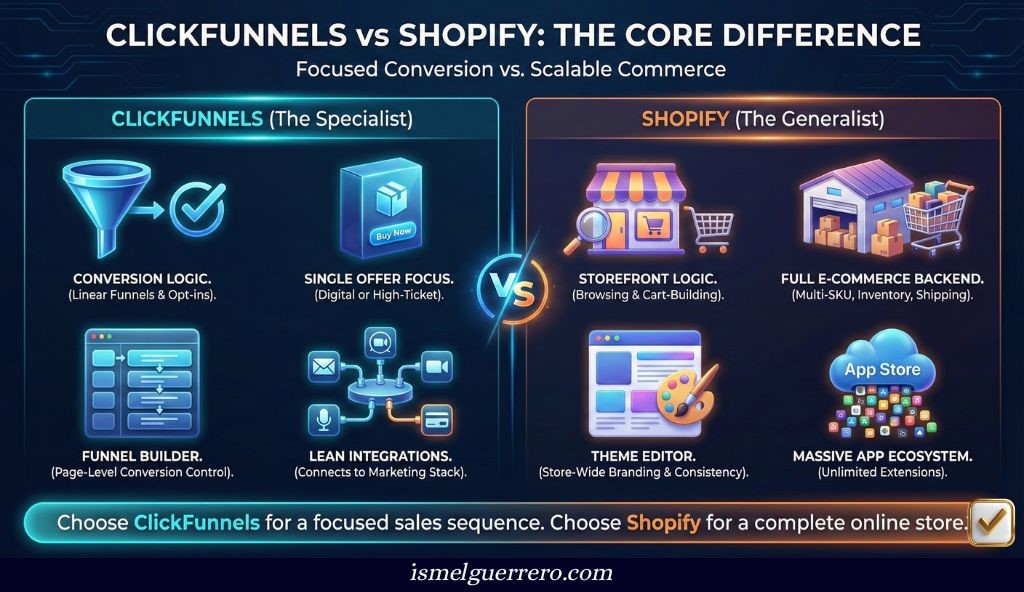
ClickFunnels is built to control the sales journey. Shopify is built to operate the store.
ClickFunnels vs Shopify: Feature & Functionality Comparison
ClickFunnels and Shopify now share more capabilities than their traditional labels suggest. Both can sell products, process payments, run marketing campaigns, and support different parts of the customer journey.
The difference becomes clearer when you look at how those features work together and what each platform prioritizes.
Sales and Marketing Tools
ClickFunnels is built around moving people toward a specific action.
Its marketing tools are connected to the funnel, so a campaign can combine:
- Landing pages and sales pages
- Lead capture
- Checkout
- Order bumps and additional offers
- Email campaigns
- Marketing automations
- A/B testing
- Courses and memberships
The value comes from how those pieces work together.
Someone who joins a list can enter an automated sequence. A buyer can move directly from checkout into another offer. Different funnel pages or messages can be tested without separating the campaign into multiple systems.
That makes ClickFunnels particularly useful when the sale depends on controlling what the customer sees next.
Email is also built into the current platform rather than reserved for a separate product. The Launch plan includes 10,000 contacts and 50,000 emails per month, with higher plans increasing those allowances. Current email limits and included platform features are listed on the official ClickFunnels pricing page.
Shopify approaches marketing from a different direction.
Its marketing tools are tied more closely to customer behavior inside the store. Shopify Messaging can handle email, SMS, and WhatsApp campaigns, while marketing automations can respond to actions such as:
- Joining a mailing list
- Viewing a product without purchasing
- Abandoning a cart
- Abandoning checkout
- Completing a purchase
- Returning after a period of inactivity
That gives Shopify meaningful native marketing capability without requiring every store to add a separate email platform for basic campaigns and customer follow-up.
More complex workflows can also connect with Shopify Flow when additional automation logic is needed.
Shopify documents these capabilities through Shopify Messaging and its marketing automation tools.
The difference is less about which platform has marketing tools and more about what those tools are built around.
ClickFunnels organizes marketing around the funnel and the offer. Shopify organizes marketing around the customer and store activity.
E-commerce Capabilities
Shopify has the deeper ecommerce foundation, but ClickFunnels can handle substantially more product selling than its funnel-builder reputation suggests.
ClickFunnels can support:
- Physical products
- Digital products
- Subscription products
- Product variants such as sizes and colors
- Product collections and bundles
- Inventory tracking
- Shipping
- Tax calculations
- Fulfillment workflows
Global Products also lets a product be created once and used across different funnels and stores. Changes to the product can then remain consistent instead of requiring separate versions for every campaign.
That creates an interesting advantage for funnel-driven ecommerce.
A seller can maintain products centrally while creating different funnels around a flagship item, bundle, promotion, or audience without rebuilding the underlying product each time.
ClickFunnels describes its current physical-product, inventory, variation, and fulfillment capabilities through its Global Products system and Store Funnels platform.
Shopify goes further once ecommerce operations become more complex.
Its product and inventory system is designed around ongoing catalog management. Sellers can create product variants, track inventory for individual variants, and manage stock across multiple locations.
That becomes important when a store needs to know not only what it sells, but also:
- How much inventory is available
- Where that inventory is located
- Which product variants are in stock
- Which locations fulfill particular products
- How inventory changes as orders are processed
Shopify also provides the broader infrastructure for stores where customers need to browse a catalog, compare products, purchase multiple items, and return for repeat purchases.
Its current inventory system tracks product and variant quantities across active locations, while variants can carry their own inventory information. Shopify explains these capabilities in its inventory management documentation and product variant documentation.
The distinction is no longer that Shopify supports ecommerce while ClickFunnels only supports funnels.
Shopify is stronger when ecommerce operations sit at the center of the business. ClickFunnels is stronger when products are being sold as part of a controlled funnel strategy.
Checkout and Payments
Checkout is where the difference between a funnel-centered platform and a commerce-centered platform becomes especially clear.
ClickFunnels treats checkout as another step in the sales journey.
Smart Checkout can recognize returning customers after they enter their email address and retrieve saved shipping and payment information. That reduces repeated form entry and supports faster repeat purchases.
The checkout can also become part of the offer strategy rather than simply the place where payment happens.
ClickFunnels can use checkout to support:
- Order bumps
- One-time offers
- Subscription purchases
- Upgrades and downgrades
- Physical and digital products
- Saved customer payment and shipping information
That fits the broader ClickFunnels model. The objective is not only to complete the initial transaction, but also to control what the buyer sees around that transaction.
ClickFunnels documents saved customer details, one-click purchasing, one-time offers, and subscription upgrades and downgrades through its Smart Checkout features.
Shopify checkout is designed around the wider requirements of ecommerce.
Customers may arrive at checkout with multiple products, different variants, discounts, shipping requirements, taxes, and payment preferences. The checkout therefore needs to work consistently across a much broader range of shopping situations.
Shopify supports multiple payment methods, including Shopify Payments and supported third-party providers. Accelerated options such as Shop Pay, Apple Pay, Google Pay, Amazon Pay, and PayPal can also reduce the amount of information returning customers need to enter.
Shop Pay, for example, can save a customer’s email address, payment method, shipping address, and billing information for faster future purchases.
Checkout customization is available as well, although the level of control varies by plan and the type of customization. Shopify Plus provides deeper options in areas where standard plans have more restrictions.
Shopify explains its available payment methods and accelerated checkout options through its payments documentation and accelerated checkout guidance.
The practical difference follows the same pattern as the rest of the comparison.
ClickFunnels uses checkout as part of the conversion sequence. Shopify uses checkout as part of the commerce infrastructure.
Customization & Design
Both platforms let you build without starting from code, but they organize design differently.
ClickFunnels gives you control over the individual pages that make up a funnel.
A typical sales journey might include:
- Landing page
- Sales page
- Checkout
- Additional offer
- Confirmation page
Each step can be designed around a different objective.
A landing page might remove navigation and focus attention on one call to action. A checkout page can concentrate on completing the purchase. An upsell page can present a related offer immediately afterward.
That makes ClickFunnels useful when different campaigns need different layouts, messages, and conversion paths.
Its drag-and-drop editor can also be used beyond funnels for websites and stores, allowing users to customize page elements visually without requiring code for the basic design process. ClickFunnels describes the current editor as a drag-and-drop system for funnels, websites, and stores in its ClickFunnels Editor overview.
Shopify approaches design through the storefront and theme.
A theme establishes the visual framework across areas such as:
- Homepage
- Product pages
- Collection pages
- Navigation
- Cart
- Other store templates
That creates consistency across the shopping experience.
The Shopify theme editor lets you adjust content, sections, blocks, typography, colors, and layout without editing code. Changes to broader theme settings can apply across the store rather than requiring the same design decision to be repeated page by page.
More technical customization is also possible. When theme settings do not provide enough control, Shopify allows developers and experienced users to edit theme code using HTML, CSS, and Liquid.
Shopify explains its no-code theme controls and deeper code customization through its theme customization documentation.
Neither approach offers universally better design freedom.
ClickFunnels gives you more freedom to think campaign by campaign. Shopify gives you a stronger system for maintaining a consistent storefront across products and pages.
The better approach depends on what needs to stay consistent.
A focused sales campaign may benefit from treating each step as its own conversion environment. A growing store usually benefits more from a reusable design system that keeps hundreds of pages visually connected.
SEO and Content Capabilities
SEO matters differently on ClickFunnels and Shopify because the platforms are built around different types of traffic and content.
ClickFunnels can support organic search, but its strongest use case remains conversion-focused pages and funnels.
You can optimize funnel pages with SEO metadata such as page titles and descriptions, and ClickFunnels also supports blogging for businesses that want to publish informational content alongside their funnels.
That makes it possible to use organic content to attract visitors before moving them into a more structured sales journey.
The difference is emphasis.
ClickFunnels is primarily designed to turn traffic into leads and customers once visitors reach the site. Content and SEO can support that process, but they are not the organizing structure of the platform.
ClickFunnels documents editable SEO metadata for funnel pages and also supports blog publishing with SEO and sharing settings.
Shopify gives SEO a broader role because products, collections, pages, and content all exist within the same store structure.
Its built-in SEO capabilities include:
- Editable page titles and meta descriptions
- Editable URLs
- Image alt text
- Automatically generated sitemaps
- Canonical tags
- Structured data through supported themes
- A built-in blogging engine
- SEO controls for products, collections, pages, and blog posts
That gives Shopify a stronger foundation when organic discovery is an important part of how customers find products.
The built-in blog also makes it easier to publish informational content without adding a separate content platform. Blog posts can support product discovery, answer customer questions, and create additional entry points from search engines.
Shopify automatically handles several technical SEO elements while still allowing merchants to control important on-page settings. Shopify SEO overview
The practical difference is straightforward.
ClickFunnels can use SEO and content to bring people into a funnel. Shopify provides a stronger structure when organic search and content are ongoing parts of operating the store.
Analytics and Reporting
Both platforms provide built-in analytics, but they focus on different questions.
ClickFunnels analytics are centered on funnel performance.
That means you can evaluate areas such as:
- Page views
- Opt-ins
- Conversion rates
- Orders
- Revenue
- Product performance
- Customer behavior inside funnels
This is useful when the main question is not simply how much was sold, but where people are converting or dropping out of the sales journey.
A funnel with several steps can be evaluated as a sequence. That makes it easier to identify whether the problem is the landing page, offer, checkout, or another part of the path.
ClickFunnels Analytics is included across its current plans and provides customizable dashboards for funnel, customer, product, and revenue performance.
Shopify reporting is built around the broader commerce operation.
Its analytics can cover areas such as:
- Sales
- Traffic and sessions
- Products
- Customers
- Acquisition
- Inventory
- Sales channels
- Fulfillment
- Average order value
That broader view matters when performance needs to be understood across an entire store rather than one sales sequence.
A merchant can compare sales by product or channel, review traffic and conversion behavior, monitor fulfillment data, and create or customize reports for deeper analysis.
Shopify’s analytics dashboard and reports bring sales, visitor, transaction, and operational data into the same reporting environment.
The distinction mirrors the rest of the comparison.
ClickFunnels analytics are more naturally focused on how a funnel performs. Shopify analytics are more naturally focused on how the overall commerce operation performs.
Integrations and Extensions
Both platforms can connect with outside tools, but they take very different approaches to extending what the platform can do.
Shopify relies heavily on its app ecosystem.
The Shopify App Store contains more than 16,000 apps across categories such as:
- Sales channels
- Product sourcing
- Shipping and fulfillment
- Subscriptions
- Reviews and loyalty
- Upsells and bundles
- Marketing
- Customer service
- Store design
- Analytics and reporting
That ecosystem is one of Shopify’s biggest strengths.
A store can start with the core platform and add more specialized functionality as its needs become more complex. A retailer might add a loyalty program, subscription system, advanced shipping tool, product-review platform, or specialized inventory application without replacing Shopify itself.
The trade-off is that extensions can create additional costs and complexity.
A store using several paid apps may end up managing multiple subscriptions, dashboards, support providers, and integrations alongside Shopify.
Shopify describes its App Store as offering more than 16,000 apps across commerce, marketing, shipping, store management, and other categories.
ClickFunnels takes a more consolidated approach.
Many functions that might otherwise require separate tools are already part of the broader platform, including:
- Funnels
- Landing pages
- Marketing automations
- Checkout
- Stores
- Courses
- Communities
- Analytics
That can simplify the technology stack when those tools are central to the sales process.
ClickFunnels still supports outside integrations when another platform needs to remain part of the workflow. Its API and webhooks can connect ClickFunnels with external systems, while its Zapier integration provides a no-code option for connecting with thousands of additional applications.
That gives ClickFunnels two paths: keep more of the sales system inside the platform, then integrate specialized tools where they are actually needed.
ClickFunnels currently supports public API and webhook integrations, while its native Zapier app can connect the platform with more than 7,000 applications.
The difference is therefore not simply which platform has more integrations.
Shopify scales functionality through a large app ecosystem. ClickFunnels tries to consolidate more of the sales process first and connect outside tools when necessary.
How Each Platform Scales
ClickFunnels and Shopify can both support growth, but they scale in different directions.
ClickFunnels scales by expanding the sales system around funnels, audiences, offers, and customer journeys.
As the operation grows, you may need:
- More funnels
- More stores
- More email contacts
- Higher email volume
- More workspaces
- More team members
- Additional courses and communities
- More custom domains
That makes ClickFunnels particularly suited to growth that comes from running more campaigns, managing more brands or offers, building larger audiences, and adding more connected sales experiences.
Its current plan structure reflects that model. Launch includes one workspace and one store, while higher tiers expand workspaces, stores, team members, contacts, email volume, courses, communities, and other allowances. Compare current ClickFunnels plan limits
Shopify scales around commerce operations.
Growth may mean:
- More products
- More inventory
- More fulfillment locations
- More sales channels
- More international markets
- More retail locations
- More complex reporting
- More specialized ecommerce applications
Shopify can track inventory separately across locations such as warehouses, retail stores, pop-ups, and fulfillment services. It can also route orders between locations and extend the same product catalog across social platforms, marketplaces, retail, and other sales channels.
Shopify Markets adds another layer by allowing stores to tailor product availability, pricing, currencies, languages, and other elements for different customer groups or regions.
Shopify documents this operational model through its location, sales-channel, and Markets systems. See how Shopify manages inventory and fulfillment locations
The difference comes down to what is becoming more complex.
ClickFunnels scales around campaigns, funnels, offers, and audiences. Shopify scales around products, inventory, channels, locations, and commerce operations.
That distinction becomes more important as the sales system grows because the platform needs to support the type of complexity you are actually creating.
ClickFunnels vs Shopify: User Experience and Interface
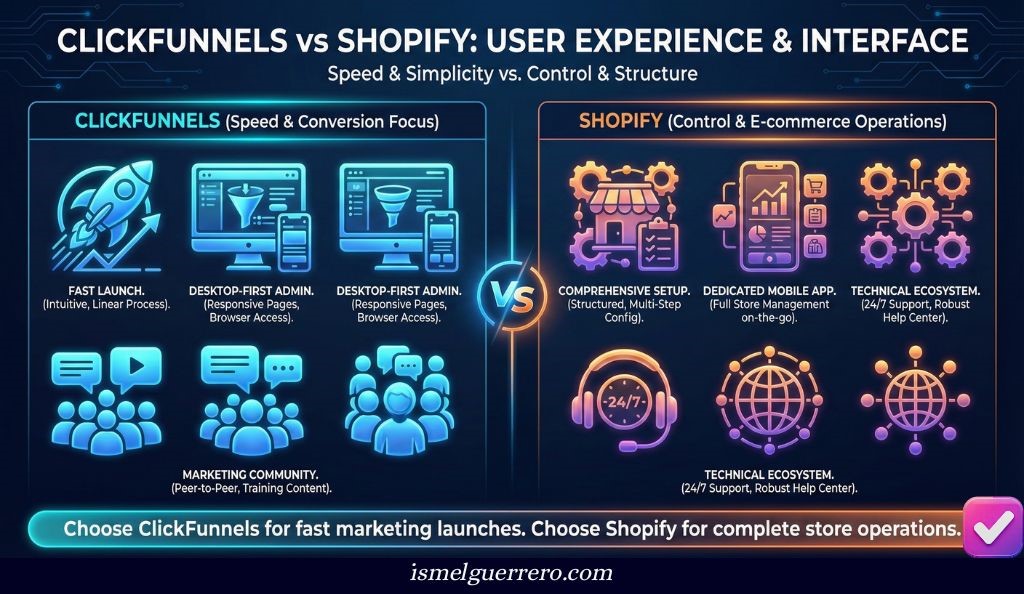
Both platforms are designed to make online selling manageable without requiring users to build everything from code.
Their complexity comes from different places.
Ease of Use
ClickFunnels can feel straightforward when the sales objective is clear.
You decide what action the visitor should take, then build the funnel around that goal.
A basic setup might involve:
- Landing page
- Offer
- Checkout
- Additional offer
- Email follow-up
- Automation
That makes the workflow relatively easy to understand when the sale follows a defined sequence.
The learning curve grows as you use more of the platform. Stores, products, email, automations, courses, communities, analytics, and other applications add more moving parts.
So ClickFunnels is not automatically the easier platform.
It is easier when the way you sell naturally follows a funnel.
Shopify requires a different kind of setup.
A complete store may involve:
- Products
- Collections
- Variants
- Inventory
- Payments
- Shipping
- Taxes
- Navigation
- Themes
- Sales channels
That can take more preparation than launching a simple funnel.
Once those pieces are configured, however, Shopify gives sellers a structured admin for managing them as the store grows.
Shopify is therefore easier when the job itself is running an ecommerce store.
The useful comparison is not which dashboard has fewer settings.
It is which platform organizes the work in the way you actually need to manage it.
Mobile & Admin Functionality
Shopify has the stronger mobile management experience.
Its mobile app lets sellers manage orders, update products, review store performance, edit parts of the storefront, capture payments, create fulfillments, and receive order notifications from an iPhone or Android device.
Most Shopify admin functions are available through mobile, although some advanced settings still require desktop access.
That makes the app particularly useful when managing a store involves checking orders, inventory, customers, and performance throughout the day rather than only during dedicated desktop sessions.
Shopify details those capabilities in its mobile app and admin documentation.
ClickFunnels also provides mobile access to funnel performance through its Stats app.
The app is designed primarily for monitoring rather than replacing the full desktop working environment. Users can view funnel opt-ins, sales, and page visits while away from their main dashboard.
That reflects the broader difference between the platforms.
Shopify mobile tools are built around operating a store.
ClickFunnels mobile functionality is more focused on monitoring funnel performance.
ClickFunnels explains the current mobile Stats app in its official mobile application guide.
Community & Support
Support matters more as the platform becomes more central to the sales operation.
ClickFunnels structures support by plan.
Launch includes Standard Support, while Scale and Optimize include Priority and Live Chat Support. Dominate adds VIP and Live Chat Support. Training access also expands across the plans through the ClickFunnels knowledge base and different FunnelFlix levels.
That gives higher-tier users more direct access as their funnels, teams, and customer volume become more complex.
ClickFunnels lists the current support and training differences on its official pricing page.
Shopify takes a broader support approach.
All Shopify plans include 24/7 chat support. Shopify Plus adds phone and email support, while stores using the Retail plan or POS Pro can receive additional support options for retail operations.
Shopify also has a large Help Center and an extensive ecosystem of developers, agencies, app providers, designers, and ecommerce specialists.
That broader network can become valuable when a store depends on custom themes, apps, integrations, retail systems, or more specialized ecommerce workflows.
Shopify outlines the current support options by plan in its official support documentation.
The difference is less about which company offers “better” support overall.
ClickFunnels support is more concentrated around funnels and sales systems. Shopify has a broader support ecosystem around ecommerce, development, apps, and retail operations.
ClickFunnels vs Shopify: Pricing, Fees, and Value for Money
Price matters, but the monthly subscription tells only part of the story.
ClickFunnels starts at a higher price because more funnel, email, automation, and sales tools are included inside the platform. Shopify starts lower, but the total cost can increase as a store adds apps, payment services, retail tools, or other specialized functionality.
Pricing Breakdown
ClickFunnels currently offers four main plans:
| Plan | Monthly Billing | Annual Billing |
|---|---|---|
| Launch | $97/month | $81/month |
| Scale | $197/month | $164/month |
| Optimize | $297/month | $248/month |
| Dominate | Annual only | $5,997/year |
Launch includes one workspace, two team members, 10,000 email contacts, 50,000 emails per month, one store, five custom domains, and unlimited funnels, visitors, site pages, and landing pages.
Scale expands the limits to five workspaces, five stores, 75,000 contacts, and 300,000 emails per month while adding features such as full API access, webhooks, and priority live chat support.
Optimize increases capacity again for larger teams and audiences, while Dominate is designed for higher-volume operations with 20 workspaces, 20 stores, 400,000 contacts, and 1.2 million emails per month.
Current prices and plan allowances are listed on the official ClickFunnels pricing page.
Shopify currently offers four primary plans:
| Plan | Monthly Billing | Annual Billing |
|---|---|---|
| Basic | $39/month | $29/month |
| Grow | $105/month | $79/month |
| Advanced | $399/month | $299/month |
| Plus | Starts at $2,300/month | Contract dependent |
Basic provides the core ecommerce platform and is aimed at solo entrepreneurs. Grow adds more staff access and lower payment rates. Advanced expands reporting, international selling, shipping capabilities, and team access. Plus is built for more complex businesses that need features such as advanced checkout customization, B2B capabilities, and larger operational limits.
Shopify currently offers a three-day free trial followed by a promotional period of $1 per month for three months on eligible plans.
Current subscription prices, payment rates, and plan differences are available on the official Shopify pricing page.
The starting-price difference is significant.
Shopify Basic costs substantially less than ClickFunnels Launch, but the platforms are not packaging the same type of system. ClickFunnels includes more funnel and marketing infrastructure within the subscription, while Shopify puts deeper ecommerce infrastructure at the center.
Transaction and Payment Fees
Subscription cost is only one part of what it costs to sell online.
ClickFunnels does not take a percentage of each sale as a platform transaction fee. The payment processor connected to the account can still charge its own processing fees, so the actual cost depends on the payment setup being used.
ClickFunnels confirms on its current pricing page that it does not take a percentage of sales.
Shopify’s payment costs depend on both the plan and the payment provider.
When Shopify Payments is used as the sole payment provider, Shopify does not charge an additional third-party transaction fee on orders processed through Shopify Payments, Shop Pay, Shop Pay Installments, PayPal Express Checkout, or supported manual payment methods.
Card-processing rates still apply and vary by Shopify plan.
Additional transaction fees can apply when a third-party payment provider processes the payment. Those charges are separate from any processing fees charged by the outside provider itself.
Shopify explains the distinction between payment-processing charges and third-party transaction fees in its Shopify Payments fee documentation and third-party transaction fee guide.
Apps can also affect the total Shopify cost.
A store may add paid software for subscriptions, loyalty programs, advanced reviews, shipping, product bundles, customer service, reporting, or other specialized needs. Those costs vary widely because they depend on the particular store and the applications it chooses.
The practical comparison is therefore broader than the advertised subscription price.
ClickFunnels has the higher entry cost but includes more of the funnel and marketing stack. Shopify has the lower entry cost but can accumulate additional payment and app expenses as the commerce operation becomes more specialized.
Return on Investment Considerations
The better value depends on what each platform replaces and how directly its features support the way you sell.
ClickFunnels can justify its higher starting price when several parts of the sales process need to work together.
That may include:
- Landing pages
- Sales funnels
- Checkout
- Order bumps and upsells
- Email marketing
- Marketing automation
- A/B testing
- Courses or memberships
A seller who would otherwise pay for several separate tools may get more value from keeping those functions inside one system.
The return is not simply about having more features. It comes from using those features to reduce friction, simplify the stack, and support a sales process that depends on tightly connected funnel steps.
Shopify creates value in a different way.
Its strength is the commerce infrastructure behind the sale.
A growing store may benefit from having products, inventory, orders, payments, shipping, sales channels, reporting, and retail operations managed inside one ecommerce system.
That becomes more valuable as the number of products, customers, locations, and transactions grows.
The app ecosystem can increase costs, but it also allows the store to add specialized capabilities only when they become necessary.
Which Platform Fits Your Business Model?
The better platform becomes clearer when the comparison moves away from feature counts and focuses on how the sale actually happens.
ClickFunnels and Shopify can both support products, payments, marketing, and customer follow-up. The stronger choice depends on what needs to sit at the center of the sales process.
When ClickFunnels Makes More Sense
ClickFunnels makes more sense when the customer journey needs to be tightly directed.
It is especially well suited to:
- Lead-generation campaigns
- Webinars
- Coaching and consulting
- Courses and memberships
- Digital products
- High-ticket offers
- Product launches
- Subscription offers
- Focused physical-product campaigns
In these situations, the offer usually matters more than giving customers a large catalog to explore.
A seller running paid traffic to one flagship product, for example, may care more about the landing page, checkout, order bump, upsell, and follow-up sequence than about building a traditional ecommerce storefront.
That is where ClickFunnels is strongest.
Its broader ecommerce capabilities also mean physical products no longer automatically point to Shopify. A physical product can still fit ClickFunnels well when the sale depends on a focused campaign and controlled conversion path.
The deciding factor is not whether the product is physical or digital.
It is whether the sales model is built around guiding the customer through a funnel.
When Shopify Makes More Sense
Shopify makes more sense when the store itself is central to the buying experience.
It is especially well suited to stores where customers need to:
- Browse a larger catalog
- Search and filter products
- Compare different options
- Select sizes, colors, or other variants
- Add several products to a cart
- Return for repeat purchases
- Buy through different sales channels
- Shop both online and in person
Shopify also becomes more valuable as the operational side of ecommerce grows.
That includes managing:
- Inventory across products and locations
- Shipping and fulfillment
- Multiple sales channels
- Retail POS
- Large product catalogs
- Specialized ecommerce apps
- Ongoing order and store management
A store with many products, frequent orders, multiple locations, or a growing retail operation needs more than a strong conversion page. It needs infrastructure that can support the entire commerce operation.
That is where Shopify has the advantage.
The more the sales model depends on browsing, product management, inventory, and ongoing store operations, the stronger Shopify becomes.
When Using Both Makes Sense
Using ClickFunnels and Shopify together can make sense when each platform handles a different part of the sales process.
A common setup is to use ClickFunnels for the front-end campaign and Shopify for the ecommerce operation behind it.
That can look like:
- ClickFunnels handling the landing page and sales funnel
- ClickFunnels managing checkout, order bumps, and upsells
- Shopify receiving completed order information
- Shopify handling fulfillment and shipping
- Shopify continuing to manage the broader store and product catalog
The key is that the two platforms should complement each other rather than duplicate the same job.
ClickFunnels provides an official Shopify integration that can send completed ClickFunnels order data into Shopify for fulfillment. The purchase still happens through ClickFunnels, while Shopify receives the order information needed to continue the fulfillment process. ClickFunnels explains the integration here.
That approach can be useful when a business already relies on Shopify for ecommerce operations but wants a more focused funnel around a particular product, launch, or campaign.
Using both does add another subscription, another integration, and another system to manage.
So the combination makes the most sense when there is a clear division of responsibility:
ClickFunnels controls the campaign and conversion path. Shopify handles the commerce infrastructure that follows.
ClickFunnels vs Shopify: Pros and Cons
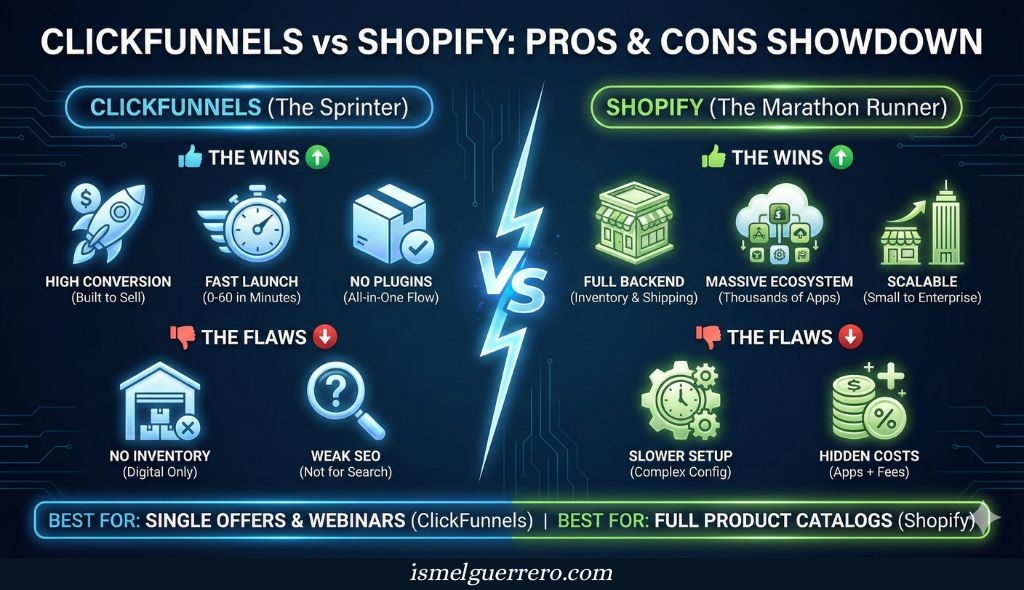
The strongest choice becomes easier to see when the main trade-offs are placed side by side.
Both platforms are capable, but each becomes less attractive when it is pushed outside the type of sales system it was designed to support.
ClickFunnels Pros and Cons
Pros
- Built specifically around guided sales funnels
- Strong landing-page and sales-page capabilities
- Native checkout with order bumps and additional offers
- Built-in email marketing and automation
- A/B testing
- Courses and memberships
- Physical and digital product support
- Product variations and inventory tracking
- Strong fit for launches, webinars, coaching, services, and focused offers
- Can replace several separate marketing and sales tools
Cons
- Higher starting price than Shopify Basic
- Ecommerce infrastructure is not as deep as Shopify’s
- Smaller app and extension ecosystem
- Less suited to complex multichannel retail operations
- Large catalogs and advanced inventory workflows are more naturally handled by Shopify
- The broader funnel and marketing toolkit can be unnecessary when the main requirement is simply running a traditional store
ClickFunnels is strongest when the value comes from controlling the path to conversion.
Its limitations become more noticeable as the business depends less on funnels and more on large-scale product management, retail operations, or broad ecommerce infrastructure.
Shopify Pros and Cons
Pros
- Deep ecommerce infrastructure
- Strong product and inventory management
- Built for larger product catalogs
- Native ecommerce checkout
- Multiple sales channels
- Shopify POS for in-person selling
- Native marketing campaigns and automations
- Strong mobile administration
- Large app ecosystem
- Lower starting price
- Well suited to growing ecommerce and retail operations
Cons
- Funnels are not the central structure of the platform
- Some direct-response functionality may require additional apps or setup
- App subscriptions can increase the total monthly cost
- More complex funnel campaigns may require more assembly than ClickFunnels
- The large extension ecosystem can create additional subscriptions and integrations to manage
- A store-first system can be excessive when most sales revolve around one focused offer
Shopify is strongest when the value comes from operating the store efficiently over time.
Its limitations become more noticeable when the sales process depends on tightly controlling each step around one offer, campaign, or conversion path.
The trade-off is consistent throughout the comparison:
ClickFunnels gives you more control over the sales sequence. Shopify gives you more infrastructure for running the commerce operation.
Conclusion
ClickFunnels and Shopify solve online selling from different starting points.
ClickFunnels is built around the sales journey. Its strength is connecting pages, offers, checkout, upsells, email, automation, and follow-up around a deliberate conversion path.
Shopify is built around the store. Its strength is managing products, inventory, checkout, orders, shipping, sales channels, and the broader commerce operation behind the sale.
Both platforms now extend beyond their traditional roles, which makes simple comparisons such as digital products versus physical products less useful.
The real distinction is how the selling process needs to work.
ClickFunnels is strongest when the funnel needs to control the journey.
Shopify is strongest when the store needs to support the operation.
Frequently Asked Questions (FAQs)
Is Shopify Better Than ClickFunnels?
Shopify is better suited to store-centered ecommerce where product catalogs, inventory, shipping, sales channels, and ongoing store operations matter most.
ClickFunnels is better suited to funnel-centered selling where customers move through a deliberate sequence of pages, offers, checkout, upsells, and follow-up.
Can ClickFunnels Sell Physical Products?
Yes. ClickFunnels supports physical products, product variations, inventory tracking, shipping, collections, and fulfillment workflows.
Physical products are no longer a reason to rule out ClickFunnels automatically. The better question is whether those products are being sold through a focused funnel or a broader store experience.
Can Shopify Build Sales Funnels?
Shopify can support funnel-style campaigns through landing pages, apps, checkout tools, offers, and marketing automations.
Funnels are not, however, the central structure of the platform in the way they are with ClickFunnels.
Which Platform Is Better for Digital Products?
ClickFunnels is often the stronger fit when digital products are sold through landing pages, sales funnels, email sequences, upsells, courses, or direct-response campaigns.
Shopify can also sell digital products, particularly when they are part of a broader ecommerce catalog.
Which Platform Is Better for Physical Products?
Shopify is generally stronger when physical products require a broad catalog, deeper inventory management, multiple sales channels, or retail operations.
ClickFunnels can make more sense when a physical product is sold primarily through a focused campaign with upsells, follow-up, and a controlled conversion path.
Which Platform Is Better for a Large Product Catalog?
Shopify.
Its product, inventory, collection, variant, and store-management infrastructure is better suited to larger catalogs and ongoing ecommerce operations.
Which Platform Is Better for One Main Offer?
ClickFunnels usually makes more sense when most traffic is being directed toward one primary offer.
Its funnel structure gives you tighter control over the sales page, checkout, additional offers, and follow-up surrounding that conversion.
Does Shopify Include Email Marketing?
Yes. Shopify includes native marketing tools for sending campaigns and creating customer automations.
Third-party platforms can still be useful when more specialized functionality is required.
Does ClickFunnels Include Email Marketing?
Yes. Email marketing is built into the current ClickFunnels platform.
Contact and monthly sending limits depend on the plan.
Which Platform Is Cheaper?
Shopify has the lower starting subscription price.
The better value depends on the full software stack required for the sales model. ClickFunnels may replace several separate funnel and marketing tools, while Shopify can accumulate additional app costs as the store becomes more specialized.
Can ClickFunnels Integrate With Shopify?
Yes. ClickFunnels can send completed order information into Shopify for fulfillment and shipping.
That allows ClickFunnels to handle a focused front-end sales funnel while Shopify continues managing the commerce operation behind it.
Should You Use ClickFunnels and Shopify Together?
Using both can make sense when each platform has a clear role.
A common setup is to use ClickFunnels for the funnel and conversion path while Shopify handles fulfillment or the broader ecommerce operation.
Using both without a clear division of responsibilities can add unnecessary cost and complexity.

4 Comments
ClickFunnels vs Leadpages: The Brutally Honest 2025 Showdown - Ismel Guerrero. · March 26, 2025 at 7:35 am
[…] if you’re building an online store instead? This ClickFunnels vs Shopify guide might […]
Stan Store vs Shopify: Creators, Read This First! - Ismel Guerrero. · April 2, 2025 at 11:14 pm
[…] read our ClickFunnels vs Shopify […]
Shopify vs BigCommerce: Brutally Honest Comparison - Ismel Guerrero. · April 9, 2025 at 8:07 pm
[…] you choose, read our ClickFunnels vs Shopify comparison for a smarter […]
Constant Contact vs Mailchimp: The Shocking 2025 Winner - Ismel Guerrero. · April 26, 2025 at 2:07 pm
[…] After mastering email, read our ClickFunnels vs Shopify Comparison. […]