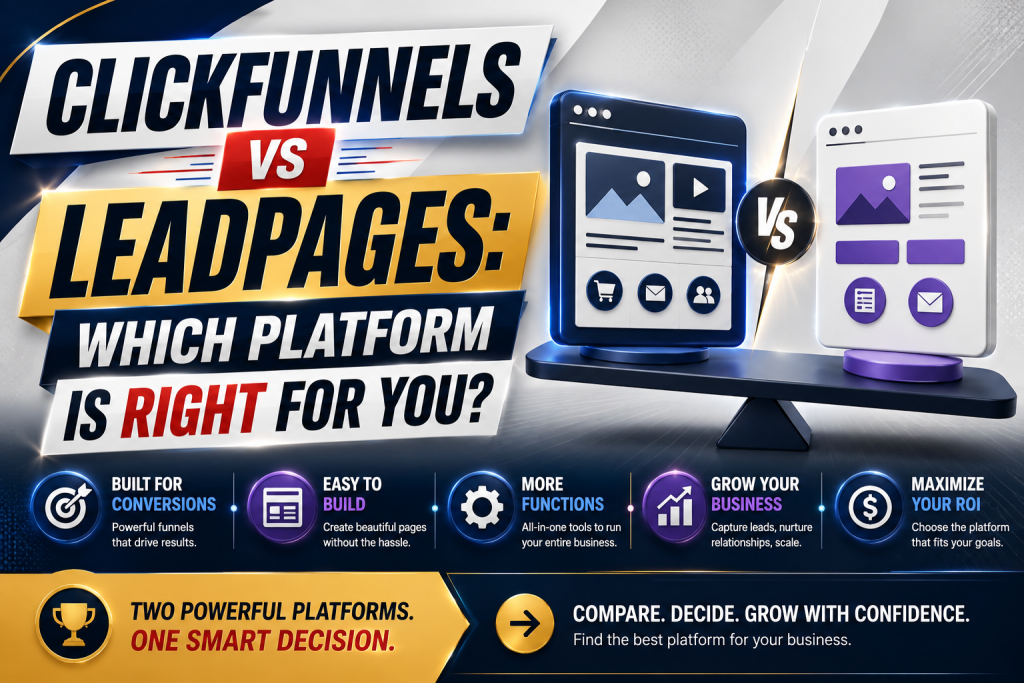
ClickFunnels and Leadpages both help you turn traffic into leads and customers, but they are built around different marketing priorities.
ClickFunnels vs Leadpages comes down to how much of the customer journey you want one platform to handle. ClickFunnels is built around broader sales funnels and connected sales processes, while Leadpages focuses more heavily on landing pages and conversion optimization.
That difference affects more than features. It shapes your workflow, software stack, costs, and how easily the platform fits your business.
This comparison breaks down the differences that matter so you can choose the platform that matches the job.
- ClickFunnels is built for broader sales journeys, including funnels, checkout, email, automation, courses, and other connected sales functions.
- Leadpages is more focused on landing pages and conversion optimization, while still offering features such as checkout, testing, personalization, and analytics.
- The main difference is scope, not simply funnels versus landing pages. The decision depends on how much of the customer journey you want one platform to handle.
- ClickFunnels makes more sense for multi-step sales systems, while Leadpages makes more sense when page creation and optimization are the priority.
- Neither platform is universally better. The better choice depends on the workflow and capabilities you actually need.
Affiliate Disclaimer: I am an independent affiliate. The opinions expressed here are my own and are not official statements. If you follow a link and make a purchase, I may earn a commission.
What ClickFunnels and Leadpages Are
Before comparing individual features, it helps to understand what each platform is designed to accomplish.
What Is ClickFunnels?
ClickFunnels is a sales funnel platform built to move prospects through a structured conversion journey.
You can use it to create landing pages, sales pages, checkout flows, upsells, email campaigns, automations, courses, membership experiences, online stores, and other parts of the sales process.
The important distinction is scope.
ClickFunnels is not simply trying to help you publish a page. It is designed to connect multiple stages of the customer journey inside the same ecosystem.
Its current platform includes funnel building, Smart Checkout, email, automation, courses, communities, stores, analytics, appointments, and other business applications.
What Is Leadpages?
Leadpages is a landing page and conversion optimization platform.
Its primary strength remains creating and publishing campaign pages quickly, but the current product is considerably broader than older versions of Leadpages.
The platform now includes an AI landing page builder, A/B testing, analytics, dynamic text replacement, Leadmeter, checkout, websites, forms, integrations, and other conversion tools. Higher plans add capabilities such as Smart Traffic, heatmaps, and automatic personalization.
Leadpages therefore sits somewhere between a basic landing page builder and a full marketing platform, while remaining more specialized around page creation and conversion rate optimization than ClickFunnels.
The Core Difference Between ClickFunnels and Leadpages
The simplest way to understand the comparison is this:
ClickFunnels is a conversion system. Leadpages is a conversion platform focused primarily on pages.
ClickFunnels is designed to connect the steps around a sale.
A visitor might enter through a landing page, move to an offer, complete checkout, accept an additional offer, receive automated emails, access a course, and remain inside the same broader platform.
Leadpages concentrates more heavily on the page itself and what happens immediately around it.
You can build the page, test variations, personalize messaging, analyze visitor behavior, collect leads, and accept payments. You can then connect those leads and customers to other tools in your marketing stack.
The difference is no longer simply “funnels versus landing pages.” There is now considerable overlap.
The real difference is how much of the customer journey you want one platform to own.
ClickFunnels vs Leadpages at a Glance
| Feature | ClickFunnels | Leadpages |
|---|---|---|
| Primary Focus | Sales funnels and broader sales infrastructure | Landing pages and conversion optimization |
| Best For | Businesses managing multi-step sales journeys | Marketers focused on campaigns, lead generation, and page optimization |
| Landing Pages | Yes | Yes |
| Multi-Step Sales Funnels | Core platform strength | Not the primary platform focus |
| A/B Testing | Yes | Yes, starting with Grow |
| Email Marketing | Built into the broader platform | Typically connects with dedicated email platforms |
| Checkout | Built-in Smart Checkout | Built-in checkout and payment integrations |
| Upsell Tools | Built for funnel-based upsells and offers | Order bumps available with checkout |
| AI Page Creation | AI tools available across the platform | Built-in AI page creation |
| Heatmaps | Not a defining native CRO feature | Available on Optimize and Scale |
| Smart Traffic | Not the same page-routing system | Available from Optimize |
| Custom Domains | Yes | Yes |
| WordPress Publishing | Custom-domain publishing available | WordPress plugin available for landing pages |
| Starting Monthly Price | $97 for Launch | $99 for Leadpages Grow |
| Free Trial | 14 days | 7 days |
ClickFunnels vs Leadpages: Which Platform Is Easier to Use?
Ease of use depends partly on what you are trying to build.
A platform with more capabilities will usually require more decisions. That does not automatically make it poorly designed. It simply changes the learning curve.
ClickFunnels: More Moving Parts
ClickFunnels gives you access to a larger marketing and sales environment.
That means you may be working with funnels, pages, products, checkout, contacts, email, automations, courses, analytics, and other applications.
For someone building an integrated sales system, having those pieces under one roof can simplify the overall technology stack.
For someone who only wants to publish a landing page and collect leads, the same breadth can create unnecessary complexity.
The editor itself uses a visual drag-and-drop approach, but learning ClickFunnels also means understanding how individual pages fit into a larger funnel.
Leadpages: More Focused Workflow
Leadpages keeps the primary workflow centered on building, publishing, and improving pages.
You can start with AI-generated content or a template, customize the page visually, connect relevant integrations, and publish it to a domain.
That narrower workflow can be easier to understand for solo marketers, consultants, small businesses, and teams that already have an email platform or CRM.
Leadpages has also expanded its optimization layer without requiring users to adopt a complete funnel ecosystem. Current features include A/B testing from Grow, with Smart Traffic and heatmaps available from Optimize.
Ease of Use Verdict
Leadpages has the advantage when the job is primarily building and optimizing pages.
ClickFunnels makes more sense when learning one broader platform allows you to replace several separate sales tools.
The right measure of simplicity is not the number of buttons in the dashboard. It is the amount of technology required to complete your actual workflow.
How Do ClickFunnels and Leadpages Compare on Features?
This is where the difference between the platforms becomes clearer.
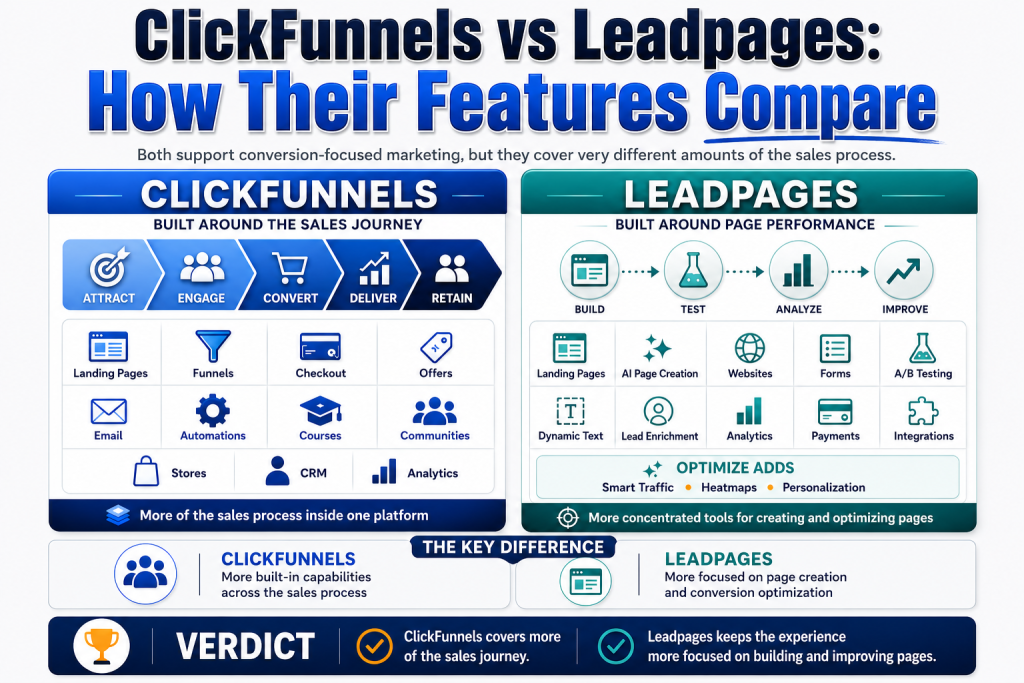
ClickFunnels: Built Around the Sales Journey
ClickFunnels is strongest when several conversion steps need to work together.
Its funnel system can support:
- Landing pages and sales pages
- Multi-step funnel sequences
- Smart Checkout
- One-time offers and additional offers
- Email campaigns
- Marketing automations
- Courses and communities
- Online stores
- Analytics
- Appointments
- Customer and contact management
The benefit is consolidation.
Instead of connecting a page builder, checkout tool, email service, course platform, and multiple automation tools, some businesses can manage more of that activity inside ClickFunnels.
That does not mean every business should.
The value depends on how many of those capabilities you will actually use.
ClickFunnels currently positions landing pages, checkout, A/B testing, email, automations, courses, stores, communities, and analytics as parts of the same platform.
Leadpages: Built Around Page Performance
Leadpages has a more concentrated feature set.
Its current capabilities include:
- Landing pages
- AI page creation
- Drag-and-drop editing
- Websites and blogs
- Forms
- A/B testing
- Dynamic text replacement
- Lead enrichment
- Built-in analytics
- Leadmeter
- Custom domains
- Payment collection
- Integrations and webhooks
Optimize adds Smart Traffic, click and scroll heatmaps, automatic personalization, and additional analytics capabilities.
This changes the old ClickFunnels vs Leadpages comparison.
Leadpages is no longer simply a basic page builder that hands leads to another application. It has developed into a more substantial conversion optimization platform.
What it still does not attempt to replicate is the same breadth of funnel-centered sales infrastructure that defines ClickFunnels.
Functionality Verdict
ClickFunnels wins on breadth.
It is the stronger option when you want one environment to manage more stages of the sales process.
Leadpages wins on focus.
It gives marketers a substantial set of page-building and optimization tools without requiring them to move the rest of their marketing stack into the same system.
How Design and Customization Compare
Both platforms provide visual page-building tools, but they prioritize different workflows.
ClickFunnels
ClickFunnels gives you the flexibility to build individual pages while thinking about how those pages connect inside a funnel.
That makes its editor particularly useful when design decisions need to support a larger sequence such as:
- Opt-in
- Sales page
- Checkout
- Additional offer
- Confirmation
- Follow-up
The platform is therefore less about designing an isolated page and more about designing the entire conversion path.
Leadpages
Leadpages places greater emphasis on building and optimizing individual campaign pages.
Its AI builder can generate a starting point, while the visual editor allows you to change sections, layouts, copy, branding, and page elements.
Leadmeter provides conversion guidance during page creation, while A/B testing and higher-tier optimization features let you improve the page after traffic begins arriving.
The current Leadpages platform also supports custom domains, AI page creation, brand kits, and multiple landing-page optimization tools.
Design Verdict
Choose Leadpages if your priority is rapidly creating and improving standalone campaign pages.
Choose ClickFunnels if page design is one part of a larger funnel architecture.
Neither advantage is universal. The better workflow depends on whether you think primarily in pages or in complete sales sequences.
ClickFunnels vs Leadpages: Conversion Optimization
Both platforms are built around conversion, but they optimize different parts of the process.
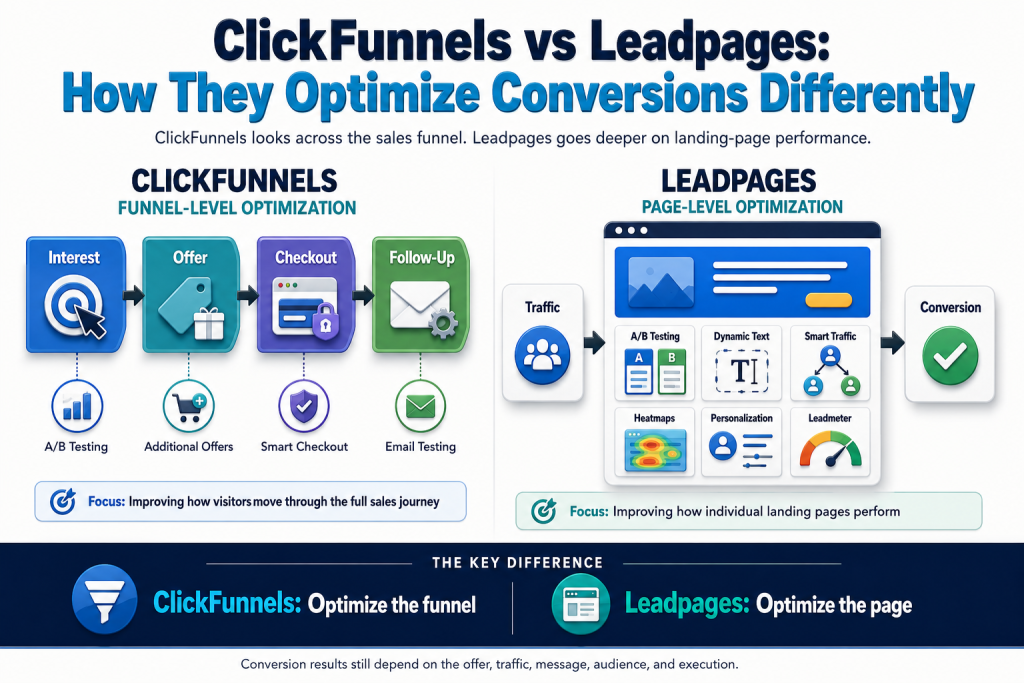
ClickFunnels: Funnel-Level Optimization
ClickFunnels focuses heavily on what happens before, during, and after the sale.
Its Smart Checkout supports streamlined purchasing and additional offers during checkout. The platform also includes A/B testing, allowing users to test funnel pages, offers, messaging, and email campaigns.
This makes ClickFunnels particularly useful when optimization involves more than improving an opt-in page.
You can evaluate how individual steps affect the larger funnel, including how effectively visitors progress from initial interest to purchase.
ClickFunnels states that A/B testing is included with ClickFunnels accounts, while Smart Checkout supports customized checkout experiences and additional offers.
Leadpages: Page-Level CRO
Conversion optimization has become one of Leadpages’ strongest differentiators.
Grow includes manual A/B testing and dynamic text replacement.
Optimize adds:
- Smart Traffic
- Click and scroll heatmaps
- Automatic personalization
- Additional insights and performance tools
Scale adds a more automated optimization workflow.
Leadpages also includes Leadmeter and built-in analytics, giving marketers several ways to evaluate page performance without adding separate CRO software.
This makes Leadpages particularly compelling for paid campaigns and lead-generation programs where optimizing individual landing pages is a recurring part of the marketing process.
Conversion Verdict
ClickFunnels has the advantage when conversion optimization spans an entire sales funnel.
Leadpages has the advantage when the primary optimization target is the landing page itself.
That distinction is more useful than asking which platform simply “converts better.” Conversion performance ultimately depends on the offer, traffic, message, audience, and execution.
Checkout and Selling Online
One of the biggest changes to this comparison is Leadpages’ current checkout capability.
ClickFunnels
Selling is central to ClickFunnels.
Smart Checkout supports direct purchases and additional offers within the funnel, making checkout part of the broader sales sequence rather than an isolated payment form.
This works particularly well for businesses selling courses, coaching, digital products, subscriptions, or other offers where additional funnel steps matter.
Leadpages
Leadpages now supports checkout directly on landing pages.
Its current payment tools can connect with Stripe, and Leadpages documentation also lists PayPal, Shopify, Lemon Squeezy, and Gumroad among supported payment options.
Stripe checkout can support one-time purchases, subscriptions, and order bumps.
That means the old claim that Leadpages cannot handle native checkout is no longer accurate.
The distinction is now about sales architecture, not whether either platform can accept money.
Leadpages can sell directly from a page. ClickFunnels is designed to surround the transaction with a broader funnel system.
Publishing and Integrations
Both platforms let you publish using your own domain and connect outside marketing tools.
ClickFunnels
ClickFunnels can host funnel pages directly and supports custom domains.
It also provides integrations for categories such as CRM, email marketing, payment processing, webinars, and other business tools.
API and webhook functionality is available for businesses that need more customized connections, although the current pricing structure places full API and webhook access on Scale and higher plans.
Leadpages
Leadpages supports custom domains and integrations with tools including Mailchimp, HubSpot, ActiveCampaign, Klaviyo, Shopify, Slack, Stripe, Google Sheets, and other services.
It also offers webhooks and broader third-party connectivity.
WordPress users have another option. Leadpages maintains a WordPress plugin that allows landing pages to be published on an existing WordPress domain, although its current support documentation notes that some plugin instructions apply specifically to the Classic landing page builder.
Publishing and Integration Verdict
Both platforms can work inside a larger marketing stack.
Leadpages is especially attractive when you already have a CRM, email service, or WordPress website and mainly need the landing-page layer.
ClickFunnels becomes more compelling when the goal is to reduce the number of separate platforms involved in your sales process.
ClickFunnels vs Leadpages: Pricing and Value
Pricing is where older comparisons between ClickFunnels and Leadpages are now particularly misleading.
The gap has narrowed significantly.
ClickFunnels Pricing
ClickFunnels currently lists these monthly plans:
- Launch: $97 per month
- Scale: $197 per month
- Optimize: $297 per month
- Dominate: $5,997 per year
Launch includes one workspace, two team members, contact and email allowances, courses, custom domains, and access to the core platform.
Higher tiers expand workspaces, team access, contacts, email allowances, courses, domains, support, and technical capabilities such as full API and webhook access.
ClickFunnels also offers a 14-day free trial.
Leadpages Pricing
The full Leadpages platform currently has three main tiers:
- Grow: $99 per month
- Optimize: $199 per month
- Scale: $399 per month
Grow includes unlimited pages and traffic, A/B testing, dynamic text replacement, and lead enrichment.
Optimize adds Smart Traffic, heatmaps, automatic personalization, and more active integrations.
Scale is positioned for larger teams and agencies and adds additional automation, team seats, workspaces, and higher usage allowances.
Leadpages offers a 7-day free trial.
Leadpages also offers lower-priced HTML publishing plans, but those are publishing-focused products and should not be confused with the full Leadpages CRO platform used in this comparison.
Which Offers Better Value?
The starting prices are now almost identical.
That changes the decision.
If you compare ClickFunnels Launch at $97 per month with Leadpages Grow at $99 per month, price alone does not provide a meaningful reason to choose one over the other.
The better question is what you want those dollars to buy.
Choose ClickFunnels when you value a broader collection of connected sales tools.
Choose Leadpages when you value specialized landing-page creation and conversion optimization while keeping the rest of your existing stack.
Value comes from feature utilization, not feature quantity.
Paying for a broad platform makes little sense if you only need landing pages.
Paying for a specialized page platform makes less sense if you will immediately need several additional tools to build the sales system your business requires.
ClickFunnels Strengths and Limitations
Strengths
- Broader funnel-building capabilities
- Built-in checkout and additional-offer functionality
- Email and automation tools
- Courses, communities, and stores
- Strong fit for multi-step sales campaigns
- Ability to consolidate several marketing functions
Limitations
The breadth that makes ClickFunnels useful can also make it unnecessary for simpler use cases.
If you already have an email platform, checkout system, CRM, course platform, and website that work well together, moving those functions into ClickFunnels may provide little benefit.
Its value increases as your need for integrated funnel infrastructure increases.
Leadpages Strengths and Limitations
Strengths
- Strong focus on landing pages
- AI-assisted page creation
- A/B testing from the Grow plan
- Dynamic text replacement
- Advanced CRO capabilities on higher tiers
- Built-in checkout
- Strong integration options
- WordPress publishing support
- Unlimited pages and traffic on the main Leadpages plans
Limitations
Leadpages has expanded significantly, but it still does not organize the entire product around multi-step sales funnels in the same way ClickFunnels does.
Businesses that need extensive email automation, course delivery, connected sales sequences, and multiple post-purchase steps may still require additional tools.
That is not necessarily a weakness.
It reflects a different product philosophy.

Which One Makes Sense for You?
The decision becomes easier once you identify what the platform needs to own.
Choose ClickFunnels If:
- You sell products, courses, coaching, or services through multi-step funnels.
- You want landing pages, checkout, email, automation, and other sales functions inside one ecosystem.
- Upsells and post-purchase offers are important to your sales model.
- You want to build complete customer journeys rather than isolated campaign pages.
- Consolidating several marketing tools would simplify your operation.
Choose Leadpages If:
- Landing pages are the main tool you need.
- Lead generation or paid campaign optimization is a major priority.
- You already have an email platform or CRM you want to keep.
- You want A/B testing and conversion optimization without adopting a complete funnel ecosystem.
- WordPress publishing matters to your workflow.
- You want to sell directly from some landing pages without building a larger funnel system.
Conclusion
ClickFunnels and Leadpages both help move visitors toward conversion, but they are built for different parts of that process.
ClickFunnels is designed to manage more of the customer journey within one system. Leadpages is designed around creating, testing, and improving the pages where conversions happen.
That is the core difference between them.
The better platform is not the one with more features. It is the one built for the role you actually need it to perform.
Frequently Asked Questions
What Is the Main Difference Between ClickFunnels and Leadpages?
ClickFunnels is centered on building and managing broader sales funnels. It combines pages with checkout, email, automation, courses, stores, and other sales tools.
Leadpages focuses more heavily on landing-page creation and conversion optimization. It also supports checkout, A/B testing, personalization, analytics, and integrations, but it is not organized around the same full-funnel model as ClickFunnels.
Is ClickFunnels Better Than Leadpages?
ClickFunnels is better when you need a complete sales funnel system.
Leadpages is better when landing pages, lead generation, paid campaigns, and conversion optimization are your main priorities.
Neither platform is universally better.
Is Leadpages Only for Lead Generation?
No.
Lead generation remains a major Leadpages use case, but the current platform can also build websites, run A/B tests, personalize pages, analyze visitor behavior, and accept payments.
Its capabilities are considerably broader than those of a basic opt-in page builder.
Can You Sell Products With Leadpages?
Yes.
Leadpages now supports direct checkout on landing pages. You can use it for one-time purchases and recurring payments, and its checkout tools can also support order bumps.
ClickFunnels still provides a broader environment for building multi-step sales journeys around those transactions.
Does ClickFunnels Include A/B Testing?
Yes.
ClickFunnels supports A/B testing, including testing funnel assets and email campaigns.
The older claim that A/B testing is restricted to higher ClickFunnels plans is no longer accurate.
How Much Does ClickFunnels Cost?
ClickFunnels currently starts at $97 per month for Launch.
Scale is $197 per month, Optimize is $297 per month, and Dominate is offered as a higher annual tier.
How Much Does Leadpages Cost?
The full Leadpages platform currently starts at $99 per month for Grow.
Optimize costs $199 per month, while Scale costs $399 per month.
Lower-priced HTML publishing plans are also available, but they do not include the full CRO feature set of the main Leadpages plans.
Which Platform Is Better for Beginners?
Leadpages will often be easier to approach when the goal is simply to create, publish, and optimize landing pages.
ClickFunnels requires understanding more components because it is designed to manage a larger sales process.
A beginner who genuinely needs that larger system may still be better served by ClickFunnels.
Can ClickFunnels Replace a Website?
ClickFunnels can handle websites, landing pages, funnels, stores, courses, and other customer-facing experiences.
Whether it should replace your main website depends on what that website needs to do.
Businesses with large editorial sites, complex content structures, or specialized SEO requirements may still prefer a dedicated content management system alongside ClickFunnels.
Can Leadpages Work With WordPress?
Yes.
Leadpages provides a WordPress plugin for publishing landing pages to an existing WordPress site. Some current plugin documentation applies specifically to Leadpages’ Classic builder, so WordPress users should verify the publishing workflow for the version they use.
Should I Use ClickFunnels and Leadpages Together?
Usually, no.
There is enough overlap that most businesses should choose one based on the role they need it to perform.
Using both can make sense in a specialized setup, but it can also add unnecessary subscription costs and duplicate functionality.
For most businesses, the cleaner approach is to choose the platform that best matches the primary workflow and integrate other tools only when needed.

5 Comments
Kajabi vs ClickFunnels: Which Platform Is Right for You in 2025? - Ismel Guerrero. · March 23, 2025 at 10:10 pm
[…] you may want to check out our ClickFunnels vs Leadpages […]
Builderall vs ClickFunnels: The No-Hype Breakdown - Ismel Guerrero. · March 24, 2025 at 10:44 pm
[…] Pick the platform that matches how you run your business—not just the one with the longer feature list. To learn more here is our comparison between ClickFunnels vs Leadpages. […]
ClickFunnels vs Shopify: Which One Fits Your Business - Ismel Guerrero. · March 26, 2025 at 7:18 am
[…] Related article ClickFunnels vs Leadpages. […]
ThriveCart vs ClickFunnels: Which Platform Sells Smarter - Ismel Guerrero. · March 26, 2025 at 11:18 am
[…] a leaner lead-gen focus, this ClickFunnels vs Leadpages guide is a […]
DropFunnels vs ClickFunnels: Which One Wins in 2025? - Ismel Guerrero. · April 6, 2025 at 12:24 pm
[…] read our ClickFunnels vs Leadpages […]