A larger commission can make one conversion more valuable. It does not make that conversion easier to earn.
High-ticket affiliate marketing focuses on promoting higher-value products and services that can generate larger commissions from successful referrals. Because these purchases can involve a greater commitment, buyers may need more information about pricing, suitability, implementation, and alternatives before choosing.
Building a useful affiliate business around those decisions requires an understanding of the audience, credible products, and content that helps people evaluate their options.
This guide explains how high-ticket affiliate marketing works and how to build around products your audience has a sound reason to consider.
- Larger commissions come with trade-offs. A valuable referral may require more research, deeper content, and a longer buying process. Acquisition costs and reversals affect what remains.
- The buyer’s problem should guide program selection. Choose products that address a real need, then evaluate whether their commission structure and terms make the opportunity worthwhile.
- A focused audience can matter more than broad reach. People researching a relevant problem or comparing suitable products can be more useful to an affiliate business than large numbers of unrelated visitors.
- Strong affiliate content helps readers decide whether to buy. Explain pricing, practical use, limitations, and alternatives so readers can recognize when a product fits their circumstances.
- A recorded referral is not necessarily a payable commission. Attribution rules, customer eligibility, approval periods, and cancellations determine which referrals earn payment.
- Credibility comes from recommendations readers can evaluate. Explain your research methods, disclose the financial relationship, and keep claims within what the evidence supports.
Affiliate disclosure: I am an independent affiliate. The views expressed here are my own and are not official company statements. If you make a purchase through a link in this article, I may earn a commission at no additional cost to you.

What Is High-Ticket Affiliate Marketing?
High-ticket affiliate marketing is the practice of promoting relatively expensive or high-value products and services in exchange for substantial commissions on eligible referrals.
The affiliate generally does not own the offer. The merchant controls the product, pricing, checkout, fulfillment, and customer service. Your role is to introduce suitable prospective customers through content or another permitted promotional method.
When the merchant attributes a qualifying conversion to your referral, you earn according to the program’s terms.
There is no universal price or commission threshold that defines a high-ticket offer. To understand an opportunity, distinguish three figures:
Three Figures to Distinguish
- Product price: The amount the customer pays.
- Commission per conversion: The payment you receive for an eligible referral.
- Recurring commission value: Additional payments earned over time when the program and customer remain eligible.
These figures do not necessarily move together. An expensive product can offer a modest referral fee. A subscription with a lower initial price can generate additional commission payments over several billing periods.
Evaluate the Actual Arrangement
Evaluate the actual arrangement, including the work required to attract suitable customers. The label alone tells you little about whether a program fits your business.
What the Affiliate Actually Contributes
Useful affiliate content helps readers understand the connection between a product and their situation.
That includes explaining what the product does, who it serves, what it costs, where it falls short, and which alternatives deserve consideration. Your judgment should help readers interpret those details.
For example, a CRM’s automation features may matter to an agency managing several sales pipelines. A freelancer maintaining a short contact list may have little reason to pay for the same capabilities.
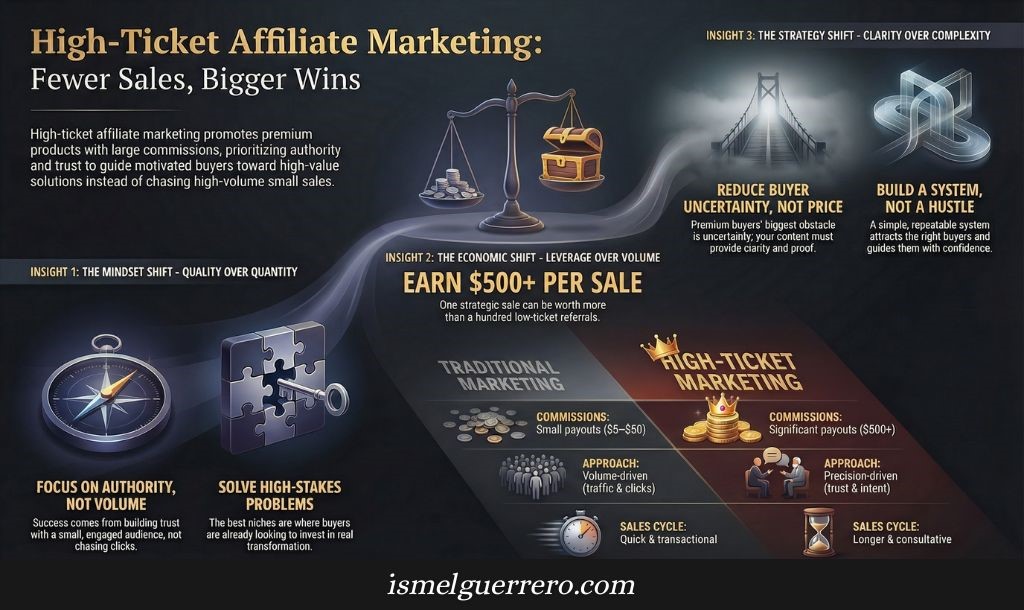
How High-Ticket Affiliate Marketing Works
High-ticket affiliate marketing connects three parties: the merchant selling the product, the affiliate recommending it, and the customer making the purchase.
The affiliate introduces prospective customers through a trackable link or another approved referral method. When a referral produces a qualifying purchase and meets the program’s conditions, the merchant pays the affiliate a commission.
Here is how that process works.
1. You Join an Affiliate Program
A merchant offers an affiliate program for its products or services. You apply or register, and the merchant determines whether you can participate.
The agreement explains what earns a commission, how much it pays, which promotional methods are permitted, and when payments are issued.
2. The Program Gives You a Tracking Link
Once accepted, you receive a unique affiliate link or another referral mechanism associated with your account.
That link allows the program to identify customers referred by you. Some arrangements use referral codes or registered introductions instead, particularly when a sales team handles the purchase.
3. You Introduce the Product to Potential Customers
You share the recommendation through content such as an article, video, email, or comparison page, using promotional methods the program permits.
An interested person follows your link to the merchant. Your role is to explain the offer and introduce the prospective customer. The merchant handles its own sales process.
4. The Customer Makes a Qualifying Purchase
The customer may buy directly, start a trial before subscribing, or speak with a sales representative before committing.
The action that earns payment depends on the agreement. A click, trial registration, or demo request does not automatically earn the commission advertised for a completed sale.
5. The Program Checks and Approves the Commission
The program determines whether the purchase can be credited to your referral and whether it meets the payment conditions.
A recorded commission may remain pending while the merchant checks customer eligibility, payment, or a refund period. A cancellation or another disqualifying condition can prevent that commission from becoming payable.
6. You Receive Payment Under the Program’s Terms
The program pays approved commissions according to its schedule and payout requirements.
Compensation may be a fixed amount, a percentage of the purchase, recurring payments, or a combination. Recurring commissions continue only while the customer and referral meet the relevant conditions.
High-Ticket vs. Low-Ticket Affiliate Marketing
Both approaches use the same underlying arrangement: refer a customer and earn a commission when the program records a qualifying conversion.
The differences concern commission value, buying behavior, and the economics of producing those conversions.
| Factor | Lower-Ticket Affiliate Marketing | High-Ticket Affiliate Marketing |
|---|---|---|
| Commission per conversion | Generally smaller | Generally larger |
| Conversions needed for the same gross revenue | More | Fewer |
| Purchase evaluation | May involve a straightforward decision | May require deeper comparison |
| Content requirements | Can support shorter buying journeys | Often benefits from detailed evaluation |
| Sales cycle | Can be shorter | Can be longer |
| Impact of one lost conversion | Usually smaller | Can be substantial |
| Audience strategy | Broad demand can support volume | Specialized demand can support valuable referrals |
Tendencies Rather Than Fixed Rules
These are tendencies rather than fixed rules. An inexpensive product can require considerable explanation, while a familiar premium product may have a relatively straightforward purchase process.
Where Each Works Well
Lower-ticket offers can work well where demand is broad, purchases are frequent, and acquisition costs remain manageable. Higher-ticket offers can be worthwhile where buyers need specialized information and approved commissions justify the work involved.
Who High-Ticket Affiliate Marketing Is For
High-ticket affiliate marketing can suit new and established publishers who can reach relevant buyers and explain the products credibly.
The audience may include business owners, professionals, agencies, creators, or consumers researching a specialized purchase. The common factor is a legitimate reason to consider a higher-value offer.
Publishers Who Can Explain the Product
Your knowledge should be sufficient to assess the product’s important claims and practical limitations.
A hosting review requires an understanding of the requirements being compared. A professional education review should examine the curriculum, delivery, support, and basis of any outcome claims.
You can develop that knowledge through product access, documentation, demonstrations, interviews, and careful research. Make your methods clear so readers can distinguish direct experience from information you verified elsewhere.
Publishers With Narrow Audiences
A specialized audience can make content and recommendations more precise.
Coverage aimed at agencies migrating client websites, for example, can address questions that a general technology article would overlook. That specificity can support commercially relevant referrals with modest traffic.
There still needs to be enough demand to justify the work. A small audience does not automatically become valuable because the available commission is large.
When the Model May Not Fit
High-ticket affiliate marketing may be unsuitable when:
- Readers mainly need free or inexpensive solutions.
- Available programs do not address the audience’s problems.
- You cannot evaluate the products confidently.
- The subject requires expertise you cannot support.
- Research and acquisition costs exceed realistic commission revenue.
A different offer or monetization method may better serve those circumstances. Let the audience’s requirements guide the decision.

Benefits and Trade-Offs of High-Ticket Affiliate Marketing
Larger commissions can make specialized coverage commercially attractive. They also increase the importance of each eligible conversion and the consequences of depending on a small number of referrals.
Potential Advantages
More revenue per successful referral
A substantial approved commission can help support the research required for a detailed evaluation. This can matter in markets where mass traffic is unlikely but individual purchases are valuable.
Fewer conversions for the same gross revenue
A larger commission reduces the number of approved referrals needed to reach a given total. The cost of obtaining those referrals still determines how much remains.
Consider this hypothetical calculation:
| Measure | Higher-Commission Offer | Lower-Commission Offer |
|---|---|---|
| Affiliate clicks | 1,000 | 1,000 |
| Approved conversions | 4 | 40 |
| Commission per conversion | $500 | $50 |
| Gross approved commission | $2,000 | $2,000 |
| Acquisition and content costs | $1,200 | $800 |
| Amount remaining before other expenses | $800 | $1,200 |
These fictional figures illustrate the calculation, not expected earnings. Both offers generate the same gross commission, while their specified costs produce different amounts remaining.
More opportunities for decision-focused content
A consequential purchase can create useful questions about pricing, compatibility, support, implementation, and alternatives. Answering those questions can support several distinct resources around the same buyer need.
Recurring commission opportunities
Some programs pay beyond the initial conversion. The duration and eligibility conditions determine what those payments can contribute.
For example, HubSpot’s affiliate program lists a 30% monthly recurring commission for up to one year and a 180-day cookie window.
Kinsta’s affiliate program lists a 50–500 one-time bonus plus 10% monthly recurring commissions for eligible Managed Hosting for WordPress referrals.
These arrangements illustrate why payment structure matters. Future recurring payments remain dependent on the customer and applicable program terms.
Potential Trade-Offs
Longer evaluation periods
Buyers may need to compare options, secure budget approval, or plan implementation. That can create a delay between useful engagement and a completed purchase.
Greater content demands
Detailed evaluations can require product access, testing, screenshots, technical research, and updates. Consider whether you can maintain that work before choosing a market.
Concentrated revenue
When a few conversions account for a large share of revenue, a reversal or missed referral can noticeably affect results. Track dependence on individual merchants as well as individual conversions.
Limited control over the arrangement
Merchants control their products and programs. Changes to rates, eligibility, or availability can affect existing content and expected commissions.
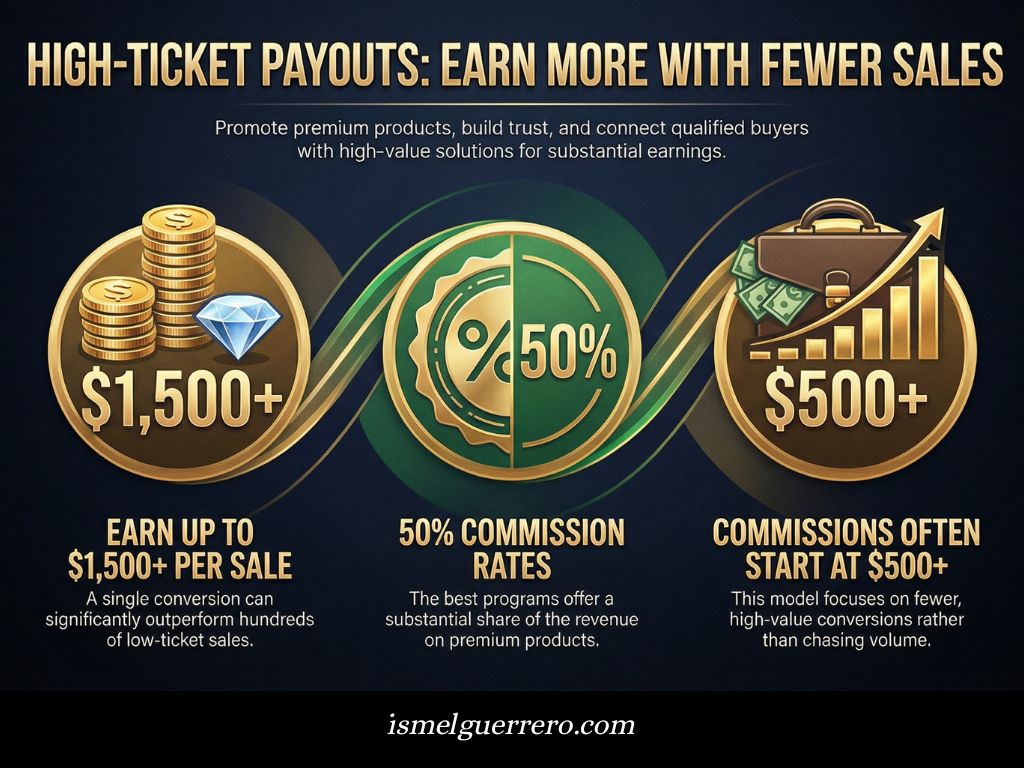
How to Choose a High-Ticket Affiliate Program
Evaluate the product and agreement together.
A credible product may still have terms that make referrals difficult to monetize. Generous compensation cannot compensate for an offer you would hesitate to recommend.
Start With Product Quality
Ask whether you would recommend the product without knowing its commission.
Examine its usefulness, reliability, pricing, customer support, refund conditions, and meaningful alternatives. Customer reviews can reveal questions worth investigating, but individual comments should not replace your own assessment.
Where practical, test the product or request a demonstration. Focus on the capabilities and limitations that matter to your audience.
Match the Offer to the Audience
Define who would benefit and what circumstances justify the purchase.
Premium CRM software may fit an agency coordinating several teams while being excessive for someone managing a few contacts. The same product can be appropriate in one situation and unnecessary in another.
Clear suitability criteria help you select the offer and explain it. They also help readers recognize when a recommendation applies to them.
Understand the Commission Model
Programs can use one structure or combine several.
| Commission Model | How It Works | What to Confirm |
|---|---|---|
| Flat-rate | Fixed payment for an eligible conversion | Qualifying action and excluded transactions |
| Percentage-based | Share of the qualifying purchase value | Which charges count toward the commission |
| Recurring | Payments continue over an eligible period | Duration, retention conditions, and exclusions |
| Tiered | Rates change after defined requirements | Thresholds and when higher rates apply |
| Hybrid | Combines upfront and ongoing payments | Conditions attached to each component |
Compare the payments available under realistic eligible purchases. The highest advertised rate may apply only to certain plans, customer types, or performance levels.
Keep projected recurring commissions separate from commissions already approved.
Review the Attribution Rules
Check the tracking window, attribution model, customer eligibility, and treatment of sales-assisted purchases.
Find out what happens when a buyer encounters multiple affiliates, uses another device, or completes the purchase through a sales representative. Where the public agreement leaves an important question unanswered, ask the program directly.
Attribution is only part of eligibility. HubSpot’s affiliate agreement, for example, conditions commission eligibility on an accepted and valid lead, a qualifying transaction, and the customer remaining through the specified locking period.
Understand Reversals
Establish when a recorded commission becomes approved and payable.
Review how the agreement handles refunds, cancellations, failed payments, invalid transactions, and program violations. Once referrals begin, examine which conditions lead to reversals in your own results.
A large provisional total can look attractive while overstating what will ultimately be paid.
Check Payment Terms
Confirm the payment schedule, approval delay, minimum payout, currency, payment methods, tax documentation, and geographic eligibility.
These conditions affect cash planning. Production or advertising expenses may be due before referral commissions become payable.
Evaluate the timing alongside the payout amount.
Evaluate Affiliate Support
Useful support can include documentation, demonstrations, tracking reports, product updates, and access to an affiliate manager.
Ask specific questions about conditions that affect your intended promotion. Keep written clarification for material issues such as permitted traffic sources or sales-assisted attribution.
Content That Works for High-Ticket Affiliate Marketing
Choose the format according to what the reader needs to understand.
A page earns its length by answering relevant questions. More words do not automatically make a review more useful or a recommendation more credible.
Reviews
A substantive review explains the product’s purpose, suitable users, strengths, limitations, costs, and alternatives.
Show how you reached the assessment. If you tested the product, describe the relevant observations and conditions. If you relied on documentation and demonstrations, make that clear.
Help readers judge suitability rather than reproducing the merchant’s sales argument.
Comparisons
Compare products using consistent criteria.
Pricing, usability, integrations, support, and implementation requirements may all matter, but their importance depends on the buyer. Explain differences through practical situations.
One tool might suit a small team seeking simplicity. Another might suit a business that needs detailed permissions and reporting. The conclusion should make those distinctions useful.
Alternatives
An alternatives article should explain why someone would consider a different product.
Reasons may include cost, complexity, missing integrations, support needs, or a mismatch with the workflow. Connect each alternative to the requirement it addresses.
This gives readers more direction than an interchangeable list of competing brands.
Tutorials and Demonstrations
Show what using the product involves.
A realistic tutorial can reveal setup requirements, practical limitations, and the effort needed to complete a task. Identify prerequisites and the plan or configuration used when those details affect the result.
The content should help prospective customers evaluate the experience while remaining useful to existing users.
Pricing Guides
Explain the costs that affect the decision.
Cover plans, billing intervals, usage limits, required add-ons, and conditions that change the total price. Help readers identify the least expensive option that meets their requirements.
Review these resources when merchant pricing changes. Outdated screenshots or plan descriptions can undermine an otherwise useful evaluation.
Case Studies
Give the outcome enough context to be understood.
Describe the starting situation, actions taken, time period, resources involved, and relevant constraints. Distinguish observed changes from assumptions about what caused them.
A successful case can illustrate a use. It cannot establish what every customer will achieve.
How to Attract High-Intent Affiliate Traffic
Different visitors arrive with different questions.
Someone learning about CRM software may need basic context. Someone comparing two named products may be ready to investigate plans, integrations, or a demonstration.
Build content and follow-up around those differences.
SEO
Cover specific problems, product evaluations, comparisons, alternatives, pricing, and implementation.
Connect related pages when the next resource answers a useful follow-up question. An explanation of a business problem might lead to a comparison, which then points toward a relevant tutorial.
Prioritize distinct information and original evaluation. Expanding coverage is worthwhile when the additional pages help readers understand something important.
YouTube
Video can make a product easier to inspect.
Demonstrate realistic tasks, explain your setup, and show limitations alongside useful capabilities. For software, a workflow demonstration can reveal details that a feature list or screenshot leaves unclear.
Direct viewers toward a resource that fits their next question, such as a pricing explanation or detailed comparison.
Use permission-based email to continue useful education after the first visit.
A reader interested in CRM migration might benefit from a preparation checklist and an implementation tutorial. Someone comparing plans may need an explanation of pricing and required features.
Let the follow-up reflect the interests readers have expressed. Repeated promotions are less useful than information that helps them complete the evaluation.
Social Media
Social channels can introduce practical ideas and help interested readers discover deeper resources.
Short demonstrations, answers to recurring questions, and observations from your research can support that process. Adapt the material to the platform and make the longer resource easy to find.
Measure whether that attention produces relevant visits and referrals.
Paid Traffic
Confirm that the affiliate program permits the proposed advertising method before spending.
Connect campaign costs with referred clicks and approved commissions. Allow for purchase delays and reversals when assessing performance.
A high commission can make a campaign worth investigating, but it does not establish that the acquisition costs will be sustainable. Increase spending when the available evidence supports the decision.
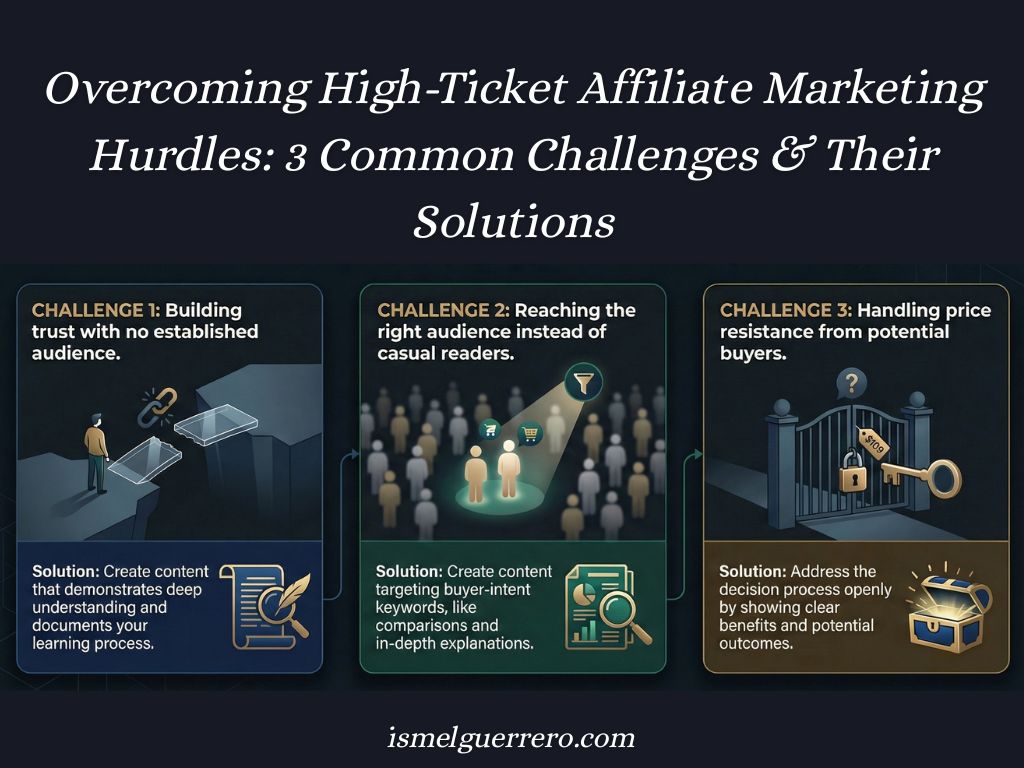
Common Challenges in High-Ticket Affiliate Marketing
Even a sensible approach can encounter difficulties. The useful response is to identify where the buying or referral process is breaking down.
Building Credibility
A new publisher may have limited recognition.
Make your work inspectable through clear evaluation criteria, accurate demonstrations, transparent research methods, and corrections when information changes.
Readers should be able to understand the basis of your judgment without relying entirely on your claim to expertise.
Reaching the Wrong Audience
Strong traffic numbers can conceal weak relevance.
Review search queries, page topics, referral clicks, and approved conversions together. Visitors seeking free templates may have little immediate interest in premium software.
Correct the content or offer when audience fit is the problem. More exposure to the same mismatch is unlikely to resolve it.
Price Resistance
A buyer may reasonably consider the product too expensive.
Explain the total cost, suitable use cases, and alternatives. If a lower-priced option meets the requirements, acknowledge that.
Your content should help readers judge whether the additional expense makes sense in their circumstances.
Program Approval
Applications may require evidence of relevant content, an audience, or suitable promotional methods.
Build substantive coverage and describe your approach accurately. If an application is declined, review the stated requirements and evaluate other credible programs serving the same audience.
Approval should support your content strategy rather than determine the entire subject you cover.
Program Changes
Changes can affect tracking links, recommendations, and expected revenue.
Keep a record of the programs you use and review material notices. Update affected pages when the product or arrangement changes.
Coverage built around a continuing audience need can remain useful even when one merchant becomes less attractive.

Affiliate Disclosure and Responsible Promotion
Readers should understand when a recommendation creates a financial benefit for the publisher.
Use plain wording that explains the relationship. For example:
I may earn a commission if you purchase through the affiliate links on this page.
Place the disclosure where readers can notice it alongside the recommendation. Check that placement on mobile devices as well as desktop layouts.
For U.S. affiliate promotion, the FTC’s endorsement guidance calls for clear, conspicuous disclosure. It explains that “affiliate link” alone may be insufficient and advises disclosing affiliate relationships in videos as well as near links in their descriptions.
Responsible promotion also requires an accurate evaluation. State the basis of your recommendation, acknowledge material limitations, and avoid implying experience or results that the evidence does not support.
Common High-Ticket Affiliate Marketing Mistakes
These mistakes concern choices the publisher can control.
Choosing the Highest Commission First
Starting with compensation can lead you toward products that do not match your readers.
Define the problem and identify suitable products first. Use commission terms to assess the commercial opportunity after establishing relevance.
Promoting Products You Barely Understand
Reproducing sales copy leaves important buying questions unanswered.
Investigate actual use, restrictions, alternatives, and costs. Narrow the recommendation when the evidence supports only a limited conclusion.
Turning Every Page Into a Promotion
Readers may need to understand the problem before considering a purchase.
Publish explanations and tutorials that stand on their own. Introduce an offer where it helps answer the question being addressed.
Hiding Product Limitations
Omitting a meaningful drawback creates an incomplete recommendation.
Explain the limitation, who it affects, and whether a workaround or alternative exists. Readers can then decide how much weight it deserves.
Making Unsupported Outcome Claims
An income screenshot, testimonial, or merchant example should not become an expected result.
Explain what the evidence demonstrates and what remains uncertain. Label hypothetical calculations clearly, and keep projected commissions separate from money already approved or paid.
Depending on One Merchant
Heavy dependence on one program can leave revenue exposed to a rate change, product problem, or closure.
Evaluate relevant alternatives before a replacement becomes urgent. Keep your audience relationships and useful topical coverage strong enough to support a change.
Ignoring Program Rules
Read the restrictions governing your intended activities.
Check conditions covering advertising, brand keywords, email, incentives, coupons, and permitted claims. Ask for clarification before launching an activity when its status is uncertain.
Program rules belong in the operating process alongside tracking, content updates, and payment review.
Conclusion
High-ticket affiliate marketing can make specialized coverage commercially worthwhile when suitable buyers, credible products, useful content, and program terms align.
The commission gives you a reason to evaluate the opportunity. The buyer’s requirements give you a reason to recommend the product.
Start with a defined problem and products you can assess responsibly. Understand how referrals qualify for payment, publish content that clarifies the decision, and use approved results to guide improvements.
That creates a practical foundation for high-ticket affiliate marketing beyond the appeal of a larger payout.
Frequently Asked Questions
Do You Need a Funnel for High-Ticket Affiliate Marketing?
No. A reader comparing products may move directly from useful content to the merchant. A reader still investigating a problem may benefit from additional resources or email follow-up. Use the simplest path that gives the buyer enough information to evaluate the offer.
Can You Start Without an Existing Audience?
Yes, but you still need a credible way to reach suitable buyers. Begin with a defined market and useful coverage. An affiliate account alone does not create demand or a distribution channel.
Do You Need to Buy Every Product You Cover?
No. Documentation, demonstrations, and other research can support useful coverage. Explain your methods and avoid claiming firsthand experience when you have not tested the product. Direct access becomes more important when your conclusions depend on practical performance.
How Do You Find High-Ticket Affiliate Programs?
Start with products your audience already considers. Look for affiliate, partner, or referral information on merchant websites. Networks and directories can help with discovery, but verify material terms directly with the program.
How Long Does It Take to Receive a Commission?
There is no standard timeline. The buyer’s decision, commission approval period, and payment schedule all affect timing. Review those stages before planning expenses around future payouts.
Why Can a Recorded Sale Fail to Produce a Payable Commission?
The conversion may remain pending, fail an eligibility condition, or be reversed. Compare its dashboard status with the agreement and ask the program to clarify unresolved details.
How Often Should Affiliate Content Be Updated?
Update it when changes affect the recommendation, including new prices, features, limitations, or program terms. Prioritize commercially important pages and resources containing information that changes frequently.

6 Comments
High Ticket: A Complete Guide to Premium Products and Services. - Ismel Guerrero. · January 21, 2025 at 6:55 pm
[…] If you’re interested in learning more, check out this guide on high-ticket affiliate marketing and how to get started. […]
High Ticket Affiliate Marketing for Beginners: A Step-by-Step Guide - Ismel Guerrero. · February 2, 2025 at 1:45 pm
[…] Learn how to get started in high-ticket affiliate marketing with our step-by-step guide. […]
High-Ticket Digital Products: Guide to Finding and Selling Them - Ismel Guerrero. · February 4, 2025 at 11:48 pm
[…] a foundational understanding, check out our What Is High-Ticket Affiliate Marketing? […]
Best High-Ticket Affiliate Programs for 2025 (Earn Big Commissions) - Ismel Guerrero. · February 13, 2025 at 12:14 am
[…] For a complete overview of high-ticket strategies, check out our High-Ticket Affiliate Marketing Guide. […]
Affiliate Marketing vs MLM: Don’t Choose Until You Read This - Ismel Guerrero. · May 10, 2025 at 2:13 pm
[…] Next: read our High-Ticket Affiliate Marketing Guide. […]
Faceless Marketing: The Strategy Taking Over the Internet - Ismel Guerrero. · May 13, 2025 at 5:58 pm
[…] Next: Read our Affiliate Marketing Guide and our High-Ticket Affiliate Marketing Guide. […]