Charging more does not make an offer valuable. Buyers pay more when the problem matters, the solution is credible, and the expected value justifies the investment.
High ticket sales focus on these higher-value buying decisions. Instead of depending on a large volume of small transactions, the seller works with fewer prospects who are evaluating a more expensive product, service, or engagement.
That changes the sales process. Buyers usually need more context, stronger evidence, clearer expectations, and greater confidence before committing.
This guide explains what high ticket sales are, how they differ from lower-priced transactions, which offers fit the model, how to attract and qualify prospects, how to handle objections responsibly, and how to build a sales process that supports better decisions without relying on pressure.
- High ticket sales involve relatively expensive products or services where buyers typically need more information before deciding.
- There is no universal price that defines a high ticket offer. What counts as expensive depends on the market, customer, and type of purchase.
- A higher price requires a stronger value proposition, not simply more persuasive sales language.
- Qualification matters because not every prospect has the need, budget, timing, or authority required for the offer.
- Strong sales conversations focus on understanding the buyer before presenting a solution.
- Objections should be investigated rather than automatically treated as barriers to overcome.
- Proof, clear expectations, relevant expertise, and transparent pricing can reduce uncertainty during larger buying decisions.
- High ticket selling works best when the offer, audience, sales process, and delivery model support the price being charged.
Disclaimer: I am an independent Affiliate. The opinions expressed here are my own and are not official statements. If you follow a link and make a purchase, I may earn a commission.
What Are High Ticket Sales?
High ticket sales involve selling products or services that represent a significant financial decision for the target buyer.
There is no universal dollar threshold.
A $1,000 purchase might be substantial in one market and routine in another. A $20,000 annual software contract could be relatively small for an enterprise buyer but unrealistic for a solo business owner.
That makes high ticket a relative concept.
The more useful distinction is how the buyer approaches the decision.
High ticket purchases often require more evaluation because the consequences of making the wrong choice are greater. Buyers may compare alternatives, ask more detailed questions, involve other decision-makers, evaluate expected returns, or require greater confidence in the seller before moving forward.
Common characteristics include:
- Higher financial commitment
- Longer or more considered buying decisions
- Greater need for product or service expertise
- More attention to fit, risk, and expected value
- Stronger expectations around delivery and support
- More direct interaction between buyer and seller
High ticket selling is therefore not simply low-ticket selling with a larger number attached.
The sales process has to justify the greater commitment.
High Ticket Sales vs. Low Ticket Sales
Neither model is inherently better. They solve different business problems.
| Factor | High Ticket Sales | Lower-Ticket Sales |
|---|---|---|
| Transaction value | Higher | Lower |
| Buyer evaluation | Usually more involved | Often simpler |
| Sales interaction | Often more direct | Can be highly automated |
| Volume required | Fewer sales may reach the same revenue target | More transactions usually required |
| Delivery expectations | Often higher | Usually more standardized |
A business selling inexpensive digital products may benefit from automation, broad distribution, and high transaction volume.
A consultant selling a complex strategy engagement may need a completely different model built around qualification, discovery, proposals, and direct conversations.
The important question is not whether high ticket sales are superior.
It is whether the economics of the offer and the needs of the buyer justify a higher-touch sales process.
Examples of High Ticket Sales
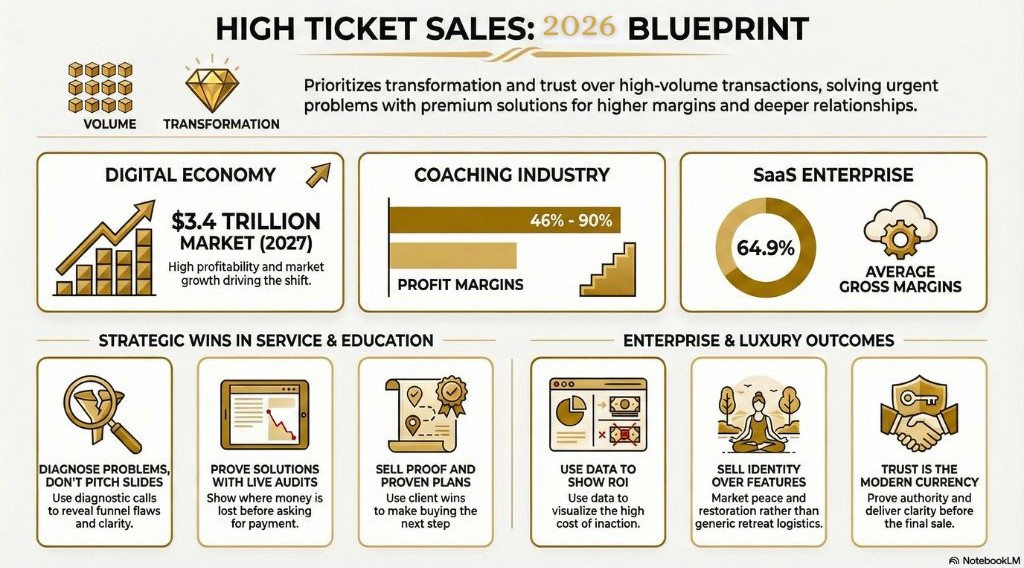
High ticket sales appear across many industries.
The examples below are illustrative rather than claims about specific companies or transactions.
Consulting and Professional Services
A business consultant might sell a $7,500 strategy engagement that includes research, planning, implementation guidance, and several months of support.
The buyer is not paying for a few meetings. They are evaluating whether the consultant’s expertise can help solve a business problem worth considerably more than the fee.
Done-for-You Services
A marketing agency might charge $10,000 per month to manage advertising, creative production, reporting, and optimization for a company with significant customer-acquisition spending.
The sale depends on whether the client believes the agency can manage the work effectively enough to justify the cost.
Coaching and Education
A specialized coaching program might cost several thousand dollars when it includes individualized support, structured training, feedback, and access to expertise that is difficult to obtain elsewhere.
The price still needs to reflect what is actually delivered. Calling a course “premium” does not make the outcome more valuable.
Enterprise Software
A company might spend tens of thousands of dollars per year on software that supports sales, customer service, security, analytics, or other important operations.
The evaluation can involve implementation, integrations, data migration, user adoption, security, and total cost rather than the subscription price alone.
Luxury Products and Services
Private travel, custom experiences, luxury goods, and specialized concierge services can also involve high ticket sales.
In these markets, buyers may evaluate craftsmanship, exclusivity, convenience, service quality, access, or personalization in addition to functional value.
These categories look different, but the underlying principle is similar: the buyer needs enough reason to believe the purchase is worth the commitment.
Benefits and Trade-Offs of High Ticket Sales
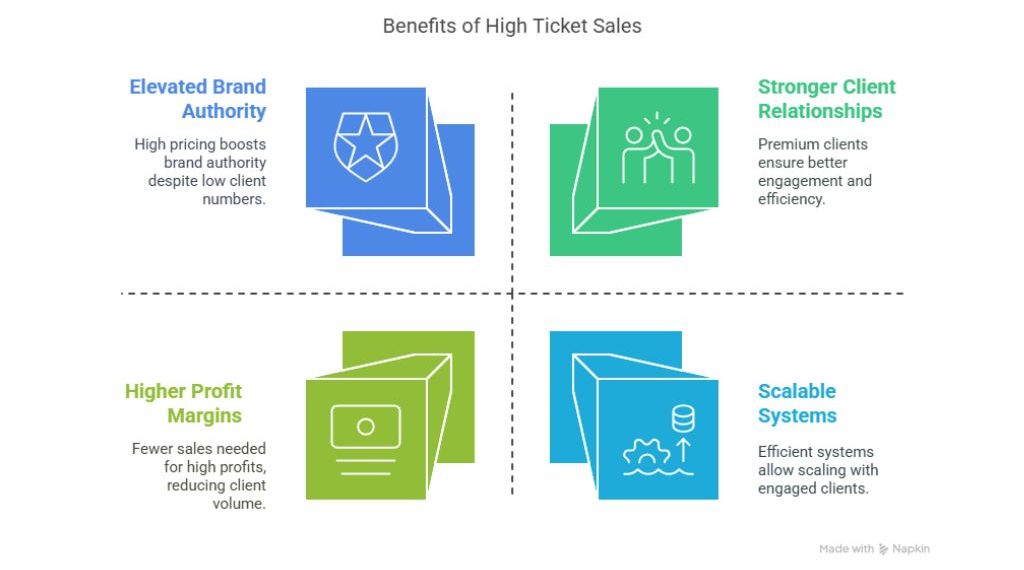
High ticket sales can create attractive economics, but larger transactions introduce additional demands.
Understanding both sides prevents the model from being presented as an automatic upgrade from lower-priced selling.
Potential Benefits
More Revenue Per Conversion
A higher transaction value means fewer completed sales may be required to reach the same revenue target.
That can be useful for businesses with specialized expertise or limited delivery capacity.
It does not mean the sales are easier to obtain.
More Room for Specialized Delivery
Higher prices can support deeper service, more customization, better implementation, dedicated support, or greater access to expertise.
The additional revenue should correspond to meaningful value for the buyer.
Greater Focus on Qualified Customers
When capacity is limited, a high ticket model can allow a business to concentrate on customers who have the strongest need and fit.
Qualification becomes more important because each engagement may require substantial time and resources.
Potential Trade-Offs
Longer Sales Cycles
Larger decisions may require more research, conversations, approvals, or comparisons.
Revenue can therefore take longer to materialize.
Higher Customer Expectations
The more someone pays, the more carefully they may evaluate communication, onboarding, delivery, support, and results.
Premium pricing raises the standard the business needs to meet.
Greater Cost of a Poor Fit
A poorly matched low-cost purchase may create disappointment.
A poorly matched high-value purchase can create a much larger problem for both the buyer and the seller.
That makes qualification and expectation setting especially important.
More Revenue Concentration
A business depending on a small number of large clients may become vulnerable when one customer leaves.
Higher transaction value does not eliminate the need for healthy customer acquisition and retention.
What Makes a Strong High Ticket Offer?
A high price is not the starting point.
The offer needs to earn that price.
Solve a Meaningful Problem
The problem should matter enough that the buyer has a legitimate reason to consider paying for help.
That may involve revenue, efficiency, risk, expertise, convenience, access, time, or another outcome the customer values.
Minor problems are difficult to turn into compelling premium offers simply by packaging them differently.
Define Who the Offer Is For
A strong high ticket offer is usually specific about the customer it serves.
“Business owners” is broad.
“Established ecommerce companies that need outside paid-media management” is more useful.
Clear positioning helps prospects determine whether the offer is relevant before entering the sales process.
Make the Scope Clear
Buyers should understand what they receive.
Define:
- Deliverables
- Access
- Timeline
- Responsibilities
- Support
- Exclusions
- Payment terms
- Expected process
Ambiguity becomes more costly as the price increases.
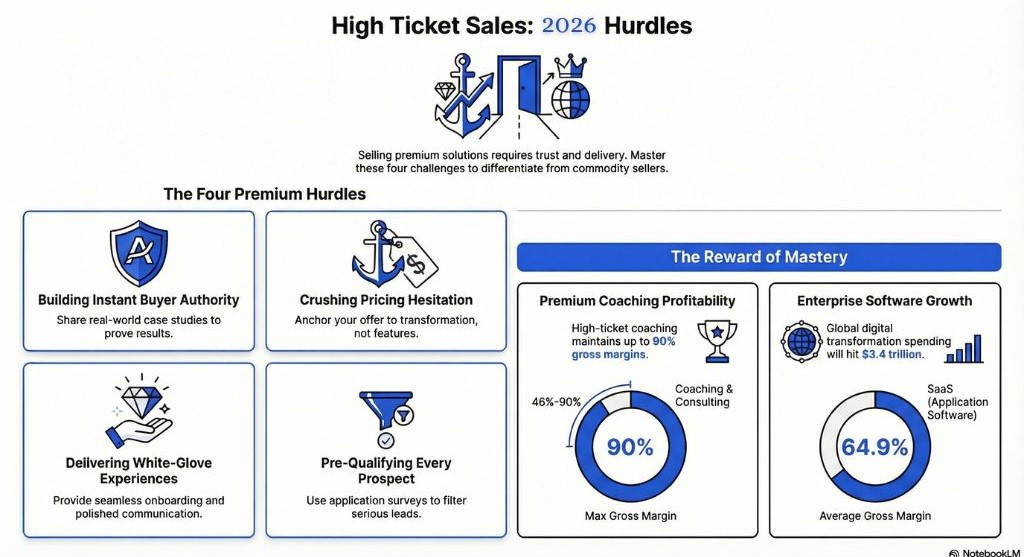
Provide Credible Evidence
Evidence can include relevant case studies, demonstrations, references, examples of previous work, product documentation, or transparent explanations of the process.
The evidence should support the claim being made.
A testimonial about excellent customer service does not prove a revenue claim.
Match Delivery to the Price
If the offer promises a high-touch experience, the delivery needs to support that expectation.
A premium price paired with weak onboarding, poor communication, or generic fulfillment creates a gap between positioning and reality.
That gap eventually becomes a sales problem because reputation and referrals depend on what happens after the contract is signed.
The High Ticket Sales Process
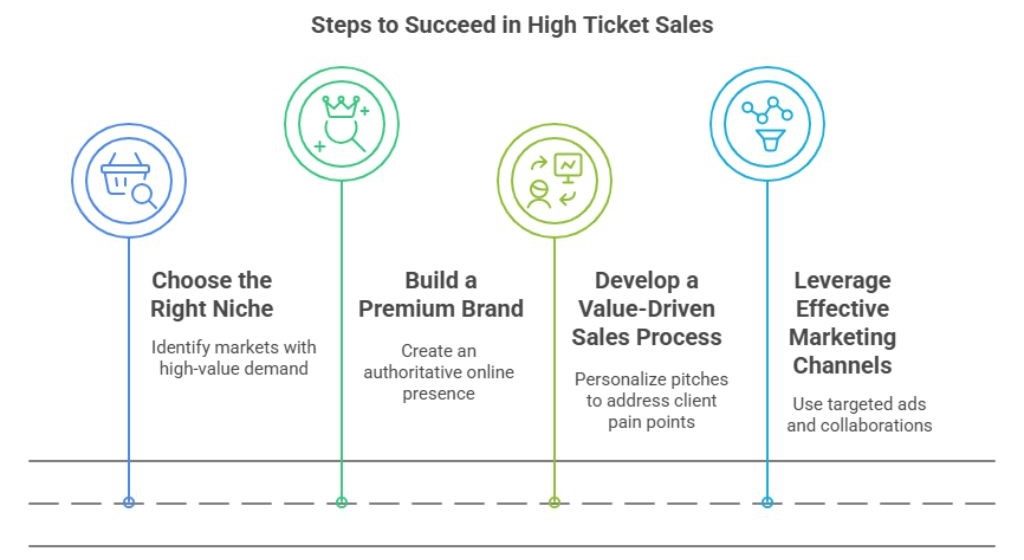
High ticket sales become easier to manage when the process has clear stages.
The exact sequence varies by business, but the following framework works as a practical starting point.
1. Attract Relevant Prospects
The goal is not simply more leads.
It is more people with a plausible reason to consider the offer.
Useful acquisition channels can include:
- Search-focused content
- Educational videos
- Referrals
- Email marketing
- Webinars
- Professional communities
- Targeted outbound prospecting
- Partnerships
- Paid acquisition
Choose channels based on where the target customer actually looks for information and solutions.
2. Qualify Before Presenting the Full Offer
Qualification determines whether a deeper sales conversation makes sense.
Depending on the offer, useful qualification criteria can include:
- Problem or need
- Budget
- Timing
- Decision authority
- Existing alternatives
- Desired outcome
- Implementation capacity
Qualification should work in both directions.
The seller determines whether the prospect is appropriate for the offer. The prospect also needs enough information to determine whether the seller deserves further consideration.
3. Understand the Problem
A discovery conversation should provide information before it produces a recommendation.
Ask relevant questions.
What is happening now?
What has already been tried?
What does the prospect want to change?
Why does the problem matter?
What constraints exist?
What would a satisfactory outcome look like?
The purpose is not to collect statements that can later be turned into pressure.
It is to understand whether the offer genuinely addresses the situation.
4. Connect the Offer to the Need
Once the problem is clear, explain how the offer relates to it.
Focus on the parts that matter to this buyer rather than presenting every feature.
A useful explanation covers:
- What the solution does
- How it addresses the stated problem
- What implementation requires
- What the buyer receives
- What the solution does not solve
- What the next step would involve
Relevance is more persuasive than volume.
5. Provide Evidence
Large claims require stronger support.
If you say your process can reduce implementation time, improve a particular business metric, or solve a technical problem, show the prospect why that claim is credible.
Use evidence that matches the claim.
Avoid presenting exceptional customer outcomes as though every buyer should expect the same result.
6. Discuss Price and Terms Clearly
Do not treat price as something that needs to be hidden until the prospect is emotionally committed.
Explain the investment when it becomes relevant to the evaluation.
The buyer should understand:
- Total price
- Payment schedule
- Contract length
- Renewal terms
- Cancellation terms
- Refund conditions where applicable
- Additional costs
- What is included
Clear commercial terms help buyers evaluate the real commitment.
7. Give the Buyer a Clear Decision
A sales process eventually needs an outcome.
The next step might be signing an agreement, arranging another conversation with additional stakeholders, reviewing documentation, starting onboarding, or deciding not to proceed.
Avoid creating urgency unless a real deadline exists.
A good sales process helps the buyer reach a decision. It does not require every decision to be yes.
Whether you build your own premium offer or promote someone else’s through affiliate programs, you can discover some of the best high ticket affiliate programs to maximize your earnings.
How to Handle Objections in High Ticket Sales
Objections are information.
They can indicate uncertainty, missing information, a competing priority, insufficient budget, lack of trust, poor timing, or genuine incompatibility.
Do not assume every objection is secretly a buying signal.
“It’s Too Expensive”
First determine what the prospect means.
The problem could be:
- The budget is genuinely unavailable.
- The expected value is unclear.
- A competitor costs less.
- The scope appears larger than necessary.
- The timing is wrong.
- The buyer does not consider the problem important enough.
Those situations require different responses.
If the offer is outside the prospect’s budget, more persuasion does not change that fact.
If the value is unclear, explain the connection between the problem, solution, scope, and price more clearly.
“I Need to Think About It”
Give the prospect room to think.
You can still clarify what remains unresolved.
A useful question is:
“What would you like to evaluate before making the decision?”
The answer may reveal a legitimate concern that deserves additional information.
It may also reveal that the person simply does not want to proceed.
Both outcomes are useful.
“I’ve Tried Something Similar Before”
Past disappointment deserves investigation.
Ask what happened.
Was the previous solution poorly implemented?
Was the product itself unsuitable?
Were expectations unrealistic?
Was support inadequate?
Understanding the previous failure helps determine whether your offer is materially different or whether the prospect risks repeating the same mistake.
“I’m Not Ready Yet”
Do not automatically interpret this as fear.
Timing may genuinely be wrong.
Ask what needs to change before the decision becomes practical.
If a reasonable future point exists, agree on an appropriate follow-up.
If not, allow the conversation to end.
High Ticket Sales Strategies That Support Better Decisions
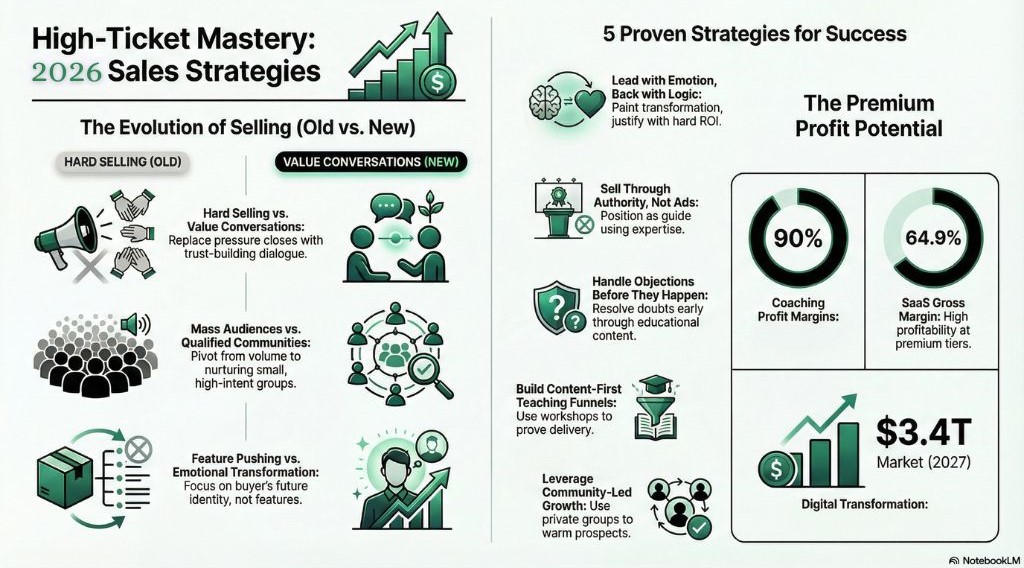
The strongest strategies reduce uncertainty rather than increase pressure.
Teach Before You Ask for the Sale
Educational content helps prospects understand the problem before they evaluate your offer.
That might include:
- Guides
- Workshops
- Demonstrations
- Case studies
- Comparisons
- Webinars
- Tutorials
The goal is not to give away everything.
It is to provide enough useful information for the prospect to understand how you think and whether your expertise is relevant.
Address Important Questions Early
Do not make prospects wait until the final sales call to understand basic facts.
Where appropriate, clarify:
- Who the offer is for
- Who it is not for
- General pricing or pricing structure
- Expected timeline
- Required commitment
- Delivery model
- Common limitations
Clear information can prevent unsuitable prospects from entering the process.
Use Case Studies Carefully
A good case study explains context.
What problem existed?
What was done?
What constraints mattered?
What changed?
What cannot be generalized from the example?
The goal is not to turn one successful customer into a universal promise.
It is to show how the solution worked in a relevant situation.
Make Follow-Up Useful
Avoid repeated messages that add nothing.
Each follow-up should have a reason.
You might:
- Answer a remaining question
- Send requested information
- Clarify a proposal
- Include another decision-maker
- Confirm whether the prospect wants to continue
If there is no new reason to contact someone and they are no longer engaging, repeated follow-up can become pressure.
Build Referrals Into the Customer Experience
High ticket businesses often depend heavily on reputation.
The most sustainable referral strategy starts with delivering the work well.
Clear onboarding, good communication, strong execution, and realistic expectations give satisfied customers a reason to recommend the business without turning every interaction into a referral request.
Common Types of High Ticket Offers
High ticket sales can support many business models.
Consulting
Consultants sell specialized expertise applied to a defined business or professional problem.
The value often comes from diagnosis, strategy, implementation guidance, or access to knowledge the client does not have internally.
Coaching
Coaching can command higher prices when it provides specialized expertise, structured support, individualized feedback, and a clearly defined scope.
The price still needs to reflect the actual service rather than vague promises of transformation.
Done-for-You Services
Agencies and specialist service providers may charge premium fees for performing complex or time-intensive work on behalf of clients.
Examples include:
- Marketing
- Software development
- Design
- Recruiting
- Operations
- Financial services
- Research
Professional Education
Advanced programs, certifications, cohort courses, and specialized training can become high ticket offers when the curriculum, access, support, and expertise justify the price.
Enterprise Software
Business software can involve substantial contract values when it supports important operations across teams or organizations.
The sales process may include demonstrations, technical evaluation, security review, implementation planning, and procurement.
Luxury Products and Experiences
High-end travel, luxury goods, concierge services, and other premium experiences can involve high ticket transactions because buyers place additional value on access, craftsmanship, personalization, convenience, or exclusivity.
Affiliate Offers
You can also participate in high ticket sales without creating the underlying product.
High-ticket affiliate programs compensate publishers or partners for referring customers to more expensive products or services.
The same principle still applies. Commission size should not override product quality, audience fit, or the accuracy of the recommendation.
How to Choose the Right High Ticket Offer
Not every business should sell the same type of premium offer.
Evaluate the opportunity from several angles.
Start With the Problem
What problem are you solving?
How important is it?
What does it currently cost the customer in time, money, risk, or missed opportunity?
A meaningful problem provides a stronger foundation for premium pricing than packaging alone.
Evaluate the Buyer
Determine:
- Who experiences the problem
- Who controls the budget
- Who makes the decision
- What alternatives already exist
- What the buyer expects from a solution
- Whether the market already pays to solve the problem
This helps determine whether the audience can realistically support the offer.
Understand the Economics
Revenue is not the same as profit.
A $10,000 service can still be unattractive if it requires excessive acquisition cost, customization, delivery time, and support.
Estimate:
- Customer acquisition cost
- Delivery cost
- Gross margin
- Sales-cycle length
- Team capacity
- Customer retention where relevant
The price needs to support the business model after those costs are considered.
Check Your Ability to Deliver
Do not sell a level of support or expertise you cannot provide consistently.
A high ticket offer becomes difficult to scale when every customer requires a completely different process.
Look for a balance between personalization and repeatability.
Compare the Offer With Alternatives
Understand what customers can choose instead.
That may include:
- Competitors
- Internal hiring
- Lower-cost products
- Doing nothing
- Solving only part of the problem
The strongest positioning explains why the offer fits a particular customer without pretending competing options have no value.

Metrics That Matter in High Ticket Sales
A large deal size can hide weaknesses in the sales process if you look only at revenue.
Track the full funnel.
Useful metrics include:
Qualified Lead Rate
What percentage of leads actually meet your basic qualification criteria?
Discovery-to-Proposal Rate
How many qualified conversations progress to a formal offer?
Win Rate
What percentage of qualified opportunities become customers?
Average Deal Size
How much revenue does the average completed sale generate?
Sales Cycle Length
How long does it typically take a qualified prospect to decide?
Customer Acquisition Cost
How much does it cost to acquire a new customer across marketing and sales activity?
Gross Margin
How much revenue remains after the direct cost of delivering the product or service?
Retention and Expansion
For recurring businesses, track how long customers remain and whether accounts grow, shrink, or cancel.
No single number explains the health of a high ticket sales model.
A business with a high close rate but poor margins may have a pricing problem. A business with many leads but very few qualified opportunities may have a targeting problem. A long sales cycle may indicate complexity, poor qualification, or simply the normal buying process for that market.
The metrics need to be interpreted together.
Conclusion
High ticket sales are not simply about charging more or finding buyers with larger budgets.
A premium sales model works when the problem matters, the offer provides meaningful value, the target customer can justify the investment, and the sales process gives them enough information to make a sound decision.
That requires qualification, diagnosis, clear positioning, relevant evidence, transparent pricing, and delivery that matches what was promised.
It also requires restraint.
Not every prospect should buy. Not every objection should be overcome. Not every service deserves premium pricing.
Start by examining the offer itself. Identify the problem it solves, who benefits most, what evidence supports its value, and whether the economics work for both sides.
When those pieces are strong, high ticket selling becomes less about pushing for a larger transaction and more about helping the right buyer make a higher-stakes decision with clarity.
Frequently Asked Questions
What Are High Ticket Sales?
High ticket sales involve relatively expensive products or services where the purchase represents a significant decision for the target customer. These sales often require more evaluation, trust, information, and direct interaction than lower-cost transactions.
What Is Considered a High Ticket Sale?
There is no universal price threshold.
What qualifies as high ticket depends on the industry, customer, and typical transaction size. The better indicator is whether the purchase requires a greater financial commitment and more deliberate evaluation than a routine purchase in that market.
How Do High Ticket Sales Work?
The process usually involves attracting relevant prospects, qualifying them, understanding their needs, explaining the offer, providing evidence, discussing price and terms, addressing questions, and helping the buyer reach a decision.
Are High Ticket Sales Better Than Low Ticket Sales?
Not necessarily.
High ticket models can generate more revenue per transaction but may involve longer sales cycles, greater customer expectations, more direct selling, and higher delivery requirements.
Low-ticket models can benefit from automation and volume.
The better model depends on the offer, market, margins, acquisition strategy, and business capacity.
Do You Need a Large Audience for High Ticket Sales?
No specific audience size guarantees success.
A smaller group of qualified prospects may be enough for a business with a high average deal value, while another business may need a much larger pipeline.
Audience relevance and purchasing ability matter more than follower count alone.
How Do You Find High Ticket Sales Leads?
Potential channels include referrals, SEO, educational content, outbound prospecting, webinars, email marketing, paid campaigns, professional communities, partnerships, and events.
The best channel depends on where the target buyer researches solutions and who controls the buying decision.
How Should You Handle High Ticket Sales Objections?
First identify what the objection actually means.
It may relate to budget, timing, trust, expected value, implementation, alternatives, or genuine lack of fit. Address the specific concern accurately rather than assuming every objection needs to be overcome.
What Are Examples of High Ticket Products and Services?
Common examples include consulting, coaching, agency services, professional education, enterprise software, specialized business services, luxury products, and premium travel experiences.
Whether an offer qualifies as high ticket depends on its market and typical customer.
What Makes a Strong High Ticket Offer?
A strong offer solves a meaningful problem for a clearly defined customer, has a credible value proposition, explains its scope and terms clearly, provides relevant evidence, and delivers an experience consistent with the price.
What Is the Biggest High Ticket Sales Mistake?
One of the biggest mistakes is assuming a higher price can compensate for weak value.
Premium pricing works only when the problem, offer, audience, sales process, and delivery support the investment.

1 Comment
High-Ticket Affiliate Marketing: Earn Bigger, Faster, Smarter - Ismel Guerrero. · April 24, 2025 at 9:10 am
[…] Earning big commissions is only part of the equation. To succeed long-term, you’ll need to understand how premium buyers think, what drives their decisions, and how to guide them without pressure. You can explore that in our article on high-ticket sales. […]