Affiliate marketing has always rewarded people who can create useful content, understand an audience, choose relevant offers, and build trust before asking for a click.
AI does not change those fundamentals. It changes how quickly some of the work can be researched, organized, drafted, tested, repurposed, and improved.
That is why AI affiliate marketing is not just about using tools to write faster. It is about building a smarter workflow. AI can help with keyword research, content planning, product comparisons, email sequences, funnel testing, analytics, and campaign optimization. But it still needs human judgment, original experience, and clear strategy to produce work people trust.
This guide explains how AI fits into affiliate marketing, where it helps most, where it can create risk, and how to use it without turning your content into generic automation. You will learn how to build a practical AI-assisted affiliate workflow that supports better content, stronger funnels, and more informed decisions.
- AI affiliate marketing uses artificial intelligence tools to support affiliate content, SEO research, funnel building, email marketing, content repurposing, and performance tracking.
- AI can speed up repetitive work, but it does not replace strategy, audience understanding, product knowledge, or trust.
- The strongest use cases for AI in affiliate marketing include keyword research, content outlines, product comparison drafts, email sequences, social repurposing, and campaign analysis.
- AI-generated content still needs human editing, fact-checking, original insight, and compliance with affiliate program rules.
- A useful AI workflow starts with one clear goal, such as publishing better product reviews, improving email follow-up, or tracking which offers convert.
- Free AI tools can help beginners test ideas, but paid tools may become useful once a campaign has traffic, leads, or revenue to justify the cost.
- The best AI affiliate marketers use AI for leverage, not shortcuts. They combine automation with judgment, testing, and a clear understanding of what their audience actually needs.
Disclaimer: I am an independent Affiliate. The opinions expressed here are my own and are not official statements. If you follow a link and make a purchase, I may earn a commission.
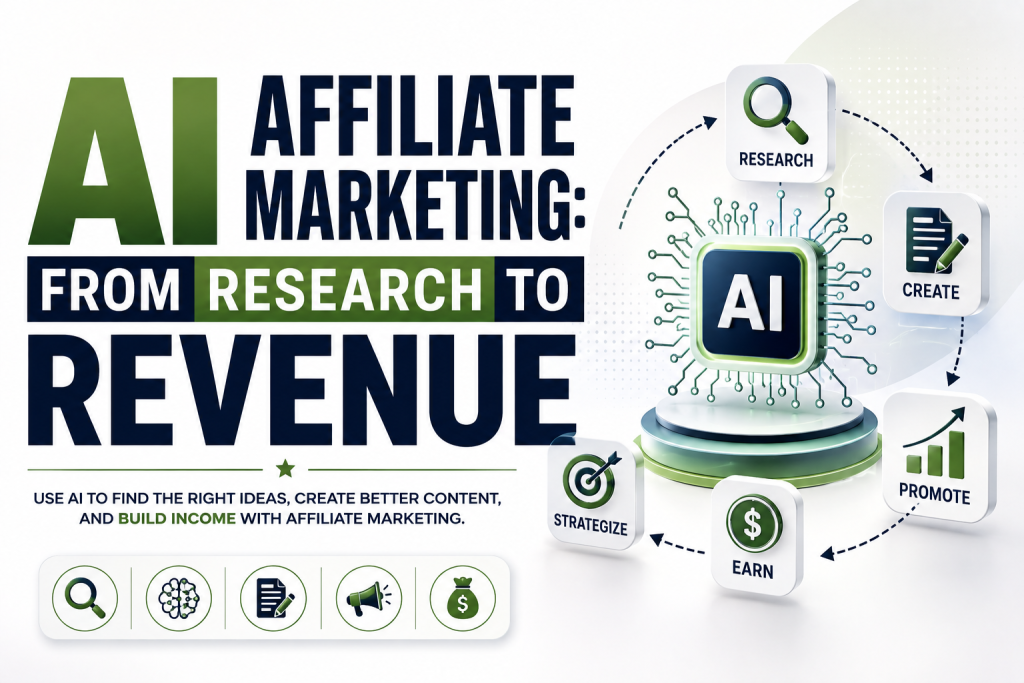
What Is AI Affiliate Marketing?
AI affiliate marketing is the use of artificial intelligence tools to support the work involved in promoting affiliate products.
That can include researching keywords, planning content, comparing products, drafting reviews, writing email sequences, creating social posts, building landing pages, analyzing campaign data, and improving conversion paths.
The business model is still affiliate marketing. You recommend a product or service, send people through a tracked affiliate link, and earn a commission when a qualified action happens. That action may be a sale, signup, free trial, lead, or subscription, depending on the program.
AI does not replace that model. It helps you work through parts of it faster.
For example, an affiliate marketer might use AI to outline a product comparison, summarize customer pain points, generate email subject line ideas, repurpose a blog post into social content, or analyze which pages are getting clicks but not conversions.
The important distinction is that AI is not the strategy.
A tool can help you create faster, but it cannot decide which audience to serve, which products are worth recommending, what claims are accurate, or why a reader should trust your opinion.
AI affiliate marketing works best when AI supports a clear system. The marketer still controls the niche, offer selection, content quality, compliance, testing, and final judgment.
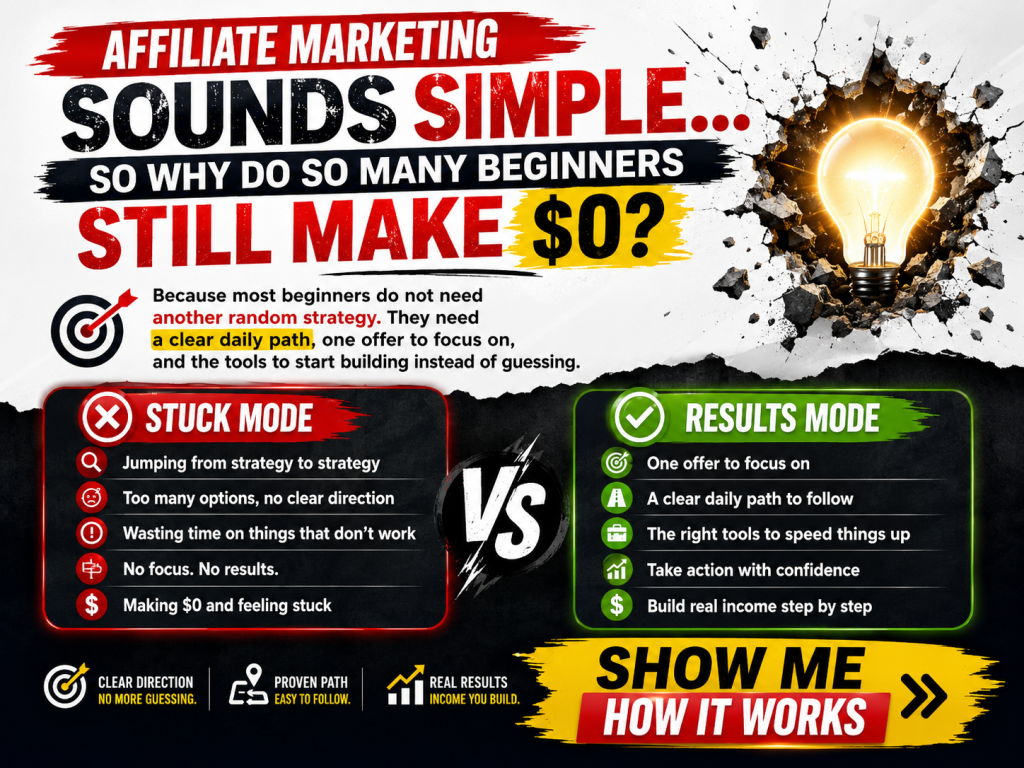
How AI Changes Affiliate Marketing Workflows
AI changes affiliate marketing by reducing the time spent on repetitive research, drafting, organizing, testing, and analysis.
That does not mean every task should be automated. It means affiliates can use AI to move faster through the parts of the workflow that often slow campaigns down.
A traditional affiliate workflow might involve researching a niche, finding keywords, studying competitors, writing content, creating emails, building landing pages, posting on social media, and checking analytics manually.
An AI-assisted workflow can make those steps more efficient.
AI can help you identify content angles, organize product comparisons, draft first versions of emails, create variations of headlines, summarize audience objections, repurpose one article into multiple formats, and surface performance patterns from campaign data.
The biggest benefit is not speed by itself.
The real benefit is feedback.
AI can help you test more ideas, compare more angles, and improve campaigns with more information. Instead of guessing which headline, offer angle, or email subject line might work, you can create several options, review them, edit them, and test the strongest version.
This is where AI becomes useful for affiliate marketers.
It helps you build a more repeatable system around content, traffic, leads, and conversions. You still need to choose the right niche, understand the audience, review the products, disclose affiliate relationships, and make the final editorial decisions.
AI improves the workflow. It does not remove the responsibility.
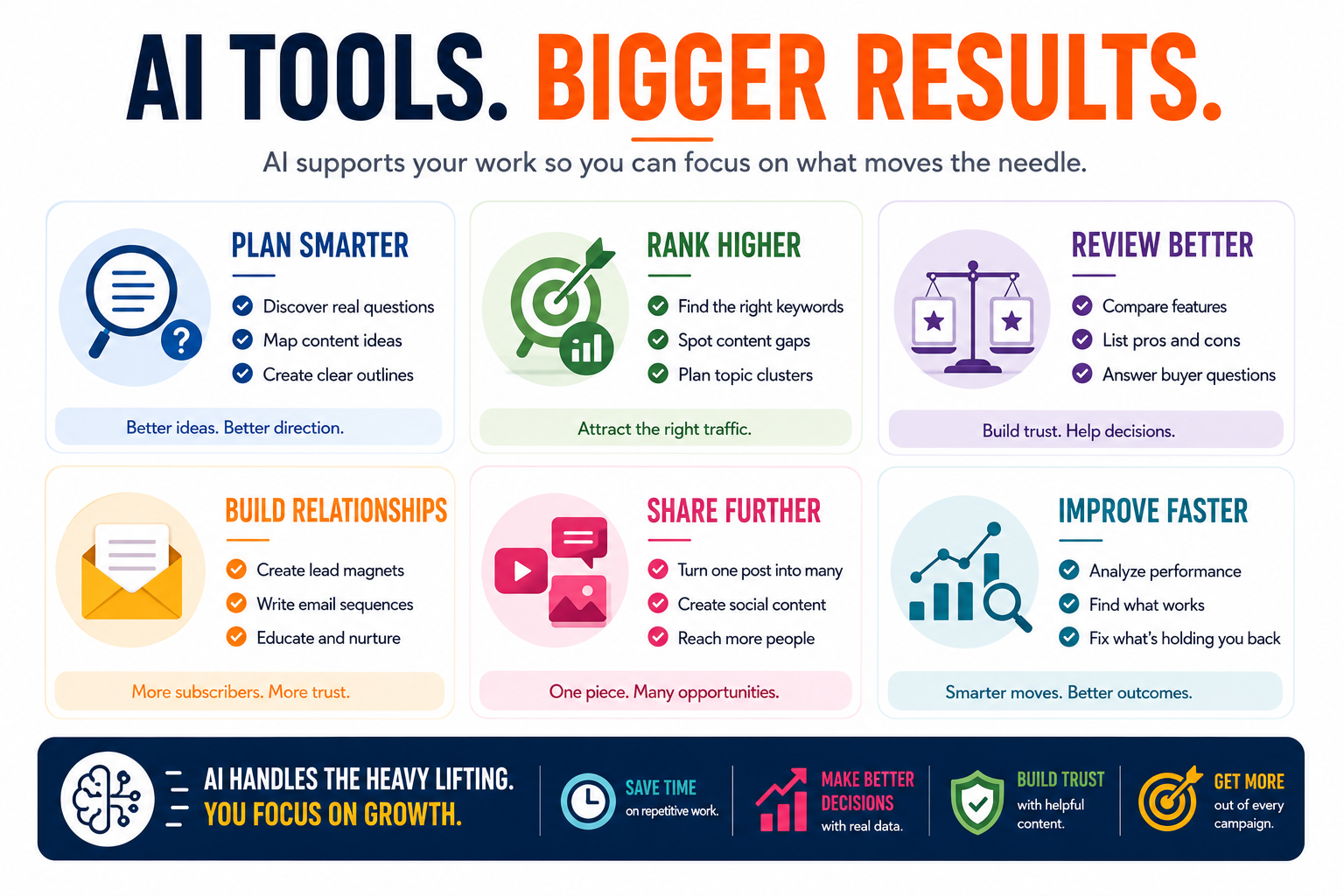
Where AI Helps Affiliate Marketers Most
AI is most useful when it supports repeatable affiliate marketing tasks.
It can help you research faster, organize ideas, draft content, repurpose assets, analyze results, and improve weak parts of a campaign. The goal is not to automate everything. The goal is to remove friction from the work that slows you down.
Content Research And Planning
AI can help you turn a broad niche into a clearer content plan.
For example, instead of starting with a general topic like “email marketing tools,” you can use AI to identify subtopics, audience questions, comparison angles, pain points, and buyer objections.
This can help you build content around real search intent.
Useful AI-assisted research tasks include:
- Brainstorming article angles
- Grouping topics by intent
- Creating content briefs
- Finding common objections
- Mapping beginner, comparison, and decision-stage content
- Turning rough ideas into outlines
AI should not be the final authority on what your audience wants. It should help you organize your thinking so you can make better editorial decisions.
SEO And Keyword Research
AI can support SEO by helping you understand how topics connect.
It can help group keywords by intent, suggest related questions, identify content gaps, and organize articles into pillar and cluster structures.
For affiliate marketers, this is especially useful because many commissions come from search-driven content. Product reviews, comparison articles, alternatives posts, buying guides, tutorials, and best-of lists all depend on matching the right keyword to the right stage of the buyer journey.
AI can help you see whether a keyword is informational, commercial, or decision-focused.
That matters because a reader searching “what is affiliate marketing” needs education, while a reader searching “best AI writing tools for bloggers” is closer to comparing options.
AI can help with structure, but you still need SEO judgment. Search volume, ranking difficulty, search results, product fit, and content quality still matter.
Product Reviews And Comparisons
AI can make product review content easier to organize.
It can help create comparison tables, summarize feature differences, generate testing checklists, and turn product research into cleaner sections.
This is useful when comparing several affiliate offers in the same category.
For example, an AI-assisted review workflow might include:
- Listing the product’s core features
- Identifying who the tool is best for
- Comparing pricing tiers
- Noting limitations
- Creating a feature-by-feature comparison
- Drafting questions a buyer may ask before choosing
But AI should not replace product experience.
Strong affiliate reviews need original judgment. Screenshots, testing notes, use cases, limitations, and honest trade-offs make review content more trustworthy than a generic summary.
Email Sequences And Funnels
AI can help draft the moving parts of an affiliate funnel.
That may include lead magnet ideas, landing page copy, welcome emails, product education emails, comparison emails, and follow-up messages.
This is useful because many affiliate marketers lose potential commissions by sending traffic directly to an affiliate link without building a relationship first.
An AI-assisted funnel can help you create a clearer path:
- A helpful lead magnet
- A simple opt-in page
- A welcome email
- Educational follow-up
- Product recommendation
- Objection-handling email
- Final reminder or next step
The value is not just automation. It is consistency.
AI can help you draft the sequence, but you still need to make sure the recommendation is relevant, the claims are accurate, and the affiliate disclosure is clear.
Social Content Repurposing
AI can help turn one strong content asset into several smaller pieces.
A product review can become a LinkedIn post, a short email, a video script, a carousel outline, a comparison thread, or a list of talking points.
This is useful because affiliate marketers often need more than one traffic source. SEO can take time. Social content can help test angles faster and bring attention to useful articles, videos, or lead magnets.
Repurposing also helps you avoid starting from zero every time.
One article can produce:
- Short social posts
- Email snippets
- Video outlines
- Newsletter sections
- Comparison graphics
- FAQ content
- Promotional angles
AI can help with the first draft. Your job is to make the content specific, accurate, and worth reading.
Analytics And Optimization
AI can help affiliate marketers understand performance data faster.
It can summarize traffic patterns, identify pages with high clicks but low conversions, compare email subject lines, group top-performing topics, and highlight weak points in a funnel.
Useful metrics include:
- Click-through rate
- Conversion rate
- Earnings per click
- Email open rate
- Email click rate
- Organic rankings
- Revenue by page
- Revenue by offer
AI can help find patterns, but it cannot decide what those patterns mean without context.
A low conversion rate might mean the offer is weak. It might mean the page attracts the wrong reader. It might mean the call to action is unclear. It might mean the affiliate program landing page does not convert well.
Use AI to surface the signal. Use human judgment to decide what to change.
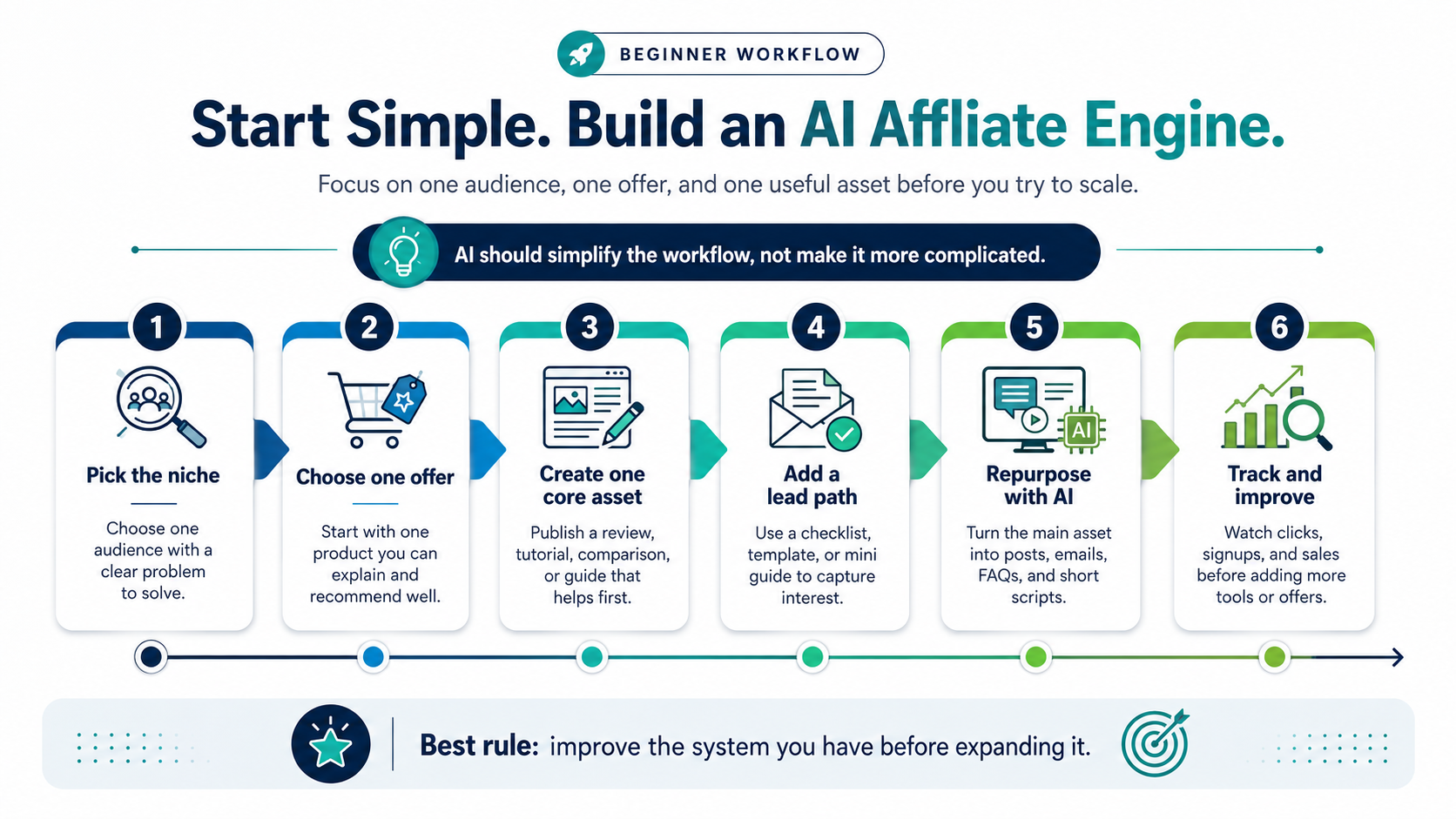
AI Affiliate Marketing Workflow For Beginners
A strong AI affiliate marketing workflow should be simple before it becomes advanced.
Many beginners make the mistake of adding too many tools, channels, offers, and automation steps at once. That creates noise. It becomes harder to know what is working, what needs improvement, and which actions actually lead to commissions.
Start with one niche, one audience, one traffic source, and one primary offer.
Choose One Niche And Audience
AI can help you research niches, but it cannot choose the right one for you.
A good affiliate niche should have three things:
- A clear audience
- Real problems or goals
- Relevant products people already buy
For example, “AI tools” is too broad. “AI tools for real estate agents” is clearer. “AI writing tools” is broad. “AI writing tools for bloggers who publish SEO content” is more specific.
A clear audience makes everything easier. It helps you choose better keywords, write stronger content, select better affiliate programs, and create more relevant recommendations.
Choose One Main Offer
Do not start by promoting ten products.
Choose one main affiliate offer that fits your audience and solves a problem they already care about. Learn the product well enough to explain who it helps, what it does, what it does not do, and when it is not the right fit.
AI can help you organize your product research, but your final recommendation should come from real evaluation.
Before promoting an offer, review:
- The product’s main use case
- The audience it serves best
- Pricing and plan limitations
- Affiliate commission terms
- Refund or cancellation rules
- Product reputation
- Support quality
- Main competitors
A strong affiliate recommendation starts with product understanding.
Build One Core Content Asset
Your first content asset should match the reader’s intent.
For a beginner, this might be:
- A product review
- A comparison article
- A tutorial
- A best-of list
- An alternatives article
- A problem-solution guide
AI can help create the outline, organize sections, draft comparison tables, and generate questions the reader may have. But the final article should include your own judgment, edits, examples, and clear affiliate disclosure.
The goal is not to publish fast. The goal is to publish something useful enough to earn trust.
Create A Simple Lead Capture Path
Not every visitor will click an affiliate link the first time they visit.
A simple lead capture path gives you another chance to build trust. This might be a checklist, template, email mini-course, comparison worksheet, prompt library, or setup guide related to the offer.
For example, if you promote an AI writing tool, your lead magnet could be a checklist for reviewing AI-generated blog posts before publishing.
The path can stay simple:
- Helpful article
- Relevant lead magnet
- Email signup form
- Welcome email
- Educational follow-up
- Product recommendation
AI can help draft the lead magnet and email sequence, but the offer should still feel useful on its own.
Repurpose The Content
Once your core article is published, use AI to repurpose it.
Turn the article into shorter assets that point people back to the main page or lead magnet.
You can create:
- Social posts
- Email snippets
- Short video scripts
- LinkedIn posts
- FAQ sections
- Comparison graphics
- Newsletter ideas
This helps you get more value from one strong piece of content instead of constantly starting from scratch.
Track The Right Metrics
A beginner workflow should include basic tracking from the start.
You do not need a complex dashboard on day one, but you do need to know whether your content is attracting the right visitors and whether those visitors are taking action.
Track:
- Page views
- Affiliate link clicks
- Click-through rate
- Email signups
- Email clicks
- Conversions
- Revenue by page
- Revenue by offer
AI can help you review performance data and identify patterns, but the goal is simple: find what is working and improve it.
Improve Before Expanding
Do not add more tools, offers, or channels too early.
First, improve the workflow you already have. Update the article. Strengthen the call to action. Improve the lead magnet. Test a better headline. Add missing buyer questions. Compare your top offer against alternatives.
Expansion only helps when the foundation is working.
A beginner does not need a complicated AI affiliate system. They need a focused workflow that turns one audience, one offer, and one useful content asset into a repeatable process.
Free Vs Paid AI Affiliate Marketing Stack
You do not need a large AI tool stack to start affiliate marketing.
A beginner can build a simple workflow with free or low-cost tools. Paid tools become more useful when you already have a clear niche, content plan, traffic source, or revenue goal.
The mistake is paying for tools before you know what job each tool needs to perform.
Free Or Low-Cost Stack
A free or low-cost stack is best for testing. It helps you validate a niche, publish your first content, build a simple lead magnet, and learn how your audience responds before adding more expenses.
A basic stack may include:
| Category | Tool Type | Purpose |
|---|---|---|
| Content Planning | AI writing assistant | Outline articles, brainstorm angles, and organize ideas |
| Website | WordPress or another basic site builder | Publish affiliate content |
| SEO | Free SEO plugin or keyword tool | Optimize titles, headings, metadata, and basic on-page structure |
| Design | Free design tool | Create simple graphics, lead magnets, and social posts |
| Email Marketing | Free or entry-level email platform | Collect subscribers and send basic follow-up emails |
| Analytics | Website analytics and affiliate dashboard | Track traffic, clicks, signups, and conversions |
This setup is enough to begin.
The goal is not to build a perfect system. The goal is to publish useful content, collect early data, and learn which topics, offers, and calls to action attract real interest.
Paid Stack
A paid stack makes more sense when you need speed, automation, deeper research, better design, or stronger tracking.
Paid tools can help with advanced keyword research, content optimization, funnel building, email automation, video creation, social scheduling, and performance reporting.
A paid stack may include:
| Category | Tool Type | Purpose |
|---|---|---|
| Content Creation | AI writing or content workflow platform | Draft reviews, comparisons, emails, and content briefs faster |
| SEO Optimization | SEO research and optimization tool | Analyze competitors, improve topical coverage, and optimize content |
| Funnel Building | Landing page or funnel platform | Build opt-in pages, bridge pages, and offer flows |
| Email Automation | Advanced email platform | Segment subscribers and send behavior-based sequences |
| Video Or Audio | AI video, voice, or editing tool | Create tutorials, product demos, and repurposed content |
| Analytics | Reporting or dashboard tool | Review traffic, clicks, conversions, and campaign performance |
Paid tools should help you earn back time, improve quality, or increase revenue.
If a tool does not clearly support one of those outcomes, it may be clutter.
When To Stay Free
Stay with a free or low-cost stack when you are still choosing a niche, testing your first offer, or learning how affiliate content works.
At this stage, your biggest constraint is usually not software. It is clarity.
You need to know who you are helping, what problem you are solving, which products fit the audience, and what type of content attracts qualified readers.
Better tools will not fix a weak niche or unclear positioning.
When To Upgrade
Upgrade when a paid tool removes a real bottleneck.
For example, upgrade if keyword research is slowing your content planning, if your email platform limits automation, if your landing pages need better testing, or if your content production process has become too manual.
The best reason to pay for a tool is not that it looks impressive.
The best reason is that it helps you do more of what is already working.
Keep The Stack Simple
A useful AI affiliate marketing stack should be easy to manage. Too many tools create more decisions, more subscriptions, more logins, and more places for work to get stuck.
Start with the smallest stack that lets you research, publish, promote, capture leads, and track results. Then add tools only when the workflow proves that you need them.
A simple system you use consistently is better than an expensive system you barely understand.

How To Use AI Without Losing Trust
Trust is the part of affiliate marketing AI cannot automate.
AI can help you draft faster, organize ideas, compare products, and repurpose content. But readers still need to believe that your recommendation is accurate, useful, and based on more than a generic tool summary.
This matters even more in affiliate content because money is involved. If the reader clicks your link and buys something, they are relying on your judgment.
Edit Everything AI Helps Create
AI-generated drafts should be treated as starting points.
They can help you move faster, but they often need better structure, clearer examples, more precise claims, and stronger human judgment.
Before publishing AI-assisted content, review:
- Accuracy
- Product details
- Pricing information
- Affiliate terms
- Tone
- Repetition
- Unsupported claims
- Search intent match
- Reader usefulness
The goal is not to hide AI. The goal is to make sure the final content is worth trusting.
Add Original Experience
Original experience is one of the clearest ways to stand out.
If you are reviewing a tool, use it. Show what it does well, where it falls short, who it fits, and who should avoid it.
Useful experience can include:
- Screenshots
- Setup notes
- Testing results
- Workflow examples
- Before-and-after comparisons
- Personal observations
- Clear limitations
- Specific use cases
AI can summarize a product page. It cannot replace your real evaluation.
Be Careful With Claims
AI tools can make claims sound confident even when they are incomplete, outdated, or wrong.
That is risky in affiliate marketing because exaggerated claims can damage trust and may violate affiliate program rules.
Avoid saying a tool will guarantee rankings, sales, income, savings, or conversions unless the claim is directly supported and properly qualified.
Stronger affiliate content uses restrained language:
- “may help”
- “can support”
- “is useful for”
- “may be a fit if”
- “works best when”
- “has limitations”
That kind of language is not weaker. It is more credible.
Disclose Affiliate Relationships Clearly
Affiliate disclosure should not be hidden.
Readers should know when you may earn a commission from a recommendation. A clear disclosure protects trust and helps the reader understand the relationship behind the link.
Place the disclosure near the beginning of the article and near important affiliate-heavy sections when needed.
A simple disclosure is usually enough:
This article may contain affiliate links. If you buy through these links, I may earn a commission at no extra cost to you.
Clear disclosure does not weaken conversions. It makes the recommendation feel more honest.
Respect Program Rules
Every affiliate program has its own terms.
Some programs restrict paid ads, coupon bidding, email promotion, brand bidding, AI-generated content, review claims, or how logos and screenshots can be used.
Before promoting a program, review the rules carefully.
AI can help summarize terms, but you should still check the original program agreement yourself. If you misunderstand the rules, you may lose commissions or get removed from the program.
Keep The Human Point Of View
AI can help create content at scale, but scale without perspective creates sameness.
Your point of view is what makes affiliate content useful. Readers want to know what you think, what you tested, what you noticed, what you would choose, and what trade-offs matter.
Do not publish content that only repeats what the product page says.
Add judgment.
Explain who the tool is best for. Explain when it is not worth paying for. Explain what a beginner should know before signing up. Explain which features matter and which ones sound better than they are.
AI can help with production. Trust comes from the human layer you add before publishing.
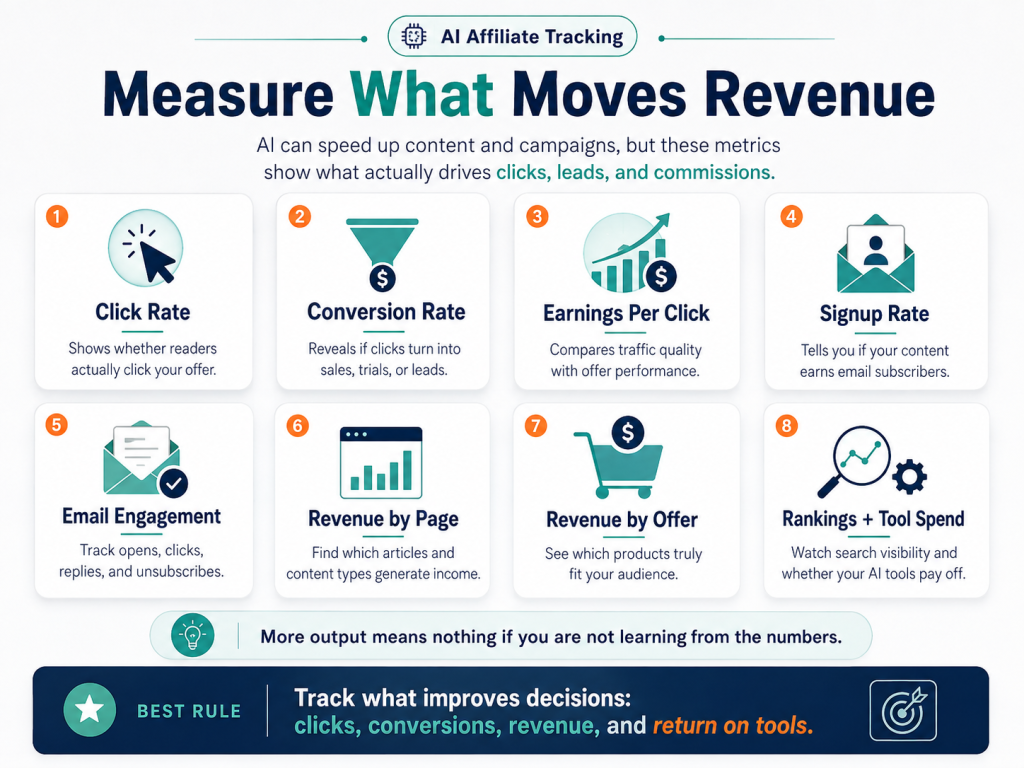
Metrics To Track In AI Affiliate Marketing
AI can help you create more content, test more angles, and build more campaigns, but more activity does not always mean better results.
You still need to measure what is working.
Tracking helps you avoid one of the biggest mistakes in AI affiliate marketing: producing more without learning more. The goal is not to publish endlessly. The goal is to identify which pages, emails, offers, and traffic sources move people closer to a qualified click or conversion.
Click-Through Rate
Click-through rate shows how many readers click your affiliate links compared with how many people view the page, email, or post.
A low click-through rate may mean the offer is not relevant, the call to action is weak, the link placement is poor, or the content attracts readers who are not ready to compare solutions.
AI can help you test different calls to action, link placement ideas, product summaries, and benefit angles. But the improvement should be based on real data, not guesses.
Conversion Rate
Conversion rate shows how many affiliate clicks turn into the desired action.
That action may be a sale, lead, trial signup, account creation, or paid subscription.
If clicks are high but conversions are low, the issue may not be your content alone. The offer may have weak positioning, unclear pricing, poor onboarding, limited trust, or a mismatch between your audience and the product.
AI can help compare patterns across pages and offers, but you still need to evaluate whether the product is the right fit for your readers.
Earnings Per Click
Earnings per click shows how much revenue you earn for each affiliate click.
This is one of the most useful affiliate metrics because it connects traffic quality, offer quality, and commission structure.
A program with a high commission is not always better. If it converts poorly, the earnings per click may be lower than a smaller commission program that fits your audience better.
AI can help organize EPC data by page, offer, traffic source, and content type so you can see which campaigns deserve more attention.
Email Signup Rate
Email signup rate shows how many visitors join your list after reading your content or landing on your opt-in page.
This matters because many affiliate sales do not happen on the first visit. A reader may need more education, comparison, proof, or time before choosing a product.
If signup rates are low, the lead magnet may not be relevant enough, the opt-in placement may be weak, or the page may not create enough trust.
AI can help brainstorm lead magnet ideas, improve opt-in copy, and draft welcome sequences, but the offer still needs to be genuinely useful.
Email Engagement
Email engagement includes open rates, click rates, replies, unsubscribes, and conversions from your email sequence.
For AI affiliate marketing, email is useful because it gives you space to educate readers before recommending a tool or product.
Track which emails get opened, which links get clicked, and which messages lead to conversions. If engagement drops quickly, your sequence may be too promotional, too generic, or not aligned with what the subscriber expected when they signed up.
AI can help test subject lines, summarize objections, and create alternative email angles. Human editing keeps the sequence relevant and trustworthy.
Revenue By Page
Revenue by page shows which articles, reviews, comparisons, or tutorials produce income.
This helps you avoid judging content only by traffic.
A high-traffic informational article may earn little. A lower-traffic comparison article may earn more because the reader is closer to a decision.
Track revenue by content type:
- Product reviews
- Best-of lists
- Comparison articles
- Alternatives articles
- Tutorials
- Problem-solution guides
- Email capture pages
AI can help you find patterns across these pages so you know which formats and topics are worth expanding.
Revenue By Offer
Revenue by offer shows which affiliate products actually produce income for your audience.
This is different from which products look best on paper.
One tool may offer a higher commission, but another may earn more because it is easier to understand, more affordable, better matched to your content, or more trusted by your readers.
Track:
- Total revenue
- Conversion rate
- Refunds or cancellations
- Recurring commission performance
- Earnings per click
- Reader feedback
- Support or product issues
AI can help organize the data, but your decision should include both numbers and reader fit.
Organic Rankings And Search Queries
For SEO-driven affiliate marketing, rankings and search queries show whether your content is being found for the right topics.
Do not only track whether a page ranks. Track what it ranks for.
A page may bring traffic from keywords that are too broad, too early-stage, or unrelated to buying intent. That traffic may look good in analytics but fail to produce clicks or revenue.
AI can help group search queries by intent, identify content gaps, and suggest updates. But ranking decisions should still be based on search results, reader needs, and content quality.
Return On Tool Spend
AI tools can become expensive if you add too many subscriptions too quickly.
Return on tool spend helps you understand whether your AI stack is actually supporting revenue or just creating overhead.
Compare what you spend on tools against what those tools help you produce, improve, or earn.
Ask:
- Did this tool help me publish better content?
- Did it save time on work I actually needed to do?
- Did it improve rankings, clicks, leads, or revenue?
- Could I get the same result with a simpler tool?
- Is this tool still useful at my current stage?
A tool is only worth keeping if it supports the workflow.
The point of tracking is not to make affiliate marketing complicated. It is to make better decisions. AI can help you process the data, but the goal stays simple: find what works, improve what is close, and stop spending time or money on what does not move the business forward.
Common Mistakes To Avoid In AI Affiliate Marketing
AI can make affiliate marketing faster, but it can also make weak strategy easier to repeat.
The biggest risks come from using AI to produce more content, more emails, more posts, and more offers without improving the quality of the thinking behind them.
Publishing AI Content Without Editing
AI-generated content should never go straight from draft to publish.
It may sound confident while including outdated product details, vague advice, repeated phrasing, unsupported claims, or generic recommendations that do not help the reader make a decision.
Before publishing, edit for accuracy, clarity, usefulness, tone, and search intent.
Add original observations where possible. Remove anything that sounds inflated, repetitive, or disconnected from the reader’s real problem.
Promoting Tools You Do Not Understand
AI tools can look impressive from the outside.
That does not mean they are worth recommending.
If you promote a product without understanding how it works, who it fits, what it costs, and where it falls short, your content will sound like a rewritten sales page.
Strong affiliate content requires product judgment.
Use the tool when possible. Study the pricing. Check the limitations. Compare it against alternatives. Explain who should use it and who should not.
Chasing Too Many Tools At Once
The AI market changes quickly, which makes it easy to chase every new tool.
That creates scattered content and weak positioning.
Instead of reviewing every product that launches, focus on a clear category and audience. Become useful in one area before expanding.
A site about AI tools for bloggers will usually be easier to trust than a site that reviews writing tools, image tools, chatbots, video editors, productivity apps, and automation platforms with no clear focus.
Treating AI As A Shortcut Around Strategy
AI can help you draft an article, but it cannot create a business strategy for you.
It will not fix unclear positioning, weak niche selection, poor offer fit, or content that does not match search intent.
Before using AI to create more assets, answer the strategic questions first:
- Who is this for?
- What problem are they trying to solve?
- What stage of decision are they in?
- Which offer genuinely fits?
- What does the reader need to believe before clicking?
AI works better when it supports clear thinking.
Ignoring Affiliate Program Rules
Every affiliate program has rules.
Some restrict paid ads. Some restrict brand bidding. Some limit how screenshots, coupons, email promotion, or product claims can be used. Some may also have specific rules about promotional methods and content quality.
Do not assume every program works the same way.
Read the terms before building campaigns around a tool. If a program changes its rules, update your content and promotion strategy accordingly.
Over-Automating The Reader Experience
Automation can help with follow-up, segmentation, and consistency.
It can also make your marketing feel cold if every message sounds generic.
Readers should not feel like they entered a machine. They should feel guided.
Use automation to deliver useful content at the right time, but keep the message specific, relevant, and human. A short helpful email is better than a long automated sequence that repeats the same sales pitch.
Making Unsupported Income Claims
AI affiliate marketing can create real opportunities, but income claims need restraint.
Avoid promising fast commissions, guaranteed results, passive income, or easy scaling. Those claims can mislead beginners and damage credibility.
It is more useful to explain the actual levers that affect results:
- Traffic quality
- Offer fit
- Content quality
- Conversion rate
- Commission structure
- Trust
- Testing
- Consistency
Realistic expectations build more trust than exaggerated promises.
Forgetting To Track Results
AI can help you create faster, but speed means little if you do not know what is working.
Track the pages, links, emails, and offers that produce clicks, leads, and commissions. Look for patterns before creating more content.
If a review gets traffic but no clicks, improve the call to action or offer match. If a page gets clicks but no conversions, review the product fit or landing page experience. If one offer earns more per click than another, study why.
The goal is not more output. The goal is better decisions.
Letting Content Become Generic
When many affiliates use the same AI tools, their content can start to sound the same.
Generic content is easy to ignore.
Add what AI cannot provide on its own: your examples, tests, opinions, comparisons, failures, screenshots, workflows, and practical judgment.
That human layer is what makes AI-assisted affiliate content useful instead of interchangeable.
Conclusion
AI affiliate marketing works best when it makes your process clearer, faster, and more focused.
It can help you research topics, plan content, compare products, draft emails, build funnels, repurpose assets, and understand performance data. Those are real advantages, especially for solo marketers and small teams.
But AI does not replace the parts of affiliate marketing that matter most.
You still need to understand your audience, choose relevant offers, create useful content, disclose affiliate relationships, test your campaigns, and make honest recommendations. AI can support those decisions, but it should not make them for you.
The strongest affiliate marketers will not be the ones who automate the most. They will be the ones who use AI with discipline.
Start with one audience, one offer, one content asset, and one workflow. Use AI to improve the process. Then use real data and human judgment to decide what should happen next.
That is how AI becomes leverage instead of noise.
Frequently Asked Questions
What Is AI Affiliate Marketing?
AI affiliate marketing is the use of artificial intelligence tools to support affiliate marketing tasks such as content research, SEO planning, product comparisons, email sequences, funnel building, content repurposing, and performance tracking.
The business model is still affiliate marketing. AI simply helps improve parts of the workflow.
Can You Use AI For Affiliate Marketing?
Yes. AI can help with many affiliate marketing tasks, including keyword research, article outlines, product review drafts, comparison tables, email campaigns, social posts, landing page copy, and analytics review.
The content still needs human editing, fact-checking, original insight, and clear affiliate disclosure.
Does AI Replace Affiliate Marketers?
No. AI can support affiliate marketers, but it does not replace strategy, judgment, product knowledge, or trust.
Affiliate marketers still need to choose the right niche, understand the audience, evaluate products, follow program rules, and create recommendations people can rely on.
What Are The Best Ways To Use AI In Affiliate Marketing?
Some of the best ways to use AI in affiliate marketing include planning SEO content, drafting product comparisons, creating email sequences, repurposing articles into social posts, analyzing campaign performance, and improving calls to action.
AI is most useful when it supports a focused workflow instead of creating random content.
Is AI-Generated Affiliate Content Allowed?
AI-generated affiliate content is generally allowed, but it must meet content quality standards and follow the rules of each affiliate program.
Do not publish unedited AI content, fake reviews, unsupported claims, or misleading product recommendations. Always review affiliate program terms before using AI-generated content in promotional campaigns.
Can AI Content Rank In Google?
AI-assisted content can rank when it is useful, accurate, original, and aligned with search intent.
Using AI does not remove the need for quality. Thin content, repeated information, poor product understanding, and generic recommendations can still perform poorly.
What AI Tools Do Affiliate Marketers Use?
Affiliate marketers may use AI tools for writing, SEO research, design, email marketing, automation, analytics, video creation, and content repurposing.
The best tool depends on the task. A beginner does not need a large stack. Start with tools that help you research, publish, promote, capture leads, and track results.
Do Beginners Need Paid AI Tools?
Not always.
Beginners can start with free or low-cost tools while testing a niche, publishing early content, and learning what their audience responds to. Paid tools make more sense when they solve a clear bottleneck or help improve work that is already producing results.
What Is The Biggest Risk Of AI Affiliate Marketing?
The biggest risk is using AI to create more content without improving the strategy behind it.
This often leads to generic articles, weak recommendations, inaccurate claims, and low trust. AI should support better decisions, not replace them.
How Do You Start AI Affiliate Marketing?
Start with one niche, one audience, one main offer, and one traffic source.
Use AI to research the audience, plan one useful content asset, draft supporting emails or social posts, and track performance. Improve that workflow before adding more tools, offers, or channels.

1 Comment
What Are AI Affiliate Programs and How Do They Work? - Ismel Guerrero. · March 31, 2025 at 10:58 pm
[…] Next: check out our AI Affiliate Marketing Guide. […]