AI tools are now part of everyday work for marketers, creators, business owners, agencies, educators, and software teams.
That has created a growing opportunity for affiliates. Instead of promoting generic digital products, affiliates can recommend tools that help people write faster, edit videos, create voiceovers, build workflows, optimize content, automate tasks, or improve productivity.
But not every AI affiliate program is worth promoting.
Some tools have strong demand, clear use cases, trusted brands, and recurring revenue potential. Others look attractive because of high commissions but may be difficult to sell, too narrow for your audience, or risky because the product is not differentiated.
This guide compares AI affiliate programs by product type, audience fit, commission structure, promotional potential, and trade-offs. The goal is not to chase every new AI tool. It is to help you choose programs that match your content, your audience, and the kind of recommendations you can make with confidence.
- AI affiliate programs let you earn commissions by promoting AI-powered tools, software, and platforms through tracked affiliate links.
- The best AI affiliate program depends on your audience, niche, traffic source, product knowledge, and ability to explain the tool clearly.
- Recurring commissions can be attractive, but product quality, retention, conversion rate, cookie duration, and buyer fit matter just as much as payout percentage.
- AI writing, SEO, video, voice, design, automation, and productivity tools all serve different audiences, so the strongest program is the one that matches your content strategy.
- High commissions do not automatically make a program better. A lower commission tool that converts well may earn more than a high commission tool your audience does not need.
- Affiliates should review each program’s terms before promoting, including rules around paid ads, brand bidding, email promotion, coupon use, and disclosure requirements.
- Start with a small number of relevant AI affiliate programs, learn the products well, and build useful content before adding more tools to promote.
Disclaimer: I am an independent Affiliate. The opinions expressed here are my own and are not official statements. If you follow a link and make a purchase, I may earn a commission.
What Are AI Affiliate Programs?
AI affiliate programs are partner programs that pay affiliates for referring customers, leads, trials, or signups to AI-powered tools and platforms.
The product may be an AI writing tool, SEO platform, video editor, voice generator, chatbot, design tool, automation platform, productivity app, or business software with AI features.
The basic process works like any other affiliate program.
You apply to join the program, receive a tracked affiliate link, promote the product through approved channels, and earn a commission when someone takes a qualifying action through your link.
That action depends on the program. Some programs pay when a customer starts a paid subscription. Others pay for leads, free trials, annual plans, or specific product purchases.
AI affiliate programs are attractive because many AI tools solve clear business problems. They can help users save time, create content, automate workflows, analyze data, improve marketing, or reduce manual work.
But the product category also moves quickly.
New tools launch often. Features change. Commission terms can shift. Some tools become essential to a workflow, while others lose relevance when larger platforms add similar features.
That is why choosing an AI affiliate program requires more than chasing the highest commission.
You need to understand what the tool does, who it serves, how strong the product is, how long users are likely to stay, and whether your audience has a real reason to buy it.
How We Chose The Best AI Affiliate Programs
The best AI affiliate programs are not chosen by commission rate alone.
A high payout can look attractive, but it does not matter much if the product is hard to explain, difficult to sell, poorly matched to your audience, or unlikely to keep customers.
For this list, we evaluated each program using practical affiliate criteria.
Product Quality
The product needs to solve a real problem.
AI tools are easy to promote when the value is clear. A writing tool should help with content creation. A video tool should simplify production. An SEO tool should support research, optimization, or planning. A voice tool should create usable audio. A workflow tool should save time or reduce manual work.
If the tool sounds impressive but does not solve a clear problem, it is harder to recommend with confidence.
Audience Fit
A strong affiliate program should match a specific audience.
Some AI tools are best for bloggers. Others fit agencies, ecommerce sellers, course creators, YouTubers, developers, sales teams, or small businesses.
The better the audience fit, the easier it is to create useful content around the tool.
A program may be strong overall but still be wrong for your site if your readers do not need it.
Commission Structure
Commission rate matters, but it needs context.
A recurring commission can be valuable if customers stay subscribed. A one-time commission can still work well if the product has strong conversion rates or a higher price point.
When reviewing commission structure, consider:
- Commission percentage or flat payout
- One-time vs recurring commission
- Subscription length
- Minimum payout
- Payment schedule
- Refund or cancellation rules
The best commission structure is the one that fits both the product and the buyer behavior.
Cookie Duration
Cookie duration affects how long you can receive credit after someone clicks your affiliate link.
A longer cookie window gives readers more time to compare options before buying. This can matter for higher-priced tools, B2B software, or products that require team approval.
A shorter cookie window is not always a dealbreaker, but it does make timing and buyer intent more important.
Brand Trust
Trusted brands are often easier to promote.
If readers already recognize the product, your content may not need to build as much initial trust. If the tool is newer, you may need more explanation, testing, screenshots, examples, and comparison content.
Brand trust can also affect conversion rate, retention, and refund risk.
Promotional Potential
A good AI affiliate program should give you useful content angles.
Strong promotional angles include:
- Product reviews
- Tutorials
- Comparisons
- Alternatives articles
- Use-case guides
- Workflow examples
- Before-and-after demonstrations
- Niche-specific templates
The more naturally a tool fits helpful content, the easier it is to promote without sounding forced.
Main Trade-Off
Every tool has a downside.
Some are expensive. Some are narrow. Some have a learning curve. Some work best for advanced users. Some have strong features but weaker affiliate terms.
A useful affiliate review should not hide those trade-offs.
The goal is not to find perfect programs. The goal is to choose programs you can explain honestly and recommend to the right people.
Best AI Affiliate Programs At A Glance
AI affiliate programs change often, so commission rates and terms should always be checked before publishing or promoting a tool.
The table below gives a practical overview of strong AI affiliate programs by product type, audience fit, commission structure, and main trade-off.
| Program | Category | Best For | Commission | Cookie | Trade-Off |
|---|---|---|---|---|---|
| Koala AI | AI writing | Bloggers, niche site owners | 30% recurring | No paid ads |
|
| Writesonic | AI writing | Marketers, creators | 20% recurring | 12-month limit |
|
| Murf AI | AI voiceovers | YouTubers, podcasters | 20% recurring | Requires audio/video audience |
|
| Frase | SEO/Content | SEO consultants | 30% recurring | SEO-savvy audiences only |
|
| Scalenut | AI content | Agencies, SEO teams | 30-50% recurring | Tiered earnings |
|
| Descript | Video editing | Course sellers | $25 flat | Flat payout |
|
| Deep Art Creator | AI art | Artists, Etsy sellers | 20% commission | More niche tool |
|
| Synthesia | AI video | Agencies, SaaS | 25% of net | Video use case required |
|
| Jasper | AI marketing | Marketing teams | 25% for 12 mos | Conditional terms |
|
| ElevenLabs | AI audio | Creators, developers | 22% recurring | Audio use case required |
This table should be used as a starting point, not the final decision.
Before joining any program, review the official affiliate terms, payout rules, cookie window, promotional restrictions, and disclosure requirements.
Best AI Affiliate Programs
The best AI affiliate program depends on what your audience needs and what type of content you can create well.
A blogger may do better with AI writing or SEO tools. A YouTuber may do better with video, voice, or editing tools. A consultant may do better with tools that support marketing workflows, content operations, or business productivity.
Use the programs below as a starting point, then review each affiliate page before applying because commission terms can change.
Koala AI is an AI writing and SEO content tool built for creating long-form content, product roundups, and search-focused articles.
Koala fits audiences that want to create SEO content faster without building a complicated writing workflow. It is especially relevant for bloggers and niche site owners who publish product reviews, informational content, and affiliate articles.
Best promotional angle: Show how to create a search-focused article workflow, from keyword idea to outline to draft.
Koala’s affiliate page prohibits paid advertising, so it is better suited for organic content, tutorials, YouTube, email, and niche-site promotion.
Writesonic is an AI writing and marketing platform with tools for content creation, AI search visibility, and marketing workflows.
Writesonic has broad appeal because it can support content, marketing copy, SEO workflows, and AI visibility use cases. That makes it easier to fit into content for creators, consultants, and marketers.
Best promotional angle: Create tutorials around content production, AI visibility, SEO workflows, or faster marketing execution.
The recurring commission window is limited to 12 months, so long-term earnings depend on continued referrals.
Murf AI is an AI voiceover tool that helps users create voiceovers for videos, presentations, podcasts, courses, and business content.
Murf is useful for audiences that need voiceover content but do not want to record everything themselves or hire voice talent for every project.
Best promotional angle: Show how to create voiceovers for faceless videos, course lessons, product demos, explainer videos, or training content.
It is strongest for audiences already creating audio or video. It may be less relevant for readers focused only on written content.
Frase is an SEO and content optimization platform that helps users research topics, build briefs, and improve content for search and AI visibility.
Frase is a strong fit for audiences that care about ranking content, planning topic coverage, and improving articles based on search intent.
Best promotional angle: Create content around SEO briefs, content optimization, comparison posts, and how to improve existing affiliate articles.
Frase works best for audiences that already understand SEO or are willing to learn it. It may feel too specialized for casual creators.
Scalenut is an AI content and optimization platform focused on creating, optimizing, and scaling content.
Scalenut fits audiences that want an end-to-end content workflow rather than a simple AI writing tool. It can be positioned around content planning, optimization, and scaling.
Best promotional angle: Compare it with other SEO writing tools or show how to build a topic cluster using AI-assisted content planning.
The platform may be more than a beginner needs if they only want simple drafting help.
Descript is an AI-assisted audio and video editing platform for creators, podcasters, YouTubers, educators, and teams.
Descript is easy to explain because it solves a common creator problem: editing audio and video more efficiently.
Best promotional angle: Show how to turn one recording into edited clips, transcripts, social posts, podcast episodes, or video lessons.
The flat commission may be less attractive than recurring SaaS programs, especially for affiliates focused on long-term recurring income.
Deep Art Creator is an AI art tool that helps users create stylized images and visual assets.
This program fits creative audiences that want to create art, prints, visual assets, or design-style content with AI.
Best promotional angle: Build tutorials around AI art workflows, digital print creation, Etsy product ideas, or print-on-demand asset creation.
It is more niche than writing, SEO, video, or productivity tools, so it needs the right creative audience.
Synthesia is an AI video platform that helps users create avatar-based videos from text.
Synthesia is a strong fit for audiences that need video content but want to avoid traditional filming, actors, cameras, or production setups.
Best promotional angle: Create tutorials around training videos, onboarding content, course lessons, product explainers, and multilingual video workflows.
It is best for audiences with a clear video use case. It may be harder to sell to readers who only need simple written content.
Jasper is an AI marketing and content platform built for businesses, marketing teams, and brand-focused content workflows.
Jasper’s public affiliate agreement says commissions apply during the first 12 months of a customer’s subscription while the customer remains eligible, Business plans are not commissionable, and commission can increase to 30% only after specific lead and customer milestones. The agreement also says the lead must purchase within 14 days of the first affiliate click to be commissionable.
Jasper has strong brand recognition in the AI content space and may fit audiences looking for business-grade AI writing and marketing workflows.
Best promotional angle: Position it around brand voice, marketing content production, campaign workflows, and business content systems.
The affiliate terms are more conditional than many beginner-friendly programs, so affiliates should read the agreement carefully before building content around it.
ElevenLabs is an AI audio and voice platform used for voice generation, narration, content creation, and audio workflows.
ElevenLabs fits audiences that need realistic AI voice, narration, dubbing, or audio production. It is especially relevant for creators who make video, podcasts, courses, audiobooks, or multilingual content.
Best promotional angle: Show how to create voiceovers, narration, character voices, short-form video audio, or multilingual content workflows.
It works best when the audience has a clear audio use case. It may not fit general marketing audiences as well as writing or SEO tools.
How To Choose The Right AI Affiliate Program
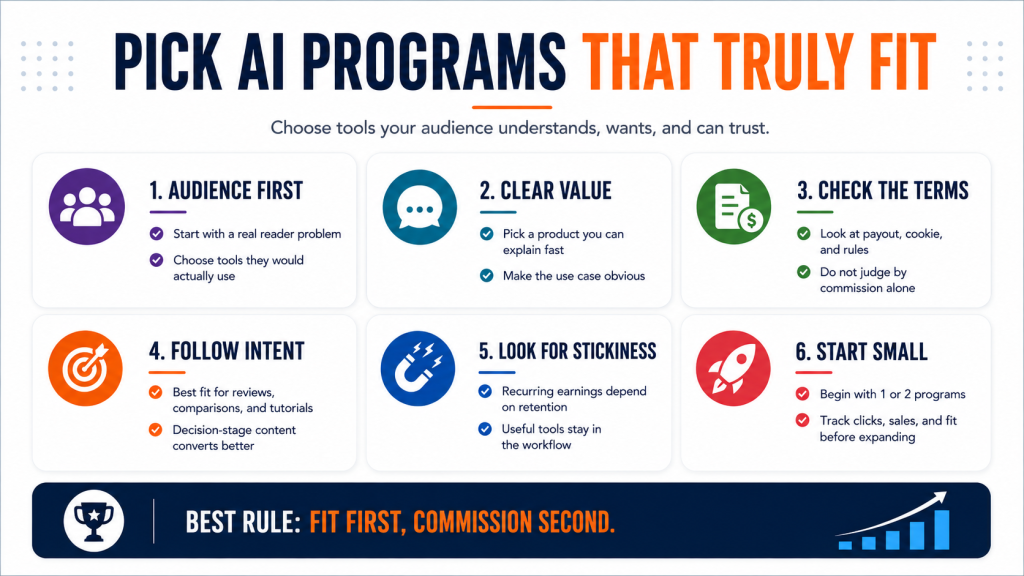
The right AI affiliate program is not always the one with the highest commission.
A strong program should fit your audience, your content strategy, and the kind of recommendation you can make honestly. If the tool does not solve a problem your readers care about, the payout will not matter much.
Start with fit before commission.
Match The Program To Your Audience
Your audience should shape the program you choose.
If your readers are bloggers, AI writing and SEO tools may be a natural fit. If they are YouTubers, AI video editors, voice tools, and scriptwriting tools may make more sense. If they are agencies, AI content workflow tools, automation platforms, and client reporting tools may be easier to recommend.
Ask:- Who is my reader?
- What work are they trying to do faster or better?
- What tool category would actually help them?
- Would they understand the product quickly?
- Would they have a reason to pay for it?
The best AI affiliate program is the one that connects naturally to the reader’s existing problem.
Choose A Product You Can Explain Clearly
AI tools can become confusing when the value is too broad.
If you cannot explain what the product does in one or two clear sentences, your readers may struggle to understand it too.
A strong product recommendation should answer:- What does the tool do?
- Who is it best for?
- What problem does it solve?
- What makes it different?
- What is the main limitation?
Clear explanations convert better than vague excitement.
Review The Commission Terms Carefully
Commission rate is only one part of the program.
Before promoting an AI affiliate program, check:- Commission rate
- One-time or recurring payout
- Cookie duration
- Minimum payout
- Payment schedule
- Refund rules
- Plan restrictions
- Geographic restrictions
- Paid ad restrictions
- Brand bidding rules
- Email promotion rules
A program may advertise a strong commission but include limits that affect how much you can actually earn.
Consider Buyer Intent
Some AI tools are easier to sell because the reader is already looking for a solution.
For example, someone searching for “best AI video generator for training videos” may be closer to buying than someone reading a general article about AI trends.
Programs work best when you can create content around buyer-intent topics, such as:- Reviews
- Comparisons
- Alternatives
- Tutorials
- Use-case guides
- Pricing breakdowns
- Best-of lists
- Workflow examples
The stronger the intent, the easier it is to turn useful content into qualified clicks.
Look At Product Stickiness
Recurring commissions are more valuable when customers stay subscribed.
A sticky product becomes part of the user’s workflow. That might mean the tool helps them publish content, edit videos, create client work, generate reports, automate tasks, or manage ongoing campaigns.
Before choosing a recurring program, ask whether users have a reason to keep paying month after month.
A tool with strong retention may earn more over time than a tool with a higher upfront payout but weak long-term use.
Check The Main Trade-Off
Every AI tool has a downside.
Some are expensive. Some are too advanced for beginners. Some are too narrow. Some have strong features but weaker affiliate terms. Some work well for one audience but poorly for another.
A good affiliate does not ignore those trade-offs.
Understanding the downside helps you create better content because you can explain who should use the tool and who should choose something else.
Start With One Or Two Programs
Do not join every AI affiliate program at once.
Start with one or two tools that clearly fit your audience. Learn the product. Create useful content. Track clicks and conversions. Then decide whether to expand.
This gives you a cleaner strategy and better data.
Promoting fewer tools with more understanding usually works better than promoting many tools with shallow content.
AI Affiliate Program Categories
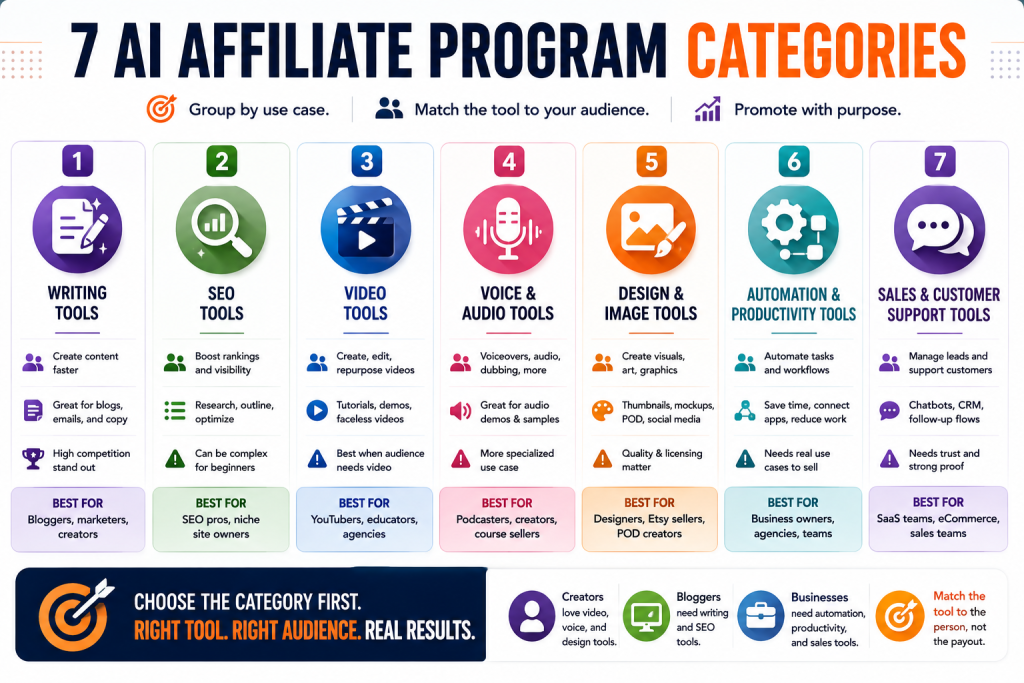
AI affiliate programs are easier to choose when you group them by use case.
The category matters because each type of AI tool attracts a different buyer, solves a different problem, and requires a different promotional angle.
AI Writing Tools
AI writing tools help users create blog posts, emails, product descriptions, ad copy, outlines, social posts, and other written content.
These programs often fit bloggers, marketers, agencies, creators, ecommerce sellers, and small business owners.
They work well for content such as:
- Product reviews
- Writing tutorials
- Blog workflow guides
- SEO content guides
- Comparison articles
- Content production templates
The main trade-off is competition. AI writing tools are popular, so your content needs a clear angle, specific audience, or original testing to stand out.
AI SEO Tools
AI SEO tools help users research topics, build outlines, analyze competitors, optimize content, and improve search visibility.
These programs fit affiliate bloggers, niche site owners, SEO consultants, content marketers, agencies, and SaaS teams.
They work well when your audience already cares about traffic, rankings, content planning, or organic growth.
The main trade-off is complexity. SEO tools can be harder to explain to beginners unless you show the workflow clearly.
AI Video Tools
AI video tools help users create, edit, repurpose, or generate videos faster.
These programs fit YouTubers, course creators, agencies, educators, SaaS teams, coaches, and businesses that need training or marketing videos.
They work well for tutorials, demos, before-and-after editing examples, faceless video workflows, and course creation guides.
The main trade-off is audience fit. Video tools convert best when your readers already need video content.
AI Voice And Audio Tools
AI voice and audio tools help users create voiceovers, narration, podcasts, training audio, audiobook content, dubbing, and character voices.
These programs fit creators, podcasters, educators, YouTubers, video producers, and course sellers.
They work well when you can demonstrate the output.
A written review can explain the tool, but an audio sample, video demo, or workflow walkthrough usually makes the value easier to understand.
The main trade-off is that audio tools are more specialized than general writing or productivity tools.
AI Design And Image Tools
AI design and image tools help users create graphics, artwork, product images, thumbnails, social visuals, digital prints, and creative assets.
These programs fit designers, Etsy sellers, print-on-demand creators, content creators, ecommerce sellers, and visual marketers.
They work well for creative tutorials, product mockups, digital product ideas, thumbnail workflows, and print-on-demand content.
The main trade-off is quality control. AI visuals can look impressive at first, but serious buyers still care about consistency, licensing, editing options, and commercial use rights.
AI Automation And Productivity Tools
AI automation and productivity tools help users organize tasks, automate workflows, summarize information, manage projects, or connect different apps.
These programs fit business owners, operators, consultants, agencies, freelancers, and teams that want to reduce manual work.
They work well for workflow guides, business process tutorials, productivity comparisons, and automation examples.
The main trade-off is that these tools can be harder to sell with simple feature lists. They need practical use cases that show how the tool saves time or reduces friction.
AI Sales And Customer Support Tools
AI sales and customer support tools help businesses manage leads, answer questions, qualify prospects, support customers, and improve follow-up.
These programs fit SaaS teams, ecommerce businesses, agencies, consultants, service businesses, and sales teams.
They work well for content about lead generation, customer support automation, chatbot setup, CRM workflows, and conversion improvement.
The main trade-off is buyer sophistication. These tools often need more explanation, proof, and trust before someone signs up.
The strongest category is the one your audience already understands and needs.
A creator audience may respond better to video, voice, or design tools. A blogging audience may respond better to writing and SEO tools. A business audience may respond better to automation, sales, or productivity tools.
Choose the category before choosing the program.
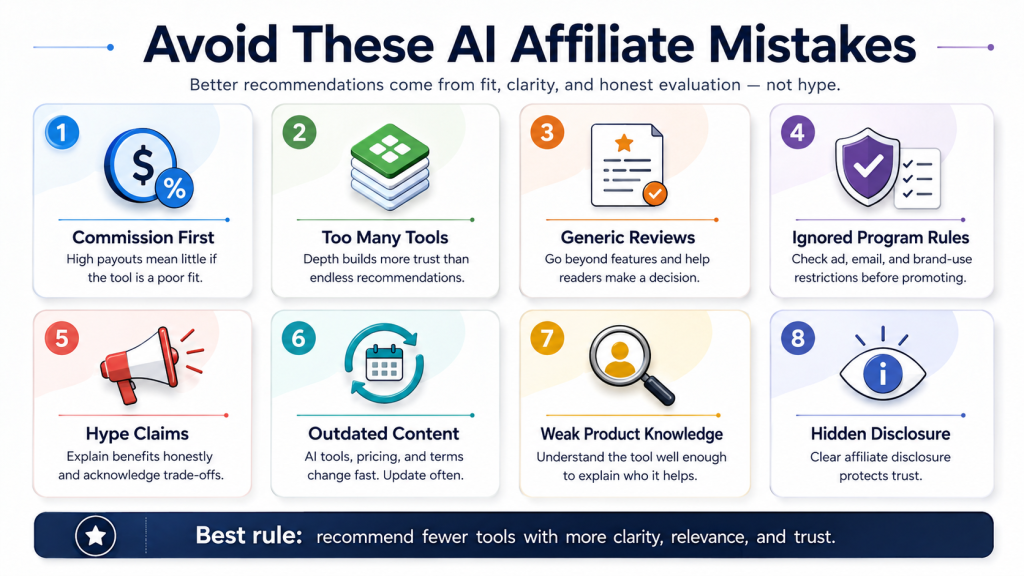
Mistakes To Avoid When Promoting AI Affiliate Programs
AI affiliate programs can be attractive, but they are easy to promote poorly.
The market is crowded. Many tools sound similar. Commission terms can change. Readers are becoming more skeptical of generic AI recommendations.
To earn trust, your content needs to be specific, accurate, and useful.
Choosing Programs Only By Commission Rate
A high commission does not guarantee high earnings.
If the product does not fit your audience, convert well, or keep customers, the payout percentage will not matter much.
Look at the full picture:
- Product quality
- Audience fit
- Conversion potential
- Cookie duration
- Retention
- Refund risk
- Program restrictions
- Brand trust
A smaller commission from a tool your audience actually needs can outperform a larger commission from a tool they do not understand or want.
Promoting Too Many AI Tools
Promoting too many tools makes your content harder to trust.
If every article recommends a different platform, readers may wonder whether you have tested anything deeply enough to give a useful opinion.
It is better to start with a focused set of tools in one category.
For example, a site for bloggers might focus on AI writing tools, SEO tools, and content optimization platforms before expanding into video, voice, or automation tools.
Depth usually builds more trust than a long list of shallow recommendations.
Publishing Generic Reviews
AI tool reviews are often weak because they repeat the same information from the product homepage.
A useful review should go further.
Include:
- Who the tool is best for
- What the tool does well
- Where it falls short
- How it compares with alternatives
- What plan may fit different users
- What use case makes the most sense
- Whether the tool is worth paying for
Readers do not need another summary. They need help making a decision.
Ignoring Affiliate Program Rules
Each affiliate program has its own rules.
Some programs restrict paid ads, coupon content, brand bidding, email promotion, social media promotion, or how affiliate links can be used.
Do not assume every program allows the same promotional methods.
Before publishing content or launching campaigns, review the affiliate agreement and check whether there are restrictions that affect your strategy.
Making Unsupported Claims
Avoid exaggerated claims about what an AI tool can do.
Do not say a product will guarantee rankings, replace an entire team, create passive income, or produce professional results without effort unless the claim is clearly supported and properly qualified.
AI tools can be useful, but they still have limits.
Strong affiliate content explains both the upside and the trade-off.
Ignoring Product Changes
AI tools change quickly.
Features, pricing, plans, commission rates, cookie windows, and program rules can shift over time. A review that was accurate six months ago may become misleading if the product changes.
Review important affiliate pages regularly.
Update commission details, pricing references, screenshots, product descriptions, and comparison tables when needed.
Recommending Tools Without Understanding Them
Readers can usually tell when a recommendation is shallow.
If you have not used the tool, studied it carefully, or compared it with alternatives, your content may sound like rewritten marketing copy.
You do not need to be an expert in every tool, but you should understand enough to explain the product honestly.
At minimum, review the official product page, pricing, use cases, limitations, affiliate terms, and competing options.
Forgetting Disclosure
Affiliate disclosure is not optional.
Readers should know when you may earn a commission from a recommendation. Place the disclosure where it is easy to see, especially near affiliate-heavy sections.
Clear disclosure protects trust.
It also helps separate honest recommendations from hidden promotion.
Sending Every Reader To The Same Tool
Not every reader needs the same product.
A beginner blogger, agency owner, course creator, YouTuber, and SaaS team may all need different AI tools.
Good affiliate content helps readers self-select.
Explain who each tool is best for, who should avoid it, and which alternative may fit a different use case.
Treating AI Tools As Easy Money
AI affiliate programs are not shortcuts.
They still require content quality, traffic, trust, testing, and product understanding. The affiliates who do best are usually the ones who explain tools clearly, create useful comparisons, and match the right product to the right audience.
The goal is not to promote every AI tool.
The goal is to recommend the right tools with enough clarity that readers can make a confident decision.
Conclusion
AI affiliate programs can be a strong fit for affiliates who understand their audience and choose tools with real use cases.
The opportunity is not in promoting every new AI product that appears. It is in finding tools that solve clear problems, explaining them honestly, and matching each program to the right reader.
A good AI affiliate program should offer more than an attractive commission. It should have a useful product, a clear audience, reliable terms, strong promotional angles, and a reason for customers to keep using it.
Start small.
Choose one or two programs that fit your niche. Learn the tools. Create helpful reviews, comparisons, tutorials, and use-case content. Track clicks, conversions, and earnings before adding more products to your site.
AI tools will keep changing, and affiliate terms will change with them. The affiliates who do best will not be the ones chasing every launch. They will be the ones building trust, updating their content, and recommending tools with clarity.
That is what turns AI affiliate programs from a trend into a focused affiliate strategy.
Frequently Asked Questions
What Is An AI Affiliate Program?
An AI affiliate program is a partner program that pays you for referring customers, leads, trials, or signups to an AI-powered tool.
You usually get a tracked affiliate link. When someone clicks your link and completes a qualifying action, you may earn a commission.
How Do AI Affiliate Programs Work?
AI affiliate programs work like most software affiliate programs.
You apply to join, get approved, receive an affiliate link, and promote the tool through approved channels such as blog posts, YouTube videos, email, tutorials, comparison articles, or social content.
If someone buys or signs up through your link within the program’s tracking window, you may earn a commission.
Are AI Affiliate Programs Free To Join?
Many AI affiliate programs are free to join, but approval is not always guaranteed.
Some programs review your website, audience, traffic sources, content quality, location, or promotional methods before accepting you.
Do You Need A Website To Join AI Affiliate Programs?
Not always.
Some programs may accept affiliates with a YouTube channel, newsletter, social audience, community, or paid traffic experience. However, a website can help because it gives the program a clear place to review your content and traffic strategy.
Which AI Affiliate Programs Pay Recurring Commissions?
Several AI affiliate programs offer recurring commissions, but terms vary by company.
Some pay recurring commissions for a limited period, such as 12 or 24 months. Others may offer lifetime recurring commissions while the referred customer remains active.
Always check the official affiliate page before publishing commission details because payout terms can change.
What AI Affiliate Program Pays The Most?
The highest-paying AI affiliate program depends on how you measure payout.
A program with a high commission percentage is not always the most profitable. You also need to consider conversion rate, cookie duration, customer retention, refund rates, product price, and how well the tool fits your audience.
A lower commission program can sometimes earn more if it converts better.
Can Beginners Promote AI Affiliate Programs?
Yes, beginners can promote AI affiliate programs, but they should start narrow.
Choose one audience, one tool category, and one or two programs. Learn the products well before creating reviews, comparisons, tutorials, or recommendation content.
What Is The Best Way To Promote AI Affiliate Programs?
The best promotion method depends on your audience and platform.
Common methods include product reviews, comparison articles, alternatives posts, YouTube demos, tutorials, email sequences, lead magnets, and niche-specific workflow guides.
The strongest content usually helps readers understand whether a tool fits their specific use case.
What Should You Check Before Joining An AI Affiliate Program?
Before joining, check the commission rate, cookie duration, payout schedule, minimum payout, refund rules, plan restrictions, promotional restrictions, and brand bidding rules.
You should also review the product itself. A strong commission does not matter if the tool is not useful for your audience.
Are AI Affiliate Programs Worth It?
AI affiliate programs can be worth it when the product solves a real problem and fits your audience.
They are not worth promoting just because AI is popular. The best programs are the ones you can explain clearly, recommend honestly, and support with useful content.
Can You Promote AI Affiliate Programs Without Using The Tool?
You can, but it is usually harder to create trustworthy content.
Using the tool helps you explain the product more clearly, compare it with alternatives, show real examples, and identify limitations. Firsthand experience can make your reviews and tutorials more useful.
Why Do AI Affiliate Program Terms Change So Often?
AI tools operate in a fast-moving market.
Companies may change pricing, plans, commissions, cookie windows, approval rules, or promotional restrictions as they grow. That is why AI affiliate content should be reviewed regularly and updated when terms change.

2 Comments
The Ultimate Guide to AI Affiliate Marketing in 2025. - Ismel Guerrero. · January 20, 2025 at 1:17 am
[…] Explore the fundamentals of AI-powered affiliate programs here. […]
How to Make Money with ChatGPT Starting from Zero - Ismel Guerrero. · April 13, 2025 at 9:25 pm
[…] out this guide to the best AI affiliate programs and start building passive commissions […]