Introduction
A ROAS calculator shows how much revenue your advertising generates for every dollar you spend.
The calculation itself is simple. The important part is knowing what the result means for your business.
A 4x ROAS may be comfortably above break-even for one company and insufficient for another. Your margins determine how much revenue your advertising needs to generate before the campaign contributes financially.
Use the calculator below to find your Return on Ad Spend, then compare the result with your break-even ROAS to understand whether your advertising is producing enough revenue for your economics.
- ROAS measures how efficiently advertising spend generates attributed revenue. It does not measure total business profitability.
- There is no universal good ROAS. The same result can have very different financial implications depending on your margins.
- Break-even ROAS gives your result useful context. It shows the minimum return required for your available contribution margin to cover advertising spend.
- ROAS depends on consistent data. Advertising spend, attributed revenue, time periods, and attribution settings should be aligned when comparing results.
- A higher ROAS can come from increasing conversion value, reducing inefficient ad spend, or both.
- Clicks and traffic are not the final objective. What matters is how much valuable revenue the advertising generates relative to its cost.
Disclaimer: I am an independent Affiliate. The opinions expressed here are my own and are not official statements. If you follow a link and make a purchase, I may earn a commission.
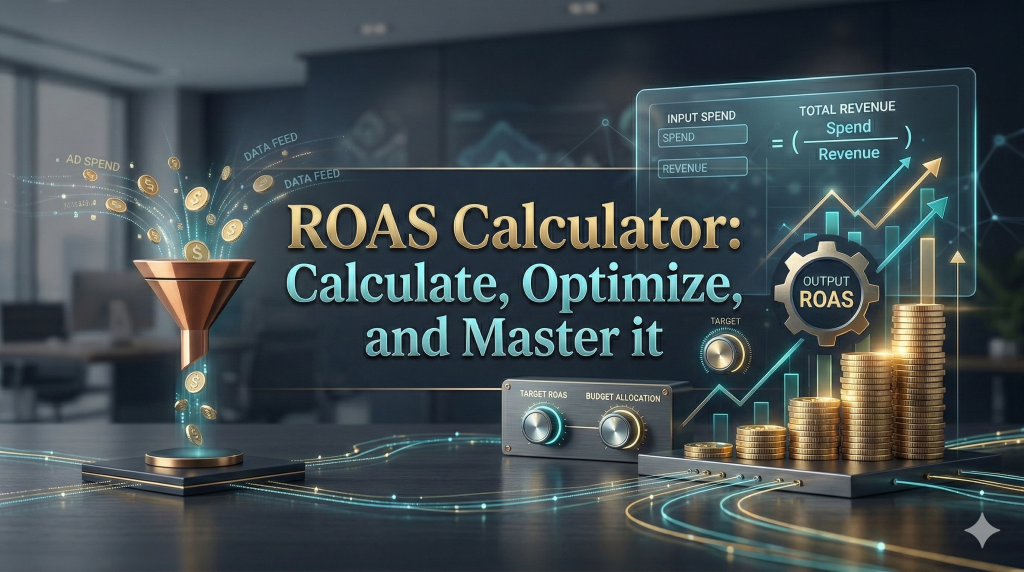
Use the ROAS Calculator
Use this simple ROAS Calculator to measure the effectiveness of your ad campaigns.
Enter your total ad spend and the revenue attributed to those ads for the same reporting period.
The calculator will show your ROAS.
For example, a 4.0x ROAS means your advertising generated $4 in attributed revenue for every $1 spent.
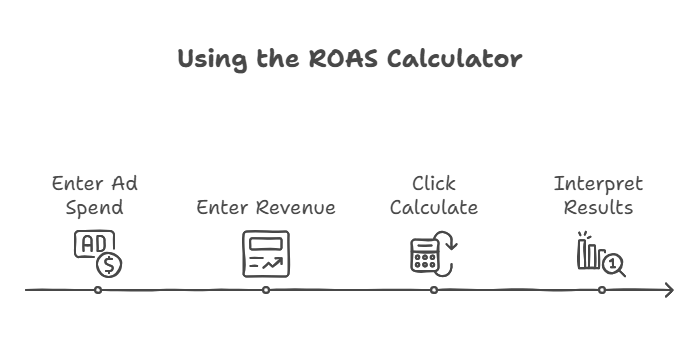
How to Use the ROAS Calculator
The calculator requires two numbers.
- Enter your ad spend. Use the total advertising cost for the campaign, account, channel, or period you want to measure.
- Enter your attributed revenue. Use the revenue connected to that advertising over the same reporting period.
- Calculate your ROAS. The result shows how much attributed revenue was generated for every dollar spent.
- Compare the result with your break-even ROAS. This helps determine whether the return is sufficient for your margins.
Keep the inputs consistent.
Do not compare one week’s advertising spend with a month of revenue. If customers often convert days or weeks after clicking an ad, allow enough time for those delayed conversions to appear before judging recent performance.
Google Ads, for example, uses conversion windows to determine how long after an ad interaction a conversion can still be recorded.
How to Calculate ROAS
The ROAS formula is:
ROAS = Attributed Revenue ÷ Ad Spend
Suppose you spend $2,000 on advertising and generate $8,000 in attributed revenue.
$8,000 ÷ $2,000 = 4.0
Your ROAS is 4.0x.
That means you generated $4 in attributed revenue for every $1 spent on advertising.
ROAS may also be expressed as a ratio or percentage:
- 4.0x
- 4:1
- 400%
All three describe the same return.
The formula tells you how efficiently advertising generated revenue. It does not tell you how much profit the business kept.
That requires additional cost context.
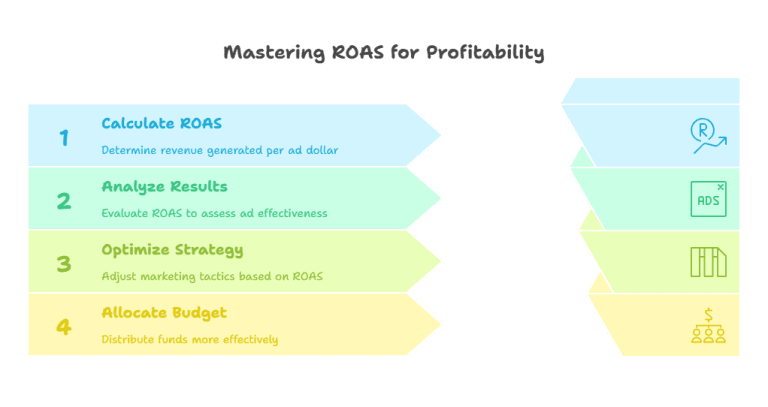
What Does Your ROAS Result Mean?
A ROAS result should not be judged against a universal number.
Instead, compare your actual ROAS with the minimum return your margins require.
Below Break-Even ROAS
If your actual ROAS is below your break-even ROAS, the campaign is not generating enough contribution to cover the advertising cost under the assumptions used in the calculation.
For example, suppose your break-even ROAS is 3.0x but your campaign produces 2.4x.
Increasing the advertising budget without changing the economics would expose more money to the same problem.
You may need to improve conversion rate, increase order value, reduce inefficient advertising spend, or address the underlying offer.
At Break-Even ROAS
If your actual ROAS matches your break-even ROAS, the contribution available before advertising is being consumed by the advertising cost.
This does not mean the entire business is breaking even.
Other expenses may still need to be covered, including fixed overhead, salaries, software, taxes, and other operating costs.
Break-even ROAS is an advertising economics threshold, not a complete measure of company profitability.
Above Break-Even ROAS
If your actual ROAS exceeds your break-even threshold, the campaign is generating contribution after advertising under the assumptions used.
The amount above break-even matters.
A campaign slightly above the threshold leaves less room than one substantially above it.
This is why statements such as “a 4x ROAS is good” are incomplete.
The better question is:
Is 4x good relative to what my business needs?
How to Calculate Break-Even ROAS
Break-even ROAS tells you the minimum return required for the contribution available before advertising to cover your ad spend.
The formula is:
Break-Even ROAS = 1 ÷ Contribution Margin Before Ad Spend
Your contribution margin should be expressed as a decimal.
For example:
- 50% margin: 1 ÷ 0.50 = 2.0x
- 40% margin: 1 ÷ 0.40 = 2.5x
- 30% margin: 1 ÷ 0.30 = 3.33x
- 25% margin: 1 ÷ 0.25 = 4.0x
- 20% margin: 1 ÷ 0.20 = 5.0x
A business with a 50% contribution margin before advertising needs a 2.0x ROAS to cover its advertising spend under this simplified framework.
A business with a 20% margin needs 5.0x.
That is why two companies can report the same ROAS and have very different financial outcomes.
What Margin Should You Use?
For break-even ROAS, use the portion of revenue remaining after the relevant variable costs associated with producing and fulfilling the sale, but before the advertising spend being evaluated.
Depending on your business, those costs may include:
- Cost of goods sold.
- Payment processing fees.
- Packaging.
- Fulfillment costs.
- Shipping subsidies.
- Sales commissions.
- Expected returns or refunds.
- Other variable transaction costs.
The exact cost structure depends on the business.
You can calculate the margin as:
Contribution Margin Before Ad Spend = (Revenue − Relevant Variable Costs Before Ads) ÷ Revenue
Suppose a sale produces $100 in revenue and has $60 in relevant variable costs before advertising.
That leaves $40.
$40 ÷ $100 = 40% contribution margin
Your break-even ROAS would be:
1 ÷ 0.40 = 2.5x
At a 2.5x ROAS, $40 of advertising spend generates $100 in revenue.
The $40 contribution available before advertising then covers the $40 advertising cost.
Why Break-Even ROAS Matters
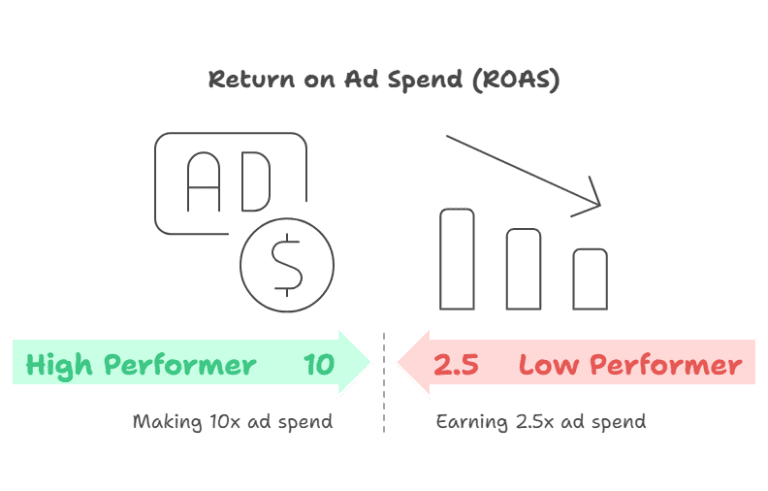
Consider two businesses that both generate a 4.0x ROAS.
Business A
- ROAS: 4.0x
- Contribution margin before ads: 50%
- Break-even ROAS: 2.0x
Business B
- ROAS: 4.0x
- Contribution margin before ads: 25%
- Break-even ROAS: 4.0x
Business A is well above its advertising break-even threshold.
Business B is only at break-even.
Same ROAS. Different economics.
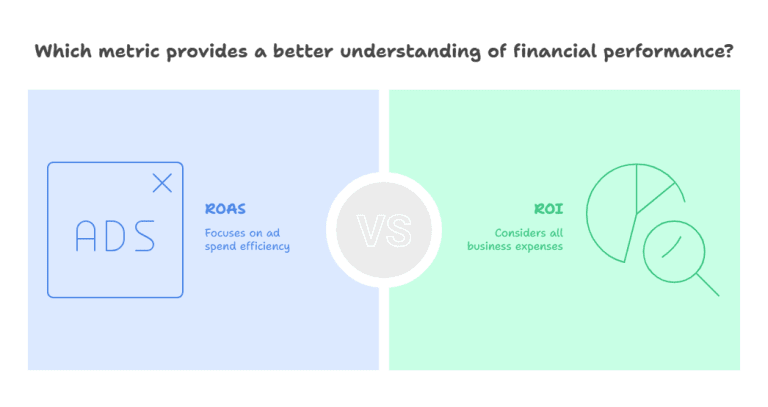
ROAS vs. ROI vs. CAC
ROAS is useful for measuring advertising efficiency, but it does not replace other financial and acquisition metrics.
| Metric | What It Measures | Main Question |
|---|---|---|
| ROAS | Attributed revenue relative to advertising spend | How much revenue did advertising generate per dollar spent? |
| ROI | Net return relative to the investment being evaluated | Was the investment profitable overall? |
| CAC | Cost required to acquire a new customer | How much did each new customer cost to acquire? |
When to Use ROAS
Use ROAS when evaluating how efficiently advertising spend generates attributed revenue.
You can calculate it for:
- A campaign.
- An ad group.
- A product.
- An advertising channel.
- A market.
- An entire advertising account.
ROAS isolates advertising spend rather than every business expense.
When to Use ROI
ROI is broader.
It evaluates the return produced relative to the overall investment being measured.
A campaign can have a strong ROAS while the underlying product or business still has weak profitability because of production costs, overhead, payroll, fulfillment, or other expenses.
When to Use CAC
Customer Acquisition Cost measures how much it costs to acquire a new customer.
A full CAC calculation commonly includes broader sales and marketing expenses rather than advertising spend alone. These can include advertising, salaries, commissions, software, agency fees, and other acquisition costs.
ROAS, ROI, and CAC therefore answer different questions:
- ROAS: How efficiently are ads generating attributed revenue?
- ROI: Is the investment profitable overall?
- CAC: How much does acquiring a customer cost?
How to Improve Your ROAS
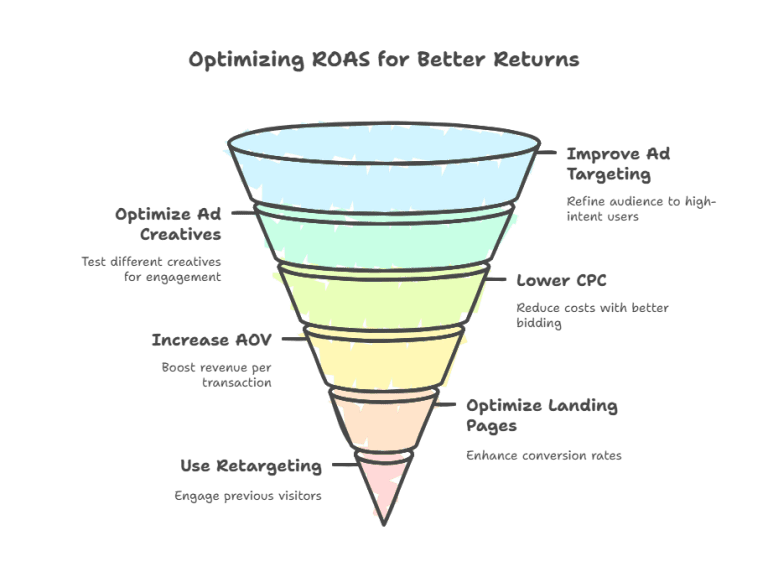
ROAS improves when attributed revenue increases relative to advertising spend.
That can happen by generating more value from existing traffic, reducing inefficient spending, or improving both sides of the equation.
Improve Conversion Rate
More conversions from the same advertising spend can increase attributed revenue and improve ROAS.
Look for friction in areas such as:
- Landing-page messaging.
- Product positioning.
- Page speed.
- Checkout.
- Lead forms.
- Pricing presentation.
- Mobile experience.
- Trust signals.
The goal is not simply to increase conversion rate.
The resulting conversions also need to produce enough value.
Increase Average Order Value
Higher revenue per transaction can improve ROAS without requiring the same increase in advertising spend.
Possible approaches include:
- Product bundles.
- Relevant upsells.
- Cross-sells.
- Volume offers.
- Minimum-order incentives.
- Subscription options where appropriate.
Keep margin in mind.
Increasing revenue through aggressive discounts does not necessarily improve the underlying economics.
Improve Traffic Efficiency
Reducing wasted advertising spend can improve ROAS when the remaining traffic continues to produce sufficient conversion value.
Depending on the campaign, this may involve:
- Refining audience targeting.
- Improving keyword selection.
- Adding relevant negative keywords.
- Testing new ads or creative.
- Adjusting geographic targeting.
- Removing poor-performing placements.
- Reviewing bidding strategy.
Do not optimize for cheaper clicks alone.
A lower cost per click only helps ROAS if the resulting traffic continues to generate enough revenue.
Reallocate Budget Based on Performance
Not every campaign or audience deserves the same share of your advertising budget.
Compare performance across campaigns, products, audiences, or channels and identify where spend is producing the strongest return relative to your required threshold.
Reduce waste before simply increasing total spend.
The goal is not to buy the cheapest traffic.
It is to put advertising dollars where they produce enough value to justify the cost.

Conclusion
A ROAS calculator gives you a fast way to measure how efficiently advertising spend generates attributed revenue.
The calculation is only the first step.
ROAS becomes more useful when you compare it with your break-even threshold and understand the margins behind the number.
A 4x ROAS is not automatically strong. A 2x ROAS is not automatically weak. The result depends on what your business needs to cover its costs and produce an acceptable return.
Use consistent spend and revenue data, calculate your ROAS, compare it with break-even, and then focus on the parts of the campaign that can improve the economics.
The goal is not simply to maximize a ratio.
It is to make better advertising decisions with the money you spend.
For more marketing terms visit to our Marketing Glossary Page.

Frequently Asked Questions About the ROAS Calculator
What Is a Good ROAS?
There is no universal good ROAS.
A useful ROAS is one that meets or exceeds the return required by your business economics.
A 3x ROAS can be comfortably above break-even for a high-margin business and insufficient for a lower-margin one.
Calculate your break-even ROAS before deciding whether a particular result is strong.
Why Does My ROAS Look Different in Google Ads and the Calculator?
The calculator uses exactly the advertising spend and revenue you enter.
Google Ads reports conversion value according to its own conversion tracking settings and conversion windows. Differences can occur when the platform and your calculator use different time periods, attribution settings, conversion values, or levels of conversion delay.
Compare equivalent data before trying to reconcile the results.
Should I Use Gross Revenue or Net Revenue in the Calculator?
For a standard revenue-based ROAS calculation, use the revenue attributed to the advertising before subtracting the ad spend itself.
Do not enter profit as revenue.
If your business adjusts reported revenue for refunds, cancellations, discounts, or similar factors, use a consistent methodology when comparing campaigns or reporting periods.
Profitability should then be evaluated separately using your margins and break-even ROAS.
Can I Calculate ROAS for a Single Campaign?
Yes.
You can calculate ROAS for any segment where you have matching advertising spend and attributed revenue.
That might include a single:
- Campaign.
- Ad group.
- Product.
- Channel.
- Market.
- Reporting period.
More specific calculations can help identify where advertising is producing or losing value.
How Often Should I Calculate ROAS?
There is no universal reporting schedule.
Use a period that contains enough conversion data to make the result useful and accounts for how long customers typically take to convert.
A high-volume ecommerce campaign may produce useful data relatively quickly. A business with a longer sales cycle may need a much longer reporting window.
Consistency matters more than following an arbitrary daily, weekly, or monthly schedule.
What Happens if Revenue Is Delayed?
Short reporting periods can underestimate ROAS when conversions occur days or weeks after the advertising interaction.
Advertising costs may already appear in the report while some resulting revenue has not yet been attributed.
Allow enough time for your typical conversion cycle before making decisions from recent ROAS data. Google likewise advises accounting for conversion delay when evaluating ROAS-based campaign performance.
What Is Break-Even ROAS?
Break-even ROAS is the minimum return required for the contribution available before advertising to cover your advertising spend under the assumptions used.
It can be calculated as:
Break-Even ROAS = 1 ÷ Contribution Margin Before Ad Spend
A 40% contribution margin, for example, produces a 2.5x break-even ROAS.
Can a ROAS Calculator Tell Me if My Campaign Is Profitable?
Not by itself.
A ROAS calculator shows the relationship between attributed revenue and advertising spend.
It does not include every cost required to operate the business.
Comparing your result with a properly calculated break-even ROAS can tell you whether the campaign clears the advertising threshold defined by your contribution margin. Broader profitability still depends on expenses outside the ROAS calculation.


1 Comment
Return on Ad Spend: How to Improve it ROAS - Ismel Guerrero. · March 9, 2025 at 2:39 pm
[…] to measure your ROAS instantly? Use our ROAS Calculator to track your ad performance and make data-driven decisions […]