Most recruiting problems do not start with a lack of effort. They start with conversations that create pressure before they create relevance.
A stronger network marketing recruiting process gives prospects enough context to understand why the conversation matters, ask questions, and evaluate the opportunity without exaggerated claims or constant follow-up.
This guide covers a practical recruiting framework, prospect conversations, social media, follow-up, company positioning, common recruiting mistakes, MLM income data, and how to support new team members after they join.
- Network marketing recruiting should start with understanding the person rather than immediately presenting an opportunity.
- A flexible conversation framework is usually more useful than relying on the same script for every prospect.
- Social media can support recruiting by creating familiarity and opportunities for relevant conversations.
- Follow-up should provide context and a clear next step without turning into repeated pressure.
- Earnings, lifestyle, and success claims require particular care because exceptional outcomes should not be presented as typical.
- Recruiting does not end when someone joins. Clear onboarding and early support affect whether new team members can follow the process.
- The goal is not to convince everyone. It is to identify genuine fit and allow people to make an informed decision.
Affiliate disclosure: I am an independent affiliate. The views expressed here are my own and are not official company statements. If you make a purchase through a link in this article, I may earn a commission at no additional cost to you.

A Practical Network Marketing Recruiting Framework
Recruiting is often reduced to activity targets. Make more contacts. Send more messages. Book more presentations.
Activity matters, but it needs structure.
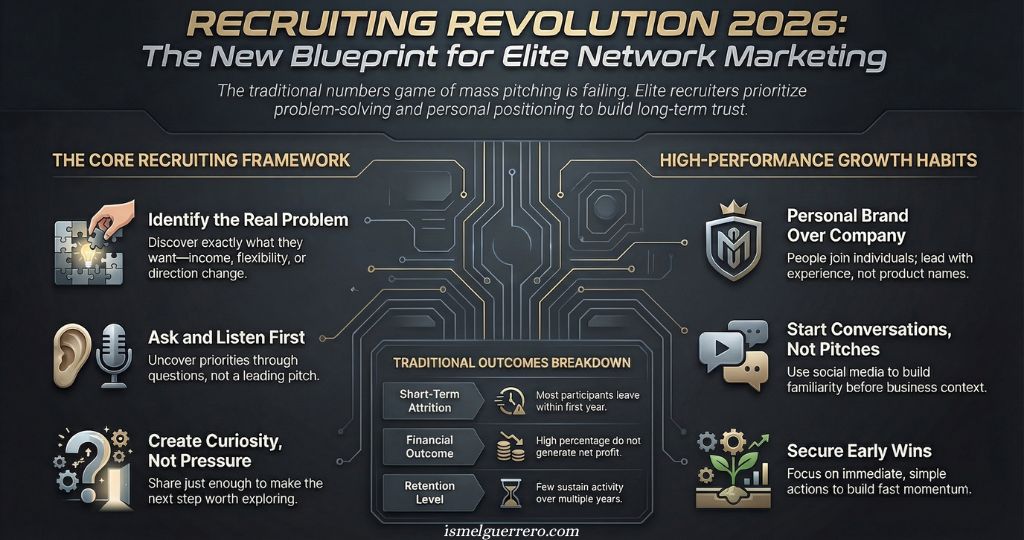
A useful recruiting process moves from understanding the person to determining whether there is enough relevance for a deeper conversation.
1. Start With Context
Do not begin by assuming what someone wants.
A person may be interested in additional work, a product, professional development, flexible scheduling, or none of those things. The first conversation should establish what is actually relevant to them.
That means avoiding statements that presume a financial need or promise a particular lifestyle.
Start with what you know about the person and the context of the conversation.
2. Ask and Listen
Questions give you information that a generic pitch cannot.
Ask about the person’s current situation, priorities, or reasons for exploring something different when those questions fit the conversation. Then allow them to answer without immediately redirecting everything toward the business.
Listening serves two purposes. It helps you understand whether there is a possible fit, and it prevents you from presenting benefits that the person never said they wanted.
3. Connect Only What Is Relevant
If something they have shared genuinely connects to the product or business, explain that connection clearly.
Keep it specific.
Avoid turning one stated concern into a long list of supposed benefits. The more claims you add, the easier it becomes to move from relevance into persuasion.
If there is no meaningful connection, the right decision may be not to present the opportunity at all.
4. Give Enough Information for the Next Decision
You do not need to explain the entire compensation plan, product line, company history, and training system in the first conversation.
Give the person enough information to decide whether they want to learn more.
That could mean watching an approved presentation, reviewing company information, asking additional questions, or scheduling another conversation.
The next step should be clear without creating artificial urgency.
5. Invite Rather Than Convince
Recruiting becomes more difficult when every objection is treated as something that must be overcome.
An invitation gives the prospect a decision to make. Persuasion becomes a problem when the recruiter keeps pushing after that decision is clear.
If someone wants more information, continue the conversation. If they are uncertain, answer reasonable questions. If they are not interested, respect the answer.
The objective is not to turn every contact into a recruit. It is to determine whether the opportunity and the person are a reasonable fit.

Why Pressure and Generic Messaging Hurt Recruiting Conversations
A recruiting conversation changes when the prospect feels that the outcome has already been decided for them.
Instead of considering the information, they may begin evaluating the recruiter’s motives, looking for the catch, or trying to end the interaction.
That is why context matters.
Pressure Shifts Attention Away From the Opportunity
Urgency can have a legitimate role when a deadline is real.
Problems begin when urgency is manufactured to force a decision.
Statements suggesting that someone must act immediately, will miss a rare opportunity, or should commit before having enough information can weaken trust.
Give prospects enough space to evaluate what they are being asked to join.
Generic Messages Remove Context
A copy-and-paste message is efficient for the sender, but it may give the recipient no reason to believe the conversation is relevant to them.
A better approach is to use a framework rather than a fixed script.
The framework can keep important information consistent while allowing the actual wording to reflect the person, the relationship, and the reason for the conversation.
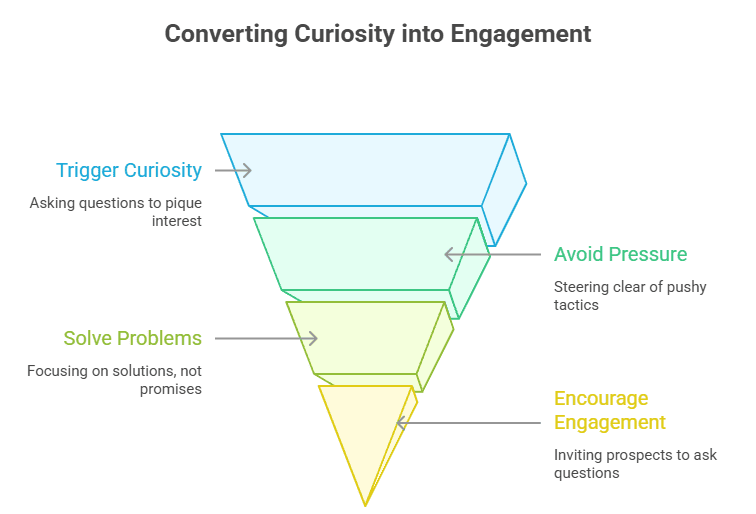
Curiosity Should Come From Relevance
Recruiters are often told to create curiosity by withholding information.
That can become counterproductive when it makes the business sound secretive.
A better form of curiosity comes from relevance. Give the person a clear reason the conversation may matter without trying to explain everything at once.
There is a difference between keeping an introduction concise and deliberately hiding important information.
Clear Language Builds Better Expectations
Avoid relying on industry phrases that may mean little to someone outside network marketing.
Terms such as “ground floor,” “financial freedom,” “time freedom,” or “life-changing opportunity” can also imply outcomes that require evidence.
Plain language is stronger.
Explain what the company does, what participation involves, and what the next step is. Let the substance create interest.
How to Use Social Media for Network Marketing Recruiting
Social media can support recruiting, but it works differently from a list of cold contacts.
People can see what you talk about, how you communicate, what you value, and whether every interaction eventually becomes a promotion.
That makes positioning important.
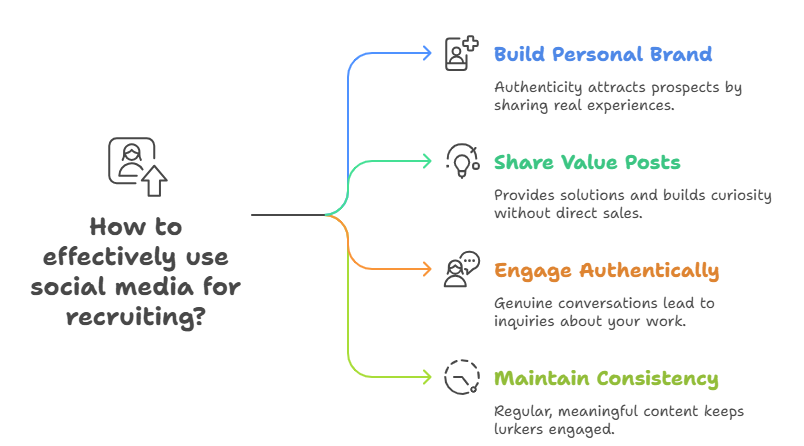
1. Build a Personal Presence
A feed made almost entirely of company graphics and promotional posts gives people little understanding of the person behind the account.
Share useful parts of your actual experience.
That can include lessons, observations, challenges, product experiences, business principles, or other subjects connected naturally to your work.
The objective is not to manufacture a personal brand. It is to give people enough context to understand who they are interacting with.
2. Create Useful Content Before Asking for Attention
Not every post needs a call to action.
Useful content might answer a common question, explain something you have learned, describe a mistake, or share an experience that could help someone facing a similar problem.
This creates a reason to follow the account even when the reader has no immediate interest in the business.
Promotional content can still have a place. It simply should not be the only thing people see.
3. Use Interaction to Create Context
A social media connection is not automatically permission for a recruiting pitch.
Respond to people as people.
Comment when you have something relevant to add. Answer questions. Continue conversations that develop naturally.
If the subject eventually connects to the business, the transition has context.
That is different from pretending to build a relationship solely to create an opening for a pitch.
4. Stay Consistent Without Posting for the Sake of Volume
Consistency helps people understand what they can expect from you.
That does not require posting constantly.
A clear pattern of useful content and genuine interaction is more sustainable than trying to maintain an arbitrary posting quota.
Quality, relevance, and continuity matter more than filling a calendar.
Be Clear About Your Relationship to the Company
Personal positioning should not become hidden promotion.
If you recommend products, discuss your business, or make endorsements through social media, be transparent about your relationship to the company when that relationship may affect how people interpret the recommendation.
The FTC explains that people endorsing a brand on social media should clearly disclose a material connection when followers might not otherwise expect that relationship.
How to Follow Up Without Chasing Prospects
Many recruiting conversations do not end with an immediate yes or no.
Someone may want to think, review information, speak with another person, or simply return to the conversation later.
Follow-up has a legitimate purpose. Repeated pressure does not.
Give Every Follow-Up a Reason
Avoid messages that say only:
“Just checking in.”
Instead, connect the follow-up to the previous conversation.
You might clarify something they asked about, send information you promised, confirm whether they had a chance to review material, or ask whether they still want to continue the conversation.
The prospect should understand why you are contacting them.
Make the Next Step Easy to Understand
Do not leave every conversation open-ended.
If another conversation makes sense, suggest it. If they need information, send the relevant information. If they are deciding, give them space to decide.
Clarity reduces the need for repeated messages.
Pay Attention to the Response
A prospect who asks another question is giving you a reason to continue.
Someone who repeatedly avoids the conversation or says they are not interested is giving you different information.
Follow-up should respond to the prospect’s behavior rather than follow an inflexible sequence regardless of what the person has said.
Give People an Easy Way to Say No
Recruiters sometimes avoid asking directly because they fear ending the opportunity.
That can create conversations that continue long after genuine interest has disappeared.
A clear answer is useful.
When someone can decline without being challenged, the relationship does not have to become collateral damage from an unsuccessful recruiting attempt.
Affiliate disclosure: I am an independent affiliate. The views expressed here are my own and are not official company statements. If you make a purchase through a link in this article, I may earn a commission at no additional cost to you.

Why Leading With Your Company Brand Often Backfires
Leading with the company can create friction before the recruiting conversation has a chance to develop.
When the company name, product line, or opportunity appears too early, the prospect may start evaluating the brand before they understand why you reached out, what you can offer, or whether the conversation is relevant to them.
That does not mean the company should be hidden. It means the company should not automatically become the opening move.
Early Brand Exposure Can Shape the Conversation
Once someone sees the company name, they may search for reviews, remember a previous experience, or bring existing opinions about network marketing into the conversation.
Those reactions may be fair or unfair, but they can change the direction of the discussion before you have established any context.
If the prospect already knows the company or asks about it directly, there is no reason to avoid the subject. The issue is using the company brand as the default way to create interest.
Give People a Reason to Engage With You
Your own credibility should carry part of the conversation.
That comes from how you communicate, the value you provide, your experience, and the perspective people associate with you. If your public presence consists mostly of company graphics, replicated posts, and promotional messages, it becomes difficult for prospects to distinguish you from everyone else representing the same business.
Building your own presence first gives people a reason to pay attention to you, not just the opportunity.
This does not require becoming an influencer or building a large audience. It simply means developing enough trust and recognition that the company is not doing all the work for you.
Introduce the Company When the Opportunity Becomes Relevant
Once the conversation genuinely moves toward the business, be clear about what you are presenting.
Explain which company you represent, what the opportunity involves, and where the prospect can review accurate information.
Do not use curiosity as a reason to conceal the company or avoid direct questions. The goal is to create context before the business is introduced, not to hide important information.
A better sequence is to establish relevance first, then introduce the opportunity clearly when the person has a reason to evaluate it.
Know When Leading With the Company Makes Sense
There are situations where the company should be part of the conversation immediately.
That may be the case when the prospect:
- Already asked about the company
- Is familiar with the products
- Responded to company-specific content
- Is comparing that company with another opportunity
- Approached you specifically because of the brand
In those situations, avoiding the company name would make the conversation less clear, not more effective.
The point is not to follow a rigid rule. It is to match the introduction to the context.
Let Official Information Support the Decision
Your role is to create a relevant conversation and explain your own experience accurately.
When the prospect begins evaluating the opportunity, official company information should support the factual side of the decision.
That includes product information, compensation details, income disclosures, policies, and other information that should not be exaggerated or improvised.
Your credibility may open the conversation. The company still needs to stand on its own once the prospect starts evaluating what is being offered.
What This Changes
Instead of relying on the company brand to create interest, you become the reason the conversation begins.
The company enters when it becomes relevant and the prospect has enough context to evaluate it properly.
That creates a better balance: build trust around your own credibility, introduce the opportunity transparently, and let accurate company information support the decision.
What MLM Income Data Actually Shows
Income discussions deserve more care than most recruiting topics.
The problem with many recruiting conversations is not simply that expectations are optimistic. It is that exceptional outcomes can be presented without enough information about what participants typically experience.
The strongest available evidence does not tell us which recruiting technique produces the best results. It does tell us why income claims should be handled cautiously.
| Finding | What It Means for Recruiting |
|---|---|
| Many participants in the reviewed MLM disclosures received little or no company payments | Significant income should not be presented as the expected outcome |
| Expenses were often omitted from income disclosures | Revenue and profit are not the same |
| High earners represented a relatively small portion of participants | Exceptional results should not be used to imply typical results |
| Disclosure formats sometimes made results difficult to interpret | Prospects should be given clear context when income information is discussed |
This evidence should not be used to claim that every MLM, participant, or compensation plan produces the same outcome.
It also does not prove that one recruiting method causes higher or lower earnings.
What it does establish is the need for restraint. A recruiter should not use an exceptional personal story, a top-earner example, or a gross income figure as though it represents what a typical participant should expect.
An FTC staff review of 70 MLM income disclosure statements found that the vast majority of participants represented in calculable data received $1,000 or less per year, while many received no payments at all, and expenses were frequently not reflected.

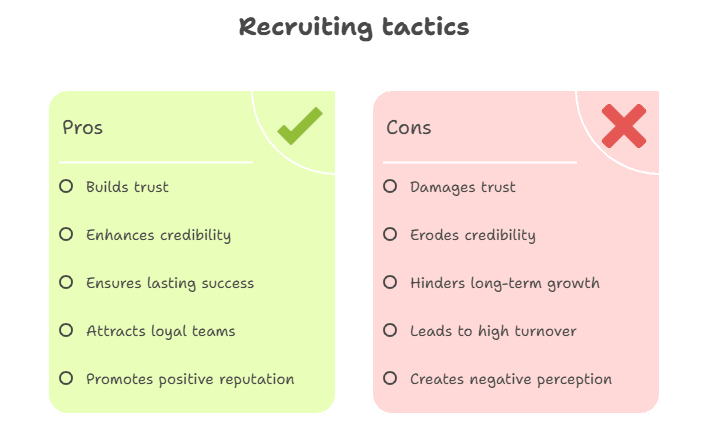
Common Recruiting Mistakes That Reduce Trust
Many recruiting problems begin before the prospect has evaluated the opportunity itself.
The way the conversation is handled can create unnecessary skepticism or leave the person with unrealistic expectations.
1. Leading With an Unsolicited Pitch
An immediate business presentation gives the recipient little context for why the message is relevant.
Start with an actual conversation when the relationship and setting make that appropriate.
Do not disguise a recruiting message as friendship, but do not treat every interaction as an opening for a sales presentation either.
2. Using the Same Script With Everyone
A script can help new recruiters remember important points.
Problems arise when it replaces listening.
Use scripts as training tools or conversation frameworks. Adapt the actual discussion to what the person says rather than forcing every prospect through identical wording.
3. Overstating Earnings or Lifestyle Outcomes
This is one of the most consequential mistakes.
Avoid implying that joining is likely to replace a salary, create financial independence, provide luxury travel, allow someone to quit a job, or generate another specific lifestyle unless the claim is properly supported.
Personal success does not automatically establish what another participant is likely to experience.
4. Creating Artificial Urgency
A real deadline can be explained.
An invented deadline designed to prevent careful evaluation is different.
Give people enough time to review the information relevant to their decision.
5. Treating Every Objection as Something to Overcome
An objection may reveal confusion, missing information, a genuine incompatibility, or a decision not to proceed.
Ask what the concern is.
Answer questions you can answer accurately. Use official information when appropriate. If the person still does not see a fit, respect the decision.
6. Treating Every Relationship as a Recruiting Opportunity
Constantly evaluating friends, relatives, coworkers, and social connections as potential recruits can damage relationships and distort normal conversations.
Recruiting works better as one part of your professional activity, not the purpose behind every interaction.
The FTC states that earnings claims made by MLM companies or individual participants must be truthful, substantiated, and reflect what the typical person is likely to achieve after relevant expenses are considered.
How to Build and Support a Team Consistently
Recruiting creates a starting point.
What happens after someone joins determines whether the person understands the process well enough to participate independently.
A useful onboarding system reduces uncertainty without trying to teach everything at once.
1. Start With a Simple Onboarding Process
New team members need priorities.
Give them a small number of actions that explain how the business operates, what company policies apply, where approved resources are located, and what they should learn first.
Do not mistake a large training library for a clear onboarding process.
The first stage should answer:
- What do I need to understand?
- What do I need to do first?
- Where do I find approved information?
- Who do I ask when I need help?
2. Focus on Early Progress
An early result does not have to mean making money or recruiting someone.
Useful progress may include completing onboarding, learning the product information, starting a first appropriate conversation, using the contact system correctly, or completing a company training requirement.
The objective is to turn information into action.
3. Set Clear Process Expectations
People need to know which activities are part of the system.
That might include prospect conversations, follow-up, product education, customer support, training, or content creation depending on the business.
Avoid presenting arbitrary activity quotas as guaranteed formulas for success.
Explain which activities matter and why.
4. Stay Available During the Early Stage
Training material cannot anticipate every question.
Review early conversations when appropriate. Correct misunderstandings before they become habits. Make it easy for new members to ask questions about company policies, products, or recruiting expectations.
Support should help people become more capable, not more dependent.
5. Develop Independence
Over time, a team member should need less direction for routine decisions.
Encourage people to use official resources, solve straightforward problems, and understand the reasoning behind the recruiting process.
As they gain experience, they can help newer participants learn the same fundamentals without turning every decision into a request for approval.
A team becomes more sustainable when knowledge is transferable rather than concentrated in one leader.
Conclusion
Better network marketing recruiting is not about finding a phrase that makes more people say yes.
It is about creating a process that helps both sides determine whether there is a legitimate fit. That requires better questions, relevant information, reasonable follow-up, transparent company communication, and restraint around earnings or lifestyle claims.
Social media can create opportunities for conversation, but it should not turn every interaction into prospecting. Scripts can provide structure, but they should not replace listening. Follow-up can keep a legitimate conversation moving, but it should stop when the prospect has made the answer clear.
The same principle applies after someone joins. Give new members a simple process, useful support, and enough context to operate responsibly without depending on constant motivation.
Improving one recruiting conversation is a better starting point than trying to increase activity everywhere at once. Look at where your current process creates the most friction, then improve that part before adding more volume.
Frequently Asked Questions
What Is Network Marketing Recruiting?
Network marketing recruiting is the process of identifying and speaking with people who may be interested in participating in a network marketing business. It can include prospecting, conversations, presentations, follow-up, and onboarding.
What Is the Best Way to Approach Someone About Network Marketing?
Start with context rather than an immediate pitch. Understand why the conversation may be relevant, ask appropriate questions, and introduce the business clearly if there is genuine interest.
How Should I Handle Objections From Prospects?
Ask questions to understand the concern before responding. Provide accurate information where you can, use official resources when appropriate, and recognize that some objections simply mean the opportunity is not a fit.
Can Social Media Help With Network Marketing Recruiting?
Yes. Social media can create visibility, familiarity, and opportunities for conversation. Its usefulness depends on the audience, platform, content, and how the recruiter handles interactions after people engage.
Do I Need a Recruiting Script?
A script can help provide structure, especially when someone is learning. A flexible framework is usually more useful in conversation because it allows you to respond to the individual rather than forcing everyone through identical wording.
How Often Should I Follow Up With a Prospect?
There is no universal schedule that fits every conversation. Follow up when there is a clear reason, such as providing promised information, answering a question, or checking whether the person wants to continue. Stop when they indicate they are not interested.
How Should I Discuss Income With a Prospect?
Use accurate, company-approved information and avoid presenting exceptional outcomes as typical. Do not imply that a prospect is likely to achieve a particular income or lifestyle unless that claim is properly supported.
How Do I Build a Team That Stays Engaged?
Start with clear onboarding, manageable early actions, accessible support, and realistic expectations. Over time, help team members understand the process well enough to make routine decisions independently.
Can I Recruit Effectively Without Being a Strong Salesperson?
Strong sales skills can help, but network marketing recruiting also depends on listening, communication, follow-up, product knowledge, and the ability to explain the opportunity clearly.
What Should I Avoid When Recruiting?
Avoid unsolicited mass pitching, unsupported earnings claims, artificial urgency, misleading curiosity tactics, and repeated pressure after someone has declined. These practices can damage trust even when they produce short-term attention.

0 Comments