The biggest network marketing company is not automatically the best one to join.
Network marketing companies can look similar from the outside, yet differ significantly in their products, costs, compensation plans, requirements, and the type of business participants are expected to build.
That makes choosing an opportunity harder than simply finding a familiar name or comparing commission percentages.
Some companies may suit people who prefer direct product sales. Others are built around services, licensed professions, digital products, or more team-based compensation structures. The right fit depends on what you want to sell, how you want to work, and what the opportunity actually requires.
This guide compares several network marketing companies using the same standards, so you can see which ones deserve a closer look and which factors matter most before you join.
- The largest network marketing company is not automatically the best opportunity for every participant.
- Product demand, ongoing costs, compensation structure, and business requirements matter more than brand recognition alone.
- Some companies are better suited to product sellers, while others fit service-based, licensed, or digital-first business models.
- A low startup cost can still lead to weak economics if recurring expenses, qualification requirements, or customer demand work against you.
- Income disclosures and compensation details usually reveal more than top-earner stories or promotional claims.
- Company stability matters, but so does how much control you have over your marketing, customer acquisition, and business growth.
- The strongest choice is the company whose products, structure, costs, and operating model fit the way you actually want to build.
Disclaimer: I am an independent Affiliate. The opinions expressed here are my own and are not official statements. If you follow a link and make a purchase, I may earn a commission.

How We Evaluated These Network Marketing Companies
A useful comparison needs more than revenue, company size, or commission percentages.
We evaluated each company using the same core factors so established brands and newer opportunities could be compared on more than reputation alone.
Product and Customer Demand
The product or service needs a reason to exist outside the income opportunity.
We looked at what the company sells, who the likely customer is, and whether the offer appears capable of competing on its own merits.
A recognizable brand helps, but genuine customer demand matters more.
Startup and Ongoing Costs
A low enrollment fee does not always mean a low-cost business.
We considered initial costs alongside recurring expenses, required purchases, licensing, subscriptions, and other commitments that could affect profitability.
The important number is not simply what it costs to join.
It is what participation may continue to cost after the first month.
Compensation Transparency
A compensation plan should make it possible to understand where income comes from and what conditions affect eligibility.
We looked for clear information about personal sales, team-based compensation, ranks, bonuses, qualification requirements, and available income disclosures.
Complexity is not automatically a problem.
Lack of clarity is.
Company Stability and Regulatory History
Longevity can provide useful evidence that a company has survived changing markets and operating conditions.
Newer companies can still be worth considering, but they have less history to evaluate.
We also consider significant regulatory actions, legal issues, or changes that materially affect how the opportunity should be understood.
A past dispute does not automatically disqualify a company, but it should not be ignored either.
Business Control and Marketing Flexibility
Network marketers operate inside systems they do not fully control.
We therefore consider how much flexibility participants have in customer acquisition, personal branding, content, sales channels, and building an audience beyond the company itself.
An opportunity becomes more attractive when the participant can develop useful skills and relationships without making the parent company their entire business identity.
Disclaimer: I am an independent Affiliate. The opinions expressed here are my own and are not official statements. If you follow a link and make a purchase, I may earn a commission.
Quick Comparison of the Best Network Marketing Companies
The companies on this list differ in what they sell, how participants operate, and the type of entrepreneur they may suit.
| Company | Main Focus | Business Model | Best Fit | Main Consideration |
|---|---|---|---|---|
| Amway | Health, beauty, and home | Product-based direct selling | Sellers wanting broad product variety | Established but structured model |
| Herbalife | Nutrition and wellness | Product sales and distributor network | Fitness and wellness sellers | Competitive product category |
| Vorwerk | Premium home products | Demonstration-based direct selling | Strong in-person sellers | Higher-touch sales process |
| PM-International | Supplements and wellness | Product-based direct selling | Wellness-focused entrepreneurs | Product positioning matters |
| Primerica | Financial services | Licensed sales organization | Finance-oriented professionals | Licensing requirements |
| eXp Realty | Real estate | Brokerage plus revenue sharing | Real estate professionals | Requires real estate licensing |
| Utility Warehouse | Household services | Service-based partner network | UK sellers preferring recurring services | Limited geographic availability |
| Coway | Home wellness | Product and service sales | Home technology sellers | Model varies by market |
| LiveGood | Supplements and memberships | Digital affiliate and multi-level model | Online wellness marketers | Shorter company history |
| GotBackup | Cloud backup | Digital reseller model | Digital-service marketers | Strong outside competition |
The table is only a starting point. Costs, compensation, company history, product demand, and participant requirements can change the picture considerably once each opportunity is examined more closely.

Best Network Marketing Companies
The companies below made the list because they offer meaningfully different products, operating models, and levels of business maturity.
Each review looks at the same basic question: what does the company offer, where is the opportunity strongest, and what should a prospective participant understand before deciding whether it fits.
Amway
Amway is one of the most established names in network marketing.
The company sells nutrition, beauty, personal care, and home products through brands such as Nutrilite, Artistry, eSpring, and Amway Home. Its broad catalog gives distributors several product categories to work with rather than tying the business to a single offer.
Scale is one of Amway’s clearest strengths.
The company reported $7.3 billion in global sales for 2025 and operates in more than 100 markets worldwide, giving it considerably more operating history and international infrastructure than most newer network marketing companies. Amway’s current company information provides the latest sales figures and global footprint.
That size does not automatically make it the best opportunity for an individual distributor.
A broad product range can give sellers more ways to serve customers, but it can also make positioning more difficult. Someone still needs to decide which market to focus on, how to differentiate their own presence, and which products make sense for the audience they want to build.
Amway may fit someone who values an established company, extensive product selection, and a large international operating system.
Its main limitation is the same one that comes with many mature network marketing organizations: the infrastructure is already highly structured, so participants need to understand how much flexibility they actually have in marketing and building the business their own way.
Best fit: Sellers who want an established global company with a broad consumer-product catalog.
Herbalife
Herbalife is a long-established network marketing company focused primarily on nutrition and wellness.
Its product range includes protein shakes, dietary supplements, hydration products, teas, and personal care. Sales are handled through independent distributors, with Nutrition Clubs providing another customer-facing part of the model.
Scale is a major advantage.
Herbalife reported about $5.04 billion in net sales for 2025 and currently operates in more than 90 markets. Its 2025 annual report provides the latest financial results.
The opportunity may appeal to people who already create content or build relationships around fitness, nutrition, or general wellness. The product category gives distributors plenty of subjects to educate around without making every interaction about the company itself.
That same category creates one of Herbalife’s main challenges.
Nutrition and supplement markets are highly competitive, and distributors need to be particularly careful about how they describe product results. Building your own positioning around a specific audience can matter more than simply promoting a recognizable company name.
Herbalife may fit someone comfortable with relationship-based wellness selling who wants an established international company and a broad consumable-product range.
Best fit: Wellness-focused sellers who can build their own audience and educate around the market rather than relying entirely on company promotions.
Vorwerk
Vorwerk stands out from many network marketing companies because its model is built heavily around direct product demonstrations.
Its best-known brands include Thermomix, the multifunctional cooking system, and Kobold, its home-cleaning line. Rather than relying mainly on online promotion, Vorwerk has traditionally used advisors to demonstrate products directly and guide customers through the buying process.
That creates a different type of opportunity.
The products are higher-consideration purchases, so the seller often needs to explain how they work, demonstrate their value, and spend more time with individual prospects before a sale happens.
For the right person, that can be a strength.
Someone who enjoys cooking demonstrations, events, one-to-one selling, or hands-on product education may find the model more natural than promoting supplements or digital memberships through social media.
The trade-off is scalability.
A demonstration-led business can require more personal involvement per customer, and the exact advisor structure varies by market. Vorwerk’s current Thermomix advisor information shows that its UK program includes commissions on personal sales, recruiting incentives, and opportunities to progress into team leadership.
Vorwerk may fit someone who prefers selling a tangible premium product through personal experience rather than building primarily through online promotion.
Best fit: Strong relationship sellers who enjoy demonstrations and higher-touch customer interactions.
PM-International
PM-International is a direct-selling company built around its FitLine range of nutrition, fitness, and beauty products.
The opportunity is strongly product-centered. Rather than offering a broad catalog across unrelated categories, PM-International concentrates on wellness products that can support repeat customer relationships when the audience already has an interest in supplements, fitness, or personal care.
Its international footprint is one of its stronger advantages.
Founded in 1993, the company has expanded across Europe, Asia, the Americas, and other markets while maintaining a direct-selling model based on personal product recommendations and demonstrations. PM-International’s current company information provides details on its history, international operations, and FitLine business.
That focus can make positioning easier for someone who already works within the wellness market.
The limitation is competition.
Supplements and wellness products are available from countless direct-to-consumer brands, retailers, and other network marketing companies. A distributor still needs a clear audience and a reason customers should choose the FitLine products beyond the income opportunity or company affiliation.
PM-International may fit someone who wants an established international company and prefers building around a focused wellness product line rather than a large general catalog.
Best fit: Wellness-focused sellers who already understand the audience they want to serve and can differentiate themselves in a competitive supplement market.
Primerica
Primerica is different from most companies on this list because the opportunity is built around financial services rather than consumer products.
Independent representatives can offer term life insurance, securities, and other financial products, depending on the licenses they obtain. That makes the business closer to building a financial-services practice than selling supplements, beauty products, or household goods.
The professional structure is one of Primerica’s main strengths.
Representatives develop skills around insurance, financial products, client conversations, and regulated sales. For someone genuinely interested in financial services, those skills may have broader value than experience tied to a single consumer-product category.
The trade-off is a higher barrier to entry.
Many products require licensing before a representative can sell them, and the business operates within regulatory and compliance requirements that do not apply to most product-based network marketing companies. That makes Primerica a poor fit for someone looking for a simple opportunity they can begin promoting immediately.
Earnings also need to be evaluated carefully. Primerica reports that its life-licensed sales force received an average of $8,199 during 2025, while noting that representatives can incur ongoing business expenses and individual results vary. Its current disclosures also list a $99 U.S. initial application fee and explain the licensing requirements attached to many product lines.
Primerica may fit someone who wants to work in financial services and is willing to complete the licensing process rather than someone simply looking for a low-friction side business.
Best fit: Finance-oriented entrepreneurs who are comfortable with licensing, regulation, and a more professionalized sales environment.
eXp Realty
eXp Realty is not a traditional product-based network marketing company.
It is a cloud-based real estate brokerage where licensed agents earn primarily through real estate transactions. Agents can also participate in a revenue-share program tied to the production of agents they sponsor into the company.
That makes the opportunity fundamentally different from selling supplements, beauty products, or household goods.
Real estate production remains the core business, while revenue sharing adds a team-building component. eXp states that revenue share is performance-based and depends on productive sponsored agents rather than simply bringing more people into the brokerage.
The professional environment is one of its strongest advantages.
Agents are building within an established real estate industry, and the skills developed around listings, negotiations, client acquisition, and transactions can remain useful beyond the revenue-share program.
The barrier to entry is considerably higher than most companies on this list.
An active real estate license is required, and U.S. agents currently face a $149 startup fee, an $85 monthly brokerage fee, and transaction-related fees. eXp’s current agent information explains those requirements and costs.
Revenue sharing should also be kept in perspective. eXp’s current income disclosure reports a $0 median revenue share for a typical Tier 1 agent, reinforcing that sponsorship does not automatically create meaningful additional income.
eXp Realty may fit someone who genuinely wants to build a real estate career and views revenue sharing as an additional part of the model rather than the primary reason to join.
Best fit: Licensed real estate professionals who want a cloud-based brokerage with an additional team-based revenue-share opportunity.
Utility Warehouse
Utility Warehouse takes a different approach from product-based network marketing companies by focusing on household services.
Partners can refer customers for services such as energy, broadband, mobile, landline, and home insurance. That gives the opportunity a practical advantage: the offer is built around services many households already use rather than products customers need to be persuaded to add to their lives.
Recurring customer relationships are one of the model’s main strengths.
Partners can earn upfront commissions when qualifying customers switch services and may also receive ongoing residual income while those customers remain with Utility Warehouse. Team-based compensation is available for Partners who choose to build and support a wider organization.
The limitation is geographic.
Utility Warehouse is focused on the UK, so the opportunity does not offer the international reach of companies such as Amway or Herbalife. Partners also need to understand the eligibility requirements attached to residual income and team-based compensation rather than assuming every customer automatically produces long-term commissions.
Current partner terms list a £10 registration fee plus £3 per month for ongoing training, support, and tools. Utility Warehouse’s Partner information also explains its upfront customer commissions and residual-income structure.
Utility Warehouse may fit someone who prefers selling familiar household services and building recurring customer relationships instead of working with supplements, beauty products, or physical inventory.
Best fit: UK-based sellers who prefer essential services and recurring customer relationships over traditional product-based network marketing.
Coway
Coway is a less conventional addition to this list because its selling structure varies by market rather than following one global network marketing model.
The company focuses on home wellness products such as water purifiers, air purifiers, mattresses, and other household systems. In markets such as Malaysia, independent Health Planners help customers choose products and arrange purchases or rentals, while Coway handles installation and ongoing service.
That service component is one of the model’s stronger advantages.
Participants can focus primarily on customer acquisition and product recommendations instead of carrying inventory, installing equipment, or managing after-sales maintenance themselves.
Coway also benefits from an established customer base and recurring rental relationships in several markets. The company reported continued growth in rental accounts during 2026, particularly across its water purification and home wellness categories. Coway’s current company results provide the latest operating information.
The main limitation is geographic consistency.
The sales opportunity, participant roles, compensation structure, and available products can differ substantially by country. Someone considering Coway should therefore evaluate the specific program available in their market rather than assuming the opportunity works the same way everywhere.
Coway may fit someone who prefers selling practical home products with an established service infrastructure behind them rather than managing fulfillment and customer maintenance independently.
Best fit: Sellers in supported markets who prefer home wellness products, rental-based customer relationships, and a company-managed service system.
LiveGood
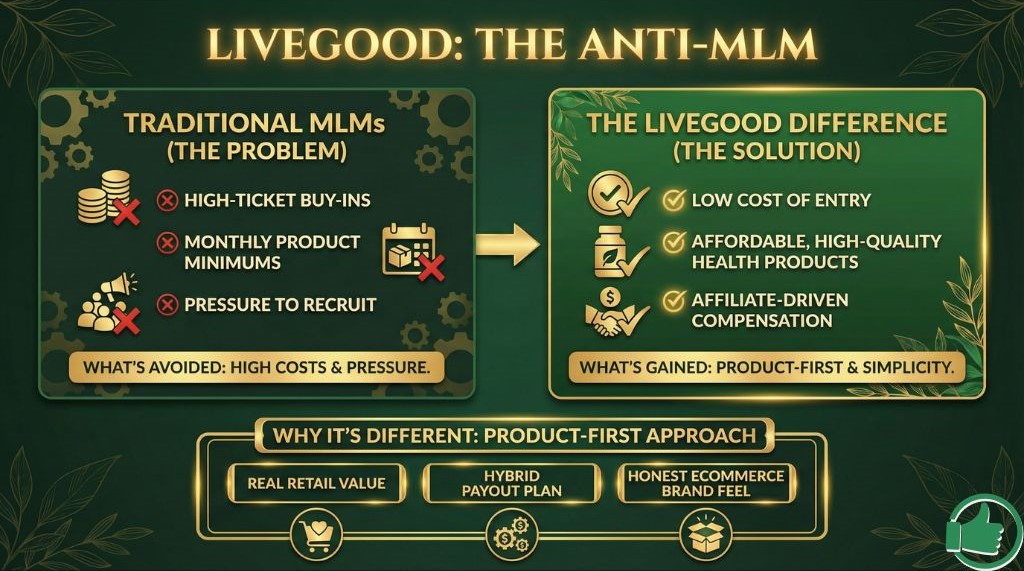
LiveGood combines a wellness membership with an affiliate compensation model.
Members can access discounted pricing on supplements and other wellness products, while affiliates can earn through retail sales, customer acquisition, referrals, and additional levels of qualifying team activity.
Lower entry costs are one of its clearest advantages.
LiveGood currently lists membership at $9.95 per month or $99.95 per year, while its compensation plan separates member pricing from the affiliate opportunity. The company’s current pay plan also includes retail commissions, customer acquisition bonuses, multi-level commissions, and rank-based pools.
That structure may appeal to someone who prefers building online around wellness content rather than relying heavily on demonstrations or a large physical product catalog.
The trade-off is complexity.
Although the entry cost is relatively accessible, the compensation plan contains several different commission types and rank requirements. A prospective affiliate still needs to understand which earnings depend on personal customers, memberships, team activity, and advancement through the plan.
LiveGood also has a shorter operating history than long-established companies such as Amway, Herbalife, or Vorwerk. That gives prospective affiliates less long-term evidence to evaluate when considering company stability and how the model performs across changing market conditions.
LiveGood may fit someone who wants a lower-cost, wellness-focused opportunity and is comfortable building their own audience through digital marketing.
Best fit: Digital-first wellness marketers who prefer a membership-based model and lower initial barriers to entry.
GotBackup
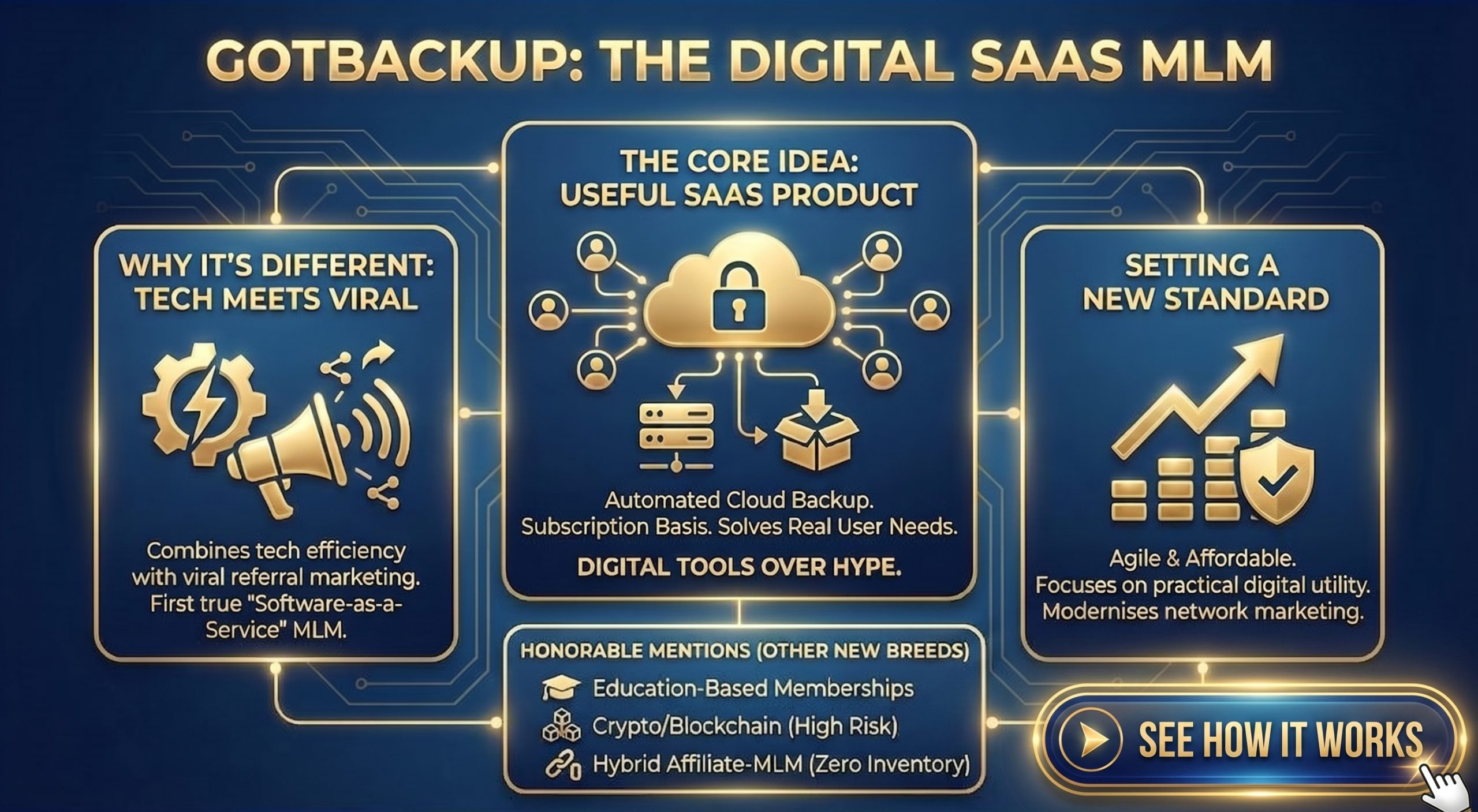
GotBackup is one of the more unusual companies on this list because the core product is digital cloud backup rather than supplements, beauty products, or household goods.
Customers can purchase storage plans for backing up files across multiple devices, while resellers can earn through customer sales and a multi-level compensation structure that also includes team-based commissions, generations, and rank pools.
The digital product is its clearest point of differentiation.
There is no physical inventory to manage, shipping is not part of the sales process, and the Family plan currently includes six accounts with 6 TB of total backup storage. GotBackup also offers reseller tools such as landing pages, follow-up systems, marketing materials, and referral links through its current business program.
That convenience does not automatically make the opportunity stronger.
Cloud backup is a competitive market with established alternatives, so the product still needs to make sense on its own price, storage, usability, and service quality. A reseller should be able to explain why a customer would choose GotBackup even if no income opportunity were attached.
Costs also vary depending on how someone enters the program. GotBackup currently lists a $9.97 monthly Family plan with reseller eligibility, while higher-priced Pro and Enterprise packages add marketing tools and additional features.
Its compensation structure is more complex than a simple affiliate commission, so prospective resellers should understand how customer commissions, cycle earnings, generations, and rank-based compensation interact before treating the opportunity as straightforward digital affiliate marketing.
GotBackup may fit someone who prefers selling a digital service and wants to build through online content, funnels, or other digital acquisition channels rather than physical product demonstrations.
Best fit: Digital marketers who prefer a subscription-based technology product and are comfortable evaluating both the product and multi-level compensation structure separately.

Which Network Marketing Company Fits You Best?
The better question is not which company looks strongest.
It is what kind of business you want to build around the opportunity.
Start with the market you understand and the people you want to serve. A company becomes more useful when its products or services fit naturally into that market instead of forcing you to build your entire identity around whatever it happens to sell.
Then consider how you want to attract customers.
If your plan is to build through content, search, email, social media, referrals, or another acquisition channel you control, the opportunity should give you enough flexibility to develop your own presence alongside the company.
The same principle applies to selling.
Some people are comfortable with demonstrations, consultations, or high-touch conversations. Others would rather build an audience first and introduce products through education and relevant offers. Neither approach is automatically better, but the company should fit the way you are actually willing to work.
Control matters too.
You will not own the parent company, its products, pricing, compensation plan, or policies. That makes the assets you build around the opportunity more important, including your reputation, content, audience, customer relationships, and marketing skills.
The strongest fit is therefore not the company with the biggest name or most exciting compensation plan.
It is the one that fits a market you understand, supports the way you want to acquire customers, and leaves enough room for you to build something valuable beyond the company itself.
How to Choose the Right Network Marketing Company for You
The best-known company is not automatically the best fit.
What matters is whether the products, costs, compensation structure, selling model, and level of control align with the type of business you actually want to build.
A strong opportunity should make sense beyond the excitement of joining.
Start With the Product or Service
You need confidence in what you are selling.
That does not mean simply liking the product.
Look at whether customers have a clear reason to buy it, whether the price makes sense for the market, and whether you can explain its value without relying on the income opportunity.
A product that only feels attractive because of the compensation plan deserves closer scrutiny.
Match the Business Model to Your Strengths
Different companies require different kinds of work.
Some depend heavily on demonstrations and relationship selling.
Others fit better with content, digital marketing, referrals, or professional sales.
Licensed opportunities such as real estate or financial services introduce another layer of requirements entirely.
Choose a model that fits how you are willing to find customers and build relationships.
Understand the Real Cost of Participation
Startup cost is only the beginning.
Look at what participation may cost over time, including:
- Registration fees
- Required or recurring purchases
- Licensing
- Software
- Events
- Travel
- Marketing
- Advertising
- Other qualification expenses
A low entry fee can still lead to poor economics if ongoing costs are difficult to recover through actual customer sales.
Study the Compensation Plan Before You Join
Do not evaluate the opportunity from commission percentages alone.
Understand what actually creates income.
Look at how personal sales, team volume, ranks, bonuses, qualification requirements, and recurring activity interact.
The plan should still make sense under conservative assumptions.
If meaningful income appears to depend on quickly reaching high ranks or building a large organization, factor that into the decision.
Review the Income Disclosure
Top-earner stories show what happened for a small number of participants.
They do not tell you what a new participant should expect.
When an income disclosure is available, look at how many participants receive little or no compensation, whether expenses are included, and how earnings are distributed across ranks.
That gives you more useful context than promotional examples alone.
Research the Company Beyond Its Marketing
Company history matters.
Look at leadership, regulatory history, major legal disputes, product changes, compensation-plan revisions, and patterns in distributor feedback.
One negative review does not prove that an opportunity is poor.
Repeated patterns deserve more attention.
Use official documents first, then compare them with independent reporting and participant experiences where useful.
Consider How Much Control You Will Actually Have
Network marketing gives you access to an existing system.
That convenience comes with limits.
The company may control:
- Products
- Pricing
- Compensation
- Brand rules
- Customer systems
- Distributor policies
- Available markets
Think about how much of your own audience, content, reputation, and customer acquisition system you can build alongside that structure.
The more dependent your business becomes on one company, the more important those limits become.
Think About the Opportunity Cost
Joining one company means committing time, attention, and money that could be used somewhere else.
Compare the opportunity with other ways you could build income or business assets.
The right choice is not necessarily the company with the highest commission rate or lowest startup cost.
It is the one whose economics, market, selling model, and level of control make the most sense for how you want to build.
Red Flags That Can Disqualify an Opportunity
Some weaknesses can be explained or managed.
Others should make you question whether the opportunity deserves any more of your time or money.
A red flag does not automatically prove that a company is illegal. It does mean the underlying business deserves closer scrutiny before you join.
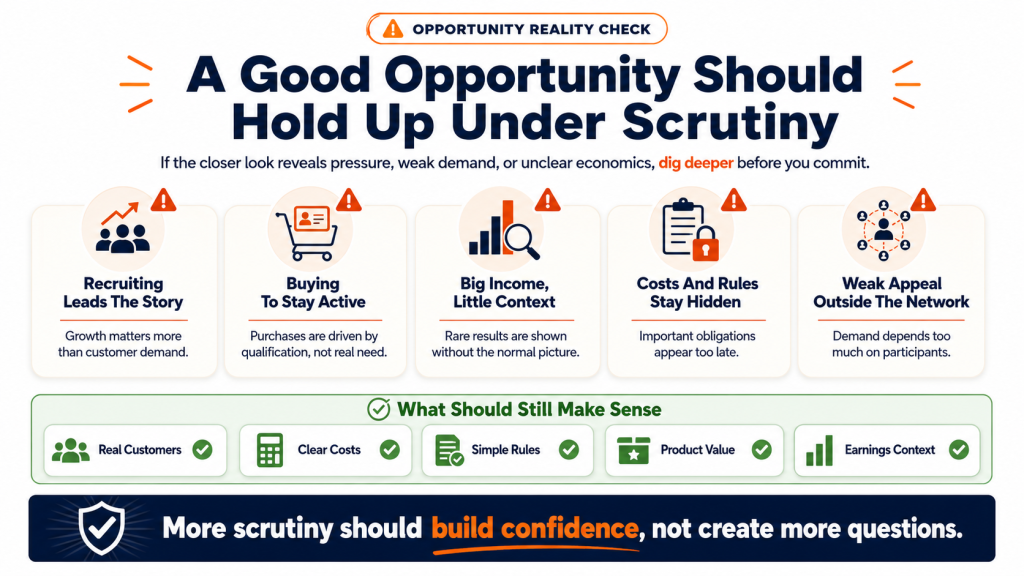
Recruitment Overshadows Customer Demand
Recruiting can be part of network marketing.
The concern begins when the opportunity seems more important than the product or customer.
Pay attention to where the excitement comes from.
If presentations focus heavily on building a team, reaching ranks, or bringing in new participants while genuine customer demand receives little attention, the economics may depend too heavily on continued recruitment.
The product should have a reason to sell even when no business opportunity is attached.
Qualification Depends Heavily on Buying
Recurring purchases are not automatically a problem.
The reason for those purchases matters.
Be cautious when participants appear to buy products mainly to remain active, qualify for commissions, advance in rank, or unlock bonuses rather than because genuine customers want the inventory.
That can turn the distributor network into a major source of demand for its own products.
Earnings Claims Lean on Exceptional Results
Top earners can show what is possible.
They do not show what a new participant should expect.
Large checks, luxury travel, early retirement stories, or rapid rank advancement deserve context before they influence your decision.
Look for income information that explains typical outcomes, relevant expenses, and how many participants earn little or nothing.
If the opportunity is sold mainly through exceptional success stories, the presentation may be giving you possibility without probability.
Important Costs or Rules Are Difficult to Find
You should not need to join before learning what participation may cost.
Startup fees, recurring purchases, licensing, subscriptions, qualification requirements, cancellation policies, and other significant obligations should be understandable before you commit.
The same principle applies to compensation.
Complexity alone does not make a plan bad, but important rules should not become clear only after money has changed hands.
The Product Has Weak Standalone Appeal
A compensation plan can make a product exciting to distributors.
Customers evaluate it differently.
Consider whether the product competes reasonably on usefulness, quality, price, convenience, or another benefit that matters outside the network.
If customers seem interested mainly because they are also participants, the opportunity deserves a much closer look.
The FTC’s business guidance concerning multi-level marketing explains that MLM analysis looks at the overall operation, including compensation incentives, recruiting emphasis, participant purchases, marketing representations, and how products are actually sold.
A strong opportunity should become more convincing as you examine it.
If deeper research keeps revealing pressure, unclear economics, weak customer demand, or incentives that are difficult to justify without recruitment, walking away may be the better business decision.
Conclusion
The best network marketing company is not necessarily the largest, newest, cheapest, or most generous on paper.
A stronger choice begins with fit.
Look at what the company sells, whether real customers have a reason to buy it, how much participation actually costs, and how the compensation plan rewards activity. Then consider whether the selling model matches your strengths and how much control you will have over the audience, reputation, and business assets you build.
Established companies may offer more operating history and infrastructure. Newer or more specialized opportunities can offer different products, lower barriers, or business models that better suit certain entrepreneurs.
Neither advantage settles the decision by itself.
Use the company reviews as a starting point, then verify the current compensation plan, income disclosure, costs, policies, and market availability before committing.
The right opportunity should become easier to understand as you research it, not harder to justify.
Frequently Asked Questions
What Is the Best Network Marketing Company?
There is no single best company for everyone.
The stronger choice depends on the product or service, ongoing costs, compensation structure, market demand, geographic availability, and how well the business model fits the way you want to sell and grow.
What Is the Largest Network Marketing Company?
Amway is one of the largest and most established network marketing companies in the world.
Company size can provide operating history and infrastructure, but it should not be confused with individual earning potential or business fit.
Are New Network Marketing Companies Better Than Established Ones?
Not necessarily.
Newer companies may offer different products, lower barriers, or more digital-first systems.
Established companies usually provide more operating history, which can make stability, policies, and long-term performance easier to evaluate.
Which Network Marketing Companies Have the Lowest Startup Costs?
Startup costs vary by company, country, licensing requirements, and current policies.
The enrollment fee should not be evaluated alone.
Recurring purchases, software, training, licensing, travel, marketing, and qualification expenses can matter more over time.
Can You Make Money in Network Marketing Without Recruiting?
That depends on the compensation plan.
Some companies allow participants to earn from personal customer sales without building a team, while additional commissions or bonuses may require distributor growth.
Review how much of the plan depends on retail customers compared with team activity.
How Do You Compare Network Marketing Compensation Plans?
Start by identifying where the money comes from.
Look at personal sales, team volume, ranks, bonuses, qualification requirements, and any recurring activity needed to remain eligible.
A higher commission percentage is not automatically better if the conditions required to earn it are difficult to maintain.
What Should You Check Before Joining a Network Marketing Company?
Review the product or service, customer demand, compensation plan, startup and ongoing costs, income disclosure, company history, policies, and any licensing requirements.
Also consider how much control you will have over your own marketing, audience, and customer acquisition.
Does a Large Company Mean It Is a Better Opportunity?
No.
Size can indicate longevity, infrastructure, and market reach.
It does not tell you whether the products fit your audience, whether the economics work for you, or whether the business model matches the way you want to operate.
What Is the Biggest Red Flag in a Network Marketing Company?
One of the strongest warning signs is when recruitment appears to matter more than genuine customer demand.
Other concerns include unclear costs, heavy qualification purchases, exaggerated earnings claims, and difficulty finding basic information about how compensation works.
Can You Join More Than One Network Marketing Company?
That depends on the policies of the companies involved.
Even when multiple affiliations are allowed, managing different products, audiences, and compensation systems can make the business harder to position and operate consistently.

3 Comments
Lawrence · November 11, 2025 at 1:08 am
Love the concept however….
Can you justify $9.97 / month when both iCloud & Google offer 2TB for $9.99?
Am I missing something?
Ismel Guerrero. · November 12, 2025 at 5:39 pm
Hey, great question and I get where you’re coming from.
At first glance, it seems like a standard cloud storage comparison. But there’s a key difference here.
The company I mentioned offers 6TB of storage for the same price, which can be shared across up to six family members. That’s triple the storage most other platforms offer at the same price, and it’s designed for people who want a single plan that covers the whole household, not just one user.
Plus, unlike iCloud or Google Drive, this service includes built-in backup protection (not just file syncing) and an affiliate option for those who want to turn the service into an income stream something the big tech companies don’t offer.
So if you’re just looking for basic storage, Google or Apple are solid. But if you want more space, shared access, and a chance to earn from what you already use, that’s where this platform stands out.
Ismel Guerrero
Network Marketing Funnel: The Smartest Way to Grow in 2025 - Ismel Guerrero. · May 31, 2025 at 6:43 pm
[…] Check out our Network Marketing Guide and the Top Network Marketing Companies Guide. […]