Introduction
Network marketing prospecting is not about turning everyone you meet into a potential recruit.
Its purpose is to find people who may have a genuine reason to care about the product, the business opportunity, or both.
That distinction matters because poor prospecting often starts with volume instead of relevance. A long contact list can create plenty of activity while producing very few conversations worth continuing.
A better approach is more selective.
Instead of chasing everyone, learn how to recognize fit, start conversations with context, and separate casual interest from someone who is actually worth moving into the recruiting or sales process.
In this guide, you’ll learn how to prospect with more purpose, so your time goes toward the right people rather than simply more people.
- Prospecting is about identifying relevance before presenting a product or business opportunity.
- A large contact list matters less than finding people with a genuine reason to continue the conversation.
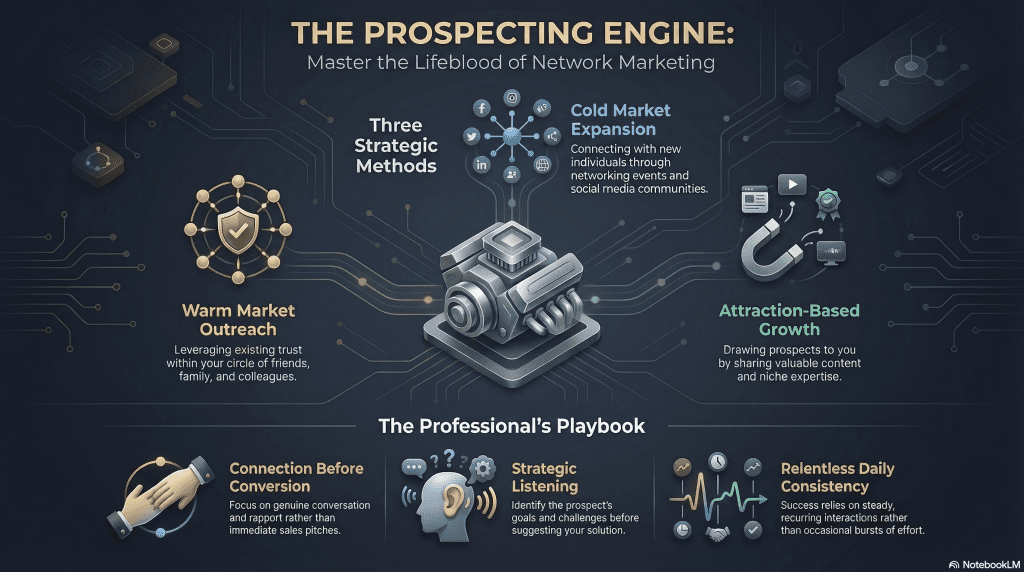
- Warm, cold, and attraction-based prospecting create different types of opportunities and require different approaches.
- Product interest and business interest should be treated as separate signals rather than assumed to be the same.
- Good prospecting uses context, listening, and timing to decide whether a conversation should move forward.
- Scripts can provide structure, but they should not replace judgment or make the interaction feel rehearsed.
- A prospecting system should track qualified conversations and next steps, not just the number of people contacted.
- The process should stop when relevance or interest is no longer there.
Disclaimer: I am an independent Affiliate. The opinions expressed here are my own and are not official statements. If you follow a link and make a purchase, I may earn a commission.

What Is Prospecting in Network Marketing?
Prospecting is the process of identifying people who may have a legitimate reason to consider your product, business opportunity, or both.
It comes before the full sales or recruiting conversation.
At this stage, the goal is not to explain everything. You are trying to determine whether enough relevance exists to continue.
A strong prospect is more than someone you can contact. There should be some connection between what the person wants and what you can realistically offer.
The Purpose of Prospecting
Prospecting helps narrow a broad audience into people worth having a deeper conversation with.
That might mean recognizing a customer need, noticing interest in the product category, or identifying someone who is genuinely curious about the business side.
The process saves time on both sides because it filters out conversations with little natural fit.
Good prospecting does not create interest from nothing. It looks for signals that interest may already exist.
A Prospect Is Not Automatically a Customer or Recruit
Someone can be a reasonable prospect without ever buying or joining.
The label only means there is enough potential relevance to explore further.
One person may care about the product but have no interest in the business opportunity. Another may be curious about earning income but have little connection to the product itself.
Those differences matter.
Prospecting works best when you identify which path, if any, makes sense before moving into selling or recruiting.
Prospecting, Recruiting, and Selling Serve Different Jobs
Prospecting, recruiting, and selling often happen close together, but they solve different problems.
Treating them as one process can lead to premature pitches, irrelevant recruiting conversations, and poor follow-up.
The cleaner approach is to understand what each stage is supposed to accomplish before moving to the next.
Prospecting Identifies Relevance
Prospecting comes first.
Its purpose is to identify whether someone has enough potential interest, need, or curiosity to justify a deeper conversation.
At this stage, you are not trying to close a sale or persuade someone to join the business.
You are looking for signals.
A person may already use similar products, ask questions about the category, engage with relevant content, mention a problem your offer may address, or express curiosity about how your business works.
Those signals do not guarantee a sale or recruit.
They simply suggest that continuing the conversation may make sense.
Strong prospecting therefore filters rather than persuades.
Recruiting Begins When the Business Opportunity Becomes Relevant
Recruiting starts when someone is genuinely evaluating participation in the business.
The conversation now shifts from general interest to questions such as what the work involves, how compensation works, what costs exist, what the company expects, and whether the opportunity fits the person’s goals.
That is a different conversation from prospecting.
Someone should not enter the recruiting stage simply because they answered a message, liked a post, or purchased a product.
There needs to be actual interest in the business side.
Keeping that threshold clear reduces the temptation to turn every customer or contact into a recruiting target.
Selling Helps a Customer Evaluate the Product
Selling focuses on the product or service.
The customer may want to understand what the product does, how it compares with alternatives, what it costs, whether it fits their situation, and what to expect from using it.
That requires a different kind of information from a recruiting conversation.
A person can become a valuable customer without ever wanting to join the business.
Respecting that distinction matters because forcing the opportunity into a product conversation can weaken a relationship that was already commercially useful.
The customer should be allowed to remain a customer.
The Stages Should Not Be Forced Together
A prospecting conversation may eventually lead to selling.
Another may lead to recruiting.
Some will lead nowhere.
That is normal.
The purpose of the process is not to move everyone through the same funnel. It is to recognize what kind of interest exists and respond accordingly.
Prospecting identifies the possible fit. Selling or recruiting begins only when the person’s actual interest makes the next conversation appropriate.
Disclaimer: I am an independent Affiliate. The opinions expressed here are my own and are not official statements. If you follow a link and make a purchase, I may earn a commission.
Where to Find Network Marketing Prospects
Finding prospects becomes easier when you stop treating everyone as a possible lead and start looking in places where relevant interest already exists.
Some prospects may already know you. Others can be found through communities, events, content, referrals, or online platforms.
The goal is not to collect as many names as possible.
It is to spend more time around people who have a realistic reason to care about the product, the market, or the business opportunity.
Start With People You Already Know
Your existing network can be one place to begin.
Friends, former coworkers, classmates, neighbors, professional contacts, and people you know through local or online communities may already have enough familiarity with you for a conversation to feel natural.
That familiarity should not be mistaken for interest.
Look for genuine relevance instead.
Someone may already use products in your category, have discussed a problem related to what you sell, or shown curiosity about the type of work you do.
The relationship creates access to the conversation. It should not become the justification for the pitch.
Look for People Already Interested in the Market
Prospects do not have to come from your personal circle.
Relevant people can often be found where your market is already gathering.
Depending on the niche, that might include:
- Professional groups
- Local events
- Online communities
- Social media conversations
- Industry meetups
- Hobby groups
- Educational communities
Participation matters more than simply appearing in those spaces to prospect.
Pay attention to the questions people ask, the problems they discuss, and the subjects they consistently engage with.
Those signals can reveal where a genuine conversation might exist.
Use Content to Attract Prospects
Content creates another path.
Instead of approaching every prospect directly, you can publish useful material around the problems, interests, and decisions your target audience already cares about.
That might include educational posts, tutorials, videos, comparisons, articles, or practical examples.
When someone discovers that content and responds, asks a question, subscribes, or returns repeatedly, you have more context than you would with a completely cold contact.
Their behavior does not automatically make them a qualified prospect.
It does give you a stronger reason to understand what they are interested in.
Ask Satisfied Customers for Referrals
Customers can also introduce you to people outside your immediate network.
A referral is especially useful when the customer understands who might genuinely benefit from the product or information you provide.
Avoid turning every purchase into a request for more names.
The better approach is to earn enough satisfaction and trust that a customer feels comfortable recommending you when a relevant situation comes up.
That extends your reach without forcing every new conversation to begin cold.
Pay Attention to Inbound Interest
Some of the best prospecting signals come from people who approach you first.
They may ask about:
- A product you use
- Something you posted
- How your business works
- What you do for work
- How they can learn more
Those moments already contain context.
Instead of immediately presenting everything, use the opening to understand what caught their attention and what they actually want to know.
That makes the next step much easier to judge.

How to Identify the Right Prospects
Finding people is only the first step.
The more important task is deciding which people have enough relevance, interest, or need to justify a deeper conversation.
A good prospect is not simply someone you can contact. There should be a reasonable connection between what the person wants and what your product or business opportunity can offer.
That is where qualification begins.
Separate Product Interest From Business Interest
Product prospects and business prospects are not always the same people.
Someone may ask detailed questions about a product, compare options, or look for a solution to a specific problem. Those signals point toward a customer conversation.
Interest in the business usually appears differently.
A person might ask how you earn, what the work involves, whether joining requires an investment, or what participation looks like day to day.
Treat those signals separately.
A customer does not need to become a recruit, and someone curious about the business may need information that has little to do with buying the product.
Look for Relevance, Not Just Access
The easiest people to contact are not always the best prospects.
A friend, relative, coworker, or social media connection may be readily available while having no genuine interest in what you offer.
Someone outside your personal network may be a stronger fit if they are already engaging with the market, researching the product category, or asking questions related to the problem you address.
Relevance gives the conversation a reason to exist.
Access only gives you a way to start it.
Recognize When the Timing Is Wrong
A relevant person may still be a poor prospect right now.
They might like the product but have other priorities. Someone interested in the opportunity may not have the time, money, or attention to evaluate it properly.
That does not automatically mean there is no fit.
It means the timing may not support the next step.
The important distinction is between not interested and not ready.
When someone clearly has no interest, move on.
When genuine interest exists but the timing is weak, a respectful follow-up later may make more sense than pushing the conversation forward now.

How to Start a Prospecting Conversation
Once you identify a relevant prospect, the next step is opening the conversation in a way that feels clear rather than forced.
The first message does not need to explain the company, product, or opportunity in full. Its purpose is simply to establish why you are reaching out and whether the other person wants to continue.
A strong opening usually comes from context that already exists.
Start With the Context You Already Have
Use the situation that gave you a reason to think of the person.
Someone may have mentioned a problem related to your product category, responded to your content, asked about your work, or expressed interest in something connected to the business.
That gives you a natural place to begin.
For example, you can reference the conversation, question, or post that created the connection rather than opening with a generic opportunity pitch.
The prospect should be able to understand why the message is relevant without wondering how they ended up on a recruiting list.
Listen Before You Introduce an Offer
An opening creates the conversation.
The other person’s response tells you where it should go.
Pay attention to what they actually seem interested in. Product questions may lead toward a customer conversation, while curiosity about your work or business may point somewhere different.
Avoid using every answer as a bridge back to what you want to present.
Listening helps you determine whether there is enough fit to continue and what kind of information would actually be useful.
Keep the First Step Simple
Do not turn initial interest into an immediate presentation.
A prospect may only need a short explanation, a relevant resource, or an invitation to learn more.
Keeping the next step small makes it easier for the person to evaluate their interest without feeling pushed into a larger commitment.
More information can follow when they ask for it or show a clear reason to continue.
Know When to End the Conversation
Not every prospecting conversation should move forward.
A clear decline, repeated disengagement, or lack of meaningful interest usually gives you enough information.
Continuing to introduce new angles after someone has shown they are not interested turns prospecting into pressure.
When the fit is there, the conversation usually gives you something to work with.
When it is not, moving on protects both your time and the relationship.
Network Marketing Prospecting Scripts for Common Situations
Scripts can make prospecting easier when you are unsure how to open a conversation.
They work best as examples, not formulas.
The wording should fit the relationship, the context, and what the person has already shown interest in. If a script sounds unlike you, rewrite it until it does.
When You Already Know the Person
An existing relationship gives you context, but it does not automatically give you permission to pitch.
Start with the reason the person came to mind.
For a product conversation:
Both openings explain why you are bringing the subject up.
The person can then decide whether they want more information.
Use Engagement With Your Content as the Opening
Someone who comments, replies, or asks a question has already created some context.
Build from what they engaged with instead of jumping straight into the opportunity.
If the conversation later connects naturally to what you offer:
The engagement gives you a reason to respond.
It does not mean the person has automatically become a prospect for everything you sell.
Give Cold Outreach a Clear Reason
Cold messages need more context because the person does not already know you.
Avoid vague openings such as:
A clearer message explains why you chose that person.
The message is still direct.
What changes is that the recipient understands why the conversation exists.
Let Product Interest Lead the Conversation
Someone asking about a product does not need an opportunity presentation.
Stay with the interest they actually expressed.
That response helps you understand the real question before giving a long explanation.
If they later ask about the business side, the conversation can move there separately.
When Someone Asks About the Business
Inbound curiosity is one of the clearest openings you can receive.
You do not need to create more mystery.
Another option:
At this point, clarity is more useful than curiosity.
The person has already shown interest, so the next step is helping them understand what they are evaluating.

When to Move From Prospecting to Recruiting
Prospecting should eventually produce a clear decision about whether the conversation deserves to continue.
When someone begins evaluating the business itself, the purpose of the conversation changes. You are no longer identifying possible interest. You are helping the person understand an opportunity they have chosen to explore.
That is where recruiting begins.
Look for Clear Business Interest
Product interest alone does not make someone a recruiting prospect.
The transition becomes more appropriate when a person starts asking about the business itself.
They may want to understand:
- How participants earn
- What the work involves
- What it costs to join
- Whether recruiting is part of the model
- How much time participation requires
- What training or support is available
Those questions indicate that the person is considering more than the product.
Shift From Curiosity to Useful Information
Once business interest becomes clear, vague positioning is no longer helpful.
Explain what participation actually involves, including the work, costs, compensation structure, expectations, and relevant company requirements.
Official company materials can support details that should not be improvised, such as compensation, policies, and income disclosures.
The goal at this stage is clarity.
Give the prospect enough accurate information to decide whether further evaluation makes sense.
Keep the Product and Business Decisions Separate
A customer can remain a customer.
Buying a product does not automatically mean someone should consider joining the company, and interest in the business does not erase the need to evaluate the products separately.
Keeping those decisions distinct makes the process easier to understand.
Someone may want the product, the opportunity, both, or neither.
Recognize When the Process Should Stop
Some prospects will explore the opportunity and decide it is not a fit.
That is a legitimate outcome.
A person may have concerns about the cost, compensation, required work, schedule, or business model. Once their decision is clear, continuing to introduce new arguments usually adds pressure rather than useful information.
Good prospecting helps identify who should move forward.
It also helps you recognize who should not.
Build a Prospecting System You Can Maintain
Prospecting becomes difficult when it depends on memory, motivation, or random bursts of outreach.
A simple system creates consistency without turning the process into a numbers game.
The objective is to know where prospects are coming from, which conversations deserve follow-up, and whether your effort is producing people with genuine interest.
Choose a Small Number of Prospecting Channels
Trying to prospect everywhere can spread your attention too thin.
Choose a few channels that fit your market and the way you prefer to communicate.
That might include:
- Existing relationships
- Referrals
- Social media
- Content
- Online communities
- Networking events
- Direct outreach
The right mix depends on where relevant people are easiest to reach.
A distributor who creates strong educational content may rely more heavily on inbound interest. Someone with an established professional network may generate more conversations through referrals and existing relationships.
You do not need every method working at once.
You need enough reliable sources of prospects to keep the pipeline active.
Set Activity Targets You Can Follow Through On
Prospecting targets can create structure, but they should not become arbitrary quotas.
Contacting more people is not automatically useful if there is no time to hold meaningful conversations or follow up appropriately.
Set activity around what you can realistically manage.
For example, you might decide how much time to spend on outreach, content, referrals, or follow-up during the week rather than chasing a fixed number of messages every day.
The target should support consistency.
It should not reward volume for its own sake.
Track Conversations and Next Steps
Once several conversations are happening at the same time, relying on memory becomes unreliable.
A simple spreadsheet, CRM, or contact system can help you record:
- Who the person is
- Where you connected
- What they showed interest in
- When you last spoke
- Whether follow-up makes sense
- What the next step is
Keep the information practical.
The purpose is not to create a complicated database. It is to prevent relevant conversations from being forgotten while avoiding unnecessary follow-up with people who already declined.
Review Prospect Quality, Not Just Contact Volume
A busy prospecting week can still produce weak results.
Twenty relevant conversations may be more useful than hundreds of generic messages sent to people with little connection to the offer.
Look beyond the number of contacts.
Pay attention to how many people show genuine product interest, ask about the business, agree to review more information, or move into the next appropriate stage.
Those patterns help you understand which prospecting channels and approaches are producing stronger opportunities.
Over time, the goal is not simply to contact more people.
It is to become better at finding the right ones.

Common Network Marketing Prospecting Mistakes
Prospecting gets harder when the process is built around volume, pressure, or assumptions about what other people want.
Most mistakes happen before a real sales or recruiting conversation even begins.
The goal is not to eliminate rejection. It is to avoid wasting time on weak-fit prospects and damaging conversations that never needed to become uncomfortable.
Treating Everyone as a Prospect
Not everyone you meet needs your product or wants a business opportunity.
Trying to turn every friend, follower, coworker, or new contact into a lead creates unnecessary friction.
Start with relevance.
Look for a real connection between the person’s interests, needs, questions, or goals and what you can offer.
A smaller pool of relevant people is more useful than a long list of names with no clear fit.
Pitching Before Relevance Exists
An offer introduced too early can make the conversation feel predetermined.
The prospect has not yet shown enough interest, but the discussion has already moved into presentation mode.
That reverses the purpose of prospecting.
First establish why the conversation makes sense.
Once there is a clear reason to continue, the product or business can enter naturally.
Using Curiosity to Hide What You Do
Keeping an opening concise is useful.
Being deliberately vague is different.
Phrases designed to make someone ask questions without giving them a fair idea of what the conversation is about can create distrust once the real purpose becomes clear.
You do not need to explain everything immediately.
You should still be honest when someone asks what you do, which company you represent, or what kind of opportunity you are discussing.
Curiosity should come from relevance, not concealment.
Confusing Follow-Up With Persistence
Follow-up makes sense when the prospect has shown interest and there is a clear reason to reconnect.
Persistence becomes a problem when the person has stopped engaging or already declined.
Repeated messages do not create stronger qualification.
They often provide more evidence that the prospect is not interested.
Use follow-up to continue a real conversation, not to keep one alive after the relevance has disappeared.
Measuring Contacts Instead of Qualified Interest
A large outreach number can look productive.
It does not tell you whether the prospecting is working.
Sending 100 messages with little response may be less useful than having 10 relevant conversations that produce genuine product interest or business questions.
Track what happens after the contact.
Pay attention to:
- Relevant responses
- Product interest
- Business interest
- Follow-up conversations
- Prospects who move into selling or recruiting
Those signals reveal more about prospect quality than raw contact volume.
Prospecting should become more selective as you learn what good fit looks like.
Conclusion
Network marketing prospecting works best when the goal is not simply to contact more people, but to identify the ones with a genuine reason to continue the conversation.
That starts with knowing where to look, recognizing the difference between product and business interest, and approaching people with enough context to make the interaction relevant.
Warm contacts, cold outreach, referrals, content, and inbound interest can all create prospects. The method matters less than whether the person is actually a fit.
From there, the process should become more selective.
Listen for real interest. Keep early conversations simple. Move into selling or recruiting only when the prospect gives you a reason to do so. Stop when the fit or timing is no longer there.
A strong prospecting system should make that process easier to repeat.
Track where good prospects come from, which conversations move forward, and which methods produce qualified interest rather than activity alone.
The goal is not to chase everyone.
It is to get better at finding the right people, starting the right conversations, and knowing when the next step makes sense.

Frequently Asked Questions
What Is Prospecting in Network Marketing?
Prospecting is the process of identifying people who may have a genuine reason to consider your product, business opportunity, or both.
The purpose is to determine whether enough relevance exists to continue into a sales or recruiting conversation.
What Is the Difference Between Prospecting and Recruiting?
Prospecting identifies potential fit.
Recruiting begins when someone is actively evaluating the business opportunity and wants more information about how participation works.
A prospect does not automatically become a recruit.
Where Can You Find Network Marketing Prospects?
Prospects can come from several places, including:
- Existing relationships
- Referrals
- Social media
- Online communities
- Networking events
- Educational content
- Direct outreach
- Inbound questions
The strongest source depends on where your target audience spends time and how naturally you can create relevant conversations there.
Is Warm Market Prospecting Still Useful?
It can be.
People you already know may be easier to approach because some familiarity already exists.
That relationship should not be mistaken for interest, though. A warm contact is only a strong prospect when there is a real connection between what they want and what you offer.
How Do You Prospect Outside Friends and Family?
You can expand beyond your personal network through content, referrals, professional groups, online communities, social media, local events, partnerships, and direct outreach.
The key is to look for people connected to the market rather than simply contacting more strangers.
What Is Attraction-Based Prospecting?
Attraction-based prospecting uses useful content to create inbound interest.
Instead of starting every conversation through direct outreach, you publish material around problems, questions, or interests your audience already cares about.
People who engage with that content may then become prospects if enough relevance exists.
How Do You Know if Someone Is a Good Prospect?
A good prospect usually shows some connection to the product, problem, market, or business opportunity.
That might appear through questions, existing interest in the category, engagement with relevant content, or curiosity about how the business works.
Access alone does not make someone qualified.
What Should You Say When Prospecting Someone?
Start with the context that makes the conversation relevant.
Refer to something the person mentioned, asked about, engaged with, or has a genuine connection to.
Keep the opening brief and give them room to decide whether they want to continue.
How Often Should You Prospect?
There is no universal number of people you need to contact each day.
Choose a routine you can maintain while still giving relevant conversations proper attention and follow-up.
Consistency is useful, but raw outreach volume should not become the goal.
When Should a Prospect Move Into the Recruiting Process?
Move into recruiting when the person begins showing genuine interest in the business opportunity.
Questions about compensation, costs, time commitment, training, or what participants actually do are stronger signals than general curiosity.
At that point, the conversation should become more specific and informational.
Should You Follow Up With Someone Who Does Not Respond?
One reasonable follow-up may make sense when there was prior interest or a clear reason to reconnect.
Repeated messages after continued silence usually provide little value.
When someone has clearly declined, respect the decision and move on.
What Are the Most Common Network Marketing Prospecting Mistakes?
Common mistakes include treating everyone as a prospect, pitching too early, hiding the nature of the opportunity, relying on generic scripts, following up after interest has disappeared, and measuring contact volume instead of qualified conversations.

0 Comments